

Hugo Black
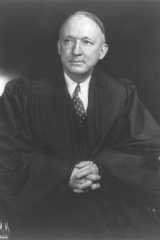
Hugo Lafayette Black (1886-1971) was an Associate Justice on theSupreme Court of the United States. He joined the court in 1937 after a nomination from PresidentFranklin Delano Roosevelt. OnSeptember 17, 1971, he assumedsenior status, serving in this capacity until his death onSeptember 25, 1971. Prior to joining the court, he was a United States Senator representing Alabama.[1]
Black was one of the nine justices nominated to the Supreme Court by President Franklin D. Roosevelt. Black served duringThe Hughes Court,The Stone Court,The Vinson Court,The Warren Court, andThe Burger Court.[2]

Early life and education
Black received his LL.B. from the University of Alabama School of Law in 1906.[1]
Military service
- U.S. Army Captain, 1917-1919[1]
Professional career
- 1927-1937: United States Senator from Alabama
- 1919-1927: Attorney in private practice, Ashland, Alabama
- 1914-1917: Prosecuting attorney, Birmingham, Alabama
- 1907-1917: Attorney in private practice, Birmingham, Alabama
- 1910-1911: Police court judge, Birmingham, Alabama[1]
Judicial nominations and appointments
Supreme Court of the United States
Black was nominated by PresidentFranklin Delano Roosevelt on August 12, 1937, to replace JusticeWillis Van Devanter. He was confirmed by the Senate on August 17, 1937, and received commission onAugust 18th. OnSeptember 17, 1971, Black assumedsenior status, serving in this capacity until his death onSeptember 25, 1971.[1] He was succeeded to this post by JusticeLewis Powell.
Noteworthy cases
| Details |
|---|
| Author: Hugo L. Black Vote Count: 9-0 Majority Justices: Warren, Douglas, Clark, Harlan, Brennan, Stewart, White, Goldberg |
Citizens have a right to counsel (1963)
When Clarence Earl Gideon was caught breaking into a Florida pool house in order to commit a misdemeanor crime, he was arrested. When he appeared in court, he asked that counsel be provided for him. However, Florida State law required that counsel only be provided to an "indigent defendant in capital cases." Gideon represented himself and lost. He was sentenced to five years in prison. In prison he filed a habeas corpus petition in the Florida Supreme Court. When his case made it to the Supreme Court, they had to determine whether or not it was unconstitutional to refuse him counsel. The Court found in favor of Gideon, saying that the Constitution provided that everyone should have counsel available, in both state and federal courts.[3]
| Details |
|---|
| Author: Hugo L. Black Vote Count: 6-1 Majority Justices: Clark, Harlan, Brennan, Warren Concurring Justice: Douglas Dissenting Justice: Stewart |
Prayer at a public institution is unconstitutional (1962)
When the Board of Regents for the State of New York authorized a voluntary, nondenominational prayer service outside, the question of whether or not it violated the Establishment Clause of the First Amendment was brought to the United States Supreme Court. On June 25, 1962, the Court determined that it did violate the Amendment and that, despite being nondenominational and voluntary, it officially endorsed a religion. This case lead to other cases that began the removal of religious acts or prayers from public events.[4]
| Details |
|---|
| Author: Hugo L. Black Vote Count: 6-3 Concurring Justices: Frankfurter, Douglas, Jackson, Burton, Clark Dissenting Justices: Vinson, Reed, Minton |
President does not have the right to control private property (1952)
President Truman issued an executive order directing Secretary of Commerce Charles Sawyer to take control of most of the nation's steel mills during the Korean War. This was an attempt by Truman to avoid the problem of a strike by the United Steelworkers of America. On June 2, 1952, the Supreme Court determined that the president did not have the power to take control of private property. Furthermore, the president's military power could not extend to labor disputes.[5]
Approach to the law
Quotes
- The public welfare demands that constitutional cases must be decided according to the terms of the Constitution itself, and not according to judges’ views of fairness, reasonableness, or justice.
- The layman's constitutional view is that what he likes is constitutional and that which he doesn't like is unconstitutional.
- It is my belief that there are “absolutes” in our Bill of Rights, and that they were put there on purpose by men who knew what the words meant and meant their prohibitions to be "absolutes."
- An unconditional right to say what one pleases about public affairs is what I consider to be the minimum guarantee of the First Amendment.
- I am for the First Amendment from the first word to the last. I believe it means what it says.
- The First Amendment has erected a wall between church and state. That wall must be kept high and impregnable. We could not approve the slightest breach.
- Compelling a man by law to pay his money to elect candidates or advocate law or doctrines he is against differs only in degree, if at all, from compelling him by law to speak for a candidate, a party, or a cause he is against. The very reason for the First Amendment is to make the people of this country free to think, speak, write and worship as they wish, not as the Government commands.
- The Press was protected so that it could bare the secrets of the government and inform the people. Only a free and unrestrained press can effectively expose deception in government. And paramount among the responsibilities of a free press is the duty to prevent any part of the government from deceiving the people.
- The interest of the people lies in being able to join organizations, advocate causes, and make political “mistakes” without being subjected to governmental penalties.
- Without deviation, without exception, without any ifs, buts, or whereases, freedom of speech means that you shall not do something to people either for the views they express, or the words they speak or write.[6]
See also
External links
Footnotes
| Political offices | ||
|---|---|---|
| Preceded by: Willis Van Devanter | Supreme Court 1937–1971 Seat #2 | Succeeded by: Lewis Powell |

| |||
|---|---|---|---|
| 1933 | Bell •Bratton •Donohoe •FitzHenry •Garrecht •Keefe •Ragon •Stone •Woodrough | ||
| 1934 | Allen •Bowen •Holly •Hulbert •Long •Major •Myers •Rippey •Sullivan | ||
| 1935 | Baldwin •Denman •Faris •Ford •Hamilton •Haney •Holmes •Mahoney •Martin •Mathews •McDuffie •Moore •Roche •A. L. Stephens •H. M. Stephens •Sweeney • Yankwich | ||
| 1936 | Abruzzo •Clancy •Davidson •Davis •Holland •Lederle •Leibell •Ling •Mandelbaum •Maris •Pollard •Thomas •Underwood | ||
| 1937 | Adair •Biggs •Black •Burke •Collet •Druffel •Edgerton •Groner •Healy •Jackson •Jenney •Kloeb •Major •McColloch •Miller •Mize •Murrah •Rice •Stephens •Sullivan •Swinford •Treanor •Trimble •Vinson •Watkins •Williams •Wyche | ||
| 1938 | Clark •Conger •Ford •Hamilton •Laws •Maris •McCord •Murphree •Reed | ||
| 1939 | Allred •Arant •Beaumont •Biddle •Black •Clark •Darr •Davies •Dobie •Douglas •Duffy •Frankfurter •Goldsborough •Huxman •Igoe •Jones •Kalodner •Kerner, Sr. •Lemley •Lumpkin •Magruder •Miller •Morris •Picard •Porterie •Roberts •Rutledge •Walker •Welsh •Whaley •Whitaker •Wilkin | ||
| 1940 | Bard •Barker •Barksdale •Boyd •Broaddus •Caillouet •Campbell •Dobie •Ganey •Goodrich •Harrison •Hartigan •Johnsen •Jones •Leamy •Mahoney •Martin •Murphy •Murrah •O'Connor •Oliver •Pine •Russell •Savage •Schwellenbach •Walker •Waller | ||

| |||
|---|---|---|---|
| 1941 | Bright •Byrnes •Eicher •Frank •Freed •Healey •Jackson •Leahy •Leavy •Lovett •Madden •McAllister •McGuire •Miller •Minton •Moore •Riddick •Rifkind •J. Smith •W. Smith •Stone •Timmerman •Vogel •Waring •Woodbury •Wyzanski | ||
| 1942 | Brennan •Cole •Delehant •Ekwall •Goodman •Hall •Hannay •Keeling •Meaney | ||
| 1943 | Arnold •Chandler •Clark •Duncan •Helvering •Hulen •Lawrence •Lee •McLaughlin •Mullins •Rutledge •Swygert • Waller | ||
| 1944 | Bone •Connor •Graven •Hutcheson •Kennedy •LaBuy •O'Connell •Schweinhaut •Shaw | ||
| 1945 | |||
- Appointed by Franklin D. Roosevelt
- Confirmed 1937
- Federal Article III judges
- Federal judiciary nominee, August 1937
- Former federal judge
- Former justices of the United States Supreme Court
- United States of America
- Noteworthy case
- Supreme Court, Seat 2
- Appointed by Franklin Delano Roosevelt
- Army veteran
- Justice of the Hughes Court
- Justice of the Stone Court
- Justice of the Vinson Court
- Justice of the Warren Court
- Justice of the Burger Court
- Former Article III judges


