

Election legislation tracking: Ranked-choice voting

| Election Administration Legislation |
|---|
| Election-related legislation topics |
| Select a state from the menu below to learn more about its election law. |
Aranked-choice voting system (RCV) is anelectoral system in which voters rank candidates by preference on their ballots. If a candidate wins a majority of first-preference votes, he or she is declared the winner. If no candidate wins a majority of first-preference votes, the candidate with the fewest first-preference votes is eliminated. First-preference votes cast for the failed candidate are eliminated, lifting the second-preference choices indicated on those ballots. A new tally is conducted to determine whether any candidate has won a majority of the adjusted votes. The process is repeated until a candidate wins an outright majority.[1][2]
On this page, you will find:
- Current ranked-choice voting legislation
- Ranked-choice voting bills enacted this year
- More information about ranked-choice voting laws in each state
The legislation on this page is curated throughBallotpedia's Election Administration Legislation Tracker. Aselection laws change, you can use the tracker to keep up with the latest developments in ranked-choice voting legislation in all 50 states. Use the bill search feature to viewall ranked-choice voting bills or filter for bills related to:
Ranked-choice voting legislation
The table below lists bills related to ranked-choice voting introduced during (or carried over to) each state's regular legislative session this year. The following information is included for each bill:
- State
- Bill number
- Official bill name or caption
- Most recent action date
- Legislative status
- Sponsor party
- Topics dealt with by the bill
Bills are organized by state and then by most recent action. The table displays up to 100 results. To view more bills, use the arrows in the upper-right corner. Clicking on a bill will open its page onBallotpedia's Election Administration Legislation Tracker, which includes bill details and a summary.
Enacted bills
- See also:Enacted election legislation, 2025
States enacted 28 ranked-choice voting bills from 2022 to 2024. The embedded table below lists all bills enacted this year. For more information about election legislation proposed and enacted in 2025, visit ourelection legislation tracker.
- In2022, state lawmakers enactedeight bills.
- In2023, state lawmakers enacted12 bills.
- The state that approved the most bills in 2023 wasIllinois, with two bills.
- In2024, state lawmakers enactedeight bills.
- No states approved more than one bill in 2024.
- In2025, state lawmakers have enacted the following bills related to ranked-choice voting:
Where is RCV used
As of January 2026, ranked-choice voting is used in some states and localities across the United States. See the map, tables, and list below for further details. The numbers below do not include states where RCV is used by a political party for partisan primaries, or where military/UOCAVA voters use ranked ballots for runoff elections. For more information on these uses of RCV, see the table beneath the map below.
If you know of any additional U.S. localities using RCV that should be included here, please emaileditor@ballotpedia.org.[3]
- RCV used statewide: Three states use RCV statewide. Alaska and Maine use RCV in some federal and statewide elections, while Hawaii uses it for certain statewide elections.
- RCV used (or scheduled for use) in some localities: Thirteen states contain localities that either use or are scheduled to begin using RCV in municipal elections.
- RCV prohibited: Eighteen states have adopted laws prohibiting the use of RCV in any elections.
- No laws addressing RCV, not in use: Sixteen states have no laws addressing RCV, and neither the state nor any localities in the state use it.[4]
The map below shows which states use ranked-choice voting statewide or in some localities as of January 2026. It also shows the states where RCV is either prohibited or not addressed in the law. It does not show states where RCV is used by a political party for partisan primaries, or where military/UOCAVA voters use ranked ballots for runoff elections. See the table beneath the map for details on these uses of RCV.
Explore other election-related legislation topics
Ballotpedia's Election Administration Legislation Tracker categorizes bills into over 20 differenttopic areas. In addition to searching by topic, users can also search by one or all of the following criteria:
- State
- Date
- State trifecta status
- Partisan sponsorship
- Legislative status
Click on the topics below to explore legislation in some of our other election-related topic areas.
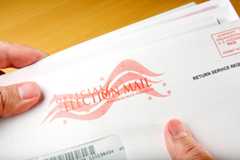 Absentee/mail-in votingRead more
 Early votingRead more
 Election dates and deadlinesRead more
 Election Day votingRead more
 RedistrictingRead more
 Voter registrationRead more
Explore election legislation with Ballotpedia
 Try Ballotpedia's Election Administration Legislation TrackerBallotpedia's Election Administration Legislation Tracker provides daily updates on legislative activity related to election policy in all 50 states.
Our election policy experts translate complex bill text into easy-to-understand summaries. And because it's from Ballotpedia, our legislation tracker is guaranteed to be neutral, unbiased, and nonpartisan. Read Ballotpedia's State of Election Administration Legislation ReportsBallotpedia publishes regular analysis of election administration legislation, including three full reports per year, providing ongoing coverage of legislative activity affecting election policy in each state.
These reports deliver insights into partisan priorities, dive deep into notable trends, and highlight activity in key states.
Subscribe to The Ballot BulletinThe Ballot Bulletin is a weekly email that delivers the latest updates on election policy.
The newsletter tracks developments in election policy around the country, including legislative activity, big-picture trends, and recent news. Each email contains in-depth data from our Election Administration Legislation Tracker.
See also
External links

- ↑FairVote, "Electoral Systems," accessed July 7, 2017
- ↑MinneapolisMN.gov, "Frequently Asked Questions about Ranked-Choice Voting," accessed July 7, 2017
- ↑Ranked Choice Voting Resource Center, "Where is RCV Used," accessed January 7, 2026
- ↑Michigan is included in this category despite numerous local jurisdictions approving the use of RCV. Although Michigan does not explicitly prohibit the use of RCV, state election laws prevent the implementation of RCV. One jurisdiction in the state, Eastpointe, did use RCV between 2019-2023 as a result offederal enforcement under Section 2 of the Voting Rights Act. The jurisdictions of Ann Arbor, Ferndale, Kalamazoo, East Lansing, and Royal Oak have all authorized the use of RCV and plan to begin using the election method if legislation providing the state's authorization is signed into law.


