

Administrative patent judge
- The Administrative State
- Administrative State Index
- Ballotpedia's Five Pillars
- Educational opportunities related to the administrative state
- The Checks and Balances Newsletter
- January 2026
- December 2025
- November 2025
- October 2025
- September 2025
- August 2025
- July 2025
- June 2025
- May 2025
- April 2025
- March 2025
- February 2025
- January 2025
- December 2024
- November 2024
- October 2024
- September 2024
- August 2024
- July 2024
- June 2024
- May 2024
- April 2024
- March 2024
- February 2024
- January 2024
- December 2023
- November 2023
- October 2023
- September 2023
- August 2023
- July 2023
- June 2023
- May 2023
- April 2023
- March 2023
- February 2023
- January 2023
- December 2022
- November 2022
- October 2022
- September 2022
- August 2022
- July 2022
- June 2022
- May 2022
- April 2022
- March 2022
- February 2022
- January 2022
- December 2021
- November 2021
- October 2021
- September 2021
- August 2021
- July 2021
- June 2021
- May 2021
- April 2021
- March 2021
- February 2021
- January 2021
- December 2020
- November 2020
- October 2020
- September 2020
- August 2020
- July 2020
- June 2020
- May 2020
- April 2020
- March 2020
- February 2020
- January 2020
- December 2019
- November 2019
- October 2019
- September 2019
- August 2019
- July 2019
- June 2019
- May 2019
- April 2019
- March 2019
- February 2019
- January 2019
- December 2018
- November 2018
- October 2018
- September 2018
- August 2018
- July 2018
- June 2018
- May 2018
- April 2018
- Tracking
- Terms and definitions
- Glossary of administrative state terms
- Deference
- Rulemaking
- Formal rulemaking
- Informal rulemaking
- Hybrid rulemaking
- Proposed rule
- Final rule
- Comment period
- Ex parte communications
- Judicial review
- Nondelegation doctrine
- Adjudication
- Administrative law judge
- Due process
- Federalism
- Guidance
- Executive agency
- Independent federal agency
- More terms and definitions
- Laws and statutes
- Executive orders
- Jimmy Carter
- Ronald Reagan
- Bill Clinton
- George W. Bush
- Barack Obama
- Donald Trump (first term)
- Presidential Executive Order 13765 (Donald Trump, 2017)
- Presidential Executive Order 13771 (Donald Trump, 2017)
- Presidential Executive Order 13772 (Donald Trump, 2017)
- Presidential Executive Order 13777 (Donald Trump, 2017)
- Presidential Executive Order 13781 (Donald Trump, 2017)
- Presidential Executive Order 13783 (Donald Trump, 2017)
- Presidential Executive Order 13789 (Donald Trump, 2017)
- Presidential Executive Order 13836 (Donald Trump, 2018)
- Presidential Executive Order 13837 (Donald Trump, 2018)
- Presidential Executive Order 13839 (Donald Trump, 2018)
- Presidential Executive Order 13843 (Donald Trump, 2018)
- Joseph Biden
- Donald Trump (second term)
- Executive Order: Exclusions From Federal Labor-Management Relations Programs (Donald Trump, 2025)
- Executive Order: Stopping Waste, Fraud, and Abuse by Eliminating Information Silos (Donald Trump, 2025)
- Executive Order: Eliminating Waste and Saving Taxpayer Dollars by Consolidating Procurement (Donald Trump, 2025)
- Executive Order: Continuing the Reduction of the Federal Bureaucracy (Donald Trump, 2025)
- Executive Order: Implementing the President's "Department of Government Efficiency" Cost Efficiency Initiative (Donald Trump, 2025)
- Executive Order: Ensuring Lawful Governance and Implementing the President's "Department of Government Efficiency" Deregulatory Initiative (Donald Trump, 2025)
- Executive Order: Commencing the Reduction of the Federal Bureaucracy (Donald Trump, 2025)
- Executive Order: Ensuring Accountability for All Agencies (Donald Trump, 2025)
- Executive Order: Implementing The President’s “Department of Government Efficiency” Workforce Optimization Initiative (Donald Trump, 2025)
- Executive Order: Unleashing Prosperity Through Deregulation (Donald Trump, 2025)
- Executive Order: Eliminating the Federal Executive Institute (Donald Trump, 2025)
- Executive Order: Council To Assess The Federal Emergency Management Agency (Donald Trump, 2025)
- Executive Order: Ending Radical And Wasteful Government DEI Programs And Preferencing (Donald Trump, 2025)
- Executive Order: Reforming The Federal Hiring Process And Restoring Merit To Government Service (Donald Trump, 2025)
- Executive Order: Establishing And Implementing The President’s “Department Of Government Efficiency” (Donald Trump, 2025)
- Executive Order: Restoring Accountability to Policy-Influencing Positions Within the Federal Workforce (Donald Trump, 2025)
- More executive orders
- Agencies
- Executive departments
- Dept. of State
- Dept. of Defense
- Dept. of Justice
- Dept. of the Treasury
- Dept. of Homeland Security
- Dept. of Education
- Dept. of Health and Human Services
- Dept. of Labor
- Dept. of Veterans Affairs
- Dept. of Transportation
- Dept. of Energy
- Dept. of Housing and Urban Development
- Dept. of the Interior
- Dept. of Agriculture
- Dept. of Commerce
- Executive agencies
- Independent agencies
- Executive departments
- Court cases
- Administrative state legislation tracker
- Research
| What is a federal administrative adjudicator? Federal administrative adjudicators are federal government officials who preside over administrative hearings and proceedings in a process calledadjudication. These officials can be divided into two categories:administrative law judges (ALJs) and non-ALJ adjudicators, sometimes referred to asadministrative judges (AJs). Although many of these officials have the wordjudge in their job title, administrative adjudicators are part of theexecutive rather than thejudicial branch. They are not judges as described inArticle III of theConstitution. |
| Administrative State |
|---|
 |
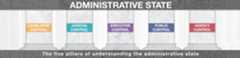
| Five Pillars of the Administrative State |
| •Agency control •Executive control •Judicial control •Legislative control • Public Control |
| Click here for more coverage of theadministrative state on Ballotpedia. |
| Click here to accessBallotpedia's administrative state legislation tracker. |
Administrative patent judges (APJs) are a type offederal administrative adjudicator that decide cases before the Patent Trial and Appeal Board (PTAB), an administrative tribunal within the United States Patent and Trademark Office. APJs preside over special classes of administrative adjudication proceedings pertaining to the issuance of patents, includinginter partes review.[1][2]
Background
- See also:Federal administrative adjudicators
Administrative patent judges (APJs) are a type offederal administrative adjudicator sometimes collectively referred to asadministrative judges, or non-administrative law judge (ALJ) adjudicators. APJs preside over special classes ofadjudication proceedings within the Patent and Trademark Office of theU.S. Department of Commerce (DOC) pertaining to the issuance of patents, including a patent reexamination process known asinter partes review.[3][4][2]
Non-ALJ adjudicators
Non-ALJ adjudicators are distinct fromadministrative law judges (ALJs). Unlike ALJs, non-ALJ adjudicators are not covered by theAdministrative Procedure Act and their positions are not standardized across the government. Their work, titles, qualifications, and pay vary substantially. Non-ALJs preside overinformal adjudication proceedings, which may involve a hearing or a written process. Non-ALJs conduct the majority of federal agency adjudication proceedings.[1]
There were more than 10,000 non-ALJ adjudicators working at various federal agencies as of February 2018, the most recent year for which comprehensive data was available at the time of this article's last update in March 2024, including the 7,856 patent examiners employed by the Patent and Trademark Office. The other largest employers of non-ALJs at the time were theInternal Revenue Service (714 non-ALJs), theDepartment of Veterans Affairs (630 non-ALJs), theNational Labor Relations Board (600 non-ALJs), and theU.S. Department of Justice (326 non-ALJs).[1]
Noteworthy events
U.S. Supreme Court requires more supervision over administrative patent judges (2021)
InUnited States v. Arthrex, theUnited States Supreme Court on June 21, 2021, held 5-4 that the U.S. Constitution’s Appointments Clause does not allow administrative patent judges (APJs) to resolve patent disputes without increased supervision from higher-level agency officials. In its decision, the court decided to sever the parts of the patent statute that prevented the director of the Patent and Trademark Office (PTO) from unilaterally reviewing APJ decisions.[5]
Chief JusticeJohn Roberts delivered the opinion of the court, writing that the PTO director’s lack of review power over APJ decisions gave APJs power that conflicted with the "design of the Appointments Clause ‘to preserve political accountability.'”[5]
The court’s ruling preserved the authority of the secretary of commerce to appoint APJs while increasing the supervision powers of the director of the Patent and Trademark Office.[5]
Federal appeals court finds PTAB structure unconstitutional, determines APJs to be inferior officers (2019)
A three-judge panel of theUnited States Court of Appeals for the Federal Circuit on October 31, 2019, held inArthrex Inc. v. Smith & Nephew Inc. et al. that the structure of the Patent Trial and Appeal Board (PTAB) violates the Appointments Clause of theUnited States Constitution.[6][7]
JudgesKimberly Moore,Raymond Chen, andJimmie V. Reyna identified a structural flaw in the PTAB's statutory scheme for appointing its administrative patent judges (APJs). Under the faulty system, the United States secretary of commerce appointed APJs. Once appointed, APJs enjoyed for-cause removal protections that only permitted removal by the secretary or the director of the U.S. Patent and Trademark Office for “such cause as will promote efficiency of the service.”[6][7]
The judges held that APJs exercise significant authority that qualifies them as principal, rather than inferior, officers. As such, APJs must be directly appointed by the president with theadvice and consent of theUnited States Senate pursuant to the Appointments Clause.[6][7]
Instead of changing the method of appointing APJs, however, the court cited precedent set forth inFree Enterprise Fund v. Public Company Accounting Oversight Board topropose removing APJs’ for-cause removal protections in order to classify them as inferior officers. Without protections against removal, the judges stated that APJs would be considered inferior officers subject to at-will removal by the director of the U.S. Patent and Trademark Office.[6][7]
“We believe that this, the narrowest revision to the scheme intended by Congress for reconsideration of patent rights, is the proper course of action and the action Congress would have undertaken,” wroteMoore.[6]
The court’s decision could result in the rehearing of 50 to 70 cases before the board.[6]
See also
- Concepts, terms, and definitions related to the administrative state
- Ballotpedia's administrative state coverage
External links
Footnotes
- ↑1.01.11.2Administrative Conference of the United States, "Non-ALJ Adjudicators in Federal Agencies: Status, Selection, Oversight, and Removal," February 14, 2018
- ↑2.02.1Fenwick & West LLP, "Administrative Patent Judges: Not Your Typical Federal Judge," July 10, 2014
- ↑U.S. Department of Justice, "BOARD OF IMMIGRATION APPEALS," accessed April 1, 2025
- ↑The Regulatory Review, "Headless Agency Adjudication at the Patent Office," May 1, 2018
- ↑5.05.15.2Supreme Court of the United States, "Unites States v. Arthrex," June 21, 2021
- ↑6.06.16.26.36.46.5Reuters, "U.S. patent board is unconstitutional, but problem can be fixed: appeals court," October 31, 2019
- ↑7.07.17.27.3United States Court of Appeals for the Federal Circuit, "Arthrex Inc v Smith & Nephew Inc et al," October 31, 2019


