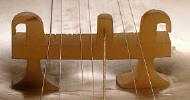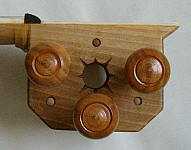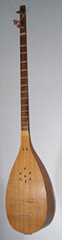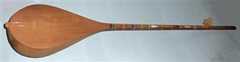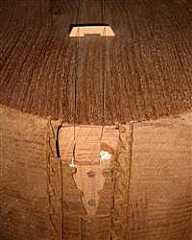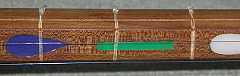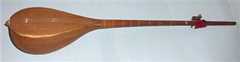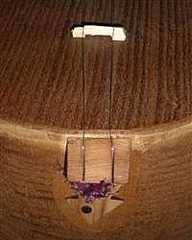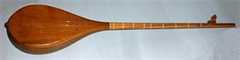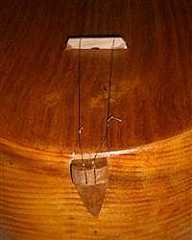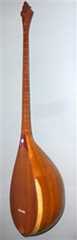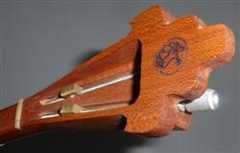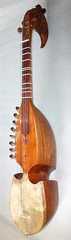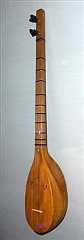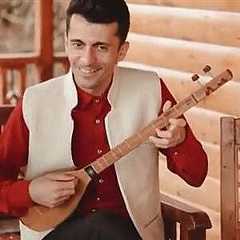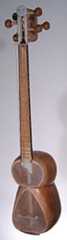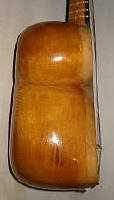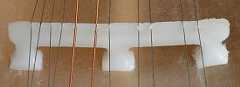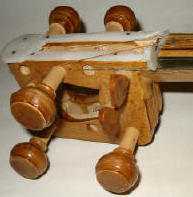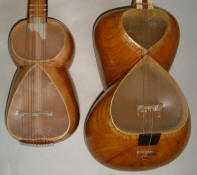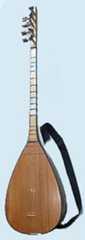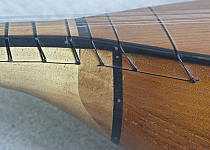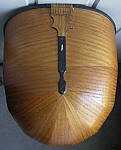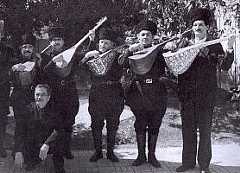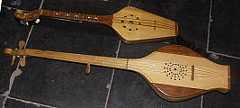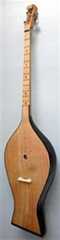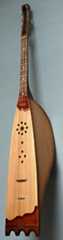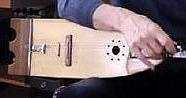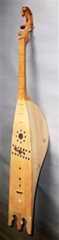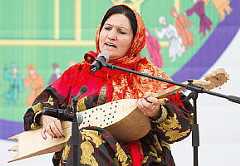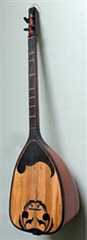
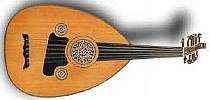
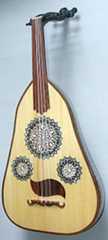
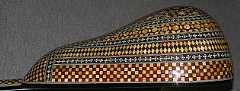
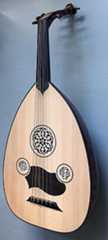
| oud Theoud (orud) is the classicallute of the Arabs. It can also be found all over the world where you find muslims; so also in many countries of Africa and South East Asia (seegambus). The back of the body of theoud is made of (10-25) quite thin ribs of wood, glued together, often in highly decorative patterns. The soundboard is made of soft wood and has one or (often) three rosettes. It has a short neck, with a fingerboard flush with the soundboard and without frets. The violin-style friction pegs are inserted from both sides of the open pegbox, which is slightly bended and fixed to the neck under an angle to the back. It has nylon strings (original gut strings) in 6 double courses, which are fixed to a bridge glued on the soundboard. The tuning of the Arabian styleoud could be : D GG AA dd gg c'c'. Theoud is played with a long thin (plastic) plectrum. The music (if written) is in western notation. The classical music is thetaqsim : a kind of basic melodies/ scales on which the player improvises. The most famousoud player of recent times was the Iraqi : Munir Bashir (see under).
| ||||||||||||||
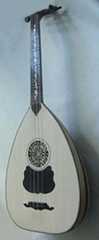
| oud Bashir Besides the often used Egyptian-styleoud, nowadays you can also find different models. In Iraq the famous (late)oud player Munir Bashir developed a special type ofoud, which is now often named after him : theoud Bashir(or oud Bachir or Iraqi oud). It can be recognized by the loose bridge and the lack of decoration. The most visual difference is that the soundholes do not have decorative rosettes in them (or around them), and usually are oval-shaped. However this type of open soundhole can also be found on a normaloud.
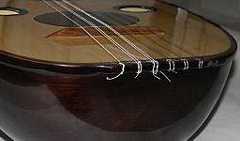
Although the back is made from separate ribs (like allouds/lutes) the outside is sanded down to an almost round smooth surface. There is a thick strip around the edge, which serves also to fix the strings to. The fingerboard is slightly raised above the soundboard. The entire instrument is highly varnished.
| ||||||||||||||
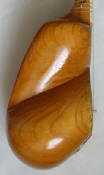
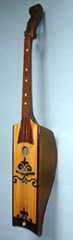
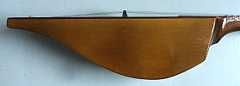
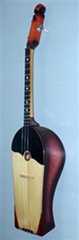
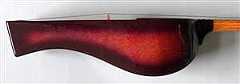
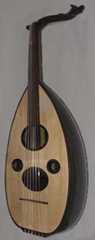
| oud kumethra / pear-shaped oud Nowadays someouds are made in different shapes, like with a flat back or an electric one with only the body shape. Also another shapedoud is getting popular, with the body shaped like a pear. So it is sometimes called :pear-shaped oud, or (in Arabic)oud kumethra or even: "pregnant oud". The main difference with the standard Egyptianoud is the back of the body, which has curves in two directions. This must be very difficult to make. It is played like the standard oud.
| ||||||||||||||
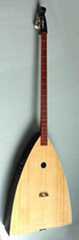
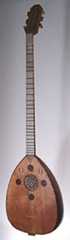
| buzok Thebuzok (orbozok) is the long-neck lute of the Middle East. It is mainly played in Syria, Libanon and Jordan. A similar looking instrument can be found in North Africa (but with a flat back): themondol(see) and in Turkey/Greece : the lavta (see under). The body of abuzok (much smaller than anoud) is made from separate ribs, glued together in a lute-shape. The neck is guitar-like, and has tied-on nylon frets. It has some 1/4 notes. The flat pegbox slopes slightly backwards, and has two slits for the tuning pegs, which are wooden T-shaped friction pegs; 3 on both sides. The fingerboard is sometimes made of white plastic. There is some wood inlay on the soundboard, and a carved wooden rosette inserted in the soundhole. Thebuzok has 3x2 metal strings, which run over a small loose wooden bridge to a piece of wood on the edge of the body. Tuning could be cc gg c'c'. It is played with a plectrum. Although usually an instrument for folk music, it is also used to play classical taqsim on it.
| ||||||||||||||
| Yemen | |||||||||||||||
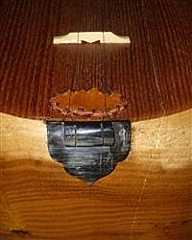
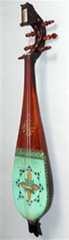
| qanbus Theqanbus is the lostlute of the Yemen. It may also be calledqambus orturbi. Theqanbus is similar to other small lute-like instruments in East Africa, with similar names likegabusion the Comoros,kibangala (on the Swahili coast - see),qabusin Saudi Arabia, andgabbus in Oman.It is replaced now almost everywhere by the much larger ArabianOud. It may have been the eldest of theouds. The body, neck and head of theqanbus are carved from one piece of wood, hollowed out. The walls are quite thin. The lower part of the body is covered with a thin leather skin, which is coloured green by using a copper based liquid. The top half of the body and the neck are covered with a thin piece of wood. It has a decorative soundhole just above the skin. The neck is fretless. The 7 nylon strings in four courses run over a loose wooden bridge on the skin to a quite large threefoil extension at the end of the body. Tuning of theqanbus is : c dd gg c'c'. It is played with a special plectrum ("risha"), made from an eagle feather. Theqanbus is mainly played solo. Nowadays there is also a five course version of theqanbus. See for much more information about theqanbus and related lutes : (from page 17). | ||||||||||||||
| Turkey | |||||||||||||||
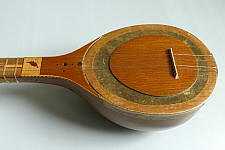
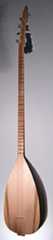
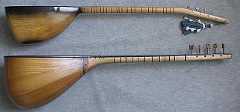
| saz Thesaz is the most well-known Turkish plucked instrument. It comes in several different sizes : the small, the, the bigger and the biggest : the. Nowadays you can also find anelectric saz. Thebaglama (pronounce : bah-lahma) is the most popular. In Iran and Azerbaijan this instrument may be calledchogur,choghur or çogur. The body of thesaz is traditionally carved from a block of wood, hollowed out with a round soundhole on the bottom side. However nowadays the body is often made from separate ribs glued together. It has a thin wooden soundboard, with usually several strips of different coloured wood on both sides. Thesaz is played with a plectrum and mainly only the first course. Some players manage to tap with the ringfinger on the soundboard while strumming (like flamenco players), to give a special extra rhythm effect. Others use a kind of tapping.
| ||||||||||||||
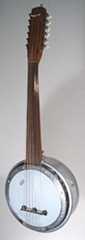
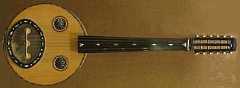
| cümbüs Thecümbüs (pronounced "dzjoom-boos", and there should be a small cédille under the s) is a banjo-like instrument from Turkey. The name comes from the name of the factory in Istanbul. The body is made from a metal bowl, that looks like a cooking-pan. The (plastic) banjo skin can be tuned by screws around the rim, which also join the bowl to the front. The wooden neck and the peghead is made from one piece of wood, and fixed with a large screw to the side of the bowl. By turning the screw the angle of the neck can be adjusted. There is a veneer layer as fingerboard, and thecümbüs is fretless. Thecümbüs has 6x2 metal strings. The tuning machines are in two rows of 6 on both sides of the open peghead. The bridge has 3 round pieces glued to the feet, to avoid the high pressure of 12 metal strings damaging the skin. The strings are fixed to a metal stringholder at the edge of the rim. Thecümbüs is tuned and played like anoud. See for lots of information about the cümbüs : and. There used to be a similar instrument called theahenk, with a wooden bowl, and a wooden front, but with the bridge resting on a small separate piece of skin. It had two small soundholes in the front. There seems to be a recent revival of theahenk.
| ||||||||||||||
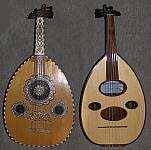
| oud (Turkey) Theoud (orud) in Turkey resembles much the Egyptian (Arabian)oud, but usually the body is more slender and a bit smaller. In general the instrument is quite plain (there is not much decoration). The tuning of theTurkish oud with 11 nylon strings (in 6 courses), is two notes higher than the Arabianoud : E AA BB ee aa d'd'.
| ||||||||||||||
| lavta TheLavta is an instrument that was popular in the early 20th century, particularly amongst Greeks and Armenians, with a famous player like Tanburi Cemil Bey. Then it was gradually replaced by theoudand around 1930 they were vanished. From the 1980’s there has been a revival of this instrument, and now you can find them again both in Turkey and in Greece. The lavta is a kind of hybridoud : the body looks much like a small (Turkish)oud (with a body made of many ribs), with a guitar-like neck. The bridge usually has mustache-like ends. The fingerboard is flush with the soundboard, which is often unvarnished, and has a carved and inlayed rosette. Notice the very peculiar fretting distances (with wound nylon frets), resembling the Turkishtanbur.
| ||||||||||||||
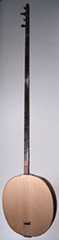
| tanbur The Turkishtanbur (also tambur) is a classical Turkishlute with a very long thin neck. The name is also used for other long neck lutes in Iran and Central Asia. The body is made of (20-25) thin wooden ribs in a very round shape. The front is very thin spruce, left unvarnished. The broomstick-like neck is fixed to the body, and continues into the peghead. There are 6 violin-type friction pegs, 4 are inserted from the front and 2 from the left side. The frets are tied-on nylon (in 5 windings per fret), with many in 1/4 note intervals. The tanbur has 3x2 metal strings, which go over a loose bridge to holes at the edge of the body. Tuning is usually Dd AA dd. In spite of its long length it is not so difficult to play, however orientation demands practice, by which the special arrangement of the 1/4 notes is helpful. Because of the long length it has a very deep sound. Usually only the first course is fingered. Thetanbur is mainly used to play classical taqsim music. It is also used by the Kurds for folk music, to accompany singing. Besides thistanbur there is another similar instrument with a long neck, but with the body like abanjo. This instrument is calledyayli tambur (see under), which is mainly used as a bowed instrument.
| ||||||||||||||
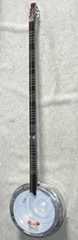
| yayli tambur This special Turkishtambur is a hybrid : a combination of the normallute-like long necktambur with the body like abanjo. This instrument is calledyaylitambur (or yaylih tambur). The neck is quite flat, and just as long as the normaltanbur. The frets are tied-on nylon (with 5 windings per fret). It has a small guitar-like peghead with machine-tuners (3 on each side). The 6 metal strings (in 3 courses) run over a loose bridge (with the two feet on flat round wooden plates) to some fixing points at the edge of the bowl. Tuning is the same as thetambur : Dd AA dd. Theyayli tambur is mainly used as a bowed instrument, but it is sometimes plucked; that is why it is included here anyway.
|
| Iran | ||||||||||||||||||||||||||||||||||||||||||||||||
) is used, in groups that also use thebenju (see page). In several areas thedotar (in different types) is in use. Theafghan rabab is used in the east in orchestras, but also in a different shape. | ||||||||||||||||||||||||||||||||||||||||||||||||
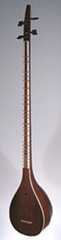
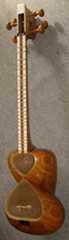
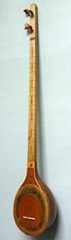
| setar Thesetar (also spelledsehtar) is the main plucked instrument from Iran. It is one of the very many long necklutes from the area of the Middle East and Central Asia. They all have a quite thin neck made of walnut or apricot, and a body usually made of mulberry; either built of ribs, or carved from a single block. Thesetarbody is made of (7 to 10) ribs, glued together. The soundhole is usually a number of small holes drilled in a pattern in the front. Thesetar is played with only the right index finger (sometimes with finger plectrum), strumming up and down. It gives a very sweet delicate sound. The music is mainly the classical Dastgah of Iran. It is also played by the Sufi mystics.
| |||||||||||||||||||||||||||||||||||||||||||||||
| tar The tar is another important long necklute from Iran. A similar shaped and named instrument is used in the Caucasus states (see under). This instrument The body of ataris a double-bowl (figure-of-eight) shape, carved from one piece of mulberry wood (some from a bookmatched pair of wood pieces). Seen from the side the body is slanting towards the end. The front is a thin membrane of stretched bladder. The neck is glued to the body and a separate quite large, square pegbox. The 6 friction pegs (with big round knobs) are in three on both sides of the open pegbox. The frets are tied-on nylon or gut, with some in 1/4 note intervals. The tar has 6 steel strings in 3 double courses (the lowest one in octave). They run over a loose bone bridge (with feet) on the skin, and are fixed to a string-holder at the edge of the body. Tuning would be cc' gg c'c'.
There is also abass tar, which has only 3 strings and only the lower half of the body is covered with a skin. It is uses in orchestras. | |||||||||||||||||||||||||||||||||||||||||||||||
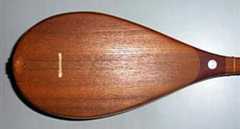
| tanboor The Iraniantanboor (also spelledtanbur or tanbour) has a narrow pear-shaped body, normally made with (7-10) separate ribs, glued together. The body-shape looks much like the Turkmendutor (see Central Asia), which is however always carved. It has a separate long neck with 14 tied-on gut frets. The soundboard is also made of mulberry wood and has a number of small holes burned in it in a pattern. It has 3 flat T-shaped pegs; 2 are inserted from the front, one from the left side. Thetanboor has three metal strings - the first course is double, on which the melody is played. The other one functions as a drone string with occasional fingering by the thumb. The strings run over a small loose bridge, to holes in the edge of the body. Tuning could be : c gg. Thetanboor has a unique playing technique by which the strings are strummed with the 3 fingers of the right hand (with arpeggios upwards, and hardly any use of the thumb) to produce a very full and even tremolo, often to accompany Sufi singing. Thetanboor has always been considered a sacred instrument associated with the Kurdish Sufi music of Western Iran and it is believed that its repertoire is based on ancient Persian music.
| |||||||||||||||||||||||||||||||||||||||||||||||
dotar In Iran several different types ofdotar (ordutar) are used. All look quite similar, and have two strings (hence the name : "two strings"). They differ slightly according to the region they are used, but of course they also differ between different local crafsmen. A global list (based on an Iranian book) could be :
A recent study learned that it would be hard to recognize whichdotar originates from which area : there is too much overlap. All dotars have the body carved from one block of mulberry wood to a thin shell, although nowadays the cheaper versions may also have a build up body from staves. The body is covered with a mulberry front (sometimes dried in an oven). In the soundboard some tiny soundholes are usually drilled in a pattern, or one small hole in the back. The body and neck are left smooth but unvarnished (or nowadays lightly oiled). The neck is long and separate, often made of pear or plum wood. The tuning head is part of the neck and has two T-shaped tuning pegs, ususally one at the front and one at the left side. Alldotars are played strumming/scraping/banging with the right hand fingers in a specific pattern, and usually only the first string is fretted. dotar East Khorasan
dotar North Khorasan
dotar Mazandaran
Thisdotar has a light oil finish. | ||||||||||||||||||||||||||||||||||||||||||||||||
| contemporary dotar This is a modern versiondotar, with a more general appearance and not related to a special area. It is also called "decorated dotar".
| |||||||||||||||||||||||||||||||||||||||||||||||
| shurangiz Theshurangiz (also spelledshourangiz orshoorangiz) is a quite new instrument from Iran. It was designed by Hossein Alizadeh and is basically asetar, but with a partly skin front, to resemble more the sound of thetar. Theshurangiz body is made of separate ribs, glued together. There are in general two different types ofshurangiz : a small one (the size of thesetar) with 4 strings, and a bit larger one (about the size of thetamboor) with 6 strings.
The strings are thin steel strings, in 3 courses. They run over a small loose wooden bridge, to a (wooden) stringholder at the edge of the body. Theshurangiz is played like thesetar, with only the right index finger, strumming up and down. It gives a slightly sharper sound than thesetar, while the 6 string version has a much fuller and stronger sound. | |||||||||||||||||||||||||||||||||||||||||||||||
| iranian robab In Iran theafghan robab (see) is used mainly in the north and east (Khorasan and Baluchistan). But recently the instrument has been altered someway, to be played in special orchestras. To distinquise it from its Afghan cousin, we will call it : theiranian robab (orrubab). There are only a few makers specialised in this instrument; well known ones are Jafroudi and Ghalami. They both have their own style. The main difference with theafghan robab is the lengthening of the neck (with extra frets), and the use of a flat fingerboard. | |||||||||||||||||||||||||||||||||||||||||||||||
| tanboureh Taleshi In the far north of Iran, in the province of Taleshi, they still use a small instrument, called thetanboureh ("small tanbour"). It looks a bit like adotar, but is shorter and has 4 strings. It was hardly used anymore, but there seems to be some revival.
The 4 steel strings run over a small bridge to a stringholder at the edge of the body. The first two strings form a course and are fingered. The two other strings are drones. | |||||||||||||||||||||||||||||||||||||||||||||||
CAUCASUS area Armenia does not have special local instruments, but uses those mentioned under other countries, likeoud andazeri tar. | ||||||||||||||||||||||||||||||||||||||||||||||||
| Azerbaijan | ||||||||||||||||||||||||||||||||||||||||||||||||
| Azeri tar /Caucasus tar The tar of Iran can be found (in a slightly different shape) in the Caucasus states of Armenia and especially Azerbaijan. It is known as theAzeri tar orCaucasus tar or 11 string taror qafqazi tar. It was developed from theIranian tar around 1870 by Sadikhjan, a tar player from Azerbaijan. It is the national instrument of Azerbaijan, but it is also popular in Uzbekistan. See for theIranian tar : above. The body of theAzeri tar has a double-bowl (figure-of-eight) shape, carved from one piece of mulberry wood. It lacks the slanting sides of theIranian tar, and the top half is rounded. The front is a thin membrane of stretched bladder. The neck is glued to the body (which has a strengthening stick through it) and a separate (quite large) square pegbox. The friction pegs are 3 big round knobs on both sides, and 3 violin-like pegs on the left side of the open pegbox. The frets are tied-on nylon (4 windings), with some in 1/4 note intervals (based on 17 intervals in an octave). These fret intervals differ from theIranian tar. The Azeri tar has (like theIranian tar) 6 steel strings in 3 double courses (the low one in octave). It has further one extra bass-string on the left side, on a raised nut, and usually 2 double resonance strings via small metal nuts halfway the neck. All these strings are running next to the main strings over the bridge and are fixed to a string-holder at the edge of the body. Thetaris played with a special small brass plectrum and hold horizontally high across the chest.
| |||||||||||||||||||||||||||||||||||||||||||||||
| azeri saz /qopuz In Azerbaijan (next to Georgia and Armenia in the Caucasus) and in the north of Iran they use asaz that looks quite similar to thesaz of, but is rather different. In Iran it is sometimes calledgopuz, orghopooz, (orchogur /choghur) but usually it is referred to asazeri saz. The Lezgin name for it ischungur. The body of theazerisaz is quite deep and made of separate staves of usually mulberry wood (only rarely it is carved from a block of wood). The same wood is used for the front, which has two tiny soundholes, and lays on top of the body. The neck is a bit wider at the body join, and the pegbox is a straight extension of the neck. Some instruments may be highly decorated with inlay or with paintings, both on neck and body.
Playing style is holding the instruments rather high over the shoulder with a short strap. It is mainly used by the poet-singers of the Ashigh.
| |||||||||||||||||||||||||||||||||||||||||||||||
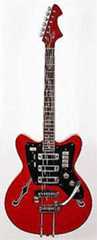
| gitara azerbaijani The "gitara azerbaijani" is in fact more a music style than another musical instrument. However, as most players of that style use the same model electricguitar, it is included here. This music style was developed by Rüstam Quliyev around 1990 in Baku. It is based on traditional local music ontarandsaz, but adding foreign influences - like Spanish flamenco, Indian Bollywood and Afghan pop. He used a Czech made red coloured double cutaway archtop hollow body electric guitar, model Jolana Tornado, which was quite popular around 1980. This model became later also the favouriteguitar for many of his followers. Thisguitar was made since 1963 by the Czech guitar-factory of Jolana (the firm still exist). The body shape of the Tornado looks quite similar to a Gretsch Nashvilleguitar. However the Tornado uses a wide range of hardware, like three single coil pickups, several switches and buttons, and a Bigsby-like tremolo outfit. The tuning head is based on the Fender design. The instrument is still populair on the vintage market. Recently another model became populair : the Fitar - a localy made electricguitar. Thegitara is usually played solo, with an (electronic) keyboard and some percussion. | |||||||||||||||||||||||||||||||||||||||||||||||
| Georgia | ||||||||||||||||||||||||||||||||||||||||||||||||
| chonguri In Georgia (in the west Caucasus) they use two plucked lutes : the largechonguri , and the smallerpanduri (see under). In Abkhazia they use a similar looking instrument calledachamgur (see under). The shape of the chonguri is a long oval, ending in a flat end. The back of the body is made from (7-10) ribs in such a way that the end forms a flat square end block, which gives thechonguri its special shape. Some instruments have a body carved from one piece of wood. The front overhangs the sides. There are usually several soundholes drilled (or burned) in the soundboard, in a round pattern. The 4 nylon strings run over a large loose wooden bridge to a single pin on the flat endblock. Thechonguri is mainly used to accompany singing, and because it is fretless, no chords are played.
| |||||||||||||||||||||||||||||||||||||||||||||||
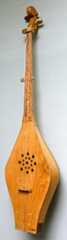
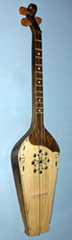
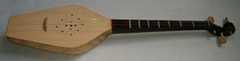
| panduri Thepanduriis another popular plucked instrument from Georgia, and looks very similar to thechonguri (see above). In Abkhazia they call this instrument :apandur. The main differences with thechonguri are : thepanduri is smaller, it lacks the string halfway (so thepanduri has just 3 nylon strings), thepanduri has frets and the body shape is only rounded near the neck, with straight tapering sides to the flat end. So usually more in the shape of a spade. The neck and peghead are made from one piece of wood. The sickle shaped tuning head ends in a scroll to the front. The often closed peghead has three friction pegs (one right, two left), or machine tuners. The frets are traditionally made of wood, inlayed in the front of the neck. Originally there are 7 frets to an octave, but nowadays metal frets in a chromatic scale are common. The three nylon strings run over a large loose wooden bridge to a pin at the flat eind of the body.
For lots of different types ofpanduri see :.
| |||||||||||||||||||||||||||||||||||||||||||||||
| Abkhazia | ||||||||||||||||||||||||||||||||||||||||||||||||
| achamgur Musicians in Abkhazia (a Russian republic bordering the Black Sea and Georgia, in the west Caucasus) use an instrument similar to thechonguri from Georgia, but an altered version : with frets and omitting the string halfway the neck. This instrument is calledachamgur (oraçamgur orachangur). In fact it is mainly used as a large Georgianpanduri. Some makers in Georgia call it therefore a"bass panduri". The main differences with thechonguri are : theachamgur misses the short string halfway the neck (so it has just 3 strings), and it has metal frets in a chromatic scale. Like most of the modernchonguri, the back of the body is made from seven separate strips glued together, or carved from one block of wood. The body shape is a long oval and widens again at the flat end. The rosette is usually a small round hole, often surrounded by small holes. The neck and peghead are made from one piece of wood. The sickle shaped tuning head ends in a sharp scroll to the front. The open tuning head has either three friction pegs (one right, two left), or machine tuners. Tuning of theachamgur could be : e c#' a', or : g a c' or maybe : d f a'. Playing is often strumming with the fingers in a rhythmic style, to accompany singing. Note the similarity of the body shape with thebas dombyra from. | |||||||||||||||||||||||||||||||||||||||||||||||
| Dagestan | ||||||||||||||||||||||||||||||||||||||||||||||||
| agach kumuz In Dagestan (a Russian republic between Chechnya and the Caspian Sea, just East of Georgia in the Caucasus) exists a special instrument calledagach kumuz (oragach-komus). The Darghin call it alsokumuz, and the Tabasar : khumutz.
The neck with tuninghead are separate. The metal frets are inlayed in the neck, in a normal western scale. The tuning head is quite simple. There is often a round soundhole in the front and some instruments are nicely decorated.
The tuning could be : d e g Playing theagach kumuz is usually with simple chords and strumming (at the end of the fingerboard) all strings in a specific rhythmic style, to accompany singing (often by the player self). A related instrument seems the oldShirvan tanburin Azerbaijan, although that looks much longer (see). | |||||||||||||||||||||||||||||||||||||||||||||||
| avar pandur The Avar people in Dagestan use an instrument that resembles theagach kumuz (see above) calledavar pandur (orpondur,pandor or pandure). The Avar people themselves call it :tamur, ortemur ortampur or tambur or tamur pondur. From the number of videos on YouTube it seems still very popular. The body of theavar pandur is much more slender and often longer than the agach kumuz.The entire instrument is usually carved from one block of wood, although nowadays is may also be made from separate pieces, glued together. The 2 equal gauge nylon strings are tuned with two simple friction pegs on the side of the tuning head. The strings run over a small loose bridge, then under a small grip and are fixed through a hole throught the body to a small stick. Probably one long string is used for the two playing strings. The strings are on the nut further apart then on the bridge. Playing theavar pandur is usually strumming both strings in a complex rhythmic style, to accompany singing (often by the player self).
| |||||||||||||||||||||||||||||||||||||||||||||||
| chugur In Dagestan the largeazeri saz (see) with its many strings is widely used. But also another, smaller and more rustic saz is in use, with 4 single strings. It is calledchugur orchungur. Note that theazeri sazis in some areas also calledchungur. The back of the body of thechugur is made like the azeri saz - from separate staves, glued together. The front is often a bit wide/rounder than theazeri saz. The neck is separate and continues into a straight tuning head. It has 7 to 10 frets (glued-on wood, or wrapped around nylon) in a non-western scale. The four T-shaped friction tuning pegs are two in the front, two on the left. The 4 metal strings run over a small loose bridge, and are fixed to a wooden stringholder at the bottom of the body. Playing thechuguris usually with simple chords and strumming to accompany singing. | |||||||||||||||||||||||||||||||||||||||||||||||
| Chechnya | ||||||||||||||||||||||||||||||||||||||||||||||||
| dechig pondar In Chechnya (a Russian republic West of Dagestan, just North-East of Georgia in the Caucasus) exists a special instrument, mainly known asdechig pondar ("wooden pondar"). Other names are pondar, ponder, pandir, orpandur,dechig pondur ordechik pondur,adkhoku pondur ordakhch pandr, ormerz ponder. The Circassians call itapa pshina. In Ossetia a quite similar looking instrument is calleddala fandyr(see under).
The body and neck are traditionally carved from one block of wood and hollowed out from the front, but nowadays most are made from separate parts glued together (like aguitar). It has a small round soundhole, and often some contrasting inlay or painted decoration on the front. The guitar-like neck has a slightly raised fingerboard with metal frets (in a western scale), and a simple open peghead with 3 guitar-tuners on the left side. The 3 metal strings run over a loose wooden bridge to a small stringholder at the end of the body. Thedechig pondar is usually strummed with the fingers at the end of the fingerboard, in a specific rhythmic style - often to accompany singing.
| |||||||||||||||||||||||||||||||||||||||||||||||
| Ossetia | ||||||||||||||||||||||||||||||||||||||||||||||||
| dala fandyr In Ossetia (a Russian republic West of Dagestan, just North of Georgia in the Caucasus) exists a similar instrument as thedechig pondar of Chechnia (see above), but here it is calleddala fandyr.
Although originally carved from one block of wood and hollowed out - nowadays they are usually made from separate parts glued together. Usually it has a small round soundhole on the front, and often some contrasting inlay decoration or scratchplate near the neck. Thedala fandyr is usually strummed with the fingers at the end of the fingerboard, in a specific rhythmic style - often to accompany singing.
| |||||||||||||||||||||||||||||||||||||||||||||||
| Kalmykia | ||||||||||||||||||||||||||||||||||||||||||||||||
| (Kalmyk) dombra In Kalmykia (a Russian republic west of the Caspian Sea, between Dagestan and Kazakhstan) exists a special instrument, which looks like a mixture of both the 2-stringdombra and the body shape of abalalaika. Kalmykia is the only Buddhist republic in Europe, and the Kalmyk people are closely related to a group in Mongolia, from where they originated. This instrument is also in use there, to accompany throat singing. It is calledKalmyk dombra (ordongbula ortovshur).
For more information about Kalmyk music, see, with music examples. | |||||||||||||||||||||||||||||||||||||||||||||||