| China | ||||||||||||
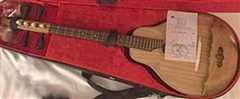
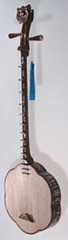
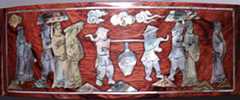
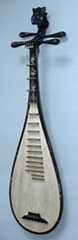
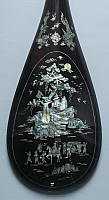
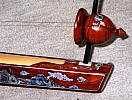
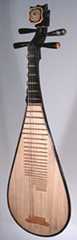
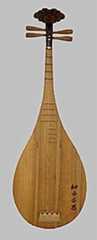
| Thepipa is the main lute of China. Old pictures show it must have been known for more than 2000 years; it is still the most popular plucked instrument. See under for other types ofpipa. The name comes from the finger movement :pi (= play forward) andpa (= play backward). The peghead is sickle-shaped and ends in a curl to the front, with a special Chinese type decoration of different woods. The four long grooved friction pegs (ending with slices of different woods) are with two on both sides of the open peghead. The four silk (Or steel) strings are fixed to a nicely shaped bamboo bridge, glued to the front. There is no soundhole, except one tiny hole under the bridge. Thepipa used to be played with bare fingers, although since the original silk string are replaced by steel strings (for more volume) it is played with nail picks, taped to the thumb and all fingers, or with a plectrum. It is usually played in an upright position with the body resting on the left thigh. The picking direction is opposite that of guitar-playing : the fingers flick out and the thumb pulls up (nail first). Often a mandoline-like tremelo is used, by playing "rolls" with alternating fingers. The music is (for centuries) written in special tablature, indicating string, fret position, finger, direction, volume, etc. Thepipa is used in all Chinese orchestras for accompaniment, but there are many solo pieces, usually reflecting some mood, or celebrating some historical happening (often some battle). | |||||||||||
| ||||||||||||
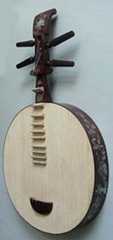
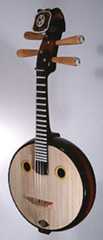
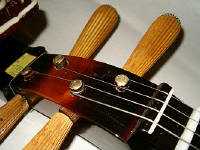
| ruan Theruan is the Chinese "mandolin". It comes in several sizes :gaoyinruan (soprano),xiaoruan (alto),zhongruan (tenor),daruan (bass) anddiyinruan (contrabass). Only thezhongruan(tenor) and daruan(bass) are commonly used in Chinese orchestras. The body of theruan is made from two round pieces of soft wood of about 30 cm diameter for front and back, with a shallow rim of hardwood around them. Usually there are two soundholes (round or other shape) on the front. The neck is joined to the body, and has a raised fretboard. The peghead is sickle-shaped and ends in a curl to the front, with a special Chinese type of decoration, made of different woods. The frets are small strips of bamboo (or plastic), glued on the fretboard, in a normal western scale (12 frets to an octave). The 4 long (grooved) friction pegs are placed two on each side of the pegbox. They have an invisible tuning mechanism inside the peghead, which turns the pin on the front of the closed peghead. Theruan is played with a plectrum. With sizes ranging from large, medium to small, the modern ruan is capable of producing a variety of tones that range from rich to delicate. It is often used in orchestral performances, as well as for accompaniment of folk operas.
| |||||||||||
| ||||||||||||
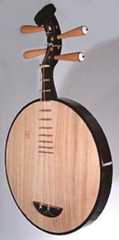
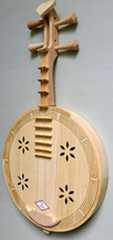
| Theyueqin (oryueh qin, oryueh chin) is the Chinese "moon-guitar" and looks quite similar to theruan. For the differentyueqin from the minorities and from Taiwan see under. For the similar JapaneseGekkin see. The body of theyueqin is made from two round pieces of soft wood of about 30 cm diameter, for front and back, with a shallow rim of bended hardwood around them (thinner than theruan). There is only one tiny sound hole under the bridge. The 4 silk (or nylon or metal) strings are fixed to a (half round) hardwood bridge which is glued to the front. Theyueqin is played with a long plectrum, in mandolin-style. | |||||||||||
| ||||||||||||
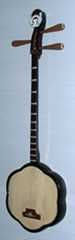
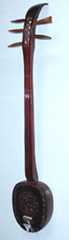
| liuqin Theliuqin (pronunciation: Lee-oo-chin) orliuyeqin,is the small relative of thepipa. It's name derives from the fact that it looks like a willow leaf (ye is leaf,liu is Chinese for "willow"). It would originally have been made of willow too, but new models are made of tong and sandal wood. The example instrument is a modern, cheaper version where everything black is made of black plastic. In general theliuqin is made like thepipa. So the body, neck and pegbox are carved from one piece of hardwood, and painted black. The front is made from some softwood. All frets are made from strips of bamboo and in a normal western scale. Usually there are two soundholes next to the strings on the front, each covered with an ivory (now always plastic) pierced rosette. The pegbox is sickle-shaped with a forward curl that ends with a special decoration of different woods/plastics. It has 4 long grooved wooden pegs, two on each side of the open pegbox. The 4 steel strings run over a small (rounded) bamboo bridge to some pins on the edge of the body. The tuning is g d' g' d''. The liuqin is played with a plectrum, and is mainly used in the accompaniment of folk operas, although quite often it can be heard as a solo instrument. Because of its shorter strings & relatively small resonator, theliuqin is noted for high pitches and distinctively bright tones.
| |||||||||||
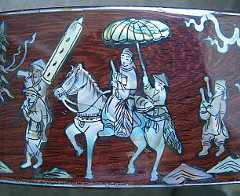
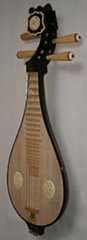
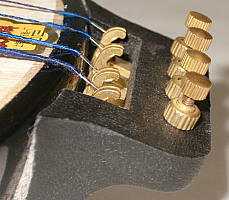
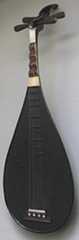
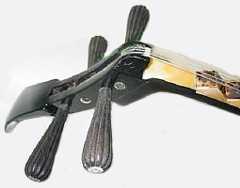
The frets on the example are made from turtle-like plastic. | Besides the normalpipa there is an other stylepipa, called thenanyin pipa, (or short :nanpa) or "Nanguan pipa" ("southern pipa") or sometimes "horizontally held pipa". It is mainly used in the Fujian region (South East) and on Taiwan. The body is more or less the same as the normalpipa, the main differences are the frets, the pegbox and the black coloured soundboard. Thenanyin pipa has only 4 triangular frets (instead of the 6 of the normalpipa, missing the lowest and the top one), made of triangular pieces of wood, covered with sea turtle shell. The 10 lower frets are made of the same thin material and in a diatonic scale. The fingerboard on both sides of the triangular frets is covered with mother-of-pearl.
Nanyin is a traditional opera sung in the Minnan (south Fujian) dialect. Closely tied with imperial and Buddhist music, poetic rhythm and drama tunes from Central China, Nanyin is accompanied by a band oferxian (fiddle),sanxian,dongxiao (flute),nanpa (bent-neck pipa) andpaiban (clappers). | |||||||||||
|
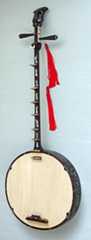
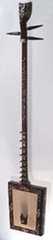
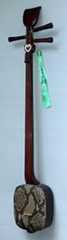
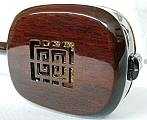
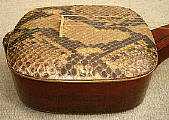
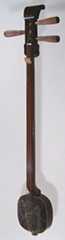
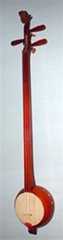
| sanxian Thesanxian (or san-hsien, which literally means "three strings" in Chinese) is a popular Chinesebanjo. The body of thesanxian is made from a hoop of hardwood, with on front and back the skin of a snake (python), glued all around the edge of the rounded hoop. Tuning could be : G d g or : G c g. Thesanxian is usually played with thumb and finger plectrums. With a strong, rich tone and a wide range, it is used in accompaniment as well as orchestral and solo performances. The bigsanxian (which has a less sharp sound) is mainly used to accompany songs. The example instrument (with the small body) has a special wooden capodastre on the neck, through which all 3 strings go; by sliding this up and down the neck the easiest range for the singer can be found, without re-tuning. | |||||||||||||||||
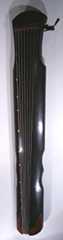
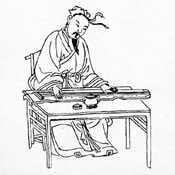
| guqin/ku chin Theqin orguqin (or old spellingchin orguchin) is a seven string fretless zither, and one of the oldest instruments. Because it was played by the higher classes it was also known as the "lute" of China. In Chinese, "gu" means "old", and "qin" means "musical instrument". So although it was historically known as CHIN, during the last century is has been widely called GUCHIN. The body of theguqin is made from a big plank of hardwood (of about 1.20 meter), hollowed out from the back. The bottom is covered with a flat plank. The entire body is painted with black lacquer. In the bottom plank is a long slit (soundhole), which is covered on the inside with half a bamboo pole. Is has two round "feet" at the left side. The 7 silk strings are fixed on the right side to pegs that can be twisted (and therefore tuning the strings) from the bottom up. The strings run to a small bone bridge at the left end of the soundbox, and are then fixed at the bottom to some tuning device near the feet. The seven strings can be tuned in a variety of keys, but the basic tuning is: C D F G A c d. On the far side of the top string (the thickest, furthest from the player) are 13 white dots to indicate the flageolet points. Theguqin is played by laying it flat on a table and plucking it with the right hand. The left hand shortens the strings (more or less holding the thumb sideways) by pressing the string down on the soundboard - often sliding up and down. Also a variety of flageolets can be produced. Because of this technic of shortening the strings, it is the only zither included here on the website. Maybe there are thousands ofchin pieces in existence, some from 500 AD and many of these pieces are still played today. The music is in tablature, which gives detailed information about place, string, finger, direction, volume, etc.
| |||||||||||||||||
| qinqin The qinqin (orchinchin, but same pronounciation) is a plucked instrument mainly used in folk music in South China. Theqinqin can be found with several body shapes :
| |||||||||||||||||
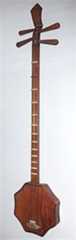
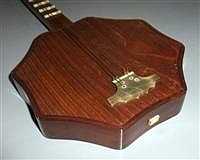
| shuangqing Theshuangqing (orshuangqin) is an instrument that is related to theqinqin, but is longer, has 4 strings in two pairs, and has an octagonal body.
The neck has 13 high white bone (or ivory) frets in a scale of 7 (more or less) equal intervals for an octave. The 4 long grooved friction pegs are cone shaped, and placed two on each side of the open pegbox. Theshuangqing is played with a plectrum. | |||||||||||||||||
| Chinese minorities | ||||||||||||||||||
|
The body and neck of asugudu is made from one piece of wood. The body shape slowly tapers to the top, and then goes over with vague "points" to the narrow neck. The lower part (a circle) is hollowed out, and covered with skin (now often python snake, but also goat was used). There is a narrow slit along the top of the skin. Halfway the neck are some decorated small "soundholes" in the front - probably originally the top half of the body was also hollowed out and covered with a thin piece of wood. The neck is long and fretless, and ends with a straight peghead, which maybe is slightly slanting to the back. The peghead is half open on the back. Thesugudu is used for playing in a small group (with flutes, 2-string fiddles,pipa andsanxian) or in large orchestras. For more information see :. | |||||||||||||||||
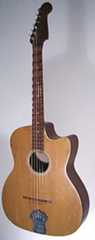
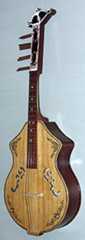
| This new guitar-type instrument is loosely based on thesugundu (see above) and named huobusi (orhuobosi - all meaning "musical instrument"). The body of thishuobusi is made like aguitar, but the (quite thick) front and back are slightly overhanging the sides. The bottom half follows the roundings of a normalguitar, but the top half has sharper curves. The soundholes on both sides of the bridge are decorative holes in a vague f-style. There are decorative black/white painted curly lines on the front, around the edges on the top half and along the bottom half.
The thick fretboard has metal frets, and the long part over the soundboard is free from it. The 4 steel strings run over a large loose wooden bridge to holes in an extension on the bottom of the body. Tuning could be similar to thesugudu : A d g c, or like thepipa : A c d a, or ?. | |||||||||||||||||
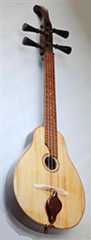
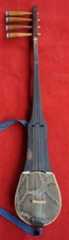
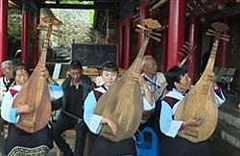
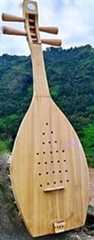
| TheNaxi people in Yunnan (Southwest China) use a type ofpipa that seems similar to the normal mainstream Chinesepipa, but is older and different. It may also be called thepear-shaped pipa. The tuninghead is open and has four large round tuningpegs : two on each side.
| |||||||||||||||||
| Thetianqin is popular amongst theZhuang people. It looks very much like thedan tinh from Vietnam (see) - the main difference is the peghead. Most of the Zhuangs live in southwest China's Guangxi Zhuang Autonomous Region. The Bupian people call itdingding.
The two or three silk (or nylon) strings run over a small loose wooden bridge to the end of the neck that sticks out of the body. Often it has a special device fixed as stringholder. Tuning could be : (G) d g.
| |||||||||||||||||
| Thedong pipais popular amongst theDong people. It resembles thesung from Thailand (see page). The Dong minority live in southwest China's Guangxi Zhuang Autonomous Region and Guizhou Province, as well as in south China's Hunan and Hubei provinces. The body (and first part of the neck) of thedong pipa is made from one piece of wood, hollowed out from the front. The soundboard is a piece of wood glued on the front. The body may be in the shape of a heart, a square or a bit rounded. The neck with the pegbox is made from another piece of wood, and joined halfway the neck to the body. It usually resembles the neck of asanxien (China) orshamisen (Japan). It has 2 or 3 inlayed metal frets. In general the instrument will look a bit rustic.
| |||||||||||||||||
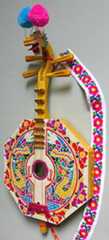
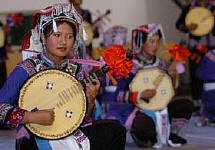
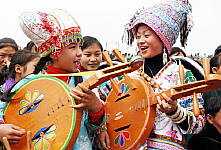
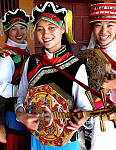
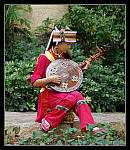
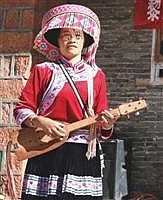
| The Yi ethnic minority uses ayueqin (moon-guitar), which is quite similar to the one used by the Han Chinese. However they call it :xianzi,kuzhu orsixian. The difference with theyueqin is mainly in decorations and soundholes, but sometimes also the body size, shape and the number of strings.
| |||||||||||||||||
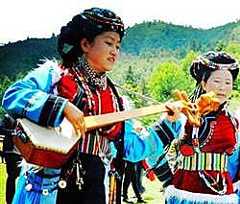
| The people of theLisu tribe in Yunnan province in Southwest China use a lute-like instrument calledqiben (orqibue). It comes in different sizes.
The tuning head is often in a slight curve. The top end may have some wood carving. The half open pegbox has four long round pegs : two on each side. Some tuning heads may be flat with guitar tuners. Tuning could be: d f g a, but there are more. | |||||||||||||||||
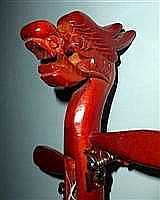
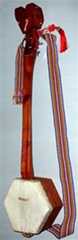
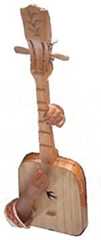
| ThePumi people use a lute-like instrument calledsixian, oryangtou qin ("sheep's head lute").The Pumi is a small ethnic group that live in the mountainous area of Yunnan Province in Southwest China, near the town of Lanping.
The tuninghead is separate from the neck, and half open, with on both sides two big round friction pegs (or nowadays guitar-tuners). The tuning head ends in a rather big carved head of a sheep, showing a stylised ear and horn on both sides. The entire instrument is varnished. | |||||||||||||||||
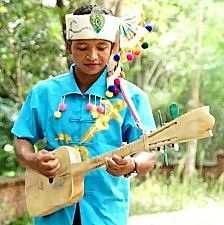
| TheBulang people use a lute-like instrument calledding.The Bulang is an ethnic group that lives mainly in Yunnan Province in Southwest China, and in north Thailand.
The four metal strings run in two courses over a small loose wooden bridge to a small stringholder at the edge of the body. | |||||||||||||||||
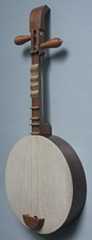
| In South China and on the island Taiwan they use a special type ofyueqin. This instrument looks like a hybrid of several Chinese plucked instruments : the round body of ayueqin, the neck with the frets of apipa, the tuning head of asanxian and the size of aruan ! But note that (like theruan) there are different sizes. The flat round body of thisyueqin is made of wood (back and side), with a thin piece of unvarnished soft wood glued to the front, on top of the sides. The neck and pegbox are made from another piece of wood. The frets are made of bamboo wood and in a diatonic (western) scale, with the first four frets made of triangular pieces, and the rest of thin high pieces. It has a small round soundhole under the bridge. Theyueqin is played by strumming both strings with a plectrum (or finger), but only the first one is fingered. It is mainly used to accompany singing, or in small instrumental groups. In Taiwan it seems very popular with schoolchildren. |
_mz.jpg&f=jpg&w=240)
| Mongolia | ||||||||||||
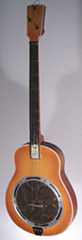
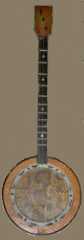
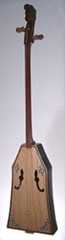
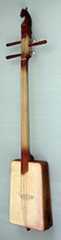
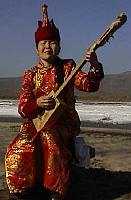
| (inner Mongolia, China) In the Chinese Province of Inner Mongolia they use a fretlesstobshuur (ortovshur) that looks very much like the well knowncello of the Mongolians, theMorin Khuur. It seems made in a factory. The body is built like a guitar, with some soft wood front. The body shape is usually quite rectangular, or bottle shape - it may vary between makers. The back, sides and neck are painted. The sound holes could be like two f-holes or just a single round hole. The decoration lines near the edge and the Mongolian signs are painted on the wood. Thetobshuur is strummed with the right finger (or a plectrum) and often only the first string is fingered (and the second with the thumb). It is mainly used to accompany throat singing.
| |||||||||||
| ||||||||||||
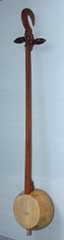
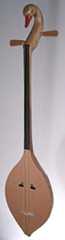
| tobshuur(Mongolia - the state) In Mongolia (the country) thetobshuur has a different shape. Although it used to be made with a skin top (like abanjo), nowadays they have changed to wooden tops for more volume. Also quite recently the idea of a swan has turned up. On CD's of Mongolian music these instruments are now often called "swan-neck-lutes". On the example the idea of the swan is not only used for the shape of the head, but also for the two sound-holes (cut in the front), and the carving on the back of the body. The instrument resembles much the bowed-luteigli from Tuva, which has a skin front and a horsehead peghead. The body of thistobshuur is carved from one piece of wood. The back has some carving in the shape of two wings. The neck is joined to the body and is, together with the peghead, made of one piece of wood. The peghead has a carving of a swan head. The eyes and the beack are painted. The fretless neck is flush with the soundboard and has no fingerboard (the black is painted on). The tobshuur has two (nowadays nylon) strings, tuned with a round wooden tuning peg on each side of the (open on the back) pegbox. The strings go through holes near the nut to the back. The strings go over a rather big loose wooden bridge, and are fixed to a wooden pin at the end of the body. Thetobshuur is strummed with the right finger and often only the first string is fingered (or the second with the thumb). It is mainly used to accompany singing.
| |||||||||||
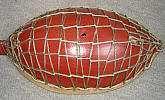
| topshur / khomys(Russian Federation) This is another tobshuur or as it is called in the Russian Federation :topshur orkhomys. It looks more like the traditionaltobshuur, as it has a skin front. So it also looks like the Tuva bowed-luteigli. The body of thetopshur is carved from a solid block of wood in a smooth oval shape, and a small round soundhole in middle of the the back. The leather skin is not glued, but stretched by means of many pieces of (nylon) rope all around the back of the wooden body. In the skin are three small decoration holes. The neck and (square) peghead are made from a separate piece of wood. All the wood is painted dark brown. Thetopshur has two nylon (guitar) strings, which are tuned by a round wooden peg on each side of the (open on the back) pegbox. The strings go passed a plastic nut through small holes to the back. At the other end they run over a rather big loose wooden bridge to a small wooden pin at the end of the body. The neck is not rounded, but five-sided and slightly raised above the skin; it has no fret board. The frets are in western scale, and are made of wound nylon, but in one long binding, so all frets are joined. Thetopshur is strummed with the right finger and often only the first string is fingered. It is mainly used to accompany singing.
| |||||||||||
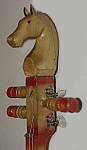
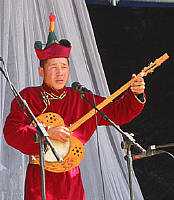
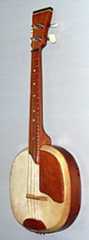
| shanz / shudraga This instrument is in fact the same as the large size Chinesesanxian (see above), which is also popular in the Mongolian area, but here it is calledshanz orshanzaor shudraga. Theshanz has strings of nylon instead of the often used metal strings for thesanxian. Theshanz is mainly used to accompany singing, and for "classical" music. Nowadays it seems also very populair in Mongolian popmusic.
| |||||||||||
| Tuva | ||||||||||||
| doshpuluur In Tuva (a small republic of the Russian Federation, just north-west of Mongolia) they use a kind of plucked instrument which is quite similar to thetobshuur, but calleddoshpuluur (also spelled :toshpulur,tochpuluur,dospulur, etc.) Thedoshpuluur is a kind ofbanjo, but usually with the body in the shape of a rectangle. The wooden sides are covered on both sides with goatskin. Sometimes (pine) wood is used for the soundboard. The skin is folded over at the top and on sides and bottom joined together with a leather rope. The (pine wood) neck (with the tuning head) is long and goes straight through the entire body. Some instruments have a few frets, but normally the neck is fretless. Nowadays the three strings are metal wound (guitar) strings.
| |||||||||||
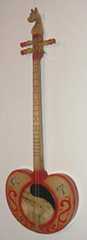
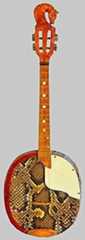
| chanzy In Tuva they use a second kind of plucked instrument, which is quite similar to theshudragaand called the chanzy(also seen :chanzi andtyanzi). It is regarded as a special shapeddoshpuluur. Thechanzy is a kind of (round) banjo, with a (goat or snake) skin glued on the front of a round wooden hoop. It has some decorative wooden box around it (made of triplex), in a kind of heart shape (some call it kidney-shape). Usually it has two similar soundholes and some painted decoration. The example instrument has a Ying-Yang shaped black plastic scratchplate glued to the skin.
| |||||||||||
| Buryat | ||||||||||||
| chanza In Buryat (a republic of the Russian Federation near Lake Baikal in Siberia) they use besides the large Mongolianshanz (see above), a smaller instrument calledchanza (orshanza). This instrument seems a combination of ashanz body with amandolin neck. They come in several sizes : primo, alto, and tenor. As bass the large three stringshanz is used.
Thechanza is played with a plectrum (balalaika-style, with lots of tremelo) and mainly used to accompany singing, or for "classical" music. Note that in Tuva they use an instrument calledchanzy, and in Mongolia another one calledshanz. |
| Japan | |||||||||||||||||||
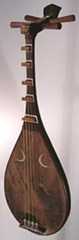
| biwa Thebiwa is the Japanese lute, and looks much like its predecessor - the Chinese pipa. However it is quite differently played and the sound is also completely different. There exist several types ofbiwa, which differ in size and tuning, like thegaku biwa, thechikuzen biwa and thesatsuma biwa. For more information see The body of the biwa is carved from one piece of hardwood, with a thin softwood soundboard, slightly rounded. This has two half moon shaped soundholes, with bone inlay around them. The back has vague carvings, like glued-on papers. The neck is part of the body (although on the example both the neck and the pegbox can be taken separate). The 5 (or 4) high frets (and the top bridge) are made from small "piles" of different woods, with a rounded top. The pegbox is square and bends backwards, ending in a kind of upwards curl. The 4 (or 5) silk strings are tuned with long round wooden tuning pegs, 2 on each side of the open bexbox. They are fixed to the bridge, which is a carved piece of wood glued to the front, and has bone (?) decoration on the sides and around the string fixing holes.
Asbiwas are rarely made anymore, you are lucky to find one - the example instrument had burn marks on the front, and missed the pegs and one fret, which are replaced by some look-alikes. | ||||||||||||||||||
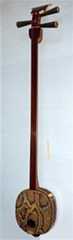
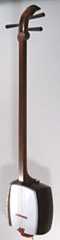
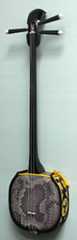
| shamisen Theshamisen (orsamisen orjamisen) is the most well known Japanese plucked instrument, which arrived around the 16th C in mainland Japan via the Chinesesanxian and the Okinawasanshin. Both predecessors used python snake as skin, but for some reason (probably the lack of snake skin) the Japanese started using the skin of dog, or cat (which is more expensive because you can get less skin from one cat...). Nowadays often a synthetic skin is used, like on westernbanjos. Putting on a skin at the very high tension that is required, is work for specialists. As is the woodwork : the neck is made of 3 pieces which fit together (with special lips and holes) so tightly that you can hardly see the joins. The body of theshamisen is made from 4 pieces of hardwood, joined so they make an almost square hoop. On front and back a white skin is glued.
The 3 strings run over a loose small, neatly carved bamboo bridge, and are tied to 3 coloured silk ropes. These are fixed to the end of the neck sticking through the body. Tuning can be : C F c (honchoushi), C G c (niagari), C F Bmol (sansagari).
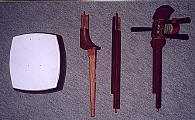
Transporting theshamisen is easy : by slightly loosening the strings, the coloured ropes come loose from the endpin and the strings can be wound around the pegs, the neck taken in pieces and the entireshamisen fits in a small bag. Theshamisen comes in slightly different sizes :nagauta,tsugaru, andjiuta - the main difference is the thickness of the neck. | ||||||||||||||||||
| sanshin Thesanshin is a kind ofbanjo, like the Chinesesanxian (where the name seems to come from) and its close relative : the Japaneseshamisen. It is the "national" instrument of Okinawa - one of the Japanese islands in the South.
The 3 nylon strings are tuned with 3 long round wooden pegs (often black with white endings), 2 on the right and one on the left of the open pegbox. The strings run over a small loose plastic bridge to a decorative piece of rope-knot which is hooked on a wooden pin at the bottom of the body (the end of the neck). Around the body is a piece of cloth, with embroidery with special Okinawa decoration patterns.
On the islands of Amami (between mainland Japan and Okinawa) the same sanshin is played, but with a pick made of a long thinly shaved bamboo stem. At the end of WorldWarII materials were scarce and the body was made of empty milk tins : these simple instruments are now again available : thekankara sanshin.
| ||||||||||||||||||
| gottan Thegottan is ashamisen made completely out of wood - usually of Japanese cedar. Other names arehako shamisen orita shamisen. It is mainly populair in the south of Kyushu (Kagoshima and Miyazaki). The body of thegottan is made from four pieces of wood, glued together to form more or less a square. Some are shaped to have more rounded sides. Thegottan is played with a normal small plastic plectrum, to accompany folk songs. | ||||||||||||||||||
| gekkin The gekkinis the close relative of the Chinese yueqin, and nowadays the instrument is not made in Japan anymore : all instruments these days come from China, and are in fact normalyueqin(see). The oldgekkin (made in Japan) was almost the same as the modernyueqin : so also two circles of softwood for soundboard and back, but now glued on top of the narrow strip of hardwood for the sides. Inside the body is a long circular piece of wire that makes a jingling sound when the instruments is shaken/played. Thegekkin is played with a long thin plectrum to accompany Chinese folksongs, but the instrument is not often used anymore. | ||||||||||||||||||
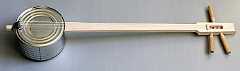
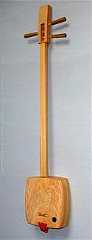
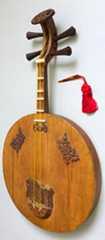
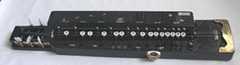
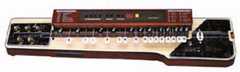
| taishogoto It may be a surprise to find the simple folk-like Indianbulbul tarang (see) to be quite popular in Japan, where it is calledtaishogoto (also spelled:taisho-koto). Maybe this is the reason why this instrument is often called "Japanese Banjo". Some instruments are electric and even have electronic devices attached to it. Basically thetaishogoto is a long acoustic sound box, with strings on top (close together), which can be tuned on the left side, and strummed with a pick on the right side. With the left hand you can press typewriter-like keys, which press down small metal bars on the strings, and work as frets (although there are real frets as well). Thetaishogoto is usually played by large groups of women playing together popular music. |
KOREA | |||||||||||||
| Korea does not have many plucked instruments, just a few zithers. | ||||||||||||
| komungo Thekomungo (or also calledgeomungo) is a long zither, quite similar to the Japanesekoto or to the Koreangayagum. Although normal zithers are excluded from this website, the komungo is fretted, so several strings can be used for different pitches. The body is usually made from paulownia wood, hollowed out at the bottom like a half tube. The back and both ends are pieces of hardwood. There are 16 fixed frets for the 3 inner strings and 3 movable bridges for the 3 outer strings (which are always played open). Two open strings are on the far side of the player, and one is nearest the player. The high frets are made of hardwood. The 6 silk strings are at the right side of the player fixed to a small piece of wood, and run from underneath through a hole in the body, over the wide nut/bridge to the other side of the zither and are there tied with a special knot to a long silk rope, which is tied to the end of the body. Thekomungo is played sitting cross-legged with the right side of the instrument on the lap. The strings are not strummed with the fingers, but with a bamboo stick as plectrum. Nevertheless, the sound is quite similar to thekoto andkayagum, which are always played with (long) open strings. The hitting of the strings with the stick can sound quite percussive. |
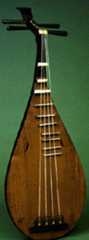
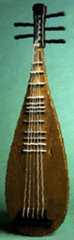
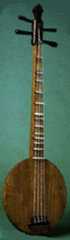
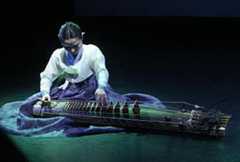
| oungum Theoungum (also spelled :eoeungeum)is an instrument made and found only in. It is there the national instrument. According to legend it was designed in 1962 by fellow students of chairman Kim Jong Il and named by him. It is said to be based on the original hyang bipa. Theoungum is played (solo or in an ensemble) with a plectrum, in a mandolin-style, with often lots of tremelo.
| ||||||||||||
VIETNAM , and about Vietnamese music :. | |||||||||||||
| dan nguyet / dan kim The Dan Nguyet orDan Kim is a relative of the Chinese yueqin orruan, but with a much longer neck and only two strings. The front and back of the body of theDan Nguyet are made from a round piece of unvarnished soft wood (diameter of about 350 mm). The side is made of bended hardwood, about 60 mm in height. There is no soundhole. The neck is separate, without a fingerboard and glued to the body. The peghead is made from one piece, slightly sickle shaped and ending in a spade-like backward curve. On both sides of the open pegbox is a long rounded tuning peg, ending with decorative slices of different materials. Often theDan Nguet still has holes for 4 pegs, but nowadays only 2 strings (and pegs) are used. In the past fingernails were used to playDan Nguyet. Nowadays, they play it with a plastic or tortoise-shell plectrum. Dan Nguyet is used to accompany singing, in ceremonial music and in the traditional orchestra.
| ||||||||||||
| TheDan Sen is a slightly smaller instrument than theDan Nguyet, but is in fact made in the same way. The body of theDan Sen has the shape of a flower (with 6 "petals") and two thin nylon strings. Its origin is the Chineseqinqin (which usually has 3 strings). The side of the body, the bridge, and the neck are highly decorated with inlay mother-of-pearl. It is only used in the Hat Boi (Traditional Drama) in South Vietnam.
| ||||||||||||
| dan doan TheDan Doan looks very similar to the Chineseyueqin ("moon-guitar"). It is sometimes also calledDan Nhat orDan Tu. The body of aDan Doan is made of a long bended strip of hardwood. The almost circular shaped front and back are made of unvarnished softwood. The short neck is separate and is inserted into a square hole in the body. The frets are strips of (rough) bamboo, glued to the neck and soundboard, in a diatonic scale. The open tuning head curls slightly to the back, and has 4 long round tuning pegs (two on each side). The four (sometimes three) nylon single strings run to a half round bridge, glued to the soundboard. There are no sound holes anywhere. It is played with a plectrum.
| ||||||||||||
| dan day TheDan Day is the mainlute of the Viet majority. Its literary name is"Vo de cam" or "bottom-less lute". It can be found only in Vietnam. The sound box of aDan Day has the shape of a trapezium of hardwood with sides of about 28x20 cm, and a depth of about 6 cm. The soundboard is made of unvarnished light softwood.
There are no frets on the top half of the neck, only lower down are 10 high frets, made of hardwood with a rim of bamboo. The 3 nylon strings run to a box-shaped bridge, glued to the front.
| ||||||||||||
| dan tam This three-stringed banjo-lute is used by several ethnic groups in Vietnam. The Viet call itDan Tam, whereas the Ha Nhi call itTa in. The sound box of theDan Tam is oval-shaped, with (python) snake skin on the front. In fact the front is rounded wood, with a small square hole in the middle; the skin seems to be glued to the rounded edge. Playing is with a plastic plectrum. The tones of theDan Tam are bright and cheerful. The techniques for the left hand include tremolos, trills, picking, stopping and especially sliding. Full tones, three-quarter tones and quarter-tones can be played.TheDan Tam is often part of an orchestra accompanying Cheo drama.
| ||||||||||||
| dan tyba TheDan Tyba is very similar to the Chinese pipa. The main difference is that the top six frets are not triangular, but just the same high strips of wood that are used for the rest of the frets. The frets are sometimes in a special oriental scale (7 frets in an octave - like the example), but often in a western scale (sometimes omitting a few frets).
The technique for the left hand, which presses the strings, includes glissando, staccato, arpeggio and tremolo. TheDan Tyba music is light and cheerful. The instrument is played solo or as part of an orchestra or a band accompanying the singing of Hue melodies or operas. | ||||||||||||
| dan bau | ||||||||||||
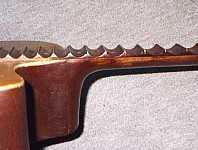
| ghita Theghita(orDan Ghi-ta) is a remarkable guitar-shaped instrument, but typical of the Vietnamese instruments. It is also calledluc huyen cam orvong co guitar (after the music style). The story is that the Vietnamese who emigrated to the USA in the 1930's were eager to get an instrument that could be played like their home instruments - when you pluck a thin string between high frets (like on theDan Nguyet for instance) you can easily bend the tone up by pressing a bit harder. To reach that same effect on aguitar (which was easy to buy in USA) they scraped the fingerboard between the frets in a scalloped way; the frets were left in place. (This scalloping is now also used by some western guitarplayers to ease very fast playing).
TheVong Co guitaris still quite populair in Vietnam, especially for the Vong Co Opera style, and evenelectric guitars are used, but all with the scalloped fingerboard. See for examples :. | ||||||||||||
| dan tinh Dan Tinh is a kind of banjo, played by some ethnic groups in north Vietnam. The Tay and Nung calls itTinh Then, while the Thai ethnic group calls itTinh Tau ('Tinh' means a lute and'Tau' means a gourd). It looks identical to the Chinesetianqin. The body of theDan Tinh is made from a thick, round bottle-gourd of about 20cm diameter. On the back are 6 small soundholes. The front is often made from thin cinnamon wood which is glued in the rim of the cut-off gourd. The neck is made of one piece of some hardwood (often 'Thung muc' or strawberry wood) and goes with a pin through the gourd and sticks out at the bottom. Traditionally the length of a Tinh lute is equal to 0.9x the fist’s length of the player (or 75-90 cm). Experience shows that this length would best fit with the player’s voice. There are no frets. Dan Tinh has either two or three strings. The two-string Tinh is tuned at a fourth or fifth. The three-string Tinh is the same, with the 3th string tuned an octave lower than the high string. TheDan Tinh is played with a plectrum. Fingering techniques are mainly glissando, slurring, mordent and vibrating. Dan Tinh is used by several ethnic groups to accompany singing. It is normally played by men only, but with the 'Then' of the Tay ethnic group it is played by women only. | ||||||||||||