DOI:10.5194/angeo-32-705-2014 - Corpus ID: 55038191
Dawn–dusk asymmetries in the coupled solar wind–magnetosphere–ionosphere system: a review
@article{Walsh2014DawnduskAI, title={Dawn–dusk asymmetries in the coupled solar wind–magnetosphere–ionosphere system: a review}, author={Andrew P. Walsh and Stein Haaland and Colin Forsyth and Amy M. Keesee and Jennifer Kissinger and K. Li and Andrei Runov and Jan Sou{\vc}ek and B. M.Walsh and Simon Wing and Matthew G. G. T. Taylor}, journal={Annales Geophysicae}, year={2014}, volume={32}, pages={705-737}, url={https://api.semanticscholar.org/CorpusID:55038191}}- A. WalshS. HaalandM. Taylor
- Published1 July 2014
- Physics, Environmental Science
- Annales Geophysicae
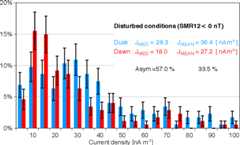
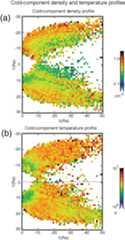
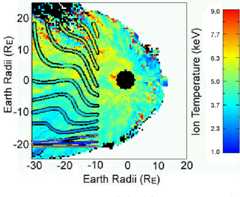
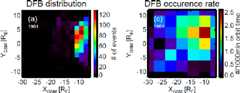
Abstract. Dawn–dusk asymmetries are ubiquitous features of the coupled solar-wind–magnetosphere–ionosphere system. During the last decades, increasing availability of satellite and ground-based measurements has made it possible to study these phenomena in more detail. Numerous publications have documented the existence of persistent asymmetries in processes, properties and topology of plasma structures in various regions of geospace. In this paper, we present a review of our present knowledge…
Figures and Tables from this paper






100 Citations
Dawn-Dusk Asymmetries at the Terrestrial Magnetopause
- S. HaalandH. HasegawaJ. KeyserL. Maes
- 2017
Physics, Environmental Science
The terrestrial magnetopause is a thin current sheet forming the boundary between the solar wind and the Earth’s magnetosphere. It is thus a key region for the transfer of energy and momentum from…
Asymmetries in the Earth's dayside magnetosheath: results from global hybrid-Vlasov simulations
- L. TurcV. TarvusM. Palmroth
- 2020
Physics, Environmental Science
Abstract. Bounded by the bow shock and the magnetopause, the magnetosheath formsthe interface between solar wind and magnetospheric plasmas andregulates solar wind–magnetosphere coupling. Previous…
Characteristics of the flank magnetopause: Cluster observations
- S. HaalandJ. ReistadN. Dorville
- 2014
Physics, Environmental Science
The magnetopause is a current sheet forming the boundary between the geomagnetic field on one side and the shocked solar wind on the other side. This paper discusses properties of the low‐latitude…
Interhemispheric differences in ionospheric convection: Cluster EDI observations revisited
- M. FörsterStein Haaland
- 2015
Physics, Environmental Science
The interaction between the interplanetary magnetic field and the geomagnetic field sets up a large‐scale circulation in the magnetosphere. This circulation is also reflected in the magnetically…
Study on the local time asymmetry of the Earth’s ring currents based on multiple low-Earth-orbit satellite magnetic observations
- Jiaming OuYing JiangQing Yan
- 2024
Physics, Environmental Science
The azimuthal morphology of Earth’s ring currents has consistently shown asymmetry during extreme space weather events at low latitudes, particularly during geomagnetic storms. A dawn-dusk pattern…
Dusk‐Dawn Asymmetries in SuperDARN Convection Maps
- M. WalachA. GrocottE. G. ThomasF. StaplesM. Walach
- 2022
Physics, Environmental Science
Journal of geophysical research. Space physics
The Super Dual Auroral Radar Network (SuperDARN) is a collection of radars built to study ionospheric convection. We use a 7‐year archive of SuperDARN convection maps, processed in 3 different ways,…
Inter-hemispheric asymmetries in high-latitude electrodynamic forcing and the thermosphere during the October 8–9, 2012, geomagnetic storm: An integrated data–Model investigation
Inter-hemispheric asymmetry (IHA) in Earth’s ionosphere–thermosphere (IT) system can be associated with high-latitude forcing that intensifies during storm time, e.g., ion convection, auroral…
Investigation of the occurrence of significant deviations in the magnetopause location: solar-wind and foreshock effects
- Niklas GrimmichAdrian PöppelwerthRumi Nakamura
- 2025
Physics, Environmental Science
Abstract. Common magnetopause models can predict the location of the magnetopause with respect to upstream conditions from different sets of input parameters, including solar-wind pressure and the…
Distribution of the field−aligned currents in the ionosphere: dawn–dusk asymmetry and its relation to the asymmetry between the two hemispheres
- V. MishinV. MishinA. Moiseev
- 2016
Physics, Environmental Science
The dynamics of the system of field-aligned currents (FACs) and closing ionospheric Pedersen currents is considered with the use of original processing methods and the data from four substorms of…
Hall effect control of magnetotail dawn‐dusk asymmetry: A three‐dimensional global hybrid simulation
- San LuYing LinX. Y. Wang
- 2016
Physics, Environmental Science
Magnetotail reconnection and related phenomena (e.g., flux ropes, dipolarizing flux bundles, flow bursts, and particle injections) occur more frequently on the duskside than on the dawnside. Because…
...
261 References
Dawn‐dusk asymmetries in the Earth's magnetosheath
- B. WalshD. SibeckYansen WangYansen WangD. Fairfield
- 2012
Physics, Environmental Science
[1] Statistical observations by the THEMIS spacecraft show a dawn-dusk asymmetry in plasma parameters within the Earth's magnetosheath. Proton density and temperature are greater on the dawnside…
A dawn‐dusk density asymmetry in Earth's magnetosheath
- K. PaularenaJ. RichardsonM. A. KolpakC. JacksonG. Siscoe
- 2001
Physics, Environmental Science
Magnetosheath data from IMP 8 and solar wind data from ISEE 1, ISEE 3, and WIND are used to investigate Earth's magnetosheath structure. Magnetosheath data are transformed into a coordinate system…
Magnetospheric convection and thermal ions in the dayside outer magnetosphere
[1] We have surveyed 3.5 years of Polar Thermal Ion Dynamics Experiment (TIDE) data between 1 January 2000 and 30 June 2003, when Polar apogee paths (sections of orbits with geocentric distances r >…
Dawn‐dusk asymmetry of geosynchronous magnetopause crossings
- A. DmitrievA. SuvorovaJ. ChaoY. H. Yang
- 2004
Physics, Environmental Science
[1] Geosynchronous magnetopause crossing (GMC) data were collected from literature sources from 1967 to 1993 (189 GMCs) and from the experimental data on magnetic measurements on GOES (129 GMCs) and…
Structure and Dynamics of the Magnetopause and Its Boundary Layers
- H. Hasegawa
- 2012
Physics, Environmental Science
The magnetopause is the key region in space for the transfer of solar wind mass, momentum, and energy into the magnetosphere. During the last decade, our understanding of the structure and dynamics…
Dawn‐dusk asymmetries, ion spectra, and sources in the northward interplanetary magnetic field plasma sheet
- S. WingJ. JohnsonP. NewellC. Meng
- 2005
Physics, Environmental Science
[1] During periods of northward IMF, plasma sheet ions often have two components: hot (magnetospheric origin) and cold (magnetosheath origin). The temperatures of the cold-component ions are ∼30–40%…
Dawn-dusk asymmetries and sub-Alfvenic flow in the high and low latitude magnetosheath
- M. LongmoreS. SchwartzA. Fazakerley
- 2005
Environmental Science, Physics
Abstract. We present the results of a statistical survey of the magnetosheath using four years of Cluster orbital coverage. Moments of the plasma distribution obtained from the electron and ion…
Geotail observations of the dayside outer boundary region: Interplanetary magnetic field control and dawn‐dusk asymmetry
- H. HasegawaM. FujimotoK. MaezawaY. SaitoT. Mukai
- 2003
Physics, Environmental Science
[1] On the basis of Geotail observations, we investigate the ion and electron behavior in the dayside low-latitude magnetosphere just inside the magnetopause in order to obtain clues for…
Statistics of low-frequency variations in solar wind, foreshock and magnetosheath: INTERBALL-1 and CLUSTER data
- N. ShevyrevG. ZastenkerJ. Du
- 2007
Physics
Transport of cold ions from the polar ionosphere to the plasma sheet
- Kun LiStein HaalandQ. Y. Ren
- 2013
Physics, Environmental Science
Ionospheric outflow is believed to be a significant contribution to the magnetospheric plasma population. Ions are extracted from the ionosphere and transported downtail by the large‐scale convection…
...
Related Papers
Showing 1 through 3 of 0 Related Papers