DOI:10.1051/0004-6361/201527700 - Corpus ID: 35724352
Evolution of the stellar-merger red nova V1309 Scorpii: SED analysis
@article{Tylenda2016EvolutionOT, title={Evolution of the stellar-merger red nova V1309 Scorpii: SED analysis}, author={Romuald Tylenda and Tomasz Kami'nski}, journal={arXiv: Solar and Stellar Astrophysics}, year={2016}, url={https://api.semanticscholar.org/CorpusID:35724352}}- R. TylendaT. Kami'nski
- Published30 June 2016
- Physics
- arXiv: Solar and Stellar Astrophysics
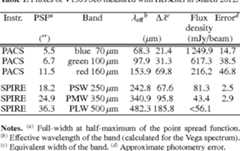
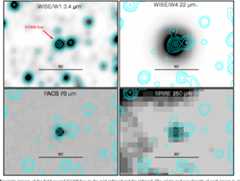
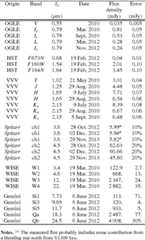
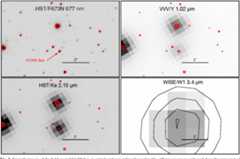
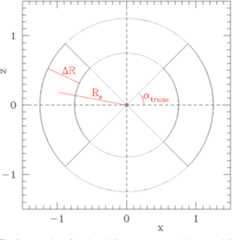
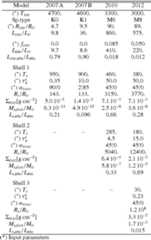
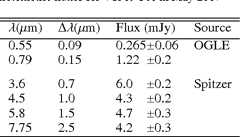
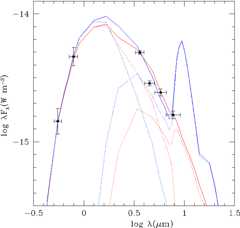
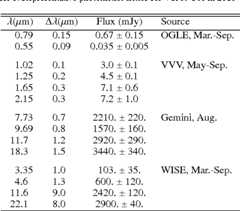
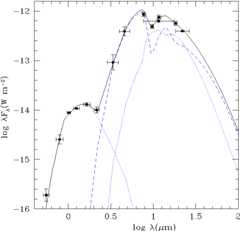
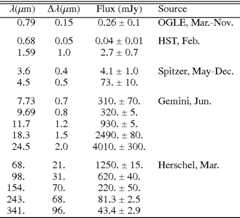
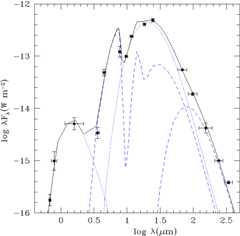
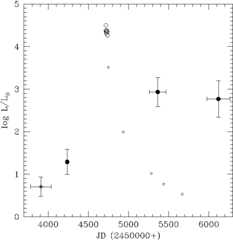
One very important object for understanding the nature of red novae is V1309 Sco. Its pre-outburst observations showed that, before its red-nova eruption in 2008, it was a contact binary quickly evolving to the merger of the components. It thus provided us with a direct evidence that the red novae result from stellar mergers. We analyse the spectral energy distribution (SED) of the object and its evolution with time. From various optical and infrared surveys and observing programmes carried out…
35 Citations
Figures and Tables from this paper
35 Citations
The asymptotic evolution of the stellar merger V1309 Sco: a Blue Straggler in the making?
- T. FerreiraR. SaitoP. Lucas
- 2019
Physics
Stellar mergers are estimated to be common events in the Galaxy. The best studied stellar merger case to date is V1309 Sco (= Nova Scorpii 2008) which was originally misclassified as a Nova event.…
Lessons from the Onset of a Common Envelope Episode: the Remarkable M31 2015 Luminous Red Nova Outburst
This paper investigates the recent stellar-merger transient M31LRN 2015 in the Andromeda galaxy. We analyze published optical photometry and spectroscopy along with a Hubble Space Telescope detection…
Progenitor, precursor, and evolution of the dusty remnant of the stellar merger M31-LRN-2015
- N. BlagorodnovaV. KarambelkarU. Rebbapragada
- 2020
Physics
M31-LRN-2015 is a likely stellar merger discovered in the Andromeda Galaxy in 2015. We present new optical to mid-infrared photometry and optical spectroscopy for this event. Archival data show…
Simulating a Stellar Binary Merger. II. Obtaining a Light Curve
- Roger W. M. HatfullNatalia Ivanova
- 2025
Physics
Luminous red novae are enigmatic transient events distinguished by a rapid rise in luminosity, a plateau in luminosity, and spectra, which become redder with time. The best-observed system before,…
Submillimeter-wave emission of three Galactic red novae: cool molecular outflows produced by stellar mergers
Red novae are optical transients erupting at luminosities typically higher than those of classical novae. Their outbursts are believed to be caused by stellar mergers. We present…
Molecular remnant of Nova 1670 (CK Vulpeculae)
- T. KamińskiK. MentenN. Patel
- 2020
Physics
CK Vul erupted in 1670 and is considered a Galactic stellar-merger candidate. Its remnant, observed 350 yr after the eruption, contains a molecular component of surprisingly rich composition,…
A population of dust-enshrouded objects orbiting the Galactic black hole
- A. CiurloR. CampbellA. Stephan
- 2020
Physics
Observations of four additional G objects, all lying within 0.04 parsecs of the black hole and forming a class that is probably unique to this environment are reported.
A blue ring nebula from a stellar merger several thousand years ago
- K. HoadleyChristopher MartinB. Schaefer
- 2020
Physics
Observations of an unusual, ring-shaped ultraviolet ('blue') nebula and the star at its centre, TYC 2597-735-1 provide a look at an unobstructed stellar merger at an evolutionary stage between its dynamic onset and the theorized final equilibrium state, enabling the direct study of the merging process.
The search for failed supernovae with the Large Binocular Telescope: confirmation of a disappearing star
We present Hubble Space Telescope imaging confirming the optical disappearance of the failed supernova (SN) candidate identified by Gerke, Kochanek & Stanek. This ∼25 M⊙ red supergiant experienced a…
Properties of the post in-spiral common envelope ejecta II: dust formation
We study the formation of dust in the expanding gas ejected as a result of a common envelope binary interaction. In our novel approach, we apply the dust formation model of Nozawa et al. to the…
38 References
V1309 Scorpii: merger of a contact binary
- R. TylendaM. HajdukK. Ulaczyk
- 2010
Physics
Context. Stellar mergers are expected to take place in numerous circumstences in the evolution of stellar systems. In particular, they are considered as a plausible origin of stellar eruptions of the…
Post-outburst spectra of a stellar-merger remnant of V1309 Scorpii: from a twin of V838 Monocerotis to a clone of V4332 Sagittarii
- T. KamińskiE. MasonCamk Torun
- 2015
Physics
We present optical and infrared spectroscopy of V1309 Sco, an object that erupted in 2008 in a stellar-merger event. During the outburst, V1309 Sco displayed characteristics typical of red…
V4332 Sagittarii: A circumstellar disc obscuring the main object
- T. KamińskiM. SchmidtR. Tylenda
- 2010
Physics
V4332 Sgr experienced an outburst in 1994 whose observational characteristics in many respects resemble those of the eruption of V838 Mon in 2002. It has been proposed that these objects erupted…
High-resolution optical spectroscopy of V838 Monocerotis in 2009
Context. V838 Mon erupted at the beginning of 2002. In the course of the outburst the object evolved to low effective temperatures and declined as a very late M-type supergiant. Among various…
VLT/UVES spectroscopy of V4332 Sagittarii in 2005: The best view on a decade-old stellar-merger remnant
V4332 Sgr is a red transient (red nova) whose eruption was observed in 1994. The remnant of the eruption shows a unique optical spectrum: strong emission lines of atoms and molecules superimposed on…
THE OPTICAL AND INFRARED PHOTOMETRIC EVOLUTION OF THE RECENT STELLAR MERGER, V1309 SCO
- B. MccollumS. LaineR. Ramphul
- 2013
Physics
Nova Sco 2008 was recently shown to have resulted from the merger of the two stars in the contact binary V1309 Sco. This is the first stellar merger ever observed between two convective stars. We…
A LUMINOUS RED NOVA IN M31 AND ITS PROGENITOR SYSTEM
- S. WilliamsM. DarnleyM. BodeI. A. Steele
- 2015
Physics
We present observations of M31LRN 2015 (MASTER OT J004207.99+405501.1), discovered in M31 in 2015 January, and identified as a rare and enigmatic luminous red nova (LRN). Spectroscopic and…
V4332 Sagittarii revisited
- R. TylendaL. CrauseS. GórnyM. Schmidt
- 2005
Physics
The eruption of V4332 Sgr discovered in February 1994 shows striking similarities to that of V838 Mon started in January 2002. The nature of these eruptions is, however, enigmatic and unclear. We…
The dusty aftermath of the V1309 Sco binary merger
- C. NichollsC. MelisP. Pietrukowicz
- 2013
Physics
We present mid-IR photometry and spectra of the merged binary V1309 Sco taken between 18 and 23 months after outburst. Strong mid-IR emission and a solid state absorption feature indicate the…
Evolution of the progenitor binary of V1309 Scorpii before merger
- K. Stȩpień
- 2011
Physics
It was recently demonstrated that the eruption of V1309 Sco was a result of a merger of the components of a cool contact binary. We computed a set of evolutionary models of the detached binaries with…
Related Papers
Showing 1 through 3 of 0 Related Papers