DOI:10.1109/PROC.1975.9939 - Corpus ID: 269166
The protection of information in computer systems
@article{Saltzer1975ThePO, title={The protection of information in computer systems}, author={Jerome H. Saltzer and Michael D. Schroeder}, journal={Proc. IEEE}, year={1975}, volume={63}, pages={1278-1308}, url={https://api.semanticscholar.org/CorpusID:269166}}- J. SaltzerM. D. Schroeder
- Published inProceedings of the IEEE1 September 1975
- Computer Science, Materials Science
Cationic graft and cross-linked copolymers are provided which have excellent properties for use in cosmetic compositions, in particular wavesetting lotions. These copolymers are derived by copolymerizing:
2,802 Citations
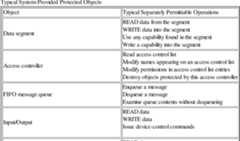
Figures and Tables from this paper

Topics
Capability Systems (opens in a new tab)Economy Of Mechanism (opens in a new tab)Fail-safe Defaults (opens in a new tab)Protected Subsystems (opens in a new tab)Separation Of Privilege (opens in a new tab)Principle Of Least Privilege (opens in a new tab)Complete Mediation (opens in a new tab)Capability Registers (opens in a new tab)Protection Domains (opens in a new tab)Hardware (opens in a new tab)
2,802 Citations
Polaris: virus-safe computing for Windows XP
- M. StieglerA. KarpK. YeeT. CloseMark S. Miller
- 2006
Computer Science, Engineering
CACM
It limits the damage a virus can do by using the operating system's own security mechanisms to enforce the Principle of Least Authority on individual applications.
Lessons learned from 30 years of MINIX
- A. Tanenbaum
- 2016
Computer Science
MINIX shows even an operating system can be made to be self-healing, and that even the most complex systems can be modified to be able to heal themselves.
Rebooting the CS publication process
- D. Wallach
- 2011
Computer Science
A proposal for a new cost-free open-access publication model for computer science papers and its implications for innovation, research and teaching is presented.
Investigating the Combination of Text and Graphical Passwords for a more secure and usable experience
- C. SinghLenandlar SinghC. Singh
- 2011
Computer Science, Engineering
ABSTRACT
WATCHDOG PROCESSORS AND CAPABILITY CHECKING
- M. NamjooE.J. HcCluskey
- 1995
Computer Science, Engineering
Twenty-Fifth International Symposium on Fault…
Managing the impact of change through survivability and pliability to achieve viable systems of systems
- Brian Mekdeci
- 2013
Engineering
Thesis (Ph. D.)--Massachusetts Institute of Technology, Engineering Systems Division, 2013.
Domain Specific Language for Specifying Access Controls
- Markus Weißmann
- 2007
Computer Science, Engineering
A handle for use with items, such as mops and brooms, which is encapsulated in a heat shrunk PVC plastic tubing to provide a smooth, protective surface around the handle.
Secrecy-Preserving Refinement
- J. Jürjens
- 2001
Computer Science
FME
A useful paradigm of system development is that of stepwise refinement, but many security properties proposed in the literature are not preserved under refinement (refinement paradox).
Biometric logical access control enhanced by use of steganography over secured transmission channel
- A. KapczynskiA. Banasik
- 2011
Computer Science, Engineering
Proceedings of the 6th IEEE International…
In the paper we present a novel approach to logical access control to secured repository or container by integration of methods related to cryptography, steganography and biometrics.
A dissertation submitted in partial satisfaction of the requirements for the degree Doctor of Philosophy in Computer Science
- L. Angeles
- 2003
Computer Science
Defending Against Malicious Software
...
136 References
Making computers keep secrets
- Leo J. Rotenberg
- 1973
Computer Science, Engineering
Massachusetts Institute of Technology. Dept. of Electrical Engineering. Thesis. 1973. Ph.D.
Cryptology, computers, and common sense
- G. Mellen
- 1973
Computer Science, Philosophy
AFIPS National Computer Conference
With that as titles, the writer ought give at once the meaning of the final term. Here, "common sense" is used with double intent.
Protection in programming languages
- James H. Morris
- 1973
Computer Science, Linguistics
Linguistic mechanisms which can be used to protect one subprogram from another's malfunctioning are described and an attempt is made to distinguish between access limitation and authentication.
Security controls in the ADEPT-50 time-sharing system
- C. Weissman
- 1969
Computer Science, Engineering
AFIPS '69 (Fall)
At present, the system described in this paper has not been approved by the Department of Defense for processing classified information. This paper does not represent DOD policy regarding industrial…
Protection systems and protection implementations
- R. Needham
- 1972
Computer Science, Engineering
AFIPS '72 (Fall, part I)
The paper outlines a system which is being developed to the point of hardware implementation in the Computer Laboratory, Cambridge, and outlines the potentialities and limitations of a variety of approaches to protection systems.
An implementation of a multiprocessing computer system
- W. AckermanW. W. Plummer
- 1967
Computer Science
A PDP-1 computer was donated to the Electrical Engineering Department of the Massachusetts Institute of Technology in late 1961 and in May, 1963 the first time-sharing system was operational.
Enhancing Computer System Security
- D. Hollingworth
- 1973
Computer Science
An attractive and cost-effective partial solution may reside in a different approach to the problem--implementation of an entrapment strategy--where the nature of the system/penetrator interaction is altered via introduction of counter-penetration elements into the system hardware and software.
An Annotated and Cross-Referenced Bibliography on Computer Security and Access Control in Computer Systems.
- Jeffrey G. Bergart
- 1972
Computer Science
The study includes a selective annotated bibliography of some eighty-five important published results in the field and, based on these papers, analyzes the state of the art in computer systems.
Protection and the control of information sharing in multics
- J. Saltzer
- 1974
Computer Science
CACM
Five design principles help provide insight into the tradeoffs among different possible designs in the Multics system and several known weaknesses in the current protection mechanism design are discussed.
A high security log-in procedure
- G. Purdy
- 1974
Computer Science
It is suggested that for the protection of time sharing systems from unauthorized users polynomials over a prime modulus are superior to one-way ciphers derived from Shannon codes.
...
Related Papers
Showing 1 through 3 of 0 Related Papers