DOI:10.1152/JN.00942.2002 - Corpus ID: 18253128
Spindle model responsive to mixed fusimotor inputs and testable predictions of beta feedback effects.
@article{Maltenfort2003SpindleMR, title={Spindle model responsive to mixed fusimotor inputs and testable predictions of beta feedback effects.}, author={Mitchell Gil Maltenfort and Robert E Burke}, journal={Journal of neurophysiology}, year={2003}, volume={89 5}, pages={ 2797-809 }, url={https://api.semanticscholar.org/CorpusID:18253128}}- M. MaltenfortR. Burke
- Published inJournal of Neurophysiology1 May 2003
- Biology, Engineering
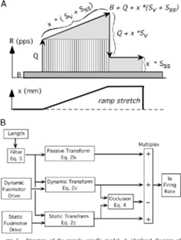
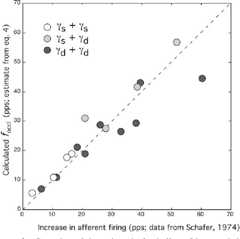
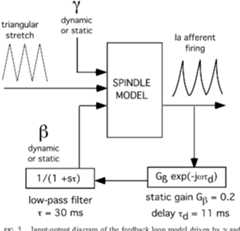
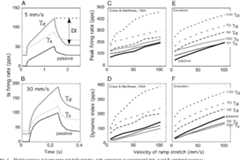
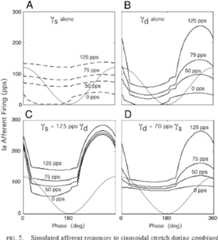
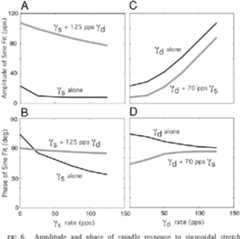
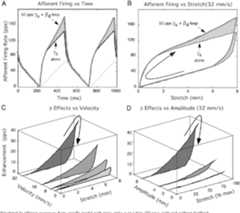
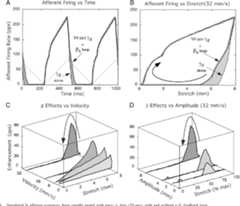
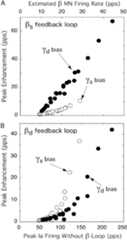
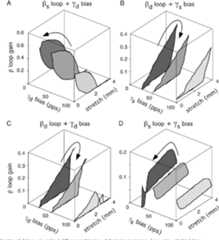
A computationally efficient model of group Ia afferent behavior, capable of responding to multiple fusimotor inputs, was developed that matched experimental data and the strength of beta feedback, estimated as a "loop gain" was comparable to experimental estimates.
Figures and Tables from this paper
35 Citations
Mathematical models of proprioceptors. I. Control and transduction in the muscle spindle.
- M. MileusnicI. E. BrownN. LanG. Loeb
- 2006
Mathematics, Medicine
A physiologically realistic model of a lower-limb, mammalian muscle spindle composed of mathematical elements closely related to the anatomical components found in the biological spindle is constructed and validated against data that originated from the cat's medial gastrocnemius muscle.
Proprioceptive Feedback through a Neuromorphic Muscle Spindle Model
- Lorenzo VannucciEgidio FaloticoC. Laschi
- 2017
Computer Science, Engineering
This model provides a completely spike-based building block, suitable for neuromorphic platforms, that will enable the development of sensory-motor closed loops which could include neural simulations of areas of the central nervous system or of low-level reflexes.
Spindle Model Responsive to Mixed Fusimotor Inputs: an updated version of the Maltenfort and Burke (2003) model
- Laura SchmidT. KlotzU. YavuzM. MaltenfortO. Röhrle
- 2022
Engineering, Biology
An updated version of the Muscle spindle model is provided, which is now capable of replicating the originally published data by modifying the equations describing the modulation of the muscle spindle output in response to dynamic fusimotor drive.
EFFECTS OF SINGLE PINNA REFLEX AND DYNAMIC STRETCH ON SPIKE DISCHARGES OF CAUDATE MUSCLE SPINDLE NERVES IN RAT
- E. BarghiH. PakdamanM. Hadi
- 2010
Biology, Medicine
The DS was as distinctive stimulus for exciting of single Ia and II fibers as the PR (dependent to γd SPs), and the γD showed strong inactivity by the DS, which would be playing role in controling the movement disorders.
Gamma->alpha linkage and persistent firing of Ia fibers by pudendal nerve stimulation in the decerebrate cat.
- J. G. RayaA. RamírezE. Muñoz‐Martinez
- 2004
Biology, Medicine
The sensory pudendal nerve (SPN) was stimulated in decerebrate female cats. Spikes of single Ia muscle spindle afferents from the medial gastrocnemius (MG) muscle were recorded in dorsal root…
Using primary afferent neural activity for predicting limb kinematics in cat
- Joost B. Wagenaar
- 2011
Engineering, Biology
It is shown that kinematic information extracted from the firing rates of primary afferent neurons can be used in a 'real-time' application as a feedback for control of FES in a neuroprostheses.
A physiologically enhanced muscle spindle model: using a Hill-type model for extrafusal fibers as template for intrafusal fibers
- Pablo F S ChaconMaria HammerIsabell WochnerJohannes R. WalterS. Schmitt
- 2023
Engineering, Biology
This work establishes a more physiological model of the muscle spindle, aligned to the advantage of easy integration into large-scale musculoskeletal models, and presents a well-tuned Hill-type model as muscle spindle fibers, and accounts for real sarcomere force-length and force-velocity aspects.
A comparison of resonance tuning with positive versus negative sensory feedback
- Carrie A. WilliamsS. DeWeerth
- 2007
Biology
The results indicate that resonance tuning can be achieved with positive feedback and it is shown that the feedback configuration affects the parameter space over which the endogenous frequency of the CPG or resonant frequency the mechanical dynamics dominates the frequency of a rhythmic movement.
Control of Mammalian Locomotion by Somatosensory Feedback.
- A. FrigonT. AkayB. Prilutsky
- 2021
Biology, Medicine
The role of somatosensory feedback in the recovery of locomotion after neurological injury is described and the fact that somatosENSory feedback is an essential component of a highly integrated system for locomotor control is highlighted.
Modeling of Isometric Muscle Properties via Controllable Nonlinear Spring and Hybrid Model of Proprioceptive Receptors
- Mario Spirito
- 2025
Engineering, Physics
This work investigates the macroscopic behavior of skeletal muscles from a system-theoretic perspective. Based on data available in the literature, we propose an initial evaluation model for…
65 References
Reflex actions of muscle afferents on fusimotor innervation in decerebrated cats: an assessment of beta contributions
The existence of beta innervation in many cat muscles raises the possibility that spindle afferent discharge will excite beta motoneurons, augmenting spindleAfferent discharge and thereby closing a positive feedback loop, and the contribution of such a beta configuration to reducing the sensitivity of muscle to changes in load and muscle properties is evaluated.
Beta-contributions to fusimotor action in triceps surae muscles of decerebrated cats.
It appears likely that beta-motoneurons are able to produce both static and dynamic effects above extrafusal threshold, but that the actions require on-going gamma-activity in order to be effective.
A muscle spindle model for primary afferent firing based on a simulation of intrafusal mechanical events.
- A. SchaafsmaEgbert OttenJ. D. V. Willigen
- 1991
Biology, Engineering
A muscle spindle model for primary afferent firing is presented that contains two components representing a gamma d-dependent and gamma s-dependent intrafusal fiber, and provides insight into how intraFusal events may contribute to observed firing properties of real muscle spindles.
Activation of cat muscle spindles by static skeletofusimotor axons.
The persistence ofstatic beta‐driving after suppression of extrafusal contraction provided evidence for its intrafusal origin, and driving elicited by static beta‐axons could persist during changes in muscle length, but small fluctuations in the delay between each impulse and the preceding stimulus were observed.
The use of sinusoidal and ramp stretch stimuli in characterizing fusimotor effects on cat muscle spindles
- J. RodgersR. DurbabaA. TaylorA. Fowle
- 1994
Biology
Comparisons were made between the results of testing muscle spindle primary afferents with low‐frequency, large‐amplitude sine waves of muscle stretch and with repeating ramp‐and‐hold stretches, showing that it is important to recognize the different effects of chain and bag2 intrafusal fibre activation as components of static fusimotor excitation.
Response characteristics of muscle spindle endings at constant length to variations in fusimotor activation.
- Bengt AnderssonGunnar LennerstrandUwe Thoden
- 1968
Biology
The aim of the present investigation was to determine the transfer function between fusimotor stimulus rate and afferent impulse frequency of muscle spindles at constant length and all combinations of fusicotor fibres and spindle endings were equivalent.
Summation of responses of cat muscle spindles to combined static and dynamic fusimotor stimulation
- Richard W. CarrJohn E GregoryUwe Proske
- 1998
Biology
Models of ensemble firing of muscle spindle afferents recorded during normal locomotion in cats
- A. ProchazkaM. Gorassini
- 1998
Biology
Length was predicted very accurately from firing profiles with the inverse of the above models, indicating that the nervous system could in principle process spindle firing in a relatively simple way to give accurate information on muscle length.
A model of spindle afferent response to muscle stretch.
- Z. Hasan
- 1983
Biology, Physics
A unified model of the properties of stretch responses of mammalian spindle endings is proposed that mimics qualitatively the observed fusimotor effects not only on the response to large ramp stretch but also the contrasting effects seen with smaller, sinusoidal stretch.
A quantitative study of skeletofusimotor innervation in the cat peroneus tertius muscle.
1. Physiological tests were used to identify skeletofusimotor or beta axons to the cat peroneus tertius muscle in order to assess the proportion of beta axons in the motor supply to this muscle. 2.…
...
Related Papers
Showing 1 through 3 of 0 Related Papers