DOI:10.1051/0004-6361/201322995 - Corpus ID: 118656241
The brown dwarf atmosphere monitoring (BAM) project - I. The largest near-IR monitoring survey of L and T dwarfs
@article{Wilson2014TheBD, title={The brown dwarf atmosphere monitoring (BAM) project - I. The largest near-IR monitoring survey of L and T dwarfs}, author={Paul A. Wilson and Abhijith Rajan and Jennifer Patience and Jennifer Patience}, journal={Astronomy and Astrophysics}, year={2014}, volume={566}, url={https://api.semanticscholar.org/CorpusID:118656241}}- Paul A. WilsonA. RajanJ. Patience
- Published17 April 2014
- Physics
- Astronomy and Astrophysics
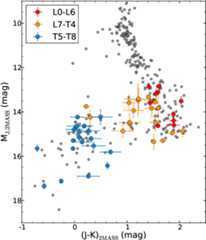
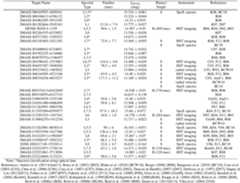
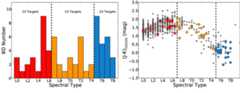
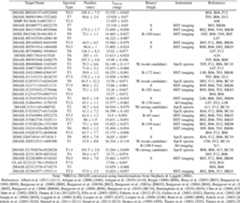
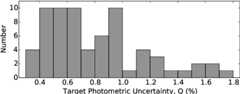
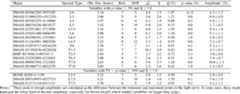
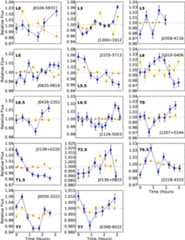
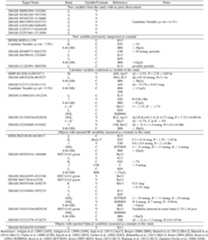
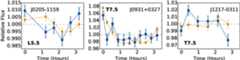
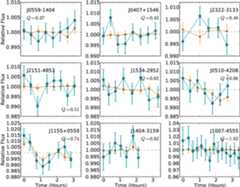
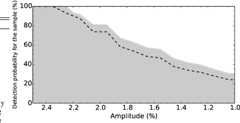
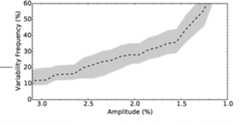
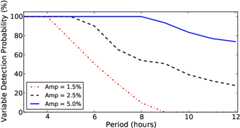
Using SofI on the 3.5m New Technology Telescope, we have conducted an extensive near-infrared monitoring survey of an unbiased sample of 69 brown dwarfs spanning the L0 and T8 spectral range, with at least one example of each spectral type. Each target was observed for a 2-4 hour period in the Js-band, and the median photometric precision of the data is ~0.7%. A total of 14 brown dwarfs were identified as variables with min-to-max amplitudes ranging from 1.7% to 10.8% over the observed duration…
Figures and Tables from this paper
57 Citations
AN INDEPENDENT ANALYSIS OF THE BROWN DWARF ATMOSPHERE MONITORING (BAM) DATA: LARGE-AMPLITUDE VARIABILITY IS RARE OUTSIDE THE L/T TRANSITION
- Jacqueline Radigan
- 2014
Physics, Environmental Science
Observations of variability can provide valuable information about the processes of cloud formation and dissipation in brown dwarf atmospheres. Here we report the results of an independent analysis…
KEPLER MONITORING OF AN L DWARF. II. CLOUDS WITH MULTI-YEAR LIFETIMES
- J. GizisK. DettmanP. Williams
- 2015
Physics
We present Kepler, Spitzer Space Telescope, Gemini-North, MMT, and Kitt Peak observations of the L1 dwarf WISEP J190648.47+401106.8. We find that the Kepler optical light curve is consistent in phase…
HST ROTATIONAL SPECTRAL MAPPING OF TWO L-TYPE BROWN DWARFS: VARIABILITY IN AND OUT OF WATER BANDS INDICATES HIGH-ALTITUDE HAZE LAYERS
We present time-resolved near-infrared spectroscopy of two L5 dwarfs, 2MASS J18212815+1414010 and 2MASS J15074759−1627386, observed with the Wide Field Camera 3 instrument on the Hubble Space…
Weather on Other Worlds. V. The Three Most Rapidly Rotating Ultra-cool Dwarfs
- Megan E. TannockS. MetchevP. Plavchan
- 2021
Physics
We present the discovery of rapid photometric variability in three ultra-cool dwarfs from long-duration monitoring with the Spitzer Space Telescope. The T7, L3.5, and L8 dwarfs have the shortest…
An Informed and Systematic Method to Identify Variable Mid-L Dwarfs
- Natalia Oliveros-GómezE. ManjavacasDaniella C. Bardalez GagliuffiT. KaralidiJ. VosJ. Faherty
- 2024
Physics
Most brown dwarfs show some level of photometric or spectral variability. However, finding the most variable dwarfs more suited for a thorough variability monitoring campaign remained a challenge…
STRONG BRIGHTNESS VARIATIONS SIGNAL CLOUDY-TO-CLEAR TRANSITION OF BROWN DWARFS
We report the results of a J-band search for cloud-related variability in the atmospheres of 62 L4–T9 dwarfs using the Du Pont 2.5 m telescope at Las Campanas Observatory and the Canada–France–Hawaii…
PHOTOMETRIC MONITORING OF THE COLDEST KNOWN BROWN DWARF WITH THE SPITZER SPACE TELESCOPE
- T. EsplinK. LuhmanAdam C. Schneider
- 2016
Physics, Environmental Science
Because WISE J085510.83−071442.5 (hereafter WISE 0855-0714) is the coldest known brown dwarf (∼250 K) and one of the Sun’s closest neighbors (2.2 pc), it offers a unique opportunity to study a…
Detection of new strongly variable brown dwarfs in the L/T transition
- S. ErikssonM. JansonP. Calissendorff
- 2019
Physics
Context. Brown dwarfs in the spectral range L9–T3.5, within the so called L/T transition, have been shown to be variable at higher amplitudes and with greater frequency than other field dwarfs. This…
OBSERVED VARIABILITY AT 1 and 4 μm IN THE Y0 BROWN DWARF WISEP J173835.52+273258.9
- S. LeggettM. CushingG. Mace
- 2016
Physics
We have monitored photometrically the Y0 brown dwarf WISEP J173835.52+273258.9 (W1738) at both near- and mid-infrared wavelengths. This ≲1 Gyr old 400 K dwarf is at a distance of 8 pc and has a mass…
Dynamic Photometric Variability in Three Young Brown Dwarfs in Taurus: Detection of Optical Flares with TESS Data
- Samrat GhoshSoumen MondalSneh Lata
- 2025
Physics
We present I-band time-series photometric variability studies of three known nearby (∼140 pc) and young (∼1 Myr) brown dwarfs (BD) in the Taurus star-forming region in the Perseus molecular cloud.…
...
88 References
The brown dwarf atmosphere monitoring (BAM) project – II. Multi-epoch monitoring of extremely cool brown dwarfs
- A. RajanJ. PatienceR. Windhorst
- 2015
Physics, Environmental Science
With the discovery of Y dwarfs by the WISE mission, the population of field brown dwarfs now extends to objects with temperatures comparable to those of Solar System planets. To investigate the…
Photometric Variability at the L/T Dwarf Boundary
- M. EnochM. BrownA. Burgasser
- 2003
Physics
We have monitored the photometric variability of nine field L and T brown dwarfs for 10 nights during the course of 1 month. Observations were obtained in the Ks band with the Palomar 60 inch (1.5 m)…
The 2MASS Wide-Field T Dwarf Search. III. Seven New T Dwarfs and Other Cool Dwarf Discoveries
We present the discovery of seven new T dwarfs identified in the Two Micron All Sky Survey. Low-resolution (R ∼ 150) 0.8–2.5 μm spectroscopy obtained with the Infrared Telescope Facility (IRTF) SpeX…
Discovery of the Brightest T Dwarf in the Northern Hemisphere
We report the discovery of a bright (H = 12.77) brown dwarf designated SIMP J013656.5+093347. The discovery was made as part of a near-infrared proper-motion survey, SIMP (Sondage Infrarouge de…
BROWN DWARF PHOTOSPHERES ARE PATCHY: A HUBBLE SPACE TELESCOPE NEAR-INFRARED SPECTROSCOPIC SURVEY FINDS FREQUENT LOW-LEVEL VARIABILITY
Condensate clouds strongly impact the spectra of brown dwarfs and exoplanets. Recent discoveries of variable L/T transition dwarfs argued for patchy clouds in at least some ultracool atmospheres.…
THE DISCOVERY OF Y DWARFS USING DATA FROM THE WIDE-FIELD INFRARED SURVEY EXPLORER (WISE)
- M. CushingJ. KirkpatrickE. Wright
- 2011
Physics
We present the discovery of seven ultracool brown dwarfs identified with the Wide-field Infrared Survey Explorer (WISE). Near-infrared spectroscopy reveals deep absorption bands of H2O and CH4 that…
THE NIRSPEC ULTRACOOL DWARF RADIAL VELOCITY SURVEY
- C. BlakeD. CharbonneauR. White
- 2010
Physics
We report the results of an infrared Doppler survey designed to detect brown dwarf and giant planetary companions to a magnitude-limited sample of ultracool dwarfs. Using the NIRSPEC spectrograph on…
Discovery of a Bright Field Methane (T-Type) Brown Dwarf by 2MASS
- A. BurgasserJohn C. WilsonJ. Houck
- 2000
Environmental Science, Physics
We report the discovery of a bright (J = 13.83 ± 0.03) methane brown dwarf, or T dwarf, by the Two Micron All Sky Survey. This object, 2MASSI J0559191-140448, is the first brown dwarf identified by…
37 NEW T-TYPE BROWN DWARFS IN THE CANADA–FRANCE BROWN DWARFS SURVEY
- L. AlbertÉ. ArtigauC. Willott
- 2011
Physics
The Canada–France Brown Dwarfs Survey is an i′- and z′-band survey realized with MegaCam at the Canada–France–Hawaii Telescope that covers a surface area of 780 deg2. Image analysis is now completed…
Near-Infrared Photometry and Spectroscopy of L and T Dwarfs: The Effects of Temperature, Clouds, and Gravity
- G. KnappS. LeggettJ. Brinkmann
- 2004
Physics
We present new JHK photometry on the MKO-NIR system and JHK spectroscopy for a large sample of L and T dwarfs. Photometry has been obtained for 71 dwarfs, and spectroscopy for 56. The sample…
...
Related Papers
Showing 1 through 3 of 0 Related Papers