library(tidyr)library(dplyr)library(ggplot2)theme_set(theme_bw())library(survival)library(mgcv)library(pammtools)Set1<-RColorBrewer::brewer.pal(9,"Set1")Analysis of the recidivism data
In the following, we demonstrate an analysis containingtime-dependent covariates, using the well-known recidivism datadiscussed in detail inFox and Weisberg(2011). The R-Code of the original analysis using the extendedCox model can be foundhere,the respective vignettehere.
# raw data# https://socserv.mcmaster.ca/jfox/Books/Companion/scripts/appendix-cox.Rrecidivism<-read.table( file="https://math.unm.edu/~james/Rossi.txt", header=TRUE)%>%mutate(subject=row_number())Data preprocessing
In this example we don’t need a dedicated function fortransformation, as we basically just need to transform the data intolong format (equals splitting at each week for which subjects are in therisk set):
# transform into long formatrecidivism_long<-recidivism%>%gather(calendar.week,employed,emp1:emp52)%>%filter(!is.na(employed))%>%# employed unequal to NA only for intervals under riskgroup_by(subject)%>%mutate( start=row_number()-1, stop=row_number(), arrest=ifelse(stop==last(stop)&arrest==1,1,0), offset=log(stop-start))%>%select(subject,start,stop,offset,arrest,employed,fin:educ)%>%arrange(subject,stop)recidivism_long<-recidivism_long%>%mutate(employed.lag1=lag(employed, default=0))%>%slice(-1)%>%# exclusion of first week, as lagged information is missingungroup()Fitting the models
Below we fit a PAM and an extended Cox model. In this case the formatfor both models is the same (which is not always the case for analyseswith time-dependent covariates, see the second example below using thepbc data): Thestop variable defines theinterval endpoints and is used to model the baseline log hazardrates.
## Fit PAM (smooth effects of age and prio, using P-Splines)pam<-gam(arrest~s(stop)+fin+s(age, bs="ps")+race+wexp+mar+paro+s(prio, bs="ps")+employed.lag1, data=recidivism_long, family=poisson(), offset=offset)tidy_fixed(pam)### A tibble: 6 × 4## variable coef ci_lower ci_upper##<chr><dbl><dbl><dbl>##1 fin -0.349 -0.732 0.0349##2 race 0.330 -0.289 0.949##3 wexp -0.0192 -0.449 0.411##4 mar -0.325 -1.09 0.444##5 paro -0.0501 -0.444 0.343##6 employed.lag1 -0.767 -1.20 -0.331## respective extended cox modelcph<-coxph( formula=Surv(start,stop,arrest)~fin+pspline(age)+race+wexp+mar+paro+pspline(prio)+employed.lag1, data=recidivism_long)# extract information on fixed coefficientstidy_fixed(cph)[c(1,4:7,10),]### A tibble: 6 × 4## variable coef ci_lower ci_upper##<chr><dbl><dbl><dbl>##1 fin -0.341 -0.727 0.0451##2 race 0.368 -0.254 0.991##3 wexp -0.00569 -0.438 0.427##4 mar -0.277 -1.05 0.498##5 paro -0.109 -0.505 0.288##6 employed.lag1 -0.765 -1.20 -0.327Graphical comparison of the two models
The figure below summarizes the comparison between the twomodels.
Expand here for R-Code
all_eff<-purrr::map_df(list(tidy_fixed(pam),tidy_fixed(cph)[-c(2:3,8:9),]),bind_rows, .id="Method")%>%mutate(Method=factor(Method, levels=2:1, labels=c("Cox-PH","PAM")))## plot of fixed coefficientscoef_gg<-ggplot(all_eff,aes(x=variable, y=coef, ymin=ci_lower, ymax=ci_upper))+geom_hline(yintercept=0, lty=3)+geom_pointrange(aes(col=Method, shape=Method), position=position_dodge(width=0.5))+scale_colour_manual( values=c("black",Set1[1]), limits=rev(levels(all_eff$Method)))+scale_shape_manual( values=c(19,15), limits=rev(levels(all_eff$Method)))+coord_flip(ylim=range(-1.5,1))+ylab(expression(hat(beta)%+-%1.96%.%SE))+xlab("")## to visualize smooth effect of age, create data set where all covariates are## fixed to mean values except for age, which varies between min and max## (n = 100)age_df<-recidivism_long%>%make_newdata(age=seq_range(age, n=100))## add information on contribution of age to linear predictor (partial effect of age)age_df<-age_df%>%add_term(pam, term="age")%>%mutate(cphfit=predict(object=cph,., type="terms")[,"pspline(age)"])## prep plot object for smooth effectssmooth_gg<-ggplot(age_df,aes(y=fit))+geom_line(aes(col="PAM"))+geom_ribbon(aes(ymin=ci_lower, ymax=ci_upper), alpha=0.3)+geom_line(aes(y=cphfit, col="Cox-PH"))+scale_colour_manual(name="Method", values=c("#E41A1C","#000000"))+ylab(expression(hat(f)(x)))+theme(legend.position="none")## plot of the age effectage_gg<-smooth_gg+aes(x=age)+xlab("Age")## same as "age"" for "prio" variableprio_df<-recidivism_long%>%make_newdata(prio=seq_range(prio, n=100))prio_df<-prio_df%>%add_term(pam, term="prio")%>%mutate(cphfit=predict(object=cph,., type="terms")[,7])## plot of the prio effectprio_gg<-smooth_gg%+%prio_df+aes(x=prio)+xlab("Number of prior convictions")## Warning: <ggplot> %+% x was deprecated in ggplot2 4.0.0.##ℹ Please use <ggplot> + x instead.##This warning is displayed once per session.##Call `lifecycle::last_lifecycle_warnings()` to see where this warning was##generated.## put all plots togethergridExtra::grid.arrange(coef_gg+theme(legend.position="bottom"),age_gg,prio_gg, layout_matrix=matrix(c(1,1,2,3), ncol=2))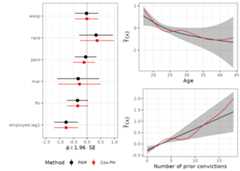
As we can see, the estimates of the fixed coefficients (left panel)are very similar between the two models, including the confidenceintervals. Using the default settings in both model specifications(using P-Splines for smooth terms), the PAM estimates are smoothercompared to the Cox estimates (right panel).
Analysis of thepbc data
Here we show an example with continuous time-dependent covariatesusing the Primary Biliary Cirrhosis Data (pbc) from thesurvival package (see?pbc fordocumentation).
## id time status trt age bili chol## 1 1 400 2 1 58.76523 14.5 261## 2 2 4500 0 1 56.44627 1.1 302## 3 3 1012 2 1 70.07255 1.4 176## 4 4 1925 2 1 54.74059 1.8 244## 5 5 1504 1 2 38.10541 3.4 279## 6 6 2503 2 2 66.25873 0.8 248## id trt age day bili chol## 1 1 1 58.76523 0 14.5 261## 2 1 1 58.76523 192 21.3 NA## 3 2 1 56.44627 0 1.1 302## 4 2 1 56.44627 182 0.8 NA## 5 2 1 56.44627 365 1.0 NA## 6 2 1 56.44627 768 1.9 NApbc<-pbc%>%mutate(bili=log(bili), protime=log(protime))pbcseq<-pbcseq%>%mutate(bili=log(bili), protime=log(protime))Extended Cox analysis of thepbc data
We first replicate the analysis fromvignette("timedep", package="survival"):
# below code copied from survival vignette "timedep"temp<-subset(pbc,id<=312, select=c(id:sex))# baselinepbc2<-tmerge(temp,temp, id=id, death=event(time,status))#set rangepbc2<-tmerge(pbc2,pbcseq, id=id, bili=tdc(day,bili), protime=tdc(day,protime))fit1<-coxph(Surv(time,status==2)~bili+protime,pbc)fit2<-coxph(Surv(tstart,tstop,death==2)~bili+protime,pbc2)rbind("baseline fit"=coef(fit1),"time dependent"=coef(fit2))## bili protime## baseline fit 0.930592 2.890573## time dependent 1.241214 3.983400This demonstrates that results can differ substantially if only thebaseline values of TDCs are used for the analysis instead of theircomplete trajectories over time.
PAM analysis of thepbc data
Data transformation is performed using theas_pedfunction with theconcurrent special as described in thedata-transformation vignette. Notethat a covariate value observed at day 192 will by default affect thehazard starting from interval.This can be modified using thelag argument, which defaultsto zero, but can be set to any positive integer value.
pbc<-pbc%>%filter(id<=312)%>%select(id:sex,bili,protime)%>%mutate(status=1L*(status==2))pbc_ped<-as_ped( data=list(pbc,pbcseq), formula=Surv(time,status)~.+concurrent(bili,protime, tz_var="day"), id="id")Now we can fit the model withmgcv::gam:
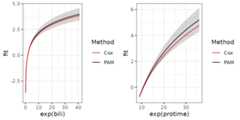
pbc_pam<-gam(ped_status~s(tend)+bili+protime, data=pbc_ped, family=poisson(), offset=offset)cbind(pam=coef(pbc_pam)[2:3], cox=coef(fit2))## pam cox## bili 1.266443 1.241214## protime 4.277453 3.983400Coefficient estimates are very similar for both models, especiallyfor the effect ofbili. A graphical comparison yieldssimilar results:
Expand here for R-Code
## Effect of bilirubin# note that we use the reference argument to calculate# the relative risk change (x - \bar{x})'\beta for comparison with predict.coxph# (see also Details section in ?predict.coxph)reference=sample_info(pbc_ped)bili_df<-pbc_ped%>%ungroup()%>%make_newdata(bili=seq_range(bili, n=100))%>%add_term(pbc_pam, term="bili", reference=reference)%>%mutate(cox=predict(fit2,., type="term")[,"bili"])## Effect of protimeprotime_df<-pbc_ped%>%ungroup()%>%make_newdata(protime=seq_range(protime, n=100))%>%add_term(pbc_pam, term="protime", reference=reference)%>%mutate(cox=predict(fit2,., type="term")[,"protime"])# visualization# remember that bili and protime are log transformedp_term<-ggplot(data=NULL,aes(y=fit))+geom_line(aes(col="PAM"))+geom_ribbon(aes(ymin=ci_lower, ymax=ci_upper), alpha=0.2)+geom_line(aes(y=cox, col="Cox"))+scale_colour_manual(name="Method", values=c("#E41A1C","#000000"))gridExtra::grid.arrange(p_term%+%bili_df+aes(x=exp(bili)),p_term%+%protime_df+aes(x=exp(protime)), nrow=1L)