The American Academy of Achievement invited men and women of exceptional accomplishment to share their wisdom and experience with over 80 outstanding young scholars, scientists, artists, entrepreneurs, and public servants in New York City at the 53rd International Achievement Summit, September 13 -15, 2019.
53rd International Achievement Summit
From September 13 to 15, 2019, the American Academy of Achievement returned to New York City to celebrate the 53rd annual International Achievement Summit.
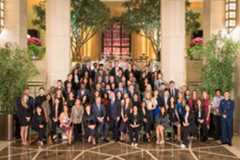
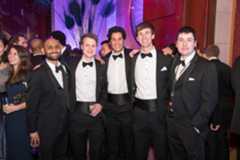
More than 80 young scholars, scientists, entrepreneurs and public servants gathered to meet and exchange ideas with the world’s outstanding leaders in the arts, sciences, business and public service, including 35 new recipients of the Academy’s Golden Plate Award, as well as the Awards Council, composed of returning honorees of the Academy.
Among the new and returning members of the Academy were ten recipients of the Nobel Prize, nine recipients of the Pulitzer Prize, two Justices of the United States Supreme Court, and seven members of the Rock and Roll Hall of Fame.
Academy members, honorees and delegates stayed at the luxurious Four Seasons Hotel on Park Avenue, a unique venue designed by the late giant of modern architecture I.M. Pei.
In evening and daytime sessions of the Summit, also held at the Four Seasons, attendees engaged in intense colloquy over the pressing issues of the day, as well as matters of timeless significance.

At a time of nearly unprecedented political polarization, when public discourse frequently descends into rancorous bickering, the International Achievement Summit provides a unique opportunity for promising young men and women of different backgrounds, nations, beliefs, disciplines and persuasions to meet and learn from one another, and from the most accomplished practitioners in their fields.
The interplay of myriad points of view and the knowledge drawn from varied disciplines and diverse experience produces expansive insights and opens new avenues for constructive dialogue.
Delegates attending the Summit for the first time included Soros Fellows, MacArthur Fellows, fellows of the MIT Media Lab, young physicians and researchers from the Harvard-MIT Medical Scientist Training Program, startup entrepreneurs from Silicon Valley, a promising novelist from Nigeria, a city council member from Houston, the minority leader of Alabama’s House of Representatives, and the lieutenant governor of Wisconsin.
A host of eminent public servants participated in this year’s Summit, including retired Supreme Court Justice Anthony M. Kennedy and Justice Brett M. Kavanaugh. Two members of the President’s cabinet — Secretary of Housing and Urban Development Benjamin S. Carson and Secretary of Transportation Elaine L. Chao — were joined by former CIA Director General David Petraeus, former NATO commander General Joseph Ralston, and the Librarian of Congress, Dr. Carla Hayden.
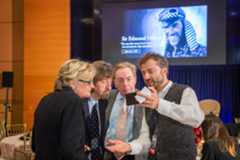
Distinguished members of the legal profession attending the Summit included ACLU Director Anthony Romero, Equal Justice Initiative founder Bryan Stevenson, and forensic DNA pioneer Barry Scheck.
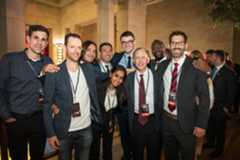
New Academy members Leymah Gbowee and Nadia Murad are both recipients of the Nobel Prize for Peace. Recipients of the Nobel Prize in Physics included Dr. Saul Perlmutter, Dr. Adam Riess, Dr. Donna Strickland and Dr. Kip Thorne.Dr. James Allison received the Nobel Prize in Medicine; Dr. Frances Arnold is a recipient of the Nobel Prize in Chemistry; Dr. Daniel Kahneman was awarded the Nobel Prize in Economics.
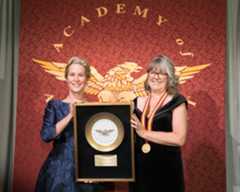
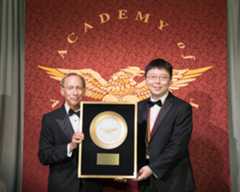
Other brilliant innovators in the sciences, medicine and public health who graced the Summit were biomedical engineer Dr. Robert Langer; artificial intelligence developer Dr. Yann LeCun; satellite radio and biotechnology innovatorDr. Martine Rothblatt; integrative medicine advocate Dr. Andrew Weil; the co-developer of CRISPR gene editing technology, Dr. Feng Zhang; the Director of the National Institutes of Health, Dr. Francis Collins; and Dr. Steven Rosenberg of the National Cancer Institute.
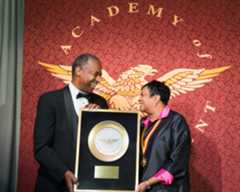
The realms of literature and journalism were represented by distinguished Academy members, including a recipient of the Nobel Prize for Literature, novelist Orhan Pamuk, and the award-winning British novelist Ian McEwan.
Recipients of the Pulitzer Prize included historian Rick Atkinson and biographers A. Scott Berg, Ron Chernow and T.J. Stiles; former Poet Laureate of the United States Rita Dove; playwrightLynn Nottage; and photojournalist Lynsey Addario, who was joined by the award-winning war correspondent and photojournalist James Nachtwey.
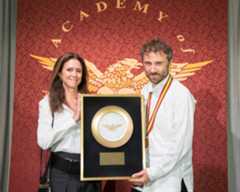
Distinguished leaders from the worlds of business and finance included the Chairman of Maverick Capital, Lee Ainslie; the CEO of Breyer Capital, James Breyer; Kleiner Perkins Chairman John Doerr; Universal Music Group Chairman Sir Lucian Grainge; Lockheed Martin Chairman Marillyn Hewson; Tudor Group founder Paul Tudor Jones II; and the mastermind behind the iPod and Nest digital home devices, Tony Fadell.
This year’s Summit was particularly rich in attendees from the worlds of popular music, from Broadway to rock and roll, rhythm and blues, and hip-hop. Iconic musicians in attendance included the composer and impresario Lord Andrew Lloyd Webber, as well as Rock and Roll Hall of Fame honorees Roger Daltrey and Pete Townshend of The Who, Led Zeppelin founder Jimmy Page, Peter Gabriel, blues great Buddy Guy, Sir Van Morrison, Smokey Robinson and Steven Tyler.
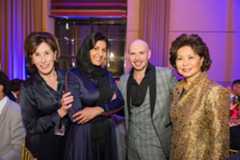
They were joined by Grammy Award-winning folk singer Judy Collins, hit record producer Lukasz “Dr. Luke” Gottwald and rapper Armando Christian Pérez (aka “Pitbull”). The arts were also represented by award-winning directors of film and theater such as Sir Peter Jackson, Sir Trevor Nunn, Bartlett Sher and Julie Taymor, ballet great Edward Villella, choreographer Justin Peck, and groundbreaking designer Thomas Heatherwick.
The Host Chairman of the 2019 Summit was Catherine B. Reynolds, the Chairman, CEO and President of the Catherine B. Reynolds Foundation. The Summit’s Co-Hosts were John Overdeck, the Co-Founder and Co-Chairman of Sigma Two Investments, and Walgreens Boots Alliance CEO Stefano Pessina.
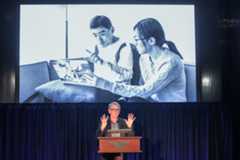
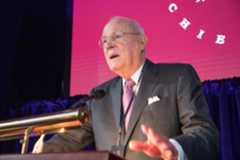
Delegates, honorees, Academy members and guests convened at the Four Seasons on Friday evening for an elegant dinner. After gracious welcoming remarks from Summit Host Catherine Reynolds, Justice Anthony Kennedy greeted the assembly. Recently retired from the Supreme Court after 30 years of distinguished service, Justice Kennedy reflected on the felicity of the Academy meeting in New York City, where so much of the nation’s history has been enacted and where so much of its cultural life has flourished. He recalled observations of the founding fathers on the city’s unique character, reflected in George Washington’s decision to take his oath of office in a public ceremony in New York City.
This year’s Summit commenced a few days after the 18th anniversary of the September 11th terror attacks on New York City. Justice Kennedy read a poem written by a student at the city’s Stuyvesant High School — evacuated on the morning of September 11, 2001 — a poem he suggested reflected something of the city’s indomitable spirit. He ended by quoting Shakespeare’sTwelfth Night: “I can no other answer make but thanks, and thanks, and ever thanks.”
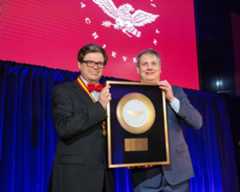
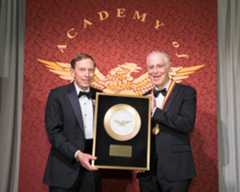
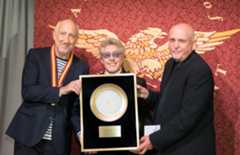
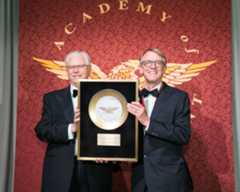
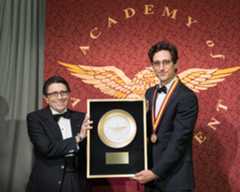
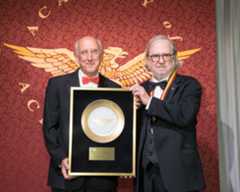
Academy Co-Host John Overdeck presented the Academy’s Golden Plate Award to Dr. Yann LeCun, pioneer of deep learning technology. Dr. LeCun was the originator of the convolutional neural networks that underlie much of the work being done in artificial intelligence today, as well as the voice and character recognition software essential to the devices we use in daily life.
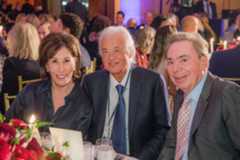
The internationally acclaimed director of film, theater and television, Sir Trevor Nunn, recalled his long collaboration with Lord Andrew Lloyd Webber, the composer of such beloved musicals asCats,Phantom of the Opera, andJesus Christ Superstar. Sir Trevor noted that the composer — a member of the Academy’s Class of 2019 — has donated over £20 million ($26.6 million at this writing) to music and arts education on both sides of the Atlantic through the Andrew Lloyd Webber Foundation.
After a video presentation reviewing Lord Lloyd Webber’s spectacular career, the man himself took the stage, where he took part in a brief conversation with the Pulitzer Prize-winning national correspondent ofThe Washington Post, Mary Jordan. Lord Lloyd Webber emphasized that his great success was essentially due to only undertaking projects that he cared about deeply and found personally exciting. He expressed concern about the current state of musical theater, noting the current predominance of “jukebox musicals” — composed of existing popular songs — over the traditional musical with a complete score of original music. In discussing the work of his foundation, he argued forcefully for the importance of music, art and drama to society as a whole.
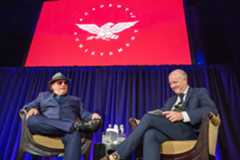
Led Zeppelin founder and guitarist Jimmy Page gave a warmly nostalgic account of the first time he heard Van Morrison perform, and of the enthusiasm with which he had followed Morrison’s career ever since. After a video montage of Morrison’s half-century of music-making, including hits like “Here Comes the Night,” “Brown Eyed Girl,” “Moondance” and “Crazy Love,” Sir Van engaged in a conversation with fellow Belfast native Conor Houston. A community and business leader in Northern Ireland, Houston’s familiarity with Morrison’s career enabled him to draw out the usually reserved singer and songwriter.
The pair reviewed Morrison’s early years as a blues musician and the development of his solo career as a singer and songwriter. Morrison disclosed that he decided to become his own producer when he “started reading the contracts” and decided he wanted to “own the means of production.” On reflection, he looked at all of his music and creative work as an effort “to create order out of chaos.”Morrison’s belief in poetry and music as fundamental values was evident throughout his blunt answers. As the conversation began with a reference to Robert Frost’s poem “The Road Not Taken,” it drew to a close with the first and last lines of T.S. Eliot’sFour Quartets — “In my beginning is my end… …and in my end is my beginning.” The ever-laconic Morrison ended with the words, “Life is difficult; take it from there.”
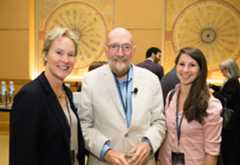
The first morning session of the Summit began with Dr. Donna Strickland, creator of the world’s most intense laser pulses. Strickland reflected that she is only the third woman to receive the Nobel Prize in Physics in the award’s 113-year history. Although she usually prefers to discuss the substance of her work, she took this occasion to address the issue of gender imbalance in the sciences. During a question-and-answer session, the Director of the National Institutes of Health, Dr. Francis Collins, supported her call for greater participation by women in making science policy and affirmed that he no longer participates in all-male panels or advisory bodies.
Attorney, author and entrepreneurDr. Martine Rothblatt reflected on her extraordinarily varied career. The founder of the SiriusXM satellite radio system, she created a biotechnology company to find a cure for her daughter’s lung disease, which has since saved the lives of thousands around the world. As an attorney and author, Dr. Rothblatt has also been a successful advocate for the rights of the transgendered and is the author of visionary works on the subjects of xenotransplantation and cyber ethics. She reflected on the extraordinary good fortune of the present generations of men and women in comparison with the centuries of poverty and serfdom that most of their ancestors endured. She urged the Academy’s delegates to “use the skills you have to make life better for others,” and imagined the spirits of those long-dead ancestors saying, “For God’s sake, enjoy your life.”
John Doerr, the Chairman of Silicon Valley venture capital firm Kleiner Perkins, gave an illustrated presentation of the management philosophy he learned from Intel founder Andy Grove. Called OKR — for “Objectives and Key Results” — it calls for managers to “set the right goals for the right reasons.” As one of many examples of OKR in action, he cited the efforts of Academy delegate Jini Kim.
As a nine-year-old child, Kim had helped her Korean immigrant parents enroll in Medicaid to assist her autistic brother and save the family from bankruptcy. As an adult, Kim founded Nuna, a company that built Medicaid’s first centralized data warehouse, facilitating access to medical care for Americans of limited means. Doerr exhorted the Academy’s delegates to apply the principles of OKR in their own lives, setting realistic but meaningful objectives and establishing clear metrics for assessing their progress. He has provided every Academy delegate with a copy of his bookMeasure What Matters.
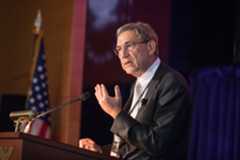
The next speaker of the morning was author T.J. Stiles, who received the Pulitzer Prize for Biography forThe First Tycoon, a life of railroad magnate Cornelius Vanderbilt, and the Pulitzer Prize for History for his bookCuster’s Trials, on the life of the controversial Civil War general who died at the Little Bighorn. In recounting his own trials, Stiles recalled the words of his revered martial arts master, who told him, “If you want to climb to the top, you have to cry the whole way.”
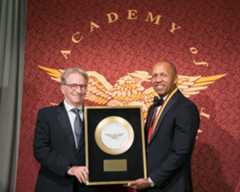
Another tale of perseverance in the face of even more extraordinary challenges was told by the next speaker, Leymah Gbowee, a recipient of the Nobel Prize for Peace. Gbowee successfully mobilized the women of Liberia to force the nation’s warlords to negotiate a peaceful settlement to the country’s brutal civil war. She recalled the enormous difficulties she had to overcome to pursue higher education in the United States, a world away from the simple village life she had known in Liberia. She has since assisted many young women from her country to travel the same road. With great humor and warmth, she recalled her experience traveling on an airliner in the United States, casually dressed among well-dressed businesspeople, and their astonishment when she received a message informing her that she had won the Nobel Prize.
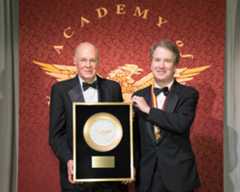
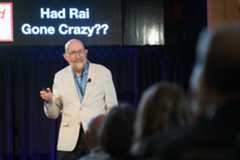
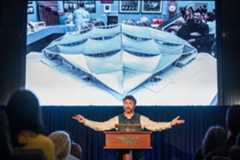
The final speaker of the Saturday morning session was Dr. Kip Thorne, whose theories and discoveries inspired the filmInterstellar. Dr. Thorne received the Nobel Prize in Physics for his work leading to the discovery of gravitational waves — disturbances in the curvature of space-time. Thorne conceived the experimental framework for detecting gravitational events of this kind and campaigned forcefully for the construction of the Laser Interferometer Gravitational-Wave Observatory (LIGO). In his address to the Academy, Dr. Thorne recalled the skepticism he encountered on the way to building a 1,000-member team to staff the experimental facility. The first evidence of a gravitational wave, in 2016, confirmed a prediction Albert Einstein had made in his general theory of relativity 100 years earlier. Today, gravitational waves are observed on a regular basis and can be tracked on any smartphone with the app Gravity Events. An engaging and compelling speaker, Dr. Thorne easily conveyed the excitement of his area of astrophysical research.
The first speaker of the Summit’s afternoon session, Paul Tudor Jones, founded the Tudor Group of investment companies, as well as Robin Hood, the New York-based foundation dedicated to directly addressing issues of childhood poverty in the nation’s largest city. Jones attributed many of society’s present ills to the identification of profit maximization as the sole responsibility of business management. Jones believes that the application of this philosophy to management justified a culture of unchecked greed that led to massive job outsourcing, the opioid crisis, and a 500-percent increase in wealth disparity since 1970. “Business is too important not to be an agent of change,” he said.
Noting that in the United States, the private sector is four times larger than government and 40 times larger than philanthropy, he proposed a model of “venture philanthropy” based on Andy Grove and John Doerr’s concept of OKR. To create an index of social responsibility for the socially conscious investor, he found that given a choice, people are drawn to companies they believe serve the interests of employees, customers, communities, and the planet.
The fantastically imaginative designer Thomas Heatherwick gave a detailed illustrated presentation of his work. As a student, he became frustrated with the uniformity of modern architecture and set out to build something new and more interesting himself, although he had no formal training in architecture. Following his own axiom, “It’s better to be weird than boring,” he designed what described as “a giant tent” made of solar panels. As an example of his innovative design process, he demonstrated how he repurposed a complex of 90-year-old grain silos in Cape Town, South Africa into the building that now houses the city’s Zeitz Museum of Contemporary Art.
Since winning the Nobel Prize for Literature, the Turkish novelist Orhan Pamuk has often been asked why he writes. In his address to the Academy, he shared a list of reasons, ranging from “I write because I love the smell of ink and paper” to “I write because I am so angry at everyone.” In surveying the world today, he suggests that a fear of humiliation is the driving force behind many conflicts. A novel, he said, teaches “a secret hierarchy of values,” in the “childish hope” of finding that we all resemble one another more than we know. “I believe in the novel more than anything,” he said. “My religion is literature.”
Art of another kind came up for discussion as Steven Tyler, the lead singer of Aerosmith, took the stage. The child of a musical family, he recalled lying under the family piano as his father practiced scales overhead. Reflecting on his own early struggles to make it in the music business, he stressed the importance of finding collaborators. In Joe Perry and the other members of Aerosmith, he found comrades who were willing to sacrifice all else to pursue their dreams of musical glory. Reflecting on the excess of their early years, he quipped, “Of all the things I’ve ever lost, I miss my mind the most.” Taking questions from the audience, he said, “I got my dream — to make others happy, even when I wasn’t.”
The Librarian of Congress, Dr. Carla Hayden — also the daughter of classical musicians — described herself as “an accidental librarian.” As a young liberal arts graduate, she spent her days in the library between job interviews, until a friend tipped her off about a job in a South Chicago branch library, where she was encouraged to get a graduate degree in library science. When President Obama asked her to assume leadership of the Library of Congress, the world’s largest library, he tasked her with making the treasures of the library more accessible to the public. She enumerated a few astonishing examples of the library’s vast holdings, including the contents of Lincoln’s pockets the night he died, and locks of hair from the heads of Thomas Jefferson and Ludwig van Beethoven.
Civil rights attorney Bryan Stevenson recounted how he began his education in a segregated school system where there was no high school for black students. At age 16, as an outstanding high school student, he participated in the Academy of Achievement’s annual Summit. It was the first time he had ever traveled from his small town, and the experience inspired him to go to college. He chose law school, he said, because graduate studies in any other field have undergraduate requirements, but “You don’t have to know anything to go to law school.”
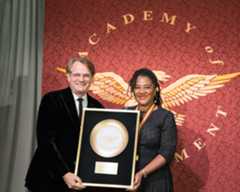
Stevenson’s law practice has focused on the disproportionate prosecution and sentencing of impoverished Americans and defendants of color. The number of incarcerated Americans has grown from 300,000 to 2.2 million since 1972, he observed, and the United States now has more imprisoned citizens than any country in the world. It is estimated that one in every three African American males will face the prospect of incarceration at some point in their lives. His organization, the Equal Justice Initiative, has won major legal challenges to unjust and excessive sentencing in criminal cases.
Stevenson also led the drive to create the National Memorial for Peace and Justice in Montgomery, Alabama, commemorating thousands of victims of racist violence. The Great Migration of African Americans from the rural South to the urban North in the 20th century was a movement of refugees fleeing terror, he asserted, and called for America to embrace a narrative of truth and justice, and consciously come to terms with the crimes of the past, as Germany was forced to do after World War II and the Holocaust. “Injustice prevails where hopelessness persists,” he said. “The opposite of poverty is not wealth, but justice.”
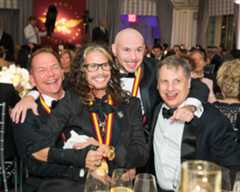
On a lighter note, Armando Christian Pérez, the rapper, producer and entrepreneur known as “Pitbull,” gave an exuberant account of his unlikely rise in the Miami music scene. He recounted the experiences of his parents as refugees from Cuba, his own troubled youth as a high school dropout, and his redemption through the universal language of music. “We all speak music,” he said.
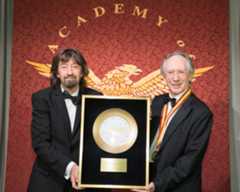
He enjoyed some good-natured jabs at his own industry. “The beautiful thing about the music business is half of them don’t know music and half of them don’t know business.” He also discussed the charter school he has created, with its Sports, Leadership, Arts and Management (SLAM) curriculum. Recalling the struggles of his forebears, he quoted the Cuban aphorism “Pasos cortos, visión larga” — “Short steps, long vision.”
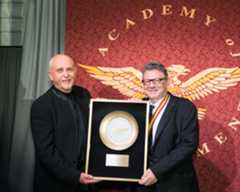
Supreme Court Justice Brett Kavanaugh began his address by joking, “When I was invited, I said I would only come if I could follow Pitbull.” The Justice spoke warmly of teachers and mentors who had the greatest influence on him. As a recent law school graduate, Kavanaugh clerked for Justice Anthony M. Kennedy, and he praised Justice Kennedy’s deep learning as well as his example of unfailing civility on the bench.

Among his teachers, he cited the priest who explicated the Bible verse Matthew 25:35, “When I was hungry, you fed me…” as the inspiration for his pursuit of public service. He spoke of the rewards of providing direct help to someone in need, such as by serving food in a homeless shelter, as he has continued to do while serving on the Court. In discussing his commitment to diversity in the judiciary, he recalled the influence of his mother, a schoolteacher who later went to law school and eventually became a judge. Kavanaugh is the first Justice on the Supreme Court to hire an all-female staff of law clerks. He announced proudly that the majority of the Court’s clerks are now female.
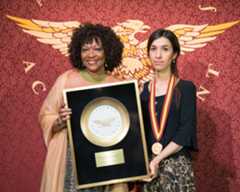
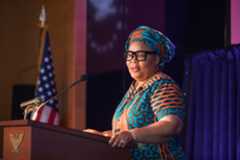
Nadia Murad, a recipient of the 2019 Nobel Prize for Peace, is a Yazidi woman who was kidnapped by ISIS in Iraq and escaped to become an advocate for survivors of war crimes and human trafficking. When asked who inspires her, she says that everyone she meets inspires her. The world leaders she meets fall into two categories: those who understand her story empower her in her work, and those who cannot understand her story inspire her to continue, “Because I can’t let them decide our fate.”
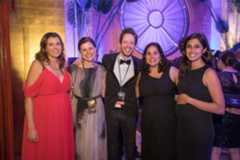
She spoke of her special concern for refugee children, who are often denied education, which makes them vulnerable to recruitment by extremist groups such as ISIS or Boko Haram. Murad was the only one of her siblings to go to school, but her mother always assured her “the real wealth is knowledge.” Murad believes that her education enabled her to resist ISIS brainwashing and to overcome the taboos that prevented other victims of war crimes from speaking of their experience.
The photojournalist James Nachtwey has spent his career documenting some of the most harrowing calamities of our times. Nachtwey illustrated his talk with stunning photographs from the world’s war zones and disaster areas: the hellish orphanages of communist Romania; a famine-stricken wasteland in Sudan; the epidemic of birth defects in Vietnam, caused by exposure to Agent Orange; the ravages of the opioid epidemic across America; the horrors of war in Iraq and Afghanistan. He hopes that his photographs demystify euphemisms such as “boots on the ground” and “collateral damage.” Photography, he said, allows the victims of these tragedies to say, “This happened to us here, in this place.” He ended this sobering presentation with the words, “As we share these photos, we bear witness. Let us not forget.”
The afternoon’s symposium ended with a presentation by Academy Chairman and CEO Wayne Reynolds. Reynolds discussed plans for the Global Forum for Freedom and Justice, which will be an anchor institution in downtown Birmingham, Alabama, that advances the historic legacies of its groundbreaking civil rights pioneers as a global forum to inspire and teach leadership skills in the 21st century. The Global Forum will be an interdisciplinary center of scholarship, learning, research, and public civic engagement, offering a wide collection of digital archives, recordings, and a research library. The modern civil rights struggle will be a crucible towards better understanding complex contemporary social issues. The Forum will encourage a more meaningful exploration into these heroic role models and, as a result, provide insights that will empower and educate future generations of young leaders.

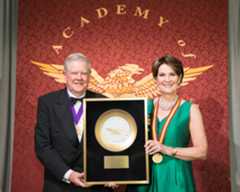
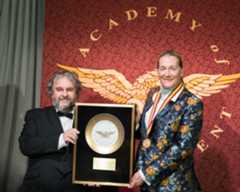
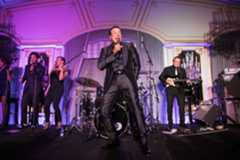
The culmination of the International Achievement Summit was the Banquet of the Golden Plate, held Saturday evening at the St. Regis Hotel. In a stirring ceremony, 34 new members were inducted into the Academy, each presented with the Golden Plate Award by a past recipient of the honor.Following dinner, the assembly was treated to a concert by a 2019 inductee of the Academy, Motown great Smokey Robinson. Effortlessly leading a full band and vocal group, with a voice that has defied the passage of the years, Robinson treated the audience to a choice selection of his timeless hits, interspersed with sly anecdotes about Motown comrades Stevie Wonder and others. His set built in intensity, from the tenderness of “Being With You” and “I Second That Emotion,” to the pulsing four-four rhythm of “Tears of a Clown,” rising to a climax with a cathartic rendition of “Tracks of My Tears.” By the end of the set, delegates and Academy members, including Robinson’s fellow members of the Rock and Roll Hall of Fame, were all on their feet as the wizard of Motown led the audience in a joyous singalong of his classic “My Girl.”
After the Banquet, Academy members and delegates repaired to the Four Seasons for a final reception and dance party on an interactive video dance floor. Although conversation lasted long into the night, a full house gathered for the last session of the Summit the following morning.
The Sunday morning symposium began with a colorful visual presentation by Dr. Feng Zhang, a pioneer of CRISPR technology, the revolutionary gene-editing technique that is transforming the study of all living things. A former student delegate of the Academy of Achievement, he returned this year as an honoree. Now a professor of neuroscience at MIT, he led the team that successfully applied CRISPR technology to human cells for the first time. Through a series of ingenious slides, he effectively dramatized the chemistry of gene editing, and in clearly accessible terms, laid out the enormous potential CRISPR presents for new developments in medicine, agriculture and more.
The British author Ian McEwan is among the most acclaimed novelists in the English-speaking world. All his life, he pointed out, critics have predicted the death of the novel, but it refuses to die. He suggested that the novel remains “the best mode of representing the flow of consciousness.”

He discussed at length the research he undertakes to give imagined lives the texture of reality. As an example, to supply the background for the neurosurgeon protagonist of his novelSaturday, he spent two years accompanying a neurosurgeon in his work, even touching a living brain in the operating room. By the end of the two years, he could impersonate a neurosurgeon in front of a medical student.
In his latest novel,Machines Like Me, he explores the ethical dilemmas raised by artificial intelligence. In his next, he borrows the premise of Franz Kafka’sMetamorphosis, in which an ordinary man is mysteriously transformed into a giant insect, to create a satire of British politics in the era of Brexit. He pointed out that the relationship of the individual to the state is a perpetual subject of the novelist, and that novelists are among the first to be imprisoned by dictators when they seek to suppress dissent.
A delegate of the 2019 Summit, the collegiate gymnastic champion Katelyn Ohashi spoke after showing a video of her virtuosic performance in artistic floor exercise. She discussed the challenges of focusing on such a grueling discipline for her entire childhood and adolescence, and the emotional cost of being judged constantly on her physical appearance. She related the necessity of learning to define herself as a human being, apart from her appearance and athletic performance. “The choices we make decide the life we live,” she stated, and now that her career as a college athlete is over, looked out at the room full of CEOs and entrepreneurs and suggested, “Maybe one of you guys could hook me up with a job.”
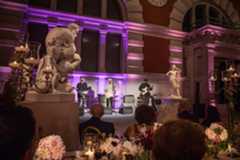
In the final segment of the morning’s symposium, the Executive Director of the American Civil Liberties Union, Anthony Romero, led a discussion with two young leaders from Alabama who, though they come from opposite sides of the political divide, have found opportunities to collaborate in improving life for all the citizens of their state.

Katie Britt is the President and CEO of the Business Council of Alabama, while Anthony Daniels is Minority Leader of the Alabama House of Representatives. Britt, a former chief of staff to U.S. Senator Richard Shelby, is a Republican, while Daniels leads the Democrats in the lower house of the state legislature. Despite their differences, the two have found common ground on many issues. In a model of disinterested public service, the pair explored improvements to their state’s schools and reforms of the state’s prisons and criminal justice system. The 2019 Summit’s last morning session concluded on a note of bipartisanship, and a vivid demonstration of young leaders rising above partisan differences to pursue practical solutions to solve serious problems.
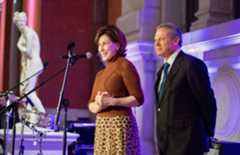
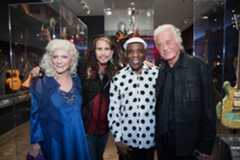
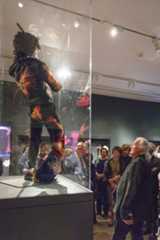
Sunday evening, Academy members gathered at New York’s Metropolitan Museum of Art, where Jimmy Page guided members on a tour of the exhibitionPlay It Loud: Instruments of Rock & Roll. The exhibition included some of the most iconic instruments of modern music, such as those played by The Beatles, Jimi Hendrix, Keith Richards and Eric Clapton.

Academy honoree Buddy Guy enjoyed seeing the vintage Fender Telecaster that was the primary instrument of his old friend and bandmate, the late blues innovator Muddy Waters. Jimmy Page lent several instruments to the exhibition from his own collection, including the two Les Paul guitars he played on his classic Led Zeppelin albums. One guitar, stolen from him in 1970, disappeared for 45 years before it was recovered in 2015.
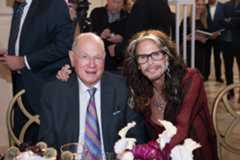
After the viewing of these, as well as musical treasures such as Louis Jordan’s saxophone, Ringo Starr’s drums, and the piano played on tour by Jerry Lee Lewis, the assembly gathered for an intimate dinner in the museum’s Carroll and Milton Petrie European Sculpture Court. In the shadow of Canova’s monumental statue of Perseus and other masterpieces of the classical tradition, Academy members were treated to a performance by blues master Buddy Guy. “I was born to play guitar…” he sang, and proved it with a typically intricate and soulful display of fretboard wizardry.

Longtime Academy members, the honorees of the Academy’s Class of 2019, and the Academy’s young delegates will carry memories of a remarkable weekend in New York as they return to their respective endeavors. We hope that the exchange of ideas they enjoyed — and the formation of lasting bonds between men and women of many nations, young and old, across academic disciplines, professions and beliefs — will continue for many years to come.

In the last weeks of 2019, two more distinguished honorees were inducted into the Academy during a festive holiday celebration in the historic village of Washington, Virginia, at the foot of the Blue Ridge Mountains.

The evening began with an inspiring performance in the village’s venerable Trinity Episcopal Church, featuring the international opera star Denyce Graves and rhythm-and-blues legend Gladys Knight. Following the concert, two members of the Academy’s Awards Council — CNN anchor Wolf Blitzer and the U.S. Secretary of Housing and Urban Development, Dr. Ben Carson — took the stage to present both world-renowned singers with the Gold Medal of the Academy of Achievement.
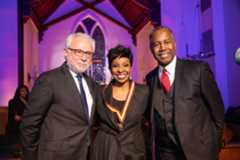
The evening concluded with a warm and elegant dinner in the beautifully restored Inn at Little Washington, a gratifying conclusion to the year’s events, honoring the accomplishments of truly extraordinary individuals in every field.
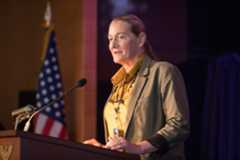
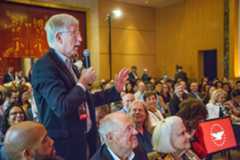
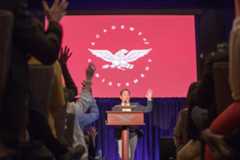
A 1977 Academy student delegate and 2019 honoree Bryan Stevenson, Founder of the Equal Justice Initiative, addresses the International Achievement Summit in New York.