

Weston Meters were made in the UK and USA by Sangamo Weston, and thedifferences between the two are very minor but they have differentmodel numbers. Some later models were made by other manufacturers under licence. The US company was founded in 1888 Springfield Illinoisas a manufacturer of electrical measuring instruments with a factory inNewark NJ, with the UK company following on in Enfield Middlesex a yearlater.
In 1954 the US company was bought out by Daystrom, then in 1962Schlumberger took over Daystrom. In 1974 the Newark plant wasshut down. In 1987there were investigations going on over contamination of thesurrounding land. Sangamo manufactured PCB-containing electricalcapacitors there during 1955-74. Sangamo notified the US EnvironmentalProtection Agency of its disposal of approximately 38,700 cubic yardsof PCB waste on its plant site and an undetermined amount in sevensatellite dumps, all in the Twelve-Mile Creek Basin. Solid, sludge, andliquid wastes were stored or disposed of in piles, landfills, andimpoundments. How nice! Since then Sangamo-Weston has removed over17,000 cubic yards of waste from past disposal areas on and off theplant property. How sad it should all end this way - I'm sure Edwardwould be turning in his grave if he knew.
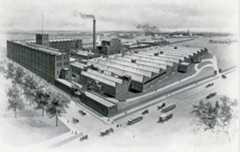
Weston's plant in Newark NJ.
A bit more complicated in the UK. In 1936 BritishSangamo of Cambridge Arterial Road, Enfield, Middlesex who had mademeters and time switches at that address since being founded in 1921,bought51% ofthe UK company who were then on the Kingston Bypass, Surbiton, Surreyand moved theiroperation to Enfield. They became a public company in 1935. In 1977British Schlumberger took over thecompanyincluding Weston. Up until then, they were distributed by Ilford Ltd,then and still the supplier of choice for monochrome photographicmaterials. This continued until 1980 when Sangamo Weston were involvedin various takeovers and amalgamations being rather grandly known asWeston Aerospace at one time. Making exposure meters was probablyconsidered unprofitable by the new owners so it was left to JohnGahagan, a former manager there to set up East Kilbride Instruments inScotland to continue manufacture of the Euromaster. Manufacturingcontinued there until July 1984 when that company went intoliquidation. A sad but familiar story. Fortunately a white knight inthe shape of Tottenham-based instrument repair specialistMegatron,bought the parts and stocks, and took started manufacturing theEuromaster 2, strangely just 3 miles from the original factory atEnfield. Megatron sadlywent out of businessin February 2010 so Weston manfacturing is no more. Meanwhile thenon-exposure meter part of the company was bought by Norwich Aerospacein 1998 and since 2003 has been part of Esterline.
For a really good thorough account of the company, do read the book Measuring Invisibles which is available onlinehere.
Graces Guide have some info athttp://www.gracesguide.co.uk/Edward_Weston
James Ollinger has some history on his excellent website.
Ian Partridge has some fully restored meters for sale on his website and is a great repair guy in the UK.
More information on the complex structure of Weston Aerospace is athttp://www.westonaero.com/weston/history/extended.htm
For all the history buffs out there, here is aninteresting letter from a former employee, Charles J.Mulhern.
Of course, with the advent of digital cameras, only a few professionalsand very serious amateurs use separate exposure meters, so any companythat relied on them was going to have a problem - just as Kodak hadwith film. Mechanical electrical measuring instruments similarly - nowonly aircraft really use them as most are digital orsimply readouts on a computer screen. So really, it was the end of anera but we are fortunate indeed to have plenty of these beautifulinstruments around that we can treasure instead of having to use.
The Man and his achievemnts
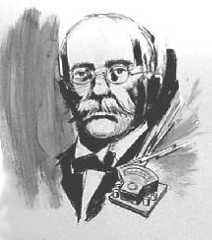
EdwardWeston was an Englishman Born: May 9, 1850 and who Died: Aug. 20, 1936in Montclair, N.J. U.S. By 1900 -1920 he was living in Essex NJ withhis son Edward Faraday and Minnie Weston who was 46 in 1900.Minnie Weston - what a name for a small exposure merer!
He was an electrical engineer and industrialist who had alreadyrevolutionized the Electro-plating industry when founded the WestonElectrical Instrument Company in 1888. A prolific inventor who held 334patents, Edward Weston helped revolutionize the measurement ofelectricity. In 1886 he developed a practical precision, directreading, portable instrument to accurately measure electrical current,a device which became the basis for the voltmeter, ammeter and wattmeter. Oh, and in his spare time, he later produced the world's bestexposure meters!
Edward Weston was born in the rather dull town of Oswestry, Shropshire(England), in 1850 and brought up in nearby Wales. His father was anunsuccessful merchant, and mother was a novelist, as well as a magazinewriter - perhaps that is why his manufacturing plant eventually wentbust but his manuals were so good. Edward Weston attended the AdamsSchool. He studied medicine at the insistence of his parents and beganhis career as apprentice to a local physician where he developed aninterest in chemistry After receiving his medical diploma in 1870, hewent to New York City, at the age of 20 where he soon found a job inthe electroplating industry. He started making improvements and duringthe first eighteen months in America, he is described as"revolutionizing the Electro-plating industry". He realized that aconstant source of current was required for quality plating, and thebatteries used at the time were not sufficient for the job (not a lotchanged there then).
After the first company he worked for went out of business, Weston hada short career as a photographer, but returned to the plating industryin 1872 after realising that there was only room for one photographercalled Edward Weston. He then opened a business in partnership with oneGeorge G. Harris, the surprisingly named Harris & WestonElectroplating Co. He patented the nickel-plating anode here in 1875and then developed his first dynamo for electroplating - a machinedescribed as being rational in it's construction, whatever that maymean. Whatever it means though, it apparently raised the efficiency ofdynamos from just over 45% to over 90% in 1875..
Fed up by 1875 with electroplating, he moved to New Jersey, in businessfor himself making dynamos, called with abounding creativity The.Weston Dynamo Electric Machine Company. Frustration with inadequateelectricity supplies led to an obsession with power generation (betterbe frustrated with that than some other things though). In 1876 hepatented a design for a dc generator. One of Weston's dynamos, runningelectric arc lamps, was shown at the Centennial Exposition inPhiladelphia in 1876, but it received surprisingly little attention.Shortly after this, Weston was contacted by Frederick Stevens, whooffered Weston the opportunity to set up a dynamo division of hisSteven, Roberts & Havell company. In 1877 the division wasorganized as a separate company, the Weston Dynamo Machine Company, inNewark, New Jersey, - the first US factory of it's kind. To expand themarket, he began making generators for arc lighting.
Inevitably, innovations and improvements to the lamps themselvesfollowed and, due to its success, the company changed its name to theWeston Electric Light Company, going on to win the contract toilluminate the new Brooklyn Bridge. At the same time, independent ofEdison and others, Weston was experimenting with incandescent light.Using his knowledge of chemistry, electricity and mechanicalengineering he designed a carbon filament of unprecedented uniformityand longevity, subsequently used in all incandescent lights until theintroduction of tungsten 25 years later.
From 1875 to 1884, Edward Weston was granted a total of 139 US patents,yet despite this prodigious output, his best was still to come...Weston's arc lamp Weston had first used a carbon arc lamp in his ownshop in 1874, run by his plating dynamo, and he continued to researchlighting equipment. By 1877 he had made many developments in arclighting and in 1878 he put an arc light on the Newark FireDepartment's watchtower in the center of town. Publicity from this ledto an order from the city for lighting Military Park, and this wasfollowed in 1879 by an installation in Boston's Forest Garden.
On 26 September 1882 he was granted a patent on the Tamidine filament,a carbon material which gave a bulb life of up to 2000 hours, whenother materials burned out after only a few hundred hours. Weston alsotook out patents on incandescent lamp seals and many other inventionsin the lighting field, and by 1886 had been granted 186 patents. Hiselectric arc furnaces and incandescant lamps were as good as Edison'sor Swan's, if not better, and his filaments were used until thetungsten became available.
Since his early days in electroplating, Weston had been concerned aboutthe lack of accurate, practical devices for measuring electricalparameters so in 1887, having withdrawn from the generator and lampbusiness, he established a laboratory, and the following year WestonElectrical Instrument Company began trading and in 1888 he developedthe truly permanent magnet. He also developed two important alloys,especially for electrical measurement: Constanta having a negativetemperature coefficient; and Manganin, having an extremely lowtemperature coefficient, Patents No. 381304 reissue No. 10994 andPatents No. 381305, reissued No. 10945 in 1888.
In 1888 he developed a practical precision, direct reading, portableinstrument to accurately measure electrical current, a device whichbecame the basis for the voltmeter, ammeter and watt meter. The WestonStandard Cell, developed in 1893, was recognized as an internationalstandard and was used by the National Bureau of Standards for almost acentury to calibrate other meters. His company, Weston Instruments,produced world famous precision electrical measuring instrumentsincluding volt, amp, watt, ohm, and HF meters, current /potentialtransformers and transducers. In 1930, Dr. Edward Weston helped foundNewark Technical School, predecessor to New Jersey Institute ofTechnology, and served on its Board of Trustees.
Weston became a U.S. citizen in 1923. In 1932 Dr. Edward Westonreceived the Lamme Medal "For his achievements in the development ofelectrical apparatus, especially in connection with precision measuringinstruments.His many other achievements are shown at the foot of thispage. Edward Weston died in 1936, aged 86, with more than 300patents to his name. His legacy lives on with the marvellous WestonExposure Meters.
At some point during all this he managed to find the time to see MrsWeston and produce a son, Edward Faraday Weston (1878-1971) who'smiddle name perpetuated his father's reverence for England's greatPhysicist. In 1928/9 Weston and his son began to experiment withexposure-meters by the use of the Photo-electric cell (the magic eye),which Weston was producing. The elder Weston was apparently still akeen Photographer and who saw it as a useful tool. In 1931, EdwardFaraday Weston applied for a U.S patent on the first Weston Exposuremeter, which was granted patent No. 2016469 on October 8, 1935, also animproved version was applied for and granted U.S patent No. 2.042665 onJuly 7th 1936. From 1932 to around 1967, over 36 varities of WestonPhotograhic Exposure Meters were produced in large quantities and soldthroughout the world, mostly by Photographic dealers or agents, whichalso included the Weston film speed ratings, as there were no ASA orDIN data available at that time.
Weston had two factors which contributed to the success of themeter. First was a patented method of making the cells. They werecoated and sealed so that they were relatively immune from moisture,which kills Selenium cells. Weston meters that do not react to light atall have generally lost this seal due to deterioration. Secondly wasthe Weston method of measuring film speeds. While it had someshortcomings it had the advantage of being based on a method which gavepractical speeds for actual use and it was independant of any filmmanufacturer. Previous speed systems such as the H&D and earlySchneiner speeds were both threshold speeds and capable of considerablemanipulation by manufacturers. Weston's method measured the speed wellup on the curve making it more nearly what one would get in actualpractice. (This means that he was a bit less optimistic about filmsensitivity than the maunfacturers of the day who were notorious forpretending their films were more sensitive than they really were) Acertain Mr W.N.Goodwin of Weston is usually credited with this system.The Weston calculator also shows some thought about what the practicalphotographer had to deal with. From the first these calculators hadmarkings on them for determining the scene contrast and theinstructions with the meter told how to do this, a sort of early zonesystem. Some older meters incidentally can become non-linear so can'tbe corrected by a simple factor like adjusting the film speed.
Other items invented by the prolific Weston included:-
Take a deep breath… Electric motors, potentialtransformers, current transformers, A.C and D.C. voltmeters, ammeters,wattmeters including polyphase, ohmmeters, both A.C and D.C laboratorystandards, standard cells, panel meters in hundreds of sizes, shapesand ranges, power factor meters, control relays, tachometer generators,A.C and D.C. amplifiers, radio tube (bulb), radio test instruments,insulation testers, multi-range, multi-purpose industrial circuit testinstruments, mutual conductance electronic radio-tube analyzers, A.C.industrial test units, A.C clamp ammeters and voltmeters for powerlineworks, moisture measuring meters, electrical and mechanical recordersand controllers, thermometers mercury tube, thermocouple and bimetaltypes, hydrometers for all branches of chemistry, ground detectors,humidity indicators, meggers, frequency meters, sensitive relays,laboratory standard electrical measuring instruments, aircraftnavigational and engine condition instruments, including thefirst-blind landing instrument in 1933, switchboard instruments,shunts, resistors, D.C. galvano-meters thermal converters, copper oxiderectifiers, projection instruments, VU meters, photoelectric cellsinitally used in illumination meters, light meters and foot-candlemeters. The magnetic speedometer, and the dashboard ammeter for Harley- Davidson motorcycles.
And, in chronological order:
Applied the dynamo to electroplating (1872).
Patented an anode for making malleable plated nickel (1875)
Patented the rational construction of dynamos (1876).
Patented laminated pole pieces and cores for dynamos, raising their efficiency from about 45 per cent to 85 per cent (1875).
Gave a public exhibition of arc lighting in the United States (1877).
Used the arc light for general lighting purposes (1877)
Opened a commercial arc light factory in the United States (1880)
Used a soft metal core for arc light carbons (1878).
Copperplated the ends of arc light carbons (1878).
Used an electric arc furnace industrially in the United States (1875).
Used the dynamo as an electric motor for industrial purposes (1878)
Made a successful homogeneous carbon lamp filament (1885).
Cured weak spots in carbon lamp filaments with hydrocarbon flashing process (1885).
Made nitrocellulose into pure fiberless cellulose (1885).
Made a truly permanent magnet (1887).
Compounded a German Silver alloy containing 30 per cent nickel (1887).
Made a metal having a negative temperature co-efficient (1887).
Made a metal having an extremely low temperature co-efficient (1887).
Made an aluminum alloy which could be drawn to very thin tubes (1887).
Used a metal frame for damping the motion of moving coils (1887)
Made a commercial, direct-reading electrical measuring instrument (1888).
Used the shunt circuit (1893 - US Patent No. 497,482).
Made a stable cell for use as a secondary standard of the volt (1893).
Developed the magnetic drag-type speedometer (1885).
Made an ammeter for use with automobile starting batteries (1911).
Instruments such as the Weston A.C. Voltmeter, Model 155 WestonElectrical Instrument Corp. Newark N.J.,(c 1926) were used by trainedtechnical/scientific staff for precision laboratory measurements ofvoltage, and as secondary standards for calibrating other meters. Themirrored scale makes it easier to read the instrument to a givenaccuracy by enabling the user to avoid parallax errors. This particularinstrument was specified to be accurate to ±0.5%.
Here are some more landmarks:
1888 The first commercial double pivoted moving coil instrument for electrical measurement
1908 The international conference on Electrical Units and Standardsnames the Weston cadmium cell the standard for electromotive force. Thefirst commercial use of Bakelite
1919 First direct measurement of high frequency radio signals
1921 Steamproof train speedometer
1932 The first exposure meter
1933 Aircraft "blind landing" system
1935 Bi-metal thermometer. The first "electric eye"
HOME
