


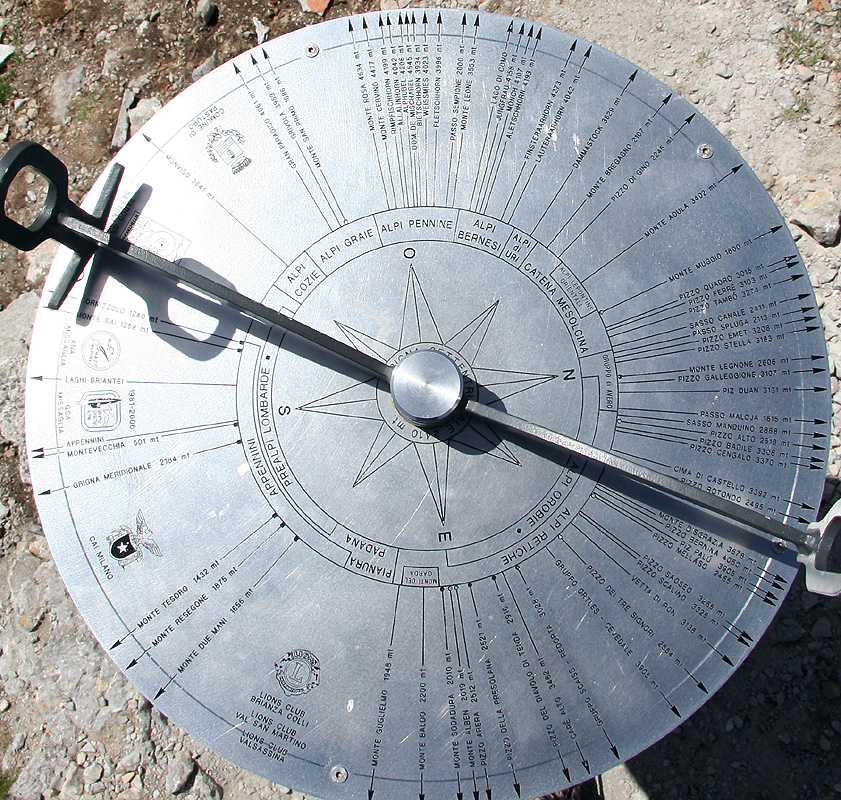


As far as I know the longest ground to ground line of sight that has ever been photographed in the US lower 48 is to San Gorgonio Mountain, 190 miles or 306 kilometers from Mount Whitney, California. It was photographed by John Samson of Loughborough, England and can be seenhere.
It is stated in Guinness World Records 2006, under "longest lines of sight", that "Mount McKinley can be seen from Mount Sanford, a direct distance 370km (230 miles)". The two mountains are intervisible, and this line of sight, which has been photographed and can be seenhere, may be the longest that has ever been seen and recognised, but there are longer lines of sight which certainly could be seen by anyone knowing exactly where to look for them. Denali (aka Mt McKinley) is intervisible at a greater distance with Mount Blackburn, seethe Denali panorama.
The longest ground to ground line of sight that I have seen in a photograph is 443 km (275 miles), from Pic de Finistrelles in the French Pyrenees, to Pic Gaspard in the French Alps, against the background of the rising sun. Seehere.
If anyone knows of any photograph with a longer line of sight then please tell me!

GWR go on to claim that "owing to the light bending effects of atmospheric refraction, Vatnajökull (2119m), Iceland, can sometimes be seen from the Faroe Islands, 340 miles (550km) away". I think this is based on the claimed similar sighting by a British sailor in 1939, see below. In my opinion the statement is too tenuous to merit a place in GWR and should be withdrawn. It is a case of people seeing what they want to see.
Assuming normal refraction, the distance of the sea horizon, in kilometers, can be calculated by multiplying the square root of the elevation in meters by 3.85. I make that 177km for Vatnajökull and 114km for the high point of the Faeroes (882m). These distances can be added to create a net distance of 291km. Refraction is variable but notthat variable. Clouds and mountains, especially icy mountains, look very similar from long distances (c.f. the legend of Tir Nan Og west of Ireland) and I cannot see how anyone could have known that anything visible from the Faeroes was a vast ice dome in Iceland and not a similarly shaped cloud.
Temperature inversions can enhance the effect of refraction; a good example from the German Alps, across a distance of 135 kilometres, has beencaptured on camera. But freak light ducts distort lines of sight and usually break them up, rendering them unrecognisable. Such ducts are part of the "arctic mirage" or (in Icelandic)hillingar phenomenon and are discussedhere. Although there is speculation that Iceland may have been seen from the Faeroes by Celtic mariners, there is no mention of any recorded observation of such a line of sight. The claimed observation of an Icelandic landmark (Snaefells Jokull) from a comparable distance from the direction of the southern tip of Greenland is interesting. It is claimed that "the apparent distance of those landmarks was judged to be 40 to 50 km (25 or 30 miles) distant; however, from ship's actual recorded position, they were located 536 to 560 km (335 to 350 miles) away". But if these landmarks appeared so close, then either they were magnified in both the horizontal and vertical directions, which would seem impossible, or they were elongated vertically by a factor of more than 10, which would make them unrecognisable. It seems to me to be more likely that the "landmarks" were clouds that looked a bit like the SJ skyline.
Perhaps light from Iceland can reach the Faeroes, but it would be very unlikely to be recognisable as such, and the use of the word "sometimes" by GWR would seem to be at best inappropriate.
The true longest possible line of sight based on normal refraction was researched by Xavier Eguskitza of Bilbao, and he found the line of sight between Cerro Paramillo (Colombia, N 7°06'12" W 75°58'09") and the Sierra Nevada de Santa Marta, 483km (300 miles) to the north east. The virtual view is shownhere, but it is very unlikely that it has been seen, let alone photographed, in practice. It is possible that longer views exist from south west of Paramillo, but despite extensive searching I have found no longer lines of sight anywhere else in the world. Anyone who thinks there is a longer one, please contact me.

Update 23 April: I still have not found any longer lines of sight anywhere other than across the Colombian plain to/from the Santa Marta, but longer lines of sight than the above are theoretically possible. From the west of Paramillo, there is a 491km view from Altos de Tres Morros, and from the south, there is a 500km view from Paramo Santa Ines (W 75°41'33" N 6°46'22"). In perfect visibility, Pico Ojeda (503km) would be visible through binoculars; and with a telescope part of the ridge further east could be visible at 506km. I have also seen a claim that there is a theoretical 538 kmline of sight between Mount Dankova in Kyrgyzstan and the Hindu Tagh in China. But I doubt if anyone will ever see these for real.

The longest theoretical line of sight in the British Isles is 144 miles (232 km) from Merrick, in the southern uplands of Scotland, to Snowdon in North Wales. I have found no longer sightlines, and none were found in a study by topographic researcher Chris Jesty in the 1980's. A 1990's Guinness Book of Records published this superlative, but gave the distance as 144 km (sic). Unlike the longer US views above, the line of sight is low altitude and passes primarily over the sea, so Snowdon would only be observable from Merrick on an exceptionally clear day. No sightings have come to my attention.
Merrick would be practically impossible to observe from Snowdon, because of the very thin aperture it shows behind nearby Lamachan hill. To give an analogy: if a colleague and I were in neighbouring rooms, and I were at a desk but the colleague were looking through an empty keyhole, he would probably see my clearly, but I would not see him. The "keyhole" is Lamachan Hill, which is much closer to Merrick, so an observer on Merrick would see Snowdon much more easily than vice versa. Infact, Merrick would be impossible to observe from Snowdon other than with a telescope, and then only if there were a suitable contrast with Lamachan Hill (e.g. snow or sun on one but not the other). That is why Merrick is not shown on the Snowdon panorama.
.
.
.
.
.
.
.
.
.
.
.
.
.
.
.
.
.
.
.
.
.
.
.
.
.
.
.
.
Price of CD containing all the above panoramas, including packing, postage and administration: £7. E-mailed panoramas from customer specified viewpoints may be available free of charge, but this may be changed without notice. Due to technical difficulties and high costs, printed copies are now only available by special request.
.
.
.
.
.
.
.
.
.
.
.
.
.
.
.
.
.
.
.
.
.
.
.
.
.
.
.
...
Panoramas created and collated by Jonathan de Ferranti, 1994-2007. Last update 25 January 2007.
[8]ページ先頭