 |  |
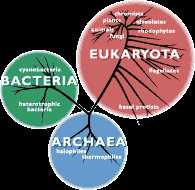
The Domain Archaea wasn't recognized as a major domain of life until quiterecently. Until the 20th century, most biologists considered all living thingsto be classifiable as either a plant or an animal. But in the 1950s and 1960s,most biologists came to the realization that this system failed to accomodatethe fungi, protists, and bacteria. By the 1970s, a system of Five Kingdomshad come to be accepted as the model by which all living things could beclassified. At a more fundamental level, a distinction was made between theprokaryoticbacteria and the foureukaryotic kingdoms (plants,animals, fungi, & protists). The distinction recognizes the common traits thateukaryotic organisms share, such as nuclei, cytoskeletons, and internal membranes.
The scientific community was understandably shocked in the late 1970s by thediscovery of an entirely new group of organisms -- the Archaea. Dr. Carl Woeseand his colleagues at the University of Illinois were studying relationshipsamong the prokaryotes using DNA sequences, and found that there were twodistinctly different groups. Those "bacteria" that lived at high temperaturesor produced methane clustered together as a group well away from the usualbacteria and the eukaryotes.Because of this vast difference in genetic makeup, Woese proposed that life bedivided into threedomains: Eukaryota, Eubacteria, and Archaebacteria.He later decided that the term Archaebacteria was a misnomer, and shortened itto Archaea. Thethree domainsare shown in the illustration above at right, which illustrates also thateach group is very different from the others.
Further work has revealed additional surprises, which you can read about onthe other pages of this exhibit. It is true that most archaeans don't lookthat different from bacteria under the microscope, and that the extremeconditions under which many species live has made them difficult to culture,so their unique place among living organisms long went unrecognized.However, biochemically and genetically, they are as different from bacteria asyou are. Although many books and articles still refer to them as "Archaebacteria", that term has been abandoned because they aren't bacteria -- they're Archaea.
| |
Archaeans include inhabitants of some of the most extreme environmentson the planet. Some live near rift vents in the deep sea at temperatureswell over 100 degrees Centigrade. Others live in hot springs (such as the onespictured above), or in extremely alkaline or acid waters. They have been foundthriving inside the digestive tracts of cows, termites, and marine life wherethey produce methane. They live in the anoxic muds of marshes and at thebottom of the ocean, and even thrive in petroleum deposits deep underground.
Some archaeans can survive the dessicating effects of extremely salinewaters. One salt-loving group of archaea includesHalobacterium, awell-studied archaean. The light-sensitive pigmentbacteriorhodopsin givesHalobacterium its color and provides it with chemical energy. Bacteriorhodopsin has a lovely purple color and it pumps protons to the outside of the membrane. When these protons flow back, they are used in the synthesis of ATP, which is the energy source of the cell. This protein is chemically very similar to the light-detecting pigmentrhodopsin, found in the vertebrate retina.
Archaeans may be the only organismsthat can live in extreme habitats such as thermal vents or hypersalinewater. They may be extremely abundant in environments that are hostile toall other life forms. However, archaeans are not restricted to extremeenvironments; new research is showing thatarchaeans are also quite abundant in the plankton of the open sea.Much is still to be learned about these microbes, but it is clear thatthe Archaea is a remarkably diverse and successful clade of organisms.




For even more archaeal information :

Sources:

