
- September 18, 2013
America’s Shameful Poverty Stats
America’s Shameful Poverty Stats
That so many of our political leaders tolerate so much misery amid so much plenty is one of the great scandals of our age.
Get The Nation’s Weekly Newsletter
Fridays. The best of the week.By signing up, you confirm that you are over the age of 16 and agree to receive occasional promotional offers for programs that supportThe Nation’s journalism.You can read ourPrivacy Policy here.
Repro Nation
A monthly newsletter on the global fight for reproductive freedom.By signing up, you confirm that you are over the age of 16 and agree to receive occasional promotional offers for programs that supportThe Nation’s journalism.You can read ourPrivacy Policy here.
The current Population Survey data show that 15 percent of Americans, roughly 46.5 million people, live at or below the government-defined poverty line—which, as most who work with the hungry, the homeless, the uninsured, and the underpaid or unemployed know, is itself an inadequate measure of poverty. By more reasonable measures, poverty in this country is even more pervasive. The headline one can take away from this is that three years into the recovery from the collapse of 2008, poverty numbers haven’t really gone down. Almost all the additional wealth being generated by a growing economy is going to those who already have the most. Median income has stagnated and, for young people, it is continuing to go down. But there’s a deeper significance to the numbers: how they compare with the figures from recent decades. The percentage of people in poverty is roughly the same as in 1983, in the middle of the Reagan presidency, as well as in 1993, at the end of twelve years of Reagan/Bush trickle-down economics. A far higher portion of the population lives in poverty than was the case in the mid-1970s, after a decade of investment stemming from Lyndon Johnson’s War on Poverty; and far more live in poverty today than did at the end of Bill Clinton’s eight years in office—years in which the earned-income tax credit was expanded, unemployment was kept to near-historic lows, and poverty rates fell significantly. That our poverty numbers have risen to such a high level exposes the fact that as a society, we arechoosing to ignore the needs of tens of millions of Americans—as we have done for much of the period since the War on Poverty went out of fashion and the harsher politics of Reaganism set in. These ignored Americans include kids like the ones I interviewed in Los Angeles, forced to choose between applying to college or dropping out of school and getting dead-end jobs to support parents who had lost not only their jobs but their homes, too. They include the elderly lady I met outside Dallas, who was too poor to retire but too sick to take the bus to her work at Walmart. Her solution? She paid her neighbors gas money to drive her to a job that paid so little she routinely ate either 88-cent TV dinners or went to bed hungry. They include, too, the residents of New Orleans’s Lower Ninth Ward I met in 2011, who, six years after Hurricane Katrina, were still living in appalling conditions in a largely obliterated community.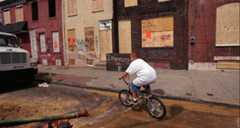
(Creative Commons)
The latest Census Bureau figures on poverty in America, combined with the data on inequality released a week earlier, confirm a shocking new reality. While a sliver of top earners are doing better than they ever have before, for tens of millions of Americans, insecurity—and, for a distressing number, destitution—is the new norm.Popular
"swipe left below to view more authors"Swipe →The Republican Crack-Up Has Begun The Republican Crack-Up Has Begun
The Yale Professor Who E-mailed Epstein About a “Small Goodlooking Blonde” Student Is No Longer Teaching The Yale Professor Who E-mailed Epstein About a “Small Goodlooking Blonde” Student Is No Longer Teaching
Walking the Camino in the Shadow of Belief Walking the Camino in the Shadow of Belief
What Peter Thiel Saw in Jeffrey Epstein What Peter Thiel Saw in Jeffrey Epstein

