Movatterモバイル変換
[0]ホーム
See you in the Funny Pages..
The early known comic has recently become an exciting, brand new field of research in thecomic industry. Up until as recent as a years ago it was generally believed that the first comicbook was a reprint collection of the first comic strip, best known as theYellow Kid.
There have been recent discoveries proving that comic books were around long before theYellow Kid. This new age of comics is being called the "Victorian Age" for now.
With this webpage I'm trying to stick to comic books rather than single panel drawings or comicstrips in newspapers. Those things I may expand to after I'm somewhat satisfied I have the comicbook history nailed down.
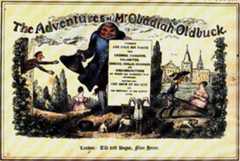
Today the earliest known comic book is calledThe Adventures of Obadiah Oldbuck. Originally published in several languages inEurope in 1837, among them an English version designed for Britain in 1941. A year later it wasthat version reprinted in New York on Sept. 14, 1842 for Americans, making it the first comic book printed in America.Odadiah Oldbuck is 40 pages long and measured 8 ½" x 11". The book was side stitched, and inside there were 6 to 12 panels per page. No word balloons, but there is text under the panels to describe the story. A copy of it was discovered in Oakland, California in 1998.
The comic was done by Switzerland's Rudolphe Töpffer, who has been considered in Europe(and starting to become here in America) as the creator of the picture story. He created the comicstrip in 1827 and the comic book/graphic novel. Rudolphe Töpffer created several (7 is known)graphic novels that were extremely successful and reprinted in many different languages, severalof them had English versions in America in 1846. The books remained in print in America until1877. There are an unknown amount of Victorian Age Comic Books, this era of comic bookhistory is still being discovered, researched and recorded. When more information is available I'llbe writing about this as well.
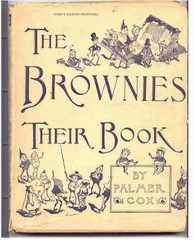 An influential illustrated book to come out in this periodwas called The Brownies: Their Book.The Browniesfeature wasn't really a comic book per say. They were created by Palmer Cox and originally part of a children'smagazine called St. Nicholas. The Brownies first appeared in the magazine in 1883 in a story called TheBrownies' Ride.The Brownies were heavily merchandised and one of the products they put out wasbook featuring their illustrations with a text story beside the pictures.The Brownies: Their Book was firstpublished in 1887 and several other books involving the same characters followed afterwards. It is likely to be thefirst North American Comic to be internationally successful.
Besides St. Nicholas, there were other magazines usingpicture stories of sorts and they were getting popular.Among the magazines wereHarper's, Puck, Judge, Life andTruth. Newspapers began torecognize their growing popularity and added a Sunday Comics feature to cash in. Thenewspapers couldn't get the popular artists and their characters because the Magazines alreadyhad them signed up. But a Puck staff member, Roy L. McCardell told Morrill Goddard, theSunday editor of The New York World (then largest newspaper) that he knew someone whocould provide something.
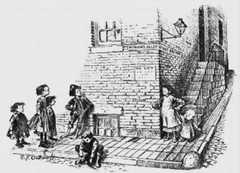
That someone was RichardF. Outcault. He did a picture of street children in the June 2nd, 1894 edition ofTruth. You can see theYellow Kid (without yellow) is in the picture atthe bottom right and plays a minor role. The captionunderneath it would read:
Feudal Pride in Hogan's Alley
Afterwards, Outcault would do four more for theTruth magazine the last one was is a homage toPalmer Cox'sThe Brownies. Originally published on the 9th of February 1895, titledFourthWard Brownies. It was reprinted in the newspapers shortly afterwards.
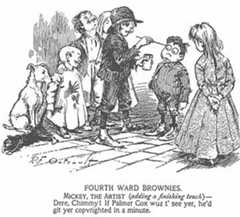 Outcault would come to thenewspaper and createHogan's Alley, best known for it's unnamed staring character, whom New Yorkersdubbed, theYellow Kid. It is believed that Outcault got his inspiration from a number ofdifferent sources. Among them were the cartoons of Michael Angelo Woolf and Charles W. Saalburgcartoons that used street kids. The titleHogan's Alley could have come from the song "O'Reilly and the FourHundred" which stats off singing "Down in Hogan's Alley."
The Platinum Age 1897 - 1938
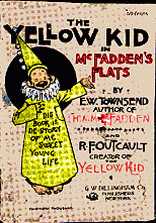 Early 1897 a book calledThe Yellow Kid in McFadden's Flats cameout. The comic was 196 pages long, square bound, black and white, 50cents and 5 ½" x 7 ½". It was published by G. W. DillinghamCompany with permission from Hearst, the newspaper that hadHogan's Alley at the time. It was a part of a series that Dillingham didon American Authors, only he took special liberties with this one andcreated what is today known as a comic book. In fact this comic thatcoined the phrase "Comic Book" as it's written on the back cover.Inside we get an origin of sorts as it reprints the earliestYellow Kid'sappearances. There is some text within by E. W. Townsend explainingOutcault and the Kid. This comic book starts what is now called thePlatinum Age of Comics.
In 1899 aFunny Folks comic book came out, taking a close first stab at a format for manyPlatinum Age comic books. The book was hardcover, 16 ½" wide by 12" tall.Funny Folks wascreated by F. M. Howarth, but published by E. P. Dutton. It was a black and white collection ofreprints from thePuck magazine.
In 1901The Blackberries came out and is the first known full color comic book. It used a formatof 9" x 12" and was a hardcover book.
Then the most often used format of 17" wide x 11 tall" began being used by a number of comicbooks. Among themThe Katzenjammer Kids,Little Nemo andHappy Hooligan. After theYellow Kid, Outcault would create many other strips and characters. One of them also ended upin comic book form. That wasBuster Brown, published in 1902 by Cupples & Leon. Thanks tothe merchandising success ofBuster Brown, many companies madeBuster Brown comics aspremiums to sell their stuff. Most of these comics were full color, but with only reprinted Sundaycomics on one side of the page. They were large volumes and were priced at 50 cents. Thisformat lasted over a decade.
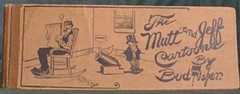
In 1910Mutt & Jeff created anew format, reprinting daily strips in black and white. The book was still a hardcover, butwas 15" wide x 5" tall. It was published by Ball and they did 5 volumes of Mutt & Jeffbooks.
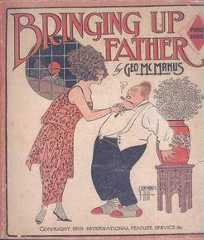 Then in 1919, Publisher Cupples & Leon used adifferent format. They were 10" by 10" with 4 panelsper page, each page. They were black and white, 52pages for 25 cents. Titles and characters used for thesebooks wasMutt & Jeff andBringing up Father.
In 1922 the first monthly comic book came out. It was cover dated January and had a price of 10cents. They were done in 8 ½ by 9 format. The title wasComics Monthlyand lasted 12 issues.Each issue was devoted to a popular comic strip character that was syndicated by King Features.Issue #1 and #12 was Polly and her Pals. #2 wasMike & Ike by Rube Goldberg. #3 -S'MatterPop?#4 -Barney Google. #5 - Tillie the Toiler. #6 -Indoor Sports. #7 - Little Jimmy. #8Toots and Casper. #9 & 10-Foolish Questions. #11Barney GoogleandSpark Plug. Thesewere all reprints of 1921 daily black and white strips.
In 1926Little Orphan Annie andSmitty comics came out in a 7 by 9 format, published byCupples and Leon. They were printed in both softcover and Hardcover with dust jackets. Theywere very popular with a 60 cents price.
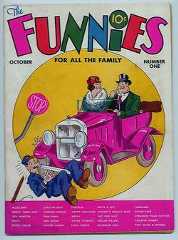 In 1929 Dell Publishing took a crack at a regular ComicBook. The comic was calledThe Funnies and was done in a big tabloid-sized format. They were 16 pages andsold for 10 cents. It was distributed by the newsstands along with newspapers. UnlikeComic Monthly, thisbook was done 4 colours and had original comic strips instead of reprints. A new issue came out everySaturday, but it lost money. Issues #3 to #21 were 30 cents each. The price changed to 5 cents with issue #22and lasted the final issue with #36.
Walt Disney got into comic books too. The earliest of these wasMickey Mouse Book. Donein1930 - 31, published by Bibo & Lang. These were 9"x12",20 pages long and stapled together.Despite the title of "book" this was in fact a magazine, inside it had a variety of songs, games andstories. There were later printings of this book but some lyrics were edited, advertising wasinserted and christmas card was a part of the front cover.
The Adventures of Mickey Mouse is considered to be the first "true"Mickey Mouse comic book.It came out in 1931, is 32 pages long and 5 -1/2" x 8 1/2". It was published by David McKay Co.with a print run of 50,000 copies. There were both hardcover and softcover versions of this book.A second book came out after theMickey Mouse cartoons and the characters within were madesimilar to the cartoons.
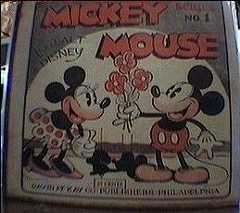 Mickey Mouse Comic #1 also came out in 1931. Itreprints theMickey Mouse comic strips done byFloyd Gottfredson from 1930 to 1931.It measures10"x 9 3/4"is 52 pages long with a cardboard cover.The series lasted 4 issues with later reprintings. It wasalso published by David McKay Co.
There were two differentMickey Mouse Magazines done in 1933. The first in January publishedby Kamen-Blair. It was distributed by daries and local theaters. It lasted until issue #9, the firstfew issues had a 5 cent cover price, the later ones did not. The second was also give aways donethrough different Dairie companies.It had two volumes, the both going 12 issues. Bothmagazines were done by Walt Disney Productionsand they ended in 1935.In the summer of thesame year A newMickey Mouse Magazine was done by publisher K. K. Publishing AKAWestern Publishing Co.. Like the previous incarnation, this magazine would run 12 issues, thenrestart back at #1 with another volume. This continued for 5 years, with #12 volume 4 convertedto a more traditional comic book format. It turned 68 pages and shrank to normal comic booksize.It then went under a title change toWalt DisneyComics & Stories. I'll discuss that when weget to that point and time.
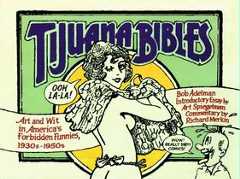 Not all comics were squeaky clean and sold on newsstands. From about the 1930's to the 1950's small dirty comics were sold through undergroundmeans. These were called Tijuana Bibles, despite the name they were made in America. While muchof their origins or artists are not known it's believed they were made by members of organizedcrime. This is partialy because the bibles were illegally using trademarked characters. Wellknown comic strips, movies stars, sport celeberties and more had their likeness used to tell dirtystories with. The book shown here is a collection of Tijuana Bibles. If you are over 18 and you want to see examples of some Tijuana bibles, clickhere andhere.
In 1933,Detective Dan, Secret Op. 48 was the first comic, sold on the newsstands, with originalmaterial in it. Done by Norman Marsh this comic had a 3 color, cardboard cover. Inside wasblack and white. Sold for 10cents, dimensions were 10x13". It had 36 pages and was only a oneshot published by Humor Publishers Corp., TheDetective Dan character was aDick Tracyclone, and didn't last very long. There was some other appearances by him though. One in TheAdventures of Detective Ace King. Also done in 1933. There are some minor differencesbetween the two books, among them a paper cover and pages 9 1/2 x12".
Free Comics became popular in the early 1930's. This was mainly because of the depression anddeflation. It also kept the publishing presses running during very hard times. Shutting down andstarting up the printing presses cost time and money and the presses did everything they could tokeep them going. Thousands of different comics were given away as companies used popularcomic strips for advertising purposes. The pioneers of this trend is given to Sam Gold and KayKamen. Among the most well known giveaways are Kelloggs Buck Rogers and Ovaltine's LittleOrphan Annie.
Eastern Color Printing Company was one company that became very important in formation ofcomic industry. They had a 45 year old sales manager named Harry I. Wildenberg, among hisduties were to come up with ideas to keep the color presses going. In 1932 he noticed the colorcomic strips sections of newspapers were popular and thought they would be good foradvertising.
He suggested the idea of a comic book used for advertising to Gulf Oil Company, one of hisclients. They liked the idea and hired a few artists to createGulf Comic Weekly among themwere Stan Schendel who didThe Uncovered Wagon, Victor (last name unknown) didCurlyand the Kids and Svess (last name unknown) doingSmileage. These were one full page, fullcolor comic pictures. The entire comic was 4 pages long and had a format of 10 ½ by 15. Thecomic was given away at Gulf Gas Stations making them probably the first comic bookpublished and distributed outside of the newspaper market. The comic was advertised on radio(telling people to go to Gulf Gas stations to get them) on April 30th 1933.
Much to everybodys surprise, the comics proved an very effective draw to the gas stations.People were quickly coming in and snatching them all up.Gulf decided to print out 3 millioncopies a week had the name changed toComics Funnies Weekly. The series remained in tabloidsized and lasted 422 issues, ending on May 23, 1941.
A few weeks after coming up with the tabloid sized comic book, Wildenberg came up with theidea of doing a comic book. He said he got it when reading a tabloid sized comic strip page,folded it in half, then in half again. He noticed it was a convenient size for reading comics. Healso thought publishing it with 32 or 64 pages would be a good size.
Wildenberg wasn't the first to use this format though. From 1880's to 1910's the size was popularfor reprinted comic pages. Pulp Dime Novels were already using that size and the LedgerSyndicate was also using 7 by 9 format for their Sunday newspaper comic strip inserts.
Convinced his idea would be popular Wildenberg secured the rights from many major Syndicatesfor to reprint their various comic strips. Among them, Associated, Bell, Fisher, McNaught andPublic Ledger Syndicate. He had an artist make up a few hand make comics for demonstrationpurposes and then has his sales staff go around to all of Eastern Color's biggest advertisers. Thefirst to respond (by telegram) was Procter and Gamble, asking for a million 32 page color comicbook.
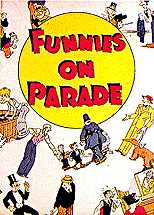 The comic published in the spring of 1933, was calledFunnies onParade. Most remarkable about was it set a format standard, using thesame 8" x 11" format that comic books are printed in today. All 1million copies were given away in a few weeks. The comic came withcoupons for Proctor & Gamble products.
Doing the grunt work of publishing the comic went to Wildenbergssales staff. Most of them were infected by the comic publishing bugafter this issue and went on to continue with comics afterwards. Thesales staff included Max Gaines (partnered with DC to create AllAmerican Comics imprint and started EC), Lev Gleason (became apublisher himself best known for starting the crime comics genre withCrime Does Not Pay) and Harold Moore. Also working on the projectwas Sol Harrison was the colour seperator (became DC Comics President - retired in 1980),George Dougherty Sr. was the printer (created a lived George Dougherty Co. comics company).Morris Margolis was from Charlton Publications, and was asked to help them figure out how toprint the pages in order.
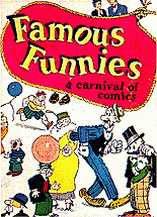 Famous Funnies: a Carnival of Comics was the second comic bookdone by the Eastern Color group. Printed in 1933, it was 64 pages witha 10 cent price. It was the first retail comic that was distributed to thepublic as it was given away only through chain department stores.Eastern Color Printing worked together on creating it and got GeorgeDelacorte of Dell Publishing to publish the book. After the first issue,Dell Publishing (not seeing any profit) decided to stop publishing thecomic.
M.C. Gaines sought to convince his boss Wildenberg that they couldmake money selling these comics on the newsstand. Wildenberg had ahard time believing that anyone would pay for a comic book. To provehis point , Gaines took a few of issues around, put 10 cent stickers onthem and went to local newsstands over the weekend. He told the newsstands what he wastesting to see if these could sell and that he'd be back Monday to see how they were doing.Monday came around and to his surprise, they had all sold out and the newsstands were askingfor more.
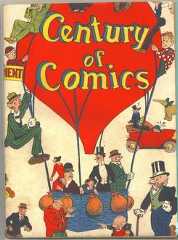 Other freebie comics done were the 100 pageCentury ofComics andSkippy's Own Book of Comics.Skippy wasa very popular comic character and was the first toreceive his own "new" comic dedicated comic series.Each of these had a print run of a half a million. Fromthere Wildenberg was really interested in publishing a"higher level" of a comic book with reprints of famouscomic strips, sold for 10 cents. He tried to get manycompanies to hop on but none would. Among those toturn him down were Oscar Fitz-Alan Douglas known asthe brains of Woolsworth department store. After muchdeliberation he decided a 10 cents wasn't worth a comicbook. Many other stores to turn them down, as didParents Magazine. The just couldn't see anyone paying10 cents for old comics they already read from thenewspapers. They Syndicates didn't see it selling either,they remembered bothComics Monthly andTheFunnies trying and failing at selling comic books.
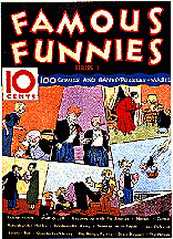 Finally Eastern Color owner George Janosik stepped in and askedGeorge Delacourt of Dell Publishing to form a 50/50 partnership ina 10 cent comic magazine for the newsstand. He agreed but the twowere stopped cold by the distributor American News Distributionrefused as they remembered Dell'sThe Funnies failure from a fewyears before. The two then decided to go to the retail chains storesagain and got some of them to sell the comics at 10 cents each.Famous Funnies (know called Series One because of duplicatenames) used material previously reprinted from the firstFamousFunnies andCentury of Comics. It was 64 pages, had a print run of400,000 and they all sold out within 30 days. Not one singlereturned. Eastern wanted to go back for a second print run but Dellwouldn't agree. Apparently advertisers felt using comic books wasbeneath them. Still the sold out print run made the two companies $2,000.
Harold Moore an employee under Wildenberg was on a train reading an article about asuccessful New York newspaper that said their Comics Section was responsible for much oftheir success. Moore then went back to American News president Harry Gold with thenewspaper article. He finally agreed to distribute a monthly comic magazine with a print run of250,000.
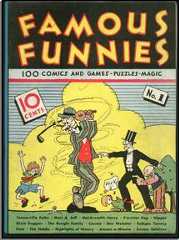 In May 1934 (the comic was dated July), another first issueofFamous Funnies appeared on the newsstands. It featuredfour pages each of several newspaper comic characters. Itwas 64 pages long but kept the 10 cent price tag. It had a90% sell though but still lost $4,150.60. A second issue cameout in July (cover dated September) and was monthly afterthat. With the second issue the magazine hired people at 5dollars a page to create original material for them.Meanwhile it costed the magazine 10 dollars a page forSyndicated reprints. The comic was edited by Steven O.Douglass but Moore got the credit in the first issue. Fromissue #3 and on Buck Rogers took the center stage andbecame the comics feature character. By 7th issue, finally aprofit emerged as the group made $2,664.25, but it must havebeen too little, too late as Dell Publishing got cold feat andsold their 50% to Eastern Color. Still, every issue had highersales, and by a years time sales were up to almost a millionper month. How the 10 cents per issue got divided among the parties bounced around as theseries progressed. At first Eastern would see 6 of the 10 cents, later it was 6 ½. The rest was splitbetween Newsstand and Distributor with the newsstand taking 2 then 2 ½ cents and AmericanNews took 1 then 1 ½ cents. Eastern proudly made public the amount of money they weremaking off the comics, as a way of saying "I told you so" to the many people rejected the idea atfirst. They were making $30,000 per issue. They also did this to drum up more business, either asa publisher or printer. By the time a year had gone by Funnies had gained some respect and wasplaced on newsstands beside slick magazines likeAtlantic Monthly and Harper's. They also had5 competitors putting out monthly magazines. This comic series would last 218 issues ending in 1955.
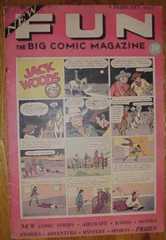 In 1934, with a cover date of February 1935,New Fun Comics came out. The creator, Major Malcolm Wheeler-Nicholson decided that hedidn't want to pay the fees that the newspapers were charging for their old comic strip reprints.So he got new comic material that wasn't being published in the newspapers. National AlliedPublications Inc. publishedNew Fun Comics in a much bigger 10" x 15" tabloid size. Whichwas closer to what the news paper comic section was. The cover was full color and wasmade out of stiff cardboard. Inside about half the book had color in it, but each strip wasusually allowed one color only. It is also said that this title is the first to have advertisementsinside, while selling on the newsstands. The strips inside were done by a mix of cartoonistveterans struggling during the depression or young cartoonists trying to break in. In fact,some of the new comic material was made by Wheeler-Nicholson himself. Some artistsalready had completed strips that the syndicates wouldn't take, and they were able to get somemoney for them by printing them here. Many were knock offs of popular newspaper strips.Out of all the strips only two had any lasting effect, those wereWing Brady andBarry O'Neill.The series would last 6 issues before the name would change toMore Fun Comics, with issue #9the format would change to a normal comic book size. Of those contributing strips to the issuewould be Walt Kelly and Al Capp who later go on to have great success in the comic strip field.With the help of superheroes, this title would last 127 issues getting cancelled in November1947. There was a brief time after issue #12 the book would start at #1 again with a volume 2.This last for 5 issues and then switched back to volume 1 returning with the original numberingwith issue 18.
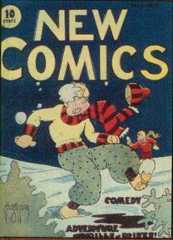 AfterNew Fun Comics, another Major MalcolmWheeler-Nicholson published another title. This wasNewComics (December, 1935) and again it featured all newmaterial. Among the artists who's work featured in here wasWalt Kelly, Sheldon Mayer and Vincent Sullivan, all threewould be important to the development of comics. The titlewould go through many name changes, turning intoNewAdventure Comics with issue #12, then to simplyAdventureComics with issue #32. LikeNew Fun, the title went through aperiod of volume 2 with new numbering starting withNewAdventure Comics #1, thenNew Adventure Vol 3 #1 andstopping with Vol. 3 #2, before returning to #22 continuing it'soriginal numbering run. This title with the help of manysuperhero features would last until 1983, ending with issue#503.
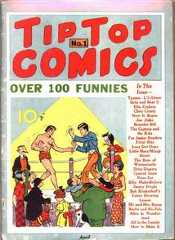 Lev Gleason would also get a comic strip Syndicate behindhim and become the editor ofTip Top Comics #1 with allUnited Features syndicated comic strips. Under theirumbrella wasTarzan,Li'l Abner,Broncho Bill,Captainand the Kids and other popular strips. EventuallyPeanutsappeared in this series as well. This title also gave us the firstpublished work of Harvey Kurtzman and Jack Davis, bothwould go on to make EC Comics very popular and successful. The series would also end up becoming one of thefirst comic book Trade Paper Back, with bound reprints of a number of issue being up for sale at the 1939 Worlds Fair.First set had issues 1-12, second 13-24, the third 25-36. This title would be published by both St. John Publishing and laterDell Publishing, stretching out and last 225 issues ending in 1961.
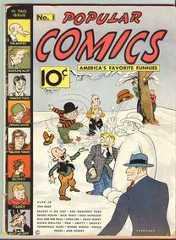 In February 1936 Chicago Tribune Syndicate teamed up withMax Gaines, his assistant Sheldon Mayer and George Delacorte (his third try at comic books) and createdPopularComicsfeaturing a huge amount of well known characters. Among them,Dick Tracy,Terry & the Pirates,GasolineAlley,Skippy,Mutt and Jeff,Tailspin Tommy,LittleOrphan Annie and many more. The third and final try atcomics would be what Delacourte needed to become a successful publisher, in fact Dell Publishing Co. would be oneof the most successful comic publishers of all time. This titlewould last 145 issues and end in 1948.
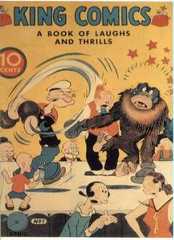 In April of 1936, another major comic strip syndicate wouldjump in the comic book business. King Features createdKing Comics. David McKay was a publisher who had donesome comic books through King Features, and he had the jobof doing this one with the editor Ruth Plumly Thompson. InitFlash Gordon,Popeye,Mandrake the Magician wouldbe among the popular strips to make their appearance in thefirst issue. Later onThe Lone Ranger,The Phantom,Prince Valiant,Blondieand Little Lulu would be amongthe other popular strips to appear in the title. The comicwould last 159 issues and end in 1952. Out of it wouldspring Standard Publishing a comic book company withmany different titles.
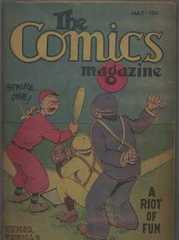 A month later two men named William Cook and JohnMahon publishedThe Comics Magazine #1. Cook andMahon were former disgruntled employees of NationalAllied Publications, owned by Major Malcolm Wheeler-Nicholson - the company that gets later renamed toDC Comics. Cook and Mahon would go on to form a publishing company called Comics Magazine Co. but thetitle changed and so did the ownership. Eventually it wouldbe called Centaur Comics.The Comics Magazine #1 wouldfeature a character and two creators that go on to becomefamous. Mr. Mystic was created and done by Siegel andShuster, the two would go on to createSuperman.Mr.Mystic was not in a costume in this issue, but the weirdthing was the character would later appear in DC ComicsMore Fun #14, with the story (called "The Koth and theSeven") continuing on from one publishers book to the next.Another Siegel and Shuster character to appear in this title wasFederal Agent, later renamedFederal Men when they also appeared in DC Comics.The Comics Magazine would change it'sname toFunny Pages with issue #6. The series would feature a character namedThe Clock,who was the first masked hero in comics. The title would last until 1940 ending with issue #42.
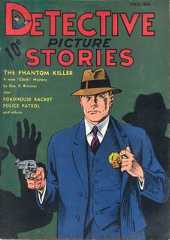 By the end of the year, Centuar Publications would be the first to publish titles devoted to asingle theme. They wereDetective Picture Stories,Western Picture Stories, and Funny PictureStories. Despite the title, Funny was about Adventure type stories. Detective Picture Storieswould last 5 issues and they would include some work by creators who later become famous likeWil Eisner and Bob Kane. The title may have continued on with another name but the specificsare not known.Funny Picture Stories lasted almost as long, but they did 3 volumes, resetting thenumbers back to #1 each time. The 1st went 9 issues, the 2nd went 11 issues (#6 being the firstwith the Centuar Comics name on it) and the 3rd lasted 3 issues before the title gets renamed toComic Pages from #4 and up. This series also had work from people who later become famous,among them Charles Biro and Bob Wood best known for Crime Does Not Pay comic, and FredGuardineer who did a lot of work for DC Comics. Lastly,Western Picture Stories lasted 4 issues.All with Wil Eisner work in them.
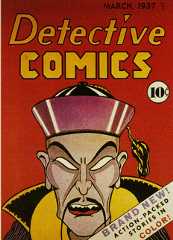 In March 1937,Detective Comics #1 came out. Thiscomic was the first true DC comic book. This issue wasthe first production of two companies that formed the DCcompany. Comic producer Major Malcolm Wheeler wasn'tmaking much money with his comic books (New Funbeing one of them) and owed money to his printer and justabout everybody else. Wheeler was forced to collaboratedwith his printer/distributor Harry Donenfeld to producethis book. Most of the stories in this issue are racisttowards Chineese people and they are the villains in themajority of the tales. One such story titled "Claws of theRed Dragon" writen by Major Malcolm Wheeler. Anotherstory of note in here is called Slam Bradley done by JerrySiegel and Joe Shuster. The character looks very similar toanother they created. That being Superman. From theopening splash page to the different layouts to the toughguy hero saves the girls it's easy to see how there stylepaved the way for the typical comic hero story.
By 1938, Donenfeld, bought out Wheeler's other books to become the sole owner. He then tookon a friend/accountant in his distribution business, Jack Liebowitz as a partner. The companywas renamed National Periodical Publications. Liebowitz stayed at the offices and headed theaccounting and creative part of DC, while Donnenfeld handled and expanded the distributionthough his company Independent News Co.. Donnenfeld remained president of DC until hisdeath in 1965. Liebowitz remained in DC until 1970 and later moved to the Board of Directorsof the Warner Brothers company. He died in 2000. Detective Comics is the DC's longest runningcomic book title, this is due to another character who took over the about 2 years later.
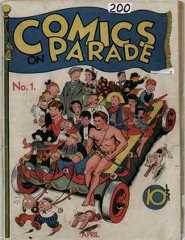 Comics On Parade #1 by United Feature Syndicate. April1938, goes to #104 1955. First issue featuredTarzan byHal Foster,Captain and the Kids,Little Mary Mixup,Abbie & Slats,Ella Cinders, Broncho Bill, andLi'lAbner.
A few months later a new comic would come out that change the comic industry forever. Upuntil now, most comics were made for adult readers. This new comic showed that you can makea lot more money by marketing comics to kids.
Read the next section
[8]ページ先頭