


The Buddhist Compassion Relief Tzu Chi Foundation yesterday announced that it would retract its proposed development plan to set up a logistics center and workshops for disaster relief in a geologically sensitive protected area in Taipei’s Neihu District (內湖), while saying that it would make public all records about donations by its followers and how the money is spent.
Tzu Chi deputy chief executive Wang Tuan-cheng (王端正) told a news conference in Hualien that the foundation is “deeply unnerved” by the controversy sparked by the development plan and would retract its proposal to rezone a 4.4 hectare plot until society could reach a consensus on the issue.
Environmentalists say that the proposed site is located on a former pond which the foundation illegally reclaimed, increasing the chances of flooding in nearby farmland.
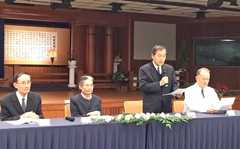
Photo: CNA
In addition, potential dip slopes are present in the area, which could lead to landslides, they say.
To promote environmental protection, Tzu Chi would cooperate with the Taipei City Government and seek advice on how to care for the protected area, Wang said.
Furthermore, Tzu Chi would restructure itself by inviting reputable individuals to serve as members of its board of directors to monitor and improve the foundation’s operations, he said.
Foundation deputy chief executive Lin Pi-yu (林碧玉) said Tzu Chi would make information about donations available online from Friday, while expenditure would be made public starting from Wednesday next week.
Lin made the announcement after media personalities Clara Chou (周玉蔻) and Jimmy Wang (汪潔民) last week accused Tzu Chi of pocketing donations, including a NT$1.5 billion (US$47.1 million) sum from its emergency reserve to purchase real estate.
Stock analyst Huang Shih-tsung (黃世聰) alleged that the foundation misappropriated funds it acquired for disaster relief to purchase bonds and stock.
Environmental activists criticized Tzu Chi’s announcement.
Treasure Our Land, Taiwan secretary-general Lin Tzu-lin (林子淩) said Tzu Chi is trying to buy time to gather the opinions of those who are in favor of the project and that it still intends to develop the protected area.
“What is the point in vowing to publish its accounts when there is so much confusion about its past dealings? Besides, it failed to respond to accusations it bought stock using donations,” Lin said.
In a press release, Taipei Deputy Mayor Charles Lin (林欽榮) expressed his thanks to Tzu Chi for proactively resolving years of controversy surrounding the development proposal.
He said the city government would send the withdrawal documents to the Taipei Urban Planning Commission as soon as they were received, expressing his hope that the land could become part of a gradual restoration of the ecology of Dahu (大湖).
Additional reporting by Abraham Gerber
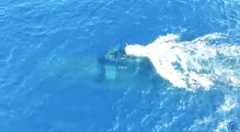
CSBC Corp, Taiwan (台灣國際造船) yesterday released the first video documenting the submerged sea trials of Taiwan’s indigenous defense submarine prototype, the Hai Kun (海鯤), or Narwhal, showing underwater navigation and the launch of countermeasures.The footage shows the vessel’s first dive, steering and control system tests, and the raising and lowering of the periscope and antenna masts.It offered a rare look at the progress in the submarine’s sea acceptance tests.The Hai Kun carried out its first shallow-water diving trial late last month and has since completed four submerged tests, CSBC said.The newly released video compiles images recorded from Jan. 29 to
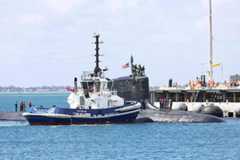
Washington and partners hope demonstrations of force would convince Beijing that military action against Taiwan would carry high costs The US is considering using HMAS Stirling in Western Australia as a forward base to strengthen its naval posture in a potential conflict with China, particularly over Taiwan, the Wall Street Journal reported on Saturday. As part of its Indo-Pacific strategy, Washington plans to deploy up to four nuclear-powered submarines at Stirling starting in 2027, providing a base near potential hot spots such as Taiwan and the South China Sea. The move also aims to enhance military integration with Pacific allies under the Australia-UK-US trilateral security partnership, the report said. Currently, US submarines operate from Guam, but the island could
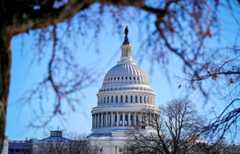
Should China’s actions pose any threat to Taiwan’s security, economic or social systems, China would be excluded from major financial institutions, the bill says The US House of Representatives on Monday passed the PROTECT Taiwan Act, which states that Washington would exclude China from participating in major global financial organizations if its actions directly threaten Taiwan’s security.The bill, proposed by Republican Representative Frank Lucas, passed with 395 votes in favor and two against.It stipulates that if China’s actions pose any threat to Taiwan’s security, economic or social systems, the US would, “to the maximum extent practicable,” exclude Beijing from international financial institutions, including the G20, the Bank for International Settlements and the Financial Stability Board.The bill makes it clear that China must be prepared

Taiwanese trade negotiators told Washington that Taipei would not relocate 40 percent of its semiconductor production to the US, and that its most advanced technologies would remain in the nation, Vice Premier Cheng Li-chiun (鄭麗君) said on Sunday.“I told the US side very clearly — that’s impossible,” Cheng, who led the negotiation team, said in an interview that aired on Sunday night on Chinese Television System. Cheng was referring to remarks last month by US Secretary of Commerce Howard Lutnick, in which he said his goal was to bring 40 percent of Taiwan’s chip supply chain to the USTaiwan’s almost


 RSS
RSS