


Taiwan would be pleased if the US has indeed agreed to help upgrade its fleet of F-16A/B aircraft and plans to move toward selling it the even more sophisticated F-35 model at some point, Deputy Minister of National Defense Andrew Yang (楊念祖) said in Richmond, Virginia, on Sunday.
“The retrofit of the F-16A/B fleet is part of Taiwan’s national defense policy. It would be great if the US approves the deal,” Yang said on the sidelines of this year’s US-Taiwan Defense Industry Conference, to which he led a Taiwanese delegation.
The administration of US President Barack Obama has reportedly decided to sell Taiwan a US$4.2 billion arms package that would include an upgrade to Taiwan’s F-16A/B fleet, but not the more advanced F-16C/Ds Taipei is eager to acquire.
Two US congressional aides told reporters that the US Department of State gave a briefing on Capitol Hill on its decision on Friday, but has yet to issue a formal notification of the intended sale. An announcement on the sale is expected by the end of this month.
Yang said Taiwan and the US have consistently addressed security issues in accordance with the Taiwan Relations Act.
“Arms procurements should follow the prescribed procedures,” Yang said, adding that the US decision to offer Taiwan the F-16A/B upgrade package might not necessarily imply it had rejected the F-16C/D deal.
Noting that the F-16A/B upgrade and the F-16C/D procurement are two separate matters, Yang said Taiwan had not received any -formal notification that the US had decided against the F-16C/D deal.
In Taipei, Minister of National Defense Kao Hua-chu (高華柱) yesterday also denied the US would not offer the F-16C/Ds as part of a new arms package, adding that he had not received any official information to that effect.
Kao said the deal had not yet been finalized and that Taiwan had not been notified.
The F-16A/B is a high-performance aircraft with all sorts of combat equipment and functions and the fleet would be able to perform even better after a mid-life upgrade, Yang said.
There were no immediate details on the package of upgrades the US is providing for the F-16A/Bs. However, even if it includes sophisticated radar, avionics and missile systems, Taiwan’s air force will still lag far behind its Chinese counterpart, defense analysts say.
A Pentagon report issued last year painted a grim picture of Taiwan’s air defense capabilities, saying many of its 400 combat aircraft would not be available to help withstand an attack from China.
Wang Kao-cheng (王高成), a military expert at Tamkang University, said Taiwan’s air defenses would get a lift from the upgrade, but that the country is still at a profound disadvantage compared with Beijing in the number of third-generation warplanes it has at its disposal.
“Taiwan has fallen behind in air superiority as of now, not to mention the fact that China is developing fourth-generation stealth fighters, which could be very powerful,” Wang said. “The upgrade program will not fill the vacuum left over by the absence of the F-16C/Ds.”
Asked whether a possible setback in the attempt to buy F-16C/Ds reflected a US change in its policy toward Taiwan following its increasing reliance on Beijing in recent years, Yang said he did not think the US would take sides.
The Taiwanese government remains confident of US neutrality in dealing with cross-strait issues, he said.
As to whether Taiwan would procure a next-generation aircraft such as the F-35, Yang said Taiwan would definitely move in that direction.
Any arms deal will be based on Taiwan’s defense needs and ultimate goals as well as Washington’s assessment of the overall situation, Yang said.
“For our part, we would not pass up any available options,” he said.
Yang is scheduled to meet US officials in Washington after the defense industry conference ends.
The China Daily yesterday warned on its front page that an arms sale would “spark strong reaction.”
The article quoted Tao Wenzhao (陶文昭), a senior researcher at Tsinghua University in Beijing, as saying “the [arms sale] hurts China’s core interests. And to keep on doing the wrong thing for 30 years just doesn’t make it right.”
In an editorial on Saturday, the Global Times warned that Beijing should not limit its focus on the US when threatening retaliation over arms sales to Taiwan, but Taipei as well.
“The mainland [China] should not sit idly by concerning this protection money paid by Taiwan. Instead, it should remind Taipei that such an investment will bring only disaster,” it said. “Beijing used to seek revenge on Washington after arms sales to Taiwan. This time, it should also include Taipei as Beijing has more leverage on the island.”
Beijing should notify Washington and Taipei in advance of the “fateful consequences” of a new arms sale, it said, adding that pressuring Taipei would produce better results than directly confronting Washington.
“In 1994, Turkey threatened Greek Cypriots that it would destroy any missiles imported from Greece and installed in areas controlled by Greek Cypriots. This worked well,” the editorial said. “The mainland has never taken such a stance against Taiwan for fear that it might be going too far. However, Beijing should no longer rule out such measures any more if it wants to prevent the island from overstepping the line.”
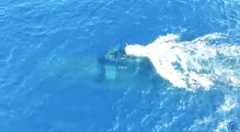
CSBC Corp, Taiwan (台灣國際造船) yesterday released the first video documenting the submerged sea trials of Taiwan’s indigenous defense submarine prototype, the Hai Kun (海鯤), or Narwhal, showing underwater navigation and the launch of countermeasures.The footage shows the vessel’s first dive, steering and control system tests, and the raising and lowering of the periscope and antenna masts.It offered a rare look at the progress in the submarine’s sea acceptance tests.The Hai Kun carried out its first shallow-water diving trial late last month and has since completed four submerged tests, CSBC said.The newly released video compiles images recorded from Jan. 29 to
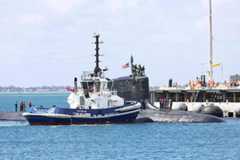
Washington and partners hope demonstrations of force would convince Beijing that military action against Taiwan would carry high costs The US is considering using HMAS Stirling in Western Australia as a forward base to strengthen its naval posture in a potential conflict with China, particularly over Taiwan, the Wall Street Journal reported on Saturday. As part of its Indo-Pacific strategy, Washington plans to deploy up to four nuclear-powered submarines at Stirling starting in 2027, providing a base near potential hot spots such as Taiwan and the South China Sea. The move also aims to enhance military integration with Pacific allies under the Australia-UK-US trilateral security partnership, the report said. Currently, US submarines operate from Guam, but the island could
Should China’s actions pose any threat to Taiwan’s security, economic or social systems, China would be excluded from major financial institutions, the bill says The US House of Representatives on Monday passed the PROTECT Taiwan Act, which states that Washington would exclude China from participating in major global financial organizations if its actions directly threaten Taiwan’s security.The bill, proposed by Republican Representative Frank Lucas, passed with 395 votes in favor and two against.It stipulates that if China’s actions pose any threat to Taiwan’s security, economic or social systems, the US would, “to the maximum extent practicable,” exclude Beijing from international financial institutions, including the G20, the Bank for International Settlements and the Financial Stability Board.The bill makes it clear that China must be prepared

Taiwanese trade negotiators told Washington that Taipei would not relocate 40 percent of its semiconductor production to the US, and that its most advanced technologies would remain in the nation, Vice Premier Cheng Li-chiun (鄭麗君) said on Sunday.“I told the US side very clearly — that’s impossible,” Cheng, who led the negotiation team, said in an interview that aired on Sunday night on Chinese Television System. Cheng was referring to remarks last month by US Secretary of Commerce Howard Lutnick, in which he said his goal was to bring 40 percent of Taiwan’s chip supply chain to the USTaiwan’s almost


 RSS
RSS