Movatterモバイル変換
[0]ホーム
Random Variables
Arandom variable, usually writtenX, is a variable whose possiblevalues are numerical outcomes of a random phenomenon. There are two types of random variables,discrete andcontinuous.Discrete Random Variables
Adiscrete random variable is one which may take on only a countable number of distinct values such as 0,1,2,3,4,........ Discrete random variables are usually (but not necessarily) counts. If a random variable can take only a finite number of distinct values, then it must be discrete. Examples of discrete random variables include the number of children in a family, the Friday night attendance at a cinema, the number of patients in a doctor's surgery, the number of defective light bulbs in a box of ten.Theprobability distribution of a discrete random variable is a list of probabilities associated with each of its possible values. It is also sometimes called the probability function or the probability mass function.
(Definitions taken from Valerie J. Easton and John H. McColl'sStatistics Glossary v1.1)
Suppose a random variableX may takek different values, with the probability thatX = xi defined to beP(X = xi) = pi. The probabilitiespi must satisfy the following:
- 1: 0< pi< 1 for each i
- 2: p1 + p2 + ... + pk = 1.
Example
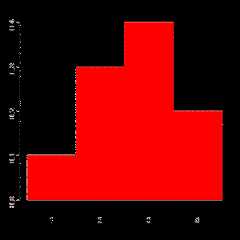 Suppose a variable X can take the values 1, 2, 3, or 4.
The probabilities associated with each outcome are described by thefollowing table:Outcome 1234Probability0.10.30.40.2
The probability thatX is equal to 2 or 3 is the sum of the twoprobabilities:P(X = 2 or X = 3) = P(X = 2) + P(X = 3) = 0.3 + 0.4 = 0.7. Similarly, the probability thatX is greater than 1 is equal to 1 -P(X = 1) = 1 - 0.1 = 0.9, by thecomplement rule. This distribution may also be described by theprobabilityhistogram shown to the right:
All random variables (discrete and continuous) have acumulative distribution function. It is a function giving the probability that the random variableX is less than or equal tox, for every valuex. For a discrete random variable, the cumulative distribution function is found by summing up the probabilities.(Definition taken from Valerie J. Easton and John H. McColl'sStatistics Glossary v1.1)
Example
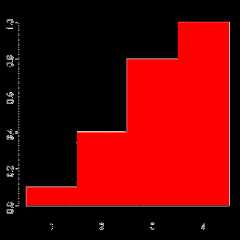 The cumulative distribution function for the above probability distribution is calculated as follows:
The probability that X is less than or equal to 1 is 0.1,
the probability that X is less than or equal to 2 is 0.1+0.3 = 0.4,
the probability that X is less than or equal to 3 is 0.1+0.3+0.4 = 0.8, and
the probability that X is less than or equal to 4 is 0.1+0.3+0.4+0.2 = 1.The probability histogram for the cumulative distribution of this random variable is shown to the right:
Continuous Random Variables
Acontinuous random variable is one which takes an infinite number of possible values. Continuous random variables are usually measurements. Examples include height, weight, the amount of sugar in an orange, the time required to run a mile.(Definition taken from Valerie J. Easton and John H. McColl'sStatistics Glossary v1.1)
A continuous random variable is not defined at specific values. Instead, it is defined over aninterval of values, and is represented by thearea under a curve (in advanced mathematics, this is known as anintegral). The probability of observing any single value is equal to 0, since the number of values which may be assumed by the random variable is infinite.
Suppose a random variableX may take all values over an interval ofreal numbers. Then the probability thatX is in the set of outcomesA, P(A), is defined to be the area aboveA andunder a curve. The curve, which represents a functionp(x), must satisfy the following:
- 1: The curve has no negative values (p(x)> 0 for all x)
- 2: The total area under the curve is equal to 1.
A curve meeting these requirements is known as adensity curve.
The Uniform Distribution
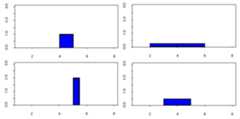
A random number generator acting over an interval of numbers(a,b) has a continuous distribution. Since any interval of numbers of equal widthhas an equal probability of being observed, the curve describing thedistribution is a rectangle, with constant height across the intervaland 0 height elsewhere. Since the area under the curve must be equal to 1,the length of the interval determines the height of the curve.The following graphs plot the density curves for random number generatorsover the intervals (4,5) (top left), (2,6) (top right), (5,5.5) (lower left),and (3,5) (lower right). The distributions corresponding to these curves areknown asuniform distributions.
Consider the uniform random variableX defined on the interval (2,6). Since the intervalhas width = 4, the curve has height = 0.25 over the interval and 0 elsewhere. The probabilitythatX is less than or equal to 5 is the area between 2 and 5, or (5-2)*0.25 = 0.75. The probability thatX is greater than 3 but less than 4 is the area between 3 and 4,(4-3)*0.25 = 0.25. To find that probability thatX is less than 3or greater than5, add the two probabilities:
P(X< 3 and X> 5) = P(X< 3) + P(X> 5) =(3-2)*0.25 +(6-5)*0.25 = 0.25 + 0.25 = 0.5.The uniform distribution is often used to simulate data. Suppose you would like to simulate datafor 10 rolls of a regular 6-sided die. Using the MINITAB "RAND" command with the "UNIF" subcommandgenerates 10 numbers in the interval (0,6):
MTB > RAND 10 c2;SUBC> unif 0 6.
Assign the discrete random variable X to the values 1, 2, 3, 4, 5, or 6 as follows:
if 0<X<1, X=1
if 1<X<2, X=2
if 2<X<3, X=3
if 3<X<4, X=4
if 4<X<5, X=5
if X>5, X=6.
Use the generated MINITAB data to assign X to a value for each roll of the die:Uniform DataX Value4.5378655.7747463.6951841.0392924.2383550.3709610.7527215.5656360.8904513.180864
Another type of continuous density curve is thenormal distribution.The area under the curve is not easy to calculate for a normal random variableX withmean and standard deviation
 . However, tables (and computer functions) are available for the standard random variableZ, which is computed fromX by subtracting and dividing by. All of the rules of probability apply to the normal distribution.
[8]ページ先頭