|
|
|
|
to distinguish thunderstorm-induced straight-line winds from the damaging, rotary winds of tornadoes. "Derecho" is a Spanish word meaning "right," "direct," or "straight ahead." (Click here to hear a pronunciation of the word "derecho"). In contrast, the word "tornado" is thought to have been derived from the Spanish word "tornar," which means "to turn." Because "derecho" is of Spanish origin, the plural form is spelled "derechos;" i.e., the letter "e" is not added after the letter "o."
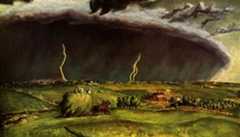
A defining excerpt from Hinrich's paper may be seen in thisfigure that shows a derecho crossing Iowa on July 31, 1877. "Derecho" was adopted to a limited extent by the meteorological community during the 1880s. However, the word disappeared from use for nearly a century until it was resurrected by NOAA National Severe Storms Forecast Center (predecessor of the Storm Prediction Center) meteorologists Robert Johns and William Hirt in a 1987paper that described derechos over the central and eastern United States.
Ray Wolf, of the Davenport, Iowa National Weather Service Forecast Office, created a web page about Gustavus Hinrichs. The page provides information on Hinrichs' background, and on his introduction of the term "derecho" in the late 1800s. Wolf's page also briefly discusses how the term "derecho" has come into more common use in recent years.
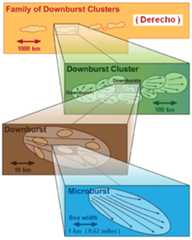
Modified from illustration by Dennis Cain
.

Modified from illustration by Dennis Cain

Modified from illustration by Dennis Cain

Modified from illustration by Dennis Cain
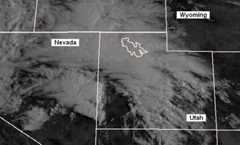
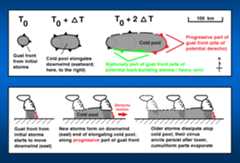
Illustration adapted fromCorfidi et al. (2016)
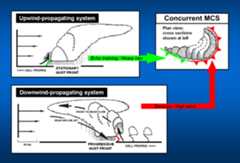
Illustration fromCorfidi (2003)

Illustration by Dennis Cain
The type of derecho most often encountered during the spring and fall is called aserial derecho. These are produced by multiple bow echoes embedded in an extensive squall line (typically many hundreds of miles long) that sweeps across a very large area, both wide and long. This type of derecho typically is associated with a strong, migratory low pressure system with strong low- to mid-tropospheric flow. An example of a serial derecho with a very extensive squall line and embedded smaller scale bow echoes is the one that affected Florida, Cuba, and adjacent parts of the Gulf of America, the Caribbean Sea, and the Atlantic Ocean during the early stages of the "Storm of the Century" onMarch 12-13, 1993.

Modified from illustration by Dennis Cain
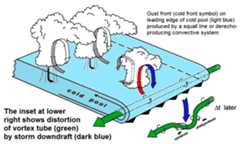
Modified fromWakimoto et al. (2006b)
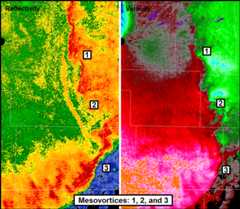
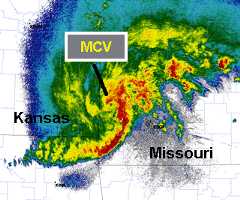

Illustration by Dennis Cain

Illustration by Dennis Cain
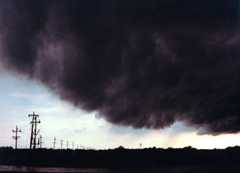
Photograph by Stephen Corfidi

Photograph by Douglas Berry
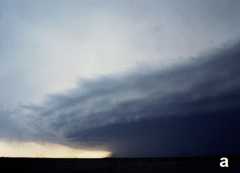 | 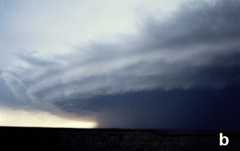   |