


Stephen Hawking: Humanity Must Colonize Space to Survive
When you purchase through links on our site, we may earn an affiliate commission.Here’s how it works.
Breaking space news, the latest updates on rocket launches, skywatching events and more!
You are now subscribed
Your newsletter sign-up was successful
Want to add more newsletters?
Delivered daily
Daily Newsletter
Breaking space news, the latest updates on rocket launches, skywatching events and more!
Once a month
Watch This Space
Sign up to our monthly entertainment newsletter to keep up with all our coverage of the latest sci-fi and space movies, tv shows, games and books.
Once a week
Night Sky This Week
Discover this week's must-see night sky events, moon phases, and stunning astrophotos. Sign up for our skywatching newsletter and explore the universe with us!

Twice a month
Strange New Words
Space.com's Sci-Fi Reader's Club. Read a sci-fi short story every month and join a virtual community of fellow science fiction fans!
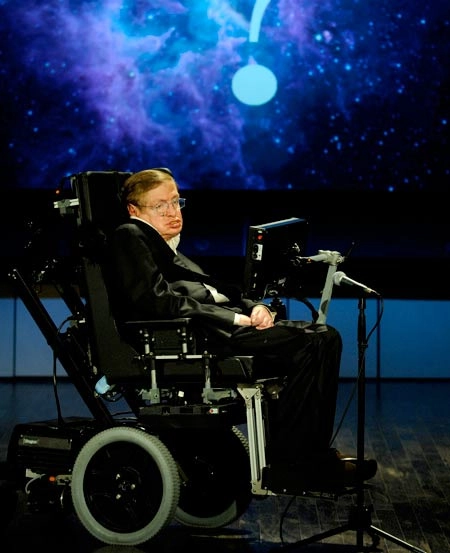
Famed British cosmologist Stephen Hawking sees only one way for humanity to survive the next millennium: colonize space. And he's probably right.
In a lecture Tuesday in Los Angles, the 71-year-oldStephen Hawking said humanity would likely not survive another 1,000 years "without escaping beyond our fragile planet,"according to the Associated Press. Hawking has long been an advocate of space exploration as a way to ensure humanity's survival. Living on a single planet leaves us at risk of self-annihilation through war or accidents, or a cosmic catastrophe like an asteroid strike.
Hawking's latest comments were made at Cedars-Sinai Medical Center after touring a stem cell laboratory that is studying how to combatLou Gehrig's disease. He's lived with the debilitating neurological disorder, also called amyotrophic lateral sclerosis, for 50 years and can only communicate via a computer attached to his wheelchair.


Email Tariq Malik at tmalik@space.com or follow him@tariqjmalik andGoogle+.Follow us@Spacedotcom,Facebook andGoogle+.
Breaking space news, the latest updates on rocket launches, skywatching events and more!

Tariq is the award-winning Editor-in-Chief ofSpace.com and joined the team in 2001. He covers human spaceflight, as well as skywatching and entertainment. He became Space.com's Editor-in-Chief in 2019. Before joining Space.com, Tariq was a staff reporter for The Los Angeles Times covering education and city beats in La Habra, Fullerton and Huntington Beach. He's a recipient of the2022 Harry Kolcum Award for excellence in space reporting and the2025 Space Pioneer Award from the National Space Society. He is an Eagle Scout and Space Camp alum with journalism degrees from the USC and NYU. You can find Tariq at Space.com and as the co-host to theThis Week In Space podcast on theTWiT network. To see his latest project, you can follow Tariq on Twitter@tariqjmalik.


