



Planet Labs Unveils Tiny Earth-Observation Satellite Family
When you purchase through links on our site, we may earn an affiliate commission.Here’s how it works.
Breaking space news, the latest updates on rocket launches, skywatching events and more!
You are now subscribed
Your newsletter sign-up was successful
Want to add more newsletters?
Delivered daily
Daily Newsletter
Breaking space news, the latest updates on rocket launches, skywatching events and more!
Once a month
Watch This Space
Sign up to our monthly entertainment newsletter to keep up with all our coverage of the latest sci-fi and space movies, tv shows, games and books.
Once a week
Night Sky This Week
Discover this week's must-see night sky events, moon phases, and stunning astrophotos. Sign up for our skywatching newsletter and explore the universe with us!

Twice a month
Strange New Words
Space.com's Sci-Fi Reader's Club. Read a sci-fi short story every month and join a virtual community of fellow science fiction fans!
The tiny satellites that could change the way humanity views and monitors its home planet are getting their first close-up.
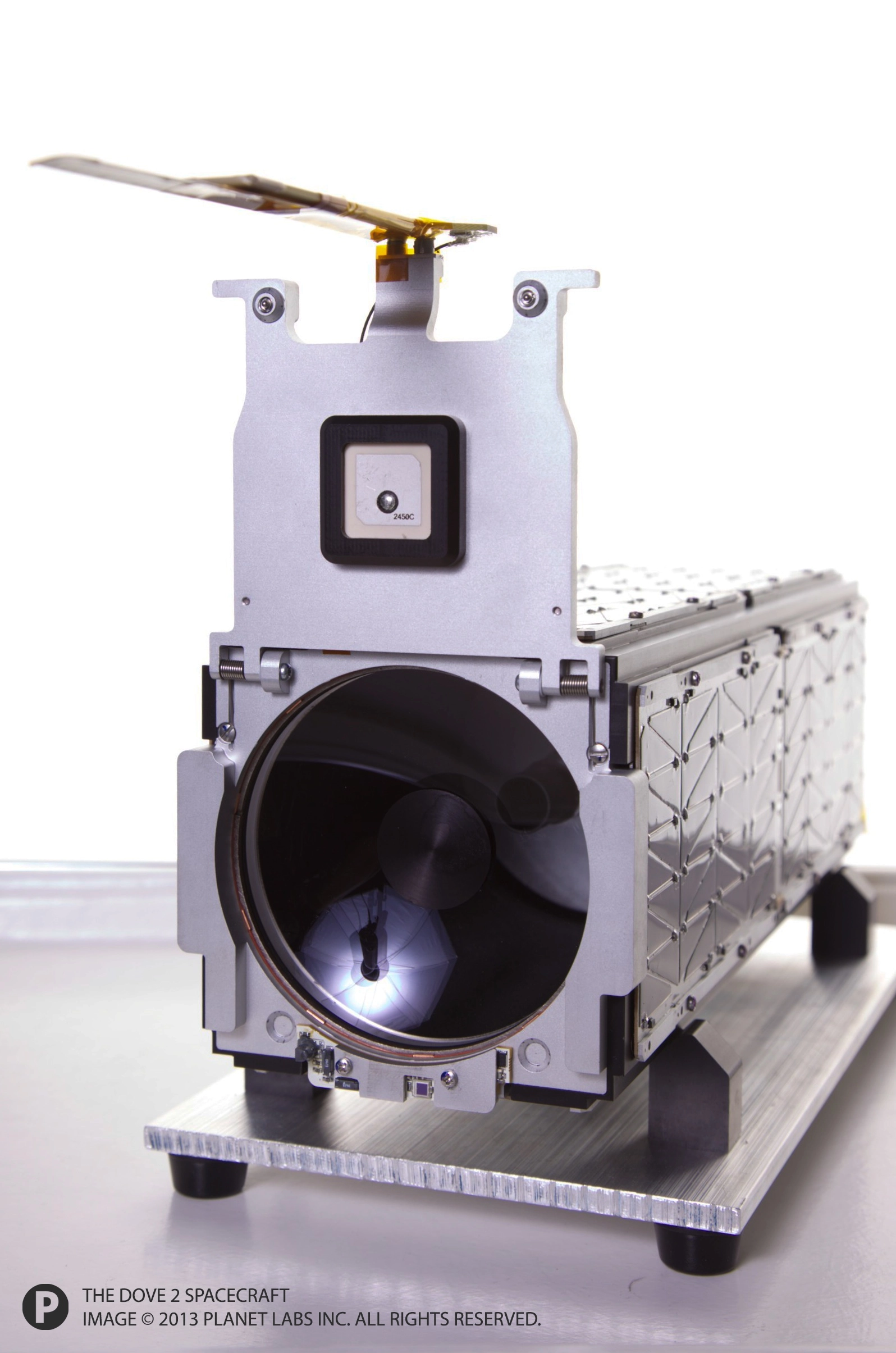
Planet Labs has released photos of its Dove line of spacecraft, 28 of which the San Francisco-based startup plans to launch a few months from now to form the world's largest constellation ofEarth-observing satellites.

Planet Labs has been keeping a low profile since its founding in 2010, unveiling its plans for the 28-satellite "Flock 1" constellation just two months ago. But after presenting the findings of its Dove 1 and Dove 2 demonstration missions at the 2013 Small Satellite Conference, which was held Aug. 10-15 in Utah, the company decided it was time to publish some photos of its hardware, officials said. [See images of (and by) Planet Labs' spacecraft]
You may like


Dove 1 and Dove 2 launched two days apart this past April, with Dove 2 hitching a ride on a Russian Soyuz rocket and its sister spacecraft getting to orbit on thefirst flight of the Antares rocket, which aerospace firm Orbital Sciences Corp. built to make robotic cargo runs to the International Space Station for NASA.
Both Dove 1 and 2 were tiny, measuring just 12 inches long by 4 inches wide by 4 inches tall (30 by 10 by 10 centimeters), yet both beamed home sharp images of Earth's surface. Dove 1 burned up in the atmosphere after less than a week on orbit because of the low altitude of the Antares test flight, but Dove 2 is still zipping around the planet.

The Doves that make up Flock 1 will piggyback on Antares' first launch toward the space station, which may come as early as December. The constellation was designed to enable frequent, high-resolution and low-cost imagery of the globe that could benefit humanity in a number of ways, Planet Labs officials have said.
"To best enable this mission, the company has selected a low orbit for its constellation and an optical resolution of three to five meters — a scale that allows measurement of a tree canopy, but does not compromise individual privacy," officials wrote in a June 26 statement announcing the Flock 1 project. "This will enable monitoring of deforestation, help improve agricultural yields, tracknatural disasters and many other applications."
Breaking space news, the latest updates on rocket launches, skywatching events and more!
Planet Labs, which has raised more than $13 million from venture capital firms, has big dreams, and they're laid out for all to read on the company's website:
"The Blue Marble is a photograph of Earth taken by Apollo 17 astronauts in 1972 and is credited with popularizing the environmental movement. What the Blue Marble did for global awareness, Planet Labs will do for global action."
Planet Labs' three co-founders — Chris Boshuizen, Will Marshall and Robbie Schingler — all previously worked on small-satellite projects at NASA's Ames Research Center in Moffett Field, Calif. Boshuizen and Marsall, for example, started and led Ames' PhoneSat project, which uses off-the-shelf cell phones as the control system for tiny satellites. Three PhoneSats launched to orbit in April along with Dove 1 on Antares' maiden flight.
Follow Mike Wall on Twitter @michaeldwall and Google+. Follow us@Spacedotcom,Facebook orGoogle+. Originally published on SPACE.com.

Michael Wall is a Senior Space Writer with Space.com and joined the team in 2010. He primarily covers exoplanets, spaceflight and military space, but has been known to dabble in the space art beat. His book about the search for alien life, "Out There," was published on Nov. 13, 2018. Before becoming a science writer, Michael worked as a herpetologist and wildlife biologist. He has a Ph.D. in evolutionary biology from the University of Sydney, Australia, a bachelor's degree from the University of Arizona, and a graduate certificate in science writing from the University of California, Santa Cruz. To find out what his latest project is, you can follow Michael on Twitter.


