


SpaceX Test Fires Private Rocket Bound for Space Station
When you purchase through links on our site, we may earn an affiliate commission.Here’s how it works.
Breaking space news, the latest updates on rocket launches, skywatching events and more!
You are now subscribed
Your newsletter sign-up was successful
Want to add more newsletters?
Delivered daily
Daily Newsletter
Breaking space news, the latest updates on rocket launches, skywatching events and more!
Once a month
Watch This Space
Sign up to our monthly entertainment newsletter to keep up with all our coverage of the latest sci-fi and space movies, tv shows, games and books.

Once a week
Night Sky This Week
Discover this week's must-see night sky events, moon phases, and stunning astrophotos. Sign up for our skywatching newsletter and explore the universe with us!

Twice a month
Strange New Words
Space.com's Sci-Fi Reader's Club. Read a sci-fi short story every month and join a virtual community of fellow science fiction fans!
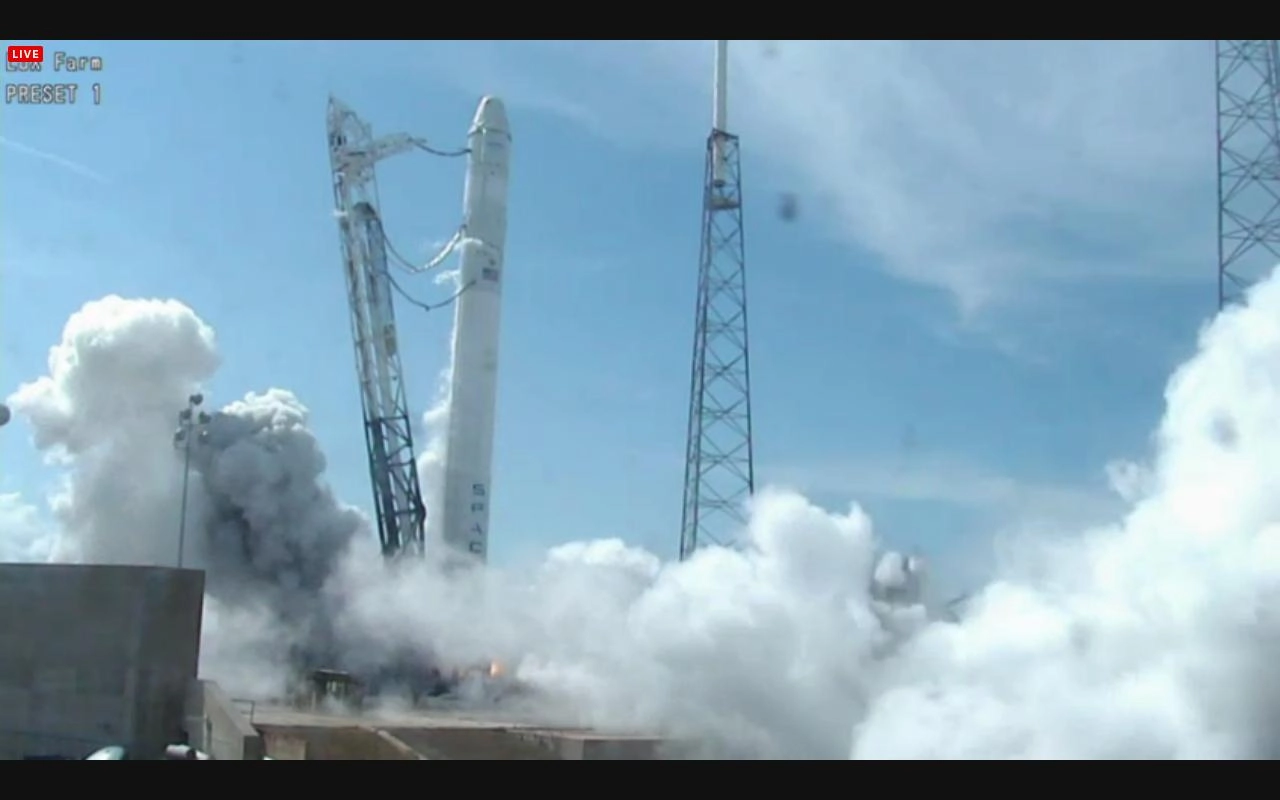
The private spaceflight company SpaceX successfully test fired the rocket that will launch the first-ever commercial space capsule to the International Space Station today (April 30), after a slight delay that was caused by an apparent computer glitch.
SpaceX officials conducted the so-called "static fire test" of the firm'sFalcon 9 rocket today on a second try at 4:15 p.m. EDT (2015 GMT) at Space Launch Complex 40 at the Cape Canaveral Air Force Station in Florida. The Falcon 9 rocket is poised on the launch pad, ready to blast off toward the space station on May 7. SpaceX aired the engine test live via the company's website.
A first attempt, which aimed to fire the rocket's engines at around 3 p.m. EDT (1900 GMT), hit a snag with 47 second remaining in the mock countdown. SpaceX officials traced the problem to a flight computer, but the issue was resolved after a brief delay.
You may like


During today's static fire test, the nine Merlin engines that power the Falcon 9 rocket's first stage were ignited for about two seconds, as the booster remained attached to the launch pad.
"So far things look good," SpaceX spokesperson Kirstin Grantham said in a statement. "Engines fired for 2 seconds, as scheduled. Engineers will now review data as we continue preparations for the upcoming launch."
SpaceX is expected to conduct a thorough review of all the data as engineers make final preparations for the upcoming launch, which is currently targeted for May 7.
SpaceX's Falcon 9 rocket is a two-stage booster that stands about 180 feet tall (55 meters) and is topped with the company's unmannedDragon space capsule. It is the capsule that will be making the trip to the International Space Station, where a crew of astronauts is waiting to pluck the gumdrop-shaped capsule from space using a robotic arm. The Dragon vehicle will be attached to the orbiting complex with the robotic arm.
Breaking space news, the latest updates on rocket launches, skywatching events and more!
The Hawthorne, Calif.-basedSpaceX (short for Space Exploration Technologies, Corp.) has a $1.6 billion contract with NASA to conduct 12 cargo missions to the space station with its Dragon spacecraft.
"This will be the first attempt by a commercial company to send a spacecraft to the International Space Station, a feat previously performed by only a few governments. Success is not guaranteed," SpaceX officials said. "If any aspect of the mission is not successful, SpaceX will learn from the experience and try again."
SpaceX is one of two private companies with contracts to provide unmanned space cargo flights to the space station for NASA. The Virginia-based company Orbital Technologies, Corp., has a $1.9 billion contract to provide eight cargo delivery missions using its own Cygnus spacecraft and Antares rocket. The first test of that spacecraft and rocket is expected to occur later this year.
SpaceX officials said theMay 7 launch of Dragon toward the space station will also be webcast live via the company's website.
Follow SPACE.com for the latest in space science and exploration news on Twitter@Spacedotcom and onFacebook.

Space.com is the premier source of space exploration, innovation and astronomy news, chronicling (and celebrating) humanity's ongoing expansion across the final frontier. Originally founded in 1999, Space.com is, and always has been, the passion of writers and editors who are space fans and also trained journalists. Our current news team consists of Editor-in-Chief Tariq Malik; Editor Hanneke Weitering, Senior Space Writer Mike Wall; Senior Writer Meghan Bartels; Senior Writer Chelsea Gohd, Senior Writer Tereza Pultarova and Staff Writer Alexander Cox, focusing on e-commerce. Senior Producer Steve Spaleta oversees our space videos, with Diana Whitcroft as our Social Media Editor.


