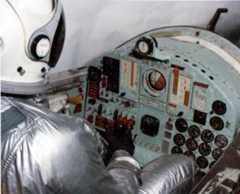
One of the nice touches on top is a head brace that folds downward infront of you.That makes deceleration at reentry a fair bit easier tohandle. 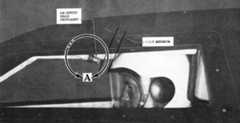 Anothernecessary nicety is that the windows are double glazed. In earlyflights the X-15 pumped Heated gaseous nitrogen between the panelskeeps them from icing over. This wasn't entirely trouble-free, so itwasn't long before the nitrogen gap was replaced by a transparentelectrical heating element.
The cockpit is unpressurized below 35,000 feet, but it's airconditioned. Above 35K it's pressurized to 3.5 psi by nitrogen. Yourpressure suit gets another nitrogen feed to keep it at 3.6 psi.
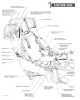
The ejection seat is almost an airplane itself. If you need it,it'll unfoldfins, put you in a nice attitude, 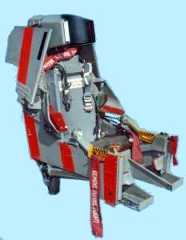 escort you to lowaltitude, then blow pieces of itself away and deploy your chute.According to the manual, it will "permit safe pilot ejection up to Mach4.0, in any attitude, and at any altitude up to 120,000 feet". You getyour choice about how much to trust those limits, such an ejection hasnever been done.
Seat diagram: mediumscale large scale
First, there's a conventional center stick and rudder pedals.There's alsoa console stick at your right hand for use when G loads make itdifficult to use the center stick. Both are mechanically coupledtogether and to a system of bell cranks that sum their inputs withthose from the Stability Augmentation System (SAS).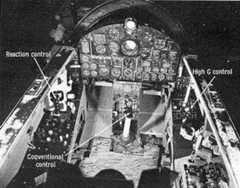
A horizontal stabilizer position indicator is located on the cockpitwall next to the console stick. This is a must-check item beforedroppingfrom the B-52 carrier aircraft and before beginning reentry.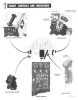 Flight control diagram
A third stick, for the ballistic control system, is at your left hand.When the ballistic control rockets are armed, you can:
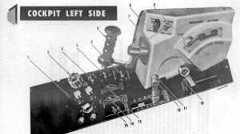
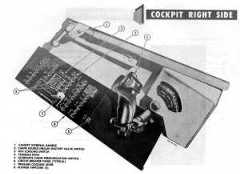
The same left-side panel houses the speed brake lever and thethrottle. The throttle allows a choice of "off" or any thrust settingbetween 50% and 100%. In the early days it could go down to 30%, butthe XLR-99 rocket motor was prone to flickering out when it wasdeveloping only a measly 4 1/2tons of thrust.
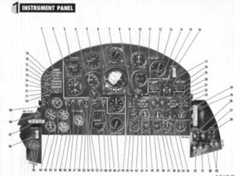
The main instrument panel is divided into three sections: Engineinstruments on the lower left, APU's on the lower right, and flightinstruments at top center. Both engine and APU sections are mainly anassortment of pressure gages, temperature gages, fire warning lights,and sundry switches.
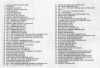
The most prominent flight instrument is a big attitude indicator,planted squarely in the middle. It looks fairly ordinary, but it'saccurate throughout 360 degrees of rotation around any axis you care toname.Scanning clockwise around the attitude indicator, starting justbelow it,the flight instruments are...
This pilot report is split into these four parts:
1. X-15 GeneralDescription & Walkaround
2. X-15 Cockpit Check
3. X-15Flight: Heading Out to Launch
4. X-15Flight: Flying the Mission and Returning
Related to all four sections:
Photo creditsand pointers to related resources
.