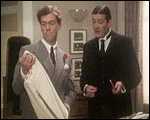
WhereasThe World of Wooster (BBC, tx. 1965-67) translatedP.G.Wodehouse's Bertie Wooster stories into a half-hour sitcom format, complete with studio audience laughter,Granada'sJeeves and Wooster was an altogether more polished affair. Shot on film at various immaculately decked-out stately locations, it marked a new departure forStephen Fry andHugh Laurie, already well established as a popular double act thanks to regular spots onChannel 4'sFriday Night Live (1986-87) and their own long-running sketch showcaseA Bit of Fry and Laurie (BBC, 1987-95). More pertinently, in the last two series ofBlackadder (BBC, 1987-89),Laurie's Prince/Captain George was so clearly modelled on Bertie Wooster that his transition to the real thing seemed entirely natural. Closer toWodehouse's original than the earlier BBC version'sIan Carmichael,Laurie was particularly effective at capturing Bertie's distinctive blend of airy nonchalance and refined gormlessness. AlthoughFry was too young to be totally convincing as Jeeves, his superciliously sarcastic "Indeed, sir?" and aura of vast intelligence were enhanced by the actor's real-life reputation as an all-round polymath. The well-chosen supporting cast broughtWodehouse's often sketchy characters to vivid life - Bertie's fearsome aunts Agatha (Mary Wimbush) and Dahlia (Brenda Bruce, laterVivien Pickles) and other menacing females such as drippy Madeline Bassett (Francesca Folan) and prankster Stiffy Byng (Charlotte Attenborough), as well as Bertie's chums Bingo Little (Michael Siberry), Tuppy Glossop (Robert Daws), Barmy Fotheringay-Phipps (Adam Blackwood, laterMartin Clunes) and effete newt-fancier Gussie Fink-Nottle (Richard Garnett). Arguably the most successful performance wasJohn Turner's fleshing-out of would-be fascist dictator Roderick Spode, little more than a vaguely thuggish presence in the books but much more satirically rounded here. But the series' real star was the veteranClive Exton, whose scripts translatedWodehouse's inimitable prose style into convincing dramatic form. Individual episodes were generally drawn from three short stories or half a novel, withExton retooling the plots to fit an hour-long slot, retaining many ofWodehouse's most inspired literary similes by working them into the dialogue. Although much sublime comic material still had to be sacrificed, andJeeves and Wooster is ultimately no substitute forWodehouse on the page,Exton's adaptations come surprisingly close to capturing the flavour of the originals - and, as one critic pointed out at the time, a production that regularly managed to slip words like "opprobrious" into a peak-time ITV slot is something to cherish. Michael Brooke  |


 1. The lovelorn Gussie (4:20)

