Browse the Archive: Young India
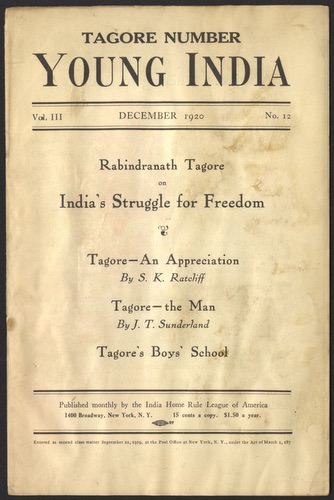
The December 1920 issue ofYoung India (Vol. 3, No. 12), entitled the "Tagore Number," contains writing by S.K. Ratcliffe, J.T. Sunderland, on Rabindranath Tagore, as well as several poems and writing by Tagore.
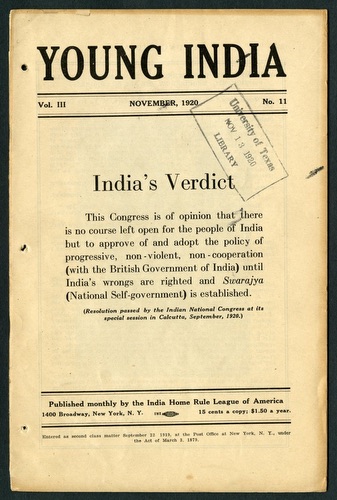
The November 1920 issue of Young India (Vol. 3, No. 11) devotes most of its pages to the special session of the Indian National Congress, held in Calcutta that September. The issue contains an overview of the Calcutta Congress and its resolutions, and also quotes from speeches by Lajpat Rai, Gandhi, B. Chakravarthi. Also included are the following articles: "India and Japan" by Sudhindra Bose, "Recognizing India's Military Strength," "Meredith Townsend on Non-Co-operation," "India Held by Terrorism," "New York and Amritsar Disasters -- A Comparison." In lieu of his usual art column, Ananda Coomaraswamy includes a photograph of a bathing ghat at Benares. The inside fold also includes a statement of ownership, management, and circulation (required by the U.S. Congress), wich explains the various business managers of the publication.
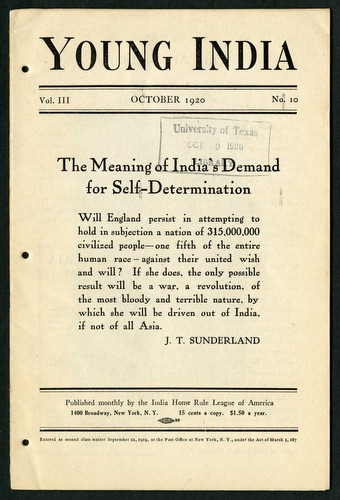
The October 1920 issue ofYoung India (Vol. 3, No. 10) opens with a quote from J.T. Sunderland on the "meaning of India's demand for self-determination," excerpted from his feature article in the issue. Other articles include "The Co-operative Movement," "Indian Soldiers in Mesopotamia," "How Bombay Treats Textile Labor," "Blacker than the 'Black Hole'" (on the Calcutta Black Hole atrocity), "O'Flaherty on Indian Self-Government," "England and the Mohammedans," and "The Doctrine of the Sword," a reprint from Gandhi's weekly newspaperYoung India. The exceptionally long editorial section contains the following headlines: "Daniel Webster on India," "Andrew Carnegie and India," "Mr. Asquith and India," "Henry George on India," "Civilizing the Hindus," "What Does India Want?," "No More Dictation, Please!," "Future Massacres in India," "India and the League of Nations," "Ireland and India," "Defense of Dyer," "The Englishmen Must Shoot," "Boycotting the Government." The art section, written by Ananda Coomaraswamy, features an essay and photograph of 12th century cooper sculpture of Siva as Nataraja, housed at the Madras Museum. On the back of the issue are two advertisements, one forThe Opium Monopoly by Ellen N. La Motte, and another for lantern slides related to Jallianwala Park and the massacre.
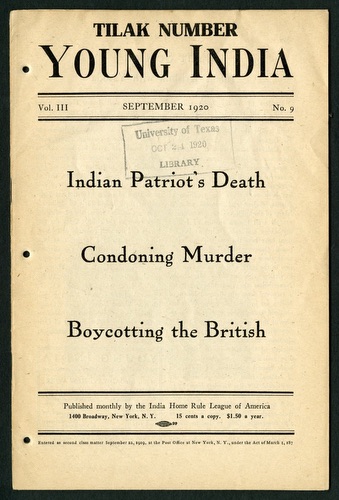
The September 1920 issue ofYoung India (Vol. 3, No. 9) was dubbed the "Tilak Number," and features a lengthy article by J.T. Sunderland titled "B.G. Tilak: Scholar and Patriot," another by Betty Hall titled "My Reminiscences of Mr. Tilak," and a photo of Tilak in his study. Other feature articles include a summary of the parliamentary debate over the Jallianwala Bagh massacre, "Boycotting the British," "Why England Keeps India," and "Deporting Indian Laborers" by N.S. Hardiker. Hardiker writes about how "2,000 Hindustani laborers are to be arrested and sent back to India," and how thirty-nine have already been arrested in South Bethelehem, Pennsylvania, where they have been taken to Ellis Island for deportation. The reason for their deportation was their violation of the Immigration Law of 1917, which "forbids entrance of Hindus, unless they be students, travelers, preachers, or the like." The art section, written by Ananda Coomaraswamy, features the 20th century paintingInfant Krishna with Yasoda by Asit Kumar Haldar.
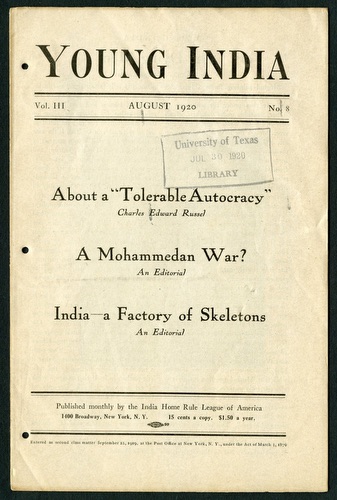
The August 1920 issue ofYoung India (Vol. 3, No. 8) features several articles, of which only two are not anonymous: "About a 'Tolerable Autocracy'" by Charles Edward Russell, "Tagore's Message" (featuring Rabindranath Tagore's response to the Jallianwala Bagh massacre), "The New Spirit in India," "Indians in British East Africa," and "India - A Factory of Skeletons." The issue also includes a larger than usual editorial notes section, featuring the following headlines: "Indian in U.S. Politic," "British Labor and India," "Indian Suffragettes," "A Serious Situation," "Britain and Turkey," "Moslem Migration," "Amnesty for India," "Barbarities in Fiji, Too," and two Jabez T. Sunderland authored editorials, "India's High Goal," and "Indian Situation in a Nutshell." The art section, written by Ananda Coomaraswamy, features a Mughal painting (1620-30) of Shah Jahan.
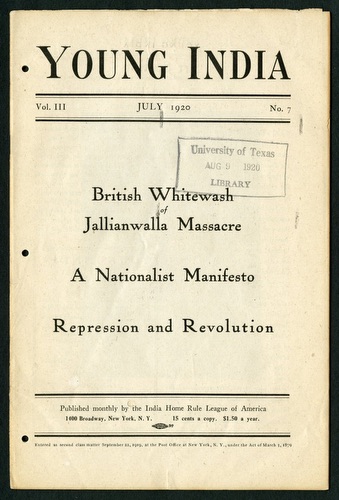
The July 1920 issue ofYoung India (Vol. 3, No. 7) featured the following articles: "Punjab Report -- More Facts," "Hunter Report -- An Official Whitewash," "The American Press on The Amritsar Massacre," "Repression -- Road to Revolution" by John Haynes Holmes and J.T. Sunderland, "A Nationalist Manifesto," "The Y.W.C.A. and India" by J.T. Sunderland, and a poem titled "Law and Order in India." The Art Section by Ananda Coomaraswamy features a 17th century Rajput painting of a scene from the Ramayana.
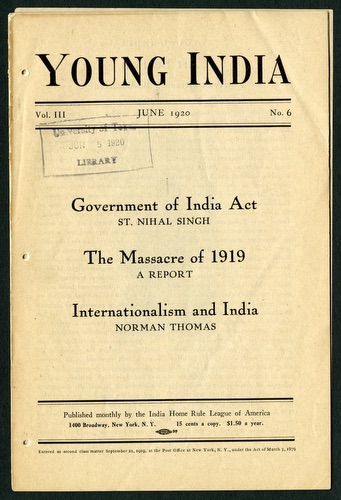
The June 1920 issue ofYoung India (Vol. 3, No. 6) featured the following articles: "Punjab Disturbances Report," "The Government of India Act" by Saint Nihal Singh, "India Reform Scheme" by Harkishenlal, "India Finance," "Turkish Problem in India," "Internationalism and India" by Norman Thomas, "India and Foreign Rule" and "A Lesson from Missionaires" by J.T. Sunderland. In the Art section, Ananda Coomaraswamy writes on the 8th century bronze statue of Bodhisattva Avalokitesvara from Ceylon. The opening editorial note reports on the dismissal of three deportation cases against Bhagwan Singh, H. Santokh, and Gopal Singh by the U.S. Department of Labor. The back cover of the issue advertises the Indian National Congress Report on the Punjab Disturbances, which documents the reported deaths from the Amritsar Massacre of 1919.
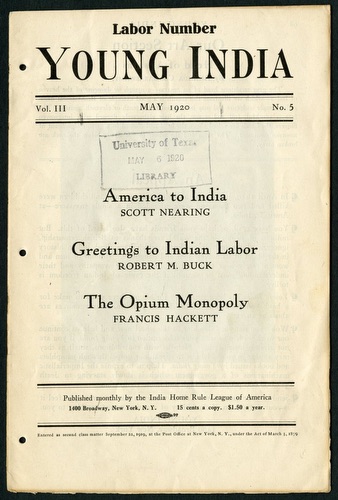
The May 1920 issue ofYoung India (Vol. 3, No. 5) was titled the "Labor Number." The opening editorial notes focus on different figures of Indian labor (the coolie, agricultural worker, and clerk) within the colony. A note is also made of N.M. Joshi, who had visited the International Labor Conference in Washington as an Indian representative. The issue contains the following articles: "U.S. Congressman May Visit India," "Strikes in India," "A Labor Revolt in the Fiji Islands," "Workers in India: Greetings from America" by Robert M. Buck (The New Majority editor), "The Opium Monopoly" by Francis Hackett, "America to India" by Scott Nearing, "American Labor and India" by A.M.E. Dudley. The final page contains a "message" from Lajpat Rai, which provides a transcript of a speech delivered in Bombay. Ananda Coomaraswamy's art section focuses on the "Head of Apsaras," a temple sculpture from the 10th or 11th century.
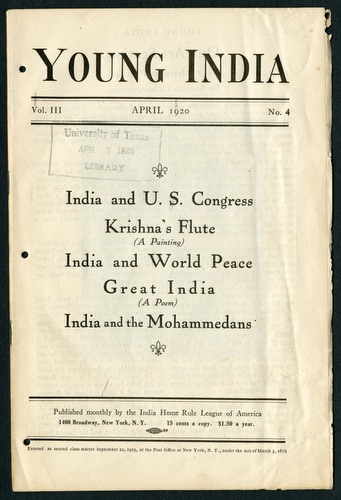
The April 1920 issue ofYoung India (Vol. 3, No. 4) featured several articles comparing the struggle for Indian freedom with America's past. Various short reports draw a connection between the U.S. and India, comparing Patrick Henry to Ram Mohun Roy, Lincoln's thoughts on slavery to the "slavery" of British colonialism, and Walt Whitman's ideas of freedom to the Indian nationalist struggle. The issue's longer essays include "The Mason Resolution," describing N.S Hardiker's addresses at meetings in Washington D.C.; during one meeting, held by the Friends of Irish Freedom, he was introduced by Illinois Congressman William E. Mason, a sympathizer of the Indian nationalist movement and opponent of American rule in the Philippines. In "India and World Peace" by Lajpat Rai, and "World's Judgment" by J.T. Sunderland, both writers assert the argument for Indian independence. In "Another Successful Dinner," the anonymous writer describes a February 28 banquet organized by the Friends of Freedom for India. There other items make up the issue's contents: "The Future of India" by Alvin Johnson, "Mohammedans of India" by N.S. Hardiker, and a poem titled "Great India" by Amy Dudley. The Art section by Ananda Coomaraswamy featured an essay on the Krishna cycle, as represented in Rajput paintings. An image of the 17th century painting "Krishna with the Flute, and Two Milkmaids," from Museum of Fine Arts, Boston is printed inside the issue. The opening editorial reports of Lajpat Rai's return to Bombay on February 20th that year.
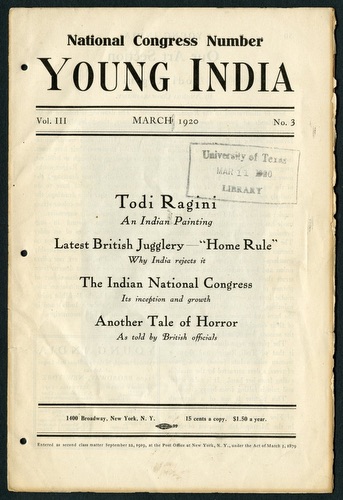
The March 1920 issue ofYoung India (Vol. 3, No. 3). The issue commenced the new "Art Section" run by Ananda Coomaraswamy. The first installment focuses on the Todi Ragini, and is accompanied by an image of a Rajput painting representing a "music section." The issue also includes a poem by Rabindranath Tagore titled "Give Power to Suffer," as well as essays on the "Indian National Congress," "Causes of the "Rebellion,'" and "The Government of India Act." N.S. Hardiker contributes an article titled "Results of the 'Rebellion,'" which includes images of public gallows in British India, as well as the public flogginf of an India by a British official in Amritsar. J.T. Sunderland contributes the essay, "What is the Indian National Congress?"