Grover Cleveland (2) advocated hard-money and sound economic policies, opposed the annexation of Hawaii, avoided war with Spain over Cuba, and also tried to treat Native Americans fairly, unlikeBenjamin Harrison (15), who built up the navy, tried to annex Hawaii, supported the Sherman Antitrust Act, and pushed for high tariffs and loose money, which helped cause the Panic of 1893.William McKinley (38) raised taxes, increased the size of government, started a war with Spain over Cuba and the Philippines, and annexed Hawaii.Theodore Roosevelt (21) avoided any major wars despite his aggressive foreign policy, but he increased the number of government employees by 50 percent and used protectionism to favour some industries and trust busting to punish others.William Howard Taft (20) pursued a less aggressive foreign policy, but he supported the income tax and high tariffs and initiated twice as many antitrust suits as his predecessor in just half the time.
The worst president of all time according to Eland isWoodrow Wilson (40), who dragged the US into WWI, allowed Britain and France to impose a harsh peace on Germany, created the Federal Reserve System, and presided over the start of alcohol prohibition in the United States.Warren G. Harding (6) cut taxes and spending and pursued a restrained foreign policy, andCalvin Coolidge (10) largely followed suit, although he kept tariffs high and expanded the money supply.Herbert Hoover (18) was also restrained in his foreign policy, but he prevented the market from righting itself after the 1929 stock market crash by lobbying business to keep wages and prices from falling, by raising spending and taxes, and by signing the Smoot-Hawley Tariff Act against the advice of virtually all economists, thereby raising American tariffs to their highest level ever.Franklin D. Roosevelt (31) gets points for ending alcohol prohibition and helping oversee the Allied victory in WWII, but loses more points for defending the needless massive bombing of cities like Dresden, doing little to allow persecuted Jews to come to the US, incarcerating many tens of thousands of innocent Japanese Americans in prison camps, and of course interfering heavily in the economy, thereby growing the welfare state and prolonging the Great Depression.
Harry S. Truman (39)needlessly dropped atomic bombs on two Japanese cities, helped start the Cold War, and entered the Korean War without a congressional declaration.Dwight D. Eisenhower (9) ended that war and pursued fiscally responsible policies, which led to impressive economic growth during his two terms. The reveredJohn F. Kennedy (35) may have resisted his hawkish advisors and diffused the Cuban Missile Crisis, but he was partially responsible for that debacle in the first place thanks to the botched Bay of Pigs invasion, and he secretly intervened in the Vietnam War.Lyndon B. Johnson (32) did support and sign the momentous Civil Rights Act and the Voting Rights Act, but he greatly expanded the welfare state and escalated US involvement in the Vietnam War. After pledging to end that war during the campaign,Richard M. Nixon (30) prolonged it, and he also instituted wage and price controls, abandoned what was left of the gold standard, increased government spending, launched the War on Drugs, and was involved in the Watergate scandal.Gerald R. Ford (16) was much more restrained in foreign policy and did not increase spending very much, although he raised income taxes, which helped to cause a deep recession, and he pardoned Nixon before he could be charged, much less tried in court.
The best modern president was apparentlyJimmy Carter (8), who pursued a restrained foreign policy, was a budget hawk, deregulated several industries, and nominated tight-money Paul Volcker as chairman of the Federal Reserve.Ronald Reagan (34), darling of conservatives, dramatically raised both government spending and the debt, intervened more abroad than his predecessors, was embroiled in the Iran-Contra scandal, and gets altogether too much credit for “winning” the Cold War.George H. W. Bush (33) pursued an aggressive foreign policy in Panama, the Persian Gulf, and Somalia, he bailed out the savings and loans banks, and he raised taxes after pledging not to. It tookBill Clinton (11) to put the brakes on federal spending and turn the deficit into a surplus, and he also reformed welfare and supported free trade. AndGeorge W. Bush (36) for his part invaded and occupied two countries, authorized the use of “aggressive interrogation techniques,” vastly increased government spending and the debt, nominated inflationist Ben Bernanke as chairman of the Federal Reserve, and bailed out the financial institutions that made bad loans in the sub-prime mortgage crisis.
There you have it. For those of you keeping track, Eland’s top four presidents are Tyler, Cleveland, Van Buren, and Hayes, far less well-known than the giants actually enshrined on Mount Rushmore, whom Eland ranks 7th, 21st, 26th, and 29th. There is of course plenty of room to quibble with Eland’s rationales for his rankings, which are only very briefly sketched above. Was Thomas Jefferson really a worse president than Herbert Hoover? Was Jimmy Carter really the best modern president? I myself was not entirely convinced by all of Eland’s specific arguments and rankings.
But the lively discussions that can arise from such a challenging reassessment of the presidents are a big part of the fun of this book. Such debate can help shake things up, maybe get people to reconsider some of their ideas and beliefs. And the book’s overall argument is a good one: that presidents who are charismatic and who do a lot of things usually get all the love, whereas the ones who simply do their best to respect the Constitution and promote peace, prosperity, and liberty are largely ignored and forgotten. When enough people take the kinds of ideas discussed in this book to heart, then a solid candidate like Gary Johnson will stand a better chance of becoming President of the United States of America.
|



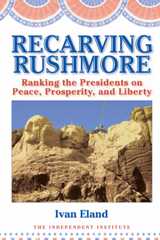 America’s first president,George Washington (7), kept out of foreign conflicts and stepped down after two terms despite being popular enough to effectively become a king. His successorJohn Adams (22) enforced the Alien and Sedition acts and appointed big-government enthusiast John Marshall to the Supreme Court.Thomas Jefferson (26) imposed a punishing embargo on US foreign trade, used draconian measures to enforce it, and began the forced displacement of Native Americans with the unconstitutional Louisiana Purchase.James Madison (28) dragged the young country into the unnecessary War of 1812, which solved nothing, whileJames Monroe (25) ordered the invasion of Florida, not to mention that his Monroe Doctrine justified future US military interventionism.
