
- Orthodox Christianity
- Western Christianity
- The Orthodox Mindset
- Living an Orthodox Life
- Death and Eternal Life
- Ecumenism
- Introduction
- Modernism
- General Articles
- The Calendar Controversy
- Baptismal Ecclesiology
- Baptism and the Reception of Converts
- False Union With Rome
- The Balamand Agreement
- Neo-Papal Patriarchalism
- Monophysites (Non-Chalcedonians)
- The Witness of the Russian Orthodox Church Outside of Russia
- Commonly Misunderstood Terms
- Ecumenical Documents and Critiques

Related Topics
Acquiring an Orthodox Mindset: Introduction
I have set up this web page to help make available—in an ordered manner—writings that should serve to guide Orthodox Christians in the development of an Orthodoxphronema, or mindset. Though most of the articles hosted on the Orthodox Christian Information Center are—to varying degrees—illustrative of this mindset, we sensed a need for a page specifically dedicated to this concept. The lack of thisphronemain many today underlies not only the general lack of fervor for the true spirit andpractice of Orthodoxy, but also the widespread success of themodernist andecumenist agendas in this century—agendas which threaten the very heart of Orthodoxy.
St. Gregory PalamasDefender of Orthodox Hesychasm Sermon on His
|
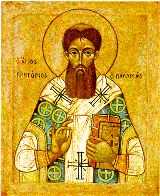
Echoing similar comments made on theStatement of Purpose page, I am very aware of the limitations of presenting material of this nature via a medium that caters to the very thing the authors in this section of the site will decry in their writings: a divorce betweentheoria andpraxis. The development of an Orthodox mindset—so essential in our day when there are so very few who propagate, or even recognize, the patristic ethos of Orthodoxy—cannot take place apart fromorthopraxis. This page is dedicated to St. Gregory Palamas for a number of reasons, not the least of which is that the concept of an Orthodoxphronema is integrally linked to the hesychastic tradition which he is so honored for elucidating and defending. Archbishop Chrysostomos of the St. Gregory Palamas Monastery in Etna, CA outlines this relation in his profound workScripture and Tradition, remarking in one place that:
Activated bytheosis, the noetic faculty is the unified “mind” of the Fathers (theconsensus patrum), which receives Scripture, witnesses to the truth, and speaks (as theBlessed Paisius Velichkovsky says of the “ecumenical teachers”) “as if one mouth.” The noetic faculty embodies the personal experience of the mind of the Church Catholic. (p. 66)
As one who reads the articles on this page will see, acquiring an Orthodox mind doesnot mean collecting a head full of “patristic quotes.” Rather it refers to the transformation of the whole man, resulting in one's gradual participation in the “noetic vision.” Metropolitan Hierotheos of Nafpaktos speaks of it thus in his superb bookThe Mind of the Orthodox Church:
[Phronema means] in the biblico-patristic Tradition the whole turn of mind which prevails in a man from the way in which he lives, and from the relationship which he has with God. And literally, if thenous [i.e., the spiritual intellect, not to be confused with “reason”] is darkened, then the whole mind is carnal. But if thenousis illuminated, which means that is has the Holy Spirit within it, then the whole mind is a mind of spirit and, of course, a mind of the Church....
When we speak of having an orthodox mind we mean chiefly that ournous is thenous of Christ, as the Apostle Paul says, or at least that we accept the experience of the saints and have communion with them. This is the way of the life of the Orthodox Tradition and the way of life of Christ's life. The orthodox mind is expressed by the dogmas of the Church, because, on the one hand, the dogmas express the life which the Church has and the revelation which the saints have received, and on the other hand, they lead the passionate people and the babes in Christ to unity and communion with God.
We must say at this point that the theology of the Church is ascetic, that is to say, it defines the methods of cure in order for man to attain deification....So the dogmas express the revelation and the life which the Church has and they also cure man and lead him towards deification. They are spiritual road signs. In this sense we can say that the dogmas save man and sanctify him. This happens because they cure him and give him the right orientation on his way towards God. (pp. 120, 122-123)
This passage from Metropolitan Hierotheos' book also describes the essential interplay between dogma and life in Christ. This page focuses on what it means to “follow the Holy Fathers” and “acquire their mind,” which is the mind of the Church. Therefore, the concept ofphronema and dogma are highlighted here, whereas the concept of ascetic life in the Church is the focus of theOrthopraxis page.
It is my great hope that this web page will serve to help others acquire some measure of the “mindset of the Fathers,” or at the very least to help others be able to recognize when any given Orthodox writer says something that belies their modernist approach (read: disdain for, or neglect of, the patristic consensus, including the writings of the modern Saints) or that lacks that “certain indescribable something” (read: the “savor” of authentic Orthodoxy that warms the heart and inspires the will to godly action). For we live in perilous times, when there are many false teachers, and the panheresy ofecumenism—with its midwife,modernism—has ravaged the Orthodox Church, placing many souls in peril (see quote at bottom by Fr. Seraphim). A recovery of a Patristic mindset is essential to the Body of Christ's resistance to these innovations that have been inspired by the modernZeitgeist.
The great challenge for Orthodoxy in the near future is not to find new and better ways of adapting to the dominant culture by assimilation and thus becoming “relevant”; the challenge is to establish and maintain genuine continuity with the Saints and Fathers of the past. This means more education, for ignorance of the Faith among many Orthodox today is appalling and is the single greatest factor in the crisis we are now facing.
—Fr. Alexey Young (now Hieromonk Ambrose),Book Review ofFacing EastandThe Faith, inOrthodox America(Feb., 1997)
“The Church's decisions also carry force across time; and for this reason, the decisions of the Holy Fourth Ecumenical Synod are of such binding character that the Church can make no disparate decisions without refuting Herself. In keeping with this spirit, the phrase, 'We now clearly understand...,' has no place among Orthodox. The classical Patristic dictum, 'Following the Holy Fathers...,' is the only one which expresses how Orthodox understand themselves.”
—The Non-Chalcedonian Heretics: A Contribution to the Dialogue
Concerning the “Orthodoxy” of the Non-Chalcedonians
by the Holy Monastery of Saint Gregory (Monastery of Gregoriou), Mount Athos,Greece.
Translated and published by theCenter for Traditionalist Orthodox Studies, Etna, CA (1996).