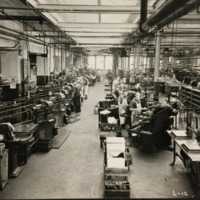
The signature tower of the North Tonawanda plant and occasional headquarters. Postcard, c.1940.Its iconic tower has presided over Sawyer's Creek and Martinsville for over 100 years. The sprawling industrial campus left behind by the world-famous Wurlitzer Manufacturing Company produced merry-go-round organs, band organs, church organs, theater organs and jukeboxes that have left an indelible mark on the world, and on generations of North Tonawandans.
Wurlitzer founder Rudolph Wurlitzer (1831-1914) was a German immigrant who (after stops in New Jersey and Philadelphia) landed in Cincinnati, Ohio in 1854 at the age of 23. He worked for a bank, and down the street was a musical retail store. His father, Christian, was a successful music retailer in Germany, and Rudolph's experience told him the Ohio store's instruments were of poor quality, and priced too high. In 1856 he begins importing quality musical instruments from his family in Germany to sell at a profit in American retail stores. The business grows; Wurlitzer begins making instruments themselves for the U. S. military and for retail. The company branches out into "automatic" musical instruments, such as music boxes and player-pianos. Rudolph's three sons, Howard, Rudolph H., and Farny become involved along the way, and take on aspects of the growing family business.
The youngest son, Farny, is sent to North Tonawanda to run the former
de Kleist Musical Instrument Mfg. Co. shortly after it is purchased by Wurlitzer in 1908. (de Kleist was building player pianos and band organs for Wurlitzer and others since 1893). Farny brings eccentric English inventor Robert Hope-Jones to the plant in 1910, initiating the worldwide success of the "Mighty Wurlitzer" theater organ, which provides sound for the silent films of the day, and entertainment in its own right. This business evaporates when sound comes to movies, and electrical sound amplification permits musical entertainment to be furnished to venues of all types much less expensively.
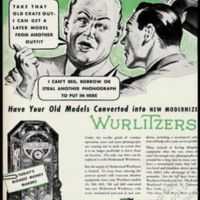
When the Wurlitzer company finds itself overextended in the wake of the Great Depression, Farny fights to keep the North Tonawanda facility open. In 1934 he strikes a deal with Homer Capehart to manufacture his automatic phonograph, which becomes the iconic Wurlitzer jukebox. Under his leadership the company also produces a successful line of electronic organs for home use, and the North Tonawanda plant becomes the flagship of the Wurlitzer factories, with 3,000 employees. After his death in 1972, jukebox and organ production are phased out, leaving 200 employees in 1974. By 1975, all manufacturing at the North Tonawanda plant is stopped, and by August 1976, all company activities are removed to other locations.