 Live Science Plus





Fearsome Malagasy Dinosaur Remained a Pipsqueak Most of Its Life
When you purchase through links on our site, we may earn an affiliate commission.Here’s how it works.
Get the world’s most fascinating discoveries delivered straight to your inbox.
You are now subscribed
Your newsletter sign-up was successful
Want to add more newsletters?

Delivered Daily
Daily Newsletter
Sign up for the latest discoveries, groundbreaking research and fascinating breakthroughs that impact you and the wider world direct to your inbox.

Once a week
Life's Little Mysteries
Feed your curiosity with an exclusive mystery every week, solved with science and delivered direct to your inbox before it's seen anywhere else.

Once a week
How It Works
Sign up to our free science & technology newsletter for your weekly fix of fascinating articles, quick quizzes, amazing images, and more

Delivered daily
Space.com Newsletter
Breaking space news, the latest updates on rocket launches, skywatching events and more!

Once a month
Watch This Space
Sign up to our monthly entertainment newsletter to keep up with all our coverage of the latest sci-fi and space movies, tv shows, games and books.

Once a week
Night Sky This Week
Discover this week's must-see night sky events, moon phases, and stunning astrophotos. Sign up for our skywatching newsletter and explore the universe with us!
Join the club
Get full access to premium articles, exclusive features and a growing list of member rewards.
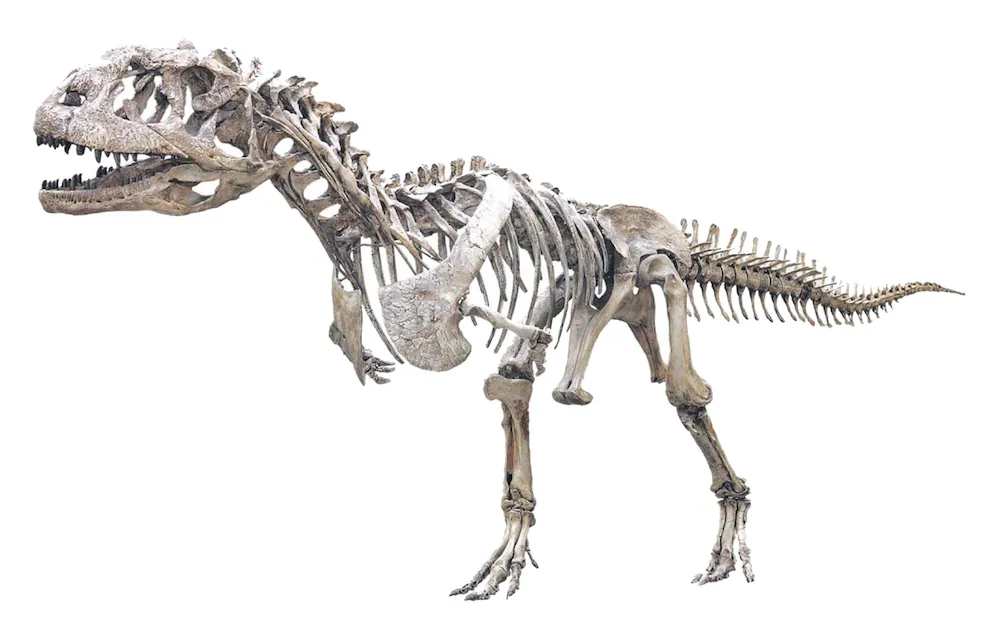
A fearsome carnivorous dinosaur known for eating its own kind wasn't that large — it weighed only about as much as a hefty crocodile. But the creature,Majungasaurus crenatissimus, took more than 20 years to reach its full size, making it one of the slowest growing dinosaurs of its kind on record, a new study finds.
The finding suggests thatM. crenatissimus was a real pipsqueak for most of its life, at least compared with its fast-growing, enormous relativesTyrannosaurus rex andAlbertosaurus, said study lead researcher Michael D'Emic, an assistant professor of biology at Adelphi University in Long Island, New York. [Image Gallery: Tiny-Armed Dinosaurs]
Malagasy dinosaur
The researchers chose to studyM. crenatissimus because it was a common dinosaur with multiple specimens available for study. "It's literally known from thousands of teeth, hundreds of isolated bones and several nearly complete skeletons," D'Emic told Live Science.


M. crenatissimus was top predator on the island of Madagascar duringthe late Cretaceous period, about 70 million to 66 million years ago.M. crenatissimus is considered an abelisaurid theropod — a bipedal, carnivorous dinosaur with stubby front arms; small, pointy teeth; and a short skull, D'Emic said.
When full-grown, the beast would have extended about 20 feet (6 meters) in length, according to a 2007 study in theJournal of Vertebrate Paleontology.
But it took most of its life to reach that length, D'Emic found. The individual the researchers studied likely weighed about 1,875 lbs. (850 kilograms) when it died at about age 27. In comparison, "T. rex was at 800 kilograms in just a few years," before it eventually reached its full size of about 9 tons (8,160 kg) in adulthood, D'Emic said.
Rock-saw slice
To analyze theM. crenatissimus individual, one of the largest and most complete on record, the researchers used a rock saw to get slices from eight bones: the dorsal rib, pubis, scapula, phalanx, metatarsal and three leg bones — the fibula, tibiaand femur.
Get the world’s most fascinating discoveries delivered straight to your inbox.
To preserve the original shape of the skeleton, they used a mold to form an epoxy in the shape of the slices removed from those bones. Then they placed the replicas back into the skeleton.
"Although it's destructive sampling, you can restore the specimen to its original morphology," D'Emic said.
Once they had the eight slices, D'Emic and his colleagues mounted them on microscope slides and then ground them down until they were transparent (about the thickness of a human hair) and. "It's a slow, time-consuming process," he said.
You may like
Once he was done, D'Emic was able to easily view each individual line of arrest growth (LAG).Just like tree rings, LAGs that were close together indicated that the dinosaur didn't grow much that particular year, while rings that were far apart implied that the dinosaur had undergone a growth spurt, D'Emic said.

Many of the LAGs were close together, indicating that the dinosaur grew slowly in comparison to its theropod relatives. For example, the allosauroidAcrocanthosaurus reached about 7,700 lbs. (3,500 kg) in about the same time it tookM. crenatissimusto reachjust a quarter of that weight, D'Emic said.
It's unclear whyM. crenatissimus grew so slowly, but perhaps the harsh Malagasy environment, plagued by droughts and floods, curtailed its growth, D'Emic said. In addition, research shows that other abelisaurids grew slowly, so it may be a common characteristic of the group, he said. [Gory Guts: Photos of a T. Rex Autopsy]
Childhood mystery
However, some information is missing from the dinosaur's youth. Some bones, such as the tibia, contained bone marrow in their center that remodeled the bone (and the LAGs) around them, meaning that the dinosaur's early years were effectively erased.
But, by examining the spacing of the later years, they were able to guess how many rings made up the inner region covered by bone marrow. In the end, they guessed that there were 14, which helped them estimate the dinosaur's age of 27, he said. The researchers plan to study a juvenileM. crenatissimus to see whether its young LAGs are spaced as they predicted they would be, D'Emic said.
The research is part of theMadagascar Paleontology Project, in which researchers are studying bone structure and LAGs of other vertebrates that lived in Madagascar's Maevarano Formation, widely known as a stressful Cretaceous ecosystem, said study co-researcher Kristina Curry Rogers, an associate professor of geology and biology at Macalester College in Minnesota.
For instance, earlier this year, Curry Rogers, D'Emic and their colleagues published a study in thejournal Science on the remains ofa baby titanosaur (Rapetosaurus), a long-necked and long-tailed herbivore from Madagascar. They found that the baby likely died of starvation during a drought. But during its short life, it grew very fast, likely at the same rate as a modern baby elephant, she said.
The new study, which has yet to be published in a peer-reviewed journal, was presented Oct. 28 at the 2016 Society of Vertebrate Paleontology meeting in Salt Lake City.
Original article onLive Science.

Laura is the managing editor at Live Science. She also runs the archaeology section and the Life's Little Mysteries series. Her work has appeared in The New York Times, Scholastic, Popular Science and Spectrum, a site on autism research. She has won multiple awards from the Society of Professional Journalists and the Washington Newspaper Publishers Association for her reporting at a weekly newspaper near Seattle. Laura holds a bachelor's degree in English literature and psychology from Washington University in St. Louis and a master's degree in science writing from NYU.


