


Friday, February 13th, 2026
Come Join the 2026 Valentine Hunt!
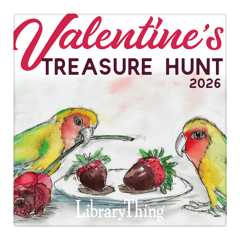
It’s (almost) February 14th, and that means the return of our annualValentine Hunt!
We’ve scattered a punnet of strawberries around the site, and it’s up to you to try and find them all.
- Decipher the clues and visit the corresponding LibraryThing pages to find a strawberry. Each clue points to aspecific page right here on LibraryThing. Remember, they are not necessarily work pages!
- If there’s a strawberry on a page, you’ll see a banner at the top of the page.
- You havea little more than two weeks to find all the strawberries (until11:59pm EST, Saturday February 28th).
- Come brag about your punnet of strawberries (and get hints) onTalk.
Win prizes:
- Any member who finds at least two strawberries will be
awarded a strawberryBadge ( ).
). - Members who find all 14 strawberries will be entered into a drawing for some LibraryThing (or TinyCat)swag. We’ll announce winners at the end of the hunt.
P.S. Thanks toconceptDawg for the love birds illustration!
Labels:treasure hunt

Wednesday, February 11th, 2026
Author Interview: Janie Chang

LibraryThing is pleased to sit down this month with best-selling Taiwanese Canadian authorJanie Chang, whose works of historical fiction draw upon her family history in pre-World War II China. After taking a degree in computer science, and then graduating from the Writer’s Studio Program at Simon Fraser University, Chang made her authorial debut in 2013 with the novelThree Souls, which was shortlisted in the fiction category for theBC and Yukon Book Prizes. Subsequent titles includeDragon Springs Road (2017), longlisted for theInternational Dublin Literary Award;The Library of Legends (2020), nominated for theEvergreen Award;The Porcelain Moon (2023); andThe Phoenix Crown (2024), which was co-written withKate Quinn. Chang was the founder of the Authors for Indies event, running from 2015-17, which eventually becameCanadian Independent Bookstore Day. Her sixth book,The Fourth Princess: A Gothic Novel of Old Shanghai—available this month as anEarly Reviewer giveaway—was published earlier in February. Chang sat down with Abigail this month to discuss the book.
How did the idea forThe Fourth Princess first come to you? Many of your books are described as being inspired by your family history. Do you have a family connection to this tale as well?
The Fourth Princess came about purely from a desire to challenge myself by writing in the Gothic vein, moving away from historical to a different genre. So alas, there aren’t any fascinating family connections to this tale.
Your story is set in 1911, in “Old Shanghai.” Did you need to do any kind of research about the history of the city during that period? What were some of the most interesting things you learned?
You should never ask a historical novelist about interesting things learned. You’ll end up with a 12-page essay! I knew that Shanghai had entire neighborhoods of Western-style homes, often called “garden villas.” Many of those homes are still there. What I did not realize was that there were also huge estates outside what was then the city center, owned by the wealthiest families, both foreign and Chinese. They occupied properties as large as 10 acres. The mansion that inspired Lennox Manor in the novel was called Dennartt, built in 1898 by a British barrister. It had a huge garden, lawns, a manmade lake, stables for polo ponies and living quarters for the grooms and house servants. Dennartt still stands, surrounded by apartments and houses instead of lawns and rose gardens and tennis courts.
I also learned that there were electric cars back then! For a while, both internal combustion gas engines and electric engine vehicles were available to consumers. Gas engines were difficult and dangerous to crank up, the emissions were dirty, but could drive farther. Electric vehicles were easy to start and clean to drive, and advertisements aimed them at women for city driving. But once a reliable ignition system for gas engines was invented, electric vehicles lost popularity. In the novel, I have an American import a car for his wife, so that’s the reason behind that particular rabbit hole. And in the end, he did not import an electric car.
Many of your earlier novels feature a fantastical element, from the ghost inThree Souls to an animal spirit inDragon Springs Road. What role does the fantastic play inThe Fourth Princess, and how does it help you to tell your story?
There is the possibility of a ghost. As the servants in the story explain to Lisan, one of the main characters, a previous owner committed suicide in Lennox Manor. Chinese superstitions say that the ghost of a suicide is the worst kind there is because they’re trapped in the afterlife, unable to move on to reincarnation unless they find a replacement. They need to drive another person to suicide, usually through madness. In Gothic novels, there’s always a strong element of psychological fear as well as real danger, so when Lisan sees or thinks she sees a woman in red outside in the garden, are her eyes playing tricks on her? When she hears wailing and sobbing at night, is it the supernatural or just the wind funneling down chimneys and cracks?
This new book addresses the meeting of East and West, both through the characters of Lisan Liu and Caroline Stanton, and in the use of a Gothic literary aesthetic more often associated with Europe. Can you expand upon that? What significance does it have?
It’s absolutely true that “traditional” Gothic novels favor European settings in a remote location, preferably with bad weather. The essential elements of Gothic, however, are portable: a setting that oozes menace and unease, a young woman who discovers a terrible secret and finds herself in danger. In transposing classic Gothic tropes to an Asian setting, it was important for me to do so in a way that was plausible and unique to this time and place.
One of the themes inThe Fourth Princess is that of identity. Both Caroline and Lisan have a hidden past. Once these are revealed, what do they do, what are they willing to risk, who should they become? For me, a Shanghai setting made it absolutely necessary to have both Chinese and Western heroines because the city was a bizarre mix of East and West.
Tell us a little bit about your writing process. Do you have a particular schedule or routine that you keep to, a specific spot where you like to write? Do you map your story out ahead of time, or discover it as you go along?
First, I have to write out a summary of the story plus the historical events and background that are the setting, just to stay anchored. Over time, I’ve found myself putting more effort into mapping out the story because it helps get over the sagging middle part of a novel. It’s no fun getting stuck in the middle of the story because it makes you doubt whether the story is worth writing at all.
For schedule, I down two cups of coffee and then get to writing. The main thing is to write every day, even if you’re not happy with it. You need to make progress on the story and remember that the next step is revision. One of the best pieces of advice I ever heard was that “revision” is “re-vision.” When you revise, you are re-visioning the story.
It would be nice if the story moved along according to plan, but as a storyteller, you need to be open to opportunities. You run across a tidbit of research that adds authenticity or detail or insight to the story and you make changes. Then there are the times when the characters themselves are a discovery, when they start telling you who they are and their real motivations. Those are the best moments in the writing process, and make up for all the other hours of agony.
What comes next for you? Do you have any new books you’re working on?
I’m currently researching a new book, nothing announced yet. However, I will be co-authoring again with Kate Quinn on a novel that we’ll start working on this summer. It’s working title isThe Jade Mirror and we call it an adventure on the high seas, about two women whose nautical achievements have been largely forgotten.
Tell us about your library. What’s on your own shelves?
I love historical fiction and speculative fiction, and it shows. I also enjoy mystery and crime. There’s one shelf reserved for children’s books that I refuse to throw out. TheNarnia series, theDoctor Dolittles, and so on. I have a weakness for cookbooks with nice photos. And I have a section of shelves that hold research books.
What have you been reading lately, and what would you recommend to other readers?
I’ve been reading theClaire North trilogyThe Songs of Penelope:Ithaca,House of Odysseus,The Last Song of Penelope. When Odysseus and all the able bodied men of Ithaca went off to the Trojan War, the only people left on the island were women, children, and old men. As queen, Penelope still had to keep the economy going, maintain the security of her island nation, all the while fending off suitors. This is her story and it’s funny and snarky, intelligent, told from the point of view of the women of Ithaca, and it’s about geopolitics.
I highly recommend this series. In fact, I highly recommend anything byClaire North.
Labels:author interview,interview
Wednesday, February 4th, 2026
February 2026 Early Reviewers Batch Is Live!
 Win free books from the February 2026 batch of Early Reviewer titles! We’ve got 255 books this month, and a grand total of 3,153 copies to give out. Which books are you hoping to snag this month? Come tell us onTalk.
If you haven’t already,sign up for Early Reviewers. If you’ve already signed up, pleasecheck your mailing/email address andmake sure they’re correct.
The deadline to request a copy isWednesday, February 25th at 6PM EST.
Eligibility: Publishers do things country-by-country. This month we have publishers who can send books to the US, Canada, the UK, Australia, Israel, New Zealand and Ireland. Make sure to check the message on each book to see if it can be sent to your country.


Thanks to all the publishers participating this month!
| Artemesia Publishing | Awaken Village Press | Bellevue Literary Press |
| Bethany House | BillBenn Books | Blueprints and Divine Steps |
| Broadleaf Books | City Owl Press | Cozy Cozies |
| Cynren Press | Egg Publishing | Entrada Publishing |
| Gefen Publishing House | Gnome Road Publishing | Grousable Books |
| Haven | Hawthorn Quill Publishing | HB Publishing House |
| Heartfold Press | Henry Holt and Company | Hinton Publishing |
| Inkd Publishing LLC | Lito Media | Master Wings Publishing |
| Mountaineers Books | NeoParadoxa | Paper Phoenix Press |
| Prolific Pulse Press LLC | PublishNation | Pure Calisthenics |
| Revell | Riverfolk Books | Rootstock Publishing |
| Running Wild Press, LLC | Tundra Books | Type Eighteen Books |
| University of Nevada Press | University Press of Colorado | UpLit Press |
| Vibrant Publishers | W4 Publishing, LLC | Whimspire Books |
| William Morrow | WorthyKids |
Labels:early reviewers,LTER
Monday, January 12th, 2026
Author Interview: Kelly Scarborough

LibraryThing is pleased to sit down this month withKelly Scarborough, who makes her authorial debut this month withButterfly Games, a historical novel set in the Swedish royal court during the early 19th century. After working for two decades as a law firm partner and white-collar prosecutor, Scarborough returned to her interest in historical fiction and her love of writing, determined to tell stories about fascinating women who lived through challenging times. Scarborough sat down with Abigail this month to discuss her new book, due out later this month from She Writes Press.
Butterfly Games is based on a true story, and its heroine, Jacquette Gyldenstolpe, on a real person. Tell us a little bit about that story and how you discovered it. What made you feel that it needed to be retold?
Like so many turning points in my life,Butterfly Games began with a book. As a teenager, I fell in love withDésirée,Annemarie Selinko’s novel about Désirée Clary—the silk merchant’s daughter who was once engaged to Napoleon and later became Queen of Sweden. I read it over and over, fascinated by how a woman could be swept into history by forces she never chose.
Years later, during a difficult period in my life, that novel came back to me. I began researching Désirée’s descendants—the Bernadotte dynasty, which still reigns in Sweden today—and uncovered a world of political upheaval, fragile alliances, and private heartbreak. That’s when I stumbled across Jacquette Gyldenstolpe.
Jacquette appears in the historical record mostly as a scandal: a young countess who fell in love with Prince Oscar, the heir to the throne. But the more I read—letters, memoirs, court gossip—the more I realized how much of her story had been left untold. She wasn’t just a footnote in someone else’s rise to power. She was a young woman navigating impossible choices in a world where love could threaten a dynasty.
Once I found her, I couldn’t look away. I knew her story needed to be retold.
What kind of research did you need to do, while writing the book, and what were some of the most interesting things you learned in that process?
Can you see me smiling? I don’t think I’m capable of separating the research I needed to do from the research that simply called to me and took over my brain.
Over the course of several years, I spent more than eighty nights in Sweden, translated hundreds of handwritten letters, and built a chronology with more than five thousand entries to track who was where, with whom, and why. Jacquette’s world became a place I loved to inhabit. One day stands out above all others. I was granted special access to Finspång Castle, Jacquette’s childhood home—now a corporate headquarters, a place closed to the public. No photographs were allowed, so I took frantic notes on my phone as we walked through the women’s wing. In a sitting room, I noticed a small mother-of-pearl nécessaire—a sewing and writing box with tiny compartments for her most personal objects. It stopped me cold. My guide, a retired corporate executive who knew the house intimately, leaned in and whispered, “Jacquette’s.”
The box had been a gift from Jacquette’s husband, Carl Löwenhielm. That moment—imagining her hands opening it, choosing a needle or a quill knife—changed the direction of the book.
Suddenly, Jacquette wasn’t a scandal or a symbol. She was real.
Your book has been described as a good fit for admirers ofPhilippa Gregory andAllison Pataki. Did the work of these authors, or others, influence you when writing your story?
Absolutely—though in different ways.Philippa Gregory is a master of taking a story with a known, often tragic ending and making it feel suspenseful and intimate. I admire how she builds emotional momentum even when readers think they know what’s coming. Two of my favorites areThe Kingmaker’s Daughter and her most recent novel,Boleyn Traitor.
Allison Pataki has also been influential, particularly in how she blends rigorous research with accessible storytelling. I love the smart, resourceful heroines she creates from women who otherwise might be lost to history. Her work reminds me that historical fiction can be immersive without being intimidating—and romantic without losing its seriousness. Both my book clubs lovedFinding Margaret Fuller, and I did, too.
You’ve had a full career as a lawyer and prosecutor, before turning to writing. How has that work informed your writing and storytelling?
Don’t get me wrong, I had a lot to learn before writing a novel, but some of the things I loved about law proved useful for writing historical fiction. Law trained me to think in terms of evidence, motive, and connections. When you’re preparing a case, you assemble fragments—documents, testimony, inconsistencies—and shape them into a coherent narrative that persuades a jury.
Writing historical fiction isn’t so different. The facts matter deeply, but facts alone don’t tell a story. You have to decide what belongs at the center, what remains in the background, and where the emotional truth lives. My legal background also made me comfortable sitting with ambiguity. History is full of unanswered questions, and I don’t feel the need to resolve every one neatly. Sometimes what’s most compelling is what can’t be proven.
Tell us a little bit about your writing process. Do you have a particular routine—a time and place you like to write, a particular method? Do you plot your stories out ahead of time, or discover how they will unfold as you go along?
When the stars align, I retreat early in the day to the attic office of my nineteenth-century house in Connecticut, take my Shih Tzu upstairs with me, and leave the modern world behind. I wroteButterfly Games in nine drafts. There was an outline, but I changed the plot in significant ways as I went along. For the sequel, I’m trying to be a little more disciplined. I started with an outline—but found myself getting too granular—so I switched to ninety old-fashioned index cards. Each card holds one scene: chapter number, date, setting, point-of-view character, and the scene’s pivot point. There’s barely room left for anything else, which forces clarity. I transcribed those cards into Scrivener, and now I’m writing. We’ll see how closely I stick to the plan.
What comes next? Are you working on any additional books?
Yes.Butterfly Games is the first novel in a planned series. The second book picks up after the events of the first and follows Jacquette and Oscar into a far more dangerous phase of their lives—when love has consequences, secrets carry weight, and survival requires choices that can’t be undone.
Tell us about your library. What’s on your own shelves?
My physical library is filled mostly with historical fiction, especially novels with complex, non- linear structures. I return again and again toHamnet andThe Marriage Portrait, as well asThe Time Traveler’s Wife andPure.
On a special shelf, I keep books connected to Jacquette’s world—likeDésirée andThe Queen’s Fortune—alongside more than a hundred antique Swedish memoirs and histories, many written by people who actually knew Jacquette.
And for bedtime? A Kindle packed with historical romance bySarah MacLean,Tessa Dare, andLisa Kleypas.
What have you been reading lately, and what would you recommend to other readers?
For lovers of royal historical fiction,Boleyn Traitor is a must-read. I was also lucky enough to read an advance copy ofIt Girl, which I loved.
My favorite read last year wasBroken Country—a deeply emotional novel with one of those intricate narrative structures that stays with you. In fact, I want to read it again.
Labels:author interview,interview
Monday, January 5th, 2026
January 2026 Early Reviewers Batch Is Live!
Win free books from the January 2026 batch of Early Reviewer titles! We’ve got 227 books this month, and a grand total of 2,976 copies to give out. Which books are you hoping to snag this month? Come tell us onTalk.
If you haven’t already,sign up for Early Reviewers. If you’ve already signed up, pleasecheck your mailing/email address andmake sure they’re correct.
The deadline to request a copy isMonday, January 26th at 6PM EST.
Eligibility: Publishers do things country-by-country. This month we have publishers who can send books to Canada, the US, the UK, Australia, Belgium, Netherlands, Poland, Latvia, Lithuania, Luxembourg and more. Make sure to check the message on each book to see if it can be sent to your country.


Thanks to all the publishers participating this month!
| Alcove Press | Anchorline Press | Autumn House Press |
| Baker Books | Bellevue Literary Press | Bigfoot Robot Books |
| Cozy Cozies | Egret Lake Books | Entrada Publishing |
| Femficatio Publishing | First Person Press | Gefen Publishing House |
| Henry Holt and Company | HTF Publishing | Legacy Books Press |
| Marina Publishing Group | NeoParadoxa | NewCon Press |
| Paper Phoenix Press | Prolific Pulse Press LLC | PublishNation |
| Real Nice Books | Rootstock Publishing | Running Wild Press, LLC |
| Shadow Dragon Press | Sunrise Publishing | Tundra Books |
| University of Nevada Press | University of New Mexico Press | Unsolicited Press |
| UpLit Press | Vibrant Publishers | W4 Publishing, LLC |
| WorthyKids |
Labels:early reviewers,LTER


