

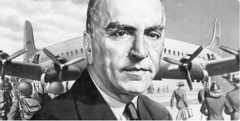
Edward Rickenbacher was born on October 8, 1890 in Columbus, Ohio.He adopted his middle name, "Vernon," later and changed the spelling ofhis last name to "Rickenbacker" in 1918. His father, William, and his mother,Elizabeth (Basler), were Swiss immigrants who met and married in Columbus."Eddie" was the third of eight children, seven of whom lived to adulthood.
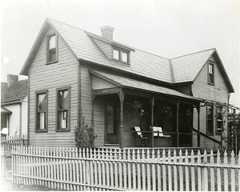 After 1893, William Rickenbacher operated his own construction company,but the family remained mired in poverty. Elizabeth Rickenbacher managed to save up enough money to buy two adjacent lots on East Livingston Avenue shortly after Eddie's birth. Against William's wishes, Elizabeth sold one lot and began building a house with two rooms and a loft on the other lot. The family moved into the house in 1893. They later added on a kitchen with another loft above. The house had no electrity, running water or indoor plumbing. Eddie recalled that most of the land surrounding their home on the outskirts of Columbus was used for growing vegetables and pasturing goats. William was a stern disciplinarian, present- and practical-minded, and Elizabethinstilled in Eddie a great reverence for religion, attributes that seemed to form the nucleus of Eddie's personality. Eddie remained close to his mother until her death in 1946.
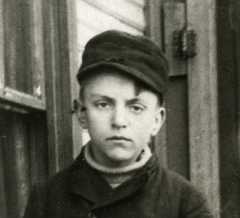 Eddie worked at odd jobs since he was seven years old, earning cashfor his own projects. This changed in 1904 when William was killed at aconstruction site. Eddie attributed his father's death to an accident,but theDictionary of American Biography entry by Dr. W. David Lewisconcludes that William "was killed by an assailant." Nevertheless, Eddiequit school immediately to find work to support his family, dropping out of seventh grade.
Though his older brother (also named William) worked full-time, Eddiedecided it was his job to support the family. He knew his mother and brotherwould oppose him, so he decided to present them witha fait accompli.He lied about his age to circumvent the child-labor laws and got a nightjob as a helper at the Federal Glass Factory. In a few weeks he quit totake a day job at the Buckeye Steel Casting Company. From there he workedin a beer factory, a bowling alley, a cemetery monument yard, and withthe Pennsylvania Railroad as an apprentice. He was unhappy and viewed every job only as a way to make money forhis family.
Like many young men of his era, Eddie was obsessed with technology and speed.The automobile combined both, and it became one of his life-long passions. Eddie saw his first automobile around 1905, a two passenger Ford runabout, and was instantly smitten. His stint in the machine shop of the Pennsylvania Railroad, combined with his lust for adventure and thoughts of the Ford, lured him into the nascent automobile industry.
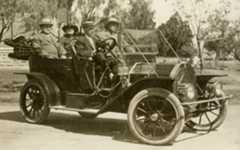 Eddie began his automotive career in the Evans Garage. To upgrade his mechanical skills, he took the mechanical engineering course from International Correspondence School in 1905. He successfully campaigned that same year to land a job with the Oscar Lear Automobile Company in Columbus, working for Lee Frayer. Eddie worked for the Oscar Lear Automobile Company until 1907 whenhe followed Lee Frayer to the Columbus Buggy Company. The photograph shows Eddie in a Firestone-Columbus, driving orator,statesman, and politician William Jennings Bryan (seated behind Eddie)on a Texas speaking tour in 1909. Eddie was in Texas helping the Columbus Buggy Company establish dealerships for the Firestone-Columbus and offered to drive Bryan as an advertising stunt.
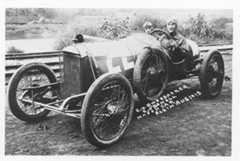 In 1910, working as the Columbus Buggy Company's branchsales manager in the mid-west, Eddie entered his first race as an advertising gimick for the Firestone-Columbus. He raced a stripped down Firestone-Columbus on a dirt track in Red Oak, Iowa. He exited the race after an accident. Eddie raced in the first Indianapolis 500 on Memorial Day, 1911. He raced for the Columbus Buggy Company until 1912, when he left to become a professional racer. He raced for a second rate team called the "Flying Squadron" until the end of 1912, when he took a job with Fred and Augie Duesenberg at Mason Company. The photograph shows Eddie in a Mason with his riding mechanic, Eddie O'Donnell. Eddie raced for Mason until the end of 1914. After a brief time racing for Peugeot and Maxwell, he was named manager of the Prest-O-Lite Racing Team. He raced for Prest-O-Lite until the end of 1916. Eddie enlisted in the U.S. Army in 1917 when Major Lewis Burgess, who was a racing fan, asked him if he would like to go with General Pershing as one of his chauffeurs. He never raced again.
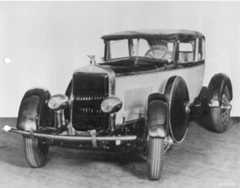 From 1921 through 1927 Eddie was a partner with Byron F. Everitt, Harry Cunningham and Walter Flanders in the RickenbackerMotor Company, manufacturers of a car he claimed to be "worthy ofits name." The company used the Hat in the Ring symbol from Eddie's World War I fighter squadron to market the car. The photograph shows a 1926 Rickenbacker "Super Sport" Coupe. Unusual in appearance, the Rickenbacker autos incorporated highly-advancedsystems such as four-wheel brakes that later became common on all cars.The company pursued technology too aggressively and was too advancedfor their time. Their competition was able to manipulate consumer conservatism and eventually drive the Rickenbacker Motor Company into bankruptcy.
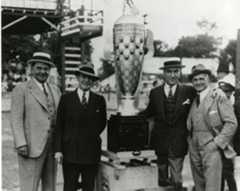 Undaunted by financial failure, Eddie raised $700,000 in one month inorder to buy the Indianapolis Speedway in 1927. The "Brickyard," as itwas called, was host to the most famous of all American automobile races,the Indy 500. Having raced in the first Indy 500 in 1911, he knew theimportance of the race as a testing ground for automotive technology. The photograph shows Eddie with the Borg-Warner Trophy at the Indianapolis Motor Speedway in 1936. Eddieclosed the Speedway during World War II. By the time the war was over,his attention had turned toward running Eastern Air Lines. The repairsneeded to make the Indianapolis Speedway usable after years of neglectwere too much for Eddie. He sold the track in 1947 for what he had paidfor it. Nevertheless, Eddie stayed in contact with automotive racing forthe rest of his life.
Auto racing and manufacturing photos from the Rickenbacker Digital Collection
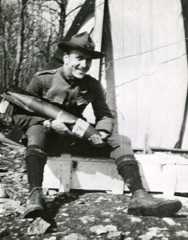 Eddieenlisted in the U.S. Army in May, 1917 as part of the American Expeditionary Forces and arrived in France on June 26.He was assigned as a staff driver forGeneral John Pershing at the rank of sergeant first-class, but what he really wanted to do was fly. With the connivanceof high-ranking friends in the AEF (especially Billy Mitchell), Rickenbacker was accepted into theArmy Air Service even though he was two years over the age limit. He trained at the 2nd Aviation Instruction Center in Tours, France.
When his training was complete, he was commissioned as a first lieutenant andbecame the chief engineer at the poorly prepared training base in Issodun. After making many improvements at Issodun, he was sent for training in aerial gunnery in Cazeau in January, 1918. He qualified as a candidate for training to become a combat pilot, although because of an old injury to his cornea he would never have better than average aim.
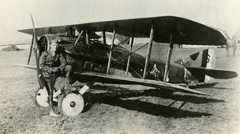 In February, Eddie was sent to Villeneuve-les-Vertus for advanced training and was assigned to the 94th Aero Pursuit Squadron, the first all-American air unit to see combat (April14, 1918). He received training there from Raoul Lufbury, a veteran of the Lafayette Escadrille. He would fly both Nieuport 28s and Spad XIIIs (shown left) in combat. Eddie had his first confirmed victory on April 24, 1918 and in May, he became an ace and won the FrenchCroix de Guerre by shooting down five German airplanes. He was named commander ofthe 94th, the "Hat-in-the-Ring" Squadron, on September 24, 1918. The followingday, Eddie shot down two more German airplanes, victories for which theU.S. government awarded him a belated Congressional Medal of Honor in 1930.His twenty-sixth confirmed victory occurred on October 30, and the lastvictory (the 69th) for the 94th occurred on November 10, 1918. World WarI ended the next day. Eddie returned home in 1919 as America's "Ace of Aces."
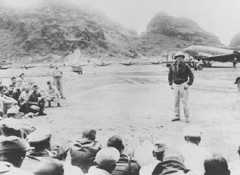 Rickenbacker vehemently opposed the United States' entry into WorldWar II and even joined the "America First" committee.Nevertheless, Eddie supported the war effort once the U.S. committed itself,though he spent the first three months of the war recuperating from anairliner crash. At the request of General H.H. "Hap" Arnold, Eddie touredArmy Air Corps training bases throughout the Southeast during March andApril of 1942 to bolster morale, impress pilots with the seriousness oftheir mission, and secretly examine the bases and training pilots received.In September, Secretary of War Henry Stimson asked Rickenbacker to tourbases in England "as a continuation of your tour of inspection" and toseek out evidence of espionage. Rickenbacker returned from England in October. Stimson immediately sent him on a tour of the Pacific theater.
In October, 1942, leaving from Hawaii on a mission to deliver a top secret message from Secretary Simson to General Douglas MacArthur, Eddie and his aide, Colonel Hans Adamson, boarded a B-17. Along with pilot Captain William Cherry, co-pilot Lieutenant James Whittaker, navigator John De Angelis, radio operator Sergeant James Reynolds and flight mechanics Private John Bartek and Sergeant Alex Kaczmarczyk, the poorly prepared B-17 took off for a refueling stop on Canton Island. Due to inadequate navigational equipment and a faulty weather report,the B-17 overshot its mark. Hundreds of miles off-course and out of fuel,Cherry ditched the plane in the Pacific.
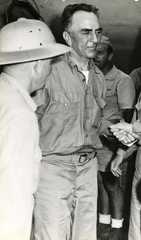 The eight men lashed together the three rubber rafts so they would not get separated. They thought that rescue would come quickly because of Rickenbacker's fame, but they remained lost at sea for twenty-four days. Their meager supply of food ran out afterthree days, but on the eighth day a sea gull lighted on Eddie's head. The unfortunate bird became dinner and fishing bait. Private Bartek's first hand account of the ordeal is a part of this collection.
On the home front, Eddie's wife Adelaide remained optimistic that Eddie would be rescued. When it appeared as though General "Hap" Arnold was giving up on the search, she "stormed into his office and "practically tore the decorations off his jacket," demanding that the hunt continue." Navy pilots finally found and rescued the crew in the Ellice Island chain on Friday, November13, 1942, more than 500 miles beyond Canton Island. The rescue came too late for Sergeant Kaczmarczyk, who died after two weeks at sea.
Suffering from exposure, dehydration, and starvation, Rickenbacker resteda few days then proceeded on his original mission, including inspections at facilitiesat Port Moresby, Guadalcanal, and Upola. He reported to Secretary Stimsonand General Arnold on December 19, and then returned to New York the followingday where he was reunited with his family.
In April, 1943, Eddie took on yet another assignment for Stimson, thistime visiting bases and production facilities in North Africa, the MiddleEast, India, Burma, China, the Aleutian Islands, and the Society Union.
World War II photos from the Rickenbacker Digital Collection
After returning home from World War I, Eddie retained his interest in the potential of aviation, and was on the look out for opportunities.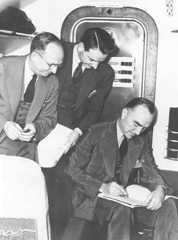 After passage of the Air Mail Act of 1925, he joined Reed Chambers, his 94th Aero Squadron flying buddy, as a silent partner in Florida Airways. This venture lasted less than a year. Eddie took a job as assisstant general manager for sales at General Motors in January of 1928. In June, 1929, Eddie nudged GM into the aeronautics industry with the aquisition of the Fokker AircraftCorporation of America. After a series of disappointments, he resigned from GM in 1932. From there he moved to American Airways for one year. In 1933,he moved back to GM as vice president for public relations of it's aeronautics division, which then included Eastern Air Transport, soon called Eastern Air Lines. Eddie was appointed general manager of Eastern Air Lines on January 1, 1935. By 1938, Eddie had turned Eastern Air Lines into a successful venture for GM. When he learned that GM planned to sell Eastern, Eddie raised $3.5 million in one month to purchase Eastern. The photograph shows Eddie signing a contract to lease space for Eastern Air Lines' offices in the Rockefeller Building in New York City.
At the time, just prior to the Second World War, all airlines in theUnited States used government subsidies to stay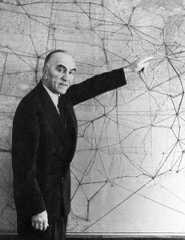 financially sound. The only government monies accepted into Eastern's coffers came from air mail contracts,money Eastern was willing to sacrifice in the interest of building itsempire. Eddie vowed to wean Eastern off of the subsidies and did so in 1939 when he put in a sealed bid of $0 for carryingthe mails across south Texas. His reward was that he secured another legof his dream route across the U.S.'s southern tier and into Mexico.
Immediately following World War II, Eddie purchased new Lockheed Constellationsand Eastern was the first airline to fly them. Eastern collaborated indesigning its successors, the Super-Constellation and the Electra. It alsore-designed its operations to be open and responsive, and implemented atraining system that prepared entry level workers to move up the corporateladder. The "Eastern family" was very loyal to their employer. The pay-off to Eastern was that it was the most profitable airlinein the country in the post-war era. Eddie resigned as president of Eastern Air Lines in 1953 to become it's chairman of the board. He named his long time subbordinate, Thomas Armstrong, president. Armstrong acted as a figurehead while all the important decisions were still made by Eddie. Eddie hoped to eventually name his son William as president of Eastern, but WIlliam had no interest in joining the company.
By the late 1950s, Eddie's ideas began to age. Eastern hadto struggle to keep up with its competition. Eddie became less flexibleas time went on, and a series of bad business decisions, particularly hisinsistence that Eastern continue to use turboprop rather than jet planes,started Eastern on a financial slide. Upper management forced Eddie outas Eastern's chief executive officer on October 1, 1959. Eddie remainedas chairman of the board until December 31, 1963 when he officially retired from Eastern.
Eastern Air Lines photos from the Rickenbacker Digital Collection
Politically, Eddie was always an arch-conservative. He made no pretenseabout his feelings that the New Deal of the 1930s created in the UnitedStates a "socialized welfare state," and he had often spoken on the subject.
As his duties at Eastern Airlines diminished after 1959, he devoted moretime to speaking for conservative causes and, by his own account, opened"a new chapter in my public-address experience" with his hour-long speechto the Chicago Economic Club in April 1961.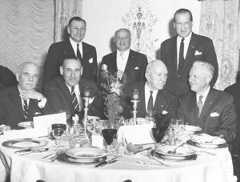 Entitled "Conservatives Must Face Up to Liberalism," it touched a nerveamong his listeners; many of whom were from the economic and politicalelite of Chicago. Eddie eventually had the speech printed as a pamphlet,and he found many other opportunities to deliver similar addresses. Always a philanthropist, hedivided the honoraria from these speeches, $300-$1000 per appearance, amongeight "uplift" organizations such as the Boys' Clubs, Big Brothers, andBoy Scouts of America. In 1957, Eddie donated his Bear Creek Ranch in Texas to the Boy Scouts. The photograph shows Eddie at a Boy Scouts executives dinner.
Over the years, Eddie's tenor changed more than his political opinions.He seemed to grow increasingly bitter in his public utterances. He alsoinjected disturbing racial imagery into his writings during the 1960s and1970s as backlash against the U.S. civil rights movement increased. Evenhis opinions about world affairs changed from resistance to Communist ideologicaldomination of the world to fear of Communist-inspired race war in Asia andAfrica.
 After Eddie returned from World War I as America's hero, he was linked romantically by the press with a variety of women. However, given the grueling travel schedule he kept, he didn't have time for romance. That changed in 1921, when Eddie renewed his aquaintance with Adelaide Frost Durant, whom he had known on the auto racing circuit. She was a beautifuland wealthy divorcee. Her first husband, Cliff Durant, was a racecar enthusiast and driver and son of General Motors founder William C. Durant. Their courtship was brisk, and they marriedin the Cumberland Presbyterian Church of South Beach, CT, before a smallparty of witnesses (including Eddie's childhood minister) on September 16, 1922. Eddie announced the marriageto his mother that evening via telegram. He and Adelaide honeymooned inEurope. In the diary that Eddie kept during their honeymoon, he writes, "Like a child with its first real toy am I, only the most beautiful toy, not in the true sense of the word but in the form of a wonderful Pal to share and suffer through life alike." This diary is part of this collection. The photograph shows them surrounded by pigeons in St. Mark's Square, Venice.It was not the only time a bird landed atop Eddie's hat. When they returned home, they settled in Detroit, Michigan.Before the end of the decade, the Rickenbackers adopted two sons, David Edwardin 1925 and William Frost in 1928.
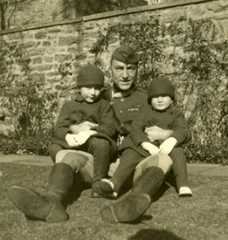 Adelaide and Eddie's marriage lasted until his death in 1973, a total of 51 years. Eddie credited Adelaide with saving his life twice. The first time was after his near-fatal airplane crash near Atlanta, Ga. While he was in the hospital, fighting for his life, his oxygen tent malfunctioned. According to W. David Lewis, "One night Adelaide awakened with an overpowering sense that he was dying. Dashing up a flight of stairs and down a hallway to his room, she found an attendant asleep at the door and saw that Eddie had ripped the tent apart in the ferocity of his struggle to live. After saving him from suffocation, she exploded at the staff for its negligence."
The second time was when he was lost at sea in late 1942. After weeks of fruitlessly searching the South Pacific, the Army Air Corps was ready to abandon the lost crew. Adelaide cajoled General "Hap" Arnold into extending the search for another week. The lost airmen were found within a few days.
A great deal of son William's correspondence survives in thiscollection. The correspondence between Eddie and Bill, from c. 1936 until just beforeEddie's death in 1973, demonstrates a strong bond of affection betweenfather and son. Bill also attests to this affection in his 1970 book,FromFather to Son: The Letters of Captain Eddie Rickenbacker to His Son William,From Boyhood to Manhood. Correspondence and testimony from David arerare, but we can extrapolate from available evidence to say that a similarrelationship existed between him and his famous father. Though loving,Eddie held his sons to high standards of conduct. He required that theylive up to his ideas of hard work and honor as well.
Family photos from the Rickenbacker Digital Collection
For more on Eddie Rickenbacker, seeEddie Rickenbacker: An American Hero in the Twentieth Century by W. David Lewis, Johns Hopkins Press, 2005.