| 1918 KANSAS AND KANSANS | Chapter 44 | Part 1 |
CHAPTER XLIV
THE LAWRENCE MASSACRE
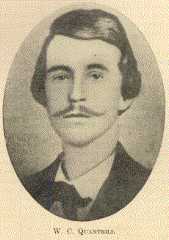
W. C. QUANTRILL
[From Photograph Owned by William E. Connelley]
The flood, in the tide of the Confederacy came in July, 1863, and therecession which followed in the same month indicated that the secession movementwould end in failure. When Vicksburg fell and Lee was defeated at Gettysburg theSouthern cause was lost. And along the border the guerrillas reached theirgreatest strength in the summer of 1863. In the waning of the Confederacy muchof its Western force abandoned the field and returned home. Great accession tothe guerrilla ranks resulted. In July, Quantrill saw that by combining theforces, of the border captains enough men could be assembled, for a masterstroke. They were called together and a plan proposed, but nothing was donebeyond calling another meeting. In the meantime the military prison for womenhad collapsed. In August when the guerrilla chiefs gathered at the rendezvous,use of that unfortunate occurrence, succeeded in enlisting them in his design todestroy Lawrence.
Lawrence had been the chief locality of resistance to the plan of the Southto make Kansas a slave State. Kansas had won her freedom, which had, in effect,destroyed slavery. This was the prime cause for the hatred of Kansas, and madeit the refuge for many of the loyal citizens exiled by Missouri. Lawrence hadbeen the principal point of attack in the old wars waged by the Missourians,many of whom were in the bushwhacker bands in 1863. The former bitternessremained, and it could be more easily fanned to a flame than could the generalanimosity against the State or against any other town.
In his designs against Lawrence Quantrill was but playing a part. Hisimplacability was a personal matter. In 1860 he had lived at Lawrence under theassumed name of "Charley Hart," where ere he led a double life and was guilty ofmany crimes. He was both Border-Ruffian and abolitionist. Pretending to beengaged in securing passengers for the Underground Railroad, he was a kidnapperof free negroes whom he sold into bondage in Missouri. Entrusted with the careof escaped slaves, he returned them to their masters for rewards. Being high inthe councils of a band of thieves, he invaded Missouri for the purpose ofrobbery. Taking advantage of conditions, he despoiled Pro-Slavery residents inKansas of their horses and cattle. Such a course can run only for a limitedtime, and in due season Quantrill found himself under indictment at Lawrence forrobbery and arson. It became necessary for him to seek other fields, in doingwhich he conceived and executed a plot to betray and murder some of hisassociates. Under pretext of obtaining thirty slaves to be sent over theUnderground Railroad from Kansas to Canada, he induced some young anti-slaveryenthusiasts of Atchison County to accompany him in a foray against MorganWalker, a planter and slaveholder in Jackson County, Mo. There he betrayed hiscompanions to death, at least one of whom he murdered with his own hands. Heremained with the Missourians and rose to be chief of the border-guerrillas. Inthis capacity he had sacked Aubry and Shawnee and had plundered Olathe and otherKansas towns.1
That the border might feel some sense of security and the Federal troopsrelax somewhat the severity of their patrol of the State-line, Quantrillcontented himself by spreading disquieting rumors and doing little in thatregion for some weeks. The last invasion of the country in Kansas adjacent tothat through which he proposed to pass was made by Bill Anderson on the 31st ofJuly. On the high land south of Argentine, Wyandotte County, at a cross-roadsknown as "the Junction," lived one Saviers, whose son, Al. Saviers, was anotorious Red Leg and Jayhawker.2Anderson attacked the Saviers house, but was beaten off by the old gentleman andhis daughters. The guerrillas then went west a quarter of a mile to house ofWright Bookout and killed him. Two miles northwest of the Junction they murderedStephen J. Payne and plundered his premises. They went then to the house ofStephen Perkins, a prominent and loyal man, to kill him, but he escaped. Afterburning the Perkins house the guerrillas burned two other dwellings, both on thelands of Shawnee Indians; after which they went up the Kansas River to the housewhere Anderson's sisters had lived and where he had previously been hiding.Taking the family at this house with them, the bushwhackers escaped to Missouri before pursuit could be made.3
This was a daring raid. The murders were committed within four miles ofGeneral Ewing's headquarters and inside his lines.
The general rendezvous of the guerrillas was on the Blackwater, Johnson County, Missouri, at the farm of Captain Pardee. On the night of the 18th of August, every captain arrived there with his command. On the 19th the march on Lawrence began. Great caution was observed. Extensive scouting was done to detect the presence of any Federal force. After riding ten miles toward Kansas, camp was made early in the afternoon. Here Quantrill addressed his men and told them where they were going. Before it was dark the guerrillas were again moving. South of the Little Blue they came upon Colonel John D. Holt, who had one hundred and four men, and he joined the expedition. At seven o'clock on the morning of the 20th the guerrilla column was on the head of the Grand River four miles from the Kansas line. There the last addition to the guerilla force was made, a company of fifty men joining it from points to the south. The guerrillas numbered four hundred and forty-eight men as follows:
| The original force | 294 |
| Holt's command | 104 |
| The last reinforcement | 50 |
| Total | 448 |
At three o'clock in the afternoon of the 20th Quantrill moved toward theState-line from a dense wood he had been concealed. He crossed the line at thesoutheast corner of Johnson County, near Aubry, one of Ewing's posts commandedby Captain J.A. Pike, with about one hundred men. Here began that strange listof untoward circumstances which so much aided the guerrillas in their daringraid. General Ewing, in his official report, said:
| Unhappily, however, instead of setting out at once in pursuit, he remainedat the station, and merely sent information of Quantrill's movement to myheadquarters, and to Captain Coleman, commanding two companies at Little SantaFe, 12 miles north of the line. Captain Coleman, with near 100 men, marched atonce to Aubry, and the available force of the two stations, numbering about 200men, set out at midnight in pursuit. But Quantrill's path was over the openprairie, and difficult to follow at night, so that our forces gained but littleon him. By Captain Pike's error of judgment in failing to follow promptly andclosely, the surest means of arresting the terrible blow was thrown away, forQuantrill would never have gone as far as Lawrence, or attacked it, with 100 menclose on his rear. |
Passing Aubry, the guerrillas dismounted and allowed their horses to grazean hour. Resuming their march at dusk they passed through Spring Hill and turnednorthwest toward Gardner, which they reached at eleven o'clock. Three miles westthey left the Santa Fe Trail and marched north several miles. It was necessaryto have guides, for which service the farmers were impressed, and when they nolonger knew the roads they were shot, ten guides having been killed in onestretch of eight miles. A mile west of the Quaker settlement of Hesper theguerrillas found at home an old man named Stone. He was recognized by GeorgeTodd, who brained him with an antiquated musket. Here they found a young Germanwhom they mounted behind one of their number and forced to guide them intoLawrence. The Wakarusa was forded at the Blue Jacket Crossing, and the oldPro-Slavery town of Franklin was reached at dawn on the 21st of August. Therethey were marching in columns of four, many of them asleep strapped to theirsaddles, and were counted by a resident physician, who found them to number fourhundred and fifty. In coming up to the summit of the ridge beyond Franklin, theguerrillas straggled, but once at the top the formation was perfected, thecolumn of fours resumed, and the descent upon Lawrence, now in plain view,arranged.
Gregg was sent forward with five men to enter the doomed town andsee if it was safe for the army to follow him in. But here some of thebushwhackers lost heart and said the venture was too great. Theycounseled retreat, or at least a drawing off until conditions were betterknown. Quantrill said he would enter the town if he had to go in alone,and when he advanced he was followed by the whole command.
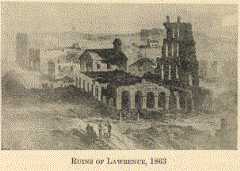
RUINS OF LAWRENCE, 1863
(Photograph of a Wood Engraving in Harper's Weekly, September,1863. - Donated by Sydney Prentice)
[Copy by Willard of Picture in Library of Kansas State HistoricalSociety]
Lawrence was unprotected and helpless. Two camps of recruits were her onlytroops; these numbered less than thirty and were unarmed. The arms provided forthe defense of the town had been taken from the citizens and locked up.Quantrill had been expected often, but had failed to come, and it had become thesettled conviction that he would never appear at the gates of Lawrence. Butthere he was. Gregg found the camp of white recruits as Quantrill came up withhim, and it was instantly ridden down and most of the recruits killed. Thecolored recruits fled at sight of the guerrillas and nearly all escaped. Thecitizens were aroused by horsemen galloping madly through the streets, and therising roar of firearms. The Eldridge House was surrendered on promise ofprotection for the guests, and this promise was kept. Men appeared in thestreets only to be shot down. The torch was applied to dwelling and store.Terror seized the men when the situation was realized. They were shot as theyran to cover. Or if they were concealed by their wives their homes were burnedover them while raving bushmen stood by to murder them if they should try toescape. Stores and liquor shops were looted and burning dwellings ransacked forplunder to carry back to Missouri. Women and children were stripped of jewelry,ornaments, and keepsakes by guerrillas, now drunk and reckless. Husbands weretorn from the arms of shrieking wives and murdered. Wounded men were cast intoseething flames to die by the fire. There was no mercy. While the loot of thetown was being packed on horses to be carried into Missouri those appointed tothe work of destruction rode headlong, firing with deadly aim and yelling likefiends. When burning buildings fell in on trapped men the air was rent withshouts of exultation. Above the tumult rose triumphant cries for Jeff Davis andthe Southern Confederacy. When the town was destroyed, the loot secured, and notanother man in sight to be murdered, Quantrill prepared to leave. Nearly twohundred citizens and non-combatants were dead in the ruins. The vengeance of theguerrilla was satisfied. As he was calling in his bloody band his guards camedown from Mount Oread and reported pursuing columns approaching. Leaving adetail under Gregg to round up the drunken and unruly, Quantrill hurried south.He left a city in ashes, innocent dead in every street, and hundreds of widowsand orphans crying wildly through the gloom or standing hopelessly about theirsmoldering homes. And on the flag under which he fought he left a blood-stainwhich only the charity of the sufferers can ever efface.
1 For an extended account of the life and operations of Quantrill, see Quantrill and the Border Wars, by this author. 2 The "Red Legs" were Federal scouts on the border during the Civil War. The name came from the red leggins which they wore. As a scourge of the border they were little inferior to Quantrill's guerrillas. The term "Jayhawker" was applied along the border at the beginning of the war to irregular troops and pillaging bands on both sides. It was accepted by some of the Kansas soldiers, and soon came to be the name by which all of them were known. It now includes all Kansas people. The origin of the name is unknown, that given by Wilder and Ingalls being erroneous. The name was in use in Texas and the West many years before Kansas was a Territory. 3 Major Plumb sent his brother, George Plumb, in pursuit of Anderson on the morning of August 1st. The guerrillas could not be overtaken. Thomas J. Payne, son of Stephen J. Payne, lives yet at Argentine and has furnished an account of this raid into Wyandotte County. |
| 1918 Kansas and Kansans | Previous Section | Next Section |
A Standard History of Kansas and Kansans, written andcompiled by William E. Connelley, transcribed by Carolyn Ward, 1998.

![[TOC]](/image.pl?url=http%3a%2f%2fwww.ksgenweb.org%2farchives%2f1918ks%2fv2%2f..%2fimages%2fbttoc.gif&f=jpg&w=240)
![[Biog. Index]](/image.pl?url=http%3a%2f%2fwww.ksgenweb.org%2farchives%2f1918ks%2fv2%2f..%2fimages%2fbtbndx.gif&f=jpg&w=240)
![[1918 Index]](/image.pl?url=http%3a%2f%2fwww.ksgenweb.org%2farchives%2f1918ks%2fv2%2f..%2fimages%2fbtndx.gif&f=jpg&w=240)
![[1919 Index]](/image.pl?url=http%3a%2f%2fwww.ksgenweb.org%2farchives%2f1918ks%2fv2%2f..%2fimages%2fbtndx19.gif&f=jpg&w=240)
![[KSGenWeb]](/image.pl?url=http%3a%2f%2fwww.ksgenweb.org%2farchives%2f1918ks%2fv2%2f..%2fimages%2fbtksck.gif&f=jpg&w=240)
![[Archives]](/image.pl?url=http%3a%2f%2fwww.ksgenweb.org%2farchives%2f1918ks%2fv2%2f..%2fimages%2fbtarc.gif&f=jpg&w=240)
