Movatterモバイル変換
[0]ホーム
By Jerry Proc VE3FAB
INTRODUCTIONThe OMEGA radionavigation system, developed by the United States Navyfor military aviation users, was approved for full implementation in 1968and promised a true worldwide oceanic coverage capability and the abilityto achieve a four mile accuracy when fixing a position. Initially, thesystem was to be used for navigating nuclear bombers across the North Poleto Russia. Later, it was found useful for submarines.
When the eight station chain became operational, day to day operationswere managed by the United States Coast Guard in partnership withArgentina, Norway, Liberia, France, Japan and Australia. Coast Guard personneloperated two U.S. stations - one in LaMoure, North Dakota and the otherin Haiku, Hawaii. OMEGA employed hyperbolic radionavigation techniquesand the chain operated in the VLF portion of the spectrum between 10 to14 kHz. Near its end, it evolved into a system used primarily bythe civil community. By receiving signals from three stations, am Omegareceiver could locate a position to within 4 nm using the principle ofphase comparison of signals. In the Royal Canadian Navy, the OMEGA systemwas used in the AOR, 280 and Halifax class ships.
HISTORY
John Alvin Pierce, the "Father of Omega," first proposed the use ofcontinuous wave modulation of VLF signals for navigation purposes in the1940's. Working at the Radiation Laboratory at the Massachusetts Instituteof Technology, he proved the viability of measuring the phase differenceof radio signals to compute a location solution. Pierce originally calledthis system RADUX. After experimenting with various frequencies, he settled on a phase stable, 10 kHz transmission in the 1950's. Thinkingthis frequency was the far end of the radio spectrum Piercedubbed the transmission "Omega," for the last letter of the Greek alphabet.
Radux-Omega showed the possibilities of very-low-frequency propagation,but there were fears about ambiguity errors if a single low frequency wereused on its own. In the 1950's two new factors appeared - the inertialnavigation system (INS) and the great increase in electronic system reliabilityfollowing the introduction of the transistor. INS was not all that accurate,particularly in ships, where it had to run for days on end without correction,but it could certainly carry over short losses of signal and resolve anycycle slippage that might have occurred, while better reliability meantthat such outages were far less likely anyway.
Thus, ambiguities might be much less of a problem than thought, andthe development of a single frequency system began to seem feasible. The40 kHz of Radux was dropped and a new system using transmitters in Californiaand Hawaii was set up, transmitting at 12.5 kHz. They provided good resultsand two further transmitters were added in Panama and the Post Office stationat Criggion, North Wales. All these stations ran on their own time standards,the development by Dr L. Essen of the National Physical Laboratory. Thisnew type of extremely stable crystal oscillator, named after him, madethis progress possible. Later, Dr Essen also built the first cesium beamatomic resonator.
These experiments continued throughout the 1950's and provided a greatdeal of data on propagation characteristics. Nothing that was found discouragedthe idea of a navaid operating at low frequencies. In 1963, an Omega ImplementationCommittee (OIC) was formed chaired by Prof. Pierce and consisting of mostof those who had been concerned with the earlier experiments. They werecharged with designing the new navaid and, on the basis of their experiments,took the decisions about how Omega would work - the choice of frequencies,location of transmitters, power levels, etc. Originally it was calculatedthat a 10 KW power level from each transmitter would prove more than sufficientfor reliable reception. Due to the high cost of constructing VLF antennas(Omega antenna towers were more than 1,200 feet in height), the first experimentaltransmissions were actually existing VLF communications stations that weremodified for Omega transmissions. This committee always denied later thatthe Decca work on Delrac, disclosed 9 years earlier, had had any effecton their deliberations, but it was interesting that they chose identicalfrequencies and other characteristics.
Over 31 possible transmitting sites were considered. Eventually, eightlocations were established as permanent transmitting stations. The Bratland,Norway station (near the Arctic Circle) and the Haiku Valley station onOahu, Hawaii, originally experimental stations, were among the first inthe system. In 1968, the U.S. Navy authorized full scale implementationof the Omega System based on the OIC report. Responsibility for the operationwas transferred from the U.S.Navy to the U.S. Coast Guard in 1971, underthe terms of title 14, USC 82. The Coast Guard created a new command, theOmega Navigation System Operations Detail (ONSOD) to operate the system.ONSOD control of the synchronization of the system was perfected whilethe Navy Project Office finished the task of constructing the stations.As construction of the final six stations proceeded through the 1970's,ONSOD assumed the duties of engineering maintenance for those stationsas they were declared operational. Eventually, eight permanent stationslocated in Bratland, Norway; Paynesville, Liberia; Kaneohe, Hawaii, US;La Moure, North Dakota, US; Plaine Chabrier, La Reunion, France (IndianOcean); Golfo Nuevo, Chubut, Argentina; Woodside, Victoria, Australia;and Shushi-Wan, Tsushima Island, Japan were completed.
Separate bilateral agreements were negotiated between the U.S. and thesix partner nations. ONSOD, later the Omega Navigation System Center (ONCEN),was named the Operational Commander (OPCON) with each partner nation maintainingresponsibility for administrative control (ADCON). The U.S. owned and maintainedall the Omega related equipment at each station. The host nation providedpersonnel, funding and non-Omega support for the station. Partner nationcrews came from military and civilian sources. The Argentine and Frenchstations were crewed by both military and civilian members of their respectiveNavies; the Japanese station was crewed by uniformed members of the JapaneseMaritime Safety Agency, while the Australian station were staffed by civilianemployees of the Maritime Safety Agency (equivalents of the U.S. CoastGuard); and the Liberian and Norwegian stations were crewed by civiliangovernment employees. It took a tremendous effort, on the part of TeamCoast Guard, to provide the system with world class support. The organizationsinvolved in this unique international system included Commandant (G-OPN-3);CG Navigation Center (NAVCEN), the current OPCON; Engineering LogisticsCenter (ELC) Baltimore; Electronics Engineering Center (EECEN); Civil EngineeringUnit (CEU) Cleveland; Civil Engineering Unit (CEU) Honolulu; CG FinanceCenter (FMCEM, Chesapeake, VA; the Eighth Coast Guard District, New Orleans,LA; and the Fourteenth Coast Guard District, Honolulu, Hawaii.
Before OMEGA could even be inaugurated, it invoked litigation againstthe United States government as the Decca Navigator Company of London,England had proposed a very similar system many years earlier and calledit DELRAC. In 1962, what eventually became the OMEGA system appeared ina U.S. proposal to International Civil Aviation Organization using thetitle "DELRAC/OMEGA" although it later defaulted to plain OMEGA. The technicalsimilarity between OMEGA and DELRAC was obvious and there was considerablebad feeling at Decca that they had not received due recognition of theirmuch earlier efforts. Decca eventually sued the U.S. Government in 1976for infringement of DELRAC patents and were awarded $44,000,000 damages.The U.S. never claimed OMEGA was a military navaid in the court case. Bythen, they didn't really need it for either aircraft or submarines, having developed inertial navigation systems. It had only implemented OMEGAworld-wide by claiming it was a civilian navaid.
It was not the first time Decca had sued the U.S. Government over anavaid - they had done so in 1967 over Loran-C, and won the case thereas well. Unfortunately for Decca, the Americans claimed Loran-C was a militarysystem necessary for "national security" and did not have to pay up eventhough found guilty by a court of law. It's strange that the same argumentwas not raised in the case of OMEGA.
Omega achieved full eight station implementation in 1983 and was usedby several airlines flying long range routes over water as well as by militaryforces. Towards the end of it's service life, the Omega system was upgradedwith new timing and control equipment; Paynesville, Liberia being the laststation to be upgraded in the Spring of 1996. Since the original equipmenthad been designed in the 1960's, certain critical components had becomeobsolete and could no longer be procured for replacement purposes. Withan initial termination date set for the year 2005 or longer, this upgradeprogram had to be executed to ensure that the system continued full andreliable operation in the short term.
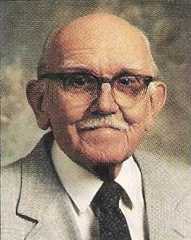 John (Jack) A. Pierce, who retired from a position as a senior researchfellow at Harvard University, Cambridge, Mass. was awarded the Medal ForEngineering Excellence in 1990 for the "design , teaching and advocacyof radio propagation, navigation and timing which led to the developmentof Loran, Loran C and Omega." In 1941, Pierce began working at theMassachusetts Institute of Technology's Radiation Laboratory which wastesting the United States' first hyperbolic radio aid to navigation calledLoran. It inaugurated in October 1942. Later work produced Loran C whichoperated at a lower frequency of 100 kHz. After WWII, he was appointedsenior research fellow in applied physics at Harvard and from 1950 to 1974did work on low frequency navigation aids that lead to Omega. John (Jack) A. Pierce, who retired from a position as a senior researchfellow at Harvard University, Cambridge, Mass. was awarded the Medal ForEngineering Excellence in 1990 for the "design , teaching and advocacyof radio propagation, navigation and timing which led to the developmentof Loran, Loran C and Omega." In 1941, Pierce began working at theMassachusetts Institute of Technology's Radiation Laboratory which wastesting the United States' first hyperbolic radio aid to navigation calledLoran. It inaugurated in October 1942. Later work produced Loran C whichoperated at a lower frequency of 100 kHz. After WWII, he was appointedsenior research fellow in applied physics at Harvard and from 1950 to 1974did work on low frequency navigation aids that lead to Omega.Among his many awards are a 1948 Presidential Certificate of Merit andthe 1953 Morris Liebmann Prize of the Institute of Radio Engineers. Heearned a BA in physics from Harvard while an assistant at the University'sCruft Laboratory.(Photo and copy courtesy IEEE Spectrum, August 1990) |
Herbert Rideout, an engineer who worked on the developmentof long range radionavigation and communications at Pickard & Burns,recalls some of the early research. "Jack Pierce worked at CruftLaboratory, Harvard University. Working for the university was consideredprestigious , however the wages paid were low, so engineers associatedwith the radionavigation program usually worked for commercial companieswho paid prevailing wages . One of those companies was Pickard & Burns,Needham MA which was under contract with the US Navy. We were closely associatedwith Jack and were in constant daily contact. We were able to accomplishwhatever Cruft Laboratory could not do such as designing and fabricatingprototype equipment. (Draco equipment, described further in this passage,fell into this class). My direct boss at Pickard & Burns wasDr. Richard H. Woodward, a graduate of Harvard and during WWII, worked along side Jack Pierce at the M.I.T. Radiation Laboratory developing Loran.Richard was one of the authors of "Loran" Volume 4 of the Radiation LaboratorySeries. Pickard & Burns was a small company, having about 20engineers on staff but we did other work besides radionavigation. As anengineer, I occasionally skipped around to other jobs, however Jack likedme and when I went on my trip aboard the vessel USS Compass Island to theMediterranean, he said I brought back the best and most accuratedata he had ever received, so from then on I belonged to Jack. The CompassIsland was a US Navy research vessel stationed at the Navy Yard in NewYork City.When the Compass Island departed New York, she was packed several differentnavigation systems which were being evaluated by the US Navy. Atthat time, the Navy was interested in testing out any navigation systemthat might be suitable for submarines. One of them, from Cornell University,measured gravity. Since the force of gravity is never the same in any twoplaces on earth, measuring it would permit position to be determined. A second system, SINS (Ships Inertial Navigation System) was North AmericanAviation's inertial navigation system. The third system from Reeves Kodakused some type of celestial based system to fix position. Lastly, therewas Draco, which was intended to be a worldwide VLF hyperbolic radionavigationsystem. It was the brain child of John Pierce with Pickard &Burns supporting him. That system was named Draco after the constellationDraco but I do not know who gave it that name.
During the voyage, a formal Draco test program was followed which wouldinvestigate these specific areas:
* Field intensity and noise in the VLF spectrum.
* Draco navigation capability.
* Reception of communication signals with a Draco receiver having a100 cycle bandwidth1.
* Reception of communication signals with a Draco receiver having aspecial 20 cycle filter1..
* Reception of special phase shift keyed signals with a Draco receiver.
Two AN/URM-6 (14 kHz - 250 kHz) field intensity meters, one narrowbandwidth filter for the Draco receiver-indicator. and three magnetic taperecorders had been installed on the Compass Island during the first weekin March 1958. An electronic antenna coupler was also installed so twoURM-6 units could be attached to the ship's VLF whip antenna. Both of thefield intensity meters were calibrated by the Dinger shield injection methodand the effective height of the antenna was determined. Once allthe equipment was installed and pretested, a preliminary cruise wasscheduled from March 8 to 11, to check the full operation of the gear.During this trip it was found that the noise in the antenna coupler wastoo high so the URM-6 equipment was connected directly to the whip antennathus bypassing the antenna coupler.
Once everything was operating to expectations, the ship departed NewYork City on 13 March and reached the Mediterranean on 23 March takingup position at 17 degrees East longitude. After cruising for 18 days (includinga 3 day stopover at Palma, Spain) and taking measurements, it wastime to depart. On the 9th of April the Compass Island left the Med returningto New York on April 17. The tests were very promising. Field intensityand Draco measurements were recorded using three VLF transmitter stations;NSS(15.5 kHz) at Annapolis, Maryland;NLK (18.6 kHz) at Jim Creek.Washington; andGBZ (19.6 kHz) at Criggion, Wales.
Besides being designed for hyperbolic navigation, Draco was being proposedfor use as a secret, one-way communications system for submarines. It worked like this: VLF transmitters NLK at Jim Creek, Washington State,and NSS Annapolis, MD had their individual frequencies stabilized to veryaccurate levels - below that of one cycle. To an astute observerit seemed they drifted at a random rate. The drift was introduced by usingmechanical cams which drove servo motors which in turn introduceda precise known drift rate of less than one cycle. At the receivingend, Draco consisted of rack mounted equipment comprising of two receivers,a phase comparator and a stabilized frequency reference all designed byPickard & Burns. Received VLF signals from NLK and NSS were then fed into the phase comparator and in turn compared to a highly accurate oscillator.The difference or output representing the drift rate of the VLF transmittedsignals was represented by a voltage - the faster the drift the largerthe voltage. The output voltage drove servo motors in a mechanical devicethat in turn drove other servos which gave a DC output voltage correspondingto the drift rate. This voltage was used to drive Esterline Angus chartrecorders.
Uncorrected, the line on the chart would go from left to right representingthe drift but when mechanical cams were installed which were the reverseof those in the transmitter we would see a straight line down thecenter representing zero phase shift in the transmitted signal. Atpredetermined times we would have our engineers at the transmittingsites introduce different drift rates and these would show up at our receiveend as a lower or higher chart reading. It was these deviations that wereproposed for communications since submarines could receive these signalswithout surfacing. In one test, the phase of the signals from JimCreek were shifted 3 times during a period of 7 minutes to produce theletter 'S' in Morse code. These special transmissions were repeated oncean hour for several days during the tests in the Med. Since the Draco equipmentresponds to shifts of phase, it was easy to read the strip recordings producedby the special transmissions.
Before leaving on the trip I asked Pierce how often he wanted the equipmentcalibrated and he said every 4 hours around the clock for the whole sixweek trip. This became somewhat complicated since it took two hoursto calibrate everything. Aboard ship, I shared a cabin with one ofthe officers and my getting out of bed every two hours in the night didupset him a bit but even worse for me. Because I was a civilian, I wasconsidered the junior officer and had to sleep in the upper bunk whichhad a ventilating duct four inches above my head. It was then thatI discovered whenever I turned over during the night I automatically liftedmy headfive inches!
After the trip, the Cornell and Reeves-Kodak systems were never to beseen again. In August 1958, Jack Pierce and Dick Woodward prepareda technical report on the operation of the Draco equipment . The measurementsshowed that the average field intensity of the signals from station NLKat Jim Creek in Washington varied from roughly 30 microvolts per meterduring the day to 100 to 200 microvolts per meter at night as observedin the Western Mediterranean Sea at a range of about 6,000 nautical miles.
The corresponding signal from station NSS at Annapolis, Maryland, variedfrom 300 microvolts per meter during the day to nearly 1.000 microvoltsper meter at night in the same area at a range of about 5,000 nauticalmiles. These observations are in reasonable agreement with predictionsbased on the Pierce empirical formula for VLF propagation. But the observedsignals from Jim Creek were several decibels weaker than the predictions.Presumably the losses were at caused at reflection points where the groundhad poor conductivity.
The average noise level in the Western Mediterranean Sea varied fromabout 30 microvolts per meter at 0800 hours GMT to about 90 microvoltsper meter at 1500 hours GMT. These observations were made in the springtimeand, of course, higher values would be expected during the winter. It wasdifficult to analyze some of the results obtained from the Draco navigationequipment because station NSS was out of sync most of the time. However,the errors in the navigator's fixes were comparable with the errors inthe Draco system. The consistency of the Draco observations indicate thatthe Draco errors rarely exceeded a mile or two in the Mediterranean area.Comparison of the qualities of signals from NLK and NSS as received withthe Draco and the Model AN/SRR11 receivers indicated that the Draco receiverwas equivalent in performance to the latter.
It was therefore concluded that the Draco equipment could be used forcommunication as well as navigation. No significant improvement in performancewas obtained by the introduction of a 20-cycle filter in the Draco receiver.The Draco strip chart recordings of special phase-shift keyed transmissionsfrom Jim Creek demonstrated that simple messages could be transmitted reliablyat a range of at least 6,000 nautical miles. Presumably such simple messagescould be recorded and read at the same range (6,000 nautical miles) anddepth (20 feet) under sea water as can Draco signals.
After I completed my work on the Draco project, I began to realizemy interests weren't in the field of radionavigation so in 1959 I camewest to work for North American Aviation. Soon I designed some equipmentfor the McDonald F-4 aircraft which made the company a great dealof money so I remained with them as a Project Manager. Jack Pierce retiredto Weare, NH and died there in 1996 at the age of 88. As of 2005, RichardWoodward is living in Cape Cod, MA.".
Although Draco never became a radionavigation system in its own right,measurements made during its
development may have been applied to Omega or into other submarinecommunication systems.
(Click to enlarge) | Cover of P& B Inc. product brochure from1957. The company was founded in 1945 and later became a subsidiary ofthe Gorham Corp. in 1960 In 1964, P&B was auctioned off and purchasedby LTV Corp . By 1970, Cardwell Condenser Co. of New York purchased P&Bfrom LTV. After that P&B slipped into oblivion.(Brochure providedby Herbert Rideout) |
 | This is just some of the equipment produced byP & B Inc around 1957.(Brochure provided by Herbert Rideout) |
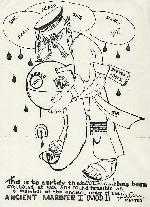 | This is the certificate presented to personnelwho participated in the Draco and SINS evaluations aboard the USS CompassIsland. (Provided by Herbert Rideout) SINS was the "Ships Inertial Navigation System" made by Autonetics a
division of North American Aviation in California. SINS was usedon the
submarines and other programs such as the Minuteman Intercontinental
Ballistic Missile and North American's Cruise Missile (GAM-77 [AGM-28]HOUND DOG) that was launched from a B-52.
|
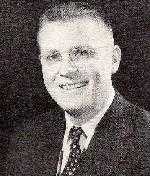 HaroldS. Burns- Co-Founder and President P & B Inc HaroldS. Burns- Co-Founder and President P & B IncHarold Burns, W1KVX, received engineering training at the Eastern RadioInstitute and the University of Hampshire and is a member of the Instituteof Radio Engineers, Institute of Navigation and the American ManagementAssociation. He has a broad background of experience in the installation,testing and operation of Navy shipboard radio and electronic equipmentand high power international short-wave transmitting installations. DuringWWII, he was chief engineer and production manager directingprojects of both applied research and the production of precision quartzfrequency elements, frequency measuring apparatus and radar components.(Photoand copy courtesy P & B Inc) Harold left P&B in 1962 to start a new company Electro Marine Corp.on Cape Cod, MA. He died 8 Sept.1999 at the Cape Heritage NursingHome in Sandwich, Mass., after a brief period of hospitalization. He was81. |
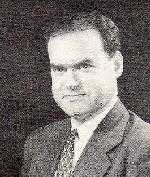 Dr.Richard H. Woodward- Vice President Engineering, Chief NavigationSection of P& B Inc. Dr.Richard H. Woodward- Vice President Engineering, Chief NavigationSection of P& B Inc.Dr. Woodward, B.S., M.S., D.Sc. in Electrical Communications from HarvardUniversity, is a member of the Institute of Radio Engineers, the AmericanPhysical Society, and the American Association for the Advancement of Science. He helped to develop the Loran system of navigation and was of the technicaladvisors assigned to the Telecommunications Research Establishmentin England. There he helped to introduce Loran into the Royal Air Forceand had close contact with the anti-jamming problems associated withGee and Loran. His work at Pickard & Burns included studies of radiopropagation and navigation systems for the Air Force, developmentof a high precision short range navigation system for the US Navy, andconsulting on a long range navigation system at the Navy ElectronicsLaboratory in San Diego along with the design and construction of equipmentfor this system.(Photo and copy courtesy P & B Inc) |
VLF TRANSMISSIONSHerbert (Art) Rideout explains the use of the AN/URH21 receiver-recorder.
"Monitoring stations were established to determine the VLF signal strengthsin the Pacific area. This was necessary to determine the feasiblyof communicating with submarines and if the signal strength was adequatefor underwater navigation. I set up stations at Shemya Alaska, Hawaii,Fiji, New Zealand, Australia, Jakarta, Philippines, Japan and Wake Island. At Shemya they had a BC-610 and 75A4 with a Rhombic antenna pointing atthe States. At the time I was W1KQG and I tried to make contact withHarold Burns W1KVX but no luck, heterodynes from all the stations callingme made it impossible. The next year, 1959 I came west to work forNorth American Aviation. I hated to leave Pickard & Burns I hadmany good friends and the projects were fascinating. Jack Piercewanted me to work for him at Harvard but the money was not there",
Knowing VLF signal strengths would no doubt help in the developmentof the Omega radionavigation system.
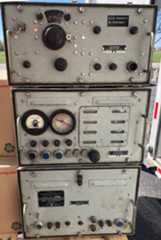 |
| AN/URH-21(XN-1) receiver. It was used with anwith an Esterline-Angus chart recorder. (Photo courtesy Nick England) |
SIGNAL CHARACTERISTICSOmega utilized CW (continuous wave) phase comparison of signal transmissionfrom pairs of stations. The stations transmitted time-shared signals onfour frequencies, in the following order: 10.2 kHz, 11.33 kHz, 13.6 kHz,and 11.05 kHz. During its life cycle, the system used quite a lot of frequencies at different times. For instance, 12.1, 12.0, 11.55, 13.1,12.3, 12.9, 13.0 and 12.8 kHz were employed. 11.05 kHz was introduced inan attempt to enlarge the area of non-ambiguity. The difference frequencybetween this and 11.33333 kHz produces a lane width of no less than 328miles. In addition to these common frequencies, each station transmitteda unique frequency to aid station identification.
The inherent accuracy of the OMEGA system was limited by the accuracyof the propagation corrections that were applied to the individual receiverreadings. These corrections were in the form of predictions from tableswhich were applied to manual receivers or stored in memory and appliedautomatically in computerized receivers. The system was designed to providea predictable accuracy of 2 to 4 nm which depended on location, stationpairs used, time of day, and validity of the propagation corrections.
| TRANSMISSION INTERVAL > | 0.9 | 1.0 | 1.1 | 1.2 | 1.1 | 0.9 | 1.2 | 1.0 | 0.9 |
| | | | | | | | | |
| A. Norway | 10.2 | 13.6 | 11.33 | f1 | ------ | ------ | ------ | ------ | ------ |
| B. Liberia | f2 | 10.2 | 13.6 | 11.33 | f2 | ------ | ------ | ------ | ------ |
| C. Haiku, Hawaii | ------ | f3 | 10.2 | 13.6 | 11.33 | f3 | ------ | ------ | ------ |
| D. LaMoure, ND. U.S.A. | ------ | ------ | f4 | 10.2 | 13.6 | 11.33 | f4 | ------ | ------ |
| E. Reunion Island | ------ | ------ | ------ | f5 | 10.2 | 13.6 | 11.33 | f5 | ------ |
| F. Argentina | ------ | ------ | ------ | ------ | f6 | 10.2 | 13.6 | 11.33 | f6 |
| G. Australia (Trinidad was a temporary site) | 11.33 | ------ | ------ | ------ | ------ | f 7 | 10.2 | 13.6 | 11.33 |
| H. Japan | 13.66 | 11.33 | ------ | ------ | ------ | ------ | f 8 | 10.2 | 13.6 |
| The Omega signals consisted of a sequence of C.W. pulses transmitted from each station on three frequencies, 10.2 kHz, 11.33 kHzand 13.6 kHz. The sequence was non-ambiguous and synchronized to universaltime. Each interval was separated by 0.2 seconds. The eight stations providedworld wide coverage on approximately a 10 second period. Three Omega transmissionswere needed to determine a position fix. Later, 11.03 kHz was introducedto enlarge the area of non-ambiguity. (Table courtesy of DeccaNavigator News, June 1973) |
All OMEGA signal patterns are transmitted starting at zerotime (OMEGA Time) and are maintained at the exact starting time throughatomic clocks at each transmitting site. All frequencies are phase lockedto zero time. All frequencies cross zero phase with a positive slope atexactly 0000 OMEGA Time.Initially OMEGA station transmissions were started at universal time.However, universal time is corrected for changes in the earth's rate ofrotation; these conditions, called leap seconds, are made periodically.Corrections to OMEGA Time to account for leap seconds are difficult becauseof complex interrelationships between stations. Additionally, signals usedduring the time change present a synchronization problem. Consequently,OMEGA Time is maintained at a steady rate and is not updated. All OMEGAstations are timed and controlled by a cesium beam atomic clock which isaccurate to 1 second in 3000 years. The overall accuracy is on the orderof a few parts in 10^12.
STATION TABLESTATION
LETTER | STATION LOCATION | ANTENNA TYPE | LAT/LONG | TRANSMISSION STATUS |
| | | | |
| A | Bratland, Norway | Valley span | 66° 25'N
13° 08'E | Normal 10 kw transmission. |
| B | Paynesville, Liberia | Grounded tower | 06° 18'N
10° 40'W | 10 kw transmission .
Modal interference at night. |
| C | Kaneoke, Hawaii | Valley span | 21° 24'N
157° 50'W | Normal 10 kw transmission. |
| D | LaMoure, ND | Insulated tower | 46° 21'N
98° 20'W | Normal 10 kw transmission. |
| E | Plaine Chabrier,
LaReunion (Indian Ocean) | Grounded tower | 20° 58'S
55° 17'E | Normal 10 kw transmission. |
| F | Golfo Nuevo, Chalut
Argentina | Insulated tower | 43° 03'S
65° 11'W | Normal 10 kw transmission. |
| G | Woodside, Victoria, Australia. Temporarilyassumed by Trindad | In planning | 38° 29'S
146° 56'E | Came on line around 1980.
Trinidad power level was 1 kw |
| H | Shushi-Wan,
Tsushima Island, Japan | Insulated tower | 34° 37'N
129° 27'E | Normal 10 kw transmission. |
| Omega summary information was broadastfrom WWV, Boulder Colorado at 16 minutes after each hour in a 40 secondduration. |
The VLF range of 10-14 KHz was selected as the best range forOMEGA primarily because of:1. Presence of a wave guided mode to VLF signals which follows the earth'scurvature and provides signal detection over great distances with a relativelylow (10KW) power output.
2. Excellent stability of VLF signals.
3. Relatively wide distances between points where phase measurementswould be the same (distances between points of equal phase measurements).
VLF WAVE GUIDED MODE
VLF propagation contains several different transmission modes: groundwave. sky waves and wave guided wave.
The wave guide effect occurs when a wave passes through a cavity whichreflects the wave and confines it to the enclosed space within the cavity.An effect similar to the wave guide effect occurs when very low frequencytransmissions travel over the earth's surface. Signals in the 10-14 KHzrange behave as though propagated through a waveguide of concentric spheres. In this case, the spheres are the earth and the ionosphere.
The stability of an OMEGA signal is the primary reason these waves aredesirable for navigation. Stability of a VLF OMEGA signal indicates thewave propagates with similar characteristics, without distortion. at almostanydistance from the transmitting station as long as it is receivable. Thisstability is confirmed through monitoring of OMEGA VLF signals at variousearth locations. Monitoring has also shown changes in exact phase measurementof VLF signals. Actual measurement at a given time can be predicted withgreat accuracy even though exact phase measurements differ greatly dayto night. season to season.
Wave guided signals travel great distances from the station with almostunlimited range over water; over land they attenuate at a greater rate.The greatest loss of signal occurs over the ice cap. A wave propagatedin one direction over water (the long way around the world) could be receivedwhile a direct signal from the station might not be received due to signalattenuation over an ice cap. When this occurs the predicted position fixaccuracy becomes extremely low and the signals should be considered invalid.
Also, when the receiver is a great distance from the transmitters, signalsmay be received from both directions, resulting in a combined signal phaseshifted an unknown amount. Therefore, use of OMEGA signals is not recommendedwhen the receiver is more than 8000 NM (great circle distance) fromthe transmitting stations.
SYSTEM ERRORS
The earth is not a perfect waveguide. The imperfect walls of the earthionosphere waveguide affect signals in many ways. Phase velocities in theVLF range are primarily dependent upon the condition of this waveguidethrough which they are propagated. The earth's waveguide condition is afunction of the shape and height of the ionosphere which is in turn a functionof the position of the sun and the season of the year. As a consequenceof these, and other factors, there are eight (8) basic error sources whichcontribute in varying degrees to the overall OMEGA system accuracy. Twoout of 8 error sources are described below. The other six were missingin the source material.
DIURNAL EFFECT
The first error source of concern is called the diurnal effect. It isprincipally associated with the sun's position since its radiation adjuststhe height and shape of the ionosphere. During daylight hours, the ionizationlayer will lower to about 70 KM, thereby increasing the phase velocity.At night, the layer moves up to about 90 KM, thus decreasing the phasevelocity. This effect will also be seasonal and, of course, nonlinear duringtransition.
A long propagation path may be either entirely sunlit (day), entirelydark (night), or experiencing mixed illumination (transition). For longpaths, night may be only a few hours; for Arctic paths during the summermonths there may be no night at all. Propagation tends to be most stableduring the day although conditions do vary slowly. At night conditionstend to be constant but less stable than during the day. Transition periodsare of intermediate stability and present additional complications in predictionand application.
GROUND CONDUCTIVITY
The second source of error is ground conductivity. Extreme variationsin phase velocities are detectable between sea water, representing low attenuation, and ice which is high in attenuation and hence slows thephase velocities. Water is a near perfect conductor in the VLF spectrumand does not greatly affect the signal.
Propagation correction tables and formulas were based on theoreticalmodels calibrated from worldwide monitor data taken over long periods.A number of permanent monitors were maintained to assess the system accuracyon a long term basis. The specific accuracy attained depended on the typeof equipment used as well as the time of day and the location of the user.In most cases, the accuracies attained were consistent with the 2 to 4nm stated in the system design goal. There were a few cases where muchbetter accuracy was reported. A validation program conducted by the USCGindicated that the OMEGA system met its design goal.
OMEGA had an availability of greater than 99 percent per year for eachstation and 95 percent for three stations. The annual system availabilitywas greater than 97 percent which included scheduled off air time. Scheduledoff air periods were announced up to 30 days before the off air activitywas to occur.
The system provided independent position fixes once every ten secondsand was capable of two or more lines of position (LOP's) fix . Due to thefact that Omega antennas were towers around 1,200 feet tall, thatmade the system very expensive to install.
AMBIGUITY
In this CW system, ambiguous LOP's occur since there is no means toidentify particular points of constant phase difference which reoccur throughoutthe coverage area. The area between lines of zero phase difference werecalled lanes. Single frequency receivers use the 10.2 kHz signals whoselane width is about eight nautical miles on the baseline between stations.
Multiple frequency receivers extended the lane width, for the purposeof resolving lane ambiguity. Lane widths of approximately 288 nm alongthe baseline could be generated with a four-frequency receiver. Becauseof the lane ambiguity, a receiver had to be preset to a known locationat the start of a voyage. The accuracy of that position had be known withsufficient accuracy to be within the lane that the receiver was capableof generating (i.e., 4 nm for a single frequency receiver or approximately144 nm for a four-frequency receiver).
Once set to a known location, the Omega receiver counted the numberof lanes it crossed in the course of a voyage. This lane count was subjectto errors which could be introduced by an interruption of power tothe receiver, changes in propagation conditions near local sunset and sunrise,and other factors. To use the single frequency Omega receiver effectivelyfor navigation, it was essential that a dead reckoning plot or similarmeans be carefully maintained and the Omega positions compared to it periodicallyso that any lane ambiguities could be detected and corrected.
The accuracy of an Omega phase difference measurement was independentof the elapsed time or distance since the last update. Unless the Omegaposition was verified occasionally by comparison to a fix obtained withanother navigation system or by periodic comparison to a carefully maintainedplot, the chance of an error in the Omega lane count increased with timeand distance. These errors were reduced in multiple frequency receiverssince they were capable of developing larger lane widths to resolve ambiguityproblems.
Omega receivers were used in the Number 3 position on some 747’s asbackup for the two Inertial Navigation Systems.
AN/SRN-12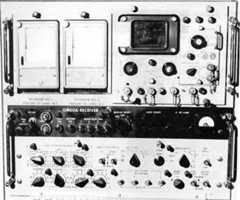 |
| TheAN/SRN-12 is one example of an OMEGA receiving set. It's a solid state, single frequency, phase-locked, superheterodyne navigationreceiver designed for use in surface ships. The AN/SRN-12 received the10.2 kHz transmissions, phase-locks and tracks any four selected stations'signals, measured the phase of each tracked signal with respect to a highlystable internal oscillator and computed and displayed three selected phasedifferences (LOPs). Lines of position were displayed on nixie tube indicatorsand a permanent record was stored on a graphic recorder. A built in oscilloscopewas used for visual monitoring of received OMEGA signals and troubleshooting.An built-in emergency battery power supply maintained synchronization duringbrief (up to 5 min) power outages. (Photo courtesy RCN) |
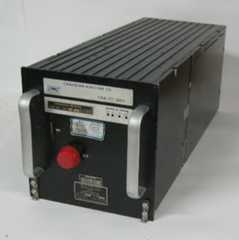 |
| This is an example of a processor receiver unit removed froman unknown commercial aircraft. It has a serviceable tag from Avionics& Aircraft Systems, Inc. dated 1/30/92. The nameplate reads: CANADIANMARCONI COMPANY CMA-771, RECEIVER PROCESSOR UNIT, OMEGA NAVIGATION SYSTEM,PN 473-157-023. |
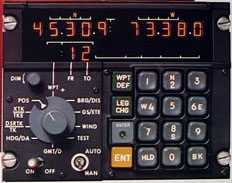 |
| Canadian Marconi CMA740 control head.(e-Bay photo) |
CLOSUREWith the Global Positioning System (GPS) being declared fully operational,the use of OMEGA had dwindled to a point where continued operation wasnot economically justified. The 1994 edition of the United States FederalRadionavigation Plan (FRP), which delineates policies and plans for federallyprovided radionavigation services, stated "the U.S. expects to continueOMEGA operations until September 30, 1997, to accommodate the transitionof civil aviation users to GPS. Continued operation after that datewill depend upon validating requirements for OMEGA that cannot be met byGPS or another system." The Federal Aviation Administration (FAA) completedits review of Omega navigation requirements for the U.S. aviation industryand notified the U.S. Coast Guard that most users will complete their conversionto GPS technology by September 1997. OMEGA was shut down precisely at 0300Zon September 30, 1997 - the end of another era. To VLF experimenters, thevery high power OMEGA signals were both a blessing and a curse; a blessingin that they provided convenient test signals in the 9.5 to 14 kHz range,and a curse in that they tended to interfere with the reception of naturalradio phenomena such as "whistlers" and "dawn chorus".
Besides affecting users, the closure of Omega had a small impact ontourism. Because of their prominent antennas and interesting mission, manyOmega stations were recognized in their local areas as major tourist attractions,including official listings and pictures in area tourist brochures. Omegastation North Dakota was located in the town of LaMoure, with a populationof less than 1,000. In this small town is located the Omega Motel, theOmega Plaza, and the Omega Room at one of the restaurants. After Omegaceased, the USN took over the site from the US Coast Guard and continuedVLF communications under the name of Naval Computer and TelecommunicationsArea Master Station Atlantic (NCTAMSLANT). The mission statement of thenew station is: " To manage, operate, and maintain those facilities, systems,equipment, and devices necessary to provide requisite communicationsand information system support for the command, operational control andadministration of the naval establishment, and the fixed submarine broadcastsystem; to test and evaluate new Very Low Frequency (VLF) broadcast technologyand minimize downtime of operational sites during VLF system upgrades andmajor transmitter and antenna maintenance". The people of
Omega Station Norway had a prominent sign along the road near the helixbuilding proclaiming their antenna as the longest antenna span in Europe.The Japan tower was the highest structure in Japan, and the Argentina andLiberia towers were the tallest structures in their entire continents.Australia registered over 10,000 visitors per year to its station.
THE MESSAGE WHICH ANNOUNCED THE CLOSURE OF THE SYSTEMThe following message was sent by the United States Coast Guardto all OMEGA users advising of the system shutdown.P 011416Z OCT 97
FM COGARD NAVCEN ALEXANDRIA VA//NIS//
SUBJ: OMEGA STATUS AS OF 01 OCT 97
1. THE OMEGA NAVIGATION SYSTEM TERMINATED AND ALL STATIONS CEASED OMEGATRANSMISSIONS AT 0300Z 30 SEPTEMBER 1997 IN ACCORDANCE WITH NAVCEN OPERATIONSORDER DATED 141026Z AUG 97.
2. OFF AIR PERIODS 221000Z SEP 97 THROUGH 300300Z SEP 97:
A. NONE
B. NONE
C. NONE
D. NONE
E. NONE
F NONE
G. NONE
H. NONE
3. REDUCED POWER PERIODS 221000Z SEP 97 THROUGH 300300Z SEP 97:
A. NONE
B. DOWN 3.7 DB 221000Z TO 300300Z
C. NONE
D. NONE
E. DOWN 1.7 DB 221000Z TO 230250Z
DOWN 1.3 DB 230715Z TO 231215Z
DOWN 4.2 DB 231415Z TO 232355Z
DOWN 1.7 DB 241000Z TO 242225Z
DOWN 1.4 DB 251440Z TO 251951Z
DOWN 1.2 DB 260101Z TO 260230Z
DOWN 5.0 DB 260740Z TO 270608Z
DOWN 2.5 DB 271602Z TO 280335Z
F. DOWN 1.9 DB 221700Z TO 230731Z
DOWN 1.2 DB 241839Z TO 242023Z
DOWN 2.4 DB 272100Z TO 280358Z
G NONE
H DOWN 1.6 DB 231230Z TO 231810Z
DOWN 1.6 DB 250305Z TO 251800Z
DOWN 1.6 DB 261750Z TO 262220Z
4. QUESTIONS REGARDING OMEGA STATUS/OPERATION MAY BE DIRECTEDTO: PHONE NUMBER (703)313-5900.
A facsimile transmission received by the Navigation Center (NAVCEN)from the Japanese Maritime Safety Agency truly summarized the 25 year relationshipbetween the U.S. and Japan. The FAX, received just days before the signalwas terminated stated:
..."(The final status message) will shine brilliantly, foot markingthe world wide radio navigation history cooperatively linking OMEGA withsix partner nations. We can't say enough in praise of your excellent duties.In Japan, both the Station and the Analysis Office employees amount tonearly three hundred persons since opening time. They have a favorableimpression of the system. Your friendship and kind support with us overthe years has been deeply appreciated. It will stay with me as a rewardingmemory of the valuable experience received from OMEGA. I hope that theOMEGA community members will continue to have a successful and enjoyablelife."
These kind words were expressed by Toshiichiro Kawamura, Director ofJMSA.
AN OMEGA POEM
This Omega Poem was published in the USCG Radionavigation Bulletin Fall/Winter 1997, after the system closed.
Omega ... Omega in the sky.
Ships and planes use you as their eyes.
You've run so long, Your waves held high.
You cover the world in the blink of an eye.
You sing a song like no other.
Your cycle covers places that no other could cover.
Your lattice ... out-stretched like the arms of a mother,
helping so many, no matter what weather.
We bid you farewell, so long and good bye...
and from all the men, past and present,
we salute you and all who have served under your majestic tower,
here at OMSTA LaMoure, North Dakota...
And Just like your song,
We are gone ... In the Blink of an eyeFireman Adam Powers,
OMSTA LaMoure, North Dakota
FOOTNOTES:1.The use of an RF filter on any receiver effectivelyextends the range.
REFERENCES and CREDITS:
Back to Index Page
[8]ページ先頭


