Movatterモバイル変換
[0]ホーム

IPCS INTERNATIONAL PROGRAMME ON CHEMICAL SAFETY Health and Safety Guide No. 39MIREXHEALTH AND SAFETY GUIDE UNITED NATIONS ENVIRONMENT PROGRAMME INTERNATIONAL LABOUR ORGANISATION WORLD HEALTH ORGANIZATION WORLD HEALTH ORGANIZATION, GENEVA 1990 This is a companion volume to Environmental Health Criteria 44: Mirex Published by the World Health Organization for the International Programme on Chemical Safety (a collaborative programme of the United Nations Environment Programme, the International Labour Organisation, and the World Health Organization) This report contains the collective views of an international group of experts and does not necessarily represent the decisions or the stated policy of the United Nations Environment Programme, the International Labour Organisation, or the World Health Organization WHO Library Cataloguing in Publication Data Mirex : health and safety guide. (Health and safety guide ; no. 39) 1. Mirex - standards I. Series ISBN 92 4 151039 0 (NLM Classification: WA 240) ISSN 0259-7268 (c) World Health Organization 1990 Publications of the World Health Organization enjoy copyright protection in accordance with the provisions of Protocol 2 of the Universal Copyright Convention. For rights of reproduction or translation of WHO publications, in part or in toto,application should be made to the Office of Publications, World Health Organization, Geneva, Switzerland. The World Health Organization welcomes such applications. The designations employed and the presentation of the material in this publication do not imply the expression of any opinion whatsoever on the part of the Secretariat of the World Health Organization concerning the legal status of any country, territory, city or area or of its authorities, or concerning the delimitation of its frontiers or boundaries. The mention of specific companies or of certain manufacturers' products does not imply that they are endorsed or recommended by the World Health Organization in preference to others of a similar nature that are not mentioned. Errors and omissions excepted, the names of proprietary products are distinguished by initial capital letters.CONTENTS INTRODUCTION1. PRODUCT IDENTITY AND USES1.1. Identity1.2. Physical and chemical properties1.3. Analytical methods1.4. Uses2. SUMMARY AND EVALUATION2.1. Human exposure to mirex2.2. Kinetics and metabolism2.3. Effects on experimental animals2.4. Effects on human health2.5. Effects on the environment3. CONCLUSIONS AND RECOMMENDATIONS3.1. Conclusions3.2. Recommendations4. HUMAN HEALTH HAZARDS, PREVENTION AND PROTECTION, EMERGENCY ACTION4.1. Main human health hazards, prevention and protection, first aid4.1.1. Advice to physicians4.1.2. Health surveillance advice4.2. Safety in use4.3. Explosion and fire hazards4.3.1. Explosion hazards4.3.2. Fire hazards4.4. Storage4.4.1. Leaking containers in store4.5. Transport4.6. Spillage and disposal4.6.1. Spillage4.6.2. Disposal5. HAZARDS FOR THE ENVIRONMENT AND THEIR PREVENTION5.1. Hazards5.2. Prevention6. INTERNATIONAL CHEMICAL SAFETY CARD7. CURRENT REGULATIONS, GUIDELINES, AND STANDARDS7.1. Previous evaluations by international bodies7.2. Exposure limit values7.3. Specific restrictions7.4. Labelling, packaging, and transport BIBLIOGRAPHY INTRODUCTION The Environmental Health Criteria (EHC) documents produced by the International Programme on Chemical Safety include an assessment of the effects on the environment and on human health of exposure to a chemical or combination of chemicals, or physical or biological agents. They also provide guidelines for setting exposure limits. The purpose of a Health and Safety Guide is to facilitate the application of these guidelines in national chemical safety programmes. The first three sections of a Health and Safety Guide highlight the relevant technical information in the corresponding EHC. Section 4 includes advice on preventive and protective measures and emergency action; health workers should be thoroughly familiar with the medical information to ensure that they can act efficiently in an emergency. Within the Guide is an International Chemical Safety Card which should be readily available, and should be clearly explained, to all who could come into contact with the chemical. The section on regulatory information has been extracted from the legal file of the International Register of Potentially Toxic Chemicals (IRPTC) and from other United Nations sources. The target readership includes occupational health services, those in ministries, governmental agencies, industry, and trade unions who are involved in the safe use of chemicals and the avoidance of environmental health hazards, and those wanting more information on this topic. An attempt has been made to use only terms that will be familiar to the intended user. However, sections 1 and 2 inevitably contain some technical terms. A bibliography has been included for readers who require further background information. Revision of the information in this Guide will take place in due course, and the eventual aim is to use standardized terminology. Comments on any difficulties encountered in using the Guide would be very helpful and should be addressed to: The Manager International Programme on Chemical Safety Division of Environmental Health World Health Organization 1211 Geneva 27 Switzerland THE INFORMATION IN THIS GUIDE SHOULD BE CONSIDERED AS A STARTING POINT TO A COMPREHENSIVE HEALTH AND SAFETY PROGRAMME1. PRODUCT IDENTITY AND USES1.1 Identity Common name: Mirex Chemical structure: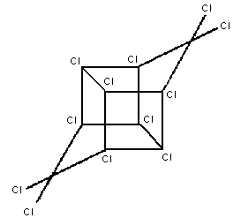 Molecular formula: C10Cl12 Common trade names: Dechlorane, Ferriamicide, GC 1283 Common synonyms: dodecachloropentacyclo[5.2.1.026039058]- decanedodecachloro-octahydro-1,3,4-metheno-2H- cyclo-buta [cd]pentalene CAS chemical name: 1,1a,2,2,3,3a,4,5,5,5a,5b,6- dodecachlorooctahydro-1,3,4-metheno-1H- cyclobuta- [cd]pentalene CAS registry number:2385-85-5 Relative molecular mass: 545.51.2 Physical and Chemical Properties Mirex is a white crystalline, odourless solid with a melting point of 485°C. It is soluble in several organic solvents including tetrahydrofuran (30%), carbon disulfide (18%), chloroform (17%), and benzene (12%), but is practically insoluble in water. It has a vapour pressure of 3 × 10⁻⁷mmHg at 25°C. Mirex is considered to be extremely stable. It does not react with sulfuric, nitric, hydrochloric, or other common acids and is unreactive with bases, chlorine, or ozone. Despite its stability, reductive dechlorination of mirex can be brought about by reaction with reduced iron porphyrin or more effectively by vitamin B12. Slow partial decomposition will also result from exposure to ultraviolet radiation (UVR) in hydrocarbon solvents or to gamma rays. Photomirex (8-monohydro-mirex) is the major product of dechlorination by UVR, and may represent the fate of most of the mirex in the environment. Mirex is quite resistant to pyrolysis; decomposition begins at 525°C, and 98-99% combustion is accomplished at 700°C within 1 second. Hexachlorobenzene is a major pyrolytic product with lesser amounts of carbon monoxide, carbon dioxide, hydrogen chloride, chlorine, carbon tetrachloride, and phosgene given off in the form of a vapour. Technical grade preparations of mirex contain 95.19% mirex and 2.58% chlordecone, the rest being unspecified. The term "mirex" is also used to refer to bait comprising corncob grits, soya bean oil, and mirex. Insect bait formulations for aerial application containing 0.3-0.5% mirex and fire ant formulations containing 0.075-0.3% mirex have also been used in the USA.1.3 Analytical Methods Gas chromatography with electron capture detection is the analytical method most commonly used for its determination.1.4 Uses Mirex is mainly used as a flame-retardant and as a stomach insecticide, usually formulated into baits, for the control of ants, especially fire ants and harvester ants. The USA appears to be the main country in which mirex was used for pest control, but this use was discontinued in 1978. The same chemical substance is used, under the name Dechlorane, as a fire retardant in plastics, rubbers, paints, etc. This application is not restricted to the USA. Recently, the use of mirex has become increasingly restricted or prohibited in many countries (see, e.g., section 7.3).2. SUMMARY AND EVALUATION2.1 Human Exposure to Mirex Food probably represents the major source of intake of mirex for the general population, fish, wild game, and meat being the main sources. Normally, such intake is below established residue tolerances. Mirex may occur in breast milk, but levels are very low or below detection limits. No data are available regarding occupational exposure.2.2 Kinetics and Metabolism Following oral ingestion, mirex is only partly absorbed into the body and the remainder, depending on the dose administered, is eliminated unchanged in the faeces. Mirex can also be absorbed following inhalation and via the skin. It is a lipophilic compound and, as such, is stored in adipose tissue to a greater extent than in any other tissue. Mirex is transferred across the placenta to the fetus and is excreted with the milk. Mirex does not appear to have been metabolized to any extent in any animal species investigated. Its elimination from the body is slow and, depending on the species, it has a half-life in the body of several months. It is one of the most stable pesticides in use today.2.3 Effects on Experimental Animals Mirex was moderately toxic in single-dose animal studies (oral LD50 values ranged from 365 to 3000 mg/kg body weight). Toxic effects included neurological symptoms, especially tremors and convulsions. The most sensitive effects of repeated exposure in experimental animals are principally associated with the liver (liver hypertrophy with morphological changes in the liver cells, and induction of mixed-function oxidases). These effects have been observed with doses as low as 1 mg/kg diet (0.05 mg/kg body weight per day), the lowest dose tested. In studies to investigate the toxicity of mirex in pregnant animals, teratogenic effects were seen in rats given 6 mg/kg body weight per day by gavage, and fetotoxic effects were seen in animals given 25 mg/kg diet. In addition, exposure of male mice to dietary levels of about 2 mg/kg for 3 months resulted in impaired reproductive performance. Mirex was not generally active in short-term tests for genetic activity. However, mirex is carcinogenic for both mice and rats.2.4 Effects on Human Health No data on effects on human beings were available to the Task Group.2.5 Effects on the Environment Mirex is one of the most stable and environmentally persistent pesticides in use today. It is not biodegraded by microorganisms, except occasionally under aerobic conditions, and hydrolysis is very slow. Although general environmental levels are low, it is widespread in the biotic and abiotic environment. Mirex is both accumulated and biomagnified. It is strongly adsorbed on sediments and has a low water solubility. The delayed onset of toxic effects and mortality is typical of mirex poisoning. The long-term toxicity of mirex is uniformly high. It is toxic for a range of aquatic organisms, crustacea being particularly sensitive. Mirex induces pervasive long-term physiological and biological disorders in vertebrates. Although no field data are available, the adverse effects of long-term exposure to low levels of mirex, combined with its persistence, suggest that the use of mirex presents a long-term environmental risk.3. CONCLUSIONS AND RECOMMENDATIONS3.1 Conclusions 1. No data on human health effects are available in connection with occupational exposure to mirex. On the basis of findings in mice and rats, this chemical should be considered, for practical purposes, as being potentially carcinogenic for human beings. 2. For the same reason, reservations must remain about the safety of this chemical in food, despite the relatively low residues so far reported. 3. Effects on the organisms studied, as well as its persistence, suggest that mirex presents a long-term hazard for the environment. 4. Taking into account these considerations, it is felt that the use of this chemical for both agricultural and non-agricultural applications should be discouraged, except where there is no adequate alternative.3.2 Recommendations 1. Surveillance should be maintained over any future production, transport, and disposal of mirex and the nature and extent of both its agricultural and non-agricultural use. 2. Comprehensive monitoring of levels of mirex in the environment should be continued.4. HUMAN HEALTH HAZARDS, PREVENTION AND PROTECTION, EMERGENCY ACTION4.1 Main Human Health Hazards, Prevention and Protection, First Aid Mirex is an organochlorine insecticide. It is toxic and may be hazardous for human beings if incorrectly or carelessly handled. It is therefore essential that the correct precautions should be observed during handling and use. For details, see the International Chemical Safety Card (section 6).4.1.1 Advice to physicians 4.1.1.1 Symptoms of poisoning Mirex is toxic by mouth, by skin contact (especially liquid formulations), and by inhalation of dust from powder concentrates. It acts as a stimulant of the central nervous system. Following accidental ingestion or over-exposure, symptoms may include headache, dizziness, nausea, vomiting, weakness in the legs, and convulsions. Organochlorines can cause respiratory depression. They also sensitize the heart to endogenous catecholamines leading to ventricular fibrillation and cardiac arrest in severe cases. Respiratory depression may lead to metabolic acidosis and, if necessary, blood gases should be checked. The use of an ECG monitor is recommended if the symptoms are severe. No cases of poisoning in man have been reported so far. 4.1.1.2 Medical advice Medical treatment is largely symptomatic and supportive and directed against convulsions and hypoxia. Because many liquid formulations contain hydrocarbon solvent, vomiting should notbe induced and emetics are contraindicated. If swallowed, the stomach should be emptied as soon as possible by careful gastric lavage (with a cuffed endotracheal tube), avoiding aspiration into the lungs. This should be followed by intragastric administration of 3-4 tablespoons of activated charcoal and 30 g magnesium sulfate or sodium sulfate in a 30% aqueous solution. Oily purgatives are contraindicated. No fats, oils, or milk should be given. If convulsions occur, anti-convulsants should be given, e.g., diazepam, 10 mg slowly intravenously (children 1-5 mg), repeated as necessary; or thiopental sodium, or hexobarbital sodium slowly intravenously in a dose of 10 mg/kg body weight with a maximum total dose of up to 750 mg for an adult. On account of their short action, these barbiturates should always be followed by phenobarbital given orally at 3 mg/kg body weight (up to 200 mg for an adult), or phenobarbital sodium given intramuscularly at 3 mg/kg (also up to 200 mg for an adult). Morphine and its derivatives, epinephrine and norepinephrine shouldnever be given. An unobstructed airway must be maintained. Oxygen and/or artificial respiration may be needed.4.1.2 Health surveillance advice A pre-employment and an annual general medical examination are advised for regularly exposed workers. Special attention should be paid to liver and kidney function.4.2 Safety in Use Handling liquid formulations: Wear protective neoprene or PVC gloves, cotton overalls, rubber boots, and face shield. Handling powder formulations: Avoid raising a dust cloud. Wear protective gloves and dust mask. Follow the advice relating to personal hygiene.4.3 Explosion and Fire Hazards4.3.1 Explosion hazards The explosion hazard will depend on the solvent used in the formulation, or on the characteristics of the dust.4.3.2 Fire hazards Liquid products containing organic solvents may be flammable. Extinguish fires with alcohol-resistant foam, carbon dioxide, or powder. With sufficient burning or external heat, mirex will decompose, emitting toxic fumes. Fire-fighters should wear a self-contained breathing apparatus, eye protection, and full protective clothing. Confine the use of water spray to the cooling of unaffected stock, thus avoiding the accumulation of polluted run-off from the site.4.4 Storage Products should be stored in locked buildings, preferably dedicated to insecticides. Keep products out of reach of children and unauthorized personnel. Do not store near foodstuffs or animal feed.4.4.1 Leaking containers in store Take precautions and use appropriate personal protection. Empty any product remaining in damaged/leaking containers into a clean empty drum, which should then be tightly closed and suitably labelled. Sweep up spillage with sawdust, sand, or earth (moisten for powders), and dispose of safely. Emptied leaking liquid containers should be rinsed with at least 1 litre water per 20-litre drum. Swirl round to rinse the walls, empty, and add the rinsings to the sawdust or earth. Do not re-use containers for any other purpose. Puncture the container to prevent re-use.4.5 Transport Comply with any local requirements regarding movement of hazardous goods. Do not transport with foodstuffs or animal feed. Make sure that containers are in good condition and labels undamaged before dispatch.4.6 Spillage and Disposal4.6.1 Spillage Before dealing with any spillage, precautions should be taken as required and appropriate personal protection should be used. Prevent liquid from spreading or contaminating other cargo and vegetation, and avoid pollution of surface waters and ground water by using the most suitable available material, e.g., earth or sand. Absorb spilled liquid with sawdust, sand, or earth, sweep up and place it in a closeable container for later transfer to a safe place for disposal. As soon as possible after the spillage and before re-use, cover all contaminated areas with damp sawdust, sand, or earth. Sweep up and place in a closeable container for later transfer to a safe place for disposal. Care should be taken to avoid run-off into surface waters or drains.4.6.2 Disposal Surplus product, contaminated absorbents, and containers should be disposed of in an appropriate way. Mirex is not readily decomposed chemically or biologically and is relatively persistent. Waste material should be burned only in a proper incinerator designed for organochlorine waste disposal (1000°C and 30-min residence time with effluent gas scrubbing). If this is not possible, bury in an approved dump or landfill where there is no risk of contamination of surface or ground water. Comply with any local legislation regarding disposal of toxic wastes.5. HAZARDS FOR THE ENVIRONMENT AND THEIR PREVENTION5.1 Hazards Mirex is one of the most stable of the organochlorine insecticides. Although general environmental levels are low, it is widespread in the biotic and abiotic environment. Mirex is both accumulated and biomagnified. It is strongly adsorbed on sediments and has a low water solubility. Delayed onset of toxic effects and mortality is typical of mirex poisoning. The long-term toxicity of mirex is uniformly high. Mirex is toxic for a range of aquatic organisms, crustacea being particularly sensitive. Although no field data are available, the adverse effects of long-term exposure to low levels of mirex, combined with its persistence, suggest that the use of mirex presents a long-term environmental risk.5.2 Prevention Industrial discharges from manufacturing, formulation, and technical applications should not be allowed to pollute the environment and should be treated properly. Any spillage or unused product should be prevented from spreading to vegetation or waterways and should be treated and disposed of properly.6. INTERNATIONAL CHEMICAL SAFETY CARD This card should be easily available to all health workers concerned with, and users of, mirex. It should be displayed at, or near, entrances to areas where there is potential exposure to mirex, and on processing equipment and containers. The card should be translated into the appropriate language(s). All persons potentially exposed to the chemical should also have the instructions on the chemical safety card clearly explained. Space is available on the card for insertion of the National Occupational Exposure Limit, the address and telephone number of the National Poison Control Centre, and for local trade names. MIREX CAS chemical name: 1,1a,2,2,3,3a,4,5,5,5a,5b,6-dodecachloroocta-hydro-1,3,4-metheno-1H-cyclobuta[cd]pentalene CAS registry number:2385-85-5 RTECS registry number: PC8225000 Molecular formula: C10Cl12 PHYSICAL PROPERTIES OTHER CHARACTERISTICS Melting point (°C) 485 Mirex is a white crystalline, odourless solid; it is Vapour pressure (mmHg at 25°C) 3 × 10⁻⁷ considered to be extremely stable and does not react Relative molecular mass 545.5 with common acids, bases, chlorine, or ozone; slow, Solubility: partial dechlorination by UV radiation yields in water practically photomirex; it is quite resistant to pyrolysis, insoluble hexachlorobenzene being a major pyrolysis product; it is a in tetrahydrofuram 30% stomach insecticide with little contact activity; in carbon disulfide 18% a major use is for ant control; it is also used as a in chloroform 17% flame retardant under the name Dechlorane in benzene 12% HAZARDS/SYMPTOMS PREVENTION AND PROTECTION FIRST AID GENERAL: Potential human carcinogen; on repeated exposure mirex may accumulate in the body SKIN: Overexposure may cause Avoid skin contact; wear Remove contaminated clothing poisoning protective clothing, PVC or immediately; wash skin with water neoprene gloves, rubber boots and soap EYES: Irritation, redness Wear face-shield or goggles Flush with clean water for 15 minutes; if irritation persists, seek medical attention INHALATION: Dust may irritate Wear appropriate dust mask or respirator INGESTION: Unlikely Do not eat, drink, or smoke occupational hazard during work; wash hands before eating, drinking, or smoking Accidental or intentional ingestion Obtain medical attention immediately; do may cause poisoning not induce vomiting; keep at rest lying face downwards; ensure clear airway; fat, milk, or oil shoud not be given ENVIRONMENT: Toxic for aquatic Do not spill on animal feed or and terrestrial life; persistent in waterways SPILLAGE STORAGE FIRE AND EXPLOSION Take appropriate personal Products should be stored in Liquid products will burn and emulsifiable precautions; prevent liquid locked buildings, preferably concentrates are miscible with water; from spreading or contaminating dedicated to insecticides extinguish fires with alcohol-resistant foam, other cargo, vegetation, or carbon dioxide, or powder; with sufficient waterways, with a barrier of the burning or external heat, mirex will most suitable available material, Keep products out of reach of decompose, emitting toxic fumes; the smoke e.g., earth or sand children and unauthorized and fumes could be injurious through personnel; do not store near inhalation, or absorption through the skin; Absorb spilled liquid with foodstuffs or animal feed therefore, firefighters should wear sawdust, sand, or earth; sweep up protective clothing and self-contained breathing and place it in a closeable container apparatus; confine the use of water spray for later safe disposal to the cooling of unaffected stock, thus avoiding polluted run-off from the site WASTE DISPOSAL NATIONAL INFORMATION Mirex is not readily National Occupational Exposure UN No. 2762, 2995, 2996 decomposed chemically or biologically Limit: and is relatively persistent; waste material should be burned in a proper incinerator designed for organochlorine waste disposal; National Poison Control Centre: if this is not possible, bury in an approved dump or landfill where there is no risk of contamination of surface or ground water; comply with any local legislation Local trade names: regarding disposal of toxic wastes
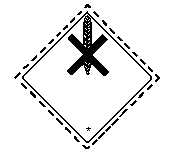 7. CURRENT REGULATIONS, GUIDELINES, AND STANDARDS The information given in this section has been extracted from the International Register of Potentially Toxic Chemicals (IRPTC) legal file and other United Nations sources. Its intention is to give the reader a representative but non-exhaustive overview of current regulations, guidelines, and standards. The reader should be aware that regulatory decisions about chemicals taken in a certain country can only be fully understood in the framework of the legislation of that country. Furthermore, the regulations and guidelines of all countries are subject to change and should always be verified with the appropriate regulatory authorities before application.7.1 Previous Evaluations by International Bodies IARC (1979) evaluated the carcinogenic hazard resulting from exposure to mirex and concluded that "there is sufficient evidence for its carcinogenicity to mice and rats. In the absence of adequate data in humans, it is reasonable, for practical purposes, to regard mirex as if it presented a carcinogenic risk to humans". An acceptable daily intake (ADI) for mirex has not been established by FAO/WHO.7.2 Exposure Limit Values Some exposure limit values are given in the table on the opposite page.7.3 Specific Restrictions Recently, the use of mirex has been increasingly restricted or prohibited in many countries. In the USA, all registered products containing mirex have been cancelled. It has been banned in Ecuador and in various other countries. In the German Democratic Republic, mirex is not permitted in agricultural formulations. EXPOSURE LIMIT VALUES Medium Specification Country/ Exposure limit description Value Effective organization date FOOD, USA Acceptable residue limit (ARL) 1981 ANIMAL - Specified animal products 0.1 mg/kg FEED - General 0.01 mg/kg FOOD Germany, Maximum residue limit (MRL) 1984 Federal - Plant (all) 0.01 mg/kg Republic of FOOD Animal Germany, Maximum residue limit (MRL) 1984 Federal - of animal origin (specified) 0.1 mg/kg Republic of wet weight 0.1 mg/kg lipid weight - of animal origin (general) 0.01 mg/kg wet weight7.4 Labelling, Packaging, and Transport The United Nations Committee of Experts on the Transportation of Dangerous Goods classified mirex in: - Hazard Class 6.1: poisonous substance - Packing Group III: a substance presenting a relatively low risk of poisoning in transport (mirex liquid formulations >60%) The label should be as follows:
 The bottom half of the label should bear the inscriptions: Harmful, stow away from foodstuffs.BIBLIOGRAPHY FAO (1985a) Guidelines for the packaging and storage of pesticides, Rome, Food and Agriculture Organization of the United Nations. FAO (1985b) Guidelines for the disposal of waste pesticides and pesticide containers on the farm,Rome, Food and Agriculture Organization of the United Nations. FAO (1985c) Guidelines on good labelling practice for pesticides, Rome, Food and Agriculture Organization of the United Nations. FAO (1986) International code of conduct on the distribution and use of pesticides,Rome, Food and Agriculture Organization of the United Nations. FAO/WHO (1986) Guide to Codex recommendations concerning pesticide residues.Part 8. Recommendations for methods of analysis of pesticide residues,3rd ed., Rome, Codex Committee on Pesticide Residues. GIFAP (1982) Guidelines for the safe handling of pesticides during their formulation, packing, storage and transport,Brussels, Groupement International des Associations Nationales des Fabricants de Produits Agrochimiques. GIFAP (1983) Guidelines for the safe and effective use of pesticides,Brussels, Groupement International des Associations Nationales des Fabricants de Produits Agrochimiques. GIFAP (1984) Guidelines for emergency measures in cases of pesticide poisoning,Brussels, Groupement International des Associations Nationales des Fabricants de Produits Agrochimiques. GIFAP (1987) Guidelines for the safe transport of pesticides, Brussels, Groupement International des Associations Nationales des Fabricants de Produits Agrochimiques. IARC (1972-present) IARC monographs on the evaluation of carcinogenic risk of chemicals to man,Lyons, International Agency for Research on Cancer. IRPTC (1985) IRPTC file on treatment and disposal methods for waste chemicals,Geneva, International Register of Potentially Toxic Chemicals, United Nations Environment Programme. IRPTC (1987) IRPTC legal file 1986,Geneva, International Register of Potentially Toxic Chemicals, United Nations Environment Programme. PLESTINA, R. (1984) Prevention, diagnosis, and treatment of insecticide poisoning,Geneva, World Health Organization (unpublished document WHO/VBC/84.889). SAX, N.I. (1984) Dangerous properties of industrial materials,New York, Van Nostrand Reinhold Company, Inc. UNITED NATIONS (1986) Recommendations on the transport of dangerous goods,4th ed., New York, United Nations. US NIOSH/OSHA (1981) Occupational health guidelines for chemical hazards,3 Vols. Washington DC, US Department of Health and Human Services, US Department of Labor (Publication No. DHHS(NIOSH) 01-123). WHO (1984) Environmental Health Criteria 44: Mirex.Geneva, World Health Organization. WHO (1988) The WHO recommended classification of pesticides by hazard and guidelines to classification 1988-89,Geneva, World Health Organization (unpublished document WHO/VBC/88.953). WHO/FAO (1975-90) Data sheets on pesticides.Geneva, World Health Organization (unpublished documents). WORTHING, C.R. & WALKER, S.B. (1983) The pesticide manual,7th ed., Lavenham, Lavenham Press Limited, British Crop Protection Council.
[8]ページ先頭