Movatterモバイル変換
[0]ホーム

IPCS INTERNATIONAL PROGRAMME ON CHEMICAL SAFETY Health and Safety Guide No. 32d-PHENOTHRINHEALTH AND SAFETY GUIDE UNITED NATIONS ENVIRONMENT PROGRAMME INTERNATIONAL LABOUR ORGANISATION WORLD HEALTH ORGANIZATION WORLD HEALTH ORGANIZATION, GENEVA 1989 This is a companion volume to Environmental Health Criteria 96: d-Phenothrin Published by the World Health Organization for the International Programme on Chemical Safety (a collaborative programme of the United Nations Environment Programme, the International Labour Organisation, and the World Health Organization) ISBN 92 4 154353 1 ISSN 0259 World Health Organization 1989 Publications of the World Health Organization enjoy copyright protection in accordance with the provisions of Protocol 2 of the Universal Copyright Convention. For rights of reproduction or translation of WHO publications, in part or in toto,application should be made to the Office of Publications, World Health Organization, Geneva, Switzerland. The World Health Organization welcomes such applications. The designations employed and the presentation of the material in this publication do not imply the expression of any opinion whatsoever on the part of the Secretariat of the World Health Organization concerning the legal status of any country, territory, city, or area or of its authorities, or concerning the delimitation of its frontiers or boundaries. The mention of specific companies or of certain manufacturers' products does not imply that they are endorsed or recommended by the World Health Organization in preference to others of a similar nature that are not mentioned. Errors and omissions excepted, the names of proprietary products are distinguished by initial capital letters. This report contains the collective views of an international group of experts and does not necessarily represent the decisions or the stated policy of the United Nations Environment Programme, the International Labour Organisation, or the World Health Organization.CONTENTS INTRODUCTION1. PRODUCT IDENTITY AND USES1.1. Identity1.2. Physical and chemical properties1.3. Analytical methods1.4. Production and uses2. SUMMARY AND EVALUATION2.1. Human exposure2.2. Environmental fate2.3. Kinetics and metabolism2.4. Effects on organisms in the environment2.5. Effects on experimental animals and in vitrotest systems2.6. Effects on human beings3. CONCLUSIONS AND RECOMMENDATIONS3.1. Conclusions3.2. Recommendations4. HUMAN HEALTH HAZARDS, PREVENTION AND PROTECTION, EMERGENCY ACTION4.1. Human health hazards, prevention and protection, first aid4.1.1. Advice to physicians4.1.2. Health surveillance advice4.2. Explosion and fire hazards4.3. Storage4.4. Transport4.5. Spillage and disposal4.5.1. Spillage4.5.2. Disposal5. HAZARDS FOR THE ENVIRONMENT AND THEIR PREVENTION6. INTERNATIONAL CHEMICAL SAFETY CARD7. CURRENT REGULATIONS, GUIDELINES, AND STANDARDS7.1. Previous evaluations by international bodies7.2. Exposure limit values7.3. Specific restrictions7.4. Labelling, packaging and transport7.5. Waste disposal BIBLIOGRAPHY INTRODUCTION The Environmental Health Criteria (EHC) documents produced by the International Programme on Chemical Safety include an assessment of the effects on the environment and human health from exposure to a chemical or combinations of chemicals, or to physical or biological agents. They also provide guidelines for setting exposure limits. The purpose of a Health and Safety Guide is to facilitate the application of these guidelines in national chemical safety programmes. The first three sections of a Health and Safety Guide highlight the relevant technical information in the corresponding EHC. Section 4 includes advice on preventive and protective measures and emergency action; health workers should be thoroughly familiar with the medical information to ensure that they can act efficiently in an emergency. Within the Guide is an International Chemical Safety Card which should be readily available, and should be clearly explained, to all who could come into contact with the chemical. The section on regulatory information has been extracted from the legal file of the International Register of Potentially Toxic Chemicals (IRPTC) and from other United Nations sources. The target readership includes people in the occupational health services, ministries, governmental agencies, industry, and trade unions, who are involved in the safe use of chemicals and the prevention of environmental health hazards, and also workers who would like more information on this topic. An attempt has been made to use only terms that are familiar to the user. However, sections 1 and 2 inevitably contain some technical terms. A bibliography has been included for readers who would like to have further background information. Revision of the information in this Guide will take place in due course. The eventual aim is to use standardized terminology. Comments on any difficulties encountered in using the Guide would be very helpful and should be addressed to: The Manager International Programme on Chemical Safety Division of Environmental Health World Health Organization 1211 Geneva 27 Switzerland THE INFORMATION IN THIS GUIDE SHOULD BE CONSIDERED AS A STARTING POINT TO A COMPREHENSIVE HEALTH AND SAFETY PROGRAMME1. PRODUCT IDENTITY AND USES1.1 Identity Common name: d-Phenothrin Chemical structure: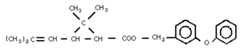 Molecular formula: C23H26O3 CAS chemical name: Cyclopropanecarboxylic acid, 2,2- dimethyl-3-(2-methyl- 1-propenyl)-(3-phenoxyphenyl) methyl ester CAS registry number:26002-80-2 (racemic) RTECS registry number: GZ 1975000 (racemic) GZ 2002000 (d-phenothrin) Common synonyms and trade names: Sumithrin, S-2539 Forte Relative molecular mass: 350.49 d-Phenothrin is a synthetic pyrethroid insecticide. Racemic phenothrin was invented in 1969. It is a mixture of four stereoisomers. d-Phenothrin is a mixture of the two isomers that have the highest activity and is the only technical product commercially available. The technical grade is 92.5-94.5% pure.1.2 Physical and Chemical Properties Some physical and chemical properties of d-phenothrin are given in the International Chemical Safety Card (section 6). Technical grade d-phenothrin is a colourless or pale yellow liquid. It has a low solubility in water, but is soluble in organic solvents such as acetone, xylene, and hexane. It is fairly stable in air, but unstable to light, although it is not photodegraded as rapidly as natural pyrethrins. It is also unstable under alkaline conditions.1.3 Analytical Methods Residue analysis is done with high-performance liquid chromatography with a UV detector, the minimum detectable concentration being 0.05 mg/kg. Gas chromatography with a flame ionization detector is used to analyse technical products.1.4 Production and Uses d-Phenothrin has been used since 1977. It is estimated that 70 to 80 tonnes of d-phenothrin are used annually worldwide. d-Phenothrin is used primarily to control household insects and insects endangering public health, to protect stored grains, alone or in combination with other insecticides and/or synergists, and to control lice in human beings. It is formulated as an aerosol, in oil and dust formulations, or as an emulsifiable concentrate. When used to control lice, it is formulated as powders, shampoos, and lotions.2. SUMMARY AND EVALUATION2.1 Human Exposure Air levels from conventional household aerosol spraying with d-phenothrin are not expected to exceed 0.5 mg/m3. Residues of up to 4 mg/kg might be present in stored wheat. In flour, these residues decrease to 0.8 mg/kg after milling and to 0.6 mg/kg after baking. To control lice, d-phenothrin (32 mg/person) is usually applied to the hair once a day every 3 days for a maximum of 9 days. No data are available on occupational exposure to d-phenothrin. Exposure of the general population to d-phenothrin is expected to be very low, but precise data are not available.2.2 Environmental Fate Phenothrin degrades readily on plants and other surfaces and has a half-life of <1 day. There is little translocation of d-phenothrin and its degradation products to the untreated parts of the plants. Limited uptake of radiolabelled products into bean plants took place from soils treated with14C-phenothrin. When soils are treated with [1R, trans]-or [1R, cis]-phenothrin (1 mg/kg), both isomers decompose rapidly having initial half-lives of 1 to 2 days. Under flooded conditions, the degradation is much slower, with initial half-lives of 2 to 4 weeks for [1R, trans]- phenothrin and 1 to 2 months for [1R, cis]-phenothrin. Very little movement (approximately 2%) of trans- and cis-phenothrin is observed through soil columns when leaching is begun immediately or 14 days after treatment with the insecticide. In general, the degradative processes that occur in the environment lead to less toxic products.2.3 Kinetics and Metabolism After rats were given single or repeated oral exposure or dermal treatment with radiolabelled phenothrin, radiolabels were rapidly and almost completely excreted in the urine and faeces (3-7 days). The major metabolic pathways of both trans- and cis-phenothrin in rats were ester cleavage and oxidation at the 4'-position of the alcohol moiety or the isobutenyl group of the acid moiety. Ester-cleaved metabolites (excreted mainly in the urine) were the principal products of the trans isomer, whereas ester-form metabolites (excreted mainly in the faeces) were mostly formed from the cis isomer.2.4 Effects on Organisms in the Environment Phenothrin has been tested only on a few groups of non-target organisms and only on a few species within each group. The range of 96-h LC50 values for racemic phenothrin and (1R)-stereoisomers in fish ranged from 17 to 200 µg/litre. In a single study on aquatic invertebrates, 3-h LC50 values for Daphnia pulexwere 25 000 to 50 000 µg/litre for all isomers and racemic phenothrin. A single field study in which phenothrin was applied to ponds showed no effect on aquatic arthropods. Toxicity to birds is low with an acute oral LD50 for bobwhite quail of >2500 mg/kg body weight, and a dietary LC50 for mallard duck and bobwhite quail of >5000 mg/kg diet. Since phenothrin breaks down rapidly in sunlight and is used primarily on stored grain, environmental exposure is expected to be very low. Therefore, adverse effects on the environment are extremely improbable.2.5 Effects on Experimental Animals and In Vitro Test Systems The acute toxicity of d-phenothrin is extremely low with LD50 values of >5000 mg/kg body weight in rats and mice (through the oral, subcutaneous, dermal, and intraperitoneal routes), and LC50 values of >3760 mg/m3 in rats (through the inhalation route). d-Phenothrin causes a poisoning syndrome which may include tremor, ataxia, hyperexcitability, prostration, or paralysis. These symptoms, and the results of electrophysiological studies of cockroach cercal sensory nerves, classify d-phenothrin as a Type I pyrethroid. When rats were exposed to d-phenothrin by inhalation at concentrations of up to 210 mg/m3 for 4 h/day for 4 weeks, or orally for 5 consecutive days at a dose of 5000 mg/kg body weight, no adverse toxicological effects were observed. Several feeding studies of phenothrin (racemic or d-phenothrin, from 200 to 10 000 mg/kg diet) in rats and mice, with exposure periods from 6 months to 2 years, were performed. No-observed-effect levels (NOELs) in these studies ranged from 300 to 1000 mg/kg diet which correspond to approximately 40 to 160 mg/kg body weight per day. In two studies studies in dogs in which d-phenothrin was given in doses from 100 to 3000 mg/kg diet, with exposure periods of 26 to 52 weeks, NOELs of 300 mg/kg diet, corresponding to 7-8 mg/kg body weight per day, were obtained. d-Phenothrin is not mutagenic in a variety of in vivoand in vitro test systems that studied gene mutations, DNA damage, DNA repair, and chromosomal effects. In 2-year studies, d-phenothrin was not oncogenic in rats and mice at dietary levels of up to 3000 mg/kg diet. Neither teratogenicity nor embryotoxicity was observed in fetuses of rabbits and mice given oral d-phenothrin at up to 1000 and 3000 mg/kg body weight, respectively. In a two-generation reproduction study in rats, the NOEL was 1000 mg/kg diet. Rats exposed to very high doses of d-phenothrin at a concentration of up to 3760 mg/m3 for 4 h by inhalation, or to a dose of 5000 mg/kg body weight per day for 5 days orally, showed no myelin degeneration or axon disruption in the sciatic nerve.2.6 Effects on Human Beings Although d-phenothrin has been used for more than 10 years, there have been no reports of poisoning in human beings. There are no indications that d-phenothrin, when used as recommended, will have an adverse effect on human beings.3. CONCLUSIONS AND RECOMMENDATIONS3.1 Conclusions (a) General population:The exposure of the general population to d-phenothrin is expected to be very low and is not likely to be a hazard when used as recommended. (b) Occupational exposure:With reasonable work practices, hygiene measures, and safety precautions, d-phenothrin is unlikely to be an occupational hazard. (c) Environment:Since d-phenothrin breaks down rapidly in sunlight and is used principally on stored grain, environmental exposure is expected to be very low. Therefore, environmental effects of the compound are extremely improbable.3.2 Recommendations When d-phenothrin is used as recommended, exposure levels are expected to be very low. However, monitoring studies should be continued.4. HUMAN HEALTH HAZARDS, PREVENTION AND PROTECTION, EMERGENCY ACTION4.1 Human Health Hazards, Prevention and Protection, First Aid d-Phenothrin is a synthetic pyrethroid insecticide. There have been no cases of poisoning reported in the general population or from occupational exposure. Experimental studies in animals suggest that neurological signs and symptoms, tremors, and ataxia could occur after massive over-exposure or accidental ingestion. The human health hazards associated with certain types of exposure to d-phenothrin, together with preventive and protective measures and first-aid recommendations, are given in the International Chemical Safety Card (section 6).4.1.1 Advice to physicians There is no specific antidote for d-phenothrin poisoning. Treat symptomatically. Chemical pneumonitis resulting from aspiration of the solvent into the lungs occurs when liquid formulations are ingested.4.1.2 Health surveillance advice Depending on the degree of exposure, general medical examinations should be done annually.4.2 Explosion and Fire Hazards Some solvents in pyrethroid formulations are highly flammable. DO NOT USE WATER to extinguish fires. Use dry powder, carbon dioxide, or alcohol-resistant foam, sand, or earth. Cool nearby drums with water spray. If pyrethroid products are involved in a major fire, advise the fire service to wear protective clothing and breathing apparatus. Inform the fire service and other relevant authorities that pyrethroids are toxic for fish and that water should be used only to cool unaffected stock. In this way, the accumulation of polluted run-off from the site is prevented.4.3 Storage Store technical material and formulations away from heat, in a locked, well-ventilated area, preferably without drains, designated for insecticide storage only. Keep out of reach of children, unauthorized personnel, and away from animals. Store away from food and animal feed.4.4 Transport For transport purposes, pyrethroids are classified as "harmful" or as "low hazard". Formulations made with flammable solvents may be subject to local transport controls. Before transport, ensure that containers are sound and that labels are securely fixed and not damaged. Comply with local transport regulations. Do not transport in compartments that contain food and animal feed.4.5 Spillage and Disposal4.5.1 Spillage Keep spectators away from leaking or spilled product. Prohibit smoking and the use of naked flames in the immediate vicinity. Avoid exposure by wearing appropriate protective clothing and masks. Transfer any product remaining in damaged or leaking containers into a clean, empty drum, and label the drum. Absorb spillage and cover contaminated area with lime, damp sawdust, sand, or earth, and place in a secure container for safe disposal (see section 4.5.2). Contain a large spillage by building a barrier of earth or sandbags. Prevent liquid from spreading to other cargo, vegetation, or waterways by containing it with the most readily available barrier material, e.g., earth or sand. Decontaminate empty, damaged, or leaking containers with a 10% sodium carbonate solution added at the rate of at least 1 litre per 20-litre drum. Puncture containers to prevent reuse.4.5.2 Disposal Waste that contains d-phenothrin should be burnt in an appropriate high-temperature incinerator with effluent scrubbing. If no incinerator is available, contaminated absorbents or surplus products should be decomposed by hydrolysis at pH 12 or above. Contact with a suitable hydrolysing agent is required to ensure degradation of the active ingredient to a safe level. For emulsifiable material, use 5% sodium hydroxide (caustic soda) solution or saturated (7-10%) sodium carbonate (washing soda) solution. For non-emulsifiable material, use a 1:1 mixture (by volume) of caustic soda or washing soda (as above) and a water/oil soluble solvent such as denatured alcohol, monoethylene glycol, hexylene glycol, or isopropylalcohol. Cover the material with a hydrolysing agent and let it stand for 7 days. Before disposal, the waste must be analysed to ensure that the active ingredient has been degraded to a safe level. Never pour untreated waste or surplus products into public sewers or where there is any danger of run-off or seepage to streams, water-courses, open waterways, ditches, fields with drainage systems, or to the catchment areas of boreholes, wells, springs, or ponds.5. HAZARDS FOR THE ENVIRONMENT AND THEIR PREVENTION When used as recommended, it is very unlikely that either d-phenothrin or its degradation products will reach levels of environmental significance. d-Phenothrin is toxic for fish, but due to the very low exposure levels that could occur, it will only cause a problem if spilled. Do not dispose of d-phenothrin or its containers in ponds, waterways, or ditches.6. INTERNATIONAL CHEMICAL SAFETY CARD This card should be easily available to all health workers concerned with, and users of, d-phenothrin. It should be displayed at, or near, entrances to areas where there is potential exposure to d-phenothrin, and on processing equipment and containers. The card should be translated into the appropriate language(s). All persons potentially exposed to the chemical should also have the instructions on the chemical safety card clearly explained. Space is available on the card for insertion of the National Occupational Exposure Limit, the address and telephone number of the National Poison Control Centre, and for local trade names. d-PHENOTHRIN CAS chemical name: Cyclopropanecarboxylic acid, 2,2-dimethyl-3-(2-methyl- 1-propenyl)-(3-phenoxyphenyl)methyl ester CAS registry no:26002-80-2 Molecular formula: C23H26O3 RTECS registry no: GZ2002000 PHYSICAL PROPERTIES OTHER CHARACTERISTICS Physical state liquid Phenothrin is a mixture of four stereo-isomers; Colour pale yellow to yellow brown d-Phenothrin is a mixture of the Relative molecular mass 350.49 two most active isomers. The technical Water solubility (25 °C) 2 mg/litre grade is 92.5-94.5% pure. d-Phenothrin is Solubility in organic solvents solublea fairly stable in air but unstable to light 25 Density d25 1.058-1.061 and under alkaline conditions. It is a synthetic pyrethroid, mainly used alone or in Vapour pressure (20 °C) 0.16 mPa combination as a household insecticide and for public health. It is used mostly in aerosol form.a Hexane (>1 mg/kg), acetone, methanol, xylene. HAZARDS/SYMPTOMS PREVENTION AND PROTECTION FIRST AID SKIN: Some formulations may Use proper application techniques Remove contaminated clothing; wash cause skin irritation and proper skin protection skin with soap and water EYES: Splashes may cause Wear face shield or goggles Flush immediately with clean water irritation for at least 15 min INHALATION: Dust or droplets Do not inhale fine dust and mist Fresh air may cause irritation INGESTION: Unlikely Do not eat, drink, or smoke during occupational hazard work; wash hands before eating, drinking, or smoking Accidental or deliberate Obtain medical attention; if breathing ingestion could lead to neurological has stopped, apply artificial signs and symptoms such as tremor respiration and ataxia A hazard of ingested liquid Do not induce vomiting formulations is aspiration into lungs ENVIRONMENT: Toxic for Do not contaminate ponds, waterways, fish or ditches with product or used containers SPILLAGE STORAGE FIRE AND EXPLOSION Absorb spillage with lime, damp Store in locked, well-ventilated DO NOT USE WATER; some liquid sawdust, sand, or earth; sweep storeroom, out of reach of children formulations may be highly flammable; up, place in closed container, and unauthorized personnel, and use dry powder, carbon dioxide, or and dispose of safely; do not away from food and animal feed. alcohol-resistant foam; cool nearby contaminate personnel, ponds, drums with water spray or waterways WASTE DISPOSAL NATIONAL INFORMATION Burn in high-temperature National Occupational Exposure Limit: incinerator with effluent scrubbing Or, treat with 5% caustic soda National Poison Control Centre: as a hydrolysing agent; comply with local regulation Local trade names:
 7. CURRENT REGULATIONS, GUIDELINES, AND STANDARDS The information given in this section has been extracted from the International Register of Potentially Toxic Chemicals (IRPTC) legal file and other United Nations sources. It is a representative but non-exhaustive overview of current regulations, guidelines, and standards. Regulations and guidelines about chemicals can be fully understood only within the framework of a country's legislation, and are always subject to change. Therefore, they should always be verified with the appropriate authorities.7.1 Previous Evaluations by International Bodies The Joint FAO/WHO Expert Committee on Pesticide Residues (JMPR) evaluated d-phenothrin at its meetings in 1979, 1980, 1984, and 1988. In 1988, an acceptable daily intake (ADI) of 0-0.07 mg/kg body weight was established. The Division of Vector Biology and Control, World Health Organization, classified phenothrin as a technical product that is not likely to present an acute hazard when used as recommended (WHO, 1988).7.2 Exposure Limit Values Some exposure limit values are given in the table that follows.7.3 Specific Restrictions No information is available.7.4 Labelling, Packaging, and Transport The United Nations Committee of Experts on the Transportation of Dangerous Goods classifies pyrethroids in: - hazard class 6.1: poisonous substance - packing group III: a substance with a relatively low risk of poisoning during transport. EXPOSURE LIMIT VALUES Medium Specification Country/ Exposure limit description Value Effective organization date FOOD Intake from FAO/WHO Temporary acceptable daily intake 0.04 mg/kg 1985 (TADI) (mg/kg body weight for d-phenothrin) FOOD Plant residues FAO/WHO Temporary maximum residue limit (TMRL) - Wheat bran (unprocessed) 15 mg/kg 1980 FAO/WHO Maximum residue limit (MRL) 5 mg/kg 1980 (cereal grains) The label should be as follows:
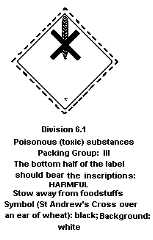 The European Community legislation requires labelling as a dangerous substance using the symbol:
 The label must read: Harmful by inhalation, in contact with skin and if swallowed; keep out of reach of children; keep away from food, drink, and animal feeding stuff.7.5 Waste Disposal In some countries, permits are required to empty pyrethroids into water.BIBLIOGRAPHY FAO (1985a) Guidelines for the packaging and storage of pesticides. Rome, Food and Agriculture Organization of the United Nations. FAO (1985b) Guidelines for the disposal of waste pesticides and pesticide containers on the farm.Rome, Food and Agriculture Organization of the United Nations. FAO (1985c) Guidelines on good labelling practice for pesticides. Rome, Food and Agriculture Organization of the United Nations. FAO (1986) International code of conduct on the distribution and use of pesticides. Rome, Food and Agriculture Organization of the United Nations. FAO/WHO (1986) Guide to Codex recommendations concerning pesticide residues.Part 8. Recommendations for methods of analysis of pesticide residues, 3rd ed., Rome, Codex Committee on Pesticide Residues. GIFAP (1982) Guidelines for the safe handling of pesticides during their formulation, packing, storage and transport.Brussels, Groupement International des Associations Nationales des Fabricants de Produits Agrochimiques. GIFAP (1983) Guidelines for the safe and effective use of pesticides. Brussels, Groupement International des Associations Nationales des Fabricants de Produits Agrochimiques. GIFAP (1984) Guidelines for emergency measures in cases of pesticide poisoning.Brussels, Groupement International des Associations Nationales des Fabricants de Produits Agrochimiques. GIFAP (1987) Guidelines for the safe transport of pesticides. Brussels, Groupement International des Associations Nationales des Fabricants de Produits Agrochimiques. IARC (1972-present) IARC monographs on the evaluation of carcinogenic risk of chemicals to man.Lyons, International Agency for Research on Cancer. IRPTC (1985) IRPTC file on treatment and disposal methods for waste chemicals.Geneva, International Register for Potentially Toxic Chemicals, United Nations Environment Programme. IRPTC (1987) IRPTC legal file 1983.Geneva, International Register of Potentially Toxic Chemicals, United Nations Environment Programme. PLESTINA, R. (1984) Prevention, diagnosis, and treatment of insecticide poisoning.Geneva, World Health Organization (unpublished document WHO/VBC/84.889). SAX, N.I. (1984) Dangerous properties of industrial materials.New York, Van Nostrand Reinhold Company, Inc. UNITED NATIONS (1986) Recommendations on the transport of dangerous goods.4th ed., New York, United Nations. US NIOSH/OSHA (1981) Occupational health guidelines for chemical hazards.3 Vols., Washington DC, US Department of Health and Human Services, US Departmnent of Labor (Publication No. DHSS (NIOSH) 01-123). WHO (In press) Environmental Health Criteria No. 96: d-Phenothrin. Geneva, World Health Organization. WHO (1988) The WHO recommended classification of pesticides by hazard. Guidelines to classification 1988-89.Geneva, World Health Organization (unpublished document WHO/VBC/88.953). WORTHING, C.R. & WALKER, S.B. (1983) The pesticide manual.7th ed., Lavenham, Lavenham Press Limited, British Crop Protection Council.
[8]ページ先頭