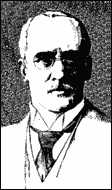
 In 1893, German inventor Rudolph Diesel published a paper entitled "The Theoryand Construction of a Rational Heat Engine," which described an engine in whichair is compressed by a piston to a very high pressure, causing a hightemperature. Fuel is then injected and ignited by the compression temperature. Diesel built his first engine based on that theory the same year and, though itworked only sporadically, he patented it. Within a few years, Diesel's designbecame the standard of the world for that type of engine and his name wasattached to it. Diesel thought that the United States was the greatest potential market for hisengine. The first diesel built in the United States was made in 1898 byBusch-Zulzer Brothers Diesel Engine Co. The president of that company wasAdolphus Busch, of Budweiser brewing fame, who had purchased North Americanmanufacturing rights.1 Diesel's Humanitarian Vision: Diesel originally thought that the diesel engine, (readily adaptable insize and utilizing locally available fuels) would enable independentcraftsmen and artisans to endure the powered competition of largeindustries that then virtually monopolized the predominant power source-theoversized, expensive, fuel-wasting steam engine. During 1885 Diesel set up hisfirst shop-laboratory in Paris and began his 13-year ordeal of creating hisdistinctive engine.. At Augsburg, on August 10, 1893, Diesel's prime model, asingle 10-foot iron cylinder with a flywheel at its base, ran on its own powerfor the first time. Diesel spent two more years at improvements and on the lastday of 1896 demonstrated another model with the spectacular, if theoretical,mechanical efficiency of 75.6 percent, in contrast to the then-prevailingefficiency of the steam engine of 10 percent or less. Although commercialmanufacture was delayed another year and even then begun at a snail's pace, by1898 Diesel was a millionaire from franchise fees in great part international.His engines were used to power pipelines, electric and water plants, automobilesand trucks, and marine craft, and soon after were used in applications includingmines, oil fields, factories, and transoceanic shipping.2 DuPont, Mellon, and Hearst: Diesel expected that his engine would be powered by vegetable oils (includinghemp) and seed oils. At the 1900 World's Fair, Diesel ran his engines on peanutoil. Later, George Schlichten invented a hemp 'decorticating' machine that stoodpoised to revolutionize paper making. Henry Ford demonstrated that cars can bemade of, and run on, hemp. Evidence suggests a special-interest group that included the DuPontpetrochemical company, Secretary of theTreasury Andrew Mellon (Dupont's major financial backer), and the newspaper man William Randolph Hearst mounted ayellow journalism campaign against hemp. Hearst deliberately confused psychoactivemarijuana with industrialhemp, one of humankind's oldest and most useful resources.DuPont and Hearst were heavily invested in timber and petroleum resources, andsaw hemp as a threat to their empires. Petroleum companies also knew thatpetroleum emits noxious, toxic byproducts when incompletely burned, as in an autoengine. Pollution was important to Diesel and he saw his engine as a solution tothe inefficient, highly polluting engines of his time. In 1937 DuPont, Mellen andHearst were able to push a "marijuana" prohibition bill through Congress in lessthan three months, which destroyed the domestic hemp industry. A Mystery: Diesel died under mysterious circumstances in 1913, vanishing during an overnightcrossing of the English Channel on the mail steamer Dresden from Antwerp toHarwich. Diesel's death might have been suicide, accidental or an assassination. Proponents of theassassination theory point out that shortly after Diesel's death, adiesel-powered German submarine fleet became the scourge of the seas. Diesel hadbeen friendly to France, Britain and the United States.1 What's To Come? 2000: Volkswagen was the only manufacturer to offer passenger cars with diesel engines in the U.S. The diesel car is dead in this country, killed by cheap gasoline. However, the diesel engine is being reconsidered by the Society of Automotive Engineers. The future CAFE (Corporate Average Fuel Economy) standards (40 miles per gallon +) could be met with highly efficient diesel engines as are currently built and marketed in Japan. Electric cars are another possible solution. Diesel powered vehicles have many advantages when compared to electric-vehicles. The development and implementation of biofuels in conjunction with small diesel engines could greatly reduce air pollution. |