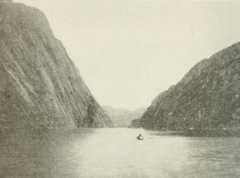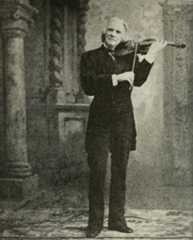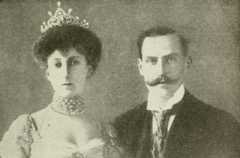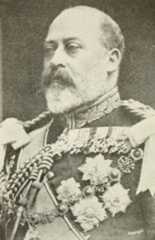
| Note: | Images of the original pages are available through Internet Archive. See https://archive.org/details/oldworlditswaysd00bryarich |

BY
DESCRIBING
A TOUR AROUND THE WORLD
AND
JOURNEYS THROUGH EUROPE

ST. LOUIS
The Thompson Publishing Company
1907
Copyright 1907
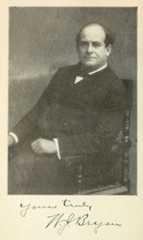
By William Jennings Bryan
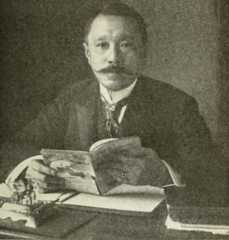
This volume is published in response to numerous requests from manysections, and my purpose is to put in permanent and convenient form theobservations made during travels in the old world.
The illustrations will throw light on the subjects treated and it is believedwill add much to the interest. The photographs from which they were madewere collected at the places visited or taken by members of our party. Chaptersone to forty-six were written from time to time during the trip around theworld.
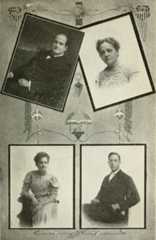
I was accompanied on this tour by my wife and our two younger children,William J., Jr., and Grace, aged sixteen and fourteen years respectively. Thetrip was taken for educational purposes and proved far more instructive thanwe anticipated.
We left our home September 21, 1905, sailed from San Francisco September27, and arrived in New York August 29, 1906—the day before the datefixed for the home-coming reception in that city—and reached Lincoln September5, sixteen days less than a year after our departure.
While most of our travel was in the North Temperate Zone, we werebelow the Equator a few days in Java and above the Arctic Circle in Norway.
In this narrative I fear I have sacrificed literary style to conciseness, for Ihave endeavored to condense and crowd into the space as much information aspossible. The statement of facts may be relied on, being based either uponobservations gathered at first hand from persons worthy to be trusted, or takenfrom authoritative writings.
Mrs. Bryan assisted me in the collection of materials and the preparation ofthe matter, and I am also indebted to the American Ambassadors, Ministers andConsuls, as well as to the officials of the countries which were visited, for valuableinformation.
I have included a series of articles written during a former visit to Europein 1902. As I have avoided in the World Tour Narratives the subjects treatedin these previous European articles, the two series are appropriately publishedtogether.
All of these are published with the more pleasure because I believe theywill give the reader increased admiration for American institutions and a largerconfidence in the triumph of American Ideals.
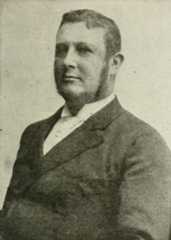
WILLIAM JENNINGS BRYAN
Lincoln, Nebraska, 1907
| Author's Preface | 5 |
| Chapter I—Crossing the Pacific—Hawaii | 15 |
| Chapter II—Japan and Her People | 25 |
| Chapter III—Japanese Customs and Hospitality | 37 |
| Chapter IV—Japan—Her History and Progress | 49 |
| Chapter V—Japan—Her Industries, Arts and Commerce | 61 |
| Chapter VI—Japan—Her Educational System and Her Religions | 69 |
| Chapter VII—Japan—Her Government, Politics and Problems | 80 |
| Chapter VIII—Korea—"The Hermit Nation" | 90 |
| Chapter IX—China—As She Was | 101 |
| Chapter X—China—As She Was—Part Second | 112 |
| Chapter XI—Chinese Education, Religion and Philosophy | 119 |
| Chapter XII—China's Awakening | 127 |
| Chapter XIII—Chinese Exclusion | 137 |
| Chapter XIV—The Philippines—The Northern Islands | 151 |
| Chapter XV—The Philippines—The Moro Country | 177 |
| Chapter XVI—The Philippine Problem | 186 |
| Chapter XVII—The Philippine Problem—Continued | 197 |
| Chapter XVIII—Java—The Beautiful | 205 |
| Chapter XIX—Netherlands India | 215 |
| Chapter XX—In The Tropics | 223 |
| Chapter XXI—Burma and Buddhism | 234 |
| Chapter XXII—Eastern India | 247 |
| Chapter XXIII—Hindu India | 260 |
| Chapter XXIV—Mohammedan India | 273 |
| Chapter XXV—Western India | 285 |
| Chapter XXVI—British Rule in India | 295 |
| Chapter XXVII—Ancient Egypt | 312 |
| Chapter XXVIII—Modern Egypt | 321 |
| Chapter XXIX—Among the Lebanons | 331 |
| [viii]Chapter XXX—The Christian's Mecca | 341 |
| Chapter XXXI—Galilee | 349 |
| Chapter XXXII—Greece, the World's Teacher | 358 |
| Chapter XXXIII—The Byzantine Capital | 366 |
| Chapter XXXIV—In the Land of the Turk | 376 |
| Chapter XXXV—Hungary and Her Neighbors | 385 |
| Chapter XXXVI—Austria-Hungary | 396 |
| Chapter XXXVII—The Duma | 403 |
| Chapter XXXVIII—Around the Baltic | 417 |
| Chapter XXXIX—Democratic Norway | 425 |
| Chapter XL—England's New Liberal Government | 435 |
| Chapter XLI—Homes and Shrines of Great Britain | 445 |
| Chapter XLII—Glimpses of Spain | 456 |
| Chapter XLIII—A Word to Tourists | 464 |
| Chapter XLIV—American Foreign Missions | 470 |
| Chapter XLV—World Problems | 478 |
| Chapter XLVI—A Study of Governments | 485 |
| Chapter XLVII—The Tariff Debate in England | 492 |
| Chapter XLVIII—Ireland and Her Leaders | 498 |
| Chapter XLIX—Growth of Municipal Ownership | 504 |
| Chapter L—France and Her People | 510 |
| Chapter LI—The Republic of Switzerland | 521 |
| Chapter LII—Three Little Kingdoms—Denmark | 525 |
| Chapter LIII—Belgium | 527 |
| Chapter LIV—The Netherlands | 529 |
| Chapter LV—Germany and Socialism | 533 |
| Chapter LVI—Russia and Her Czar | 542 |
| Chapter LVII—Rome—The Catholic Capital | 549 |
| Chapter LVIII—Tolstoy, The Apostle of Love | 559 |
| Chapter LIX—Notes on Europe | 567 |
| PAGE | |
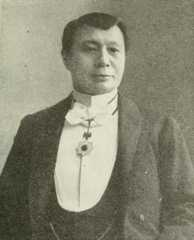
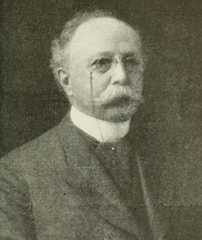
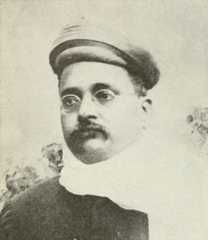
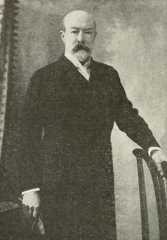
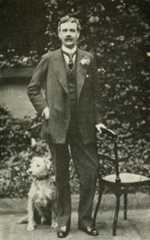
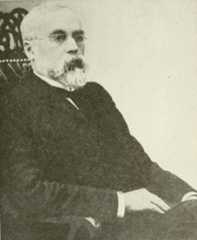
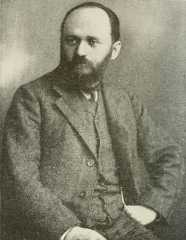
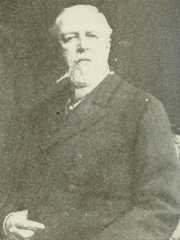
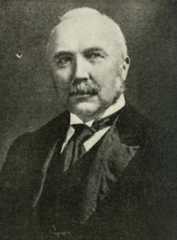
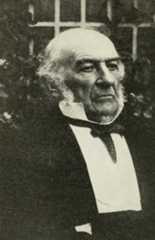
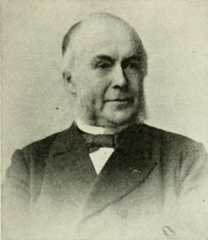
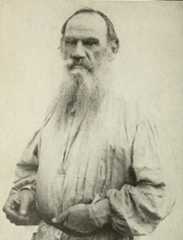
| William Jennings Bryan | Frontispiece |
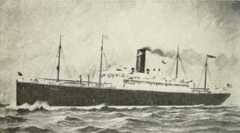
| Leaving San Francisco on the Manchuria | 16 |
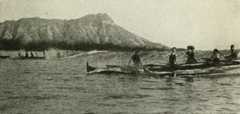
| Surf-Riding in Hawaii | 19 |
| Our Party | 21 |
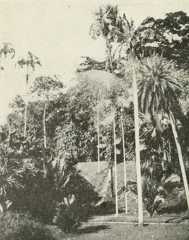
| Hawaiian Foliage | 24 |
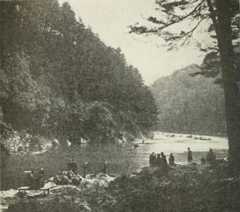
| A Picturesque View | 26 |
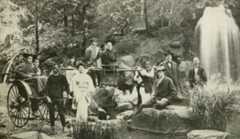
| At Miyanoshita | 29 |
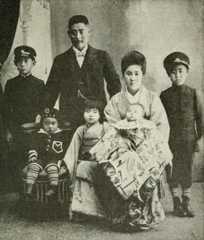
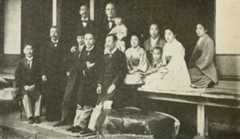
| A Japanese Family | 31 |
| Dwarf Maple—50 years old | 36 |
| Japanese Geisha Girls | 38 |
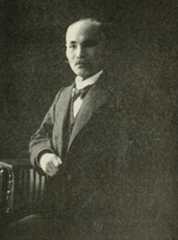
| Yukio Ozaki—Mayor of Tokyo | 40 |
| In Count Okuma's Conservatory | 43 |
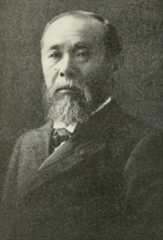
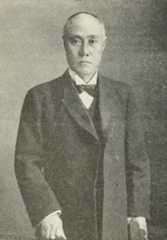
| Marquis Ito | 44 |
| Count Okuma | 45 |
| The Guest of Gov. Chikami at Kagoshima | 50 |
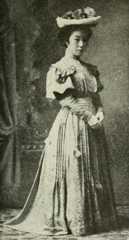
| Japanese Lady in American Dress | 53 |
| A Japanese Maiden | 54 |
| Yukichi Fukuzawa, Jr. | 57 |
| Sumitka Haseba—Japanese Statesman | 59 |
| Japanese Water-Carrier | 64 |
| A Visit to Count Okuma's School near Tokyo | 70 |
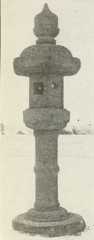
| Japanese Stone Lantern | 74 |
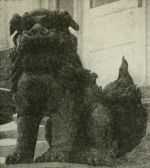
| Korean Lion—Yes | 75 |
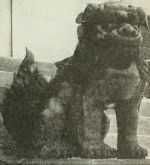
| Korean Lion—No | 75 |
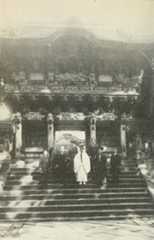
| In Front of Nikko Temple—Japan | 76 |
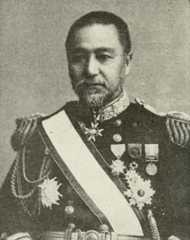
| Admiral Togo | 82 |
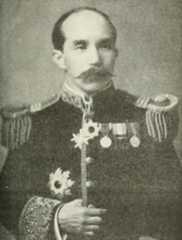
| President of Diet—Japan | 84 |
| Baron Kentaro Kaneko | 85 |
| Mr. Okura, a Successful Japanese Business Man | 87 |
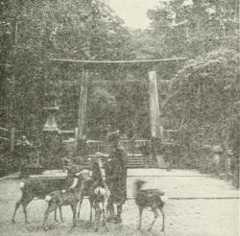
| A Shinto Gate at Nara | 89 |
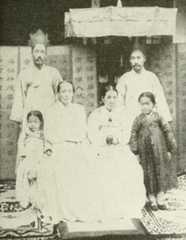
| Two Korean Families | 91 |
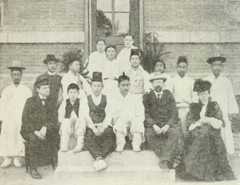
| In Korea—Group of Natives | 92 |
| A Korean Scene | 95 |
| American Hospital at Seoul—Korea | 99 |
| Doing the Family Washing | 100 |
| A Group of Chinese—Pekin | 103 |
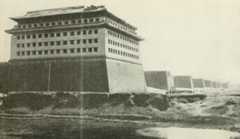
| The Wall at Pekin | 105 |
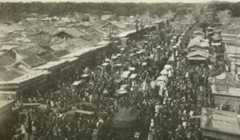
| A Street in Pekin | 107 |
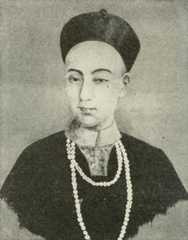
| Chinese Emperor | 108 |
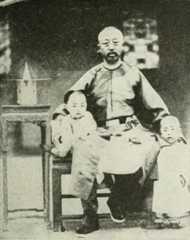
| The Father of the Chinese Emperor | 109 |
| Empress Dowager—China | 110 |
| One of the Principal Streets of Pekin | 111 |
| House Boats at Canton | 114 |
| Yuan Shi Kai—Viceroy Tientsin and Pekin | 117 |
| Altar of Heaven—Pekin | 123 |
| Illustration of Foot-Binding | 125 |
| Traveling: in North China | 126 |
| Viceroy Chang Chih Tung | 129 |
| Wu Ting Fang | 130 |
| Chinese Cart at Pekin | 133 |
| [x]Chou Fu, Viceroy of Nanking | 134 |
| A Canton Bridge | 136 |
| Manchu and Chinese Women—China | 139 |
| The Chinese Wheelbarrow | 143 |
| Fashionable Conveyance at Hong Kong | 147 |
| Colossal Statue of Ming, Ruler of China | 150 |
| A Filipino Village | 152 |
| Filipino Houses | 153 |
| General Emilio Aguinaldo | 154 |
| Filipino Boys with Blow Guns | 155 |
| Group of Filipinos | 156 |
| In the Philippines | 157 |
| The Accomplished Wife of a Filipino Official | 159 |
| Filipino Night School—American Teachers | 161 |
| A Filipino Belle | 165 |
| Emilio Aguinaldo, Mother, Sister, Brother and Son | 167 |
| A Filipino Teacher | 169 |
| Hauling Hemp | 170 |
| Moro Huts | 176 |
| Threshing Rice | 176 |
| Moros | 182 |
| Moro School—Zamboanga | 185 |
| Henry C. Ide, Gov. Gen. Philippine Islands | 187 |
| Datu Piang and Grandson | 188 |
| Dr. G. Apacible | 191 |
| Plowing in Sulu Land | 193 |
| Sailing in Manila Bay | 195 |
| Carabao Cart and Driver | 198 |
| Harvesting Sugar Cane | 199 |
| The Rice Harvest | 200 |
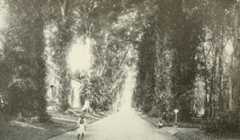
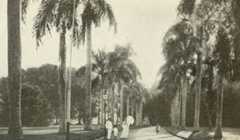
| A Driveway in Botanical Garden—Buitenzorg | 206 |
| Extinct Volcano, Salak | 207 |
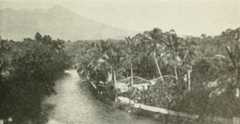
| A Java Road | 210 |
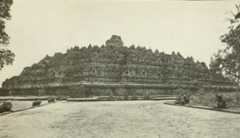
| Temple at Boro Boedoer | 213 |
| A Native | 216 |
| A Group of Javanese | 219 |
| In the Tropics | 224 |
| The Lake at Kandy, Ceylon | 226 |
| Singalese Chief's Daughter—Showing Jewelry | 228 |
| Singalese Carpenter | 229 |
| Tamil Girl—Ceylon | 231 |
| An Elephant at Work in Rangoon | 235 |
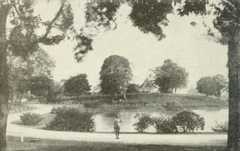
| The Park at Rangoon | 236 |
| Five Hundred Pagoda at Mandalay | 237 |
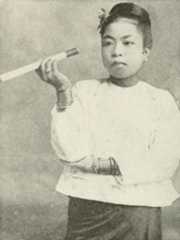
| Burmese Woman with Cigarette | 238 |
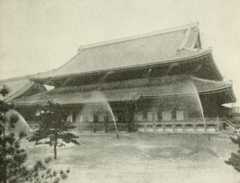
| Buddhist Temple | 239 |
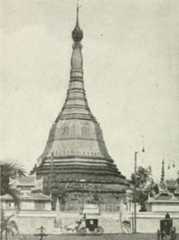
| The Shwe Dagon Pagoda | 240 |
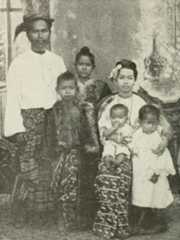
| Burmese Family | 242 |
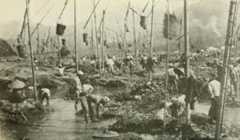
| Gathering Precious Stones in Burma | 245 |
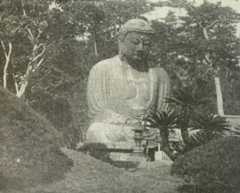
| Bronze Image of Buddha, Built 1252 | 246 |
| Calcutta Burning Ghat | 248 |
| The Maharaja of Mourbharag—An Indian Prince | 250 |
| Indian Princess | 251 |
| The Great Banyan Tree—Calcutta | 252 |
| A Calcutta Street—India | 253 |
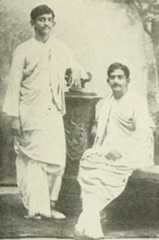
| Keshub Chunder Sen | 255 |
| The Bull Cart in India | 256 |
| Thibetans, as Seen at Darjeeling | 257 |
| View of the Himalayas, as seen from Darjeeling | 258 |
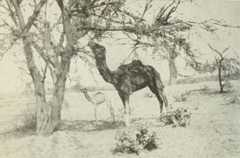
| [xi]The Camel in India | 261 |
| Cultivating Psychic Power on Spikes at Benares, India | 262 |
| Bathing Ghat on the Ganges | 263 |
| Pundit Sakharam Ganesh | 264 |
| Hindu Types | 266 |
| Hindu Fair at Allahabad—India | 267 |
| Hindu Fakir | 268 |
| Mrs. Besant's College | 269 |
| A Gala Day in India | 270 |
| Cremation of Dead Bodies—Burning Ghat | 271 |
| Hindu Group | 272 |
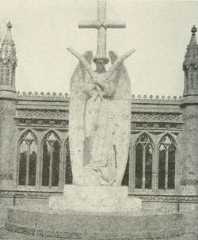
| Angel of the Resurrection | 274 |
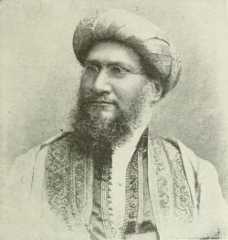
| The Honorable My Justice Badruddin Tyabji | 275 |
| Ruins of the Residency—Lucknow, India | 276 |
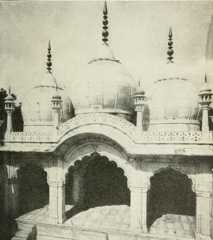
| Pearl Mosque at Delhi | 277 |
| Gokale—Prominent Indian Reformer | 278 |
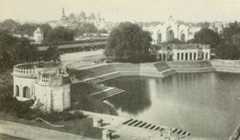
| A Pool at Lucknow—India | 279 |
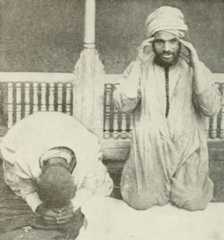
| Mohammedans at Prayer | 280 |
| Klanjiban Ganguli, Supt. Instruction | 281 |
| Taj Mahal, Agra | 283 |
| Street in Jaipore—India | 287 |
| An American Maid in Parsee Costume | 290 |
| Maharaja—Jaipore | 291 |
| Mohammedan Lady, Bombay | 292 |
| Elephant Parade | 293 |
| Assembling for the Bombay Meeting | 294 |
| His Excellency the Earl of Minto | 296 |
| Viceroy's Palace at Calcutta | 298 |
| Sir James Diggs La Touche | 300 |
| Sir Andrew Frazer | 302 |
| Lord Curzon | 303 |
| Gov. Lamington—Bombay, India | 307 |
| Indian Students | 309 |
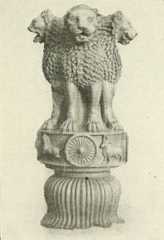
| Famous Asoka Pillar | 311 |
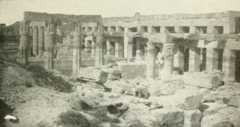
| Karnak Temple | 313 |
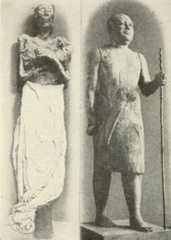
| Mummy and Wooden Statue | 314 |
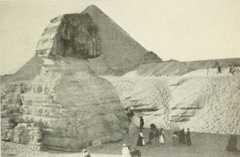
| The Pyramid and the Sphinx | 319 |
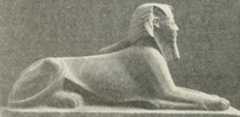
| A Sphinx | 320 |
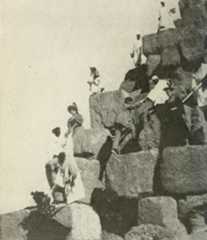
| Climbing the Pyramids | 322 |
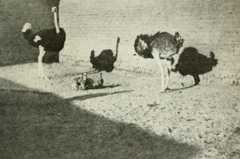
| The Ostrich Farm near Cairo | 323 |
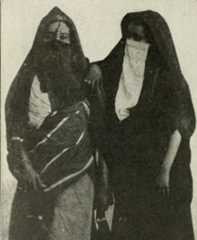
| Egyptian Ladies | 324 |
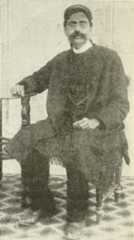
| An Egyptian Merchant | 325 |
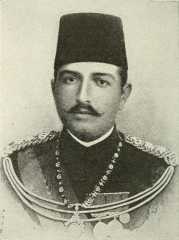
| Khedive of Egypt | 328 |
| Reunion on the Desert | 329 |
| Temple at Baalbek | 332 |
| The Giant Stone at Baalbek | 334 |
| Cedars of Lebanon | 336 |
| Beyrouth—Syria | 337 |
| The Big Tail Sheep | 338 |
| Damascus Dogs | 339 |
| Mount of Olives | 344 |
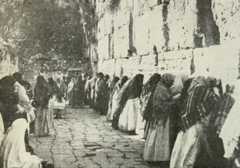
| Wailing Place of the Jews | 346 |
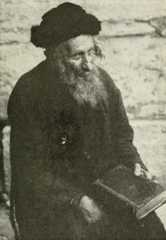
| A Jewish Rabbi | 347 |
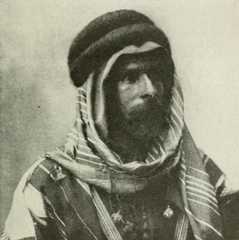
| A Bedouin | 351 |
| At Breakfast | 352 |
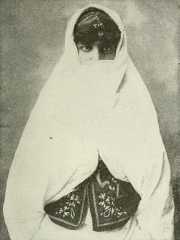
| An Arab Maiden | 353 |
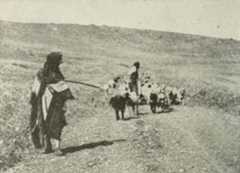
| The Bedouin Shepherd and His Flock | 354 |
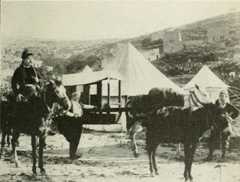
| Salim Moussa, with Party of Tourists | 355 |
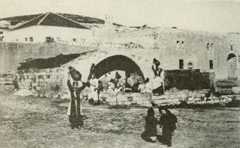
| Mary's Well at Nazareth | 356 |
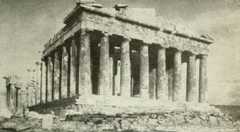
| [xii]The Parthenon | 359 |
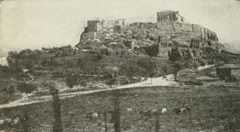
| The Acropolis at Athens | 360 |
| Mars Hill | 362 |
| Demosthenes' Platform | 363 |
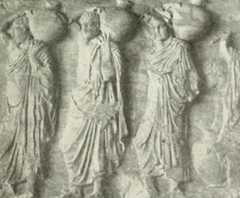
| Frieze of the Parthenon. | 365 |
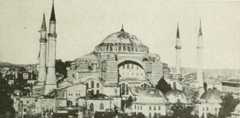
| St. Sofia at Constantinople | 367 |
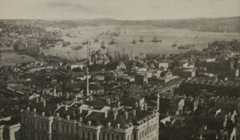
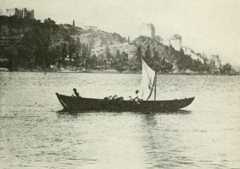
| The Bosphorus at Constantinople | 369 |
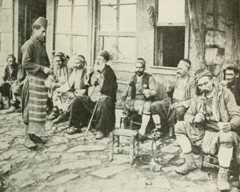
| Smoking the Hubble-Bubble Pipe | 371 |
| Robert's College near Constantinople | 373 |
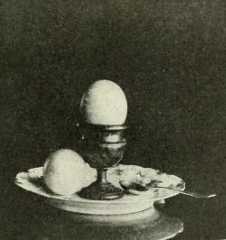
| At the World's Breakfast Table | 375 |
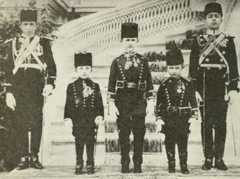
| Sons of the Sultan. | 378 |
| Turkish Officials | 381 |
| The Danube and Parliament Building—Budapest | 387 |
| A Street in Budapest | 388 |
| Budapest | 391 |
| Prime Minister Wekerle—Hungary | 393 |
| Count Apponyi | 394 |
| Minister Kossuth | 395 |
| Carlsbad | 399 |
| Count Ignatieff | 404 |
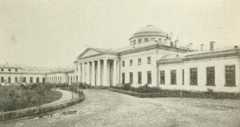
| The Palace Where the Russian Duma Meets | 405 |
| Prof. Serge Murmetzeff | 407 |
| Editor Paul I. Miliukoff | 408 |
| Some Members of Russian Duma | 410 |
| Members of the Russian Duma | 411 |
| Maxim Winawer | 412 |
| Group of Russian Duma with Mr. Bryan in Center | 413 |
| Ivan Petrunkevich | 415 |
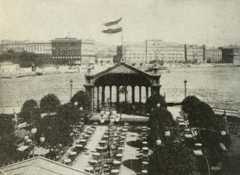
| A View of Stockholm | 418 |
| King Oscar of Sweden | 420 |
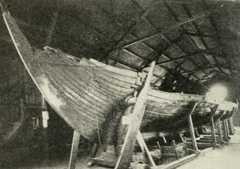
| The Viking Ship at Christiania | 426 |
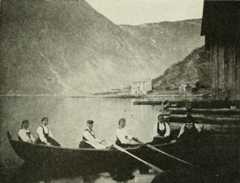
| In Hjorendfiord | 427 |
| Troldfjord | 428 |
| Ole Bull | 430 |
| King Haakon and Queen Maud | 433 |
| King Edward VII | 436 |
| Sir Henry Campbell-Bannerman | 438 |
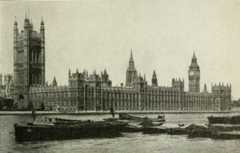
| House of Parliament, London | 439 |
| John Morley, M. P. | 441 |
| John Burns | 443 |
| Melrose Abbey | 446 |
| Birthplace of Robert Burns | 449 |
| Shakespeare's Birth-House Restoration | 450 |
| Hawarden Castle—Home of Gladstone | 453 |
| W. E. Gladstone | 454 |
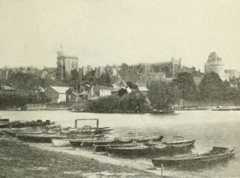
| Windsor Castle | 455 |
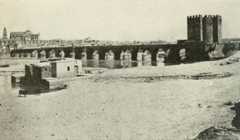
| The Old Bridge at Cordova | 458 |
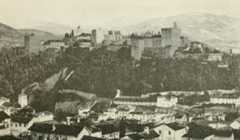
| The Alhambra—Spain | 461 |
| Resignation | 463 |
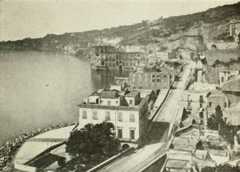
| Vesuvius as Seen from Naples | 466 |
| Mission School | 477 |
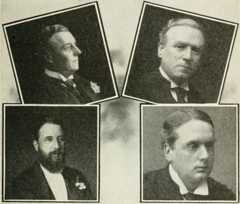
| Four Statesmen of England | 493 |
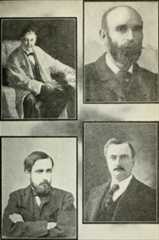
| Irish Patriots | 499 |
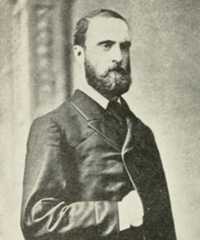
| Charles S. Parnell | 502 |
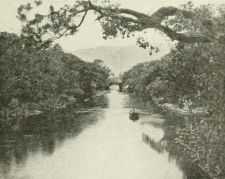
| Meeting of the Waters—Killarney | 503 |
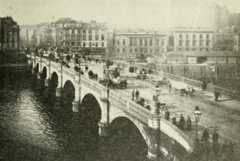
| The Broomelaw Bridge at Glasgow | 505 |
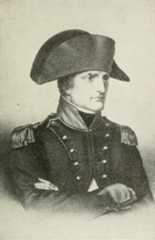
| Napoleon Bonaparte | 511 |
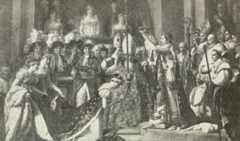
| Napoleon Bonaparte Crowning Josephine. | 514 |
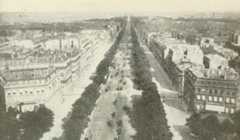
| Avenue Champs-Elysees—Paris | 516 |
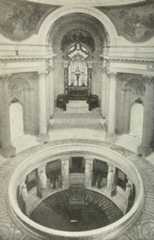
| [xiii]Tomb of Napoleon | 518 |
| King Christian and Wife | 526 |
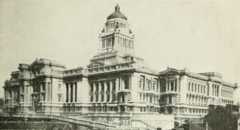
| Palace of Justice—Belgium | 527 |
| The Hague | 529 |
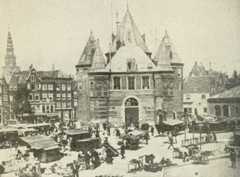
| The Market Place at Amsterdam | 530 |
| A Netherlands Statesman | 531 |
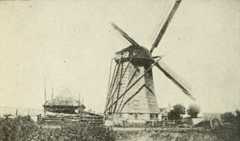
| A Dutch Windmill | 532 |
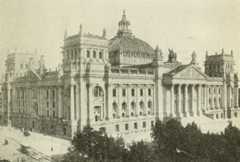
| The Reichstag | 533 |
| Leipsic University | 534 |
| The Rhine | 536 |
| Kaiser Wilhelm | 538 |
| Breton Peasants | 540 |
| The Czar of Russia | 543 |
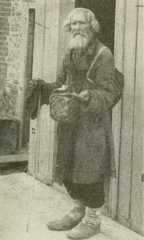
| Russian Beggar | 547 |
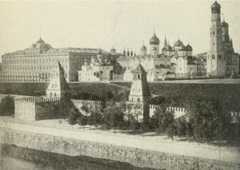
| Kremlin of Moscow | 548 |
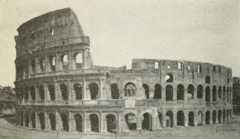
| Coliseum—Rome | 550 |
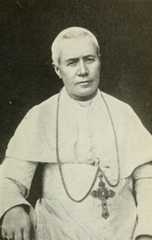
| Pope Pius X | 551 |
| Naples | 553 |
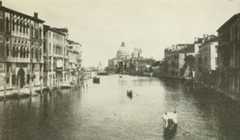
| Grand Canal—Venice | 555 |
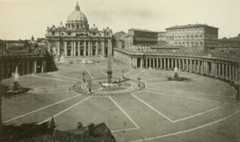
| St. Peter's at Rome | 557 |
| Madonna | 558 |
| Count Tolstoy | 560 |
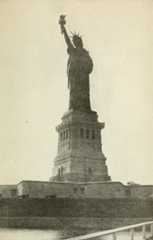
| Goddess of Liberty—New York Harbor | 575 |
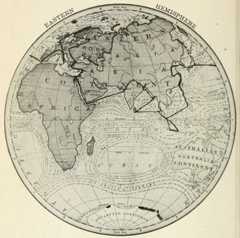
ROUTE TRAVELED.
There is rest in an ocean voyage. The receding shores shut out thehum of the busy world; the expanse of water soothes the eye by its veryvastness; the breaking of the waves is music to the ear and there ismedicine for the nerves in the salt sea breezes that invite to sleep. Atfirst one is disturbed—sometimes quite so—by the motion of the vessel,but this passes away so completely that before many days the dippingof the ship is really enjoyable and one finds a pleasure inascending the hills and descending the valleys into which the decksometimes seems to be converted.
If one has regarded the Pacific as an unknown or an untraversedsea, the impression will be removed by a glance at a map recently publishedby the United States government—a map with which everyocean traveler should equip himself. On this map the Pacific iscovered with blue lines indicating the shortest routes of travelbetween different points with the number of miles. The first thing thatstrikes one is that the curved line indicating the northern routebetween San Francisco and Yokohama is only 4,536 miles long, whilethe apparently straight line between the two points is 4,791 miles long—thedifference being explained by the curvature of the earth,although it is hard to believe that in following the direct line a shipwould have to climb over such a mountain range of water, so to speak,as to make it shorter to go ten degrees north. The time between theUnited States and the Japanese coast has recently been reduced to lessthan eleven days, but the northern route is not so pleasant at thisseason of the year, and we sailed on the Manchuria, September 27,going some twenty degrees farther south via Honolulu. This routecovers 5,545 miles and is made in about sixteen days when the weatheris good.
The Manchuria is one of the leviathans of the Pacific and is ownedby Mr. Harriman, president of the Union Pacific and Southern PacificRailways. The ship's crew suggests the Orient, more than three-fourths[16]being Chinese, all wearing the cue and the national garb.There is also a suggestion of the Orient in the joss house and opiumden of the Chinese in the steerage.
In crossing the one hundred and eightieth meridian we lost a day,and as we are going all the way around, we cannot recover it as thosecan who recross the Pacific. We rose on Saturday morning, October 7,and at nine o'clock were notified that Sunday had begun and theremainder of the day was observed as the Sabbath (October 8).
According to the chart or map referred to there are threecenters of ocean traffic in the Pacific. Honolulu, the most importantof all, the Midway Islands, 1,160 miles northwest of Honolulu, andthe Samoan Islands, some twenty-two hundred miles to the south.The Society Islands, about the same distance to the southeast of Honolulu,and Guam, some fifteen hundred miles from the mainland ofAsia, are centers of less importance.
Our ship reached Honolulu early on the morning of the sixth dayout and we had breakfast on the island. The Hawaiian Islands (inhabited)number eight and extend from the southeast to the northwest,covering about six degrees of longitude and nearly four of latitude.Of these eight islands, Hawaii, the southernmost one, is the largest,having an area of 4,200 square miles and a population of nearlyfifty thousand. Hilo, its chief city, situated on the east shore, is thesecond Hawaiian city of importance and contains some seven thousand[17]inhabitants. The island of Oahu, upon which Honolulu is situated,is third in size but contains the largest population, almost sixtythousand, of which forty thousand dwell in or near the capital. Theislands are so small and surrounded by such an area of water as toremind one of a toy land, and yet there are great mountains there, onepiercing the clouds at a height of 14,000 feet. Immense cane fieldsstretch as far as the eye can reach, and busy people of different colorsand races make a large annual addition to our country's wealth. Onone of the islands is an active volcano which furnishes a thrillingexperience to those who are hardy enough to ascend its sides and crossthe lava lake, now grown cold, which surrounds the present crater.Each island has one or more extinct volcanoes, one of these, called"The Punch Bowl," being within the city limits of Honolulu. On oneof the islands is a leper colony, containing at times as many as athousand of the afflicted. During campaigns the spellbinders addressthe voters from boats anchored at a safe distance from the shore.
As the Manchuria lay at anchor in the harbor all day the passengerswent ashore and, dividing into groups, inspected the various placesof interest. By the aid of a reception committee, composed of democrats,republicans and brother Elks, we were able to crowd a greatdeal of instruction and enjoyment into the ten hours which we spentin Honolulu. We were greeted at the wharf with the usual salutation,Aloha, a native word which means "a loving welcome," and weredecorated with garlands of flowers for the hat and neck. While thesegarlands or leis (pronounced lays) are of all colors, orange is thefavorite hue, being the color of the feather cloak worn by the Hawaiiankings and queens in olden times. The natives are a very kindlyand hospitable people, and we had an opportunity to meet someexcellent specimens of the race at the public reception and the countryresidence of Mr. Damon, one of the leading bankers of the island.
When the islands were discovered in 1778 by Captain Cook, thenatives lived in thatched huts and were scantily clothed, after themanner of the tropical races. They were not savages or cannibals, butmaintained a degree of civil order and had made considerable progressin the primitive arts. In their religious rites they offered human sacrifices,but they welcomed the white man and quickly embracedChristianity. American influence in the islands reaches back someseventy-five years, beginning with New England missionaries, manyof whose descendants have made permanent homes here. Some ofthese, mingling their blood with the blood of the natives, form connectinglinks between the old and the new civilization. Foreign ways[18]and customs soon began to manifest themselves and long before annexationthe native rulers built buildings after the style of our ownarchitecture. The Capitol building, erected twenty years ago for theking's palace, is an imposing structure, and the Judiciary buildingis almost equal to it. The parks and public grounds are beautiful andwell kept, and the business blocks commodious and substantial. Inshort, Honolulu presents the appearance of a well built, cleanly andprosperous American city, with its residences nestling among palmtrees and tropical plants. Good hotels are abundant. The AlexanderYoung hotel is built of stone imported from the States and would docredit to a city of half a million. The Royal Hawaiian hotel, evenmore picturesque, though not so large, and the Moana hotel, at thebeach, vie with the Young in popularity.
The program for our day's stay began with a seven mile automobileride to the Pali, the pass over which the natives cross to the fartherside of the island. The road is of macadam and winding along a picturesquevalley rises to a height of about 1,200 feet. At this point theeye falls upon a picture of bewitching beauty. Just below is aprecipitous cliff over which a conquering king, Kamehameha the First,about one hundred and ten years ago, drove an opposing army whenhe established himself as ruler of the islands. To the east from thefoot of the cliff, a thousand feet down, stretches a beautiful valley withan endless variety of verdure; and beyond, a coast line broken bya rocky promontory, around whose base the waters reflect from theirvarying depths myriad hues of blue and green. There are ocean viewsof greater expanse, mountain views more sublime and agriculturallandscapes more interesting to a dweller upon prairies, but it is doubtfulwhether there is anywhere upon earth a combination of mountain,valley and ocean—a commingling of the colors of sky and sea androck and foliage—more entrancing. Twice on the way to Pali wepassed through mountain showers and were almost ready to turn back,but the members of the committee, knowing of the rare treat ahead,assured us that Hawaiian showers were of short duration and "extradry." When we at last beheld the view, we felt that a drenching mightgladly have been endured, so great was the reward.
The committee next took us by special train on the Oahu railroad toone of the great sugar plantations of the island, a plantation outsideof the trust, owned and operated by a San Francisco company. Thiscompany has built an immense refinery upon the plantation and themanager showed us the process of sugar making from the crushingof the cane to the refined product, sacked ready for shipment.
The stalks, after passing through the mill, are dried and carried tothe furnace, thus saving some sixty-five per cent of the cost of fuel—animportant economy when it is remembered that all the fuel formanufacturing is brought from abroad. Until recently, several hundredthousand dollars' worth of coal was annually brought from Australia,but California oil is now being substituted for coal. The refusewhich remains when the sugar making process is completed is returnedto the land as fertilizer. The economies effected in fuel and in fertilizer,together with the freight saved on impurities carried in the rawsugar, amount to a considerable sum and to this extent increase theprofit of the business. While at the sugar plantation we were shownan immense pumping plant used in the irrigation of the land. Thewater is drawn from artesian wells and forced to a height of almostsix hundred feet, in some places, and from the summits of the hillsis carried to all parts of the plantation. Some idea of the size of theplants can be gathered from the fact that the pumps used on thisplantation have a combined capacity of sixty million gallons per day.
Speaking of irrigation, I am reminded that the rainfall varies greatlyin different parts of the island. At Honolulu, for instance, it is somethinglike thirty inches per year, while at one point within five milesof the city the annual rainfall sometimes reaches one hundred andforty inches. The sugar plantation visited, while one of the largest,is only one of a number of plantations, the total sugar product of theislands reaching about four hundred thousand tons annually.
Next to the sugar crops comes the rice crop, many of the rice fields[20]lying close to the city. Pineapples, bananas, coffee and cocoanuts arealso raised. Attention is being given now to the development of cropswhich can be grown by small planters, those in authority recognizingthe advantage to the country of small holdings.
The labor problem is the most serious one which the people ofHawaii have to meet. At present the manual labor is largely done byJapanese, Chinese and Koreans—these together considerably outnumberingthe whites and natives. Several thousand Portuguese have beenbrought to the islands and have proven an excellent addition to thepopulation. On the day that we were there the immigration commissionauthorized the securing of a few Italian families with a view oftesting their fitness for the climate. The desire is to develop a homogeneouspopulation suited to the conditions and resources of the islands.
We returned from the sugar plantation in automobiles, stopping atthe country home of Mr. Damon, which was once a royal habitation.The present owner has collected many relics showing the life, habitsand arts of the native Hawaiians.
Still nearer the town we visited two splendid schools, one for nativeboys, the other for native girls, built from the funds left by nativechiefs. The boys and girls were drawn up in front of one of thebuildings and under the direction of their instructor sang the nationalanthem of the natives, now preserved as the territorial hymn. Theywere a finely proportioned, well dressed and intelligent group and aresaid to be studious and excellently behaved. Nothing on the islandsinterested us more than these native children, illustrating as they do,not only the possibilities of their race, but the immense progress madein a little more than a hundred years of contact with the whites. Themuseum, the gift of Mr. Bishop, now of California, who married thewidow of one of the native chiefs, is said to contain the best collectionof the handiwork of the natives of the Pacific Islands to be found anywhere.
The public reception at the Royal Hawaiian hotel gave us an opportunityto meet not only the prominent American and native citizensand their wives, but a large number of the artisans and laborers of thevarious races, and we were pleased to note throughout the day the harmoniousfeeling which exists between the whites and the brown population.
Political convictions produce the same results here as in the UnitedStates, sometimes dividing families. For instance, Prince Cupid, thepresent territorial representative in congress, is a republican, while hisbrother, Prince David, is an enthusiastic democrat.[21]
[22]The luncheon prepared by the committee included a number ofnative dishes cooked according to the recipes which were followed forhundreds of years before the white man set foot upon the island. Thehealth of the guests was drunk in cocoanut water, a nut full of whichstood at each plate. Poi, the staple food of the natives, was present inabundance. This is made from a root or tuber known as taro, whichgrows in swamps and has a leaf resembling our plant, commonly knownas elephant's ear. This tuber is ground to a pulp resembling paste andis served in polished wooden bowls, in the making of which the nativesexhibit great skill. Next in interest came the fish and chicken, wrappedin the leaves of a plant called ti (pronounced like tea) and cookedunderground by means of hot stones. The flavor of food thus cookedis excellent. The crowning glory of the feast was a roasted pig, alsocooked underground—and a toothsome dish it was. Besides these, therewere bread fruit, alligator pears and delicacies made from the meatof the cocoanut. The salt, a native product, was salmon colored. Theinvited guests were about equally divided between the American andnative population. But for the elegant surroundings of the Younghotel, the beautifully appointed table and the modern dress, it was sucha dinner as might have been served by the natives to the whites onthe first Thanksgiving after the New England missionaries landed.
After a call upon Governor Carter, a descendant of the third generationfrom missionary stock, we visited the aquarium. When wenoticed on the printed program that we were scheduled for a visit tothis place, it did not impress us as possessing special interest, but wehad not been in the building long before we were all roaring withlaughter at the remarkable specimens of the finny tribe here collected.
Language can not do this subject justice. No words can accuratelyportray what one here sees. The fish are odd in shape and have all thehues of the rainbow. The tints are laid on as if with a brush andyet no painter could imitate these—shall we call them "pictures in watercolor?" Some were long and slim; some short and thick. One had aforehead like a wedge, another had a very blunt nose. Some lookedlike thin slabs of pearl with iridescent tints; others had quills like aporcupine. One otherwise respectable looking little fellow had a longnose upon the end of which was a fiery glow which made him looklike an old toper; another of a deep peacock blue had a nose for allthe world like a stick of indigo which it wiggled as it swam.
There were convict fish with stripes like those worn in penitentiariesand of these there were all sizes; some moving about slowly and solemnlylike hardened criminals and others sporting about as if enjoying[23]their first taste of wrongdoing. One variety wore what looked like anorange colored ribbon tied just above the tail; the color was so likethe popular flower of Hawaii that we were not surprised to find thatthe fish was called the lei. In one tank the fish had a habit of restingupon the rocks; they would brace themselves with their fins and watchthe passersby. At one time two were perched side by side and recalledthe familiar picture of Raphael's Cherubs. Besides the fishes there werecrabs of several varieties, all brilliant in color; one called the hermitcrab had a covering like velvet, with as delicate a pattern as ever camefrom the loom. And, then, there was the octopus with the under sideof its arms lined with valve-like mouths. It was hiding under therocks, and when the attendant poked it out with a stick, it darkenedthe water with an inky fluid, recalling the use made of the subsidizedAmerican newspapers by the trust when attacked.
No visitor to Honolulu should fail to see the aquarium. Every effortto transport these fish has thus far failed. To enjoy the dudes, clownsand criminals of fishdom one must see them in their native waters.
The tour of the island closed with a trip to the beach and a ride inthe surf boats. The native boat is a long, narrow, deep canoe steadiedby a log fastened at both ends to the boat and floating about ten feetfrom the side. These canoes will hold six or seven persons and arepropelled by brawny-armed natives. Our party clad themselves inbathing suits and, filling three canoes, were rowed out some distancefrom the shore. The natives, expert at this sport, watch for a large waveand signal each other when they see one approaching, and then withtheir big round paddles they start their canoes toward the land. Asthe wave raises the stern of the canoe, they bend to their work, thepurpose being to keep the canoe on the forward slope of the wave. Itis an exciting experience to ride thus, with the spray breaking overone while the canoe flies along before the wave. Sometimes the boatmenare too slow and the wave sweeps under the canoe and is gone,but as a rule they know just how fast to work, and there is greatrivalry between the surf riders when two or more crews are racing. Itis strange that a form of sport so delightful has not been transportedto the American seaside resorts. There is surf bathing the year roundat Honolulu and few beaches can be found which can compare withWaikiki.
The Oahu railroad, which carried us out to the sugar plantation,and which has seventy miles of track on the island, passes within sightof the Pearl harbor, which is the only large inlet in the islands capableof being developed into a harbor. The United States government is[24]already dredging this harbor and preparing it for both naval and commercialuses. The Hawaiian Islands occupy a strategic position as wellas a position of great commercial importance, and as they are on a directline between the Isthmus of Panama and the Orient, their value as amid-ocean stopping place will immeasurably increase. The islandsbeing now United States territory, the advantage of the possession ofPearl harbor is accompanied by a responsibility for its proper improvement.No one can visit the harbor without appreciating its importanceto our country and to the world.
When we departed from the wharf at nightfall to board the Manchuriawe were again laden with flowers, and as we left the island, refreshedby the perfume of flowers and cheered by songs and farewells,we bore away grateful memories of the day and of the hospitality ofthe people. Like all who see this Pacific paradise, we resolved toreturn sometime and spend a part of a winter amid its beauties.
The eyes of the world are on Japan. No other nation has evermade such progress in the same length of time, and at no time in herhistory has Japan enjoyed greater prestige than she enjoys just now;and, it may be added, at no time has she had to face greater problemsthan those which now confront her.
We were fortunate in the time of our arrival. Baron Komura, thereturning peace commissioner, returned two days later; the naval reviewcelebrating the new Anglo-Japanese alliance took place in Yokohamaharbor a week afterward, and this was followed next day by thereception of Admiral Togo at Tokyo. These were important eventsand they gave a visitor an extraordinary opportunity to see the peopleen masse. In this article I shall deal in a general way with Japanand her people, leaving for future articles her history, her government,her politics, her industries, her art, her education and her religions.
The term Japan is a collective title applied to four large islands, thatis, Honshiu, Kyushu, Shikoku, Hokkaido and about six hundredsmaller ones. Formosa and the islands immediately adjoining it arenot generally included, although since the Chinese war they belongto Japan.
Japan extends in the shape of a crescent, curving toward the northeast,from fifty north latitude and one hundred and fifty-six east longitudeto twenty-one degrees north latitude and one hundred and nineteeneast longitude. The area is a little less than one hundred and sixtythousand square miles, more than half of which is on the islandof Honshiu. The coast line is broken by numerous bays furnishingcommodious harbors, the most important of which are at Yokohama,Osaka, Kobe, Nagasaki, Kagoshima and Hakodate. The islands areso mountainous that only about one-twelfth the area is capable ofcultivation. Although Formosa has a mountain, Mt. Niitaka (sometimescalled Mt. Morrison) which is two thousand feet higher,[26]Fujiyama is the highest mountain in Japan proper. It reaches a heightof 12,365 feet.
Fuji (Yama is the Japanese word for mountain) is called the SacredMountain and is an object of veneration among the Japanese. Andwell it may be, for it is doubtful if there is on earth a more symmetricalmountain approaching it in height. Rising in the shape of aperfect cone, with its summit crowned with snow throughout nearly theentire year and visible from sea level, it is one of the most sublimeof all the works of nature. Mt. Ranier, as they say at Seattle, orTacoma, as it is called in the city of that name, and Popocatapetl, nearMexico's capital, are the nearest approach to Fuji, so far as the writer'sobservation goes. Pictures of Fuji are to be found on everything; theyare painted on silk, embroidered on screens, worked on velvet, carvedin wood and wrought in bronze and stone. We saw it from Lake[27]Hakone, a beautiful sheet of water some three thousand feet above theocean. The foot hills which surround the lake seem to open at onepoint in order to give a more extended view of the sloping sides of thissleeping giant.
And speaking of Hakone, it is one of the beauty spots of Japan.On an island in this lake is the summer home of the crown prince.Hakone is reached by a six-mile ride from Miyanoshita, a picturesquelittle village some sixty miles west of Yokohama. There are here hotsprings and all the delights of a mountain retreat. One of the bestmodern hotels in Japan, the Fujiya, is located here, and one of itsearliest guests was General Grant when he made his famous tour aroundthe world. The road from the hotel to Hakone leads by foamingmountain streams, through closely cultivated valleys and over a rangefrom which the coast line can be seen.
Nikko, about a hundred miles north of Tokyo, and Nara about thirtymiles from Kyoto, are also noted for their natural scenery, but as theseplaces are even more renowned because of the temples located therethey will be described later. The inland sea which separates the largerislands of Japan, and is itself studded with smaller islands, adds interestto the travel from port to port. Many of these islands are inhabited,and the tiny fields which perch upon their sides give evidence of anever present thrift. Some of the islands are barren peaks jutting a fewhundred feet above the waves, while some are so small as to look likehay stacks in a submerged meadow.
All over Japan one is impressed with the patient industry of thepeople. If the Hollanders have reclaimed the ocean's bed, the peopleof Japan have encroached upon the mountains. They have broadenedthe valleys and terraced the hill sides. Often the diminutive fields areheld in place by stone walls, while the different levels are furnishedwith an abundance of water from the short but numerous rivers.
The climate is very much diversified, ranging from almost tropicalheat in Formosa to arctic cold in the northern islands; thus Japan canproduce almost every kind of food. Her population in 1903 was estimatedat nearly forty-seven millions, an increase of about thirteenand a half millions since 1873. While Tokyo has a population ofabout one and a half millions, Osaka a population of nearly a million,Kyoto three hundred and fifty thousand, Yokohama three hundredthousand, and Kobe and Nagoya about the same, and there are severalother large cities of less size, still a large majority of the population isrural and the farming communities have a decided preponderance in[28]the federal congress, or diet. The population, however, is increasingmore rapidly in the cities than in the country.
The stature of the Japanese is below that of the citizens of theUnited States and northern Europe. The average height of the menin the army is about five feet two inches, and the average weight betweena hundred and twenty and a hundred and thirty pounds. Itlooks like burlesque opera to see, as one does occasionally, two or threelittle Japanese soldiers guarding a group of big burly Russian prisoners.
The opinion is quite general that the habit which the Japanese formfrom infancy of sitting on the floor with their feet under them, tendsto shorten the lower limbs. In all the schools the children are nowrequired to sit upon benches and whether from this cause or some other,the average height of the males, as shown by yearly medical examination,is gradually increasing. Although undersize, the people aresturdy and muscular and have the appearance of robust health. Incolor they display all shades of brown, from a very light to a verydark. While the oblique eye is common, it is by no means universal.
The conveyance which is most popular is the jinrikisha, a narrowseated, two wheeled top buggy with shafts, joined with a cross pieceat the end. These are drawn by "rikisha men" of whom there areseveral hundred thousand in the empire. The 'rikisha was inventedby a Methodist missionary some thirty years ago and at once spranginto popularity. When the passenger is much above average weight,or when the journey is over a hilly road, a pusher is employed and inextraordinary cases two pushers. It is astonishing what speed thesemen can make. One of the governors informed me that 'rikisha mensometimes cover seventy-five miles of level road in a day. They willtake up a slow trot and travel for several miles without a break. Wehad occasion to go to a village fifteen miles from Kagoshima andcrossed a low mountain range of perhaps two thousand feet. The tripeach way occupied about four hours; each 'rikisha had two pushersand the men had three hours rest at noon. They felt so fresh at theend of the trip that they came an hour later to take us to a dinnerengagement. In the mountainous regions the chair and kago take theplace of the 'rikisha. The chair rests on two bamboo poles and is carriedby four men; the kago is suspended from one pole, like a swinginghammock, and is carried by two. Of the two, the chair is much themore comfortable for the tourist. The basha is a small one-horse omnibuswhich will hold four or six small people; it is used as a sort of stagebetween villages. A large part of the hauling of merchandise is done[29]
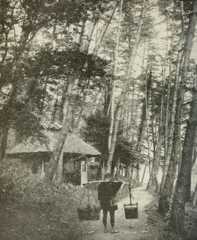
[30]by men, horses being rarely seen. In fact, in some of the cities thereare more oxen than horses, and many of them wear straw sandals toprotect their hoofs from the hard pavement. The lighter burdens arecarried in buckets or baskets, suspended from the ends of a pole andbalanced upon the shoulder.
In the country the demand for land is so great that most of the roadsare too narrow for any other vehicle than a hand cart. The highwaysconnecting the cities and principal towns, however, are of good width,are substantially constructed and well drained, and have massive stonebridges spanning the streams.
The clothing of the men presents an interesting variety. In officialcircles the European and American dress prevails. The silk hat andPrince Albert coat are in evidence at all day functions, and the dresssuit at evening parties. The western style of dress is also worn by manybusiness men, professional men and soldiers, and by students after theyreach the middle school, which corresponds to our high school. Thechange is taking place more rapidly among the young than among theadults and is more marked in the city than in the country. In one ofthe primary schools in Kyoto, I noticed that more than half of the childrengave evidence of the transition in dress. The change is also morenoticeable in the seaport cities than in the interior. At Kyoto, an inlandcity, the audience wore the native dress and all were seated onmats on the floor, while the next night at Osaka, a seaport, all saton chairs and nearly all wore the American dress. At the Osakameeting some forty Japanese young ladies from the Congregationalcollege sang "My Country 'Tis of Thee" in English.
The shopkeepers and clerks generally wear the native clothing,which consists of a divided skirt and a short kimono held in place bya sash. The laboring men wear loose knee breeches and a shirt inwarm weather; in cold weather they wear tight fitting breeches thatreach to the ankles and a loose coat. In the country the summerclothing is even more scanty. I saw a number of men working inthe field with nothing on but a cloth about the loins, and it wasearly in November, when I found a light overcoat comfortable.
A pipe in a wooden case and a tobacco pouch are often carried inthe belt or sash, for smoking is almost universal among both men andwomen.
Considerable latitude is allowed in footwear. The leather shoe haskept pace with the coat and vest, but where the native dress is worn,the sandal is almost always used. Among the well-to-do the foot isencased in a short sock made of white cotton cloth, which is kep[31]tscrupulously clean. The sock has a separate division for the greattoe, the sandal being held upon the foot by a cord which runs betweenthe first and second toes and, dividing, fastens on each sideof the sandal. These sandals are of wood and rest upon two blocksan inch or more high, the front one sloping toward the toe. Thesandal hangs loosely upon the foot and drags upon the pavementwith each step. The noise made by a crowd at a railroad stationrises above the roar of the train. In muddy weather a higher sandalis used which raises the feet three or four inches from the ground,and the wearers stalk about as if on stilts. The day laborers weara cheaper sandal made of woven rope or straw. The footwear above[32]described comes down from time immemorial, but there is cominginto use among the 'rikisha men a modern kind of footwear whichis a compromise between the new and the old. It is a dark cloth,low-topped gaiter with a rubber sole and no heel. These have theseparate pocket for the great toe. The sandals are left at the door.At public meetings in Japanese halls the same custom is followed,the sandals being checked at the door as hats and wraps are in ourcountry. On approaching a meeting place the speaker can formsome estimate of the size of the audience by the size of the piles ofsandals on the outside. After taking cold twice, I procured a pairof felt slippers and carried them with me, and the other members ofthe family did likewise.
The women still retain the primitive dress. About 1884 an attemptwas made by the ladies of the court to adopt the Europeandress and quite a number of women in official circles purchased gownsin London, Paris and the United States, in spite of the protests oftheir sisters abroad. (Mrs. Cleveland joined in a written remonstrancewhich was sent from the United States.) But the spell wasbroken in a very few months and the women outside of the courtcircles returned to the simpler and more becoming native garb. Itis not necessary to enter into details regarding the female toilet, asthe magazines have made the world familiar with the wide sleeved,loose fitting kimono with its convenient pockets. The children wearbright colors, but the adults adopt more quiet shades.
The shape of the garment never changes, but the color does. Thisseason grey has been the correct shade. Feminine pride shows itselfin the obi, a broad sash or belt tied in a very stiff and incomprehensiblebow at the back. The material used for the obi is often brightin color and of rich and expensive brocades. A wooden disc is oftenconcealed within the bow of the obi to keep it in shape and also tobrace the back. Two neck cloths are usually worn, folded inside thekimono to protect the bare throat. These harmonize with the obiin color and give a dainty finish to the costume. As the kimono isquite narrow in the skirt, the women take very short steps. Thisshort step, coupled with the dragging of the sandals, makes thewomen's gait quite unlike the free stride of the American woman.In the middle and higher schools the girls wear a pleated skirt overthe kimono. These are uniform for each school and wine color isthe shade now prevailing. The men and women of the same classwear practically the same kind of shoes.
Next to the obi, the hair receives the greatest attention and it is[33]certainly arranged with elaborate care. The process is so complicatedthat a hair dresser is employed once or twice a week and beetle'soil is used in many instances to make the hair smooth and glossy. Atnight the Japanese women place a very hard, round cushion underthe neck in order to keep the hair from becoming disarranged. Thestores now have on sale air pillows, which are more comfortable thanthe wooden ones formerly used. The vexing question of millineryis settled by dispensing with hats entirely. Among the poorer classesthe hat is seldom used by the men.
More interesting in appearance than either the men or women arethe children—and I may add that there is no evidence of race suicidein Japan. They are to be seen everywhere, and a good natured lotthey are. The babies are carried on the back of the mother or anolder child, and it is not unusual to see the baby fast asleep whilethe bearer goes about her work. Of the tens of thousands of babieswe have seen, scarcely a half dozen have been crying. The youngerchildren sometimes have the lower part of the head shaved, leavinga cap of long hair on the crown of the head. Occasionally a spot isshaved in the center of this cap. After seeing the children on thestreets, one can better appreciate the Japanese dolls, which look sostrange to American children.
Cleanliness is the passion of the Japanese. The daily bath is amatter of routine, and among the middle classes there are probablymore who go above this average than below. It is said that in thecity of Tokyo there are over eleven hundred public baths, and it isestimated that five hundred thousand baths are taken daily at theseplaces. The usual charge is one and a quarter cents (in our money)for adults and one cent for children. One enthusiastic admirer ofJapan declares that a Japanese boy, coming unexpectedly into thepossession of a few cents, will be more apt to spend it on a baththan on something to eat or drink. The private houses have bathswherever the owners can afford them. The bath tub is made likea barrel—sometimes of stone, but more often of wood—and is sunkbelow the level of the floor. The favorite temperature is one hundredand ten degrees, and in the winter time the bath tub often takes theplace of a stove. In fact, at the hot springs people have been knownto remain in the bath for days at a time. I do not vouch forthe statement, but Mr. Basil H. Chamberlain in his book entitled"Things Japanese," says that when he was at one of these hot springs"the caretaker of the establishment, a hale old man of eighty, usedto stay in the bath during the entire winter." Until recently the[34]men and women bathed promiscuously in the public baths; occasionally,but not always, a string separated the bathers. Now differentapartments must be provided.
The Japanese are a very polite people. They have often beenlikened to the French in this respect—the French done in bronze,so to speak. They bow very low, and in exchanging salutations andfarewells sometimes bow several times. When the parties are seatedon the floor, they rise to the knees and bow the head to the floor.Servants, when they bring food to those who are seated on the floor,drop upon their knees and, bowing, present the tray.
In speaking of the people I desire to emphasize one conclusion thathas been drawn from my observations here, viz., that I have neverseen a more quiet, orderly or self-restrained people. I have visitedall of the larger cities and several of the smaller ones, in all partsof the islands; have mingled in the crowds that assembled at Tokyoand at Yokohama at the time of the reception to Togo and duringthe naval review; have ridden through the streets in day time andat night; and have walked when the entire street was a mass ofhumanity. I have not seen one drunken native or witnessed a fightor altercation of any kind. This is the more remarkable when itis remembered that these have been gala days when the entire populationturned out to display its patriotism and to enjoy a vacation.
The Japanese house deserves a somewhat extended description. Itis built of wood, is one story in height, unpainted and has a thatchedor a tile roof. The thatched roof is cheaper, but far less durable.Some of the temples and palaces have a roof constructed like athatched roof in which the bark of the arbor vitæ is used in placeof grass or straw. These roofs are often a foot thick and are quiteimposing. In cities most buildings are roofed with tile of a patternwhich has been used for hundreds of years. Shingles are sometimesused on newer structures, but they are not nearly so large as ourshingles, and instead of being fastened with nails, are held in placeby wire. On the business streets the houses are generally two stories,the merchant living above the store. The public buildings are nowbeing constructed of brick and stone and modeled after the buildingsof America and Europe. But returning to the native architecture—thehouse is really little more than a frame, for the dividingwalls are sliding screens, and, except in cold weather, the outsidewalls are taken out during the day. The rooms open into each other,the hallway extending around the outside instead of going throughthe center. Frail sliding partitions covered with paper separate the[35]rooms from the hall, glass being almost unknown. The floor is coveredwith a heavy matting two inches thick, and as these mats areof uniform size, six feet by three, the rooms are made to fit the mats,twelve feet square being the common size. As the walls of the roomare not stationary, there is no place for the hanging of pictures,although the sliding walls are often richly decorated. Such picturesas the house contains are painted on silk or paper and are rolled upwhen not on exhibition. At one end of the room used for company,there is generally a raised platform upon which a pot of flowers orother ornament is placed, and above this there are one or two shelves,the upper one being inclosed in sliding doors. There are no bedsteads,the beds being made upon the floor and rolled up during theday. There are no tables or chairs. There is usually a diminutivedesk about a foot high upon which writing material is placed. Thewriting is done with a brush and the writing case or box containingthe brush, ink, etc., has furnished the lacquer industry with one ofthe most popular articles for ornamentation. The people sit uponcushions upon the floor and their meals are served upon trays.
Japanese food is so different from American food that it takes thevisitor some time to acquire a fondness for it, more time than thetourist usually has at his disposal. With the masses rice is the staplearticle of diet, and it is the most palatable native dish that the foreignerfinds here. The white rice raised in Japan is superior inquality to some of the rice raised in China, and the farmers areoften compelled to sell good rice and buy the poorer quality. Millet,which is even cheaper, is used as a substitute for rice.
As might be expected in a seagirt land, fish, lobster, crab, shrimp,etc., take the place of meat, the fish being often served raw. As amatter of fact, it is sometimes brought to the table alive and carvedin the presence of the guests. Sweet potatoes, pickled radishes, mushrooms,sea weed, barley and fruit give variety to the diet. The radishesare white and enormous in size. I saw some which were twofeet long and two and a half inches in diameter. Another varietyis conical in form and six or eight inches in diameter. I heard ofa kind of turnip which grows so large that two of them make a loadfor the small Japanese horses. The chicken is found quite generallythroughout the country, but is small like the fighting breeds or theLeghorns. Ducks, also, are plentiful. Milk is seldom used except incase of sickness, and butter is almost unknown among the masses.
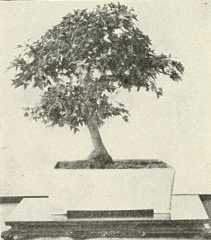
But the subject of food led me away from the house. No descriptionwould be complete which did not mention the little gate through[36]which the tiny door yard is entered; the low doorway upon whichthe foreigner constantly bumps his head, and the little garden at therear of the house with its fish pond, its miniature mountains, itsclimbing vines and fragrant flowers. The dwarf trees are cultivatedhere, and they are a delight to the eye; gnarled and knotted pinestwo feet high and thirty or forty years old are not uncommon. Littlemaple trees are seen here fifty years old and looking all of their age,but only twelve inches in height. We saw a collection of these dwarftrees, several hundred in number, and one could almost imaginehimself transported to the home of the brownies. Some of thesetrees bear fruit ludicrously large for the size of the tree. The housesare heated by charcoal fires in open urns or braziers, but an Americanwould not be satisfied with the amount of heat supplied. Thesebraziers are moved about the room as convenience requires and supplyheat for the inevitable tea.
But I have reached the limit of this article and must defer untilthe next description of the Japanese customs as we found them inthe homes which we were privileged to visit.
Every nation has its customs, its way of doing things, and a nation'scustoms and ways are likely to be peculiar in proportion as the nationis isolated. In Japan, therefore, one would expect to see many strangethings, and the expectation is more than realized. In some thingstheir customs are exactly the opposite of ours. In writing they placetheir characters in vertical lines and move from right to left, whileour letters are arranged on horizontal lines and read from left toright. Their books begin where ours end and end where ours begin.The Japanese carpenters pull the saw and plane toward them, whileours push them from them. The Japanese mounts his steed fromthe right, while the American mounts from the left; Japanese turnto the left, Americans to the right. Japanese write it "Smith JohnMr.," while we say "Mr. John Smith." At dinners in Japan wineis served hot and soup cold, and the yard is generally at the backof the house instead of the front.
The Japanese wear white for mourning and often bury their deadin a sitting posture. The death is sometimes announced as occurringat the house when it actually occurred elsewhere, and the date of thedeath is fixed to suit the convenience of the family. This is partlydue to the fact that the Japanese like to have the death appear asoccurring at home. Sometimes funeral services are held over a partof the body. An American lady whose Japanese maid died whileattending her mistress in the United States, reports an incident worthrelating. The lady cabled her husband asking instructions in regardto the disposition of the body. He conferred with the family of thedeceased and cabled back directing the wife to bring a lock of the hairand the false teeth of the departed. The instructions were followedand upon the delivery of these precious relics, they were interredwith the usual ceremonies.
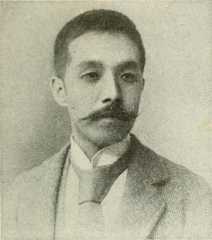
The handshake is uncommon even among Japanese politicians,except in their intercourse with foreigners. When Baron Komura[38]returned from the peace conference in which he played so importanta part, I was anxious to witness his landing, partly out of respect tothe man and partly out of curiosity to see whether the threatenedmanifestations of disapproval would be made by the populace, it havingbeen rumored that thousands of death lanterns were being preparedfor a hostile parade. (It is needless to say that the threats didnot materialize and that no expressions of disapproval were heardafter his arrival.) I found it impossible to learn either the hour orthe landing place, and, despairing of being present, started to visita furniture factory to inspect some wood carving. Consul-GeneralJones of Dalney (near Port Arthur), then visiting in Yokohama,was my escort and, as good fortune would have it, we passed near theDetached Palace. Dr. Jones, hearing that the landing might be madethere, obtained permission for us to await the peace commissioner'scoming. We found Marquis Ito there and a half dozen other officials.As Baron Komura did not arrive for half an hour, it gave me thebest opportunity that I could have had to become acquainted with theMarquis, who is the most influential man in Japan at present. He[39]is President of the Privy Council of Elder Statesmen and is creditedwith being the most potent factor in the shaping of Japan's demandsat Portsmouth.
When Baron Komura stepped from the launch upon the soil ofhis native land, he was met by Marquis Ito, and each greeted theother with a low bow. The baron then saluted the other officials inthe same manner and, turning, bowed to a group of Japanese ladiesrepresenting the Woman's Patriotic Association. Dr. Jones and I stoodsome feet in the rear of the officials and were greeted by the baronafter he had saluted his own countrymen. He extended his hand tous. The incident is mentioned as illustrating the difference in themanner of greeting. For who would be more apt to clasp hands,if that were customary, than these two distinguished statesmen whosepersonalities are indissolubly linked together in the conclusion of aworld renowned treaty?
A brief account of the reception of Admiral Togo may be interestingto those who read this article. While at Tokyo I visited thecity hall, at the invitation of the mayor and city council. Whilethere Mayor Ozaki informed me that he, in company with the mayorsof the other cities, would tender Admiral Togo a reception on thefollowing Tuesday, and invited me to be present. Of course I accepted,because it afforded a rare opportunity to observe Japanese customsas well as to see a large concourse of people. As I witnessedthe naval review in Yokohama the day before and the illuminationat night, I did not reach Tokyo until the morning of the reception,and this led me into considerable embarrassment. On the train Imet a Japanese gentleman who could speak English. He was kindenough to find me a 'rikisha man and a pusher and to instruct themto take me at once to Uyeno Park. He then left me and the 'rikishamen followed his instructions to the letter. They had not proceededfar when I discovered that Admiral Togo had arrived on the sametrain and that a long procession had formed to conduct him to thepark. Before I knew it, I was whisked past an escort of distinguishedcitizens who, clad in Prince Alberts and silk hats, followed the carriages,and then I found my 'rikisha drawn into an open spacebetween two carriages. Grabbing the 'rikisha man in front of me, Itold him by word and gesture to get out of the line of the procession.He could not understand English, and evidently thinking that Iwanted to get nearer the front, he ran past a few carriages and thendropped into another opening. Again I got him out of the line,employing more emphasis than before, only to be carried still nearer[40]the front. After repeated changes of position, all the time employingsuch sign language as I could command and attempting to convey bydifferent tones of voice suggestions that I could not translate intolanguage, I at last reached the head of the procession. And the'rikisha men, as if satisfied with the success of their efforts, pausedto await the starting of the line. I tried to inform them that I wasnot a part of the procession; that I wanted to get on another street;that they should take me to the park by some other route and do soat once. They at last comprehended sufficiently to leave the carriagesand take up a rapid gait, but get off of the street they would not. Forthree miles they drew me between two rows of expectant people, whoseeyes peered down the street to catch a glimpse of the great admiral,who, as the commander of the Japanese navy, has won such signalvictories over the Russians. I saw a million people; they represented[41]every class, age and condition. I saw more people than I ever sawbefore in a single day. Old men and old women, feeble, but strengthenedby their enthusiasm; middle aged men and women whose sonshad shared in the dangers and in the triumphs of the navy; studentsfrom the boys' schools and students from the girls' schools with flagsand banners, little children dressed in all the colors of the rainbow—allwere there. And I could imagine that each one of them oldenough to think, was wondering why a foreigner was intruding upona street which the police had cleared for a triumphal procession. Ifsome one had angrily caught my 'rikisha men and thrust themthrough the crowd to a side street I should not have complained—Iwould even have felt relieved, but no one molested them or me andI reached the park some minutes ahead of the admiral. How gladI was to alight, and how willingly I rewarded the smiles of the 'rikishamen with a bonus—for had they not done their duty as they understoodit? And had they not also given me, in spite of my protests,such a view of the people of Tokyo as I could have obtained in noother way?
At the park I luckily fell in with some of the councilmen whomI had met before and they took me in hand. I saw the processionarrive, heard the banzais (the Japanese cheers) as they rolled alongthe street, keeping pace with Togo's carriage, and I witnessed theearnest, yet always orderly, rejoicing of the crowd that had congregatedat the end of the route. When the procession passed byus into the park the members of the city council fell in behind thecarriages, and I with them. When we reached the stand, a seat wastendered me on the front row from which the extraordinary ceremoniesattending the reception could be witnessed. Mayor Ozaki, thepresiding officer, escorted Admiral Togo to a raised platform, andthere the two took seats on little camp stools some ten feet apart, facingeach other, with their sides to the audience and to those on the stand.After a moment's delay, a priest, clad in his official robes, approachedwith cake and a teacup on a tray and, kneeling, placed them beforethe admiral. Tea was then brought in a long handled pot and pouredinto the cup. After the distinguished guest had partaken of theserefreshments, the mayor arose and read an address of welcome. Hehas the reputation of being one of the best orators in the empire, andhis part was doubly interesting to me. As he confined himself to hismanuscript, I could not judge of his delivery, but his voice was pleasingand his manner natural. The address recited the exploits of AdmiralTogo and gave expression to the gratitude of the people. At[42]its conclusion the hero-admiral arose and modestly acknowledged thecompliment paid to him and to his officers. Admiral Togo is short,even for the Japanese, and has a scanty beard. Neither in stature norin countenance does he give evidence of the stern courage and indomitablewill which have raised him to the pinnacle of fame.
When he sat down the mayor proposed three times three banzais,and they were given with a will by the enormous crowd that stood inthe open place before the stand. While writing this article, I amin receipt of information that Mayor Ozaki has secured for me oneof the little camp stools above referred to and has had made for mea duplicate of the other. They will not only be interesting souvenirsof an historic occasion, and prized as such, but they will be interestingalso because they contrast so sharply with the large and richly upholsteredchairs used in America on similar occasions.
From this public meeting the admiral and his officers were conductedto a neighboring hall where an elaborate luncheon was served.With the councilmen I went to this hall and was presented to theadmiral and his associates, one of whom had been a student atAnnapolis.
By the courtesy of Hon. Lloyd Griscom, the American minister, Ihad an audience with the emperor, these audiences being arrangedthrough the minister representing the country from which the callercomes. Our minister, to whom I am indebted for much assistanceand many kindnesses during my stay at the capital, accompanied meto the palace and instructed me, as they say in the fraternities, "in thesecret work of the order." Except where the caller wears a uniform,he is expected to appear in evening dress, although the hour fixed isin the day time. At the outer door stand men in livery, one of whomconducts the callers through long halls, beautifully decorated on ceilingsand walls, to a spacious reception room where a halt is madeuntil the summons comes from the emperor's room. The emperorstands in the middle of the receiving room with an interpreter at hisside. The caller on reaching the threshold bows; he then advanceshalf way to the emperor, pauses and bows again; he then proceedsand bows a third time as he takes the extended hand of the sovereign.
The conversation is brief and formal, consisting of answers to thequestions asked by his majesty. The emperor is fifty-three years old,about five feet six inches in height, well built and wears a beard,although, as is the case with most Japanese, the growth is not heavy.On retiring the caller repeats the three bows.
We were shown through the palace, and having seen the old palace[43]
[44]at Kyoto, which was the capital until the date of the restoration(1868), I was struck with the difference. The former was severelyplain; the latter represents the best that Japanese art can produce.
No discussion of Japanese customs would be complete without mentionof the tea ceremonial. One meets tea on his arrival; it is hisconstant companion during his stay and it is mingled with the farewellsthat speed him on his departure. Whenever he enters a househe is offered tea and cake and they are never refused. This customprevails in the larger stores and is scrupulously observed at public[45]buildings and colleges. The tea is served in dainty cups and takenwithout sugar or cream. The tea drinking habit is universal here,the kettle of hot water sitting on the coals in the brazier most of thetime. At each railroad station the boys sing out, "Cha! Cha!" (theJapanese word for tea) and for less than two cents in our money theywill furnish the traveler with an earthen pot of hot tea, with pot andcup thrown in.
The use of tea at social gatherings dates back at least six hundredyears, when a tea ceremonial was instituted by a Buddhist priest to[46]soften the manners of the warriors. It partook of a religious characterat first, but soon became a social form, and different schools oftea drinkers vied with each other in suggesting rules and methodsof procedure. About three hundred years ago Hideyoshi, one of thegreatest of the military rulers of Japan, gave what is described asthe largest tea party on record; the invitations being in the form ofan imperial edict. All lovers of tea were summoned to assemble ata given date in a pine grove near Kyoto, and they seem to have doneso. The tea party lasted ten days and the emperor drank at everybooth.
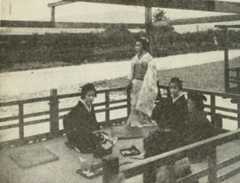
According to Chamberlain, tea drinking had reached the luxuriousstage before the middle of the fourteenth century. The lords tookpart in the daily gatherings, reclining on tiger skins, the walls ofthe guest chamber being richly ornamented. One of the populargames of that day was the offering of a number of varieties of tea,the guests being required to guess where each variety was produced,the best guess winning a handsome prize. The tea ceremony answeredat least one useful purpose—it furnished an innocent way of killingtime, and the lords of that day seem to have had an abundance oftime on their hands. The daughters of the upper classes were trainedto perform the ceremony and displayed much skill therein. Even tothis day it is regarded as one of the accomplishments, and youngladies perfect themselves in it, much as our daughters learn music andsinging. At Kagoshima, Governor Chikami, one of the most scholarlymen whom I have met here, had his daughter perform for my instructiona part of the ceremony, time not permitting more. Withcharming grace she prepared, poured and served this Japanese nectar,each motion being according to the rules of the most approved sect,for there are sects among tea drinkers.
The theatre is an ancient institution here, although until recentlythe actors were considered beneath even the mercantile class. Theirsocial standing has been somewhat improved since the advent of westernideas. The theatre building is very plain as compared with oursor even with the better class of homes here. They are always on theground floor and have a circular, revolving stage within the largerstage which makes it possible to change the scenes instantly.
The plays are divided into two kinds—historical ones reproducingold Japan, and modern plays. The performance often lasts throughthe entire day and evening, some of the audience bringing their teakettles and food. Lunches, fruit, cigarettes and tea are also on salein the theatre. The people sit on the floor as they do in their homes[47]and at public meetings. One of the side aisles is raised to the levelof the stage and the actors use it for entrance and exit.
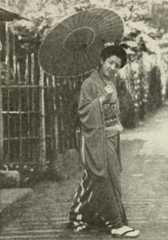
In this connection a word should be said in regard to the Geishagirls who have furnished such ample material for the artist and thedecorator. They are selected for their beauty and trained in what iscalled a dance, although it differs so much from the American danceas scarcely to be describable by that term. It is rather a series ofgraceful poses in which gay costumes, dainty fans, flags, scarfs andsometimes parasols, play a part. The faces of the dancers are expressionlessand there is no exposure of the limbs. The Geisha girlsare often called in to entertain guests at a private dinner, the performancebeing before, not after, the meal.
Our first introduction to this national amusement was at the MapleClub dinner given at Tokyo by a society composed of Japanese menwho had studied in the United States. The name of the society is aJapanese phrase which means the "Friends of America." The MapleClub is the most famous restaurant in Japan, and the Geisha girlsemployed there stand at the head of their profession. During thedancing there is music on stringed instruments, which resembles thebanjo in tone, and sometimes singing. At the Maple Club the Geishagirls displayed American and Japanese flags. We saw the dancingagain at an elaborate dinner given by Mr. Fukuzawa, editor of theJiji Shimpo. Here also the flags of both nations were used.
In what words can I adequately describe the hospitality of theJapanese? I have read, and even heard, that among the more ignorantclasses there is a decided anti-foreign feeling, and it is not unnaturalthat those who refuse to reconcile themselves to Japan's new attitudeshould blame the foreigner for the change, but we did not encounterthis sentiment anywhere. Never in our own country have we beenthe recipients of more constant kindness or more considerate attention.From Marquis Ito down through all the ranks of official life we foundeveryone friendly to America, and to us as representatives of America.At the dinner given by Minister Griscom there were present, besidesMarquis Ito, the leader of the liberal party, Count Okuma, the leaderof the progressive party (the opposition party), and a number ofother prominent Japanese politicians.
At the dinner given by Consul General Miller at Yokohama, GovernorSufu and Mayor Ichihara were present. The state and cityofficials wherever we have been have done everything possible to makeour stay pleasant. The college and school authorities have openedtheir institutions to us and many without official position have in unmistakableways shown themselves friendly. We will carry away[48]with us a number of handsome presents bestowed by municipalities,colleges, societies and individuals.
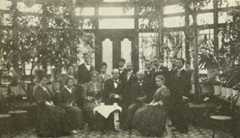
We were entertained by Count Okuma soon after our arrival andmet there, among others, Mr. Kato of the state department, andPresident Hatoyama of the Waseda University, and their wives. Thecount's house is half European and half Japanese, and his gardenis celebrated for its beauty. At Viscount Kana's we saw a delightfulbit of home life. He is one of the few daimios, or feudal lords, whohas become conspicuous in the politics of Japan, and we soon discoveredthe secret of his success. He has devoted himself to the interestsof agriculture and spent his time in an earnest and intelligenteffort to improve the condition of the rural population. He is knownas "The Farmer's Friend." His house is at the top of a beautifullyterraced hill, which was once a part of his feudal estate. He andhis wife and six children met us at the bottom of the hill on ourarrival and escorted us to the bottom on our departure. The childrenassisted in serving the dinner and afterward sang for us the Americannational air as well as their own national hymn. The hospitalitywas so genuine and so heartily entered into by all the family thatwe could hardly realize that we were in a foreign land and entertainedby hosts to whom we had to speak through an interpreter.
In the country, fifteen miles from Kagoshima, I was a guest atthe home of Mr. Yamashita, the father of the young man, who, whena student in America, made his home with us for more than five years.Mr. Yamashita was of the samurai class and since the abolition offeudalism has been engaged in farming. He had invited his relativesand also the postmaster and the principal of the district schoolto the noon meal. He could not have been more thoughtful of mycomfort or more kindly in his manner. The little country schoolwhich stood near by turned out to bid us welcome. The childrenwere massed at a bridge over which large flags of the two nationsfloated from bamboo poles. Each child also held a flag, theJapanese and American flags alternating. As young Yamashita andI rode between the lines they waved their flags and shouted "Banzai."And so it was at other schools. Older people may be diplomatic andfeign good will, but children speak from their hearts. There is nomistaking their meaning, and in my memory the echo of the voicesof the children, mingling with the assurances of the men and women,convinces me that Japan entertains nothing but good will toward ournation. Steam has narrowed the Pacific and made us neighbors; letJustice keep us friends.
As for the islands themselves, they are largely of volcanic origin,and a number of smoking peaks still give evidence of the mightyconvulsions which piled up these masses of masonry. Asosan mountain,on the island of Kyushu, has the largest crater in the world.
Japan is the home of the earthquake. The Japanese Year Bookof 1905 is authority for the statement that Japan was visited by17,750 earthquakes during the thirteen years ending 1887—an averageof more than thirteen hundred a year, or three and a half eachday. It is needless to say that a large majority of these were sotrivial as to be unnoticed, except by those in charge of the delicateinstrument which registers them.
If the average is as great at this time, there have been more thanseventy-five since we landed, but we have not been aware of them.The severe shocks have come at periods averaging two and a halfyears, and the really disastrous ones have been something like fiftyyears apart. The country about Tokyo is most subject to earthquakes,the last severe one being in 1894. According to an ancient legend,Japan rests upon the back of a large fish and the earthquakes arecaused by the moving of the fish. There is a Seismological society inJapan which has published a sixteen-volume work giving all that isscientifically known of the cause and recurrence of these disturbances.
Of the origin of the Japanese themselves nothing certain is known.The best authorities say that they came from the continent in an earlyMongol invasion, while others believe that they came from the islandswhich stretch to the south. One writer announces the theory thatthey are the lost Israelites. It is quite certain that when the firstJapanese landed on the islands they found an earlier race in possession.Some seventeen thousand of these, called Ainus, now occupy thenorthern extremity of the empire—an indication that the migrationwas from the southwest. The Ainus have remained distinct; wherethey have intermarried with the Japanese, the half breeds have died[50]
[51]out in the second or third generation. They are a hairy race and inphysical characteristics quite different from the Japanese. Their religionis a sort of nature worship, and it is their custom to say asimple grace before eating.
The remoteness of the settlement of Japan is shown by the fact thatthe reigning family, which claims descent from the gods, has heldundisputed sway for twenty-five hundred years, although the recordof the first thousand years is so dependent upon verbal tradition thatthe official history cannot be verified. As concubinage has been practicedfrom time immemorial, the heir, the oldest son, has not alwaysbeen born of the empress.
Soon after the beginning of the Christian era the influence of Chinaand Korea began to be felt in Japan, the written characters of thelanguage being quite like the Chinese. Koreans and Japanese donot agree as to the influence which the former have had upon the latter.A very intelligent Korean informs me that his is the mother countryand that Japan was settled from Korea, but the Japanese do not takekindly to this theory.
The feudal system, of which I shall speak more at length in anotherarticle, was early established in Japan, and society was dividedinto well defined classes. First came the members of the royal familyand those admitted to the circle by favor; next, the Shogun (of whommore will be heard under the subject of government) and his relatives.
Next in rank were the daimios, or lords, of varying degrees ofimportance. Each daimio had a large number of retainers, who werecalled samurai, and below these were a still larger number of peasantswho tilled the soil and did the manual labor. Some of the earlypictures show the gorgeous dress of the daimios and portray the elaborateceremony employed on state occasions.
The samurai were the warriors and had no other occupation thanto defend their lords in the struggles between the clans. They correspondedto the knights in Europe during the days of chivalry, exceptthat there were no romantic adventures over women—womanholding until recently a very subordinate place as compared with"her lord and master."
The samurai were given an annual allowance for their subsistence,and felt that toil was far beneath their dignity. They wore lacqueredarmor and costly helmets and carried two swords—a long one for theenemy and a short one for themselves.
It was with this short sword that the famous hara-kiri was committed.This ancient form of suicide by disembowelment was considered an[52]highly honorable death and has been practiced until within a generation.General Saigo, one of the great men of Japan and one ofits popular heroes, was the last man of prominence to terminate hislife in this way. He was one of the leaders in the movement to restoreto the emperor the authority which the shoguns had usurped andwas for a while close to the throne. In 1874, however, he organizedan army for the invasion of Korea, and coming into conflict with theforces of the empire, which were called out to prevent the invasion,he was defeated. In his humiliation he committed hara-kiri. A fewyears ago the title of Marquis was conferred upon him by a posthumousdecree and is now enjoyed by his eldest son. One of hissons is the present mayor of Kyoto and another a colonel in the ImperialGuard. A bronze monument of heroic size, the gift of admiringfriends, has recently been placed in the principal park in Tokyo.
Only a few years ago a young Japanese committed suicide in thisway in order to emphasize his protest against the encroachments ofthe Russians, but a strong sentiment is developing against hara-kiri,and it will soon take its place among other obsolete customs.
The samurai represented the intellectual as well as the militarystrength of the nation. The daimios have furnished few of the menof prominence in modern Japan, nearly all of the leaders in government,education, literature and the professions having come from thesamurai class. Now, however, that all social distinctions have beenremoved and the schools opened to the children of all, the old linesbetween the classes cannot so easily be traced.
The merchant class has always been looked down upon in Japan.In the social scale the members of this class were not only lower thanthe samurai, but lower than the tillers of the soil. It was probablybecause of the contempt in which they were held that so low a standardof integrity existed among them—at least this is the explanationusually given. Even now Japanese, as well as foreigners, complainthat the merchants impose upon their customers, but here also achange is taking place and a new order of things being inaugurated.There are in every city merchants of honor and responsibility whoare redeeming trade from the stigma which it so long bore. Still,unless the stranger knows with whom he is dealing, it is well to havea Japanese advisor, for we found by experience that the price namedto foreigners was sometimes considerably above the regular price.
For centuries Japan lived an isolated life and developed herselfaccording to her own ideas. Of her native religion, Shintoism, ofthe introduction of Buddhism and of the first Christian missionaries,[53]I shall speak in a later article. She repelled an attack of the Mongolswhich might have been disastrous to her but for the fact that a timelystorm destroyed the invading fleet, much as the Spanish Armada wasdestroyed. She has from time to time attempted the invasion ofKorea, the last attempt being made about three hundred years ago.A little later the Shogun, Iemitsu, alarmed by the spread of theChristian religion, introducedby Catholic missionariesfrom Spain andPortugal, shut the countryup, and for two anda half centuries no foreignerwas admitted andno citizen of Japan waspermitted to go abroad.
To more surely keephis people at home theShogun prohibited thebuilding of any but smallsailing vessels. It is almostincredible that solarge a group of peoplecould have enjoyed thecivilization which existedhere and still concealedthemselves so completelyfrom the outside worldand remained so ignorantof the mighty movementsin Europe and America.In 1853 Commodore Perryarrived with an Americanfleet and a treaty wasfinally entered into whichopened the country toforeign intercourse.Japan was ripe for the change. While there was at first an anti-foreignsentiment which affected domestic politics and at one timeresulted in an attack upon a foreign fleet, the assimilation of westerncivilization was rapid and constant. Young men began to go abroad,foreign teachers were sent for and the Japanese people began to manifest[54]a wonderful aptitude for the adaptation of foreign ideas to localconditions. The army and navy were reconstructed upon the Europeanmodels and a public school system largely like our own wasestablished.
In most countries reforms have come up from the masses throughmore or less prolonged seasons of agitation, but in Japan the higherclasses have been the leaders and have extended increasing social andgovernmental advantages to the whole people without a struggle. In[55]every department of thought there has been progress, and in every lineof work there have been leaders whose ambitions and ideals have beenhigh and noble.
To illustrate the change that has taken place, Count Okuma citesthe case of the famous military genius, the present Marshal Yamagata.When a very young man Yamagata was a spearman in thearmy organized by the daimios of Choshu to attack the foreign shipsat the Shimonoseki Straits. He was so ignorant of modern warfarethat he was confident of the ability of the Japanese to defeat theforeigners with spears. He thought that the Europeans and Americanswould be at the mercy of the natives as soon as they landed.His surprise may be imagined when leaden missiles mowed down hiscomrades long before the spears could be brought into use. But thisyoung man who attempted in 1864 to measure spear against rifle,betook himself to the study of the military methods of the foreigners,and in the recent war with Russia he has been chief of the generalstaff of the Japanese army—an army which in equipment, in preparation,and in provision for sick and wounded, as well as in its exploitsupon the battlefield, has astonished the world. Count Okumasaid that the progress made in the army and in the navy was paralleledby the progress made in other directions.
While there are here abundant preparations for war, there is aprevalent desire for peace. Notwithstanding Japan has a most efficientarmy and navy, and notwithstanding the natural exultation overtheir success at arms, the Japanese as I have met them are stronglyinclined toward peace. Several times in introducing me the presidingofficer has referred in terms of generous appreciation to the action ofour president in bringing about the recent treaty of peace. The warsagainst China and Russia have been regarded by the people as defensivewars and it will be remembered that the civil war of 1874was simply a suppression by the government of an attempt to invadeKorea. General Saigo raised his army for the purpose of conqueringKorea, but the government met the insurrectionists with an armylarge enough to completely overwhelm the forces of the famousgeneral.
The Anglo-Japanese alliance is everywhere defended as a guaranteeof peace. I met yesterday a Japanese of some local prominence whohas issued a plea for universal peace. He proposes the establishmentof an international peace society and in earnest language sets forththe horrors of war and the material, as well as the moral, argumentsin favor of peace.
Upon no element of Japanese society has the rising sun of a highercivilization shed its rays more benignantly than upon woman. Theposition of the mother was an honored one when she became the headof the family, but while the children cared for both parents with agenerous filial devotion, the wife and daughter were under the almostabsolute power of the husband and father. Marriages were arrangedby the parents and the young people were allowed to see each otherafter the match was agreed upon. Theoretically, each had a rightto protest if dissatisfied, but practically the girl's protest amountedto nothing.
The wife was not only the servant of the husband, but might alsobe the servant of the mother-in-law—the mother-in-law joke beinghere on the daughter-in-law instead of the son-in-law. The fact thatthe husband was permitted to keep as many concubines as he desiredstill further lowered the status of woman. The daughters were oftensold into prostitution to relieve the indebtedness of the father, andwhile this custom is on the decline, there are still thousands of Japanesegirls whose virtue is made a matter of merchandise in accordancewith this ancient custom. There is recorded among the decisions ofOoka, sometimes called the Japanese Solomon, who lived three centuriesago, a case in which the release of a young woman from ahouse of ill-fame was the central feature. The report of the judge'sdecree shows a discriminating mind as well as devotion to justice.Incidentally, the record reveals the fact that there were Shylocks inthose days who loaned on short time at high rates and exacted thepound of flesh. In this case, the usurer compelled the sale of thedaughter in extinguishment of a debt of fifteen yen, which by rapidlyaccumulating interest, had reached the, to them, enormous sum ofthirty-five yen (or $17.50). The righteous judge confiscated thehouse of the extortioner and with the proceeds redeemed the woman.By the aid of the missionaries, under the leadership of Rev. Murphy,of Nagoya, legislation has been secured making it unlawful for a girlto be retained in one of these houses against her will, and many havealready been rescued. As the taking of a concubine is a matter ofrecord it is possible for the newspapers to acquaint themselves with thedomestic relations of prominent men, and some of the papers haveassisted in creating a public opinion against concubines. This customis certain to give way before the advance of western ideas.
One of the foremost leaders in the elevation of woman was YukichiFukuzawa, one of the greatest, as well as one of the most influential,of the men who have appeared in Japan. He was a journalist,[57]an educator, an orator and a philosopher. He refused to accept anytitles or decorations and was called "The Great Commoner." Hefounded a college, the Keio-Gijuku, to which many of the public mentrace their ideals and their interest in national and social problems.He delivered the first public speech made in Japan for, strange as itmay seem, the habit of public speaking does not reach farther backthan twenty-three years.Until constitutional governmentwas formed therewas no place for theforum. Shortly before hisdeath, Mr. Fukuzawa reducedhis philosophy tothe form of a code ofmorals which has madea profound impression uponthe thought of hiscountry. He presented "independenceand self respect,"as he defined them,as the "cardinal tenet ofpersonal morals and living."He insisted uponthe care of the body, thetraining of the mind andthe cultivation of themoral nature. He was oneof the first to raise hisvoice against hara-kiri and in his code of morals he says: "To completethe natural span of life is to discharge a duty incumbent onman. Therefore, any person who, be the cause what it may or thecircumstances what they may, deprives himself by violence of hisown life, must be said to be guilty of an act inexcusable and cowardly,as well as mean, and entirely opposed to the principle of independenceand self respect."
Concerning woman his code of morals says: "The custom of regardingwomen as the inferiors of men is a vicious relic of barbarism.Men and women of any enlightened country must treat and love eachother on a basis of equality, so that each may develop his or her ownindependence and self respect."
When this great man died in 1901 his widow was in receipt of lettersfrom many women expressing their appreciation of his labors in[58]behalf of the women of Japan. Some of these are reproduced in alife of Mr. Fukuzawa, recently issued, and show the deep gratitudewhich the women feel toward him. It is also interesting to know thatMr. Fukuzawa believed in the dignity of labor and taught that eachperson should be "an independent worker beside being his own breadwinner."While he taught patriotism, he also taught that the peopleof all nations "are brethren" and that "no discrimination should bemade in dealing with them."
The emperor sent him, just before his death, fifty thousand yenas a recognition of his eminent services, but he immediately turnedthe sum over to the Keio-Gijuku.
The Jiji Shimpo, the newspaper established by Mr. Fukuzawa, is stillconducted by one of his sons, with whom we had the pleasure of dining.Another son is an instructor in the Keio-Gijuku.
Newspaper development has kept pace with the development inother directions. Tokyo, the capital, has sixteen daily papers withsufficient circulation to make them known as large papers. Besidesthese, there are magazines, periodicals and papers published in English.The Kokumin Shimbun is known as the government organ while mostof the others are regarded as independent. The Tokyo Times is an excellentpaper published in English. There is a weekly publicationcalled the Economist, with a circulation of five thousand, which dealswith commercial, financial and economic questions. Yokohama haspapers published in both languages and the same is true of the otherlarge seaport towns.
All the cities are supplied with daily papers published in Japanese.At Kagoshima, a city of about fifty thousand, situated at the southernextremity of Kyushu Island, I found a prosperous daily paper calledthe Kagoshima Shimbun. (Shimbun means daily newspaper.) Ithas a circulation of nine thousand six hundred, six thousand being inthe city.
At Osaka I noticed a building elaborately decorated. In front werelarge flags on bamboo poles and smaller flags strung on cords, whileJapanese lanterns were present in profusion. As none of the buildingsaround were decorated, I inquired and found that the decoratedbuilding was the office of the Osaka Asahi News and that the paperwas celebrating the withdrawal of the governmental order which fortwo weeks had suspended its publication. The issue for that day containeda large sized picture of the Goddess of Liberty. When riotingoccurred at Tokyo just after the treaty of peace with Russia, an orderwas issued authorizing the arbitrary suspension of any newspaper containingutterances deemed incendiary. Under this order the Asahi[59]News received notice to suspend publication until permission wasgranted to resume. The withdrawal of the notice was duly celebratedand the paper announced that its readers, rather than the paper,had reason to complain of the suspension. This paper has the largestcirculation of any in Japan, about two hundred thousand, and theorder suspending it has been the subject of much editorial criticism.
Besides the newspapers which are conducted as business propositions,there are papers supported by associations formed for the propagationof various reforms. For instance, a paper called Romaji is publishedmonthly at Tokyo—Japanese words being spelled with Roman letters,in the place of the present Japanese characters. A society was formed[60]some twenty years ago for the purpose of urging this reform and apaper advocating it was published for three years, but finally suspendedfrom lack of support. This fall the Romaji was established and hopesfor a better fate. While this reform would be very acceptable toforeigners who are trying to learn the language, the movement doesnot seem to have gathered much momentum.
In one of the leading papers, the Hocho Shimbun, Mr. Gensai Murai,a novelist of distinction, published a continued story running dailythrough six years. It is not yet completed, having been suspendedduring the war. In this story the writer presents a large amount ofinformation on national, political, economic and social questions, atthe same time putting in enough fiction to sustain the interest.
Progress along some other lines will be treated under special heads.I find that there is some tendency here to resent the statement thatJapan has borrowed largely from other nations. Some native writersinsist that New Japan is but the natural development of Old Japan.There is a measure of truth in this, because there is no growth exceptfrom a living germ; and yet it can not be denied that Japan has appropriatedto her own great advantage many foreign ideas, and it is notto her discredit that she has done so. Both individuals and nationsborrow; imitation, not originality, is the rule. It will humble the prideof anyone to attempt to separate that which he has learned from othersfrom that which he can claim as his own by right of discovery.
Steam is the same to-day that it was ages ago, and yet millionswatched it escaping from the kettle with no thought of its latent power.One man showed mankind the use to which it could be put and allthe rest profited by the idea. Shall we refuse to ride upon the railroador cross the waters in an ocean greyhound for fear of employing theconception of another? Electricity is not a new agency. The lightningshave illumined the sky from the dawn of creation, and thepeople saw in them only cause for fear. A few decades ago one manthought out a method by which it could be imprisoned in a wire, andnow widely separated lands are united by telegraph lines, while cablestraverse the ocean's bed. Shall we refuse to read the news that thecurrent carries or reject a message from home because we must employan idea which sprang from another's brain? He is stupid who rejectstruth, no matter from what source it comes; that nation isblind which does not welcome light from anywhere and everywhere.It is to the glory, not to the shame, of the land of the Rising Sun thather people have been quick to obey the injunction, "Prove all things;hold fast that which is good."
The basis of Japanese industry is agricultural, although each yearshows a decreasing proportion engaged in the tilling of the soil. Riceis the principal product, but owing to the large amount consumed athome it is not the chief export. As this crop needs an abundance ofwater, the rice fields occupy the low lands and the mountain gorges.Sometimes the narrow valleys that pierce the ranges are so terracedas to look like steps, and at this time of the year when the crop is beingharvested, they resemble golden stairs. The men and women work togetherin the field, and in many places we saw them standing almostknee deep in mud, cutting the grain with old fashioned hand-sickles.The rice is tied in bundles somewhat smaller than our wheat sheaves,and hung over poles or laid along the edge of a terrace to cure. If thethreshing is delayed the grain is stacked, not as we stack wheat andoats in the United States, but in little columns with the heads of thesheaves tied to a pole in the center. Sometimes the stacks are builtaround a living tree. The grain is separated from the straw by meansof a long toothed comb, and at this season innumerable groups of personsare busily engaged at this work. The yellow heaps of rice in thehull, looking from a distance like wheat, can be seen from the trainand from the country roads. Straw mats are used to keep the grainoff the ground and, I may add, the mat is in evidence everywherein Japan and is used for all sorts of purposes.
The cultivation of the tea plant is an industry of no small magnitude,although not so universal as the cultivation of rice. The teafields occupy the higher levels and add an interesting variety to thelandscapes. At one point on the railroad between Yokohama andNagoya the hillsides are covered with tea plantations, if such tiny farmscan be called plantations. The tea plant is something like our gooseberryand currant bushes in size, but the foliage is much thicker. Theleaves vary widely in value, from the cheaper grades, which are exported,[62]to the Uji which costs what is equivalent to five or more dollarsper pound.
Some cotton is grown here, but the cotton plant as we saw it issmall compared with our plant, and the tillable area is too limited toadmit of the growing of cotton on a large scale.
Tobacco is cultivated to some extent, but the sale of manufacturedtobacco is a government prerogative.
Raw silk is by far the most valuable export, thirty-five million dollars'worth having been sent abroad last year. Three-fifths of the entireexport goes to the United States, the remainder to Europe, with Franceas the largest European purchaser. As fifteen million dollars' worthof silk fabrics went abroad also, as against five million dollars' worthof tea and four million dollars' worth of rice, it will be seen that thecultivation of the silk worm and the mulberry tree is extensivelycarried on. The silk worms are kept indoors and the leaves broughtin to them. When put outdoors the silk worms are devoured by birds.
Fruits grow here in great variety. We have found everywhere applesof excellent quality, raised in the northern parts of the islands, whilethe southern islands produce oranges, bananas and pineapples. Theapple tree was imported from America about thirty-five years ago; nowapples are exported to China and Siberia. The most popular orange isthe tangerine, or kid glove orange as it is sometimes called; many ofthese are exported.
There is a kind of fruit called the ban-tan grown on the island ofKyushu. It looks something like the grape fruit, but grows considerablylarger and has a thicker skin; the meat is pink in color, sweeterand less juicy than the grape fruit. Pears grow here; one variety lookslike a russet apple in shape and color. Peach trees are sometimestrained as we train grape vines on an arbor, so that the orchard seemsto have a flat roof of foliage.
They have here, too, persimmons as large as apples and as solid. Wefound these on the table in all parts of the island and there are severalvarieties. The grape is cultivated in Japan, but we did not see grapevines in such profusion as they are seen in southern Europe, along thelakes in western New York or in California. And, in this connection,I may add that wine is not used here to the extent that it is in someother countries, the national drink, sake, being made from fermentedrice. Ordinarily this beverage contains from eleven to fourteen percent of alcohol, but there is a stronger kind called shochu, which containsas much as fifty per cent of alcohol. It is evident, however, thatliquor by any other name can be as intoxicating as our whisky, and[63]we found at Tokyo a national temperance society with branches throughoutthe empire. Mr. Ando, the president of this society, is a Japanesegentleman of great earnestness and intelligence, who was converted toChristianity a few years ago when he was representing his country inHonolulu. While, as I have stated in another article, I have seen noevidences of drunkenness, Mr. Ando informs me that his society hasample work to do. I carry back with me a badge which the societygave me on learning of my total abstinence habits. I have only mentionedthe leading products of the field, but I can not leave the cultivatorsof the soil without a word concerning the gardens. They areso cute, occupying as they do the little nooks and corners that can notbe utilized for the large crops. There does not seem to be a squareinch of ground wasted. The vegetables are planted in rows which areeither straight or curved, never crooked, and we have scarcely seen aweed. Fertilizer is extensively used, being kept in stone or cement vatsprotected from the weather by a straw colored shed. Near the citiesthe soil is enriched by the refuse from closets which is collected andcarried away during the night. The introduction of sewage systemshas been somewhat impeded in some cities by the fact that sewagewould be an expense while closets are now a source of profit. It mustbe confessed, however, that the present system tends to make freshvegetables unpopular with the tourist.
Most travelers land at Yokohama and depart at Kobe, or land atKobe and depart at Yokohama, these being the two principal ports.As these are about 300 miles apart, one has a chance to see much ofthe farming land from the railroad. The side trips from Tokyo toNikko, from Yokohama to Miyanoshita and from Kyoto to Nara, giveadditional opportunities for seeing the farmer at work, but the ridefrom Kobe west to Shimonoseki surpasses any of these in interest andin beauty of scenery. As this route leads along the sea coast as wellas through densely populated valleys, there is greater variety. Nowone skirts the inland sea, with its numerous islands, its transparentwaters, its little harbors and its fleets of fishing boats; now he winds hisway along a stream with falls and rapids and spanned by frail footbridges or by stone wagon bridges. On the one side he sees a bamboogrove and on the other a tiny graveyard or a little hill dedicated to aShinto shrine—stone steps ascending along a shaded path from thesacred gate, which invariably marks the entrance to holy ground. Inpassing over this railroad route one gathers a large amount of informationconcerning the industries of the sea coast, as well as those of theinland, and besides one can visit the Shimonoseki Strait which is of[64]historic interest to Americans. The Sanyo railroad, which connects Kobeand Shimonoseki, is well equipped and well managed and has builtan excellent hotel, The Sanyo, at Shimonoseki for the accommodationof its patrons. From this point a steamer runs to Fusan, the nearestKorean port, where direct connection is made for Seoul, the Korean[65]capital. From Moji, just across the strait from Shimonoseki, onecan take a train to Nagasaki, the western seaport of Japan. AtShimonoseki one is shown the house in which Marquis Ito and LiHung Chang drafted the Japanese-Chinese treaty in 1894.
Mining is an industry of considerable importance here. Gold,silver and copper are found in paying quantities. More than sixmillion dollars' worth of copper was exported last year. One of thegold fields on the island of Kyushu, near Kagoshima, gives promiseof considerable richness. Coal is found in such abundance that theexports of this commodity have amounted to nearly ten million dollarsin a single year. A hard quality of smokeless coal has recentlybeen discovered in western Japan.
The islands also produce a number of varieties of valuable woods.The camphor tree grows to an enormous size, a gigantic statue ofthe Goddess of Mercy in one of the temples at Kamakura beingcarved from a single camphor log. The value of the camphor exportedfrom Japan last year exceeded a million and a half dollars.Among the hard woods suitable for carving, cherry seems to be themost popular.
Of all the trees, however, the bamboo is the most useful. Just atthis time when the returning soldiers are being welcomed, it is presenteverywhere in the form of flag poles, and there is nothing that equalsit for this purpose; long, slender, light and strong, it is just the thingfor flags and banners, and when a little plume of leaves is left atthe top, it is still more beautiful. The bamboo is used for waterpipes and for fences, for furniture and picture tubes, for dippers,baskets, fishing poles, flower vases, candlesticks, wicker work, etc., etc.
In wood carving the Japanese have long been skilled. Specimensof work done hundreds of years ago and testifying to their taste, noless than to their deftness of hand, may be seen in their ancient palacesand temples.
Stone cutting is also an ancient industry here. There is anabundance of stone and granite, while the lanterns, Korean lions andsacred gates have furnished subjects for many a chisel. Osaka seemsto be the center of the stone cutting industry.
The iron industry is represented by an increasing number of establishments.In many instances workmen have been brought fromabroad and employed until Japanese artisans were sufficiently trainedto take their place. Much of the iron work is still done in littleshops and by hand, although machinery is being imported in largequantities.
I visited a tannery at Kagoshima and found that the proprietorhad spent seven years in America learning the business, and thaton his return he had taught native help each branch of the business.He is now turning out an excellent product.
One of the most promising industries in Japan is cotton spinning.There are a number of factories already in operation and new onesare building. I visited one of the plants of the Osaka Nippon BosekiKaisha at Osaka. This company has about seventy thousand spindlesand the mills employ nothing but native labor. Foreign artisanswere used in the beginning, but are no longer needed. A great manywomen are employed and some children; for the latter a school ismaintained for two hours a day in the building. Cotton yarn isnow selling for about forty cents a pound and is becoming one ofthe leading articles of export; China is the largest purchaser. Someidea of the growth of this branch of industry can be gathered fromthe fact that the exports of cotton yarn amounted to less than fourthousand dollars in 1891 and 1892; in 1896 it had grown to overtwo millions, in 1898 to over ten millions, and during the last twoyears it has averaged about fifteen millions.
At Osaka I also visited a brush industry and found that frombones, imported from the slaughter houses of America, and frombristles, purchased in Russia and in China, they made tooth, nail andhair brushes for export to both Europe and America. Here, too, theyhave dispensed with the foreign labor which they employed in thebeginning.
Earthenware is manufactured in abundance and of every variety.The exports of porcelain and earthenware reached almost two milliondollars last year. In Kyoto we visited a pottery and found two roomsin which the finished product was displayed; the first contained beautifulspecimens of Japanese skill, graceful in shape and dainty in decoration;the second was filled with big pieces in loud colors and of inferiorworkmanship. These last articles, we were informed, were madeespecially for the American trade.
Some beautiful porcelain work is done in Kyoto, the decoration representinga high degree of artistic skill.
One of the most famous kinds of china produced by Japan is knownas Satsuma ware, the glazing of which is of a peculiar tint and has acrackled appearance. The secret of the manufacture of this ware wasbrought from Korea by the captives taken in war some three hundredyears ago, and the industry still flourishes in Japan, although it hasperished in Korea. Kagoshima is the center for Satsuma ware, and a[67]colony of Koreans living near there, as well as Japanese manufacturers,produce excellent specimens.
Lacquer work has been done in Japan from time immemorial, samplesof which, centuries old, can be seen in temples, palaces and museums.When gold and silver are used in connection with the lacquerthe product is often very valuable.
The bronzes produced in the little shops scattered over Japan giveplay to the artistic taste which one finds here. Osaka and Kyoto arenoted for their bronzes. Sometimes various metals are inlaid in theforms of flowers, birds, animals and landscapes, producing a most pleasingeffect. Then there are damascene factories and places for embroideryand for pictures made in cut velvet, etc., etc.
No one can pass through Japan without being impressed with thetaste, which seems to be national, and with the delicate skill which hasbeen handed down from generation to generation. And nothing, inmy judgment, more clearly exhibits this union of taste and skill thanthe Cloisonne work. Upon a metallic base, as a vase, placque or box, anartist draws a design; this design is then outlined with fine wires ofgold and silver, then enamels of various colors are filled in. When theenamels are hardened and the whole polished, the product is a thingof marvelous beauty.
I have not space to speak of the minor industries, such as papermaking, matches (in which Japan monopolizes the trade of the East),fans, umbrellas, lanterns, napkins, etc. The Japanese lantern which weuse for ornamentation is here a practical thing, in daily, or rathernightly, use. These lanterns hang in front of the houses and are carriedon the streets. They are also used for illumination on festive occasions;at the time of the naval review and the reception to Admiral Togo,Yokohama and Tokyo were illuminated by these lanterns as I never sawan American city lighted.
When Japan was opened to the commerce of the world, there were fewbusiness houses or trading establishments of any size. Now there areseveral department stores and large wholesale houses, besides manufacturingand trading companies of importance. One business man inTokyo, Mr. K. Okura, has a private collection of curios valued at onemillion dollars, which he offered to sell in Europe or America, the proceedsto be given to the government for carrying on the war againstRussia. Osaka has a successful business man who has earned the nameof the "Japanese Carnegie" by giving a fine library building to thatcity.
Consul General Miller, at Yokohama, and Consul Sharp, at Kobe,[68]furnished me with interesting statistics regarding the commerce ofJapan. Exports have increased from about eighty millions in 1891 toabout three hundred and twenty millions in 1904; during the sameperiod imports increased from a little more than sixty-three millionsto a little more than three hundred and seventy-one millions. Whileour country sells less to Japan than Great Britain and British India,she buys more than any other nation from Japan. Our chief exportsto Japan last year were electric motors, locomotive engines, steamboilers and engines, iron pipes, nails, lead, oil, paraffine wax, cottondrills, cotton duck, raw cotton, tobacco, coal, cars, turning lathes,condensed milk, flour and wheat. Of these items, flour, raw cottonand oil were by far the most valuable, each amounting to more thanfour and a half million dollars.
In the ocean carrying trade, Japan is making rapid strides. Inten years her registered steamers have increased from four hundredand sixty-one to twelve hundred and twenty-four and her sailing vesselsfrom one hundred and ninety-six to three thousand five hundredand twenty-three. There are now two hundred private ship yards inJapan, and in 1903 they built two hundred and seventy-nine vessels.The Japan Mail Steamship Company has a paid-up capital ofeleven million dollars, runs steamers between Japan, America, Europeand Asia and pays a ten per cent dividend on its capital. The OsakaMercantile Steamship Company (Osaka Shosen Kaisha) has a paid-upcapital of nearly three and a half million dollars, owns about one hundredvessels and pays a dividend of ten per cent. These are the largestcompanies, but there are many smaller ones, some paying dividendsof sixteen and twenty per cent.
I will close this article with the suggestion that the mercantilemarine seems likely to show large growth in the future, offering,as it does, a legitimate field for national expansion.
Japan's fishing industries furnish a training for seamen and herpeople seem at home upon the water. She needs more territory forher expanding population and has about reached the limit in thecultivation of her tillable land. Every additional ship manned by hercitizens is like a new island, rising from the waves, upon which herincreasing population can be supported. If she seeks to acquire landin any direction, she finds her efforts contested by the inhabitantsalready there; no wonder she hails with delight these floating farmsconstructed by the genius of her own people—new land, as it were,won and held without the sacrifice of war.
Back of Japan's astonishing progress along material lines lies heramazing educational development. Fifty years ago but few of herpeople could read or write; now considerably less than ten per centwould be classed as illiterate. It is difficult to conceive of such atransformation taking place almost within a generation. Theprompt adoption of western methods and the rapid assimilation ofwestern ideas give indubitable proof of the pre-existence of a vitalnational germ. A pebble dropped into soil, however rich, and cultivated,no matter how carefully, gives back no response to the raysof the springtime sun. Only the seed which has life within canbe awakened and developed by light and warmth and care. Japanhad within her the vital spark, and when the winter of her isolationwas passed, her latent energies burst forth into strong andsturdy growth.
Her sons, ambitious to know the world, scattered themselvesthroughout Europe and America, and having laden themselves withnew ideas, returned to apply them at home. In this way Japanconstantly gained from every quarter and her educational systemis modeled after the best that the ages have produced. She has herprimary schools for boys and girls, attendance being compulsory,and below these in many places there are kindergarten schools. Themiddle schools, in which the boys and girls are separated, take upthe course of instruction where the primary schools leave off.
Then follow the universities, of which there are seven under thecontrol of the government. Besides these there are in the citiesinstitutions known as higher commercial schools, which combine generalinstruction with such special studies as are taught in our commercialcolleges. There are also a number of normal schools forthe training of teachers. In addition to the schools and colleges[70]
[71]established and conducted by the government, there are a numberfounded by individuals and societies. The largest of these is WasedaCollege, founded and still maintained by Count Okuma, the leader ofthe progressive party. It is adjoining the home of the count and isbuilt upon land which he donated. Dr. Hatoyama, at one timespeaker of the national house of representatives, who holds a degreefrom Yale College, is the official head of this institution; in all ofits departments it has some five thousand students.
I have referred in a former article to the Keio Gijuku, the collegefounded by Mr. Fukuzawa. The attendance here is not so large asat Waseda, but the institution has had an illustrious career and exertsa wide influence upon the country. I visited both of these collegesand never addressed more attentive or responsive audiences.As English is taught in all the middle schools, colleges and universities,the students are able to follow a speech in that language withoutan interpreter.
The state university at Tokyo includes six departments—law,medicine and engineering courses being provided, as well as coursesin literature, science and agriculture. The total number of studentsenrolled at this university is about thirty-five hundred. The nationaluniversity at Kyoto has three faculties—law, medicine and science—thelast named including engineering; the attendance at this universityis between six and seven hundred. In the states of Choshu andSatsuma there are higher schools supported by funds given by formerfeudal lords of those states.
The education of girls is not neglected, although as a rule thegirls do not go as far in their studies as the boys. There are a numberof normal schools and seventy-nine high schools for girls, besidesthe Peeresses' school and several private institutions. The Woman'sUniversity of Tokyo, situated near Waseda College and under thepatronage of Count Okuma, has had a phenomenal career. Establishedonly five years ago, it has now an enrollment of some sevenhundred, and is putting up several new buildings.
There are also a number of missionary schools and colleges.The Presbyterians support three boarding schools for boys and elevenfor girls, besides ten day schools; the total attendance at these schoolsis nearly twenty-three hundred.
The Congregationalists have a number of schools, the largest, DoshishaCollege at Kyoto, being the most influential Christian institutionin Japan. I had the pleasure of visiting both this college andKyoto University.
The Methodists have eighteen boarding schools and nineteen dayschools with a total attendance of nearly five thousand. Their collegeat Kobe is a very promising institution.
The Baptists have a theological seminary, an academy, five boardingschools for girls and eight day schools, with a total attendance ofnearly a thousand. The Episcopal Church has also taken an importantpart in educational work, while the Catholics (who were firston the ground) have over sixty seminaries, schools and orphanages,with an attendance of some six thousand.
The Japanese government supports more than twenty-five thousandprimary schools, attended by over five million boys and girls;it supports more than two hundred and fifty middle schools, with anattendance of nearly one hundred thousand. While less than twoper cent of the primary students enter the middle schools, more thanten per cent of the middle school students enter the higher colleges.
Although these figures give some idea of the interest taken in education,they do not furnish an adequate conception of the enthusiasmwith which a large number of these students pursue their studies.Nearly fifty young men called upon me or wrote to me asking to betaken to America that they might continue their studies. Many ofthe leading men in Japan to-day are graduates of American orEuropean colleges. The physicians have shown a preference forGerman schools, while to engineers and politicians our universitieshave been more attractive. A part of the friendliness felt towardforeigners can be traced to the favors shown Japanese boys who lefthome in search of knowledge. Marquis Ito, one of the first of these,owes much to an elder of the Presbyterian Church in England inwhose home he lived as a student, and the marquis has ever sincebeen making returns in kindness to foreigners and Christians.
Marquis Ito's case is not exceptional; all over Japan are men whohold in grateful remembrance Americans and Europeans to whomthey are indebted for assistance. I met a man, now the publisher ofan influential paper, who twenty years ago, at the age of sixteen,went to sea and in a shipwreck was cast upon one of the islands inthe South Pacific. He became a retainer for the king of the islandsand as such wore the scanty native dress, consisting of a loin cloth.He went with his king to Honolulu to pay a visit to the Hawaiianqueen, and finding a Japanese settlement there, remained for two orthree years. He then went to the United States and, making a friendof a professor in one of the universities, attended school there forseveral years. He now visits the United States every year or so on[73]business, and one seeing him wearing a silk hat and a Prince Albertcoat would hardly guess the experiences through which he has risento his present position. If Japan, beginning fifty years ago with noeducational system and scarcely any educated men or women, couldaccomplish what she has accomplished in half a century, what willshe accomplish in the twentieth century, with the start which she nowhas and with the educational advantages which her people now enjoy?
Japan has several religions, although Shintoism has been, since1868, the state religion. As a matter of fact, however, Shintoismcan hardly be called a religion for it has no creed, no priesthood andno code of morals. It is really ancestor worship and comes downfrom time immemorial. It implies a belief in immortality, for theancestral spirits are invoked and vows are paid to them at the numberlessshrines that dot the country. These shrines are not usuallyin temples, although sometimes Shintoism and Buddhism have beenmixed together and one temple employed for both shrines; as a rule,however, the Shinto shrine is in some secluded spot on the top of a hillor on a mountain side where a bit of natural scenery awakens a spiritof reverence. A gate of simple but beautiful design is placed at thepoint where the pathway to the shrine departs from the main road.We had read of these Shinto gates and had seen pictures of them,but we first saw one at Honolulu, itself the gateway to the Orient.No description can convey to the reader the impression which thisgate makes upon the traveler; its outlines are so graceful and yet sostrong that it seems an appropriate portal to a holy place.
The moral code of Confucius has also influenced the thought ofJapan.
About fourteen hundred years ago the Buddhist religion was introducedinto Japan by Chinese priests, and it spread rapidly throughoutthe islands. Its temples were imposing, its ceremonies impressiveand the garb of its priests costly and elaborate. It did not root outShintoism, it simply overwhelmed and absorbed it. The Buddhisttemples, though not as popular as they once were, are still visited bymillions of believers and are objects of interest to the tourist. Mostof them are old, one at Nara having been built about the year 700.It is in such an excellent state of preservation that one can hardlybelieve that it has stood the storms of twelve centuries.
In the center of the temple is an image of Buddha, and on eitherside the figure of a huge warrior. There is also in this temple a Godof War to which the Japanese were wont to pay their vows before[74]going to battle. The devout Buddhist, approaching the image of thefounder of his religion, bows and mutters a prayer, half audibly,and, throwing his mite in a box or on the floor before the shrine,departs. There is usually a bell, or sometimes only a chain, hangingabove the place where prayers are said, and the suppliant swingsa rope against the bell or shakesthe chain before his prayer andclaps his hands two or three timesat its close. We inquired about thebell and received two answers: One,that it was to attract the attentionof the god, and the other that itwas to awaken the conscience ofthe one about to present his petition.
Near the temple at Nara standsan ugly image which never fails toattract the attention of the visitor.It is literally covered with paperwads which have been thrownagainst it by worshipers at the templein the belief that their prayerswould be answered if the wadsadhered to the image. There is alsoat Nara a huge bell, almost as oldas the temple. This bell is aboutthirteen feet high, nine feet in diameterand eight inches thick. Ithangs in a pagoda quite near theground, and when struck upon theside by a swinging log gives fortha sound of wonderful depth andrichness. It was rung for us, andas its mellow tones reverberatedalong the hills we were awed by thethought that a thousand years beforeour Declaration of Independencewas written, eight hundred years before the Pilgrims landed atPlymouth Rock, yes, even seven hundred years before America wasdiscovered, this old bell was calling people to worship.
There is at Nara an immense bronze image of Buddha, even larger[75]than the famous one at Kamokura,though not so finelyproportioned. The smallerone is forty-nine feet inheight and nearly one hundredfeet in circumference(both represent Buddha,seated tailor-fashion, on alotus flower) and the largerone is almost twice as largeas the smaller one. The lanternof stone or bronze seemsto be as necessary an adjunctto a Buddhist temple as theShinto gate is to that formof religion. At Nara thereare twenty-nine hundredstone lanterns of varioussizes along the walks that lead from one temple to another, and they arefound in abundance in other cities. The Korean lions are also identifiedwith Buddhistic worship, these animals wrought in bronze or carvedin stone guarding all temple doors. They are not as ferocious in appearanceas the Numidianlion, and they illustrate anidea. One has his mouthopen and the other has hismouth tightly shut, andthey together represent theaffirmative and the negative,or, in other words, theeternal conflict between thepositive and the negative—onesays yes, the other no.
Nara has an additionalattraction in the form of abeautiful park containingsome seven hundred deer,which are here regarded assacred animals. They areso gentle that they willcome, old and young, andeat from the hand.
Next to Nara, in our opinion, and in the opinion of many even beforeNara, comes Nikko in beauty and interest. The spot was wisely chosenfor a temple, a foaming stream, rugged mountains and stately treesadding to the attractiveness of the place. There is a shaded avenuetwenty-five miles long leading from the lowlands to the temple, and itis said that when other feudal lords were bringing stone lanterns, onepoor daimio, unable to make so large a gift, offered to plant little treesalong the way; these, now three hundred years old, furnish a gratefulshade for the pilgrims who visit this Mecca, and the poor tree planter isnow known as "The Wise Daimio who went into partnership withNature."
The temple at Nikko is only about three centuries old and its decorationsare the richest and most costly to be found in Japan. As theBuddhists and Shintoists worship together here, the temple is kept inrepair by the government and one can see the best in architecture andornamentation that the temples exhibit. So famous are this temple andits environment that the Japanese have a phrase which when translatedmeans, "You cannot say beautiful (kekko) until you have seenNikko."
The most modern of the large temples is that at Kyoto. It was erectedabout thirty years ago on the site of one which had burned. It is notso large as the original, but is a reproduction in other respects and is oneof the thirty-three temples to which pilgrimages are made. Some estimatecan be formed of the ardor of those who worship here when it isknown that the immense timbers used in the construction of the buildingwere dragged through the streets and lifted into place by cablesmade of human hair contributed by Japanese women for that purpose.One of these cables, nearly three inches in diameter and several hundredfeet long, is still kept in a room adjacent to the temple, the othershaving been destroyed by fire. Japanese women pride themselves upontheir hair and arrange it with great care. What a poem of piety—whata strong sacrifice in these myriad strands of mingled black and grey!
All of the Buddhist temples stand within a walled enclosure, enteredthrough a gorgeous gate which contrasts sharply with the simplicity ofthe Shinto gate. The Buddhist gate has a roof resembling a templeroof and is often ornamented with animals, birds and fantastic figurescarved in wood. As an illustration of the superstition to be foundamong the ignorant, the following incident is given: An American,Mr. Frederick W. Horne, who lives at Yokohama and who has built upa large importing business in American machinery, has a handsomenew home modeled after a Buddhist temple. At one gable he put a[78]devil's head. The servants of the man living next door threatened toleave because the devil looked over into that yard. But they werequieted when the neighbor put two brass cannon on his roof and pointedthem at the devil's head. The story seems too absurd to believe, butwe were shown the cannons when we called at Mr. Horne's.
But Buddhism is losing its hold upon the Japanese; its temples arenot crowded as they once were; its ceremonies do not interest and itsteachings do not satisfy the new generation. Christianity will appealmore and more to the educated element of the Japanese population.Already favor is taking the place of toleration, as toleration thirty yearsago supplanted persecution.
The Catholics, who have been the pioneers of the Cross in so manylands, brought Christianity to Japan through their missionaries aboutthe middle of the sixteenth century. The success of the Jesuits wasso pronounced that in thirty years they estimated their converts atone hundred and fifty thousand. In fact, the adherents to Christianitybecame so numerous and so influential that the Shogun, Hideyoshi,began to fear for his temporal power, and, having absoluteauthority, he expelled the foreigners, closed the ports and establishedthe policy of non-intercourse with other nations—a policy which wasfollowed until 1853. When the country was again opened to Christianmissionaries it was found that some ten thousand men and womenwere still worshiping according to the forms of the Catholic Church,although for two and a half centuries there had been no communicationbetween them and the church outside. Even after the opening ofthe country to foreign commerce there was some persecution of Christiansand several thousand were imprisoned. But in 1873 the prisonerswere set at liberty and the exiles allowed to return; since that timethere has been absolute religious freedom and many men prominentin official life have been devoted Christians. The most noted of thesenative Christians was Mr. Kataoka, who was four times chosen speakerof the popular branch of the Japanese congress, or diet. He was anelder in the Presbyterian Church, and when it was suggested that itwould advance his political chances to resign his eldership, he repliedthat if compelled to choose between them he would rather be an elderthan speaker.
The Catholic population of Japan numbered fifty-eight thousandin 1903; at the last report the Protestant communicants numberednearly fifty-one thousand. There are among the natives fourhundred and forty-two ordained ministers, five hundred and fifty-nine[79]unordained ministers and helpers, and one hundred and eighty-sixtheological students. I met a number of Japanese Christians andwas profoundly impressed by their earnestness and devotion. Thereis a large Y. M. C. A. at Tokyo and a smaller one at Kyoto; at KagoshimaI found a Women's Christian Association. While I have metAmerican missionaries everywhere, I have tried to gather informationfrom Japanese sources as well and have been gratified to find suchcordial co-operation between foreign and native Christians. Aphysician in the navy introduced himself and volunteered the informationthat one American woman had undertaken the establishmentof Christian clubs at the various naval stations, and withinfive years had gathered together more than five hundred members.He said that she met with opposition from the authorities at first,but now has their hearty support. The war with Russia, while retardingthe work of the Greek Church among the Japanese, has beenutilized by other denominations to reach a large number of sailorswith Bibles and pamphlets.
Japan needs the Christian religion; a nation must have some religionand she has outgrown Buddhism. The ideals presented bythese two systems are in many respects diametrically opposed to eachother. One looks forward, the other backward; one regards life asa blessing to be enjoyed and an opportunity to be improved, theother sees in it only evil from which escape should be sought; onecrowns this life with immortality, the other adds to a gloomy existencethe darker night of annihilation; one offers faith as the inspirationto noble deeds, the other presents a plan for the perfecting ofself with no sense of responsibility to God to prompt it or promise ofreward to encourage it; one enlarges the sympathies and links eachindividual with all other human beings, the other turns the thoughtinward in search of perpetual calm.
Christianity dominates Europe and the western hemisphere, whileBuddhism still holds the Orient under its drowsy spell. On theislands of Japan a struggle is now going on between these two greatreligious systems, and the triumph of the Gospel of Love and of consecratedactivity in the Land of the Rising Sun will open the way toa still larger triumph in Asia.
The government of Japan is a constitutional monarchy in whichthe emperor not only claims to rule by divine right but by right ofdivine birth. He is described as Heaven born, and according to theaccepted history there has been no break in the family line fortwenty-five hundred years. Among no people on earth has thereever been more universal respect shown, or implicit obedience yielded,to the reigning family. There never has been a revolt of any consequenceagainst the emperor, although there have been numerousconflicts between the shoguns. For about twelve hundred years, from670 to 1868, the shoguns were, however, the actual rulers, and whilethey never questioned the sovereignty of the emperor, they did notallow him to retain much more than the empty title.
The shoguns were military rulers and a number of them were menof great force and executive ability. First, the Fujiwara family controlledthe country through the shogunate for nearly four hundredyears; then for a century the Taira and Minamoto families alternatedin the exercise of power; then came the Hojo family and others ofless importance until finally the Tokugawa family became supremein the shogunate and continued in power for something like threehundred years. The emperor lived at Nara until about 1600, whenthe capital was moved to Kyoto, where it remained until less thanforty years ago. Tokyo, on the other hand, was the seat of the shogunpower, and there is a very noticeable difference between the twocities. The shoguns fortified their castles and required the feudallords to keep headquarters in Tokyo. One cannot go through thepalace in which the emperor lived permanently without noticinghow plain it is as compared with the castle (both at Kyoto) in whichthe shogun resided for a few days during his annual call upon theemperor. While it may seem strange that the real rulers neverattempted to become emperors in name, it only shows their intelligence,[81]for by not insisting upon the recognition of the royal familythey were probably more successful in maintaining the real authoritythan they would have been had they questioned the divine right of theimmemorial rulers.
During the early part of the last century there began to be a reactionagainst the shogun, and when he agreed to the treaties openingthe country to foreign intercourse, his action was taken advantageof by the friends of the emperor. When the feudal lords of Choshuattacked the foreign ships at Shimonoseki Strait, the shogun wascompelled to pay an indemnity of three million dollars and he attemptedto chastise the Choshu leaders. His forces were defeated andhe died soon afterward. The emperor seized upon this event andwith the aid of the influential lords of Choshu and Satsuma abolishedthe shogunate in 1868. The new shogun accepted the situation withouta struggle and those of his followers who attempted a resistancewere soon routed.
Everything in modern Japan dates from 1868, which is called therestoration. While in the restoration the emperor was acknowledgedas the sole and absolute ruler in whom all authority was vested, stillit was really the beginning of constitutional government, for theemperor voluntarily promised his people a constitution, a promisewhich was not finally fulfilled until 1889.
The fervor of patriotism that restored to the emperor his originalauthority wrought wonders in Japan. The feudal lords came forwardand voluntarily turned their vast estates over to the emperorand relinquished the authority which they had exercised over theirtenants; then they joined with the samurai (their former retainers)in supporting the emperor in abolishing all social distinctions. Fromthat day to this the country has grown more and more democratic,the reforms working from the upper classes down.
In 1889 the constitution promised by the emperor was promulgated.It was prepared largely by Marquis Ito who visited Germanyand modeled the document after the Prussian constitution. Thelegislative power is vested in a diet consisting of two houses, one resemblingthe English house of lords, and the other resembling ourhouse of representatives. The upper house is composed of the princesof the royal blood, marquises (these sit by virtue of their rank),counts, viscounts and barons, selected from among their respectiveclasses, men of erudition or distinguished service appointed by theemperor, and one representative from each prefecture or state, selectedby the highest taxpayers. The members of the diet, except those who[82]sit by virtue of their rank, receive two thousand yen (one thousanddollars) per year. The members of the house of representatives aredivided among the states in proportion to the number of franchiseholders; last year they numbered three hundred and twenty-threeand were voted for by seven hundred and fifty-seven thousand franchiseholders. The franchise holders numbered less than ten percent of the men of voting age, there being a property qualificationwhich excludes from suffrage more than nine-tenths of the adult males.
The emperor appoints the governors of the various states, andthese need not be selected from the states over which they preside.The emperor has the right to convoke and prorogue the diet and todissolve the house of representatives; he also has the right to issueurgency ordinances when the diet is not in session, the same to besubmitted for approval to the next session.
The constitution contains a bill of rights. Among other rights theJapanese subjects shall enjoy freedom of religious belief "withinlimits not prejudicial to peace and order and not antagonistic to theirduties as subjects," and "within the limits of law" they shall enjoy"the liberty of speech, writing, publication, public meeting and association."After the Tokyo riots which followed the announcementof the treaty with Russia an urgency ordinance was issued restrainingthe press and certain newspapers were suspended under this ordinance,but it is probable that this urgency ordinance will be vigorouslydiscussed at the coming session of the diet.
The emperor is assisted in the discharge of his executive duties bya prime minister and nine department ministers; besides these he hasthe advice of a privy council, composed of elder statesmen, of whichMarquis Ito is now the president.
Each state has what corresponds to our legislature, and each cityhas a council; both of these bodies are elective and to the city councilis entrusted the selection of the mayor.
They have a judiciary, federal and local, appointed for life, butno jury system. Among the laws is one forbidding aliens to ownproperty, although this is avoided to some extent by long time leases.There is also a law by which a debt descends with the property tothe oldest son, even though the debt may exceed the property.
Through the courtesy of Hon. N. W. McIvor, former consul generalat Yokohama, now engaged in the practice of international law,I had an opportunity to meet a number of governors and congressmenand found them, as a rule, an intelligent and accomplished body ofmen, many of them having finished their education abroad. Theirmost famous minister of finance, Count Matsukata, bore some resemblanceto J. Pierpont Morgan.
They have politics in Japan. The promise of a constitution seemsto have been given by the emperor before there was any general agitationfor it, but as about twenty-one years elapsed between themaking of the promise and the realization of the hopes excited by it,there was a period of discussion. As early as 1874 several of theministers joined in a petition asking for the promulgation of thepromised constitution. Their memorial being disregarded they resignedtheir offices and became the founders of a democratic party.They called themselves liberals and their efforts resulted in an imperialrescript issued in 1881, fixing 1889 as the date for the beginningof constitutional government. Marquis Ito is now the leader of theliberal party, which had one hundred and thirty members in thehouse of representatives in 1904.
In 1882 Count Okuma organized the progressive party, which hadlast year a membership of ninety in the house of representatives.This is known as the party of the opposition, Marquis Ito's partybeing the power behind the throne. There is not as much differencebetween the platforms of these parties as between the platforms ofthe two leading parties of our country, but of the two Count Okuma'sparty is the more radical. The count himself is a born leader andexerts a large influence upon the politics of his country. When[85]premier some years ago he lost a leg by the explosion of a bomb,thrown with murderous intent by a political opponent, but it did notdiminish his zeal in the prosecution of reforms. The fact that therewere in the last diet one hundred and thirty who styled themselvesindependents shows that there is a considerable body to which theopposition party can appeal when the minister makes an unpopularmove.
Besides the party organizations there are a number of societiesformed for the study of political questions. There are economic associations[86]in a number of the cities, composed of the leading businessand professional men. I met the members of these societies at Tokyo,Osaka and Nagoya and was impressed with the attention that theyare giving to economic problems. They have in Tokyo another organizationcalled the Political Economy Association which deals moredirectly with matters of government. The society formed by the menwho were educated in America, known as the Friends of America(Baron Kaneko is one of the leading members), takes a deep interest inall matters relating to government and political economy.
The leading political question in Japan to-day, in so far as it affectsdomestic affairs, is whether the cabinet shall be selected by the emperor,regardless of the prevailing sentiment in the house, or be made to conformto the will of the people as expressed through their representatives.At present the emperor's councilors are chosen at his own discretionand the states of Satsuma and Choshu have had a controlling influencein the selection of the emperor's advisors. The democratic sentimentof the country is at this time crystallizing in favor of the demand thatthe emperor take for his premier the leader of the popular party, as theking of England does. However much this reform may be delayedby circumstances, it is bound to come if Japan is to recognize the rightsof the people to govern themselves.
In the cities, sanitation furnishes a most difficult problem. Atpresent there is little sewage, although there is a pressing need for it.
In the industrial development of Japan the people must meet theproblem of child labor and also consider the shortening of the lengthof the working day. Women now work twelve hours in the factoryand one cannot see them and the children at toil without askingwhether Japan can afford to impair the strength of the next generationfor any advantage which may be derived from such longhours and such youthful labor. This subject is likely to be broughtbefore the next session of the diet.
In some reforms Japan has moved more rapidly than the UnitedStates. Wherever she has waterworks in her cities, they are ownedand operated by the municipalities. She also has a telegraph systemand a telephone system operated by the national government. Telegramsare sent at the same rate to all parts of the empire and theservice is satisfactory.
The telephone service is not so good. While it is all right as faras it goes, the system is not extended as rapidly as the demand requires.In Tokyo, for instance, those who want to install telephoneshave to wait until someone discontinues his 'phone or is willing to[87]sell it, and a bonus is often demanded. If the local telephones wereowned by the city and only the interurban lines managed by theimperial government, the service would respond more quickly to theneeds of the community.
The Japanese government also owns and operates a part of therailroad system, and in doing so employs nothing but native help.I traveled on both the government and private lines and could notsee that they differed materially so far as efficiency was concerned.
The first-class fare is about four cents per mile (in our money)the second-class about two cents and the third-class (nearly all thetravel is third-class) about one cent. A reduction of twenty per centis made on return tickets, a reduction of from twenty to thirty percent on commutation tickets, and a reduction of from forty-five toeighty per cent on season tickets for students. This reduction to[88]students might be imitated to advantage in our country. The governmentroad is all, or nearly all, double track and has the latestsafeguards for the protection of passengers at depots. The Japaneseare much given to meeting friends when they arrive and escortingthem to the train when they leave, and this custom has led to thesale of platform tickets for one cent (in our money).
Japan has two educational problems: First, the increase in thepercentage of those going from the primary to the middle schools;and, second, the cultivation of an ideal which will connect a respectfor manual labor with intellectual advancement. To-day a large majorityof her people work with their hands and at labor which forbidsthe wearing of good clothes. It is probable that the education of themasses will show itself to some extent in improved methods and inthe more extensive use of animals and machinery, but there mustremain a large amount of work which requires daily contact withthe soil. The rice crop grows in the mud and cannot be harvestedby machinery; the fields, too, are so small that they cannot well becultivated with the aid of animals. The farmers' boys and girls arenow going to school and gradually adopting the European dress.Will they be content to return to the paddy fields when they havefinished their education? Some of the young men pull 'rikishas inthe daytime in order to earn money to attend school at night. Willtheir learning make them unwilling to do hard work? Or will theysubstitute the cab for the 'rikisha?
Japan faces the educational problem that confronts the civilizedworld, viz., how to put behind a trained mind an ideal which willmake the educated citizen anxious to do service rather than to bewaited upon. Tolstoy's solution of the problem is "bread labor,"that is, physical toil sufficient to produce what one eats. This hebelieves will teach respect for labor and by dignifying it unite allparts of society in sympathetic co-operation. Has any better solutionbeen proposed?
With a broader educational foundation Japan will find it necessaryto extend the suffrage. At present the right to vote is determined bya strict property qualification, but there is already an urgent demandfor the reduction of the tax qualification, and it will not be long beforea large addition will be made to the voting population.
The most serious national problem with which Japan has to dealis that imposed upon her by the attempt to extend the sphere of herpolitical influence to Formosa on the southwest and Korea on thenorthwest. The people of Formosa do not welcome Japanese sovereignty[89]and an army of some six or seven thousand is kept on thatisland to support Japanese authority.
But Korea presents a still more delicate and perplexing situation.For more than a thousand years a feud has existed between Japanand Korea and two attempts have been made by the former to invadethe latter, the last about three hundred years ago. At that time anumber of captives were carried back to Kagoshima where they, asbefore mentioned, introduced the art of making what has since beenknown as Satsuma ware. The fact that the descendants of thesecaptives lived in a colony by themselves for three centuries withoutintermarrying with the Japanese is sufficient evidence of the feelingentertained toward them by their captors.
To aggravate the matter Japan has been engaged in two wars, firstwith China and then with Russia, over Korea, and it was also thecause of one civil war in Japan. Having driven China from Koreaten years ago and now having driven Russia out, she is undertakingto exercise a protectorate over the country. When it is rememberedthat Korea is separated from both Manchuria and Siberia by an imaginaryline and that the Koreans themselves regard the Japanese asintruders, some estimate can be formed of Japan's task. In a futurearticle on Korea I shall speak on this subject more at length, but thematter is referred to here because the experiment is as dangerous toJapan as it is to Korea.
Will Japan be able to accomplish what other nations have failedto do, viz., exercise a colonial power without abusing it and withoutimpoverishing herself?
Poor little Korea! One hardly knows whether to be amused orgrieved, so strangely have comedy and tragedy been blended in herhistory.
Mr. Griffiths in his very comprehensive book bearing that title, callsKorea the "Hermit Nation," and the appellation was a fitting one untilwithin a generation. Since that time she might be described as abone of contention, for she has been the cause of several bloody quarrels.
The position of Korea on the map of Asia very much resemblesFlorida's position on the map of North America, and Japan's relativeposition is something like that which Cuba bears to Florida. Separatedon the south from Japan by about a hundred miles of water and joiningboth China and Russia on the north, it is not strange that all three ofthese nations have looked upon her with covetous eyes and begrudgedeach other any advantage obtained. The surface of Korea is quitemountainous, the ranges and valleys extending for the most part fromthe northeast to the southwest. Until recently the country was inaccessibleand few of the white race have penetrated the interior. A few yearsago a railroad was built from Seoul thirty-five miles west to Chemulpo,the nearest seaport. Since then the Japanese have built a road fromSeoul north to Pen Yang, and southeast to Fusan. The last line, whichhas been finished less than a year, is two hundred and seventy-five mileslong and connects the Korean capital with the nearest seaport to Japan.This railroad is of such great military importance to Japan that sheaided the building to the extent of guaranteeing six per cent interest onthe investment for fifteen years, with the provision that the cost of theroad should not exceed twenty-five million yen. The Korean governmentgave the right of way for the road and the free admission of materialimported for its construction and equipment. The engines andcars are of American style and make, and the road is standard gauge.It is now so easy to pass through Korea in going from Japan to Pekin[91]that the tourist should not miss its strange and interesting sights, butthe trip should be made before November. We took the train at Fusanand made the ride nearly all the way in daylight, thus having an opportunityto see both the country and the people. The road crosses threerivers and the water sheds which separate them, making the constructionof the road extremely difficult. The mountains are bare, and wewere informed that they had been denuded by the natives and the woodused for fuel. The Koreans sometimes blame the Japanese for the appearanceof the country and attributed it to the invasion three hundredyears ago; an intelligentson of Japanreplied that as hiscountry recoveredfrom earthquakeshocks within a fewyears, the Koreansshould have beenable to remove thetraces of an invasionin less than threecenturies.
The valleys arefertile but in tillageand in evidences ofindustry they do notapproach the valleysof Japan. Onemisses the orchards,the trees, the vinesand the flowerswhich are ever presentin "The Land ofthe Rising Sun."
Rice is the principalcrop in the south,while barley and wheat are more cultivated in the north. Beans andpeas are also raised in large quantities and last year constituted thechief article of export. Rice, while often the largest export, fell belowbeans and peas that year and was closely followed by hides and ginseng.There are some gold mines, the export of this ore amountingto nearly fifty thousand dollars last year, but the country has beenso isolated that its mineral wealth has not been exhaustively explored.
The population of Korea is variously estimated at from eight tofifteen millions. The men are larger than the Japanese and somewhatlighter in color but not so alert. Like the Japanese they have rather ascanty beard, but it seems to be more fashionable for the older men toallow their chin whiskers to grow. In dress the Korean man is unique.He wears a long white coat of thin cotton reaching to the knees, withtrousers generally of white, very full in the seat and tied around theankles. The vest is of red, blue or green if he is not in mourning, butmourning seems to be a permanent occupation in Korea. It was explainedto us that white is the color used for mourning and that themourning period lasts three years. When one of the royal family dies,all of the people wear mourning for the full period, and as they havesometimes had three royal funerals within a decade, white came intogeneral use as a matter of economy.
The hat ordinarily worn is made of horse hair and has a high crown,and being only about a third as large as our hats, it sits upon the top ofthe head without covering it. It has a narrow brim of the same material[93]and is tied on with strings under the chin. These hats are generallyblack, although different colors may be seen upon the street; sometimesan enormous straw hat is used for mourning.
The unmarried men wear the hair in one long braid like a Chinesepigtail, but when one marries he combs his hair to the top of his headand ties it in a stiff top knot which is visible through the gauze hat.The foot is encased in a sock, padded with cotton, and a canoe shapedshoe of grass, cloth, leather or wood.
The women, except those of the coolie class, are seldom seen on thestreet in the daytime, and the men are not allowed on the street at night,or were not until western ways began to invade the island. Even whengoing out the women wear over their heads a green cape with scarletsleeves and draw it across the face in such a way that little more thanthe eyes can be seen. The streets of Seoul and of the towns throughwhich we passed were full of men, many of them walking about in aleisurely way or standing in groups smoking long pipes. Mingled withthem were coolies carrying immense packs on their backs or leadingponies, oxen or cows laden with hay, wood or fagots. We saw more idlemen in two days in Korea than we saw in Japan in a month. Whilethe coolies seem to be quite industrious and carry astonishing weights,there seems to be a deep-rooted contempt for labor—even among themiddle classes, and a contractor told us that in the employing of thecoolies it was necessary to pay them every day because a week's compensationwould have to be spent before they would return to work. Anincident will serve to illustrate the feeling in regard to labor of anykind. In making a purchase we wanted two things tied together witha string. We called the guide's attention to it; he handed the things tohis attendant and the attendant handed them to the shopkeeper, whodid the tying. We were also informed that the Koreans lack the powerof organized co-operation. Each one works by himself and carries hisburden on forked sticks strapped to his back. In walking he uses whatseems like a staff, but its real purpose is that of a prop for his load whenhe stops to rest.
The shopkeepers of Korea have the oriental taste for bargaining to amarked degree and always ask a great deal more than they expect toreceive, finding, apparently, intellectual recreation in haggling over theprice. In making a few small purchases we were very much amused atthe spirited discussions which took place between our guide and themerchants. Followed by a crowd of interested spectators, numberingfrom twenty to fifty, we moved from shop to shop. The vendor would[94]announce a price as if his was a one-price store. The guide wouldreceive the announcement with absolute contempt and the wordy warwould begin. The bystanders took sides and joined in the fray; theclerks and members of the storekeeper's family flocked to his aid,while the crowd elbowed each other to get nearer the scene of action.Usually the guide would start toward another store before an agreementcould be reached, sometimes less than half of the original pricewas settled upon, and in the calm which followed the storm, everyoneseemed satisfied. We heard of instances where one-eighth of theprice asked was finally accepted, but either the merchants with whomwe dealt were more reasonable or our guide yielded too soon.
The Korean houses are entirely different from those of Japan; theyare not so high nor so large but are more warmly built. They areusually constructed of stone set in mud and have poorly thatched roofsof straw; occasionally tile is used. Often the earth supplies a floorexcept for the little sleeping rooms, which have floors of stone coveredwith oiled paper. These rooms are heated by flues under the floorswhich conduct the flame and smoke to a chimney which opens on theside of the house. Leaves, fagots, coarse grass and all sorts of trash areused for fuel and these stone floors, heated twice a day, keep the smallrooms quite comfortable.
The people sit on the floor as in Japan, except that they sit cross-leggedinstead of sitting on the feet, and sleep on mats spread on thefloor at night and stowed away during the day.
While in Seoul we were, through the courtesy of Rev. S. F. Moore,one of the missionaries, invited to the wedding of two Korean Christiansand after the ceremony had a chance to inspect the house of the groom'sfather. It was quite neat and clean, but the houses generally as seenfrom the narrow streets are dirty and uninviting. One wonders wherethe men keep the long white coats of which they seem so proud, untilhe is informed that the wives wash and iron them at night while thelord of the household sleeps.
Speaking of the marriage, I must as a truthful chronicler recordthat the young man whom we saw married (they marry young in Koreaand the marriages are arranged by the parents) had a pleasant face andthat the bride was modest and comely. He wore a dark red, loose-fittingcoat, a wide belt and a black gauze hat of indescribable shape.The girl wore a green silk waist which, just below the armpits, joined a[95]
[96]very full skirt of red. Her head was ornamented with two very largerolls of hair which, according to custom, were borrowed for the occasion.We were informed that the wedding clothes are often rented and thateven the goose, which in the native ceremony the wife presents to thehusband as a symbol of constancy, is obtained in the same way. As inthis case the Christian ceremony was used, the couple did not pledgethemselves according to the native practice by saying "Black is thehair that now crowns our heads, yet when it has become as white as thefibers of the onion root, we shall still be found faithful to each other,"but as among the non-Christian Koreans the man is allowed to takea concubine into his home whenever he is able to support one, thepledge would seem to be a mere formality on his part.
Seoul, the capital and largest city, is surrounded by a substantial walland entered by gates which until recently were shut at night eventhough the city long ago outgrew the walls. These gates remind one ofthe gates described in the Bible, and they are not lacking in the beggarwho finds the gate a convenient place to make his plea to the passerby.Aside from two or three broad thoroughfares, the streets are narrow,crooked and filthy. The open sewers on each side are filled with refusematter and reek with foul odors.
There is no general educational system in Korea, and the percentageof illiteracy is naturally large. The missionary schools are doing anexcellent work and a few of the young men have been sent to China,Japan and America. During recent years there has been quite anawakening among the young men, and they are showing an increaseddesire to learn about western civilization. So great is this interest thata newly organized branch of the Young Men's Christian Association atSeoul has a membership of over five hundred, four-fifths of whom arenot professing Christians but are drawn to the institution because itgives them a chance to study western problems and methods. Mr.Wanamaker, the merchant prince of Philadelphia, has just offered tosupply the money necessary for a permanent Y. M. C. A. building inSeoul, and having addressed a meeting in the present crowded quarters,I can testify that a new hall is badly needed.
The Chinese characters are used in writing, but the Koreans have aspoken language which is quite different. There is no extensive literaturethat can be called Korean, although Dr. Allen, for many yearsAmerican minister at Seoul, has published, in a volume entitled[97]"Korea: Facts and Fancies," a number of delightful folklore stories,which show an appreciation of the love story and a very clear recognitionof the personal virtues as illustrated in daily life. Dr. Allen'sbook also contains an interesting chronology of the principal events,but it is significant of the change wrought by foreign influence thatit only requires twelve pages to record the things worth mentioningfrom the beginning of the Christian era down to 1876, while eightypages are devoted to the things that have transpired since.
In examining the pages devoted to the last century one is struck withthe disinclination of the Korean government to accept the offers ofintercourse made by the various nations of Europe since 1875, and withthe number of missionaries who suffered for religion's sake prior to thatdate. Persecution, however, seems to have increased rather than diminishedthe zeal of the various denominations, and to-day Korea is regardedas one of the most promising of the missionary fields. WhileConfucianism has influenced Korea, Buddhism never gained such afoothold in this country as in China and Japan. There are no gorgeoustemples here, and for five hundred years (and until recently) Buddhistpriests were not allowed within the walls of Seoul. There are missionarystations throughout the country, and at Peng Yang there is a nativecongregation of fifteen hundred. At Seoul a modern hospital, builtwith money given by Mr. Severance, of Cleveland, Ohio, has beenopened by Dr. Avison, where, besides care for the sick, medical trainingis furnished to natives who desire to fit themselves for this profession.I was assured by Dr. Avison and by missionaries that young Koreans,both men and women, learn quickly and are faithful assistants. Themedical missionary, being in an excellent position to show his Christianspirit by helpful service, is doing much to aid in the propagation ofour religion in the Orient. In this connection I might add that Dr.Allen went to Korea as a medical missionary and became the emperor'sphysician. This intimate relation gave our country a good standingwhen the doctor afterward became the American minister. Thesefriendly relations are still maintained through present Minister Morgan.
The government of Korea is an absolute monarchy and has a reigningfamily which has held the throne for about five hundred years. Allauthority emanates from the emperor and is exercised through ministers,governors and subordinate officials, appointed by him. If one cantrust the stories afloat, the government is as corrupt an organization as[98]can be found on earth. Just who is responsible is not clearly known,but that offices are sold and all sorts of extortion practiced there canscarcely be doubt. There is no spirit of patriotism such as is to befound in Japan, and why should there be when the government givesso little in return for the burdens which it imposes?
Changes in the cabinet are of frequent occurrence, there havingbeen something like sixty within a year.
For a long time Chinese influence was paramount in Korea and theChinese government had a resident minister in Seoul who was the confidentialadvisor of the royal family. But Chinese influence ended withJapan's victory in 1894; soon afterward Queen Min, the wife of thepresent emperor, was put to death and, the murder being charged tothe Japanese, the emperor took refuge at the Russian legation. Nowthat Japan has driven Russia out, she is virtually in control of thecountry, although the nominal sovereignty of the emperor has notbeen interfered with. Just what form the Japanese protectorate willtake has not yet been decided, or at least has not yet been announced.Marquis Ito is in Seoul now as the representative of his governmentconferring with the emperor and his ministry.
In the end the protectorate will be whatever Japan desires to have it,for neither Korea nor Russia nor China is in a position to question herdecision. Besides building railroads through Korea, the Japanese haveestablished banks and issued a currency for Korea in place of the coppercash generally used. The government, recognizing the inconvenienceof a currency which had to be kept in huge boxes and paidout at the rate of a thousand or more to the dollar, had farmed out theright to coin nickels and these were soon counterfeited. The counterfeitnickels have been classified as, first, better than the originals; second,good imitations; third, poor imitations; and fourth, those thatcan only be passed on a dark night.
Japanese soldiers are to be seen everywhere and Japanese settlementsare to be found in all the larger cities. The Koreans, as a rule, regardthe new Japanese invasion with silent distrust and are in doubt whetherthe purpose of Japan is simply to protect herself from future danger atthe hands of China and Russia, or whether she is expecting to colonizeKorea with her own people. If Japan purifies the government andmakes it honest; if she establishes schools and raises the intellectualstandard of the people; if she revives the industries now fallen into[99]
[100]decay and introduces new ones; if, in other words, she exercises herpower for the upbuilding of Korea and for the advancement of theKorean people, she may in time overcome the prejudice which centuriesof hostility have created. But what nation has ever exercised power inthis way? And how can Japan do it without developing an educatedclass which will finally challenge her authority? If she keeps theKoreans in ignorance and poverty, they will be sullen subjects; if sheleads them to higher levels they will the more quickly demand theirindependence and be the better prepared to secure it. Which course willshe pursue?[1]
The contrast between the China of antiquity—hoary with age—andthe new China—just awakening into life—is so great as to suggest thetreatment of the two periods in different articles. And if the contrastbetween China of yesterday and the China of to-day is great, what shallwe say of the contrast between the Flowery Kingdom and our owncountry? The same stars shine overhead and the same laws of natureoperate on the earth, but in mode of living, appearance, customs andhabits of thought, the Chinese people could scarcely be more differentfrom ours.
First, a word as to the land which they occupy; its very vastness impressesone, unless he has recently consulted his geography. While theeighteen provinces which constitute China proper have something lessthan two million square miles, yet the Chinese empire with its tributarystates has an area of about five million three hundred thousand squaremiles, and extends over thirty degrees north and south and seventy degreeseast and west. We hardly realize when we speak of China that heremperor holds sway over a territory nearly twice as large as the UnitedStates; that his decrees are law to a population estimated at from twohundred and fifty to four hundred millions; that her climate is likethat of Russia in the north, while in the southern provinces her peoplelive under a tropical sun; and that she has so many mountains and suchmighty deserts that more than half of her population is crowdedtogether upon a plain which contains but a little more than two hundredthousand square miles. Williams, in his work entitled "TheMiddle Kingdom," calls this district "the most densely settled of anypart of the world of the same size," and estimates that upon this plain—lessthan three times the size of Nebraska—one hundred and seventy-sevenmillions of human beings dwell.
The harbors of China are hardly what one might expect on so extendeda line of sea coast. While the harbor at Hong Kong is an admirableone—one of the best in the world—the one at Shanghai has no[102]hills to protect it, the one at Chefoo is open to the storms and the oneat Taku does not deserve to be called a harbor at all. In leaving Shanghaiwe went an hour and a half by launch in order to reach a steamerof only six thousand tons; at Chefoo a still smaller ship was delayed aday because the lighters could not unload it in the wind, and at Taku,the seaport of Tientsin and Pekin, we spent a day on the bar waiting forten feet of water.
The capital of the empire has until recently been so difficult of accessthat comparatively few tourists have visited it. The large ocean steamersstop at Shanghai and Hong Kong only, making it necessary for onedesiring to visit Pekin to take a smaller boat and risk indefinite delayson account of wind and tide.
Since the completion of the railroad from Hankow to Pekin it ispossible to accomplish the journey from Shanghai to Pekin in less time,and, in addition, enjoy the advantage of a trip inland. When the projectedroad is completed from Hankow to Canton, the tourist can landat Shanghai, take a river boat six hundred miles up the Yangste Kiangto Hankow, then go by rail to Pekin, about eight hundred miles north,then back through Hankow to Canton nearly as far south, from whichpoint there are daily boats to Hong Kong. This trip, covering nearlya thousand miles of river travel and about fifteen hundred miles of railroadtravel (not including the return trip from Pekin to Hankow)can be made in the time formerly spent in travel along the coast andfurnishes an infinitely better opportunity for the study of the countryand the people. As a matter of precaution I ought to add that Pekinis so far north that before the opening of the railroad it was extremelydifficult to visit it after the first of December, and even now it is desirablethat the trip should be made before the middle of November.
China is well watered; the largest river, the Yantse Kiang, whichempties into the ocean at Shanghai, is three thousand miles long, drainsmore than half a million square miles. Seven hundred miles aboveits mouth carries a volume of water estimated at five hundred thousandcubic feet per second. It is one of the great rivers of the earthand is navigable for large vessels for more than a thousand miles.
The Yellow river, or, in Chinese, the Hwang Ho, drains a basinalmost as large and is nearly as long, but does not carry so large avolume of water. This is the river whose overflows have been so disastrousas to earn for it the name of "The Great Sorrow." This rivercarries down so much deposit that within recent times it has chokedits original outlet and formed a new channel, entering the ocean some[103]
[104]three hundred miles farther north. At that time thousands of villageswere swept away and the loss of life was estimated at severalmillions. The current of the Yellow river is so shifting, the sandbarsso numerous and the volume of water so changeable that the river ispractically useless for navigation.
Besides these, there are a number of rivers of less importance andtributaries of these two large rivers, which only seem small by comparison.
As if inspired by the numerous and extensive natural waterways,the Chinese people centuries ago connected the great water systems byan immense canal, which with the streams utilized by it, gave watercommunication between Pekin and Canton. This canal, sometimesknown as the Transit river, is nearly twice as long as the Erie canaland is not only the greatest work of its kind in Asia, but at the timeof its construction was the greatest in the world.
Before speaking of the people, a word should be said in regard tothe great wall. It extends from the ocean westward along the northernboundary of China proper for a distance of about fifteen hundredmiles, climbing in its tortuous course hills and mountains, onemore than five thousand feet high. It is about twenty-five feet thickat the base and fifteen at the top and varies from fifteen to thirtyfeet in height. It is made of earth with a shell of stone or large brickto hold the earth in place. The watch towers, built at intervals alongthe line, add to its imposing appearance and make it an object ofhistoric interest, although a large part of the wall has fallen into decayand in some places only a ridge of dirt remains. This wall was constructedabout two hundred years before the Christian era as a protectionagainst the hostile tribes of the north, and for many centuriesit answered its purpose, although to-day it only suggests a tremendouswaste of labor.
But the great wall, imposing as it is because of its length, is inferiorin height, thickness and construction to some of the city walls. Thewall of the city of Pekin, for instance, is about sixty feet high andforty feet wide at its base, and is kept in excellent repair. The wallencloses what is known as the Tartar city and is nearly four milessquare. Huge watch towers rise above each gate, and to give stillgreater security, the gates open into an enclosed square. While thewalls of the city of Pekin are the most substantial in the empire, thewalls of Nanking, the former capital, enclose nearly four times asmuch ground. There was a double object in making the walls ofthe city so extensive. First, to provide for future growth; and, second,[105]
[106]to enable the people to withstand a longer siege. How well thesecond purpose was served is shown by the fact that during the Taipingrebellion the city of Nanking was besieged for thirteen years.Just outside the walls of the city may still be seen the earthworksthrown up by the imperial army, which sometimes numbered thirty-fivethousand.
But it must not be understood that the capital cities were the onlyones protected by walls. On the contrary, all the cities are walled;one sees fifteen or twenty of these walled cities on the railroad fromPekin to Hankow and a number of others on the ride down the riverto Shanghai.
The agricultural population, instead of occupying individual farms,as in America, is gathered into little villages, each home being enclosedin its own wall. During the summer the people swarm outfrom the cities and villages and cultivate their little tracts of landwith the most primitive tools, carrying the farm products back totheir homes on wheelbarrows or in baskets balanced on poles. Inthe north of China the camel is used for long distance travel, and inthe south we saw the water buffalo drawing the plow, but in Chinaless than anywhere else we have been, has man supplemented hisstrength by the strength of domestic animals.
In the cities the streets are so narrow that travel by ordinary vehiclesis impossible. In Pekin there are a few wide streets leadingfrom the gates through the city, and on these a peculiar heavy-wheeled,springless cart is used, but most of the streets are more likealleys in which two 'rikishas can hardly pass. We did not see a fullsized horse in the capital city. Some ponies have been brought downfrom Manchuria (Manchuria is regarded as the personal property ofthe imperial family and there is a royal monopoly in ponies) but themost popular saddle animal is the patient donkey. It looks ludicrousto see a fat Chinaman perched upon the rump of one of these tinybeasts, but there seems to be entire harmony between the two and thedonkey trudges along with little thought of change.
In Canton the streets are not wide enough for the 'rikisha, andboth the pony and the donkey are conspicuous by their absence. Thesedan chair, borne by coolies, was the only conveyance we saw in aday's tour of the city, and it required some engineering to make anyheadway with it when two parties met.
Although the business buildings are seldom more than two storieshigh (the residences are usually only one story), the streets are sonarrow and so filled with signs and advertising banners that the sun[107]
[108]can scarcely find its way to the pavement. The stores are narrow littlestalls with the entire front open to the street. Often there is a littleshrine outside the door where incense is burned, and innumerablegods of wood, brass and stone are to be seen.
While in their style of dress and in their institutions the Chineseare much the same throughout the empire, they differ considerablyin size and color according to the latitude, and in features accordingto race history. In the north the people are lighter and larger thanin the south, while the men and women of Manchuria have coarserand stronger faces than the Chinese. The people in the north seemto be more vigorousand warlikeand less artisticthan the people ofthe south.
The shavedforehead and thequeue were prescribedby theManchurian rulerstwo hundredand fifty yearsago as a sign ofsubjection, butthey are now asource of pride,and no greaterhumiliation canbe inflicted uponone than to cutoff his queue. Inthe northernprovinces themen, women andchildren wearpadded clothes,generally of darkblue cotton. Thebreeches of the men are tied at the ankles and the long, narrow coatreaches almost to the feet. In China the women also wear trousers,but they are more like the American article and the coat worn by[109]the women is considerably shorter than that worn by the men. Chinais a great place for furs, and the right to wear sable is conferred asa mark of distinction upon the higher officials.
The Manchu women and the Chinese women differ materially. TheManchus, whose ancestors came from Manchuria, still retain the customspeculiar to their section. The hair is stretched over a broad,winglike frame and three hours are required for its arrangement.Flowers, natural and artificial, and ornaments made of feathers, beadsand tinsel are profusely used in hair decoration. The Manchu women,except the widows, employ paint and powder with a boldness whichwould put to shame the most inveterate user of cosmetics in America.In the painting here there is no suggestion of a delicate glow ofhealth; it is a generous application of bright red in two streaks, runningfrom above the eyes to the corners of the mouth. The rest ofthe face is whitened with ricepowder, which does not harmonizewith the yellow skinof the neck.
But if the Manchu womenshow more vanity in thetreatment of the face, theyat least do not imitate theChinese women in the bindingof the feet, though bywearing skirts and a shoeresting on a block, shapedlike a French heel, the sizeof the foot is concealed.
Foot-binding is probablythe strangest form thathuman pride has ever taken,and it is hard to believe thatChinese women from timeimmemorial have enduredthe agonies of foot-bindingand forced it upon theirdaughters. It is not known certainly how the custom originated. Onetradition is that it began with a club-footed queen; another that it wasdesigned to distinguish the upper class women from the coolies; anda third tradition has it that it was a scheme devised by the men forkeeping the women at home. But whatever causes may have led to[110]
[111]the inauguration of the custom, it has become so firmly established thata prominent Chinaman told me that being opposed to foot-binding, hehad, when a young man, tried to find a wife with natural feet but wasnot able to do so. He has in recent years persuaded his wife to unbindher feet and has kept his daughters from undergoing the ordeal.
The process, as described by a physician and as shown in a photographand model which I secured, is as follows: At the age of fiveor six the little girl's feet are tightly bandaged; the second, third,fourth and fifth toes being gradually brought back under the sole ofthe foot; the heel is then drawn forward under the instep and thenatural growth of the foot entirely arrested. The medical missionariesreport instances in which the foot has rotted away because of lack ofcirculation. On one of the boats we met an intelligent Chinese merchantwho, after condemning the practice of foot-binding and tellingus that, in opposition to his wife's wishes and in opposition tothe girl herself, he had saved one daughter from foot-binding, comparedthis custom to that of lacing, affirming that the latter wasmuch more injurious. He also ventured to suggest that Chinese womendo not expose their health and their shoulders in decollete gowns, butperceiving that he had discovered a weak spot in our own social armor,I hurriedly changed the subject. But I must reserve for anotherarticle the discussion of other characteristics.
In the first article on China, reference was made to some of thecharacteristics of the Chinese, but the subject was not exhausted—infact, it would require several articles to exhaust this subject, andattention can only be given to those traits or customs which are inmost violent contrast with our own.
Chinese society is patriarchal in its organization, the family beingthe unit and the father the head of the family. The Chinese sagespresent filial piety and fraternal submission as the root of all benevolentaction. The children are subject to the parents as long as theparents live, and the younger sons are subject to the eldest. Thefour relations which are continually discussed by the philosophers are:First, the relation between the king and his ministers; second, betweenthe father and his sons; third, between the elder brother andthe younger brothers; fourth, between the individual and his fellows,but the fourth relation receives the least consideration.
Marriages are arranged by the parents, and the children must becontent with the selection made. When the wife is taken to the homeof the husband, she becomes a member of his family and subject toher mother-in-law, if the husband's mother is still alive. As othersons are married their wives are brought in and they are expected tolive peaceably together—an expectation which is not always fullyrealized. As law and custom permit the system of concubinage, it isnot strange that the home is often the scene of contention ratherthan the center of felicity.
As the duty of sacrificing to ancestors falls upon the son, the adventof a boy is the signal for rejoicing, while the birth of a girl is notconsidered a good omen. So unpopular was the female baby that insome provinces many of them were formerly put to death, but child-murderis now on the decrease.
No one can visit China without becoming acquainted with a peculiarlyoriental phrase called "losing face." One of the first newspapersthat I picked up in China described the attempted suicide ofa man who complained that he had "lost his face" because a magistraterefused to commence a prosecution on his complaint. In Chinathere is a constant effort to keep up appearances, and when this is nolonger possible, the unfortunate one feels that he can not look anyoneelse in the face. Chinese life is saturated with this "face" doctrine;it percolates through their disputes and oozes out through the pores oftheir diplomacy. Justice is of less importance in the deciding of acontroversy than the saving of the parties from the loss of "face."There are in each community "peace-talkers" who make a business ofso adjusting disputes that neither party will seem to be in the wrong.
In dealing with China this national characteristic must be borne inmind, and it is to be regretted that foreign nations have in their negotiationssometimes imitated China instead of setting her a better example.One constantly meets over here with the theory that the foreignermust conform to the methods of the Orient, but this is alwaysadvanced as an excuse for following a bad custom. It is impossible toconvince China that our ideal is a better one than hers unless thatideal is embodied in action. When our country admitted that the indemnitycollected from Japan after the Shimonoseki affair was excessive,and returned it, she made a deep impression upon the Japanese. Itwas several times referred to by speakers during our recent visit toJapan as an evidence of our country's desire to do justice to other nations.It was just as honorable for a nation to acknowledge an erroras it is for an individual to do so, and our nation has an opportunityto admit another excessive demand and return to China a part of theindemnity collected at the close of the Boxer trouble.
No nation has ever given more emphasis to ceremony than doesChina. Confucius places propriety among the cardinal virtues, andthe doctrine has been elaborated until the whole life is fettered byformality. Each rising generation is drilled in the performance ofcertain rites required by approved etiquette, and it would be humiliatingfor one to have to confess that he did not know the proper thingto do and the proper way to do it. Even sincerity is considered muchless important, and both Confucius and Mencius set demoralizingexamples in placing the latter above the former. In the Analects,an instance is given where one, Joo Pei, wished to see Confucius, butthe latter refused to see him "on the ground of being sick." Whenthe bearer of the message had left, Confucius "took his harpsicord,[114]and sang to it, in order that Pei might hear him." It is related ofMencius that he was about to go to court to see the king when he receiveda message from the king saying that the latter "was wishingto call on Mencius but was detained by a cold." Mencius replied,"Unfortunately, I am unwell and unable to go to court," but thenext day he went out and paid a visit of condolence to another family.While he was absent from the house the king's messenger called witha physician, whereupon the representative of Mencius explained thathe was sick the day before, but that being a little better he hadhastened to court. It was then necessary to send out several men tointercept Mencius and get him to the king's house. All of this subterfugewas resorted to in order to get the king to call upon Mencius first.
The kowtow is still a part of the ceremonial greeting. If twoofficials are riding and meet, they dismount and bow their heads tothe ground. In the schools the students kowtow before a Confuciantablet twice each month. When we visited the government schoolat Shanghai we noticed mats upon the floor of the otherwise emptyassembly hall, and upon inquiry learned that at seven the next morningthe students would perform the usual Confucian rites. Theseconsist of a series of kowtows. At a given signal the students kneelon the mats and bow three times toward the tablet, their heads each[115]time touching the floor; they then rise and after a short intervalkneel again at a signal and bow three times more. This ceremony isagain repeated, making nine bows in all. Then they kneel and bowthree times to the professors; after saluting the professors each studentbows once to the student next to him and the meeting adjourns.We thought it would be interesting to witness this service in honorof one who has received more formal reverence than any other mortal,and arising before it was light, we made the journey to the college,which is distant an hour's ride from the hotel. When we arrivedwe found that for some reason which we could not ascertain, theceremony would not be performed. Whether the postponement wasdue to objection to the presence of foreigners (visitors had beenpresent on former occasions) or to some other cause, was left in mystery.
Our morning ride, however, answered one purpose; as the road ransome distance by the side of a little stream, it enabled us to see somethingof houseboat life. Hundreds of little boats line the stream, andin their diminutive mat-covered cabins were housed thousands ofnatives, many of whom are born, live and die in these unstable homes.As they were preparing the morning meal we had a chance to confirmthe stories regarding their want of cleanliness. It was not anuncommon thing to see a woman washing rice in the muddy waterand a few feet away, another woman throwing refuse matter intothe stream, or a man performing his morning ablutions. At Cantonone has a still larger opportunity to observe houseboat life where thePearl river furnishes the water supply and at the same time an opensewer for a floating population of many thousands.
The contrast between the bath-loving Japanese and the dirty, complacentChinese laborer is very marked and this contrast is also noticeablein the streets. The sights and smells that greet the senses alongthe narrow streets of a native city are not soon forgotten by one whotravels through China, and one's ideas of modesty, too, are sadlywrenched.
But whatever may be said of the habits of the lower class Chinese,they are an industrious and patient people. After watching themwork and observing the conditions under which they live, one canscarcely begrudge them whatever comfort they can find in the dreamsof Heaven which they draw from their opium pipes. And speakingof opium, one is restrained from speaking too harshly of the habitby a recollection of the fact that the opium trade was forced upon the"Heathen Chinee" by a great Christian nation.
The Chinese have their amusements, one of which is the theatre.We attended one theatre in Pekin and found the room crowded withmen. It was a commodious hall with a gallery, but the stage wasnot relatively so large as in Japan. The acting reminded us more ofthe American stage than did the Japanese, but the scenery was exceedinglyscanty. The audience expressed itself in approval or disapprovalwith a good deal of freedom.
We found a sport in China which we have not heard of elsewhere,viz., quail fighting. These little birds are matched against each otheras fighting cocks are in the Spanish countries. One American toldus of a fight between cockroaches. These combats, as well as thosebetween the quails, give an opportunity for betting—a vice whichprevails in the Orient as well as in the Occident.
The Chinese have a bird contest which involves neither cruelty norbloodshed, although the element of gambling is also present in it.I refer to the singing matches between larks. The Chinese are veryfond of birds and one cannot go upon the street without seeing mencarrying bird cages. The birds are aired much as pet dogs are exercisedin our country. The favorite singing bird is the lark, and theseare entered by their owners in contests, considerable sums often beingplaced upon a bird. The award is made by the birds themselves, oneafter another confessing defeat until but one songster is left upon hisperch. The winner is quite exultant, while the others show as muchhumiliation as a Chinaman who has "lost his face." The defeatedbirds will not sing again for months.
In another article I have referred to the superstitions so widespreadin China. There is one form of superstition which has interferedwith both religion and commerce. The natives have for centuriesbeen the victims of sorcerers and fortune tellers who, professinga knowledge of terrestrial and celestial forces, style themselves "Fungshui"doctors and make a living by selecting lucky burial sites, foretellingthe future, etc. There are certain spirits which are supposedto preside over certain places, and any change in the conformationof the ground is thought to anger the spirits. A railroad cut or fillis sometimes objected to for this reason, and a church spire is, in theopinion of the superstitious, liable to endanger the peace and safetyof a community. However, commerce is extending in spite of the"spirits" and the Christian religion is gradually making headwayagainst superstition.
At Pekin I attended a morning service at the Methodist churchwhere some six hundred Chinese men and women listened to a sermon[117]in their own language delivered by an American missionary. OnThanksgiving day we ate dinner at the Presbyterian Mission, andduring our travels through China met a number of ministers, physiciansand teachers. They all testified to the stimulus given to thespread of religion by the fidelity shown by the Chinese Christiansduring the Boxer troubles. At Nanking we visited a school conductedby the Disciples or Christian Church, and at Shanghai, a schoolsupported by the Episcopalian Church of America. There is also atShanghai a college, the main purpose of which is to bring the whiteand yellow races into closer harmony. Prof. Isaac T. Headland ofthe Methodist University at Pekin has published a volume entitled"Chinese Heroes," in which he gives a number of instances of consecrateddevotion on the part of the Chinese to the Christian faith,and why should not China be a promising mission field? Buddhismhas here done its perfect work and can not reasonably ask for afurther trial; the philosophy of the sages has also been shown impotentfor the harmonious development of the three-fold man. China[118]has followed an ideal and followed it with a diligence rarely exhibited,but that ideal has been weighed in the balance and foundwanting. It is often said in defense of Confucianism that its foundergave to his disciples the golden rule, stated in its negative form, buttoo little emphasis has been given to the difference between the doctrineof Confucius, "Do not unto others as you would not have othersdo unto you," and, the doctrine of the Nazarene, "Whatsoever ye wouldthat men should do to you, do ye even so to them." There is a worldof difference between negative harmlessness and positive helpfulness,and Christianity could well afford to rest its case against Confucianismon the comparison of these two doctrines.
In the Analects of Confucius the philosopher is asked, "Is there oneword which may serve as a rule of practice for all one's life?" Hewas answered, "Is not reciprocity such a word?" Here we have thedoctrine of selfishness as plausibly presented as it will ever be again.Life is described as a balancing of favors—a nice calculation of gooddone and good received. There is no suggestion here of a heartoverflowing with love, no intimation of a blessedness to be found ingiving.
At another time someone asked Confucius, "What do you say concerningthe principle that injury should be recompensed with kindness?"He replied, "With what then will you recompense kindness?Recompense injury with justice and recompense kindness with kindness."In reply to another question, he goes so far as to charge thatone "who returns good for evil, is a man that is careful of his person."How different these precepts are from those of the Sermon on theMount! Christians are accused of failure to live up to the high idealpresented by Jesus, and the accusation is just, and yet, although theChristian nations fall far short of the measure which they themselvesrecognize, although professing Christians reflect but imperfectly therays which fall upon them from the Sun of Righteousness, they areleading the world in all that is ennobling and uplifting, and Chinagives silent recognition to the superiority of the western ideal in everyreform which she undertakes.
Chinese education has been very much overestimated. The literatihave boasted of the antiquity of the government and educationalsystem, the invention of the compass, the printing press and of gunpowder,and the western world has been inclined to concede theirclaims, but these claims will not bear investigation. The governmentis ancient, but it is also antiquated. The emperor exercises a poweras unlimited as that of the czar and is as inaccessible to his subjects.The ruling family seized the throne two and a half centuries ago andhas retained power because the people have learned to submit toalmost anything. The laws have not only been arbitrary, but theyhave been cruel; the officials have not only been appointed withoutconsulting the governed, but they have been shamelessly corrupt.
When Confucius and Mencius taught, they complained of the degeneracyof the government, and in more than twenty centuries thathave elapsed since those days, there has been no marked improvement.Of course there have been pure and patriotic men in highplaces occasionally, but the government showed neither perfectionthen nor improvement afterwards—until within the last few years.
What if the compass was known to the Chinese before it was toEurope? They made little use of it compared with the use to whichit was put by the Portuguese, the Spaniards, the Dutch and otherEuropeans.
They invented gunpowder, and yet they equipped their soldierswith bows and arrows down to the present generation.
They invented the printing press, and yet until recently they hadscarcely any newspapers and but few books. I shall speak in anotherarticle of the improvement in this direction, but as an evidence ofthe little use made of the printing press even now, I record the factthat in a four days' ride (at present the train runs only in the daytime)from the capital of the empire to Hankow, through a denselypopulated section, we did not see a man reading a paper or hear thevoice of a newsboy.
Equally without justification is the boast of great learning amongthe people. They have had no educational system and their childrenhave had to rely upon private schools, a few families getting togetherand hiring a teacher. Even then the main purpose of their highereducation was to obtain a government position. As only a very limitednumber could possibly be selected at the competitive examinationsheld by the government, there was small incentive to studyand the written language, with two hundred and fourteen radicalsand twelve hundred different characters, was enough to discourageeven the ambitious. A Chinese official informed me that not morethan one man in a hundred could write a letter and that not morethan one in ten could understand a letter when read to him.
The object of the schools, such as they had, was to cultivate thememory and to teach the pupils to write essays expounding the doctrinesof the Chinese sages. All of the schools used the same textbook, the primer in universal use having been prepared over eighthundred years ago. Education was limited in the number who receivedit and limited in the amount provided, and the course ofinstruction was fossilized. None of the students were taught anythingabout the outside world and but few of the people were students.It is sufficient evidence of the absolute failure of their educationalsystem to compare this great empire, containing approximately one-fourthof the population of the globe, with even the smaller states ofEurope in the production of scientists, scholars and poets. China hashad diplomats and astute statesmen, but these have been developed inthe school of experience rather than in halls of learning. Consideringthe educational opportunities furnished, it is astonishing that shehas produced any great men at all.
China has her religions and they have doubtless exerted a mouldinginfluence upon the people, but the influence has not been an unmixedgood. Take, for instance, ancestor worship; it contains agerm of good, in that it teaches respect and care for parents, but thespirit has been lost in the observance of the letter until the welfare ofthe living is neglected, that senseless sacrifices may be made to thedead. At Canton we visited a place called "The Place of the Dead."It is connected with a Buddhist temple and is just outside the citywall. There are some four hundred rooms in the group of buildingsand nearly every room contains a coffin. Here the well-to-do depositthe body of an ancestor and keep incense burning as long asthey can afford to pay for it. Rent must be paid for the rooms; thelight must be kept bright; food and drink must be offered to the[121]departed each day and the incense must be paid for. As someonehas remarked, it costs more to care for a dead ancestor than a live one.We saw one coffin that had cost three thousand dollars; it had beenin the building for sixteen years and had been moved from one apartmentto another, a cheaper one being chosen each time as the resourcesof the family declined. In some cases the families have becomeso poor that they can neither pay rent nor buy a burying plot.
There is also at Canton an ancestral hall where for a specified sumthe name of an ancestor may be inscribed on a little wooden tablet;incense is also burned here, too. Foreign residents relate instanceswhere servants have spent three years' income in burying a parent,the money being borrowed and gradually repaid from the earnings.Besides the first cost of burial, there must be frequent pilgrimagesto the grave. It is within the bounds of truth to say that the moneyexpended in elaborate funerals, in sacrifices to the dead, and in periodicalpilgrimages to tombs would have gone far toward educating andenlightening each rising generation—and who will say that respectfor the dead can better be shown by formal ceremonies than by aproper regard for the welfare of the descendants?
The tombs of the royal family are always objects of interest tothe tourist. The most famous of these tombs are north of Pekin andso near to the great wall that they are usually visited at the same time,three or four days being required for the trip. There are othertombs of less renown still nearer to Pekin, while the tomb of thefirst emperor of the Ming dynasty is just outside the walls of Nanking.Some of these tombs are mere masses of masonry now, but allwere once richly carved. The avenues leading up to these tombs arelined with large stone figures of men and animals. These are arrangedin pairs, one on each side of the road—two huge warriors, two priests,two elephants standing, two elephants kneeling, two camels standingand two kneeling, two horses standing and two kneeling, and lions,bears and other animals in like positions. These figures are put near thetomb that the ruler may be supplied with the things needful for hishappiness in the spirit world. And, speaking of tombs, the worship ofancestors is destined to make China a vast graveyard, if, as now, gravescannot be disturbed. It will be remembered that the Chinese governmentcautioned the Russians and Japanese not to trespass upon thegraveyards at Mukden, where a number of Manchu emperors areburied. The graves of the masses are as securely regarded, although distinguishedmerely by a mound. In the neighborhood of the large citiesthe cemeteries cover many square miles, and as they are constantly[122]added to and never diminished, they occupy an ever increasing area.In the agricultural districts the burying grounds are scattered throughthe fields, each family having its own plot. Sometimes when thefamily has died out, the mound is neglected and the coffin is exposed.At Shanghai and at Nanking we saw a number of coffins in the fieldswhich had never been covered.
The temples of China are interesting, but are generally in a stateof decay. The Confucian temple at Pekin is visited once a yearwhen sacrifices are made to China's supreme sage. The court of thetemple is filled with gnarled and knotted cedars of great age, inwhich a colony of crows was chanting a requiem when we were there.There are also in the court numerous tablets of marble, each restingon the back of a stone turtle and bearing inscriptions; there areother tablets bearing quotations from the writings of Confucius.
At Canton our guide took us to the temple of the five hundred gods.They represent Buddhistic saints, are life size and each has an incenseurn before him. One of the gods has a very long arm, he being theone who puts the moon up at nights; another represents a saint whocut open his breast and exposed an image of Buddha to prove hisfidelity to the faith.
(Our guide at Canton was Ah Cum, who had conducted travelersthrough the city for more than forty years and has brought up hissons to the same profession. I mention his name for the benefit ofany readers of these lines who may chance to visit, as every touristshould, this most Chinese of Chinese cities.)
There is in the vicinity of Pekin a temple with several thousandimages of Buddha, but they are small and made of clay, the originalbronze images having been carried away by the foreign troops duringthe Boxer troubles.
Close to the walls of the city of Pekin stands what is called theYellow Temple, a rare work of art. The figures representing incidentsin the life of Buddha are very skillfully carved and one can not helpfeeling indignation at the vandalism of the foreign soldiers who,during the Boxer troubles, defaced this ancient monument. By farthe most impressive and elaborate religious structure in China is the"Altar of Heaven," not far from the city of Pekin. It was built underthe Ming dynasty five hundred years ago and is still visited twiceeach year by the emperor, who here offers sacrifices to heaven. Thesacrificial altar is built entirely of white marble. It is a triple circularterrace, the base being a little more than two hundred feet in diameter,the middle terrace one hundred and fifty feet and the top terrace[123]
[124]nearly a hundred feet, each terrace being enclosed by a beautifullycarved balustrade. It stands about eighteen feet high, and the emperorascending to it alone, kneels at midnight and, as the representativeof the whole people, makes his offering to heaven. A bullockwithout a blemish is used as the offering on these occasions. In architecturethe altar reminds one of the Greek structures, while some ofthe features of the ceremony recall the rites of the Israelites as describedin the Old Testament.
Near to this altar is a pagoda, standing upon another triple, butsmaller, marble terrace; it is popularly known as the "Temple ofHeaven." Here on the first day of the Chinese year the emperor offershis supplications to heaven for a blessing upon the year. This is themost graceful and symmetrical pagoda in the empire, if not in theOrient, and no one who visits the capital should fail to see it. Boththe altar and the temple are surrounded by a high wall, and the enclosedcourt is shaded by veteran cedars.
While Buddhism has been regarded as the religion of China, Taoismhas also influenced the thought of the nation. It teaches theexistence of spirits but has degenerated into superstition and theattempted conciliation of evil spirits. For instance, before each officialresidence and before many private residences will be found awall, higher and wider than the front door, the purpose of whichis to keep out the evil spirits, which are supposed to travel only ina straight line. When a building is to be made more than two storieshigh, bunches of leaves are often tied to the top of the poles used forscaffolding: this is done to deceive the evil spirits and make thembelieve that it is a forest instead of a building, they being supposedto be hostile to high buildings. After the roof is on, however, thebuilding is safe, but the ridge pole must curve up at the ends to keepthe spirits from descending. Boys are very much at a premium inChina, because the duty of guarding the graves devolves upon theoldest son. If a man loses a boy or two, he sometimes dresses thenext boy like a girl in order to deceive the spirits, for a girl is, or atleast used to be, beneath the notice of even evil spirits. A very intelligentChinaman explained the disinclination of the ordinary Chinamanto rescue a drowning man on the ground that if the evil spiritswere trying to drown the man, they would resent and punish anyattempt to save him.
But more potent than either Buddhism or Taoism has been the influenceof Confucius and his commentators. This great philosopherwas born 551B. C., and Mencius, his greatest disciple, nearly two[125]hundred years later. The moral principles discussed by them werenot presented as original conceptions but rather urged as the principlesof previous emperors whose lives were regarded as ideal. Inanother article, in the discussion of China's awakening, I shall speakof the ethical teachings of Confucius, but it is worth while to noteat this time that his utterances withregard to government fall far shortof the generally accepted doctrines ofto-day. While he insisted that rulersowed certain duties to their subjects,and were good or bad in proportionas they set an example of virtue andgoverned wisely, he did not intimatethat the people have either the rightto, or the capacity for, self-government.His doctrines support the ideathat classes are necessary, the"superior" people governing andteaching, the rest doing the manuallabor.
Confucius taught that those whowere not in office need not concernthemselves about the administrationof the government—a doctrinewhich paralyzed the patriotism ofthe masses and invited abuses on thepart of the officials.
The system by which officials werechosen was also calculated to breedselfishness and indifference to thepublic weal, as well as to impedeprogress. The course of instruction,as before stated, contemplated merelythe memorizing of the Chineseclassics composed of the sayings ofthe sages, poetry and Chinese history.
The aspirants for honors were not required to think for themselves,to understand the problems of their generation or to know anything ofthe science of government. To compose a good essay upon what Confuciussaid, upon what Mencius thought, or upon what Shun or Wan[126]or Woo did was sufficient. This naturally chained each generation tothe past and locked the door to advancement.
The successful candidate felt that his appointment was due to hisown merit and that he was under no obligation to anyone except themembers of his family who had furnished the money necessary toenable him to take the various examinations. Neither the securingof the office nor the retaining of it rested upon his ability to devisewise policies or upon his interest in the people at large. The emperorwith unlimited power was above him, and the people with unlimitedpatience were below him.
In later years the examinations have sometimes become a farce, andrank has been offered to the highest bidder, bidding being encouragedby an intimation that this might be the last chance. But even whenhonestly conducted, the civil service system of China was not calculatedto develop the official or to secure a good, wise and progressivegovernment.
In what I have said of the Chinese government, system of education,religion and superstitions, I have referred to the nation as it has beenfor some twenty centuries—chained to tradition, stagnant, asleep. Societywas stratified; those in power seemed to have no higher aspirationthan to live upon the labor of the masses, and the masses seemedto entertain no thought of emancipation. The life of the people wasoccupied with ceremony, but there was no genuine fellowship or sympatheticconnection between them, outside of the family tie, and eventhe family was likely to be a storm center because of the conflictinginterests collected under one roof. Education was monopolized by acomparatively few, and there was no breadth to such instruction as wasgiven. Superstition took the place of religion and the placating of thespirits of the deceased outweighed the nurture and development of thosestill on earth.
But a change is taking place in China such as has revolutionizedJapan within the last half century. The sleeping giantess, whosedrowsy eyes have so long been shut to the rays of the morning sun,is showing unmistakable signs of an awakening. There was a vitalityamong her people which even two thousand years of political apathycould not exhaust—a sturdiness which centuries of poverty and superstitioncould not entirely destroy. Increasing contact with Europeand America is having its influence, and the example of Japan is evenmore potent, for the people of Japan are not only neighbors, but aremore like them in color and race characteristics. Let me note someof the evidences of this change.
The government, so long an absolute despotism, is about to becomea constitutional monarchy. In 1898 the emperor, under the influenceof some radical reformers, prepared a program almost revolutionary inits character. Recognizing that his aunt, the dowager empress, wouldoppose him, he prepared to put her under guard while the change wasbeing made, but the old lady, learning of his plan, promptly took[128]him in hand and made him a prisoner in his own palace. Since thattime she has been the unquestioned ruler of the empire, the nominalemperor affixing his signature to the papers which she prepares. Butso rapidly has the situation developed that she is now instituting thevery reforms for the suggestion of which she so recently imprisonedher nephew. A commission of prominent officials is now abroad, somein Europe, some in America, studying the constitutions and governmentalinstitutions of other countries. What a concession, when weremember the self-sufficiency of China, the characterization of surroundingnations as "rude tribes" and the use of the term "barbarians"to designate even those with whom she made treaties!
It is reported that the dowager-empress recently called her councilorstogether and asked how long it would take to establish a constitutionalgovernment. When told that it would probably require twelve or fifteenyears, she replied that it must be done sooner than that as shecould not hope to live much longer, and wanted it in operation beforeshe died. Whether she appreciates the full importance of the changemay be doubted, but the fact that the great nations, with the exceptionof Russia, have constitutions, has doubtless made its impression uponher; and Russia's defeat at the hands of the Japanese, coupled withpresent internal disturbances in the czar's domain, contains its lesson.
As early as 1901, a commission was appointed to examine and reporton all proposed measures affecting the organization and administrationof the government, and in 1904 a general assembly of theministers of the principal boards was provided for. While these newlycreated bodies have no legislative power, they indicate the trendtoward a more popular government. The constitution, when adopted,as it ultimately will be, will inaugurate a parliamentary system. Thereis, therefore, a distinct advance along governmental lines, and this initself means much for China and for the outside world.
The criminal code is also being revised. The Hon. Wu Ting Fang,former minister to the United States and now vice-president of theboard of foreign affairs, has been made a member of the board ofpunishments. He and Shen Chia Pen, the vice-president of the boardof punishments, have by imperial decree been intrusted with the revisionand codifying of the laws of China. They have established abureau with a staff of secretaries and translators and have spent twoyears in the examination of the civil and criminal codes of the differentcountries in order to select laws which are applicable to theconditions existing in China. Ex-Minister Wu has taken a deep[129]
[130]interest in this subject and kindly furnished me with the followinglist of reforms to which the imperial sanction has been secured:
1. Ling Chi, slow death by slicing to pieces, has been abolished.It was the punishment formerly prescribed for one found guilty ofparicide, high treason, wilful murder of husband (the murder of husbandby wife was according to Chinese law a much graver offense thanthe murder of wife by husband).
2. The heads of criminals were formerly exposed to the public afterexecution. This has also been abolished.
3. The beheading of a corpse of a criminal who died before executionis no longer permitted.
4. According to the old law, parents, relatives and friends of oneconvicted of serious crimes were subject to punishment; now the punishmentis confined to the guilty party. (While the practice of includinginnocent relatives in the sentence seems barbarous in the extreme,it was, after all, not so different in principle from the practice of the[131]western nations which in times of war inflict punishment indiscriminatelyupon innocent and guilty alike.)
5. The branding of criminals has been abandoned.
6. Corporal punishment of criminals is also abolished.
7. The torturing of accused persons during trial, except where theaccused is charged with murder, and where the evidence of guilt isclear, has also been abolished. According to the Chinese law a personconvicted of murder cannot be put to death until he confesses, and torturehas been retained in a case of this kind as a means of compellingconfession when the guilt has been otherwise established, but Mr. Wuexpresses the hope that torture in such cases will be abolished in thenear future.
The revision commission has also succeeded in obtaining an imperialdecree ordering the construction of more modern prisons, requiring theinspection of prisoners and compelling humane treatment. Formerlyrelief from cruel treatment could only be secured by paying the officialin charge.
The commission is now working upon a code of procedure and intendsamong other things the recommendation of a system of trialby jury, the admission of lawyers to practice in the courts and therelieving of prisoners and witnesses from the humiliating practice ofkneeling in court.
In order to secure competent judges and lawyers for the carryingout of the new code, the commission has obtained the sanction of thegovernment for the establishment of a law school at Pekin (the site hasalready been purchased), and the high schools and colleges of thevarious provinces have been instructed to add law to the curriculumof their studies.
Minister Wu called attention to other reforms which have beenintroduced into China within the last few years, among which may bementioned the construction of railways, the establishment of a governmentboard of commerce, the formation of a police force, municipaland provincial, the promulgation of incorporation laws and the establishmentof mints.
At first the railroads were built by concessions issued to foreign companies,but because of the constant difficulties which grew out of suchconcessions, there is a growing sentiment in favor of government railroads.It was in the pursuance of this policy that the governmentacquired the rights of the American company which was projectinga road from Hankow to Canton. Some of the Americans residing inChina have expressed regret that this road should have passed out of[132]American hands, but I am satisfied that it is better for the UnitedStates that China should own the road than that it should bein the hands of foreigners or even in the hands of Americans.It would be impossible to operate the road without more or less friction,which would involve the countries in diplomatic controversies. IfChina operates the road herself, we will have equal rights with foreignerswithout the risks involved in private ownership. And, speakingof roads, the city of Pekin is passing through an era of streetimprovement. Some eleven miles of pavement have been laid withinthree years, and concrete sidewalks are making their appearance.
The finances of China have been in a miserable condition. Cash isthe money in common use, and these brass coins, running about onethousand to the dollar, are too heavy for any excepting the smallesttransactions. Think of doing business with money so heavy that youmust carry a hundred pounds of money to make a ten dollar purchase.Some complained of silver in the United States because of its weight,but the silver certificates completely answered this argument, for asilver certificate is as convenient as a gold certificate and more convenientthan gold coin; but in China paper money is not used among themasses. The monetary unit is called a tael and, if coined, wouldweigh about one and one-third times the Mexican dollar, but nocoins of this denomination are in circulation. The Mexican dollar isin common use, and in some of the provinces there are fractionalsilver coins. But the Mexican dollar is so often counterfeited that itis customary to test each coin as it passes from hand to hand. Isecured one of the "three piece dollars," as they are called. Theseare made by sawing a thin disc from each side of the dollar; thesilver is then removed from the center and the cavity filled with leadand the two faces soldered on. The work is done so skillfully thatthe counterfeit can only be detected by the ring. Several of the banksissue paper notes payable in Mexican dollars, but they are discountedin the various cities so that a traveler's currency is always undergoinga shave. The government has decided to establish a uniform systemof currency consisting of gold, silver and copper, the silver tael toremain the unit.
Patent laws and trade mark laws are now being prepared; in fact,China is being quickened in many ways by the increasing knowledgewhich she is acquiring. They are even considering a change in thealphabet and characters in order that the language may be more easilylearned.
I have already referred to the fact that China has until recently[133]
[134]been practically without newspapers. There is no better evidence ofthe progress which China is making than is to be found in the increasein the number of her newspapers. While the circulation of thesepapers is small as compared with the circulation of similar papers inthe United States and Japan, still the growth is constant and thecolloquial dialect sometimes employed brings the news and editorialpages within the comprehension of those who cannot read books. Manyof these newspapers are published in the interest of reforms. Oneof the papers started at Hong Kong opposed the examination systemby which civil officials were selected, the foot-binding custom and thehabit of wearing the queue. Theeditor cut off his own queue asan example and is now encouragedby the fact that the soldiersare gradually adopting a likecourse. He is able to note progressin the matter of foot-binding. Animperial edict has been issued exhortingthe people to abandonthe practice, and numerous societiesare engaged in spreadingliterature upon this subject.
But more important still is therecent abolition of the examinations.This is a revolution whichhas shaken the ancient empireto its foundation, for the examinationsystem not only affectedthe government but moulded theeducational system as well. Inthe larger cities elaborate provisionswere made for these examinations,in some places from ten to fifteen thousand stalls beingconstructed. These stalls are about three feet by six deep, and highenough to permit the student to stand erect. The only furniture was aboard for a seat and another for a desk. At a given hour the studentsentered these stalls and were given their themes; they were then keptin their stalls without communication until their tasks were finished.Now the stalls stand idle and the officials are chosen from the graduatesof the newly established schools.
We visited the examination stalls at Pekin and found them in[135]ruins. They had been occupied by the Boxers in 1900, who tore outthe rafters and used them for fuel. After the roofs fell in the unprotectedwalls rapidly crumbled.
The conservatives have been very much incensed by the abandonmentof the examinations, but the reformers regard it as a long stepin the right direction.
On every hand one sees signs of intellectual development. Asstated in another article, the private school was for centuries the onlysource from which instruction in books could be gained. Now acomplete system of schools is being established, consisting of primary,middle and high schools, with colleges in the larger cities. ViceroyYuan Shih Kai, who presides over the district in which Pekin issituated, and whom, through the courtesy of Minister Rockhill, I hadan opportunity to meet, informed me that he had established fourthousand schools within his jurisdiction within the past five years.The viceroy is the successor of Li Hung Chang and is considered themost influential man in the empire. He is about forty-six years oldand impresses one as a man of great mental ability and alertness. Heseems to take a deep interest in the reforms now being worked out,and is cordial in his treatment of Americans.
Consul General Rodgers, of Shanghai, happened to be in Nankingduring our visit there, and we paid our respects to Viceroy Chou Fu.This viceroy is quite old and feeble but he is grappling with thenew problems and is a patron of education. He has established onethousand schools during the last few years, and estimated the numberof Chinese students in Japan at this time at five thousand.
At Shanghai there is a government university, the buildings ofwhich cost two hundred and ten thousand dollars. We learned thatin some places Buddhist temples are being converted into schools andthat girls' schools are already being provided for. This is even agreater evidence of progress than the opening of schools for boys,because of the inferior position which woman has occupied in thecelestial empire.
Besides the government schools there are numerous missionaryschools in which instruction is given to both boys and girls. Wevisited some of these schools at Pekin, Nanking and Shanghai, andfound the instructors encouraged by the attendance and the interesttaken. A number of Americans, and a still larger number of Japanese,are teaching in the government schools.
But enough has been said to indicate the regeneration through[136]which the Flowery Kingdom is passing. What will be the effect ofthe change upon the world? Who is wise enough to peer into thefuture and outline the record of the next century? Japan furnishesthe nearest parallel. Compare the Japan of fifty years ago with theJapan of to-day and some conception can be formed of China fiftyyears hence. As Japan's commerce increased, so is China's commerceincreasing; as Japan sent statesmen abroad to investigate the methodsof other governments, so China is now sending inquirers abroad; asJapan turned her attention to schools and colleges, so China is learningthe advantage of universal education; as Japanese students journeyedinto distant lands in search of knowledge, so Chinese studentsare in increasing numbers studying in foreign colleges. Even in theenlargement and training of her army she is patterning after Japanand employing Japanese drill masters.
It need not be thought strange that there is an anti-foreign sentimentin China. Was there not an anti-foreign sentiment in Japanforty years ago? The Shimonoseki affair was not unlike the Boxertrouble, except that it was less fatal to life, but it exerted a largeinfluence in the overthrow of the shogun and in the restoration ofthe emperor. Just as in Japan the old finally gave way to the new,and progress took the place of stagnation, so in China the old mustgive way to the new.
Advance is inevitable and the world need not fear the result. IfChina were strong enough to give effect to the hostility which someof her people now feel, she might be a menace to the peace of theworld, but she cannot grow in strength faster than she grows inknowledge, and as she grows in knowledge she will learn, as othernations have learned, that nations help rather than injure each otherby the material, intellectual and moral development of their people.
If every American could visit China, the question of Chinese immigrationwould soon be settled upon a permanent basis, for no one canbecome acquainted with the Chinese coolie without recognizing theimpossibility of opening the doors of our country to him withoutinjustice to our own laboring men, demoralization to our social ideas,injury to China's reputation among us and danger to our diplomaticrelations with that country.
I made it a point to inquire among the Chinese whom I met, inorder to ascertain the real sentiment back of the boycott. I had heardof students being subjected to harsh regulations at ports of entry, oftravelers humiliated by confinement in uncomfortable sheds and ofmerchants treated rudely, and I supposed that these things hadaroused the resentment. I found, however, that the things complainedof were more difficult to deal with and the concessions demandedimpossible to grant.
In order to understand the boycott one must know something ofChinese history. As China has never had representative government,the people have been compelled to bring their complaints beforeofficials by petition, and where the petition has been ignored, theyhave been accustomed to bring such pressure to bear as was withintheir power, and the boycott has often been resorted to as a meansof compelling action upon the part of officials. They, therefore,conceived the idea of a boycott against American goods for the doublepurpose of urging their own government to favorable action and ofcalling the attention of the American government to their complaint.Our officials are doing what they can to convince the Chinese governmentof the injustice and folly of the boycott, and the Chineseofficials with whom I conversed seemed anxious to co-operate withour minister and consuls. Immediate action upon the part of ourcongress, whether favorable or unfavorable to the Chinese, will removethe excuse for a boycott and our government should not be influenced[138]in its action by any threats affecting trade, for the subject is too gravea one to be determined by commercial considerations.
The Americans who are doing business in China are naturallyanxious to cultivate friendly relations with the Chinese merchants,and just before we reached Hong Kong the American business menresiding there cabled home a statement of the minimum changes inthe exclusion act asked for by the Chinese merchants. I had theprivilege of attending a dinner at which a number of the leadingChinese merchants of Hong Kong presented their views, and it maybe worth while to give here an abstract of their demands as drawnout by cross-examination.
They desire—First, that the word laborer shall be clearly and distinctlydefined, "according to the highest standard English and belimited to such class or classes of persons as originally intended to bedesignated by both governments."
Second, that all regulations and legislative measures affecting Chineseimmigration shall be communicated to and approved by theChinese government before going into force, and that when in force,they should not be altered without consent of the Chinese government.
Third, that American consuls stationed in China shall have fullpower to grant certificates of admission to persons not included in theprohibited classes, such certificates to be conclusive except in casesof actual fraud.
Fourth, that the American consul in China shall without delayissue certificates of admission to such Chinese not included in theprohibited classes as shall obtain passports from the Chinese government.
Fifth, that the Chinese government shall be permitted to appointone European medical practitioner to act in conjunction with a medicalofficer appointed by the United States at the port of departureand that no one shall be rejected as diseased unless certified to be soby both medical officers.
Sixth, that Chinese once admitted into the United States shall enjoythe same rights and protection accorded to the subjects of the mostfavored nation, and in case of ill treatment shall be entitled to damagesfrom the government.
Seventh, that Chinese passing through the United States en routefor another country shall enjoy the same privileges as the subjectsof the most favored nations.
Eighth, that Chinese residing in the United States shall not be[139]
[140]required to register unless such registration is required of the subjectsof the most favored nation.
Ninth, that Chinese laborers shall be admitted into the Hawaiianand the Philippine Islands, provided that the legislatures or localauthorities of such islands are willing. (While this proviso is satisfactoryto the Hong Kong merchants, it seems to have been objectedto by the Chinese of Amoy and Canton.)
Tenth, that any Chinese detained at an American port of entryfor purposes of inquiry shall be permitted to engage legal assistanceand furnish bond for appearance; should the decision be unfavorable,he shall have the right to appeal to the highest court of justice, andin case of any technical or formal error in his passport or certificate,he shall be allowed to correct the same without undergoing deportation.
Eleventh, that any Chinese residing in the United States shall havethe right to bring his parents, wife, family and minor brothers andsisters to reside with him.
Twelfth, that Chinese lawfully admitted to the United States butdeported because of failure to register shall be readmitted onsatisfactory proof of possessing in the United States property orbonafide debt up to the required amount.
The second demand could not be complied with, without puttingthe enforcement of the exclusion act so largely in the hands of theChinese government as to very much cripple it.
The third demand is reasonable. Our country ought to be boundby the act of its own consuls, except in case of fraud, and those whoare to be excluded ought to be notified before incurring the expenseof a trip across the ocean.
The fourth demand should not be complied with unless theChinese government assumes pecuniary responsibility for any errorsin the issuing of the passport and for the subject's compliance withthe regulations provided by our government.
The fifth demand is absurd, because it virtually transfers to aEuropean physician appointed by the Chinese government the powerto decide on the health of the immigrant. While, according to thelanguage of the demand, the Chinese appointee would act in conjunctionwith an American physician, a favorable report by theChinese appointee would admit the immigrant in spite of an adversereport by the physician appointed by our government. It is perfectlyproper that a physician appointed by the Chinese government shouldbe permitted to be present at the examination, and it is only fairthat the examination should be made at the port of departure, but[141]it is necessary that the examination should be in the hands of physiciansappointed, and removable, by our government.
The tenth demand is for the most part reasonable. A Chinamandetained for purposes of inquiry should be allowed to secure counseland furnish bond, and if the error in his certificate is technical orformal, he should be allowed to correct it on such terms as are equitable,but it would hardly be wise to permit appeal to the supreme courtunless some vital principle is involved.
Demands six, seven and eight are based upon the theory thatChinese in the United States should be treated in every respect likesubjects of other nations, and this overlooks two material facts: First,that certain classes of Chinese are prohibited from coming to theUnited States; and, second, that the Chinese who do come to theUnited States come for reasons different from those which influenceimmigrants from Europe. (I shall consider the second reason later.)The fact that some Chinese are excluded while others areadmitted makes it necessary to enforce rules against the Chinesethat are necessary against immigrants from other nations.While no humiliating conditions ought to be imposed, still ourcountry is justified in enforcing such rules and regulations as willprevent fraud and evasion. This cannot be considered an act of unfriendlinessbecause our nation adopts the same principle in dealingwith its own people. For instance, the voters in the cities are requiredto register from time to time, often at great inconvenience, whileregistration is not required in rural districts, the discrimination beingregarded as necessary to prevent election frauds in the cities. In likemanner, Chinese may be required to register, even though registrationmay be inconvenient, if experience shows registration to be necessaryto prevent evasion of the immigration law.
In the case of travelers it ought to be possible to provide for sucha certification of passports as to relieve Chinese tourists, whether passingthrough, or visiting in, the United States from annoyance orvexation. It goes without saying that they should be protected ascompletely as tourists coming from any other country. Every encouragementshould be given to travel between countries, for an exchangeof views and ideas between nations is as wholesome and as necessary toprogress as social intercourse between individuals.
The ninth demand, while strenuously insisted upon by the Chinese,involves questions of the first magnitude. It is a question whetherChinese could be admitted into Hawaii and then excluded from otherstates and territories, and in the case of the Philippines, our country[142]should be slow to establish a policy there before the length of ouroccupation is determined.
It will be noticed that the purpose of the first, eleventh and twelfthdemands is to increase the number of Chinese in the United States.The eleventh contemplates the indefinite enlargement of the familyof each resident by the addition of first, one wife; second (possibly),two parents, not to speak of an uncertain number of children, brothersand sisters. While to the Chinese who are accustomed to thepatriarchal system, the admission of parents, brothers and sisters wouldseem a very natural demand, it would hardly seem reasonable toAmericans unless it was limited to the classes excepted from the exclusionact.
The real interest, however, centers in the first demand, viz., thatthe definition of the term laborer shall be enlarged. I questionedseveral of the Hong Kong merchants in regard to the matter, andfound that they desired especially the admission of clerks and skilledlaborers. They contended that a Chinese merchant could not conducta store in the United States without Chinese help and that to excludeclerks was virtually to exclude merchants. When questioned as tothe number of clerks needed, they estimated that there were aboutfour thousand merchants in the United States and that each merchantwould need from six to ten clerks. When surprise was expressed atthe number, it was explained that some had to cook and do housework.It was even argued that Chinese shoemakers and tailors were alsonecessary to provide clothing and footwear for the Chinese residingin the United States. There was a division of opinion as to whetherlaundry men should be classed as merchants and entitled to clerks.But excluding laundry men and counting eight clerks to the store,this one change in definition would open the door to about thirty-twothousand, almost a fifty per cent increase, according to the estimatemade by the Hong Kong merchants, of seventy thousand Chinesenow in the United States. Whether the admission of clerks could beso regulated and restricted as to make it possible to grant this demandin whole or in part is a question which I am not prepared to answerwithout further information as to the location of the merchants, thecharacter of their business and the sentiment of the local community.
The admission of skilled laborers is one upon which it is easierto form an opinion. The Chinese are not only an industrious people,but they are capable of becoming skilled artisans. They could supplyevery factory in the United States with skilled workmen and stillhave millions to spare. Nearly all the reasons which apply to the[143]
[144]exclusion of the coolie, apply to the skilled laborer, and they can,therefore, be considered together.
It developed during the dinner that while the demands expresslyrecognized the improbability of coolies being admitted, most of theChinese present favored the entire repeal of the restriction law. Theyresented any discrimination against their people as unfriendly andunwarranted. One Chinaman of prominence, in another city, wentso far as to intimate that such discrimination would not be permittedif China had a large army and navy and was able to enforce herrights.
As the whole question turns on the admission of the Chinese laborer,let us consider, first, the difference between the European immigrantand the Chinese immigrant and, second, the general objections tothe admission of Chinese workmen.
The Chinaman, unlike the European, regards America as only temporarilyhis home, preserves his national customs and peculiaritiesand finally returns, carrying his savings with him. He is not attractedby our institutions and brings with him no love of American ideals.To him the United States is a field to be exploited and nothing more.The European casts in his lot with us, mingles with the populationand in a few generations his identity is lost in our composite race. Hehas neither peculiarities of thought or dress to distinguish him fromthose among whom he labors, and his children are soon an indistinguishablepart of the community. Not so with the Chinese. Theyare not only distinguished by their dress, language and habits, butthey remain entirely separate and apart from those among whom theydwell. This difference is not only due to the wide dissimilarity inhistory, tradition and habit, but also to the absence of any permanentor patriotic interest in the land in which they sojourn.
The plane of living and the rate of wages are surprisingly low inChina. When we were crossing the Yellow River I noticed a numberof coolies unloading stone and inquired their wages. They receivedone hundred and fifty cash, or about seven and a half cents gold, perday. When this compensation is compared with the wages paid inthe United States for the same kind of labor, it is easy to understandwhy Chinese laborers are drawn to our country. In discussing theimmigration question with a Chinese official, I asked him what he paidhis coachman. He replied that the head coachman received what wasequivalent to $10 in gold per month, while the subordinates receivedfrom $3.50 to $5. Out of these wages they must pay for their ownfood. There is considerable difference in the efficiency of labor, but[145]making due allowance for that, the Chinaman could in some occupationsmake twice as much in America as at home and yet work forhalf what Americans receive.
Long experience has taught the Chinaman to economize until hehas reduced living to the minimum. Our guide in one city fixed $1(50 cents gold) as the weekly cost of living for one person, but manylive upon less. In traveling from Pekin to Hankow we were compelledto provide our own meals, and the very competent cook whomwe secured was regularly receiving $1 a week in gold.
A ride through the streets of a Chinese city furnishes ample evidenceof the economy of the people. The small measures used, the tinypiles of edibles exposed for sale, the little bundles carried from themarket—these explain why cash, running about ten to a cent, can beused as currency. Oranges are often sold without the peeling, thepeeling being sold separately, and peanuts seem to be counted insteadof measured. At Canton we saw one man trudging home from marketwith a satisfied air, carrying two pig tails tied together with a piece ofgrass. The well-to-do have many delicacies, like birds' nest soup andshark fins, some of which we tasted at the luncheon given by the viceroyat Nanking and at the Hong Kong dinner; and among those who canafford it, elaborate dinners are quite common, but among the massesthe food is of the cheapest and coarsest kind.
In the matter of fuel the same scrupulous economy is exercised.Every dead leaf and twig is scraped from the ground and even theweeds are condemned to fiery punishment for presuming to growupon such precious soil.
It would require generations to bring our people down to a planeupon which they could compete with the Chinese, and this wouldinvolve a large impairment in the efficiency in their work.
It is not just to the laboring men of the United States that theyshould be compelled to labor upon the basis of Chinese coolie laboror stand idle and allow their places to be filled by an alien race withno thought of permanent identification with our country. TheAmerican laborer not only produces the wealth of our nation intime of peace, but he is its sure defender in time of war. Who willsay that his welfare and the welfare of his family shall be subordinatedto the interests of those who abide with us but for a time,who, while with us, are exempt from draft or military burden, andwho, on their return, drain our country of its currency? A foreignlandlord system is almost universally recognized as a curse to a nation,because the rent money is sent out of the country; Chinese immigration[146]on a large scale would give us the evil effects of foreign landlordismin addition to its other objectionable features.
When I pointed out the fact that Chinese did not, like otherimmigrants, contemplate permanent residence in the United States,a Chinese official replied that they would become citizens if the lawpermitted it, and to the objection that they would even then remaindistinct from the rest of the people, he answered by advancing argumentsin favor of amalgamation. He claimed that the descendants(called Eurasians) of Chinese who had intermarried with Europeanswere brighter than the average children of either race. I did nothave an opportunity to test the accuracy of these conclusions, but itis evident that amalgamation has not been carried on to any greatextent either in China or in the countries to which the Chinamen havegone. The instances of intermarriage are so rare that they do notaffect the general problem.
The fact that the Chinese do now, and would probably if admittedto citizenship, form an unassimilated, if not an indigestible, element,separated from the remainder of our population by a race line, raisesanother objection to their admission as laborers. They make goodservants, learning quickly and obeying conscientiously. Americanswho have employed them testify to their trustworthiness and industry.If they were permitted to freely enter the United States, itis likely that they would soon solve the domestic labor problem, ofwhich we hear so much, for as cooks, waiters and house boys they arean unqualified success. But what would be the effect upon ourcivilization of such a stratification of society? At present we haveno racial distinction between employer and employé (except thatpresented by the negro problem), and one race problem is enough.If we were to admit Chinese coolies, we would find it more and moredifficult to induce white people to enter into competition with themand manual labor would bear an odium which ought not to be placedupon it. We need to teach the dignity of labor and to lessen theaversion to it; a coolie class would make it difficult, if not impossible,to make progress in the work of cementing our society into oneharmonious whole. If American ideals are to be realized there mustbe no barrier between the rich and the poor, no obstacles in the wayof advancement from manual labor to intellectual work. China hassuffered immeasurably because of the complete separation of hereducated classes from her laborers.
A sentimental argument is sometimes advanced to the effect thatwe have no moral right to exclude any who seek to come among us.[147]
[148]Whether this argument has any force depends, first, on the purposeof the immigrant, and second, upon our power to assimilate. Ifhis coming is purely commercial and he has no ambition to improveus by his coming or to profit morally and intellectually by contactwith us, he cannot demand admission upon moral or sentimentalground. And even if his paramount reason for coming were a desireto learn of us, it would still be necessary to consider how far wecould go in helping him without injury to ourselves. While visitingthe sick is most meritorious, one who gave all his time to such work,leaving no time for sleep, would soon be a physical wreck; feedingthe hungry is most commendable, but one who gave away all of hissubstance, reserving nothing for his own nourishment, could not longserve his fellows. In like manner, our own power to help the worldby the absorption of surplus population has certain natural and necessarylimitations. We have a mission to fulfill and we cannot excuseourselves if we cripple our energies in a mistaken effort to carry aburden heavier than our strength can support.
Students ought to be invited to our country; we can afford to makethe welcome cordial and access to our institutions easy, for there isno better way of influencing other countries for good than throughtheir young men and young women who, gathering new ideas inAmerica, carry them back and apply them in their own country.A small part of the money now spent in building warships to protectus from imaginary foes would, if spent in the education of the childrenof foreigners, make us friends abroad who would constantlylessen the probability of war. The newspapers have given currencyto the report that our government contemplates returning to Chinaa part of the indemnity exacted because of the Boxer attack, and theChinese are much gratified at the rumor. It is coupled with thestatement that the return of the money would be conditioned uponthe expenditure of the money for education. I can conceive of nogreater favor that our country can bestow upon China than to makepermanent provision for schools which will give the Chinese youth anopportunity to acquire the most modern instruction in literature andin physical and political science. If the sum to be returned weredivided and the larger part given for the endowment of a series ofuniversities in China, while the smaller part endowed a college atWashington, under the control of the Chinese embassy, it would domore to extend our commerce, our ideals and our prestige than ahundred times that sum expended on a military establishment ora navy.
There is one argument against the admission of coolies which oughtto commend itself to the Chinese as well as to the Americans, viz.,that the standing of China among us is prejudiced by the fact thatshe is judged by her lowest and most ignorant classes. There hasalways been an educated class in China, and while the number belongingto it has been limited and the scope of education narrow ascompared with the scope of education in the western world, stillthere have been culture and refinement. Artists have appeared fromtime to time, as well as artisans skilled in porcelain, metal working,carving, decoration, etc. There have been merchants of standing andintegrity (in fact, integrity is the rule among Chinese merchants.)If China could be known by these or even by the averaging of hersuperior and inferior classes, she would stand higher among thenations. But she is known now, except in diplomatic circles, by thecoolies who are carried by contractors from one place to another untillocal sentiment leads to their exclusion. And, I may add, that ithas led to their exclusion from Australia and that the question ofexclusion from the Transvaal has been discussed in the English parliament.
This argument received respectful attention when presented to someof the prominent Chinese, for they recognize the injury which hasbeen done to the nation's reputation by having the Chinese peopleknown by their worst representatives.
There is a fourth argument, the force of which was admitted atthe Hong Kong dinner by the merchants who had resided in theUnited States, viz., that the admission of coolies (and it would applyto skilled mechanics also) would involve the nations in constant diplomaticcontroversy over race conflicts. If it is human for Chineseto desire to improve their condition by immigration to the UnitedStates, it is also human for American laborers to resent enforcedidleness when presented as an alternative to a lower scale of living.With any large increase in the number of Chinese laborers in the UnitedStates, it would be necessary to incur the expense of an increased armyand police force to preserve order, and even then it would be difficultto prevent occasional violence, and violence in the United States wouldlead to retaliation upon Americans residing in China. These raceriots in our country and in China would not only strain the relationsbetween the nations but would nullify our attempt to create a favorableimpression upon Chinese students and embarrass the work ofour missionaries in China.
It is better to be frank and candid with the Chinese government.There are twenty times as many Chinese in America as there areAmericans in China, and we give to China as much in trade advantageas we receive from her, not to speak of the money which Americansvoluntarily contribute to extend education and religion in theCelestial empire. China has no reason to complain, for we havebeen generous in dealing with her. We can still be not only just, butgenerous, but it would be neither kindness to her nor fairness to ourown people to invite an immigration of such a character as to menaceour own producers of wealth, endanger our social system and disturbthe cordial friendship and good will between America and China.
While a deep interest in the political problems tempts me to dealat once with the policy to be pursued by our governmentwith respect to the Filipinos, I am constrained to proceedlogically and discuss first the islands and their people. And in speakingof the Filipinos, a distinction should be made between those whoinhabit the northern islands and are members of one branch of theChristian Church and those who inhabit the island of Mindanao andthe Sulu Archipelago—people who are followers of Mohammed.While a considerable number of Christian Filipinos are to be foundin Mindanao and some in Sulu, the Sultans and Datus have dominatedthe country. Even Spanish authority never extended over thesouthern islands and the garrisons maintained at the seaports wereconstantly in fear of massacre.
Leaving the southern islands for the next article, I shall confinemyself at present to Luzon, Panay, Negros, Cebu, Samar and thesmaller islands which make up the Visayan group. These islandscontain the bulk of the territory, a large majority of the people,most of the material wealth and practically all of the civilization ofthe Philippines. Luzon, the largest of the entire group, reaches northalmost to the nineteenth parallel and is about six degrees long. Likethe islands of Japan, it is mountainous and well watered. The otherislands of the group are considerably smaller and extend as far southas the ninth parallel. They, too, are mountainous, but the valleysare fertile and support a large population. The principal industryis agriculture, and the soil produces a variety of cereals, fruits andvegetables. Rice, as in other oriental countries, is the chief articleof food, though hemp is by far the largest export. The hemp plantlooks so much like the banana that the traveler can scarcely distinguishbetween them. Sugar cane is also grown in many parts of[152]the islands and would be cultivated still more largely but for the lowprice of raw sugar. Sugar, however, cannot be raised here with thesame profit that it can in Hawaii and Cuba, owing to the fact that itmust be replanted more frequently. Tobacco of an excellent qualityis produced on several of the islands and in sufficient quantities tosupply the home demand (and nearly all Filipinos use tobacco) andleave a surplus for export.
The cocoanut is a staple product here of great value, and its cultivationcan be indefinitely extended. Of all the crops it probablyyields the largest income on the investment, but as the trees do notbegin to bear until they are about eight years old, they are onlycultivated in small groves or by those who can afford to wait forreturns. Copra, the dried meat of the cocoanut, is now exported tothe value of two and a half million dollars, but systematic effortought to very largely increase this export.
The methods of cultivation and the implements used are not asmodern as one would expect. The carabao, or water buffalo, is theone all-purpose farm animal. Carabaos are something like the Americanox, but are more heavily built; they are uniform in color—a darkdrab—and have heavy, flat horns which grow back instead of forward.
The agricultural situation in the islands is at present most distressing.The fields were devastated by war, and before labor could restorewhat the soldiers had destroyed, rinderpest attacked the carabaos and[153]in some places carried away as many as 90 per cent of the animals.We visited a sugar plantation which had lost more than half of itscarabaos during the two weeks preceding. Everywhere one sees fieldsovergrown with grass which cannot be cultivated for lack of plowanimals. One can understand something of the rinderpest calamitywhen it is remembered that these patient beasts do all the plowingand all of the hauling in the Philippine Islands. We often see themridden, sometimes bearing two persons. In addition to the ravages ofdisease and the ruin wrought by arms, the Filipino farmer has sufferedfrom the closing of his market. When United States authority wassubstituted for Spanish rule, the Filipinos lost the advantage whichthey had previously had in the Spanish market, and then they wereshut out of the United States by a tariff wall. And to make mattersworse, they now bear the brunt of the Chinese boycott aimed at Americangoods. Every speaker who has attempted to voice the sentimentsof the people during our stay in the islands has laid special emphasisupon the injustice done to the islands by our tariff laws. This subjectwas also brought to the attention of Secretary Taft and his party, andall of the American officials here urge the importance of relief in thisdirection.
The well-to-do Filipinos live in houses modeled after those built bythe Spaniards, but the great majority of the people live in what arecalled nipa huts—light structures made with bamboo frames and withsides and roofs of nipa palm leaves. The houses are several feet abovethe ground and are reached by a ladder or steps. As the temperatureat midday does not change much the year round, the main objectsin building are to secure protection from rain and an abundance ofair, and the nipa hut meets these requirements. The Filipino houseis not only light and airy, but it is inexpensive; we saw a school houseat Santa Barbara built for five hundred pupils at an expense of five[154]hundred pesos, or $250 in gold. At some of the military camps,which we visited, the Filipino style of building has been adopted.
The Filipino dress is quite like that worn in Europe and America;among the educated men it is identical. The men of the middle classwear a shirt of a gauzy material outside the trousers. The womenwear a dress skirt with a long narrow train and a low-necked, wide-sleevedwaist made of jusi (pronounced hoose), or pina (penya)cloth. A kerchief of the same material folded about the neck completes[155]the toilet. All the thin fabrics worn by the women are manufacturedon hand looms kept in the homes.
Iloilo is the center of the jusi cloth manufacture, of which we sawmany beautiful samples during our tour of the islands. The pinacloth is made from the fibre of a leaf resembling that of the pineapple.In the province of Balacan a fine quality of silk is made on hand-looms—theweaving of fabrics being an accomplishment in which thewomen take pride. There is a coarser cloth made of hemp which isused for ordinary wear, and this is also produced in the home and soldon market days.
Such conflicting reports have reached the United States regardingthe Filipino people that I was anxious to study them for myself, andI feel that I am prepared to form an intelligent opinion upon thesubject. I have seen representatives of all occupations in all parts ofthe islands, in the cities and in the country. I have conversed withstudents and professional men, visited the markets where the rank andfile meet and exchange their products, watched the farmers at work inthe fields and the laborers in the city, and I have made inquiries ofboth Americans and natives. The Filipinos are a branch of the Malayrace, but there is such a strong resemblance between some of the individualFilipinos and the Japanese as to suggest the possibility of a mixing[156]of bloods, if not a common origin. At Hong Kong I visited a Filipinoof prominence, and the young lady who admitted me so resembled theJapanese that I was surprised to learn that she was the daughter ofmy host. A few hours later I noticed a young man attending to somebusiness in a shipping office and supposed him to be a Japanese, butfound that he also was a full blooded Filipino. The Filipinos are alittle darker than the Japanese and may average a little taller, but Ihave constantly been reminded of the Land of the Rising Sun duringmy stay here.
It is frequently said in disparagement of the Filipinos that they willnot work, but this is answered conclusively by a patent and ever presentfact, viz., that they produce their own food, make their own clothes,build their own homes and in other ways supply their needs. Theyhave not the physical strength of the average American, nor have theythe experience in machine labor or in the organization of work, butthey will do more physical labor than a white man can perform in thisclimate and they have shown themselves capable of doing the finerkinds of work when instructed. They are also capable of successfulco-operative effort when under efficient guidance. One of the commissioninformed me that the street car system lately inaugurated inManila was put in at a labor cost of 40 per cent below the estimate,the work being done by Filipino laborers under an American contractor.[157]
[158]This is certainly an excellent showing. The operating forceis composed of Filipinos and the cars are run very successfully.
The superintendent of the railroad from Manila to Dagupan, anEnglishman, speaks very highly of the Filipinos employed on theroad. He says that he uses natives entirely for the train service andthat he has not had an accident on the road during the thirteenyears of its operation.
A large company of men were unloading stone and gravel frombarges near our hotel, and they were as industrious and as cheerfula lot of workmen as one could wish to see. They carried the materialin baskets and accomplished more, so far as I could judge, than thecoolies whom I saw at similar work in China. The Filipino demandsbetter treatment than that accorded to the coolie, but when employedby those who understand him and show him proper consideration,he is both competent and faithful.
In the government printing office nearly nine-tenths of the employésare natives (and the proportion is increasing), and Mr. Leach,the public printer, informed me that they readily learned the workand were able to run the typesetting machines and presses, do thebookbinding and stereotyping and other skilled work connectedwith the office. The newspaper offices of the city also employ nativelabor, and I need not remind my readers that the members of thevarious typographical unions of the United States are among themost intelligent of our skilled laborers. We visited the largest tobaccofactory in Manila, the Germinal, and found between twelve andfifteen hundred men and women making cigars and cigarettes byhand and by machine. There are several smaller factories, and allare operated by native labor.
One of the leading furniture manufacturers of Manila is authorityfor the statement that in wood carving the Filipino soon becomesthe equal of the Japanese artisan. The Philippine Islands are sonear the Equator that the heat of the sun in the middle of the dayand during the almost twelve months of summer must be taken intoconsideration. When due allowance is made for climatic conditionsand for the fact that the inhabitant of the tropics lacks the spur ofnecessity which ever urges on the dweller in higher latitudes, one isinclined to excuse any seeming lack of industry. Sure it is thatthose who come here from America and Europe do not as a rule doenough manual labor to enable a comparison between them and thenatives.
Besides those who work in the fields, on the streets and in thefactories, there is an army of fishermen and boatmen. Fish forms[159]a considerable part of the food supply of the island, and these arebrought from the ocean, from the rivers and from the lakes by ahardy and active people. Much of the commerce is carried by water,and the boats are manned by natives. Except where the Chinesehave monopolized the mercantile business, the stores are kept byFilipinos, men and women sharing the labor as they do in France.
And speaking of thewomen, it must be rememberedthat womanoccupies a much higherplace in the Philippinesthan in any other partof the Orient. The Filipinoscontend that evenbefore Spanish influencemade itself felt inthe islands, woman wasaccorded an equal placewith man and dividedwith him both thehonors and the responsibilitiesof the home.However this may be,it cannot be doubtedthat at present therights of woman andher position in the familyand in society arerespected fully as muchas in continentalEurope. Her influence is felt in industrial andpolitical life as well asin the church. At one reception a lady law student delivered an excellentaddress.
Under Spanish rule education was confined to a few. In fact, oneof the indictments brought against the Friars by the natives was thateducational facilities were denied to the masses. This, too, broughtthe Jesuits, the friends of education, into conflict with the Friars.But comparatively few of the people enjoyed the advantages of higher[160]education, and these were a controlling influence in their respectivecommunities. As in Mexico and in Cuba, the cultured men andwomen of the Philippines are thoroughly refined and polished inmanner.
The American government has had no difficulty in finding mencompetent to fill the offices which have been assigned to the natives,three of the seven members of the commission and three of the sevensupreme court judges being Filipinos. The governors and mayors arenearly all Filipinos, as are most of the judges of the lower courts.As there is no satisfactory service by private boats, the commissionfurnished us a coastguard steamer for a tour of the islands, thepassengers paying the cost of subsistence, and we were thus enabledto visit the principal cities. At all of these places we found a groupof intellectual and public spirited men. At Iloilo, Bacolod, Cebuand Santa Barbara there were addresses of welcome and public receptions,and the views of the residents were presented in clear and wellchosen language. At Malolos, the first capital of the Aguinaldo government,which we visited as the guest of a committee of prominentFilipinos, similar speeches were delivered, which met with the approvalof the assembled crowd. At Manila a public dinner was given by anumber of representative Filipinos, headed by Mayor Roxas, at whichspeeches were made by Filipinos distinguished in official and professionallife. The addresses delivered on these several occasionswould compare favorably with speeches delivered under similarcircumstances in the United States. While some of the persons whotook part in these meetings showed traces of Spanish blood, otherswere unmistakably Filipino; but the racial differences could not bedistinguished by the manner in which they performed their parts.
While at Manila I met General Aguinaldo, first at the receptiontendered us by the Elks, and later at his own home in Cavite. Sincehis capture he has been living in retirement and has conducted himselfin such a manner as to win the approbation of the American officials.He is small of stature, modest in deportment and manifestsa deep interest in the welfare of his people. He has twice appealedto the government to establish an agricultural bank for the relief of thefarmers, calling attention to the scarcity of money and to the highrate of interest (sometimes 40 or 50 per cent) charged the farmers onshort loans. The agricultural bank was referred to by several speakersduring our stay in the islands, and it is certain that, from an industrialstandpoint, the government could do nothing which wouldbe more beneficial or acceptable to the people.
Dr. Apacible, the head of the Hong Kong junta during the insurrection,now a practicing physician in Manila, was selected by theFilipino reception committee to accompany us on our trip, and beingpersonally acquainted with the leaders of thought, he was able tobring us into contact with those who reflected the opinion of the people,while Captain Moss, of General Corbin's personal staff, and CollectorShuster, representing the insular government, kept us in touchwith the Americans in military and civil life. We found everywherecommendation of the educational system established by theAmericans. It is the one department of work instituted by ourgovernment which seems to have avoided serious criticism. I presentedthis universal commendation as evidence of the good intentionsof our people, pointing out to the Filipinos that people are aptto assert their rights in proportion as they increase in intelligence,and that our people would not be foolish enough to encourage educationif they really intended to do injustice to the Filipinos.
The large increase in the number of students and the interest takenin the establishment of schools must be taken into consideration byanyone who attempts to forecast the future of the islands. In manycommunities there are more people speaking English to-day than could[162]ever speak Spanish, and the multitude of dialects will soon be dissolvedinto a common language. One superintendent of schools told me thatin his district the attendance was more than 50 per cent above theschool population, owing to the fact that grown men, and women withchildren, insisted upon studying. Another superintendent reportedthat she could not find teachers for all the villages which offered toerect school houses. An incident was related by still another teacherwhich illustrates the ambition of the Filipino youth. A Filipino boy,who was working in the home of an English woman notified his mistressthat he wanted to go to school. Being anxious to keep him,she offered to raise his wages from twenty pesos per month to forty,but he rejected the offer, saying that he loved wisdom more than heloved money.
Besides the public schools, primary, secondary, industrial and normal,there are a number of religious schools. The Jesuits had theirschools and colleges under Spanish occupation, one of the boys'schools which we visited at Cebu being older than Harvard University.The Catholic sisters also have numerous girls' schools throughoutthe islands. At Manila the Jesuits have an observatory and weatherbureau which, for equipment and scientific accuracy, probably has nosuperior anywhere.
The Protestant churches are also establishing schools, some of themindustrial. Who will measure the effect upon coming generations ofthese multiplying agencies for the training of the boys and girls ofthe Philippines?
The northern islands are inhabited by a Christian population.Whatever may be said of the governmental methods of Spain or ofthe political corruption of her colonial representatives, she establishedthe Christian faith in the islands. Prior to American occupation thehigher officials of the church and many of the priests were Spanish,but since 1900 American and Filipino bishops and priests are beingsubstituted. Under the lead of Archbishop Harty the work of thechurch is being vigorously pushed and a large number of baptismsare reported. Several of the Protestant churches are gaining a foothold,there being upwards of ten thousand Filipinos enrolled in theevangelical churches. The Presbyterian church of the Tondo district,Manila, has something like four hundred natives, Señor Buencamino,secretary of state under Aguinaldo, and afterwards a memberof the civil service commission, being president of the Tondo congregation.
No discussion of the religious situation in the Philippines would be[163]complete without a reference to the independent Catholic church ofwhich Señor Gregoria Agilpay is the head. Obispo Maximo Aglipayis a native Filipino, 46 years old, with an intelligent face and finepresence. In three and a half years he has established a church withsome three hundred priests and about seven hundred congregations.He claims a membership of about four million, but the clergy of theregular Catholic church do not concede nearly so large a following.In fact, they deny that he has made any considerable impression uponthe Catholic population, and as there is no accurate church census,it is impossible to say in what proportion the Catholic membership isdivided between these two church organizations.
As to the honesty of the average Filipino, different opinions areto be heard from Americans, but we are told that less care is taken tolock the doors than in America, which would indicate less fear ofburglary. The Philippine court records would embarrass us if webecame too harsh in our reflections upon the integrity of the Filipino,for during the years 1902-3-4-5 thirty office-holding Americans werefound guilty of shortages and defalcations, the total amount embezzledexceeding seventy thousand dollars, gold. Bilibid prison at Manilais the penitentiary for the northern islands and most (I think all)who receive more than a jail sentence are confined here. There arenow about forty-six hundred prisoners in Bilibid, nearly eleven hundredserving terms for brigandage, insurrection, rebellion and sedition—theremainder for other crimes. If the convicts average a year'ssentence each, the number of natives sent to the penitentiary duringfour years would have to be about twenty-five thousand, to give thenative population a criminal class equal to the proportion which thethirty convicted Americans bear to the entire American populationin the islands, and it must be remembered that the defalcations havebeen among Americans selected because of their supposed characterand capacity. There have been many defalcations among the fiscalofficers appointed among the natives, but not knowing the total numberof the Filipinos occupying fiduciary positions and the number ofAmericans occupying similar positions, I can not make a comparison.Our chief consolation is to be found in the fact that Americans guiltyof dishonesty have been promptly punished by the American officials,but this does not entirely remove the stain which their conduct hasbrought upon our nation's good name.
I can not conclude this article without expressing my appreciationof the courtesy shown me by Acting Governor Ide, Secretary Furguson,the members of the Philippine commission and the other officials, civil[164]and military. They were all willing to furnish information, recordsand statistics regarding the things done under American authority.While mistakes have been made, some of them expensive; while therehave been outrages by the constabulary (which is merely a native armyofficered by Americans and serving under another name) and whilethere have been instances of seeming partiality to Americans wherea conflict has occurred between them and natives, I believe that theserious evils to be complained of are not personal, but are inherent ina colonial system and can not be eradicated so long as such a systemis maintained.
The greatest need that I noted in the islands is an increase in whatwe call the middle class, but this need is noticeable in the other Spanishcolonies which I have visited and will be corrected as educationincreases among the masses. With more education among the farmersthere will be improved methods of agriculture, and with more educationamong the artisans will come diversification of industry. This middleclass will be a balance wheel, as it were, to regulate the machinery ofsociety, and it will furnish a public opinion which will control officialrepresentatives.
The following extracts concerning Mr. Bryan's visit are takenfrom Filipino papers:
December 27, El Renacimiento, said editorially:
"Bryan. This is a name among names. Others may boast of it butin their cases it does not mean so much. The daily press to-day fillscolumn after column regarding him and his name is in the mouths ofeveryone. The events of yesterday claim special notice, consisting, asthey do, of more than mere generalities.
"Why do these simple people salute us? Do they treat the Americanshere this way? These are questions which were asked of his companionsduring the trip through Paranaque, Las Pinas and Bacooryesterday.
"'The salutations are for you,' replied a prominent Filipino, 'becausethey know that it is you who is approaching. These people donot know you, but they have learned that you are here and your nameis revered by them.'
"In fact few names of Americans can be mentioned among Filipinoswhich will excite more feeling. Bryan did not need to come here inorder to be popular.
"The principal impression produced by his presence, even upon hisadversaries in politics, is his consummate amiability and discretion.[165]Bryan has made no statements or passed any judgment regarding thePhilippine administration. He has not given any excuse for hisbeing characterized as an agitator or a scoffer at the enterprise whichthe United States, as a nation, has undertaken in these islands.
"But does this signify that Bryan will abstain from collecting datafor future use? We believe not. One can easily hope for a highlyoptimistic opinion from him,but a party man takes hisideas and prejudices withhim wherever he goes and hesees things through the lightof his convictions."
One Manila paper printsthe following:
The Elks gave a rousingreception last night to WilliamJennings Bryan at theclub house on the Luneta,and all of Manila turned outto do homage to their distinguishedguest. The clubrooms were artistically arrangedwith flags and pottedplants and the spacious hallswere the scene of manygroups of well-known faces.
Punch and lemonade wereserved during the eveningand the music was furnishedby the constabulary band.
The guests were receivedby Colonel Dorrington andMrs. Dorrington, GovernorIde and Mr. and Mrs. Bryan, and were ushered by Messrs. Reiser, Patstone,Steward and Fisher.
There was considerable stir when Emilio Aguinaldo entered thehall and was ushered up to the receiving party. He was introducedto Mr. Bryan by Governor Ide. Aguinaldo said in Spanish, "I amglad to meet you; I have been very anxious to see you. I have hearda great deal of you." This was interpreted to Mr. Bryan who said,"We have heard your name in our country also." Then Mr. Bryan[166]said, taking hold of Aguinaldo's arm and turning to Mrs. Bryan, "Thisis Aguinaldo."
At a meeting of prominent native citizens held in the office of thepresident of the municipal board and presided over by that official, thefollowing program for entertaining Mr. Bryan was decided upon:
A public banquet at one of the hotels of Manila.
An evening entertainment at the Liceo de Manila, at 4 o'clock p. m.,on January 6, with the following program:
1. Parade of the students.
2. Address of welcome to the Honorable William Jennings Bryan.
3. Band.
4. Speech by Mr. Bryan.
5. Theatrical performance by the students of the college.
The Manila Times of January 1 gave an account of the popularbanquet given to Mr. Bryan in the Luzon restaurant. From this reportthe following extracts are taken:
At the popular banquet held in honor of William Jennings Bryanlast Friday night in the Luzon restaurant, the distinguished guestshowed the same caution as at Malolos in dealing with the questions ofpolicy affecting these islands, never at any time doing more thanskirting issues which if not dead are generally quiescent.
About 150 guests sat down at the tables, though when the speakingbegan there were probably close on 300 persons present, most of thenew arrivals being young Filipinos of the class which made itselfprominent in the "Independence Day" held recently before the visitingcongressmen in Marble hall.
The program, which was somewhat artistically designed, had on itsfirst page the Stars and Stripes; inside, the picture of Mr. Bryan andthe menus and names of the committee of organization, and on the lastpage the Katipunan emblem of the rising sun and the three stars. Duringthe evening the Rizal orchestra discoursed music at intervals.
Generally, the speaking was too long; Judge Yusay, who occupied aplace on the program, consuming an hour in a speech which finallytired its hearers. Mr. Bryan, the last orator, did not close his remarkstill half-past one.
In his own speech he took occasion to say that he did not feel atliberty to speak freely as he would in the United States. Two or threetimes when his remarks were leading to a climax whose logical sequelappeared to be some reference to independence, his audience waited almostbreathlessly, but he carefully evaded the seemingly logical denouementand ended in some relevant but not thrilling expression, one[167]
[168]could sense rather than hear the sigh, in some cases of relief, in othersof disappointment, which followed.
His address dwelt chiefly on two thoughts, the first being that thereis a tie which binds all mankind together, that tie being knit up withthe human heart, and the second being what constitutes civilizationand how it may be attained.
The following report is taken from the Manila Times of December28:
"Independence the Soonest Possible."
"Malolos Obliged."
"Mr. Bryan, the Hope of Our Nationality."
"W. J. Bryan, Defendant of Our Liberty."
Such were the legends mounted upon the arches under which WilliamJennings Bryan passed from the railroad station to Malolos on theoccasion of his provincial excursion yesterday. The trip was made bythe famous democrat, in company with his wife and children, as guestsof Mr. Higgins. The private car of Mr. Higgins and an extra coachtook the party first to Gapan, where it arrived about 9:30 a. m., afterhaving stopped at several of the stations en route, where Bryan madeshort addresses to the delegations, which were in attendance at thestations with bands of music and banners flying to greet him.
At Malolos, the seat of the former revolutionary government andthe center of operations of the prime movers in the "independencia"campaign, luncheon was had at the home of Mrs. Tanchanco, an opulentFilipino matron. After the luncheon was over Teodoro Sandicorose to introduce Sr. De Luce, who addressed the following words tothe assembled guests:
"I salute the real champion of a democratic people, the true defenderof the rights of the people; he who at Kansas City included inhis platform the independence of the Philippine Islands. I am sorrythat his presence in Malolos, once the capital of a Filipino republic,is so short. So deep-rooted is the desire for independence in the Filipinopeople that the news of the arrival of this champion has broughtto Malolos many from all about, only to greet their savior. Suchspontaneous manifestations by all grades of people will, I believe, convinceyou that we desire our independence at once. It will show youthat we have a right to nationality, that we have everything that isnecessary to support a government of our own. If the governmentwill give us this independence it will show it is the champion of libertyas it did in its treatment of Cuba. Such a step here will eliminate[169]the need of a great American army twice its natural size, and itwould avoid the corruption of the principles inherited from the ancestorsof Americans. If America will not give us full independence,grant us a democratic government! Separate the executive and legislativebranches! Give us real independence of the judiciary! Wedrink a health to those who have not forgotten the true principlesof Americans."
After the toast to the greatorator had been drank, Bryanrose to his feet and addressedsome two or three hundrednatives, aside from those whowere gathered at luncheon. Thefollowing is his address:
"Allow me to thank you forthe welcome you have extendedto my family and to me. Iappreciate also the kindly mannerin which you have referredto the way in which I have triedto express my friendship for theFilipino people. I do not proposeto discuss here politicalquestions. I have not felt thatin these islands I should enteron any disputed questions.
"Some things I can say withpropriety. While you appreciatethe manner in which Ihave attempted to show myfriendship for the Filipinos, do not make the mistake of believing thatthose who differ from me are not interested in this people. In my countrythere are two great political parties, republican and democratic.They enter into contests which are strenuous, but in fundamental principlesboth are the same. Thomas Jefferson founded the democraticparty. Abraham Lincoln was the first great republican. Lincoln hasleft records to show the admiration that he felt for the principles andutterances of Thomas Jefferson.
"In two contests I was defeated by the republicans, but I believeas much in the patriotism of those who voted against me as I doin the patriotism of those who fought for me. Those who agreed[170]with me announced a policy for the Philippines. Those who opposedme did not. But do not make the mistake of believing thatthose others are enemies to the islands. I believe the majority of allAmerican people without regard to politics or party are sincere wellwishers of the Filipinos. Yes, all.
"However you may differ about policies, all your people speak wellof what our country stands for in regard to education. Let me remindyou that these little children who are attending school speakmore eloquently in your behalf than I am able to do. The moreeducated people you have among you the easier will be the task forthose who speak for you in the United States. The more respect yourpeople show for the law the easier will be the task for those whospeak for you. The higher the ideals shown in your languageand your lives the easier the task of those who speak for you.I want you to have as much confidence in the republicans in poweras I have, though I have been twice defeated by them. And when Isay this I am not trying to pay them for anything. I do not owethem anything. When I say trust them, I say it because I believethe American people want to do right and, given the time, will findout what is right on every question.
"Differences of opinion must be expected. In fact, that peoplediffer in opinion is to their credit rather than to their discredit.Those who agree in everything do not as a rule think on anything.[171]Differences of opinion must not only be expected but must be respected.Do not expect our people to administer authority here withoutmistakes. They make mistakes at home, and if we democrats getinto power, good as we are, we will make mistakes. The Spanish mademistakes here, and so would the Filipinos. I suggest that if you wantto help us who are interested in you, you can do it by supporting withall the enthusiasm you have, the efforts made by America here. Letus hope that whoever is in authority here and there, they will havethe wisdom to so promote the welfare of all, as to unite both peoplesin an eternal affection."
Conception Felix, the president of the Women's Association of thePhilippines, followed Mr. Bryan and spoke of the duty of the islandsin securing for them the best advantages for their welfare, and concludedwith the statement that the women of the Philippine Islandsdemanded their independence.
After leaving Malolos the trip to Pasig was made and the returnto Manila was so timed as to allow the party to arrive at Santa Mesain good season. A special car of the street railway company met itthere.
At the reception given at Bacolod, on the island of Negros, January5, Señor Joaquin Jortich spoke as follows:
"Hon. William Jennings Bryan and distinguished party—Gentlemen:
"The people of Bacolod and the province in general, through me,have to-day the honor of greeting their distinguished visitors, givingto them all a most cordial and sincere welcome, and very especiallyto the illustrious leader of the democratic party who has deigned togrant us the high distinction of his visit.
"Mr. Bryan has doubtless noticed since he set foot on Filipino soilthat the people of the islands received him as if he were an old andbeloved friend.
"There is nothing strange in this; one of the most striking qualitiesof the Filipino is gratitude, even though his enemies and detractorsassert the contrary. The Filipino people know that Mr. Bryanhas been and is a sincere champion of the Filipino ideals and interestsin America, and this little suffices to make all here, without distinction,receive him to-day with open arms and with hearts swellingwith joy.
"His visit to-day to this province gives us the satisfaction of knowinghim personally, as well as the opportunity of expressing our truesentiments toward the North American people, to whom we hope to[172]make our humble voice heard through the channel of our illustriousvisitor.
"The Filipino people can not fail to thank Providence which hasappointed to them the good fortune of being under the protectionof the noble and powerful Stars and Stripes.
"No one familiar with the history of the constitution of NorthAmerica can fail to admire the spirit of wisdom and morality whichpermeates its most liberal institutions.
"It is true that the Philippines bill is not in every way based uponthe principles which that constitution breathes, and it is also truethat in the government administration there exist certain prejudiceswhich find no place in so wise a constitution; but those defects areerrors which we hope will be rectified in time and through the educationof the people.
"To deny that the Filipino people aspire to independence in thefuture would be to deny the light of the sun in broad day. But inspite of this aspiration, we understand that peoples, like men, in orderto be independent must necessarily pass in strictly chronological order,through different stages, which they can not traverse by leaps andbounds. Nor do we fail to realize that the liberty, great or small,which may be granted to a people, must be in direct relation to thestate of their culture.
"Our ambition is just and within the bounds of reason and logic. Wewish independence through evolution, because we understand that apeople, differing from another in race and in its ethnographical andethnological conditions, can never be governed with justice and equityexcept by itself; and this, because the pride of superiority will alwaysdominate the governing race to the detriment of the governed, andthe latter will never be happy. Some of the congressmen and senatorswho were here a short time ago have said in Washington that theFilipino people are growing away from the American people. Thatstatement is by no means as clear as it should be.
"The Filipino people, by virtue of being a tropical race, are verysensitive, and with the same impetuosity with which they love andadmire a benefactor, they hate and despise a tyrant.
"The American people have brought us in the Philippines manythings of great value; they have bestowed upon us many benefits andhave granted us many liberties which formerly we did not enjoy; but itis also true that among the good things they have brought some evils;among the benefits there have sprung up like brambles certain unjustabuses, and among the many liberties conceded us petty tyrants have[173]arisen to restrict them. Therefore, the Filipino people have grownaway from the bad Americans, but in no way from the Americanpeople to whom we owe but gratitude and love.
"We love those who love us and despise those who despise us.However defective our past civilization may have been, it has left inour hearts the feeling of dignity which befits a people of culture.
"Unfortunately, in the Philippines, not all those who are here asAmericans possess the noble sentiments of the American people, whomwe admire and love, for we would be contemptible did we, throughthe fault of some bad representatives, come to hate an entire nationwhich has been and is lending us its aid.
"Our illustrious visitor has proof positive of my assertion. TheFilipino people, without knowing him personally, receive him withopen arms and as to an old and beloved friend open to him theirhearts, telling him their troubles.
"This is the Filipino people, these are their real feelings towardsthe people of North America.
"We trust that these prejudices may disappear in time, as these tworaces, destined to live together, continue on the road of mutual sympathyand a better understanding.
"With regard to our present situation, from an administrativestandpoint, although we are relatively better off than formerly, neverthelessthere are in the present government many defects which meritcensure.
"Against such defects we shall continue to struggle until the Philippinespossess a legislative body which shall know better than thatof to-day the needs and conditions of this people.
"At present we have no legislative body but the civil commission,composed of three Filipino members, without portfolios, and fourAmerican members with them. The latter members, the majorityof whom do not know the country in its inside phases, clearly cannever dictate laws which are adapted to the circumstances and conditionsof the people.
"The Philippine archipelago is very diverse in its ethnographicaland ethnological conditions, and, therefore, it is very difficult to framea law which is adapted to its general necessities, unless one has anaccurate and profound knowledge of the situation and conditions ofeach and every one of the thirty-some provinces which form thearchipelago.
"Another of the greatest defects which we observe in the present governmentis the inequality and lack of justice in the appointments of[174]government positions, as between Filipinos and Americans, with theexception of the judiciary which is the department most evenly distributed.
"In the civil commission and in the provincial boards the voiceof the Filipino is not in the majority, neither, therefore, is the voiceof the people. It is true that the municipalities appear to operatewith the fullest liberty, but this liberty is restricted, because theprovincial board exercise direct control over all their acts, so thatmunicipal autonomy is, as a matter of fact, nominal.
"The most noble and acceptable institution which American governmenthas established here is that of public instruction. Even theofficials in that department are also the best liked and those uponthe most friendly terms with the Filipino people, although defects arenot entirely absent as is the case with every human creation. Againstthis department we can say nothing up to the present. God grantthat it may continue so for many years, without being affected by thediscord and prejudice which the enemies of the country seek to sow.
"With respect to the economic phase, we could be no worse off thanwe are now, and this can be easily explained. Since the year 1896,in which the revolution against Spain commenced, the Philippineshave gone from bad to worse in all their economic conditions, particularlyin the matter of agriculture which is the sole source of theirwealth. Of 56,000,000 acres of land which we have fit for cultivation,only 6,000,000 acres are cultivated and 50,000,000 are notcultivated. War, drouth, cholera and rinderpest among our workanimals, have prostrated us to such an extent that all which the farmermight say of the situation pales before the reality. To these inferiortroubles must be added others on the outside, the lack of market forour sugar; Japan, protecting herself from Formosa, raises her customtariff upon sugar; China, with the boycott, closes her market to usbecause of our relations with America, and rich America, whichshould protect us, also closes her doors to us with a Dingley tariff.
"To sum up, the Philippines have no money, they have no production,they have no market. Could there be a harder situation?
"The plantations paralyzed and the laborers without work—thus risesthe germ of ladronism. The scarcity of money is such that in orderto find a dollar to-day one needs a searchlight, and to make mattersworse the articles of prime necessity rise in price, making existencealmost impossible for the poor workman.
"In the time of the Spanish government there were in circulation[175]some two hundred million of Mexican pesos, to-day we have hardlythirty million, according to the last report of the secretary of finance,a sum which, when divided among eight million inhabitants, gives3.75 pesos per capita.
"If to this we add the stoppage of all business through the paralysisof commerce and the industries, it will be seen that with 3.75 pesosfor each inhabitant, pauperism, hunger and misery are necessaryconsequences.
"Here we have the actual state of the Philippines, whose competitionthe powerful sugar trust in America still fears. America needsthree million tons of sugar for her home consumption; her productionamounts to only one million tons, so that she must import two milliontons from abroad. The Philippines produce only three million piculsof sugar, or about 187,500 tons. Is it possible to dream of competition?
"Our money crisis can only be met by the establishment of agriculturalmortgage banks, and if we wish to escape disaster in thatenterprise it is necessary that its administration be completely separatedfrom the government, with the exception of the usual powers ofinspection, this because it is well known that prosperity in these affairsis based upon mercantile interest, which does not exist in governmentofficials, whose interests are political rather than mercantile. As proofof this statement let us look at what happened with the $3,000,000which the national government donated to the insular governmentto improve the grievous situation of the country. With all our soulwe are grateful for so generous a gift, but we greatly regret that thegovernment has not known how to administer it better. The $3,000,000have been exhausted, but the situation of the country has notimproved in the slightest degree. That was, indeed, a disaster.
"To-day questions involving many millions are being discussed andit would be very lamentable if the protection and good wishes of thenational government should come to naught through a mistaken ordefective administration. Our agricultural crisis is due rather to theterrible mortality of the work animals, which is to-day extending toall classes of cattle. This is a misfortune from which we have beensuffering since the year 1901. Five years of massacre, no stock inthe world will stand it.
"To remedy this state of affairs we need machinery which will takethe place of the work animals, and we believe that the free entry ofevery class of machinery for a definite time would be one of the mostefficacious means of fomenting and encouraging the many lines of[176]industry which we have to exploit, and, therefore, of raising thecountry from the state of prostration in which it is found.
"With what has been said, our distinguished guest will be able toform an idea of the situation of this country under its triple aspect,political, administrative and economic and echo across the seas ourby no means enviable condition. I have spoken."
The term Moro is used to describe the Mohammedan Filipino andincludes a number of tribes occupying the large island of Mindanao,the smaller islands adjacent to it and those of the Sulu archipelago.
The northeast corner of Mindanao is separated from the island ofLeyte by the Surigao Strait, and that part of Mindanao has considerablesprinkling of Christian Filipinos, but both that island and theSulus can be considered Moro country. The Americans recognize thedifference between the two groups of islands and administer governmentaccording to different plans. Civil government has been establishedin the northern islands, and except where ladronism prevails,law and order reign. There are in some places, as in northern Luzon,wild tribes in the mountains, but these are so few in number and sodifferent from the civilized Filipinos that they do not enter into thesolution of the Philippine problem.
In Mindanao, however, and the other Moro provinces warlike tribeshave been in control. They have furnished a large number of piratesand have frequently invaded the northern island, carrying back Filipinoslaves. They never acknowledged the authority of Spain andsucceeded in keeping most of the island in the southern group freefrom Spanish control. Our country probably exercises authority overmore Moro territory than Spain ever did, and yet our authority islimited and we employ the military form of government rather thanthe civil.
In our tour of the islands we crossed over the narrow part of Mindanao,went up the Cotabato valley and called upon the Sultan ofSulu at his home near Maibun on the island of Sulu.
We landed at Camp Overton, a military post on Iligan bay on thenorth coast of Mindanao, and immediately began the ascent to CampKiethley, eighteen miles in the interior. A military road has beenconstructed between these two camps, following for the greater partof the way the Spanish trail. Owing to the heavy rainfall and the[178]luxuriant growth of vegetation it is difficult to keep a road in repair,and not far from the coast we passed a large number of prisoners whowere engaged in straightening and improving it. About three milesfrom the coast we made a short detour in order to see the famousArgus Falls, and they are well worth seeing. The Argus river, whichat this point is a larger stream, falls two hundred and twenty feet andrushes by a tortuous route through the narrow walls of a gorge. Thefalls are not only picturesque, but they suggest the possibility offuture use. It has been calculated that one hundred thousand horsepower is here going to waste. The military authorities have beentrying to secure an appropriation for an electric railroad from CampOverton to Camp Kiethley with the intention of obtaining power fromthe falls, but this would utilize only a small fraction of the energywhich the Argus possesses. Two miles farther up the road we turnedaside to see the rapids of the same river and here made our firstacquaintance with the Moros. We found a dozen of them under arude shed of palm leaves preparing the evening meal. The mostconspicuous dish, at least the dish that attracted our attention, wasa skillet full of grasshoppers being done to a neat brown over a slowfire. While we were watching them, two half bare children returnedfrom the chase with a large supply of fresh grasshoppers strung upongrass. The Moros have a most repulsive habit of dyeing the teethblack, the enamel being first scraped off. Add to this the red tingeleft on the lips by chewing of the betel nut and the mouth is anythingbut beautiful. The clothing of the Moros is scanty and of acheap quality. The men, when at work, often wear nothing but abreech cloth. When dressed up they wear very tight fitting trousersof gay color; a tight fitting waist and a turban completes their companydress. A garment much worn by men and women is thesarong, which is a piece of cloth sewed together like a roller toweland folded about the body. The men, no matter what else theywear or fail to wear, have a scarf wound around the waist in whichthey carry a knife, of which there are several varieties, the bolo, thesarong and the kris being the most popular. The Moros above mentionedconsented to having a snapshot taken, and their spokesmaninformed us in broken English that he had visited the St. LouisExposition. Captain McCoy, one of General Wood's staff, who accompaniedus as far as Zamboanga, explained to us that a number ofMoros were sent to St. Louis as an experiment and that they hadreturned very much impressed with what they saw in the UnitedStates.
As we proceeded on the road to Kiethley we passed the spot wherea sergeant was cut to pieces by the Moros three weeks before. Whileall the Moros carry knives and are expert in their use, they set a highestimate upon a gun, and the hapless traveler who carries one of theseenvied weapons is apt to be waylaid, if alone, and lose his life as apenalty for his rashness. With this incident fresh in his memory,Col. Steever, of Camp Overton, furnished us with a mounted guard.During the first part of the ride we passed through a forest in whichthere were many large trees, some of them with fantastic trunks,others festooned with vines and all surrounded by a thick undergrowthwhich furnish an admirable cover for reptiles, beasts orhostile natives. A boa-constrictor, thirty-six feet long, was recentlykilled not far from the road on which we traveled.
I have referred to the killing of the sergeant and mentioned thereason sometimes given. It is to be regretted that we occasionallylose men for reasons that reflect upon us. Governor Devore, whosejurisdiction extends over a part of Mindanao, officially reports thekilling of one soldier in a quarrel which grew out of an attempt bythe soldier to secure native wine without paying for it.
The latter part of the ride was through a series of small hillscovered with cogon grass. The soil looks like it might be very fertile,and we passed one little ranch where an American had set out somehemp plants, but there was little evidence of cultivation along the line.
Camp Kiethley is about twenty-three hundred feet above the seaon a hill which bears the same name, and commands a beautiful viewof the surrounding country. The ocean can be seen to the north,and to the south a magnificent mountain lake stretches away for twentymiles. A regiment under the command of Col. Williams is stationedhere, and this is considered one of the most healthful situations inthe Philippine Islands. The American officers insist that Mindanaohas a better climate than Luzon, and some of them are enthusiasticabout the possibility of drawing American settlers to the island.General Wood has given much attention to the products and climaticconditions, and has encouraged the coming of Americans to Mindanao.Some two hundred of these have settled about Davao bay in thesoutheastern part of the island and are cultivating hemp. I found,however, that most of the members of the military circle were countingthe months intervening before the time of their return to the States.The ride across Lake Lanao took us in sight of some hostile countrywhose inhabitants still refuse to acknowledge allegiance to the UnitedStates. Some of the cottas, or forts, from which Moros have been[180]driven within a few months were pointed out to us. Governor Devoreis building a model town on the shore of the lake and hopes to convincethe natives of the friendly intentions of our country.
Camp Vickars is only a few miles south of the lake and near thesummit of the divide. The elevation here is twenty-nine hundredfeet and the site for the camp is well chosen. It is about twenty-twomiles from this point down to Malabang, the seaport on Llanabay, and Captain Foster, who is in command at Camp Vickars,furnished us with a mounted escort. The ride down to the sea waseven more enjoyable than the trip to Camp Kiethley, the road leadingthrough forests more dense and foliage more varied. The journeywas enlivened by the sight of a number of monkeys sporting in thetrees and by the discordant notes of the horn-bill. There is a waterfallon the south side of the range also, nearly half way down the summit,which, while it does not compare with the Argus Falls, could beused for the development of several thousand horse power.
The camp at Malabang, now under command of Col. Varnum, hasa splendid water supply derived from several large springs, but theharbor is so poor that the government is preparing to remove thecamp to Parang, about twenty miles south, where there is an excellentharbor.
At Malabang we took our boat again, it having gone around theisland while we crossed over, and proceeded to Cotabata near themouth of the Rio Grande river. Acting Governor Boyd met us herewith a river steamer and took us to his headquarters about thirty-fivemiles further up the river. We had a double purpose in makingthis trip, first to see one of the most fertile valleys on the island; and,second, to pay our respects to Datu Piang, a friendly Moro of considerableinfluence among the natives. The Rio Grande is a crookedstream, wending its way through the high grass, the monotony beingbroken now and then by cocoanut groves, rice fields, mango trees,banana plants and hemp. While there is no such systematic cultivationhere as in the northern islands, there is enough to show thepossibilities of the soil.
The moon was shining brightly when we approached GovernorBoyd's camp, and we were greeted by a salute of lantakas (small brasscannon) so numerous that we lost all count. Datu Piang had inquiredof the governor how many guns should be fired and was told that asI held no official position, he could use his own discretion as to thenumber. In order that he might not err on the side of too few, hefired between fifty and a hundred. We had scarcely disembarkedbefore he came in state to make an official call, seated on the roof of[181]his vinta, or ceremonial barge, manned by forty oarsmen. He wasaccompanied by his leading datus, his Mohammedan Arab advisorand his East Indian interpreter. He brought with him also his twosons and two of the sons of the late Datu Ali, who met a violent deathlast fall at the hands of the American troops.
I regret that we were not able to secure a photograph of him ashe approached, for it was a sight of royalty such as we had not beforewitnessed. No language can convey the impression that he madeupon us as he approached the shore, smoking a cigar and flanked oneither side by a brown skinned urchin bearing an open umbrella ofred silk trimmed with wide yellow fringe. He stayed long enoughto compliment the American officials and to commend Judge Powell,who happened to be with us, for treating the rich and the poor alike.Piang's sons and the younger son of Datu Ali have been studyingEnglish under the instruction of Governor Boyd's wife, and theyshowed creditable progress in arithmetic as well as in the use of thelanguage. Piang said that he wanted the boys to finish their educationin the United States.
Datu Piang is not of royal blood; in fact, he is part Chinese, buthe showed himself so able a financier that he became indispensable toAli, the reigning Datu, and gave his daughter, Minka, to him inmarriage. When the Americans entered the valley, Piang counseledsurrender, but Ali went on the war path and he and his father-in-lawbecame such bitter enemies that the latter refused to receive hisdaughter into his house after Ali's death, until urged to do so by theAmerican officers.
We returned with Piang in his barge and spent a half an hour athis house. In that dimly lighted upper room there gathered a dusky,half-bare crowd of men and women and children, in the center ofwhich sat Minka, the child-widow, just recovering from the woundswhich she received at the time of her husband's death. I never feltmore deeply, than when I looked upon them, the responsibility of ournation, or more anxious that our country shall so act as to bring tothese people the largest possible amount of good. One would be hardhearted, indeed, who could see in them and in their habitation nothingbut the possibility of exploitation.
When we left, Piang gave a lantaka to each of the men in our party,and to some of us spears and knives in addition, while the ladies wereremembered with vessels of brass, of native manufacture, and sarongs.If our visit had been a hostile one, the cannons and weapons carriedaway would have made it memorable, for many expeditions havereturned with less of the spoils of war.
Our next stop was at Zamboanga, the most important port onthe island and the headquarters of Governor Wood. The harbor atthe city is not very well protected, but there is a little bay abouteight miles away which affords both deep water and shelter. Wefound more Americans at Zamboanga than at any point outside ofManila, nearly all ofthem being in the serviceof the government.We visited two Moroschools here and listenedto an address ofwelcome in English deliveredby one of thestudents. Dr. Saleeby,an Armenian, is the superintendentof schoolsin Zamboanga and hasfurnished a great dealof information in regardto the tradition,history and customs ofthe Moros. He has alsoprepared primers inArabic for the Moros ofMindanao and the SuluIslands.
Our tour of theislands ended at Jolo, orrather at Maibun, onthe other side of theisland. Jolo is the chiefseaport of the Sulus,and the Spanish alternatedwith the nativesin occupying the spacewithin the walled city.A guard is still kept atthe gate and the Moros are not allowed to remain within the walls atnight. They enter freely during the day, but are required to leave theirweapons outside the gate. There are only five Americans in Jolo, besides[183]the government officials; two of these keep restaurants, two havesaloons and the fifth has recently opened a photograph gallery.
Just outside of the city walls there is a Chinese village (as thereis also at Zamboanga), the mercantile business being largely in thehands of the Chinese in both of these towns. There are a numberof Christian Filipinos at both Zamboanga and Jolo.
The sultan of Sulu used to live in Jolo when the Spanish werenot there, but during their occupancy of the town, and since, hehas lived at Maibun on the opposite shore some ten miles distant.Major Stafford, who is in command of the post there, in the absence ofColonel Scott, invited the sultan to come to Jolo on the day of ourarrival, and he appeared promptly on time. So much has been writtenof him in the United States that the readers of these articles maybe interested in a description from life. He came on a pony, accompaniedby a servant, who held over him a large red umbrella, andfollowed by a retinue of datus, head men and small boys. A nativeband beat drums and tom-toms as the procession moved along. Thesultan himself was dressed in modern clothes, but all the rest worethe native dress. His single-breasted, long-tailed blue broadcloth coatwas buttoned to the throat with gold buttons and his trousers were ofthe same material. He wore tan shoes and a fez of black and red, andcarried a gold-headed ivory cane given him by the Philippine commissionupon his last visit to Manila. He is small of stature, butcompact in build, and carries himself with dignity and reserve.His teeth are black and he shares with his countrymen a fondnessfor the betel nut and tobacco. His prime minister, HajiButu, who accompanied him, speaks more English than the sultan,though the latter is able to use a few words. After a short call weall repaired to a hall near by where a spear dance had been arranged,and we saw the natives, men and women, go through native danceswhich, in some respects, resemble those of the American Indian.
The next morning we crossed the island under the protection of atroop of cavalry and returned the sultan's call. (A few miles fromthe trail stands a mountain[3] where about eighty Moros still refuseallegiance to our government.) He lives in a nipa house but has aframe building covered with galvanized iron (still unfinished) inwhich he receives his guests. He sent for one of his wives (of whomhe has four); he has three or four concubines, he does not knowwhich, but these are not included in the list of wives. The prime[184]minister has four wives and two concubines, and one of the head men,at whose house we stopped on the way, had several wives. The sultansaid that the wives were usually kept in separate houses, but thathis lived together in one house.
The sultana, whom we saw, was dressed in silk, with trousers of redand white striped satin and wore high heeled shoes. She has astrong face, one of the most intelligent that we saw in Sulu. Boththe sultan and his wife wore diamond and pearl rings. At our requestthe sultan brought forth his diamonds and pearls and exhibited hisuniforms, heavy with gold braid and buttons. He is now drawing asalary of about five thousand dollars a year from the Americangovernment for exerting his influence in our behalf, and as a matterof economy it might be cheaper to put the datus on the pay rollthan to suppress them by force of arms. His salary, however, isprobably due as much to his being the head of the church as to hisfighting qualities.
We sailed from Maibun to the Bornean coast in order to take asteamer for Singapore, and as we are studying colonialism, it wasprobably fortunate that we did, for we found a few foreigners developingNorth Borneo with Chinese coolies, the natives being lost sightof entirely.
At Sandakan there are thirty-eight English, two Germans and twothousand Chinese, but we searched in vain for a native. In andabout Kudat, another Bornean port, there are twenty-two Europeansand ten thousand Chinese, and here we found only a few of theoriginal inhabitants. At Labuan there are about twenty-five foreigners,and the local business is in the hands of the Chinese and EastIndians.
I refer to the plan of development adopted in those parts of Borneoat which our steamer stopped because they throw light upon thecolonial question with which we have to deal. Having describedbriefly, but as fully as space permits, the conditions as I found themin the Philippines, I shall devote the next article to a discussionof the policy which should be pursued by the United States in regardto them.
Having in previous articles discussed the conditions as I foundthem in the Philippines, let us consider what the United States shoulddo in regard to the Filipinos and their islands.
First, as to the northern group of islands—the islands north ofMindanao. Have the Filipinos a right to self government? Do theydesire self government and independence? Have they the capacityfor self government?
The first question must be answered in the affirmative if our theoryof government is correct. That governments derive their just powersfrom the consent of the governed, is either true or false; if true, wecannot deny its application to the Filipinos; if false, we must findsome other foundation for our own government.
To the second question I am able to answer, yes. My visit to thePhilippines has settled this question in my own mind. I have heardpeople in America affirm that the intelligent Filipinos preferredAmerican sovereignty to self government, but this is unqualifiedlyfalse. Captain J. A. Moss, a member of General Corbin's personalstaff, recently made a trip through the provinces of Pampanga, NuevaEcija and Pangasinan and published a journal of his trip in one ofthe Manila papers upon his return. He concluded his observationsas follows: "The discharged soldiers who are married to native womenand who are 'growing up with the country' and are, therefore, in amost excellent position to feel the native pulse, all told me the greatmajority of the natives have no use for us. Ex-interpreters and otherFilipinos with whom I was on intimate, cordial relations while servingin the provinces, told me the same thing. I have, therefore, fromthe foregoing, come to the conclusion that the Filipinos may bedivided into three classes: (a) The 'precious few,' comprising thosewho are really friendly towards the Americans and think our governmentbeneficial to the islands. (b) Those who are in some way beneficiariesof the government and entertain for us what may be termed'expedient friendship.' (c) The great majority, who have absolutely[187]no use for us and to please whom we cannot get out of the islandsany too soon."
The conclusion drawn by Captain Moss is warranted by the facts,and the feeling for independence is stronger in Manila, if possible,than in the provinces. I talked with Filipinos, official and unofficial,and while they differed in the degree of friendliness which they felttoward the United States, all expected ultimate independence. Thecollege students of Manila in the various law schools, medical colleges,and engineering schools, numbering in all about a thousand, preparedand presented to me a memorial of more than fifty printedpages. This was prepared by sub-committees and afterwards discussed,adopted and signed by the students. It presented anelaborate review of the economic, industrial and political situation,viewed from the standpoint of these young men. It criticised certain[188]acts of the American government thought to be unjust and set fortharguments in favor of self government and independence—argumentsso fundamental and so consistent with American ideals thatno American statesman would have publicly disputed them ten yearsago.
The Filipinos point outthat the Americans lackthat sympathy for, and interestin, the Filipinos necessaryto just legislation,and this argument is noreflection upon the goodintentions of Americans.In fact, good intention isgenerally admitted, butAmericans at home recognize,as do Filipinos here,that good intentions arenot all that is required. Wehave in the United Statesmen of equal general intelligencebut differing so insympathy that no amountof good intent can keepone from doing what theother regards as unjust.Take for instance, the representativecapitalist andthe average laboring man;neither would feel that theother, however well meaning,was competent tospeak for him.
The Filipinos also denythat the Americans are sufficientlyacquainted with Philippine affairs to legislate wisely. Wealso recognize the force of this argument at home, and we leave thepeople of each state to act upon their own affairs. The people of acity would resent interference in their local affairs by the people ofthe county although identical in race and language. And they wouldresent just as much the attempt of any group of men, however wise, to[189]direct their government during a temporary residence. How, then, cancongress expect to legislate wisely for people who are not only separatedfrom America by the widest of the oceans, but differ from thepeople of the United States in color, race, history and traditions?How can a body of men, however benevolent and intelligent, hope bya few months' residence to so identify themselves with the Filipinosas to make rules and regulations suited to their needs?
The Filipinos also present an argument against the expensivenessof American rule, and this argument is not only unanswerable, butit is directed against an evil which is without remedy. If Americansare to hold office in the Philippines, they must be well paid. Theymust not only receive as much as they would receive in the UnitedStates for the same work, but they must receive more in order tocompensate them for serving so far from home. This is not onlytheoretically true, but the theory is exemplified in the pay roll. Thegovernor general receives $20,000 a year, two-fifths of the salary of thepresident of the United States, and yet, what a contrast between theduties and responsibilities of the two positions! And what a difference,too, in the wealth of the two countries and in the ability of thetaxpayers of the two countries to pay the salaries!
The three American members of the commission (excluding thegovernor general) receive $15,000 per year, almost twice the salaryof cabinet officers and three times the salary of senators and membersof congress. It is true that these salaries do not appear as salariespaid for work on the commission, but as each American member ofthe commission receives $10,000 as head of a department and $5,000as a member of the commission, his total income is $15,000 whilethe Filipino members of the commission receive but $5,000.
The members of the Philippine supreme court receive $10,000 each(the Filipino members of the court receiving the same as the Americans),a sum much larger than that usually paid to judges in theUnited States in courts of similar importance. This high range ofsalaries runs through the entire list of civil officials, and there is nochance of lowering it. Except in the case of judges, the Filipinoofficials, as a rule, receive considerably less than the Americans performingsimilar work, and this is a constant source of complaint. ToAmericans it is a sufficient answer to say that high salaries are necessaryto secure able and efficient officials from the United States, butthe Filipino is quick to respond, "why, then, do you insist upon sendingus Americans to do what our people could do and would do forless compensation?"
Not only must the salaries of Americans be high, but Americansmust be surrounded with comforts to which the average Filipino isnot accustomed. No one can remain in the Philippines long withouthearing of the Benguet road and the enormous amount expended inits construction. There is a mountain resort in Benguet Province, innorth central Luzon, which the commission thought might be developedinto a summer capital or a place to which the families of theofficials, if not the officials themselves, might retreat during the heatedterm. The railroad running from Manila to Dagupan would carrythe health-seeker to within thirty or forty miles of Benguet, and anengineer estimated that a wagon road could be constructed the restof the way for $75,000. It seemed worth while to the commission toappropriate that much for a purpose which promised so much for thehealth and comfort of those engaged in the benevolent work of establishinga stable government. The commission could hardly be blamedfor relying upon the opinion of the engineer, and the engineer doubtlessmeant well. But the first appropriation scarcely made an impression,and the second engineer estimated that the cost would be alittle greater. Having invested $75,000, the commission did not liketo abandon the plan and so further appropriations were made untilmore than two millions and a half dollars, gold, have been drainedfrom the Insular treasury, and the Benguet road is not yet completed.If it is ever completed, it will require a constant outlay of a largesum annually to keep it in repair.
Having met the members of the commission and other Americansresiding in the Philippines, I am glad to testify that they are, as arule, men of character, ability and standing. The personnel of Philippineofficial life is not likely to be improved, and so long as weoccupy the islands under a colonial policy, the Benguet experimentis liable to be repeated in various forms, and yet the Filipinos pointto the Benguet folly to show that the Americans are both ignorantof local conditions and partial toward the foreign population.
The third question, are the Filipinos competent to govern themselves?is the one upon which the decision must finally turn. Americanswill not long deny the fundamental principles upon which ourown government rests, nor will they upon mature reflection assertthat foreigners can sympathize as fully with the Filipino as representativeschosen by the Filipinos themselves. The expensiveness ofa foreign government and its proneness to misunderstand local needswill be admitted by those who give the subject any thought, but well-meaningpersons may still delude themselves with the belief that[191]Spanish rule has incapacitated the present generation for wisely exercisingthe franchise, or that special conditions may unfit the Filipinosfor the establishment and maintenance of as good a government ascan be imposed upon them from without.
Before visiting thePhilippines, I advocatedindependenceon the broad groundthat all people arecapable of self-government—notthatall people, if left tothemselves, wouldmaintain governmentsequally good,or that all people arecapable of participatingupon equal termsin the maintenanceof the same government,but that allpeople are endowedby their Creator withcapacity to establishand maintain a governmentsuited totheir own needs andsufficient for theirown requirements.To deny this propositionwould, as Henry Clay suggested more than half a century ago,be to impeach the wisdom and benevolence of the Creator. I advocatedindependence for another reason, viz., because a refusal to admit theFilipinos capable of self-government would tend to impair the strengthof the doctrine of self-government when applied to our own people.Since becoming acquainted with the Filipinos I can argue from observationas well as from theory, and I insist that the Filipinos are capableof maintaining a stable government without supervision from without.I do not mean to say that they could maintain their independence, ifattacked by some great land-grabbing power (it would be easier toprotect them from aggression if they were independent, for then they[192]would be interested with us against the attacking party), but that sofar as their own internal affairs are concerned, they do not need tobe subject to any alien government. There is a wide difference, it istrue, between the general intelligence of the educated Filipino andthe intelligence of the laborer on the street and in the field, but thisis not a barrier to self-government. Intelligence controls in everygovernment, except where it is suppressed by military force. Whereall the people vote, the intelligent man has more influence than theunintelligent one, and where there is an obvious inequality, a suffragequalification usually excludes the more ignorant.
Take the case of the Japanese for instance, no one is disposed toquestion their ability to govern themselves, and yet the suffrage qualificationsare such that less than one-tenth of the adult males arepermitted to vote. Nine-tenths of the Japanese have no part in thelaw making, either directly or through representatives, and stillJapan is the marvel of the present generation. In Mexico the gapbetween the educated classes and the peons is fully as great, if notgreater, than the gap between the extremes of Filipino society, andyet Mexico is maintaining a stable government, and no party in theUnited States advocates our making a colony of Mexico on the theorythat she cannot govern herself.
Those who question the capacity of the Filipinos for self-governmentoverlook the stimulating influence of self-government upon thepeople; they forget that responsibility is an educating influence andthat patriotism raises up persons fitted for the work that needs to bedone. Those who speak contemptuously of the capacity of the Filipinos,ignore the fact that they were fighting for self-governmentbefore the majority of our people knew where the Philippine islandswere. Two years before our war with Spain, Rizal was put to deathbecause of his advocacy of larger liberty for his people, and afterwitnessing the celebration of the ninth anniversary of his death, Icannot doubt that his martyrdom would be potent to stir the heartsof coming generations whenever any government, foreign or domestic,disregarded the rights of the people.
A year before our war with Spain the Filipino people were ininsurrection against that country, and they demanded among otherthings "parliamentary representation, freedom of the press, tolerationof all religious sects, laws common with hers, and administrative andeconomic autonomy."
Here was a recognition of the doctrine of self-government and arecognition of the freedom of the press as the bulwark of liberty.[193]There was also a demand for freedom of conscience and the right toadminister their own affairs for their own interests. In the proclamationfrom which I have quoted there was no demand for independence,but it must be remembered that we did not demand independencefrom England until after we found it was impossible to securejustice under a colonial system.
Whether by the demand for "laws common with hers" the Filipinosmeant that they wanted the protection of laws made by the Spanishfor themselves, I do not know. If that is the meaning of theirdemand, they must be credited with understanding the importanceof a principle to which some of our own public men seem to be blind.The evil of a colonial policy, the gross injustice of it, arises largelyfrom the fact that the colony is governed by laws made for it, butnot binding upon the country which makes the laws. The Mexicanwho does not participate in the making of the laws of his country hasat least the protection of living under laws which bind the makeras well as himself. So with the colored man of the south who doesnot vote, the laws which he must obey must be obeyed by those whodo vote, and the taxes which he pays must be paid also by thosewho enjoy the franchise.
But under a colonial system the subject must obey a law made forhim by one who is not himself subject to the law. The distinction[194]is so plain that it ought to be apparent to anyone upon a moment'sthought.
If it is objected that but a small proportion of the Filipinos areeducated, it may be answered that the number of the educated isincreasing every day. The fact that the Filipinos support the schoolsso enthusiastically, even when those schools are established by outsidersand when the teaching is in a language strange to them, speakseloquently in their behalf. Nor is this a new-born zeal. TheAguinaldo government provided for public schools and, cock fightingbeing prohibited, cock pits were actually turned into school houses insome sections over which the authority of his government extended.
It is objected by some that the intelligent Filipinos would, underindependence, use the instrumentalities of government to tyrannizeover the masses. This is not a new argument; it is always employedwhere an excuse for outside interference is desired, but there is noreason to believe that the Filipinos would be less interested in thepeople of their own race and blood than are aliens whose salaries areso large that it is impossible for them to claim that they serve frompurely altruistic motives.
That those in power in Washington contemplate independencemust be admitted, unless those who speak for the administration intendgross deception. In his speech on the evening of Rizal Day, Decemberlast, General Smith, one of the Philippine commission and headof the educational department,[4] said: "Popular self-government forthe Philippines is the purpose of both people. If either seeks toachieve it independent of the other, the experiment is doomed to failure.If both work for it harmoniously there is no reason why itshould not be accomplished. If it is accomplished, the history of thePhilippines will hold no brighter page than that which recites thestruggle of a simple people to fit themselves for independent government.If it is accomplished, the fairest page in American historywill be that which records the creation of a new nation and the unselfishdevelopment of an alien race." If this is not a promise of ultimateindependence, what possible meaning can the language have?If the administration does not intend that the Filipinos shall someday be independent, its representatives should not hold out this hope.
But there is even higher authority for the hope of independence.When the so-called "Taft Party" visited the Philippines last summer,Secretary Taft made a speech in which he assumed to speak for thepresident. Referring to the president's opinion, he said: "He[195]believes, as I believe and as do most Americans who have had greatfamiliarity with the facts, that it is absolutely impossible to hopethat the lessons which it is the duty of the United States to teach thewhole Filipino people, can be learned by them, as a body, in lessthan a generation; and that the probability is that it will take alonger period in which to render them capable of establishing andmaintaining a stable independent government."
This, it is true, states when independence cannot be hoped for,rather than when it can be hoped for, and yet, no honest man woulduse the language Secretary Taft employed without having in his mindthe idea that independence would be granted at some future date.But his concluding words even more clearly present the hope of ultimateindependence, for he says: "All that can be asserted is thatthe policy which has several times been authoritatively stated, thatthis Filipino government shall be carried on solely for the benefitof the Filipino people and that self-government shall be extended tothe Filipino people, as speedily as they show themselves fitted toassume and exercise it, must be pursued consistently by the people ofthe United States or else they shall forfeit their honor."
Here Secretary Taft pledges the American government as far ashe has power to pledge it—and he pledges the president also—toextend self-government to the Filipinos as rapidly as they show themselvesfitted for it. The great trouble about these utterances andsimilar ones is that they are not binding upon the government, andthe Filipinos are constantly disturbed by doubts and fears. Bothat Manila and in the United States ridicule is often cast upon the[196]aspirations of the Filipino people, and plans are made which areinconsistent with ultimate independence. The attempt on the partof the commission to issue perpetual franchises is naturally, and Ithink rightfully, opposed by all Filipinos. If our occupation is tobe temporary, why should our legislation be permanent? Why bindthe ward in perpetuity so that he cannot control his own affairs whenhe reaches years of maturity? What is needed is an immediatedeclaration of the nation's purpose to recognize the independence ofthe Filipinos when a stable government is established. It is notnecessary that a definite time shall be stated, nor is it so importantjust when the Filipinos are to have their independence, as it is thatthe nation's purpose shall be made known in an authoritative wayand that the subsequent acts of our government shall be in harmonywith that declaration. I believe that a stable government can beestablished within a short time and that independence could begranted with advantage to our government and with safety to theFilipinos within five years at the farthest. But whether independenceis to be granted in five or ten or fifteen years or after a longer period,there should be no longer delay about announcing a policy. I havetried to impress upon the Filipinos the necessity of leaving this questionto the people of the United States and the importance of provingin every possible way the virtues, the character and the progress ofthe people; I have pointed out the folly of insurrection and thedamage done to their cause by resorting to force of arms, but I amequally anxious to impress upon my own countrymen the importanceof dealing frankly and fairly with the Filipinos.
We have more at stake in this matter than have the Filipinos.They still have their national greatness to achieve; our position isalready established. We have the greatest republic known to history;we are the foremost champion of the doctrine of self-government andone of the leading exponents of Christianity. We can afford, aye ourhonor requires us, to be candid with the Filipinos and to take theminto our confidence. We dare not make them victims of commercialgreed or use their islands for purely selfish purposes. It is hightime to announce a purpose that shall be righteous and to carryout that purpose by means that shall be honorable. In my nextarticle I shall endeavor to elaborate a plan which will, in my judgment,bring independence to the Filipinos, relieve us of the expenseof colonialism, secure us every legitimate advantage which could beexpected from a permanent occupation of the islands and, in addition,enable our nation to set the world an example in dealing withtropical races.
In speaking of the Philippine independence I have presented someof the reasons given by Filipinos for desiring it, but there are argumentswhich ought to appeal especially to Americans. If it wereour duty to maintain a colonial policy, no argument could be madeagainst it, because duties are imperative and never conflict. If, onthe other hand the Filipinos desire independence and are capable ofself-government, we cannot justify the retention of the islands unlesswe are prepared to put our own interests above theirs, and even thenwe must be satisfied that our interests will be advanced by a colonialpolicy.
In the beginning of the controversy there were many who believedthat the Philippine Islands would become a source of profit to theUnited States. It was confidently predicted that a multitude ofAmericans would flock to the islands and find rich reward in thedevelopment of their resources. These hopes have not been realized.Except in Mindanao, of which I shall speak later, there is no evidenceof any present or future colonization by Americans. There are a fewAmericans engaged in business in Manila and at other army posts, butthese are insignificant in number and the business done by them isnothing as compared with the cost of colonialism to the United States.We are maintaining about twelve thousand American soldiers in theisland and five thousand native scouts, officered by Americans andpaid for by the United States. Besides this outlay for the army,our Philippine policy has been made the excuse for a large increasein our naval expenditures. While it is difficult to determine accuratelythe annual cost of our Philippine policy to the people of theUnited States, it is safe to say that it exceeds the value of all themerchandise that we export to the Philippine Islands and all themoney made by Americans in the islands, including salaries paid toAmericans from taxes collected in the Philippines—and the expenses[198]are borne by all the people while the benefits are received by a merehandful. No one, therefore, can justify the holding of the Philippineson the ground that they are a pecuniary advantage.
If it is argued that we need the Philippine Islands as a base for theextension of our trade in the Orient, I answer that it is not necessaryto deny the Filipinos independence in order to hold a sufficient numberof harbors and coaling stations to answer all the requirementsof trade. The Filipinos are not only anxious to have the advantageof our protection, but they recognize that to protect them we musthave harbors and a naval base. In return for the services we haverendered them we have a right to ask, and they would gladly grant,such reservations as we need. These reservations could be properlyfortified and would furnish coaling stations both for our navy and forour merchant marine. It goes without saying that in case we hadwar with an oriental nation, it would be infinitely better to have theFilipinos supporting us, in their own interest as well as out of gratitude,than to have them awaiting an opportunity for insurrection.
I have already referred to the danger which may come to the principleof self-government in the United States from the systematicdenial of self-government to the Filipinos. As our officials can onlyexplain their continued presence in the Philippines by alleging incapacityin the Filipinos, they find themselves unconsciously surrenderingthe governmental theories which were until recently universallyaccepted in our country. We cannot overlook the influence that[199]these changed opinions may have upon the politics of our own countryif a colonial policy is indefinitely continued.
Neither can we ignore the fact that our prestige as a teacher of theprinciples of republican government must be impaired if we holdcolonies under the law of force and defend ourselves by using thearguments employed by kings and emperors as an excuse for denyingself-government to their own people. We cannot preach that governmentsderive their just powers from the consent of the governed andat the same time adopt a different principle in practice.
It is worth while also to remember that foreign service is more orless demoralizing to our troops. Our soldiers are good, average men,but all men are more or less influenced by environment, and oursoldiers cannot be expected to maintain as high a standard of moralitywhen far away from home and the influences of home, as whentheir good purposes are strengthened by the presence of mothers, sistersand friends. The hospital records show the extent to which oursoldiers yield to the temptations which surround the post, and thesaloons that follow our army speak forcibly of the dangers whichattend foreign service. Can we afford to subject the morals of ouryoung men to such severe tests unless there is some national gaincommensurate with the loss?
If our nation would at once declare its intention to treat the Filipinosliving north of Mindanao as it treated the Cubans, and thenproceed, first, to establish a stable government, patterned after ourown; second, to convert that government into a native governmentby the substitution of Filipino for American officials as rapidly aspossible; third, to grant independence to the Filipinos, reserving suchharbors and naval stations as may be thought necessary; and, fourth,to announce its purpose to protect the Filipinos from outside interferenceswhile they work out their destiny—if our nation would dothis, it would save a large annual expense, protect its trade interests,gratify the just ambition of the Filipinos for national existence andrepeat the moral victory won in Cuba.
In return for protection from without, the Filipinos would agree,as the Cubans did, that in their dealings with other nations theywould not embarrass us.
The reservations retained could be converted into centers for theextension of American influence and American ideals, and our nationwould increase its importance as a real world power. Unless ourreligion and our philosophy are entirely wrong, moral forces aremore permanent and, in the end, more potent than physical force,and our nation has an opportunity to prove that a nation's greatness,like the greatness of an individual, is measured by service. It alsohas an opportunity to prove that the Oriental can be led by advice and[201]improved by example and does not need to be coerced by militarypower.
Our reservations ought to contain model schools, with a centralcollege, experimental farms and institutions in which the people couldbe trained in the arts and industries most suited to the naturalresources of the country. Our nation is unfitted by history and bytradition to exploit the tropical countries according to the methodsemployed by the monarchies of Europe. To hold people in subjectionrequires a large military expenditure; if we were to attempt tomake our own people bear such a burden, they would soon protest;if we were to make the Filipinos bear it, it would crush them. TheFilipinos would resist such a policy, if employed by us, more bitterlythan if it were employed by a European country, because they havelearned from us the lessons of liberty. Subject peoples are not willinglaborers, and our country would not endorse a system of compulsorylabor. Education, too, is inconsistent with a permanent colonialsystem and cannot be carried far without danger to the ruling power.
We must choose, therefore, between two policies, and the soonerthe choice is made, the better. As we cannot adopt the Europeanpolicy without a radical departure from our ideals, and ultimatelyfrom our form of government at home, we are virtually forced toadopt a plan distinctly American—a plan in which advice, exampleand helpfulness shall be employed as means of reaching the nativeheart. Some of the European nations have been content to seize landand develop it with European capital and Chinese labor; our planmust be to develop the natives themselves by showing them bettermethods and by opening before them a wider horizon. At our reservationsthere would be religious freedom, freedom of speech, freedomof the press, self-government and public instruction for all, andevery uplifting influence would have free play. If we believe thatright makes might and that truth has within itself a propagatingpower, we cannot doubt the spread of American civilization fromthese American centers.
While the Philippine Islands are under American authority, thegovernment ought to be administered for the benefit of the Filipinos,in accordance with Secretary Taft's promise. If they are to be subjectto our tariff laws when they buy of other nations, they ought tohave free trade with us, but the Philippine Islands are so far from usthat it would be more just to allow the Philippine tariff to be made bythe Philippine assembly soon to be established. The Filipinos belong to[202]the Orient and their dealings must be largely with the countries ofthe Orient; unless they are in a position to have their tariff laws conformto their geographical position, there must necessarily be frictionand injustice.
So important are geographical considerations that Americans whosee fit to take up their residence upon such reservation as we retain forharbors, coaling stations and a naval base ought to be freed from thefetters of our tariff laws and shipping laws. I even venture to suggestthe creation of an Oriental territory, to be composed of such stationsand reservations as we may now have or hereafter acquire inthe Orient. This territory should have a delegate in congress likeother territories, but should be freed by constitutional amendmentfrom our tariff laws and permitted to legislate for itself upon thesubject. It could thus establish free ports, if it chose, and give to itspeople the trade advantages enjoyed by those who live in Hong Kong,Singapore and other open ports.
In what I have said about independence and self-government inthe Philippines, I have been speaking of Luzon and the other islandsnorth of Mindanao. As I have already pointed out, the conditionsexisting in Mindanao and the Sulu archipelago are so different fromthose existing in the northern islands that the two groups should bedealt with separately. It would not be fair to deny independence tothe Christian Filipinos living in the north merely because the Moroshave never shown any desire to adopt a republican form of government.(They live under a sort of feudal system, with sultan and datuas the ruling lords.)
But while the work of establishing a stable government among theMoros is a more difficult one and will proceed more slowly, the sameprinciples should govern it. The Moros have furnished a great manypirates for the southern seas, and the influence of the adventurer andfree-booter is still felt in Moroland. Then, too, they have an unpleasantway of killing Christians, on the theory that by doing so theynot only insure an entrance into heaven, but earn the right to fourwives in their celestial home. Occasionally a Moro takes an oath todie killing Christians (he is called a juramentado), and after a seasonof fasting and prayer, and generally with shaven eyebrows, he goesforth to slay until he himself is slain. Besides those who deliberatelytake human life by retail or by wholesale, there are religious fanaticswho act under frenzy. All in all, the Moro country is far below thenorthern islands in civilization whether the civilization is measuredby a material, an intellectual, a political or a moral standard. But[203]even among the Moros I believe it is possible to introduce Americanideas. Already some progress is being made in the establishment ofschools, and Governor Findley has succeeded in interesting the nativesin exchanges where trade is carried on according to American methods.While polygamy is still permitted, slavery is being exterminatedand the natives are being shown the advantage of free labor. I believethat even among them our work can be advanced by assuring themof ultimate independence, to be granted as soon as a government isestablished capable of maintaining order and enforcing law. Byeducating young Moros and then using them in official position, wecan convince the Moros of the sincerity of our friendship, and theseofficials will exert an increasing influence for good. In the meantime,we should establish experimental stations and by the use ofnative labor train the people to make the best use of the resources oftheir country. I believe General Wood is already planning for anexperimental farm near Zamboanga.
While the Moros are a fierce people and accustomed to bloodshed,they have enough good qualities to show the possibility of improvement.They are a temperate people, abstaining entirely from intoxicatingliquors, and while they practice polygamy and add concubinageto plurality of wives, they carefully guard the chastity of theirwomen. They have their system of laws, with courts for the investigationof criminal charges and for the imposition of fines. Theexisting code in the Sulu archipelago, while lamentably below ourpenal code, shows a desire for the establishment of justice betweenman and man. Dr. Saleeby has published a translation of the existingcode, together with the code (not yet adopted) prepared by thepresent prime minister of the sultan, and a comparison of the twoshows distinctly that American influence is already being felt.
While I do not believe that any large number of Americans canbe induced to settle permanently in Mindanao (and Mindanao seemsto be the most inviting place), there will be ample time to test thisquestion while a government is being established among the Moros.It is more likely that the waste lands will be settled upon by immigrantsfrom the northern islands and that in time the ChristianFilipinos will be sufficiently numerous to control the islands, andthey can then be annexed to the northern group.
The leaven of American ideas is already spreading. At Zamboangawe met Datu Mandi, who has adopted the American dress and openedone of his buildings for a Moro school for girls. He is manifestingan increasing interest in the American work. Datu Mandi's brother[204]was one of the Moros taken to the World's Fair and he, too, hasabandoned the native dress. I have already referred to the desireexpressed by Datu Piang to have his sons attend school in America.This is a good sign, and money spent in educating them would reducemilitary expenditures in that part of the island. The sultan of Sulualso wants to visit America, and a trip would do him more good thana year's salary. As soon as we convince these people that our purposeis an unselfish one, they will become willing pupils, and in the courseof time they will find the home more congenial than the harem andthe ways of peace more pleasant than the war path.
While our plans should be unselfish, they would probably proveprofitable in the end, for friends are better customers than enemies,and our trade is apt to develop in proportion as we teach the nativesto live as we do. When Solomon came to the throne, instead ofchoosing riches or long life, he asked for wisdom that he might governhis people aright, and he received not only wisdom, but the richesand the length of days which he had regarded as less important. Maywe not expect a similar reward if we choose the better part and putthe welfare of the natives above our own gain?
After all, the test question is, have we "faith in the wisdom ofdoing right?" Are we willing to trust the conscience and moral senseof those whom we desire to aid?
Individuals have put Christianity to the test and have convincedthemselves that benevolence, unarmed, is mightier than selfishnessequipped with sword and mail, but nations have as yet seldom venturedto embody the spirit of the Nazarene in their foreign policy.Is it not an opportune time for our nation to make the trial? Ourpresident has recently been hailed as a peacemaker because he tookthe initiative in terminating a great war, but this involved no sacrificeupon our part. May we not win a greater victory by proving ourdisinterested concern for the welfare of a people separated from usnot only by vast waters but by race, by language and by color?
Carlyle in concluding his history of the French revolution declaredthat thought is stronger than artillery parks and that back of everygreat thought is love. This is a lofty platform, but not too lofty forthe United States of America.
We had not thought of visiting Java, but we heard so much of itfrom returning tourists as we journeyed through Japan, China and thePhilippines, that we turned aside from Singapore and devoted twoweeks to a trip through the island. Steamers run to both Batavia(which is the capital and the metropolis of the western end of the island)and Soerabaja, the chief city of eastern Java, and a railroadabout four hundred miles long connects these two cities. A tour of theislands can thus be made in from ten to fifteen days, according to connections,but unless one is pressed for time, he can profitably employa month or more in this little island, attractive by nature and madestill more beautiful by the hand of man. There are excellent hotelsat the principal stopping places, and the rates are more moderate thanwe have found elsewhere in the Orient.
The lover of mountain scenery finds much in Java to satisfy the eye.The railroad from Batavia to Soerabaja twice crosses the range, and asthe trains run only in the day time, one can, without leaving the cars,see every variety of tropical growth, from swamp to mountain top,from cocoanut groves and rice fields on the low land to the tea gardensand coffee plantations of the higher altitudes, not to speak of mountainstreams, gorges and forests.
Java is the home of the volcano and contains more of these fiery reservoirsthan any other area on the earth's surface. While only about sixhundred miles in length and from sixty to a hundred and twenty milesin width, it has, according to Wallace, thirty-eight volcanoes, some ofthem still smoking and all of them interesting relics of a period whenthe whole island was deluged with molten lava. Some assert that almostall of Java has been built up by the eruptions of volcanoes. Two extinctvolcanoes, Salak and Gedah, can be seen from Buitenzorg, and from thetop of Boro Boedoer temple nine volcanoes can be counted when the airis clear—at least Groneman so declares in his description of this temple,although not so many were visible the day we visited there.
It is only twenty-three years ago that Krakatau, which stands uponan island of the same name in the Strait of Sunda, just off the eastend of Java, startled the world with an eruption seldom equaled in history.It began smoking in May, 1883, and continued active until the26th of August following, when explosions took place which wereheard at Batavia, eighty miles distant, and the next day the explosions[206]
[207]were still more gigantic, being audible two thousand miles away. Theloss of life caused by the mud and ashes and by the waves set in motionby the eruption was officially estimated at over thirty-six thousand.Various scientific societies, especially of Holland, England and France,made exhaustive reports on the Krakatau eruption. The Royal Societyof Great Britain estimated that the volume of smoke arose to a heightof seventeen miles and that several cubic miles of mud, lava and stonespoured forth from the crater to the ruin of a large area. At one placethe water rose more than seventy-five feet and threw a steamship overthe harbor-head into a Chinese market; but under the influence of atropical sun and abundant moisture the slopes of the volcano soon grewgreen again, and now the natives speed their skiffs through the adjacentwaters and the inhabitants of this volcanic belt live and movewith little thought of the mighty forces which have so often demonstratedtheir powers in the archipelago.
If one is interested in the study of trees, plants and flowers he canemploy himself indefinitely in the famous botanical garden in Buitenzorg.While Batavia is the normal capital of Netherlands India, thegovernor general lives at Buitenzorg—a city built on a mountain slopeforty miles from Batavia, where an altitude of some seven hundred feetgives an average temperature of eight degrees below that of the sealevel. The botanical garden surrounds the palace and for nearly a centurythe authorities have been collecting specimens of the flora of thetropics.
The present superintendent of the garden, Herr Wigman, is anenthusiast in his line, and we are indebted to him for a most enjoyabletour through the garden. The main entrance leads through an avenueof gigantic kanari trees, set some forty feet apart and forming a verdantroof that entirely excludes the sun. The officials believe that they havemade this the most attractive driveway in the world, and so far as myobservation goes, they are justified in their claim. Climbing vines ofevery variety have been trained upon these trees until their enormoustrunks stand like so many columns draped in living green. One climbingvine, with a trunk which one would mistake for a tree if it stoodalone, has festooned a row of trees three hundred feet long and is stillreaching out for new conquests. Herr Wigman shows this monster vinewith pardonable pride, but he has found on his visits to Europe that hecould not give a truthful description of it without endangering his reputationfor veracity. We saw, here, also, rattan vines of seemingly endlesslength, hanging from lofty limbs or coiling on the ground like acolony of serpents. A specialty has been made of orchids, as is evidencedby a collection of between two and three thousand varieties.Some of these are remarkable for their curious and variegated leaves,others for the beauty and delicacy of the flowers. We were shown threekinds of pitcher plants; one kind is fashioned like a rat trap, the tinyspines pointing downward so that the insect can enter but can notescape until the flower withers; another drowns his victims in a syrup-likewater; while a third poisons the unlucky prisoners lured into therecesses of the blossoms. Several plants growing on tree trunks haveporous bulbs which seem to be designed for ant houses; at any rate theants are always found in them. By an admirable reciprocity the antspay their house rent by protecting the plants from other insects. Someof the European nations have defended their occupation of Orientalcountries on the same theory, viz., that they give protection in exchangefor a domicile, but there is no evidence that the ant lives on the plant,while colonialism is always a burden to the natives.
In the botanical garden, as elsewhere in the island, are to be foundall varieties of the palm—the royal palm, than which there is no moreornamental tree, the cocoanut palm, with its myriad uses, the sugarpalm, the sago palm, the oil palm, the betel-nut palm, which furnishesthe Malay a substitute for chewing tobacco, the nipa palm, so helpfulin building, the fan palm, etc., etc.
Nature has been prodigal in her gifts to the people of the tropics, andbesides giving plant life in confusing abundance, her generosity isshown in a number of trees, each of which can be put to many uses.[209]Reference was made to the bamboo in one of the articles on Japan, butthe Javanese have not only the bamboo, but the palm as well, andfrom this one tree they could build their houses (though the bamboois usually used for frames and floors because it is lighter, the trunkof the palm might be employed) and secure food, drink and light, andin addition, a fermented liquor and a narcotic.
The lakes and pools of the Buitenzorg garden teem with lotus andwater lilies of many colors. One variety, brought from New Guinea,has blue flowers of various shades and is as yet unknown in Europe andAmerica. One water lily has enormous flat, circular leaves with theedges turned up like a pie pan. Some of these leaves are four feet indiameter, and an imaginative writer has pictured them as frying panson which the natives bake hot cakes.
The papyrus, from which the ancient Egyptians made their paper,grows here, though it is no longer found in Egypt. Here, too, are floweringtrees and shrubs of many kinds, one whose pods are so exactlylike tallow candles that it is called the candle tree. But it wouldoccupy more space than I have at my disposal to give an adequatedescription of the beauties of the garden, with its mighty banyan trees,its waving palms, its graceful bamboos, its odorous sandalwood andtangled vines, its rose garden, its depth of shade and wealth of bloom,its upas tree (not deadly, however, as tradition has it, but quite innocentof any criminal intent), its winding ways and really moss-grownpaths and its secluded little cemetery where rest those members ofthe families of the governors who died on the island. No wonderBuitenzorg is the Mecca of the botanist and the one spot never neglectedby even the casual tourist in the island.
Java reminds one of Japan in the appearance of its rice fields, itscultivated hills and its terraced mountain sides. Though the island isdiminutive in area, containing a little less than forty thousand squaremiles, half of which is tillable, the land is so wisely used that it supportsa population of 28,000,000. With so many mountains andwith a rainfall amounting to ten feet per annum in some places; theisland has, as might be expected, an abundance of springs and runningstreams, and these make possible a very perfect system of irrigationwhich has converted Java into a vast garden. Sugar is the chief export,followed by tea, coffee and copra, although rice is the product to whichmost attention is given. It is the chief article of food, and so much isrequired to support the dense population that its importance as a cropis not indicated by its place in the table of exports.
As a traveler is more impressed by the unusual things than by the[210]
[211]things with which he is familiar, one who visits Java immediatelynotices the numerous fruits peculiar to the island. They have here allof the fruits usually found in tropical countries and several that arenot found elsewhere. The pineapple grows in perfection and can bebought in the market for about a cent apiece. The Java orange is notequal in taste or variety to those of California or Florida, but thebanana, of which there are more than a hundred varieties, makes upfor the deficiency. Mrs. Scidmore, in her book on Java, is authorityfor the statement that four thousand pounds of bananas will grow onthe space required to produce ninety-nine pounds of potatoes or thirty-threepounds of wheat; if her calculation is correct and the ratio ofproductiveness anything like the same in the case of other fruit, onecan understand why the problem of living is so simplified in warmcountries. A fruit closely allied to our grape-fruit is found here, a varietyof which grows in China and Japan. The papaya, which we firsttasted in Honolulu, the mango, whose season had passed in the Philippines,the sour manila and the durian are all to be bought in themarket here. The last named fruit has succeeded in arraying intoardent friends and unsparing critics the tourists who have ventured toeat it. Some declare that it is delicious, while others can not bear thetaste, and all agree that the odor is exceedingly repulsive. It is rough-skinned,very large, sometimes weighing ten or fifteen pounds, andresembles in appearance both the bread fruit and the nangka.
Among the fruits which we have tasted for the first time the mangosteenand the rambutan are rivals in popularity. The first is a delicatelyflavored, orange-shaped morsel of pure white, encased in a thickhull of deep red. It melts in the mouth, and leaves a memory ofmingled flavors. Its fame has spread abroad, and there was for years astanding offer of thirty pounds to anyone who would put Queen Victoriain possession of a ripe mangosteen, but it decays so quickly thatnot even ice will preserve it during a long sea voyage. The rambutanhas not received as much praise as the mangosteen, but I am not surebut that it is superior for continuous use. The word rambutan meanshairy, and the name was given to this fruit because it has a coveringsomething like a chestnut burr, except that the so-called hairs are softinstead of spine-like. There is a variety of rambutan which has asmoother covering without the hair-like projections, and this is veryappropriately called the kapoelassen (which means bald) rambutan.The usual color of the covering is a bright crimson, but there are severaldifferent shades, and the trees present a very attractive appearancewhen laden with ripe fruit. The pulp of the rambutan resembles a[212]pigeon's egg in size and shape and contains a single seed. The flavoris half tart, half sweet, and recalls all the good things one has evertasted.
Another Javanese fruit is the doekoe, which on the outside looks likean apricot, but is divided into sections like an orange and has a tastepeculiarly its own. The jamboa, or Java apple, is conical in shape andhas a white wax appearance. But enough has been said to indicate thevariety of fruits exposed for sale on the street and peddled at railwaystations. The natives usually carry an assortment of fruit as they goto or return from market, and the floor of the third-class railroadcoaches are always littered with rinds and peelings. Verily, one canrevel in fruit to his heart's content in Java.
One of the most interesting days that we spent in Java was devotedto a trip to Boro Boedoer, the great Hindu temple near Djokjakarta.Leaving the through train at this station with the jaw-breaking name,we went by tram line about twenty miles and then drove six milesfarther. Near the temple the road crosses a ferry, the substantial bridgewhich once spanned the river there having been swept away, and whenwe reached this point we found the stream so swollen by recent rainsthat the natives were not willing to risk their boats in the angryflood. We returned to the tramway station and spent the night in thehospitable home of the Dutch stationmaster, the only white man in thetown. Returning to the river early next morning we found that thewaters had sufficiently subsided to enable us to cross, and we reachedBoro Boedoer while yet the sun was low. And what a monument isBoro Boedoer to the zeal of the Buddhist priests, the skill of the Hinduarchitect and the patient industry of the Javanese! As a temple it isnot surpassed, in labor expended upon its construction it is comparablewith the pyramids, and in artistic skill displayed in design and execution,it is even superior to them.
According to archæologists, it was built about twelve hundred yearsago when the Javanese were worshipers of Buddha, but the invasion ofthe Mohammedans of the fifteenth century was so complete that thatstupendous pile was first neglected, then deserted and at last forgotten.It was so overgrown with trees and shrubbery that the Dutch traderswere in the country for two centuries before its presence was discovered.When it was found and unearthed during the occupancy of theEnglish under Sir Stamford Raffles in 1814, the people living in thevicinity were as much surprised as the foreigners, for all tradition of itsexistence had been lost. This seems hardly possible when it is rememberedthat the temple stands upon the summit of a mound, is five[213]
[214]hundred feet square at the base and towers to the height of a hundredfeet. The structure is pyramidal in form and rises in eight terraces,the first five being square and the last three circular. Each terrace hasa wall at the outer edge, which with the wall of the next succeedingterrace forms a roofless gallery, either side of which is ornamentedwith bas reliefs descriptive of the life of Buddha. These carvings, ifplaced side by side, would, it is estimated, extend for three miles, andthe story which they tell has been interpreted by eminent archæologistswho have visited the place. These pictures in stone not onlyportray the rise and development of the great Indian teacher, but theypreserve a record of the dress and customs of the people, the arms andimplements used, and the fauna and flora of that time.
At the center of each side there is a covered stairway leading to thesummit, and there is evidence that the galleries were once separatedfrom each other by doors. In the niches along the gallery walls thereare four hundred and thirty-two stone images of Buddha, life size andseated on the ever present lotus. On the three circular terraces there areseventy-two openwork, bell-shaped structures, called dagabas, each containinga stone image of Buddha. Surmounting the temple is a greatdagaba fifty feet in diameter and in it was found an unfinished statueof Buddha similar to those found on the various galleries.
As the stone employed in the construction of the temple was of ahard variety the bas reliefs are well preserved. No mortar was used forcementing the stones and no columns or pillars were employed.
Besides Boro Boedoer there are hundreds of other temples scatteredover the island. Within two miles of the elevation upon which thegreat temple stands there are two religious edifices—one a shrine ofexquisite proportions, restored in 1904, and another a temple of considerablesize now being restored. At Brambanan, about twenty mileseast of Djokjakarta, there is a large group of temples scarcely lessinteresting than Boro Boedoer. One of the reports received by SirStamford Raffles describes this territory as the headquarters of Hinduismin Java and the temples as "stupendous and finished specimensof human labor and of the science and taste of ages long since forgot."
I must reserve for another article my observations upon the peopleand upon Dutch rule of the island and will conclude this paper withthe suggestion that Java should be included in a tour of the world,whether undertaken for instruction or pleasure, for few sections of theearth have been so blessed by the Creator's bounty, so beautified by theskill of the husbandman, or are so rich in ruins.
As the Dutch have administered in what they call NetherlandsIndia, a colonial system quite different in its methods from the systemsadopted by other nations, I have thought it worth while to make someinquiries concerning it.
The Malay archipelago, which might almost be described as acontinent cut up into islands, has furnished a farm on which several nationshave experimented in colonialism, but the Dutch, both in lengthof occupancy and in the number of people subjected to their rule, areeasily first. The archipelago is more than four thousand miles longfrom east to west, and if the Philippine Islands are included, thirteenhundred miles wide. Some of the islands are larger than Europeanstates; Borneo and New Guinea each have an area greater than the BritishIsles. On the map the islands of the archipelago look like steppingstones connecting Asia with Australia, but some writers, arguing fromthe fauna and flora as well as from the depths of the surroundingwaters, contend that the western islands are an extension of Asia andthe eastern ones an extension of Australia. Alfred Russell Wallace,for instance, points out that the animals, birds and natural products ofthe two sections differ so much as to suggest that one group is mucholder than the other.
This archipelago is the home of one of the branches into which thehuman family is divided, viz., the Malay or brown race. These peopleare distinct in appearance, and in many of their characteristics,from the yellow and black races as well as from the white race. Thereare in some of the islands remnants of aboriginal tribes, but theMalays from time immemorial have furnished the prevailing type.They have shown themselves capable of continuous and systematiclabor where they have been subjected to coercion, or wherea sufficient inducement has been presented as a stimulus; but thedepressing influence of a continuous summer, added to the bounty ofthe tropics, has naturally made them less industrious than those wholive in the temperate zone. The clothing required by the Malay is[216]insignificant in amount and value. The little children are bare andseem to enjoy a shower as much as ducks do. In Sourabaya, the secondcity in Java, we saw a group of them naked, sliding on their stomachson a marble floor of an open porch during a heavy rain. This seemeda fairly satisfactory substitute for the ice ponds of the north.
The adults, both men and women, wear a sarong (except when themen content themselves with abreech cloth). The sarong, a simplestrip of cloth, is draped aboutthe figure with all the fullness infront and fastened in some mysteriousway without the aid of buttons,hooks or pins. This garment, if garmentit may be called, gives opportunityfor the exercise of taste, andthe range in price is sufficient to permitof some extravagance in dress.The best native sarongs are more expensivethan silk, the cloth beingoverlaid with wax, upon which thepattern is traced, and the dyes appliedby hand. The masses use acheap cotton print manufactured inEurope. One of the striking peculiaritiesof Javanese life is the adoptionof the sarong by the Europeanwomen for morning wear. Ladieswho appear at dinner in full eveningdress may be seen on the balconiesand streets in the morning hours cladin loose hanging sarongs and thindressing sacques, their bare feet encasedin sandals. On the Dutch boatupon which we left Batavia we sawposted notices designating the hoursduring which the sarong could be worn, and giving permission to mento wear a pajama-like outfit during the same hours.
The Malay women wear no hats, but the men usually wear a turban,the tying of which is a great perplexity to the foreigner.
The natives of the Malay Islands appear to be a mild manneredand peaceful people, although fighting tribes have been encountered[217]in the mountain regions, the suppression of which has cost the Dutchmany lives and a large outlay of florins. In Sumatra there are sectionsthat have never been subdued.
The Chinaman is to be found throughout the archipelago; in fact,he far outstrips all other foreign elements. The population of Javais given as 28,747,000 in the government statistics, and of this total277,000 are Chinese. The number of Europeans is given as 62,477,and the number of Arabs at 18,000, while a little more than threethousand come from other Asiatic countries. I was informed thatthe 62,000 described as Europeans included the half castes whonumber more than 40,000, the number of real Europeans beingabout 20,000. In the other islands controlled by Holland, the populationis given at a little more than five and a half millions, and thenumber of Chinese at 260,000, while the European population is estimatedat 13,000, the Arabs at 9,000, and other Asiatics at 13,000. Itwill be seen from these figures that the Chinese form the chief foreigningredient in Netherlands India, as they do in Borneo and theStraits Settlements. In Java, where we had a chance to observethem, we found that the Chinese monopolized the mercantilebusiness except where they were compelled to share it withArabs and Indians. We also heard of them as money lenders,the rate of interest being generally usurious. It may be saidto their credit, however, that as Shylocks the Arabs can surpass them.The superiority of the Arab in this respect has given rise to the sayingamong the natives that the Chinaman leaves a native with nothingbut a sarong while an Arab strips him bare. Many Chinamenhave grown rich and have permanently identified themselves withthe country, and of these some have discarded the queue entirelywhile others have retained it in a diminutive form, a little wisp ofhair lengthened out with silk thread and growing from a spot notmuch larger than a dollar.
Apropos of the Chinese agitation against our exclusion act, it isinteresting to know that the Chinese born in Java presented a petitionto the governor general a few years ago asking for the restrictionof the further immigration of Chinese coolies. The petition wasnot granted, but the leader of the movement so aroused the wrath ofthe coolies that they called upon him in a body and pelted his housewith mud.
In all of the Malay states the opium vice is turned to account by therulers. In some places the sale of opium is a government monopoly,while in others it is farmed out to the highest bidder. In North Borneo[218]there is a district called Sarawak owned and ruled by an Englishmanwho is known as Rajah Brooke. When we were passingthrough Singapore, I noticed in a morning paper an advertisementwherein the Sarawak government asked for bids for a three years'lease of the "opium farm," "gambling farm," and "arrack farm"(arrack is the native name for an intoxicating liquor). In all of thearchipelago the vices of the people seem to be as remunerative to thegovernment as their virtues, and I was reminded of the Chinese officialat Pekin who jokingly informed me that he had a selfish reasonfor opposing the boycott of American goods, because it would deprivehim of American cigarettes, of which he was very fond.
The Dutch traders followed the Portuguese into the East Indies,and in time supplanted them. Holland then chartered the EastIndia Trading Company and Amsterdam became the spice centerfrom which all Europe drew its supplies. The Dutch Trading Companywas manned by a thrifty crew, and it was not long before theyconceived of monopolizing the world's spice market, and they accomplishedthis by destroying groves and prohibiting competition bytreaty with the natives. They are also charged with destroying spiceby the ton in Amsterdam in order to maintain the price. One apologistfor this almost universally condemned practice of the Dutch, says:
"When the Dutch established their influence in these seas and relievedthe native princes from their Portuguese oppressors, they sawthat the easiest way to repay themselves would be to get this spicetrade into their own hands. For this purpose they adopted the wiseprinciple of concentrating the culture of these valuable products inthose spots of which they could have complete control. To do thiseffectually, it was necessary to abolish the culture and trade in allother places, which they succeeded in doing by treaty with the nativerulers. These agreed to have all the spice trees in their possessionsdestroyed. They gave up large, though fluctuating, revenues, butthey gained in return a fixed subsidy, freedom from the constant attacksand harsh oppression of the Portuguese, and a continuance oftheir regal power and exclusive authority over their own subjects,which has maintained in all the islands except Ternate to this day. Itis no doubt supposed by most Englishmen, who have been accustomedto look upon this act of the Dutch with vague horror, as somethingutterly unprincipled and barbarous, that the native populationsuffered grievously by this destruction of such valuable property.But it is certain that this is not the case."
He then proceeds to charge that the native sultans had a "rigid[219]
[220]monopoly" of the spice trade before the Dutch arrived, and that thelatter by prohibiting the cultivation of spices left the natives moretime for the production of food and other salable things, and concludes:"I believe, therefore, that this abolition of the spice trade inthe Moluccas was actually beneficial to the inhabitants, and that itwas an act both wise in itself and morally and politically justifiable."
It will be noticed that in a very brief space he employs the argumentsmainly relied upon to support monopoly wherever it has appeared,and also for colonialism in its worst forms. In the first place,the Dutch had to "repay themselves" for having "relieved the nativeprinces from their Portuguese oppressors"—that is, they had to collectpay for their philanthropy; second, as the sultans were doing thesame thing, the Dutch might as well do it—that is, the very familiarargument, "If we don't do it, somebody else will;" and third, it wasa good thing for the natives—it is never difficult to prove this to theman who profits by the system. But nothing is said as to the effectof the monopoly upon consumers of spices throughout the world. Itdoes not seem to occur to the writer above quoted (Wallace) that theyare to be considered. The view point from which he looks at thewhole matter can be judged from his admonition to the British thatthey must not be too much "afraid of the cry of despotism and slavery"if they are to improve their "rude subjects" and raise them uptoward their own level.
At the beginning of the nineteenth century, the Dutch East IndiaCompany became involved and turned its possessions over to thecrown of Holland, since which time Netherlands India has been acrown colony. There was a brief interim of British rule (1811 to1816), but at the close of the Napoleonic wars the Dutch regainedtheir possessions by treaty, and the English congratulated themselvesthat they had been relieved of a burden.
The Dutch have governed Java through the natives, a resident actingas "elder brother" to the Javanese ruler. While the native governmenthas not been disturbed, and while the native ruler is protectedfrom rival claimants, he is really a prisoner in his own castle,and can not leave the premises without permission. However, asthese native rulers receive good salaries and are allowed to exact homagefrom their subjects, they seem quite content with their lot, andthe people, naturally docile, yield obedience to the chiefs of their ownrace.
The culture system, aside from the indirect method of ruling, is thedistinguishing feature of Dutch colonialism as it existed until recent[221]years. The East India Company followed the practice of the nativeprinces and collected a land tax or rent of one-fifth the crop, and requiredin addition the labor of all able-bodied males for one day infive. During the five years of British rule, forced labor was abolishedand a land tax substituted for the one-fifth rent, while a separateproperty system was encouraged. As soon as the Dutch resumed control,they went back to their old régime except that they demandedone day's labor in seven instead of one day in five. By regulatingthe crops to be planted, by collecting the fifth of the produce of theland and by compelling the peasants to plant one-fifth of the villageland in crops to be sold to the government at a fixed price far belowthe market price, the government of Holland derived large revenuesfrom its India possessions. It has been estimated that in fifty yearsa sum exceeding three hundred million dollars was exacted from thenatives in forced labor and in the sale of produce below the marketprice. As might be expected, the greed which manifested itself inthe conduct of the government aroused increasing criticism, and theauthorities were at last compelled to change their methods.
Those who travel through Java are unanimous in their praise ofthe beautiful roads and the substantial bridges that span the streams:they admire the commodious plantation homes, the splendid tea andcoffee farms and the well built and well kept cities, and they are inclinedto excuse the means employed by the foreigners in the developmentof the islands. It must be remembered, however, that the ricefields, which are most attractive, existed before the Europeans set footupon the soil and that the spices, instead of being introduced by theDutch, were the products which first attracted their attention. TheDutch have charged a high price for the services rendered, and havegiven little attention to the intellectual and moral improvement of thepeople. Being surprised that the Javanese had a well developed systemof agriculture and irrigation before the Europeans arrived, Iasked an intelligent Hollander: "What, then, have the Dutch taughtthe Javanese?" and he replied laughingly, "We have taught them topay us their money."
The fact that the culture system has, after full discussion, beenabandoned is a sufficient condemnation of it, and the fact that reformsare being introduced is a confession that they were needed. Ihad the pleasure of meeting the present governor, General VanHeutsz, and found him interested in enlarging the educational system,and in lightening the burdens upon the people. He has alreadyreduced the labor requirement one half, so that the natives now give[222]one day in fourteen to the government instead of one day in seven.
The governor of Netherlands India receives the same salary as ourpresident, and the resident receives a salary which, including allowances,amounts to nearly ten thousand dollars. The expenses of thecolonial government are paid by the natives and by the foreignersresiding there, but the government of Holland no longer draws anincome from the islands. Her advantages are at present indirectones and consist, first of profits earned by her citizens in trade withthe islands; second, of rents collected by her citizens from plantations;and third, of salaries drawn by her citizens for civil or militaryservice in the islands.
Formerly land was sold to foreigners, but for a great many years ithas been the policy of the government to sell no land whatever toeither Europeans or Asiatics, but to lease it for seventy-five years orless. I was surprised to find that the natives own considerably morethan twice as much as foreigners hold under lease or deed, and thatland, the product of which must be sold to the government at a fixedprice, has been reduced to 300,000 acres.
One of the beneficent reforms about to be inaugurated is the establishmentof government pawnshops, which will loan money to thepeople at a low rate of interest, and thus rescue them from the extortionwhich has been practiced upon them. The government hasalready established savings banks in which the deposits are constantlyincreasing.
There is a growing demand in Java for a greater recognition of thepeople in government, and this demand is being yielded to in the cities.The colonial authorities have encouraged the soldiers to marry nativewomen, these marriages terminating when the soldiers return toEurope. As a result, there is a half caste element which has beengiven better educational advantages than are accorded to the natives.This element considers itself as native, although counted in the censusas European, and is already organizing with a view of securingmore civil liberty.
Whatever may be said of Dutch colonialism in the past, a new erais dawning, and the present rulers recognize that their administrationmust be measured by the improvement in the people rather than bythe profits drained from the land by Europeans.
In a tour around the world one travels by steamer about six thousandmiles through the tropics. Entering the torrid zone soon afterleaving Hong Kong, almost touching the equator at Singapore, andnot entering the temperate zone again until he is nearly half waythrough the Red Sea, he has ample time to study the temperature;and our opportunities were still farther enlarged by the trip to Java,which carried us nearly eight degrees below the equator. While onthe water the heat is not so noticeable, being relieved by the oceanbreezes, on land one suffers during the middle of the day. It is notthat the heat in the shade is greater than the summer heat in theUnited States, but one can not always be in the shade, and the rays ofthe sun are piercing to a degree which is inconceivable to one withoutexperience in these latitudes. At the seaports, too, the heat is intensifiedby the weight and moisture of the air, and the temperature ispractically the same the year round—at least one who visits this partof the world in the winter time can not imagine it worse.
While, the native population work barebacked, barelegged, barefooted,and sometimes bareheaded, Americans and Europeans resortto every possible device to protect them from the climate.
The white helmet, with a lining of cork, is the most common headwearfor both men and women, and it does not require a very longstay here to convince one that it is superior to the straw hat. Whiteclothes which reflect the rays of the sun are also largely worn by bothsexes. For evening dress, men sometimes wear a close-fitting whitejacket, reaching to the waist, and before breakfast they lounge aboutin pajamas of variegated colors.
Eating extends through the entire day. Tea or coffee can be hadfrom five to eight; breakfast is ready at eight or nine and ends attwelve; lunch or tiffin as it is called here, occupies the hours from oneto three; then tea follows at four, and dinner is served from eight toten-thirty. These are the hours for Europeans and Americans, and[224]for those natives who have adopted foreign ways, but most of thenatives look as if they had missed some of these meals.
We are among the dark-skinned races here. Chinamen are adarker yellow than those seen farther north, the Malays are a darkbrown and Tamils are quite black, while the Singalese and Indians[225]are between a black and brown. Mark Twain pays a high complimentto these dark-skinned people at the expense of the white races,contending that their complexion is always good, while the white facehas freckles, pimples and moles to mar it.
There are two great seaports near the equator which every travelervisits, viz.: Singapore and Colombo, and most of the boats also stopat Penang, a thriving city on the Malay peninsula, some four hundredmiles north of Singapore. Singapore is on a small island ofthe same name not far from the mainland, and its harbor is full ofsea-going vessels of all nations. The ships from Europe to Chinaand Japan call here, as do also the boats between Europe and Javaand between India and Australia. Here, too, are to be found representativesof many nationalities, twenty-nine distinct languages beingspoken in this one city. The Portuguese were the pioneers, and thereare still some descendants of the early traders living on the island.Next in point of time came the Dutch, and their nation is still morenumerously represented among the business firms. England, however,though a later arrival, has largely supplanted both in the controlof the commerce of the port, though the Germans seem to benumerous.
Singapore and Penang are the great export ports for tin, three-fourthsof the world's output for that product being mined near by.The United States takes ten and a half million dollars of tin fromthe Straits Settlements and six millions of other products and sellsonly $1,161,000 worth in return.
I might add in this connection that the trade possibilities of thetropics have been very much overestimated by enthusiastic expansionists.The natives raise their own food at a much lower cost thanwe could possibly sell it to them, even if our food were suited to theirwants. They do not need our building material, and as for clothing,one American is worth more as a customer than a hundred of thesenatives. While a few wear rich robes, the mass content themselveswith a very scanty costume of very cheap cotton—a costume whichsomeone has described as "a handkerchief around the loins and atable cloth around the head." No shoe manufacturer need send asalesman to these parts, for even the coachman and footmen in liveryare barefooted. I once supposed that we might work up a trade inbreech clouts and fishing rods, but I find the latter grow here in profusion,and the former are not valuable enough to furnish a basis formuch trade.
There is one branch of commerce that might be developed if thiswere not the home of the gem and if the natives were not skillfulgoldsmiths. Jewelry is the passion here. Women fairly load themselvesdown with ornaments when they can afford it. They wearrings on the fingers and toes, bracelets and anklets, ear ornamentsgalore and, strangest of all, jewels in the nose. We noticed onewoman yesterday with three enormous pendants hanging from eachear, one from the top, one from the side and one from the lobe, andour coachman at Kandy was resplendent with six in either ear, buthis jewelry was more modest in size. The nose ornaments look likeshirt studs and are screwed into one or both nostrils; sometimes a ringhangs from the point of the nose. The necklaces vary greatly instyle, workmanship and value. The island of Ceylon is rich in gemsand furnishes a variety of stones for the jeweler's art. From the factthat nearly all of the precious stones mentioned in the Bible are tobe found here it is thought that Ceylon must have been known to theIsraelites and that her ships carried wealth to Solomon.
After seeing the extravagant use of jewelry here, one is almosttempted to forgive even the most vulgar display of precious stonesmade in the Occident; and then, too, the rubies, sapphires, the diamonds,the emeralds, the amethysts, the alexanderites, the cat's eyes,[227]the opals, etc., exhibited in the stores here are so beautiful that onemust be proof against vanity to resist their charms.
Ice might have formed an important item of trade, for nowheredoes the white man appreciate this luxury more, had not the icemachine made importation unnecessary. The larger boats now manufacturetheir own ice from condensed sea water, and there are plantsat all the important ports. We went from Borneo to Singapore on aship which was not equipped with an ice machine, and we complainedwhen the supply gave out. An English passenger took advantage ofour distress to compare national characteristics, and humorouslyremarked that when the Americans moved into a new territory, theyat once established an ice plant, while the English gave their firstattention to the laying out of cricket grounds.
One does not travel far in the Orient until he becomes a crank onthe subject of water. He receives so many warnings that he soon suspectsthat disease lurks in every glassful. If he tries the bottledwaters, they pall on the taste, and if he relies on boiled water he istormented with fear that it has not really been boiled or that someother water has been accidentally substituted. "The Old OakenBucket" is recalled as a vision of delight, and "the well at home" isremembered with an admiration never felt before (faucet may besubstituted for well by those who live in a city).
Colombo is situated on the island of Ceylon just below the southernmostpoint of the mainland of India. Here, too, is a commodiousharbor visited by all merchant fleets. It vies with Singapore as anequatorial port. The "spicy breezes" of Ceylon are immortalized insong and story—it is the land
At Kandy, about seventy-five miles from the coast, there is anexcellent botanical garden rivaling the garden at Buitenzorg, even asKandy itself rivals Buitenzorg as a summer resort. (There are extensivegardens at Singapore and Penang, but they are inferior to thosein Ceylon and Java.) These gardens are about equally distant fromthe equator; the former north, the latter south, but the garden atKandy has twice the altitude of the other. We were interested incomparing the plants and examining the new specimens. WhileBuitenzorg is superior in her collection of orchids the ferns at Kandysurpass anything we have seen. Here the yellow bamboo is added tothe varieties seen elsewhere; here, too, we saw the screw palm, whoseleaves form a spiral line like the thread of a screw. Another curious[228]variety is the sealing wax palm, the higher joints of which lookexactly like red sealing wax. The travelers' palm, which we also sawin Java, is to be found here, its name being derived from the fact thateach leaf stem catches and holds sufficient water to slake a traveler'sthirst. The talipot palm attracts the attention of all visitors, notonly because its leaves formed the parchment for the early books ofBuddhism, but because it flowers but once, and then, as if exhaustedby its half century's effort, dies. The sensitive plant grows wild here[229]and seems almost human in its perception, as it shrinks from theslightest touch and folds its leaves as if withered.
I have already spoken of the fruits of the tropics, especially thoseof Java, but I think I ought to qualify my words. Since reveling inmangosteens, rambutans, etc., I have eaten an apple and am convincedthat no tropical fruit can compare with it; and when to theapple are added the peach, the pear, the plum and the cherry, and tothese fruits of the trees are added the grape, the strawberry, the raspberryand the blackberry, not to speak of the pineapples, oranges andbananas of our southern states, who will say that the temperate zoneis not as highly favored as the warmer lands?
We not only have an abundance of both the necessaries and theluxuries, but we escape some of the torments of the tropics. Animals,reptiles and insects run riot here. The tiger is "man-eating," the serpents[230]are large and poisonous and the insects are omnipresent. Wesometimes complain at home of the mosquito, which seems to be auniversal pest, and found everywhere, "from Greenland's icy mountainsto India's coral strands," but here its activity is perennial andits appetite reaches its maximum. In all the hotels the beds are protectedby mosquito bars, for without them sleep would be impossible.The ant is even more annoying than the mosquito, for while theformer does most of its prowling at night, the latter "improves eachshining hour." If the natives play the sluggard, it is because theyrefuse to profit by the example of industry which the ant ever presentsto them. It is not uncommon for the legs of dining tables andcupboards to be set in bowls of water as a protection from theseinsects, and where this precaution is not taken the diner divides histime between eating and fighting ants. The white ant has a literaryturn of mind and pays especial attention to books. We have heardof several libraries being ravaged by this insect, the leaves being soperforated that the books looked like honeycombs. In his search forknowledge the ant has the companionship of the cockroach, whichgrows here to the length of two or three inches, can fly, and stainswhat it can not devour. The house lizard is always in evidence. Oneevening we counted twenty-four of these interesting little reptiles insight at one time on our porch. At night lizards in the treescall hoarsely to each other, and when it rains the air is vocal with thecroaking of frogs and the singing of insects.
In the Botanical Garden at Kandy we saw hundreds of flyingfoxes, which look like buzzards. Some of these flying foxes measurefour feet from tip to tip.
I find that there is a disease in these latitudes called tropical frenzy—anuncontrollable anger which sometimes manifests itself whenEuropean officials deal with native subjects. This has been seriouslydiscussed in medical meetings, and it has been argued that acts of violenceon the part of officials should be excused on this ground. Thesubject has been scientifically considered at a meeting of Germanphysicians. This disease seems to be confined to Europeans, thenatives being immune from it—at least, it is not considered a gooddefense when urged by a native as an excuse for doing violence to aEuropean.
My experience with the money changers of the Orient has madethe money changers of America seem virtuous by comparison. Thisis the worst place for shaving, for discounts, for premiums, for commissionsand for exchange that I have visited. In traveling, one ha[231]sfrequently to change money from the currency of one nation to thatof another, and as there seems to be no fixed rate, he never knowswhat he is going to realize. (By the way, one who thinks that a golddollar is good the world around can learn something from the discounts.)At Colombo I had some Singapore bills converted intorupees. The cashier at the hotel said that the rate was one-twenty,and gave me twelve rupees for ten dollars. A few minutes afterwardsI had occasion to buy some tickets of a tourist agent and he allowedme fifteen rupees for ten dollars; the next time I made change I[232]received sixteen rupees and seventy cents for ten. This is a sampleof the experience one has here. At Singapore I drew some money onmy letter of credit which calls for pounds; as I was going into Englishterritory, I thought it would be convenient to carry some five poundnotes, but the bank insisted on converting the pounds into Singaporedollars at eight-forty-five, and then offered to sell me five pound notesat the rate of eight-seventy. When I related the incident to an Englishman,he recalled an instance where a man presented a two hundredpound note and asked for smaller bills; the bank charged hima commission for converting the larger bills into rupees and thenanother commission for converting the rupees into five pound notes.
I found in China that the notes issued by a bank in one city wouldbe discounted when presented at a branch of the same bank in anothercity. Throughout the Malay states the Chinese are conspicuous asmoney lenders, but at Singapore they come into competition with theIndians, who are their superior in this line of business. At Colombowe saw no Chinese at all.
We have found the American missionary everywhere, but his workamong the Malays is less promising than anywhere else. Missionarywork has been quite successful among the Chinese in the Malay archipelagoand among the Tamils at Singapore, but nearly all the Malaysare Mohammedans, and while they believe in one God and recognizeChrist as a great prophet, they believe the author of their religion tohave been a superior teacher.
In traveling, one has an opportunity to study human nature in allits phases, and in an extended trip meets representatives of all thenations. The North German Lloyd has a line running from Yokohamato Bremen. (This line, I may add, makes it possible for oneto go from San Francisco to New York within two months, with buttwo changes of boat, and still stop long enough at the principal portsto learn something of the cities and the people.) We went from Singaporeto Colombo on one of the boats of this line. Besides a fewAmericans, Germans and Hollanders, and a still larger numberof English, there were several Japanese en route forEurope, and Russian officers and soldiers returning fromJapan. We made some agreeable acquaintances among the company,as it is possible to do on every voyage, but just before leaving the boatat Colombo we came into contact with a tourist who belonged to thegenus hog. Our boat arrived between eight and nine in the evening,and the porters informed us that the hotels were full, but that wecould obtain rooms in the morning, as a number would leave on our[233]ship. I stated the case to the captain, and he assured me that we werewelcome to remain on board until morning. Just as my wife anddaughter were retiring, a man came on board, followed by a lot ofbaggage, and directed his porter to put it in our room. I explained tohim that not being able to find accommodations on shore, we hadobtained permission to occupy the room until morning, but hebrusquely replied that he had engaged the room two months beforeand must have it. I called his attention to the fact that the boat waslate in reaching port and would not leave until nearly noon the nextday, and suggested as politely as I could that the captain was theproper person to decide whether he was entitled to claim the roomunder the circumstances. Without consulting the captain he went tothe steward and demanded that the ladies be moved to another room,although another room was placed at his disposal for the night. Itrequired some plain, straightforward and emphatic language to bringhim to the point where he was willing to occupy a different roomtemporarily, and I am afraid that he still regards Americans as veryrude and uncouth creatures. He is, however, the first man whom Ihave met so far who would claim as a right that to which he was notentitled, and then demand the enforcement of the assumed right withoutregard to the convenience of others.
On the last mentioned trip we witnessed a burial at sea, the firstthat has occurred during our voyage. One of the passengers diedafter we left Singapore, and we learned of it while the funeral serviceswere in progress. The corpse was enclosed in a black (weighted)coffin in which several holes were bored. The ship slackened itsspeed, and as the band played a funeral dirge, the body was slowlylowered. Upon reaching the water it floated back for a short distanceand then disappeared. It was a sad sight to see the remains of ahuman being consigned to a watery tomb with nothing to mark itsresting place; and yet he does not sleep alone, for in this mightyocean sepulcher myriads lie buried and the waves moan above thema requiem as sweet as that sung by the trees to those who rest uponthe land.
Burma is another country which was added to our list after leavinghome, but as its people are quite distinct from the inhabitants ofIndia and as it is one of the strongholds of Buddhism, we turnedaside to visit it en route from Ceylon to Calcutta. On the map it occupiesa part of the east side of the first of the three great peninsulasthat stretch down from Asia to the Indian ocean and is separatedfrom India proper by the Bay of Bengal. Its principal stream is theIrawaddy, famed in story for the magnificent scenery along itscourse and for the fertile valley through which it passes on its wayto the sea.
Rangoon, the seaport of Burma, is situated some twenty milesinland upon a river of the same name, and has a harbor quite differentfrom those at Singapore and Colombo. At those places the passengerson the incoming and outgoing steamers amuse themselves bytossing silver coins into the transparent waters and watching thedivers catch them before they can reach the bottom, but at Rangoonthe water is so muddy that a diver would have difficulty in finding anelectric light. The depth of the water, too, is insufficient except whenthe tide is high. But the city of Rangoon is substantially built andhas a number of fine business blocks and excellent public buildings.A municipal hospital now in course of construction surpasses anythingwhich we have seen in the East. The park system at Rangoonis very attractive, and one sees the well-to-do element of the city fullyrepresented there in the early evening. The roads about Rangoonare good, but not equal to those of Ceylon and Java. I have alreadyspoken of the Java roads, and those of Ceylon are not behind them.No one can see these well graded, well drained and beautifully shadedhighways without having his interest in good roads quickened.
At Rangoon we saw the elephants at work in a lumber yard, butthey do not attract anything like the attention from the natives that"Jumbo" and the "Baby Elephant" did in the United States during[235]my boyhood days. It is not necessary here for the head of the familyto take his wife and all the children to the circus in order that theyounger members of the family may catch a glimpse of one of theseungainly beasts. In Burma the elephant is simply an everyday beastof burden and earns his food as faithfully as the horse or the ox. Wesaw three at work in the lumber yard which we visited, the oldest ofwhich is more than threescore and ten years, and has labored industriouslyfor more than fifty years. A native rides upon his back anddirects him by word, sometimes emphasized by an iron pointed stick,and the huge fellow lifts, pushes and twists the logs about with almosthuman intelligence. The elephant has an eye for neatness, and onewould hardly believe from hearsay with what regularity and carefulnesshe works, moving from one end of the log to the other until itis in exactly the right place. In lifting he uses his tusks, kneelingwhen his work requires it. In carrying large blocks of wood he usesboth tusks and trunk. Sometimes the elephant pushes a heavy logalong the ground with one of his forefeet, walking on the other three,but generally the logs are drawn by a chain attached to a broad breaststrap. An eighteen-year-old elephant, working in the same yard, wasthus drawing heavy timbers and went about his work uncomplaininglyso long as he was permitted to draw one at a time, but whentwo of these timbers were fastened together, he raised his voice in a[236]pathetic lament which grew more touching when he received apointed suggestion from his driver. These trumpetings were reallyterrifying to a stranger, but did not seem to alarm the Burmese. Theears of the old elephant showed signs of age; in fact, they were thinand frayed with flapping and looked like drooping begonia leaves.
The elephants which we saw weighed about two tons each, andconsumed about 800 pounds of feed per day. When I was informedthat an elephant ate regularly one-fifth of his own weight per day,I could understand better than ever before what it means to "have anelephant on one's hands." The fact that they can be profitably usedin business shows their capacity for work. The old song that creditsthe elephant with eating all night as well as all day is founded onfact, for the animal requires but two hours' sleep out of twenty-four,and when not otherwise employed, he puts in his time eating.
The elephant, notwithstanding his huge bulk and massive strength,is a very timid animal, and can be put to flight by a dog or even arat. A short time ago a drove of Rangoon elephants was stampededby an automobile, and it is well known the shipping of an elephantis a difficult task. The elephant has a small hole resembling a knifecut, on the side of the head, and at times a watery fluid is dischargedtherefrom. For some reason, apparently unknown, the animal is subject[237]to frenzy during the period of this discharge and must be kept inconfinement.
Mandalay, the second city of Burma, is 386 miles north of Rangoon,by rail, and is situated on the Irawaddy river. Kipling, in his poem,declares that "the flying fishes play," "on the road to Mandalay," buthe has been guilty of using poetic license. The captain of one of thesteamers warned us in advance that no flying fish would be seen on theriver, and one Englishman went so far as to say that the poet had neverbeen in Mandalay. We planned to take a ride up the river, but ourpurpose was thwarted by a sandbar which detained our boat from noonuntil the next morning, so that our view of the river while verythorough at that point, was not very extensive. Most tourists go toMandalay by train and return as far as Prome by boat, but the sceneryis finer in the defiles above Mandalay.
In going by land from Rangoon to Mandalay one sees nothing butrice, but this is piled along the road in seemingly inexhaustible quantities.One is reminded of the wheat and corn states of our own countryas he sees the piles of sacks and loose grain awaiting shipment. Whilethere are other industries in Burma, the rice fields and the piles of teakwood are most in evidence. In northern Burma there are some richruby mines and the jewelry stores are as fascinating as those of Ceylon.
The gongs of Mandalay are famous throughout the world for richnessof tone, and carving in ivory, teak and sandalwood gives employment[238]to many artisans. Elephants and images of Buddha in wood, brass andalabaster are exposed for sale in all the shops, and the silks are delicatein texture and beautiful in color and design.
The Burmese have a large mixture of Chinese blood, as is shown bytheir features and traits of character, but they are darker in color. Theyare a cheerful and docile people, and their women have never been thevictims of seclusion that burdens the life of the women of India. Bothmen and women wear gay colors, which lends picturesqueness to thescenes of the street. In China and Japan we were amused at the smallpipes used by the men. In Burma one is amazed at the enormous cigarettes—sixinches long and an inch thick—which the women smoke.
In Burma, as in other Oriental countries, the streams are the wash-tubsof the nation, and a flat stone takes the place of a washboard. Itwas wash day on the Irawaddy when we started out on our boat ride,[239]and the bank of the river looked like a flower bed, so bright and variedwere the colors of the turbans and dresses of the long row of washersswinging the clothes high above their heads and beating them upon thestones.
Burma is the home of the pagoda; one is never out of sight ofthem, but they differ in shape from those seen in China and Japan.The Burmese pagoda is usually circular, though sometimes octagonal.The largest of these is known as the Shwe Dagon Pagodaat Rangoon. It is a solidly built pyramidal cone, with graduallydiminishing outline and is surmounted by a ti or "umbrella"spire of concentric iron rings from which hang little bellswhich tinkle when moved by the breeze. This pagoda has a circumferenceof 1,355 feet at the base, rises to a height of 370 feet, and standsupon a terraced mound which is itself 160 feet above the level of thecountry around. The upper part of the pagoda is gilded, and its base issurrounded by many elaborate shrines containing images of Buddha.Here the faithful offer their devotions during the day and evening,[240]and the vendors of candles, incense and flowers do a thriving business.Here, also assemble the lame, the halt and the blind, to gather theirpenny tribute from the passersby.
Mandalay is still more liberally supplied with pagodas. At thelargest, the Aracan, one sees repeated the scenes of the Shwe Dagon,only the beggars seem more numerous. At this pagoda there is a filthypool in which live a number of sacred turtles, and they must havecharmed lives to live at all in so foul a place. They rise to the surfacewhen food is thrown into the water, but they are so slow in their movementsthat the kites which hover about the place generally snatch upthe morsels before the turtles reach them.
Far more beautiful than the Aracan Pagoda is the group known as the[241]Four Hundred and Fifty. This remarkable group, which actually numbers729, stands at the foot of Mandalay Hill and was built by an uncle ofKing Thebaw. In the center of the group is the usual pagoda, andaround it in parallel, rectangular rows are small square pagodas,each terminating in a graceful tower and containing a slab inscribedon both sides. These slabs together contain all the writings of Buddha,and the smaller pagodas viewed from the center one, present animposing spectacle. These pagodas are well kept, and all the buildingsare snowy white. I emphasize the fact that these are in goodrepair, because so many of the Buddhist pagodas and monasteriesare in a state of decay. Whether this is due to decrease in the zealof the followers of Buddha or to the fact that the Burmese king,Thebaw, has for more than twenty years been a political prisoner onthe west coast of India, I do not know. A writer for one of the Rangoonnewspapers naively describes the annexation of Burma by the Englishas "necessary" and this "necessity" has deprived the Buddhist buildingsof the governmental patronage which they formerly enjoyed.
About six miles above Mandalay, near the Irawaddy, stands thefoundation of a pagoda which its builder intended should be the largestin the world. It was begun by King Bodopaya in 1790, after an unsuccessfulcampaign against Siam. In his disappointment his mind turnedto religion, and he hoped to "acquire merit," as the Buddhists say, bythe erection of this temple. The structure begins with four galleries;the first is five hundred feet square; and each succeeding one is a littlehigher by fifty feet less in diameter. Then the base of the pagodaproper, about two hundred and fifty feet square, rises to a height of onehundred and sixty feet. The entire building, as planned, would havereached to a height of five hundred feet, but the labor expended hadbecome so great that the people complained and he was compelled toabandon the enterprise. He was warned by the experience of a formerking whose extravagance gave rise to the proverb, "The pagoda isfinished and the country is ruined." King Bodopaya is not the only"captain of industry" who has attempted to "acquire merit" by constructingmonumental buildings with the labor of others, but he wasnot so successful as some of our trust magnates have been.
To match this great pagoda a bell was cast weighing ninety tons, saidto be the largest sound bell in the world. The great bell of Moscow islarger, but is cracked. The Mingoon bell, as this one near Mandalayis called, is eighteen feet in diameter at the base, nine feet at the topand thirty-one feet in height to the top of the shackle. It was formerlysupported on immense teak wood beams, but the foundation of[242]one of these gave away and for years one side of the bell rested onthe ground. Lord Curzon, while viceroy of India, caused the bell tobe suspended from iron beams and put a roof over it.
The Buddhist priests seem to have made Mandalay their Mecca, forof the fifty-seven thousand in Burma, more than seven thousand residethere. The Buddhist priesthood is the greatest mendicant orderin the world, the members of it being pledged to live by begging.Having occasion to ride out early one morning we saw a hundred ormore bareheaded, barefooted, their only garb a yellow robe, carryingtheir rice bowls from door to door. They can not ask for food by word[243]of mouth; they simply hold out the bowl and if food is denied, theymove silently to another house. They are permitted to own noproperty except a robe, a bowl, a leather mat, a razor, a needle, afan and a filter-cup. They must live under a tree unless someonefurnishes them a house and must live on roots and herbs unless betterfood is given them. They have no parishes or congregations,but are expected to spend their lives in meditation, free from allworldly cares, except when engaged in expounding Buddhistic writingor in teaching the young. They live, as a rule, in monasteries, builtfor them by pious Buddhists, and from what we saw of these buildingsno one would accuse them of being surrounded by luxury. These monasteriesrest upon posts some distance above the ground, and each roomhas an outside door about large enough for one to enter upon his handsand knees.
I visited one of these monasteries at Rangoon in company with anative Christian whose father was half Chinese. To my surprise the firstpriest whom I met was an Englishman who turned Buddhist five yearsago and donned the yellow robe. While I waited for the native priest towhom I had a letter, this Englishman gave me something of his historyand a brief defense of his new faith. He came from London six yearsago as a ship carpenter and a year after adopted Buddhism, which, heexplained to me, does not require one to believe anything. While hisparents were members of the Church of England, he had never connectedhimself with any church, and, being an agnostic, the doctrinesof Buddha appealed to him. He described his adopted religion as one ofworks rather than faith, and declared that the slums of Christendomhad no counterpart in Burma. The visitor, however, sees everywherepoverty and squalor which can only be paralleled in the most destituteportions of our great cities, and nowhere the comfort and refinementwhich are general in the United States.
Buddhism is reformed Hinduism and in its teachings presents ahigher system of ethics than the religion from which it sprung. Gautama,called the Buddha or the Enlightened, was born between five andsix hundred years before Christ, and was of the Brahmin caste. Notsatisfied with the teachings of the Hindu philosopher concerning life,he went into seclusion at the age of twenty-nine and devoted himself tomeditation. Six years later he announced his doctrine, destined to impressso profoundly the thought of the Orient. Accepting the Hindutheory that the soul passes from person to person, and even from thehuman being to the animal and back, he offered Nirvana as a finalrelease from this tiresome and endless change. Nirvana, a state of[244]unconsciousness which follows the absorption of the individual soul inthe soul of the universe. This was the end to be sought, and no wonderit came as a relief to those whose philosophy taught the perpetual transitionof the soul through man and beast and bird and reptile. Themeans of reaching Nirvana was through the renunciation of self. Lifehe conceived to be prolonged misery, infinitely drawn out, and love ofself he declared to be the root of all evil. So long as one loves life,he argued, he can not escape from the bondage of existence. In theentire elimination of self by the relinquishment of a desire for a separateexistence here or hereafter—in this alone could he find a path toNirvana.
The next forty-five years of his life he spent in expounding andelaborating his doctrines, in formulating rules and in perfecting thedetails of his system. Many of his precepts are admirable. For instance,he divides progress toward the blissful state into three stages. In thefirst, he puts those who abstain from evil from fear of punishment;these he commends, though he considers the motive comparatively low.In the second stage are those who, passing from negative harmlessnessto helpfulness, do good from hope of reward; these he praises as actingfrom a higher motive than the first. In the third state the seeker afterNirvana does good, not for hope of reward, but for the sake of lovealone. The last gift love has to give, is to give up love of life itself andpass from further change to changeless changelessness.
At one time Buddhism spread over India and promised the conquestof all Asia. Two hundred years after the Buddhist's death agreat king, Asoka, sent out eighty-four thousand missionaries andthe doctrines of Gautama were accepted as far east as China andJapan, and as far south as Java. But the wave receded; Indiareturned to Hinduism, China to Confucianism and Japan to Shintoism,and Mohammedanism now outnumbers Buddhism on theGanges. The Buddhists still hold Burma, Thibet and Ceylon, buteven in these countries there is evidence of decline. Kandy, thecapital city of Ceylon, has the distinction of guarding a "sacredtooth," thought by the ignorant to be one of the eyeteeth of Buddha.It is kept in a gold and jeweled casket enclosed in six larger onesand is an object of worship, but the more intelligent Buddhists knowthat it is a fraud.
At Rangoon I found a Baptist school, conducted by Americans,with nearly nine hundred pupils, and learned of the gratifying successwhich has attended missionary work in Burma.
And yet, there is a Buddhist propaganda in Europe and America![245]
[246]In a review called Buddhism, published at Rangoon by the InternationalBuddhist Society, I read that Kaiser Wilhelm is "alarmed"at the progress that this religion is making in Germany, and I alsoread that our country offers a promising field for Buddhist missionaries.
As a religion of agnosticism, requiring belief in neither God norimmortality, nor in the morality taught by Christ, it may appeal tosome who, like the Englishman whom I found in the monastery, havealready rejected Christianity, but it is not likely to appeal to thosewho have had religious experience. Those who emphasize good works,and fail to recognize the need of an inspiring faith behind the works,may take refuge in the teachings of Buddha from the more exactingrequirements of the Nazarene, but no one is likely to be led astraywho compares the altruism, the philanthropy and the benevolences ofChristianity with the fruits of Buddhism. To live, even in poverty,upon the labors of others with a view to gaining thus an earlierentrance into blissful unconsciousness is not so unselfish after all, asto spend one's self in the service of his fellows and to convert life intoan exhaustless fountain.
We have at least reached India—and what extremes are here!Southern India penetrates the Indian Ocean and is so near theEquator that the inhabitants swelter under the heat of a perpetualsummer, while the rocky sentinels that guard the northern frontierare clad in the ice of an eternal winter. As might be expected in aland which has every altitude from sea level to nearly thirty thousandfeet, one finds all varieties of vegetation, from the delicate fern of thetropics to the sturdy edelweiss that blossoms in the snow—from thegrain and orchards of Agra, Oudh and the Punjab to the cotton, riceand fruits of Bombay, Calcutta and Madras. The extremes are asnoticeable among the people as in nature's realm. In learning thereis a great gulf between the Hindu pundit and the ignorant ryot; thereis a wide sea between the wealth of the native prince and the povertyof the masses; and there is a boundless ocean between the governmentand the people.
Eastern India is entered through Calcutta, a city of more than amillion inhabitants which has been built up under British occupancy.It is the capital of the province of Bengal and the winter capital ofBritish India. I say winter capital because the higher English officialshave their headquarters at Simla, eight thousand feet up in theHimalayas, during eight months of the year. Calcutta is on theHooghly river, one of the numerous mouths of the Ganges; and theGanges, it may be added, is a little disappointing to one who has readabout it from youth. Instead of being a large river, flowing downfrom the Himalayas directly to the sea, it is neither of great lengthnor of great width. It runs for hundreds of miles along the foot ofthe range and joins the Brahmaputra, which comes from an oppositedirection and apparently is much longer. The mouths of thejoint stream form a delta like that of the Nile, which at the coast issomething like two hundred miles wide.
Lacking the antiquity of the cities of the interior, Calcutta does notpossess many things of interest to the tourist, no elaborate tombs, nomassive mosques and few temples of importance, although all shadesof religion are represented here. There is a very pretty Jain temple inthe suburbs, and in the city there is a Hindu temple where goats areoffered as a sacrifice, but the center of Hinduism is at Benares, whileAgra, Delhi and Lucknow furnish the finest specimens of the tasteof the Mohammedan rulers. There are at Calcutta some fine publicbuildings and less pretentious private blocks, some beautiful parksand a very extensive museum.
In this museum one can learn more of the various races of India,of their dress, implements and weapons, more of the animal andinsect life, more of India's mineral wealth, more of her woods, stonesand marbles, more of her agricultural products and manufacturesthan he can in weeks of travel. He sees here mounted specimens ofbug and butterfly, bird, fish and beast. It is the very Mecca of thestudent and we saw a number of groups thus engaged. Among theinsects there are several which illustrate the mimicry of nature to amarvelous degree. Some are like dried grass, some like moss and some[249]like leaves. The most remarkable of these is the leaf insect which canscarcely be detected from a leaf even after it has been pointed out.There is a mountain grouse which turns white in the winter, and insome countries a hare which undergoes the same change. In Ceylonthere are crabs with legs like pieces of coral and a color closelyresembling the sand upon which they crawl, but the leaf insect surpassesthem all. Not only is its color identical with the leaf, but itsbody and wings are veined and ribbed like a leaf; even rust spotscould be found on some of them. We could hardly have believed our owneyes had we not seen some of these insects alive and some of theyoung just hatched.
The botanical garden, while not equal in variety or beauty to thegardens at Buitenzorg and Kandy, has one object of growing interest,viz., a gigantic banyan tree. This tree is nearly a century and ahalf old and shades a spot of ground almost a thousand feet in circumference.Great arms run out from the parent trunk and these are supportedby four hundred and sixty-four ærial roots or minor trunks,some of which are several feet in diameter. Seen from a distance thetree presents a very symmetrical appearance, and, as it is still growing,it is likely to become, if it is not already, the largest tree in the world.
The zoological garden contains some excellent specimens. We wereespecially interested in the Bengal tigers, in a red-nosed Africanmandrill (which looks like a cross between a hog and an ape), andin the monkeys. Three of the latter belong to the shouting variety—atleast, they do shout. When the attendant gives the cue, they set upsuch a chorus of ear-splitting yells as one seldom hears. The echoingand re-echoing makes a din before which the noise of a football gameseems tame. While not a football enthusiast, I venture the suggestionthat an American team would do well to secure the assistance of theserooters, for they could work up the necessary enthusiasm on shortnotice and with a great saving to the throats of the students.
On the streets of Calcutta one sees Indian life in all its forms.The coolies wear the lightest possible clothing and carry enormousburdens on their heads. I saw eight of them hurrying down thestreet at a fast walk bearing a grand piano on their heads. In anotherplace one man carried a large Saratoga trunk on his head down thehotel stairs. He had to have assistance in lifting and lowering it,but when it was once balanced on his head he marched off with itwith apparent ease. The coolie women also carry burdens upon theirheads, water jars being their specialty. Two and even three of these,one on top of another, are sometimes carried in this way. The brass[250]water pot is, by the way, never out of sight in India; it is to be seeneverywhere, and the scouring of these pots seems to give employmentfor leisure moments.
While much carrying is done on the head and on the pole, carts ofall kinds are numerous. The water buffalo is to be found in India,but he divides the honors with the Indian bullock as a beast ofburden. The Indian bullock is a mild-eyed beast, usually white orlight in color, and has a hump on the shoulders which seems to be[251]made expressly for the yoke. There is a small variety of the bullock,which is used for drawing passenger carts, and some of these are sofast that they are entered in trotting races.
The merchants of India are a shrewd and persistent class. Theypress their wares upon one at the hotels and in their shops, and thepurchaser never knows whether he is buying at a bargain or payingtwo or three prices. It is not at all uncommon for the dealer to beginnegotiations with the assertion that he has but one price and that hisconscience will not allow him to ask more than a fair price, and conclude[252]by selling at a twenty-five or fifty per cent discount. It may bethat natives are treated differently, but the foreigner is likely to becharged "what the traffic will bear."
You can not judge of the value of a merchant's stock by the sizeor appearance of his store. He may have a little booth open in front,with no show windows, but when he begins to bring out his trunksand bundles, he may exhibit jewelry worth a hundred thousand dollars,or rich embroideries worth their weight in gold. The merchantsits cross-legged on the floor and spreads out the wares which hisattendants bring, beguiling you the while with stories of Lord So andSo's purchase, or Lady What's Her Name's order, or of a check forthousands handed him by an American millionaire.
The native buildings are, as a rule, neither beautiful nor cleanly.The little shops that open on the street exhibit food and vegetablesarranged in heaps, the vendor apparently indifferent to dust and flies.The houses are generally of adobe, plastered with mud and withoutfloors. In the warmer sections of the country they are built of mattingand bamboo. The rich Indians live in substantial homes withhigh ceilings, tile floors and spacious verandas, but these are very fewcompared with the mass of the poor.
The Indian women of the higher classes are in seclusion all thetime. They seldom leave their homes and when they do venture outthey travel in covered chairs or closed carriages. This custom wasbrought into India by the Mohammedan conquerors, but it has beengenerally adopted by Hindu society. There is a growing sentimentamong the educated Hindus against this practice, so burdensome to[253]
[254]woman, but custom yields slowly to new ideas. At Calcutta wemet several Indian ladies of high social rank who, in their home life,have felt the influence of western ideas and who have to some extentlessened the rigors of the zenana (seclusion). Two of these ladies,—onea princess—were daughters of the famous Keshub Chunder Sen,the great Hindu reformer, whose writing made a profound impressionon the religious thought of the world. In the group was also adaughter-in-law of Mr. Sen's, a brilliant woman who was left thewidow of a native prince at the age of thirteen and who recentlyshocked the orthodox Hindus by a second marriage. I mention theseladies because they represent the highest type of Indian womanhood,and it would be difficult to find in any country, in a group of thesame size, more beauty, culture and refinement.
The principal article of feminine dress is the sarai, a long strip ofcotton or silk, part of which is wrapped about the body to form askirt, while the rest is draped over the head and shoulders in gracefulfolds. This garment lends itself to ornamentation and is usually embroideredalong the edges, sometimes with silver and gold. We havenot found in our travels a more becoming and attractive costume.
The dress of the men is so varied that description is impossible.One form of dress resembles the Roman toga. Many wear trousersmade by mysterious windings and foldings of a long strip of cloth,others wear loose pantaloons. The coats are as multiform, a long,close-fitting one being the most popular. But the hat is the article towhich most care is given. While the fez is popular, it is not so conspicuousas the turban. The latter is to be seen in all colors, shapesand styles. Some of the educated Indians have adopted the Europeandress, but the change in costume has not been rapid.
Calcutta is one of the educational centers of India, and one findsin the city many of the leaders of thought, educational and political.The University of Calcutta grants degrees and affiliates to itself thecolleges whose students are preparing for the university examinations.Besides the university there are medical, law and technical schoolswhich draw young men from the entire country. The position takenby Lord Curzon in the matter of higher education aroused so muchopposition among the native population that an association wasformed two years ago for the purpose of raising money to defray theexpenses of students desiring to study abroad. Last year fourteenstudents were selected and sent to different countries. This year forty-fourare going, and I had the pleasure of meeting these at a publicreception given them at the town hall.
This meeting interested me very much. It was opened with a prayerby Editor Sen, of the Indian Mirror, a liberal Hindu, and it was sucha prayer as might have beenoffered in any Americanchurch. It was so brief that Iquote it in full:
"We thank Thee, O God,that by Thy blessing thoseyoung men whom we sentabroad for study last year aredoing their work well andhave by Thy grace been keptin the right path. We are nowmet to bid farewell to a muchlarger number of our youths,who are shortly leaving theseshores for study in distantforeign lands. We ask Thyabundant blessing on them,and we humbly beseech Theeto protect them in their travelsby sea and land and tobring them all safely to theirrespective destinations. Maythey be diligent in theirstudies, obedient to theirteachers, grateful to those bywhose help they are beingsent abroad, and blameless intheir conduct. May the loveand fear of God rule theirhearts, and may they returnto us and to those nearest and dearest to them in due course crownedwith full success and filled with an earnest desire to labor for the goodof their country and their poorer brethren. We commend them to Thygracious keeping as we now bid them a hearty farewell, and beseechThee to help us all to live and work for the glory of Thy name and thegood of our fellow men now and always."
Most of the students were going to Japan—one of the many indicationsof that country's increasing influence in the Orient—some weregoing to England and a few to America. Those bound for America[256]called upon me later at the hotel, and I found them an earnest andambitious group. They had, as all the Indians whom we met seemedto have, a high opinion of our country and spoke with enthusiasm ofthe benefits which they hoped to derive from their stay in the UnitedStates. These, and other students with whom I came in contact, impressedme as exceedingly patriotic and anxious to turn their informationand their ability to the advantage of their country.
In Calcutta there are a number of Indians, who have won prominencein various spheres of activity. Editor Sen, to whom I have alreadyreferred, is one of the most influential of the native editors andwriters; Editor Banerjee, of the Bengalee, is both a writer and anorator, and the editor of the Patrika has made his paper an exponentof advanced political thought. The Tagore family has furnishedseveral men prominent in religious, literary and official life; educationhas found a patron in the Roy family, and Dr. Bose has won morethan a national reputation in science.
Those who visit Calcutta can not afford to miss the side trip toDarjeeling, a summer resort perched upon the foothills of the Himalayas.The journey is rather fatiguing—three hours to the Ganges,then an all night ride to the foot of the range and then an eight hour[257]climb on a two-foot gauge up the mountain side, but it amply repaysthe effort. We count this experience among the richest that we haveenjoyed. The city of Darjeeling is about seven thousand feet abovethe sea, and the sides of the Himalayas are so steep at this point that itis only fifty miles down the zig-zag little railroad to the plain wherethe elevation is but two or three hundred feet. I do not know whereone can find more of the grand and picturesque in the same distancethan on this narrow gauge that threads its way up the rocky sides ofthis most stupendous of mountain ranges.
Darjeeling is so near Thibet, Nepal, Sikkim and Bhutan that onefinds here a motley variety of types and sees something of the nativelife of the forbidden land that stretches along the northern border ofIndia. The mountain tribes are sturdier in build, coarser in featureand lighter in color than the people of the lowlands, and we saw sometypes that strongly resembled the American Indian.
But to return to the mountains themselves; the view from Darjeelingis unsurpassed. The Kinchinjunga Peaks rise to a height of 28,156[259]feet above the sea, or nearly twice as high as Pike's Peak, and thoughforty-five miles distant, are clear and distinct. The summits, seenabove the clouds, seem to have no terrestrial base, but hang as if suspendedin mid air. The best view is obtained from Tiger Hill, sixmiles from Darjeeling and two thousand feet higher. We made thistrip one morning, rising at three o'clock, and reaching the observationpoint a little before sunrise. I wish I were able to convey to thereader the impression made upon us.
While all about us was yet in darkness, the snowy robe whichclothes the upper twelve thousand feet of the range, caught a tint ofpearl from the first rays of the sun, and, as we watched, the orb ofday, rising like a ruby globe from a lake of dark blue mist, gildedpeak after peak until at last we saw Mt. Everest, earth's loftiest point,one hundred and twenty miles away and nearly a thousand feet higherthan Kinchinjunga. We saw the shadows fleeing from the light likehunted culprits and hiding in the deep ravines, and we marked thetriumph of the dawn as it swept down the valleys.
How puny seem the works of man when brought into comparisonwith majestic nature! His groves, what pigmies when measuredagainst the virgin forest! His noblest temples, how insignificant whencontrasted with the masonry of the hills! What canvas can imitatethe dawn and sunset! What inlaid work can match the mosaics ofthe mountains!
Is it blind chance that gives these glimpses of the sublime? Andwas it blind chance that clustered vast reservoirs about inaccessiblesummits and stored water to refresh the thirsty plains through hiddenveins and surface streams?
No wonder man from the beginning of history has turned to theheights for inspiration, for here is the spirit awed by the infinite andhere one sees both the mystery of creation and the manifestations ofthe Father's loving kindness. Here man finds a witness, unimpeachablethough silent, to the omnipotence, the omniscience and the goodnessof God.
Before beginning the trip through the interior, a paragraph mustbe given to Indian travel. There are no Pullman sleepers in thiscountry, and the tourist must carry his bedding with him. Nighttrains have compartments containing broad seats which can be usedas couches and hanging shelves upon which one may lie. The travelercarries his own blanket, pillow, sheet, towels, soap, etc., and occasionallyhas to rely on these at hotels as well as on the trains. The cars areentered from the side, and one must take his chance of waking at theright station, for there is no official to give him warning. In India itis customary for foreigners to take an Indian servant with them whoacts as an interpreter and looks after the baggage—and looking afterthe baggage is no easy task in this part of the British empire. Afterwe had made one short trip without assistance we were glad to yieldto the custom, and Goolab, a Calcutta Mussulman, proved himself aninvaluable aid in dealing with the baggage coolies, whose language wecould not understand and whose charges vary from the legal rate asthe minimum to three or four times that if the tourist shows himselfa novice at the business.
The hotels of India are declared by the guide books to be bad, andone does not feel like disputing these authorities after having madethe trip. I do not mean to say that there is no difference betweenthem, for in several places we found comfortable rooms and in someplaces palatable food. Everywhere we were so interested in what wesaw that we could endure almost any kind of accommodations, but atone place the fare was so unsatisfactory that we were reduced to eggsand toast. Goolab, overhearing some mutterings of discontent, tookit upon himself to report in the hope of securing some improvement,and the clerk asked me for particulars. I told him that I had notintended to make any complaint, but that as he was good enoughto inquire, I would say that we did not like the cooking; that thecrackers were sometimes mouse-eaten and that we found worms in thecabbage. He thought that the mice were inexcusable, but, as if the[261]question disposed of the matter, asked: "The worm was dead, wasn'tit?" I was compelled to admit that it was.
Leaving Calcutta, we sought the ancient city of Benares, which bearsthe distinction of being the center of Hinduism. In fact, it has beenthe religious capital of India for two thousand years or more.
At Sarnath, just outside Benares, stands the first Buddhist pagoda,said to have been erected nearly five hundred years before the beginningof the Christian era to commemorate a spot in the deer parkwhere Buddha taught his disciples. Recent excavations near therehave brought to light one of the Asoka pillars which, though unfortunatelybroken, still bears testimony to the skill of the sculptor aswell as to the zeal of the great Buddhist king. But these ruins areall that is left of Buddhism in this vicinity, where Buddha livedand taught and where his doctrines were once triumphant, or Hinduismhas virtually rooted out Buddhism, adopting, it is said, the deviceof making him one of the incarnations of their own god.
At Benares one sees idolatry in its grossest and most repulsive forms,and it is therefore as interesting to-day to the student of the world'sgreat religions as to the devoted Hindu who travels hundreds of milesover dusty roads to bathe in the Ganges, whose waters he considerssacred. Benares is built upon the north bank of the Ganges, and it isestimated that each year it is visited by a million pilgrims. When morethan three hundred miles from the city, we saw the caravan of oneof the Maharaja (Maharaja is the title borne by native princes) on itsway to the river. There were five elephants, a dozen camels and[262]twenty or thirty bull carts, besides numerous pack animals and horses.The trip could not be made in much less than two months, and allthis for the sake of a bath in the waters of the sacred river.
The bank of the Ganges is lined for a long distance with bathingghats (as the steps leading to the river are called), and at one pointthere is a burning ghat, where the bodies of the dead are cremated.Cremation is universal among the Hindus, sandalwood being usedwhere the relatives can afford it. Taking a boat, as is customary, werowed up and down the river in the early morning, and such a sight!Down the steps as far as the eye could reach came the bathers, men,women and children, and up the steps went a constant stream of thosewho had finished their ablutions. Most of them carried upon theirheads water pots of shining brass, and some carried bundles of wearingapparel. The bathing is done leisurely as if according to ritual,with frequent dippings; water is poured out to the sun and prayersare said. The lame, the halt and the blind are there, some picking theirway with painful step, others assisted by friends. Here, a lepersought healing in the stream; near him a man with a emaciated formmixed his medicine with the holy water, and not far off a fakir withmatted hair prayed beneath his big umbrella. On one of the piers a[263]young man was cultivating psychic power by standing on one legwhile he told his beads with his face toward the sun.
Dressing and undressing is a simple matter with the mass of thepeople. Men and women emerging from the water throw a clean robearound themselves, and then unloosing the wet garment, wring itout and are ready to depart. Those who bring water pots fill themfrom the stream, out of which they have recently come, and carrythem away as if some divinity protected the water from pollution. Asthe river contains countless dead and receives the filth of the city aswell as the flowers cast into it by worshipers, it requires a strong faithto believe it free from lurking disease and seeds of pestilence.
When we reached the burning ghat, we found one body on thefuneral pyre and another soaking in the water as a preparation forburning. So highly is the Ganges revered that aged people arebrought there that they may die, if possible, in the water. While wewere watching, a third body was prepared for the burning, and it wasso limp that death could not have occurred long before. While theflames were consuming those three corpses, we saw coming down the[264]steps a man carrying the body of a child, apparently about two yearsold, wrapped in a piece of thin cotton cloth. (The children of thepoor are buried in the stream because of the cost of wood.) The manbore his lifeless burden to a little barge and made the corpse fast to aheavy stone slab. The boatman then pushed out from the shore, andwhen the middle of the stream was reached the man in charge of thebody dropped it overboard, and the burial was over.
No one has seen India until he has seen the Ganges; no one hasseen the Ganges until he has seen it at Benares; and no one who hasseen the Ganges at Benares will ever forget it.
In the suburbs of the city stands the Durga Temple, better known asthe Monkey Temple, because it is the home of a large family of monkeys,which are regarded as sacred. Photographs of the temple present[265]rather an attractive appearance, but the original is anything butbeautiful, and the monkeys and general filth of the place deprive it ofall appearance of a place of worship.
The Golden Temple, however, is the one most visited by tourists,and it would be difficult to picture a less inviting place. The buildingsare old and greasy, and the narrow streets are filled with imagesand thronged with beggars. One finds his interest in missionary workquickened if he wanders through these streets and sees the offeringof incense to the elephant god and the monkey god, and to imagesinnumerable. The air is heavy with perfume and the odor of decayingflowers, and one jostles against the sacred bulls as he threads hisway through the crowd. We have not seen in any other land suchevidences of superstition, such effort to ward off evil spirits and toconciliate idols. The educated Hindus, and there are many learnedmen among the Hindus, regard these idols as only visible representationsof an invisible God, but the masses seem to look no farther thanthe ugly images before which they bow.
It was a relief to find near this dark pool of idolatry an institutionof learning, recently founded, which promises to be a purifying spring.I refer to the Central Hindu College, of which Mrs. Annie Besant, thewell known theosophist, is the head. Although the school is but sevenyears old, it already includes a valuable group of buildings and hassome five hundred students. Among the professors are several Englishmenwho serve without compensation, finding sufficient reward inthe consciousness of service.
Next to Benares Allahabad is the most important Hindu center.The city is on the Ganges, at its junction with the Jumna, one of itslongest branches. There is an old tradition that another river, flowingunderground, empties into the Ganges at this point, and the place isreferred to as the junction of the three rivers. The great Mogul Akbarbuilt a splendid fort where the Ganges and the Jumna meet, andprobably on this account Allahabad is the capital of the United Provincesof Agra and Oudh. Within the walls of the fort there is anotherof the Asoka pillars, a very well preserved one, forty-nine feet highand bearing numerous inscriptions, among which are the famousedicts of Asoka, issued in 240B. C., against the taking of life. Withinthe fort in a subterranean room is another object of interest, theAkhshai Bar or undecaying banyan tree. As this tree is described bya Chinese pilgrim of the seventh century, it is either of remarkableantiquity or has been renewed from time to time.
The religious importance of Allahabad is largely due to a fair whichis held there every year and which on every twelfth year becomes a[266]national event. It is called the Mela, and last January brought to thecity a crowd estimated at from one and a half to three millions. Thisevery-twelfth-year fair brings together not only the devout Hindus,who come as a matter of religious duty, and innumerable traders, whoat such times find a market for their wares, but it draws large numbersof fakirs (pronounced fah-keers, with the accent upon the lastsyllable) or holy men. They wear full beards and long hair and noclothing except the breech cloth. They put ashes and even manureupon their heads, and their hair and whiskers are matted and discolored.These men are supposed to have raised themselves to a highspiritual state by asceticism and self-punishment. They undergo allsorts of hardships, such as hanging over a fire, holding up the armuntil it withers, and sitting upon a bed of spikes. We saw manyfakirs at Benares and Allahabad and some elsewhere (for they arescattered over the whole country), and at the latter place one accommodatedus by taking his seat upon the spikes.
At the recent Mela five hundred of these fakirs marched in a processionnaked, even the breech cloth having been abandoned for theoccasion, and so great was the reverence for them that their followersstruggled to obtain the sand made sacred by their tread, a number ofpeople meeting their death in the crowd. These fakirs are supposed[267]
[268]to have reached a state of sinlessness, but one of them seized a childalong the line of march and dashed out its brains in the presence ofits mother, claiming to be advised that the gods desired a humansacrifice. He was arrested by the British officials and is now awaitingtrial on the charge of murder. The papers recently reported anotherinstance in which a fakir was the cause of a murder. He was consultedby a woman who had lost several children and was anxious toprotect her prospective child from a like fate. The fakir told her thatshe could insure her child's life if she would herself bathe in humanblood, and she and her husband enticed a seven-year-old boy into theirhome and killed him to securethe blood necessary forthe bath. The fakirs are notonly a danger to the communityin some cases and asource of demoralization atall times, but they are aheavy drain upon the producingwealth of the country.Adding nothing to thematerial, intellectual or moraldevelopment of the country,they live upon the fearsand credulity of the people.
The Hindu religion claimssomething more than twohundred millions of humanbeings within its membership;it teaches the transmigrationof the soul or reincarnationas it is generallycalled. The Hindu mindtakes kindly to the metaphysical, and the Hindu priests have evolvedan intricate system of philosophy in support of their religious beliefs.Reincarnation is set forth as a theory necessary to bring God's plansinto accord with man's conception of justice. If a man is born blindor born into unfavorable surroundings, it is explained on the theorythat he is being punished for sins committed during a former existence;if he is born into a favorable environment he is being rewardedfor virtue previously developed.
It is not quite certain whether the Hindus have many gods or[269]many forms of one god, for the ancient Vedas speak of each of severalgods as if they were supreme. The most popular god is a sort of trinity,Bramah, the creator; Vischnu, the preserver, and Siva, thedestroyer, being united in one. Sometimes the trinity is spoken of asrepresenting creation, destruction and renovation, in which Krishnaappears as the principal god. Out of this system have sprung a multitudeof gods until the masses bow down "to sticks and stones."
The most pernicious product of the Hindu religion is the caste system.Infant marriage is terrible, but that will succumb to education;the seclusion of the women is benumbing, but it will give way beforethe spread of European and American influence, and with it will gothe practical servitude of widows, as the practice of suttee (the burningof widows) has practically gone. But the caste system, resting uponvanity, pride and egotism, is more difficult to eradicate. Nowhere inthe world is caste so inexorable in its demands or so degrading in itsinfluence. The line between the human being and the beast of thefield is scarcely more distinctly drawn than the line between the variouscastes. The Brahmins belong to the priestly class, and are supposedto have sprung from the mouth of Brahm, the great creator;the Kshatrias, or warrior class, are supposed to have sprung from theshoulders of Brahm; the Vaisyas, or merchant class, are supposed to[270]have sprung from the thighs of Brahm; while the Sudras, or laborers,are supposed to have sprung from the feet of Brahm. There arenumerous sub-divisions of these castes, and besides these there are outcasts;although there does not seem to be any room below the Sudrasfor any other class. The caste system not only affects social intercourseand political progress, but it complicates living. A high casteHindu can not accept food or drink from a low caste, and must purifyhis water bottle if a low caste touches it.
About seventy years ago a reform in Hinduism was begun underthe name of Brahmo Somaj. It was built upon monotheism, or theworship of one god, for which it claimed to find authority in theHindu sacred books. It drew to itself a number of strong men, amongthem Mr. Tagore and Mr. Sen, the latter making a trip to England topresent the principles of the new faith before prominent religiousbodies there.
The Arya Somaj, another reform sect, sprung up later. Both ofthese have exerted considerable influence upon the thought of India,far beyond their numerical strength. So far, however, Christianityhas made greater inroads upon Hinduism than any of the reformationsthat have been attempted from within.
At Allahabad we found two Christian colleges, the Allahabad ChristianCollege for men and the Wanamaker School for girls. Dr. A. H.[271]
[272]Ewing is at the head of the former and Miss Foreman, the daughterof an early missionary, at the head of the latter. Both of these schoolshave been built with American money, Mr. Wanamaker having beenthe most liberal patron. They are excellently located, are doing asplendid work and are affiliated with the Presbyterian Church. Fiftydollars will pay for the food, room, clothes and tuition of one boy,while thirty dollars will provide for one girl, and interested Americanshave already established several scholarships, but money is badlyneeded to enlarge the facilities of both these schools.
We spent the Sabbath at Allahabad and visited both of these schools,and our appreciation of their work was enhanced by our observationat Benares. It seemed like an oasis in the desert. Surely those whohave helped to create this green spot—may it ever widen—will findintense satisfaction in the good that these schools are doing and will do.
Strictly speaking, the term, Mohammedan India, could only beapplied to those frontier districts in which the Mohammedans have apreponderating influence, but the Mohammedan emperors left suchconspicuous monuments of their reign in Lucknow, Delhi and Agrathat it does not violate the proprieties to thus describe this section.The Mohammedans themselves have laid virtual claim to this territoryby the establishment of their chief college at Aligahr, nearly equidistantfrom Agra and Delhi, and their claim is still further strengthenedby the fact that while they have not a majority, they have a verylarge percentage of the population of both of the last named cities.
In approaching this section of India from the east, the tourist passesthrough Cawnpore, made memorable by the massacre of the Britishresidents during the mutiny of 1857. The recollection of the mutinyis still fresh in the minds of the British officials, and numerous monumentshave been reared to the bravery of the besieged garrisons.
At Calcutta one is shown a black piece of pavement which covers apart of the Black Hole of Calcutta (the rest of the hole is now coveredby a building) where in 1756 one hundred and forty-six humanbeings were forced to spend the night and from which only twenty-threeescaped alive. The hole was twenty-two by fourteen feet andonly sixteen or eighteen feet in height, and the awful sufferings ofthose who perished there are commemorated by an obelisk whichstands near by.
But the cruelty practiced at the time of the mutiny far more stirredthe English heart, and as the uprising was more extensive, severalcities contain memorials. Of these the most beautiful is at Cawnpore,and is called "The Angel of the Resurrection." It is made of whitemarble and represents an angel with hands crossed and each holding apalm. It stands upon an elevated mound in a beautiful park, and isenclosed by a stone screen. It was the gift of Lord and Lady Canningand bears the following inscription: "Sacred to the perpetual memoryof a great company of Christian people, chiefly women and children,who near this spot were cruelly murdered by the followers of the rebel[274]Nana Dhundu Pant, of Bithur, and cast, the dying with the dead, intothe well below, on the 15th day of July, 1857."
There is also at Cawnpore, in another park, a stately memorialchurch, the inner walls of which are lined with tablets containing thenames of British soldiers who lost their lives during the mutiny.
Lucknow is not far from Cawnpore, and here, too, the mutiny hasleft its scars and monuments. The Lucknow residency, now an ivymantled ruin, was the scene of the great siege that lasted from thefirst of July, 1857, to the seventeenth of November. At the beginningthere were within the walls nine hundred British troops andofficers, one hundred and fifty volunteers, seven hundred native troops,six hundred women and childrenand seven hundred non-combatantnatives; total,about three thousand. Whenrelief came but one thousandremained. The night beforethe arrival of Sir ColinCampbell with reinforcements,one of the besieged,a Scotch girl, dreamed of thecoming of relief, and herdream gave rise to the songso familiar a generation ago,"The Campbells Are Coming."[5]
There are in Lucknow anumber of tombs, mosquesand buildings that gave usour first glimpse of the architectureof the Mogul emperors—greatdomes, giganticgateways and graceful minarets, stately columns and vaulted galleries.The most interesting of the buildings, Imambarah, built by Asaf-ud-daulah,contains a great hall more than a hundred and fifty feet longand about fifty feet in breadth and height. On one side of the courtis a private mosque and on the other a group of apartments builtaround a well as a protection against the summer's heat. From thetop of the Imambarah one obtains an excellent view of Lucknow andits surroundings.
At Aligarh I found a great educational institution which mustbe taken into consideration in estimating the future of Mohammedanism[275]in India. It was founded in 1877, largely through the influenceand liberality of Sir Syed Ahmed, who until his death in 1898 devotedhimself entirely to its development. He was a large-minded man andfull of zeal for the enlightenment of his co-religionists. He recognizedthe low intellectual standard of the Mohammedan Indians, andthe controlling purpose of his life was to assist in their improvement.At first, his educational enterprise met with a cold reception at thehands of the leadersof his church. Emissarieswere evensent from Mecca toassassinate him, but,nothing daunted, hepursued his plansuntil the churchauthorities recognizedthe importanceof the school.
As the Mohammedansare numericallyweaker than theHindus and unableto cope with themin intellectual contests,Sir Syed opposedthe nationalcongress propositionwhich the Hindushave long urged andthe Aligarh schoolbecame conspicuous for its pro-British leanings on this question. Thismay account in part for the interest taken in it by the colonial government.(The Central Hindu College at Benares refuses government aidand is, therefore, more independent.) But since the death of Sir Syedthe congress idea is growing among the students of Aligarh.
Aligarh College now has an enrollment of seven hundred and four,more than a hundred of whom are law students. It has an EnglishCambridge graduate for president and several English professors. Imight add that England, like America, has sent many teachers toIndia, and that they are engaged in work, the importance of whichcan not be overestimated. I had the pleasure of meeting those connectedwith St. John's College at Agra as well as those at Aligarh.
Delhi is one of India's most ancient cities. When the Aryans camedown from the northwest and conquered the aboriginal tribes, theyfounded a city which they called Indrapat, just south of the presentsite of Delhi. How old it is no one knows, for the names of its foundershave been forgotten, its records, if it had any, have beendestroyed, and its streets are winding footpaths which one followswith difficulty. Every wave of invasion that has swept down fromthe north or west has passed over Indrapat, and its stones would tella thrilling story if they could but speak. The city has been rebuilt[278]again and again, the last time about three hundred years ago, but ithas little to exhibit now but its antiquity. There is a massive citywall with huge gates, there are tumble-down buildings occupied bya few people andsome goats, and thereis a stone librarybuilding erected hundredsof years beforeCarnegie was born,but the glory ofIndrapat has departed.Not far from Indrapatis the splendidtomb of Humayunand another of theAsoka pillars.
Eleven miles southof the present Delhiis what is called oldDelhi (Delhi seemsto have had a movablesite) immortalizedby the famousKutab Minar, ortower, erected nearthe close of thetwelfth century byone of the earliest Mohammedan conquerors after the capture ofDelhi. The tower—a tower of victory—is two hundred and thirty-eightfeet in height, forty-seven feet in diameter at the base and nineat the top. It has been described as one of the architectural wondersof the world, and it certainly gives one a profound respect for themind that planned it. There are so many mausoleums and mosquesscattered over the plains around Delhi that space forbids particulardescription.
Within a century after the death of Mohammed the Moslems madean attack upon India, but it was five hundred years later before theybecame masters of the great peninsula. Then for five hundred moreit was the scene of conflict between rival Moslems until Timur (Tamerlan,the Tartar) plundered it and drenched it with blood. In allthese wars Delhi was the strategic point, the natural capital of thenorth. After Timur, came his descendant of the sixth generation,[279]
[280]Babar, who consolidated the Indian empire by bravery, tact and wisdom.He is the first of the great Mogul rulers, but he was so occupiedwith the extension of his sovereignty that he was compelled to leavethe development of the empire to his descendants. His grandson,Akbar, built three great forts, one at Allahabad, to which referencehas been made in another article, another at Agra, which he made hiscapital, and the third at Atok, still farther north. He also built FatepurSikri about twenty miles from Agra. This was to be his home,and here on a sandstone ridge overlooking the plain he reared a groupof buildings which even now, though deserted for two centuries,attracts tourists from all over the world. While the material employedis red sandstone, the buildings are models of beauty as well as strength,and the minute and elaborate carvings are masterpieces in their line.
The fort built by Akbar at Agra, while not proof against modernmissiles, was impregnable in its day and still bears testimony to theconstructive genius of the second of the Moguls.
Six miles from Agra at Sikandra stands the magnificent tombwhich Akbar built and where he rests. It is constructed of red sandstoneand is part Buddhist and part Saracenic in design. The base isthree hundred and twenty feet square and its four retreating galleriesterminate in a roofless court of white marble in which stands a marblecasket surrounded by screens of marble most exquisitely carved. Specialinterest is felt in the tomb because one of its ornaments was thefamous Kohinoor diamond, the largest in the world. It had comedown to Akbar from his grandfather, who in turn secured it fromthe Rajputs. The diamond was carried away by Persian conquerors,and later was returned to India only to be transferred to Queen Victoria.
But if Akbar surpassed his grandfather as a builder, he was in turnsurpassed by his grandson, ShahJehan. This emperor, the last of thethree great Moguls, who began hiscareer by murdering two brothersand two cousins whose rivalry hefeared, and who closed his career aprisoner of his rebellious son, haslinked his name with some of themost beautiful structures ever conceivedby the mind of man. AtAgra within the walls of his grandfather'sfort, he built the PearlMosque which has been described as"the purest, loveliest house of prayerin existence." It is constructed ofmilk white marble and combinesstrength, simplicity and grace. Healso built the Gem Mosque at Delhi.
The fort at Delhi was built byShah Jehan, and if its resemblance tothe fort at Agra deprives him of creditfor originality, that argument cannot be raised against the palacewithin, for this is unrivaled amongpalaces. The marble baths, the jeweled bed chambers, the pillaredhalls, the graceful porticoes—all these abound in rich profusion. Butit was upon the great hall of Private Audience that he lavished taste[282]and wealth. The floor is of polished marble, the pillars andthe arched ceiling of polished marble inlaid with precious stones,so set as to form figures and flowers. Each square inch of it speaksof patient toil and skill, and the whole blends harmoniously. Forthis magnificent audience room he designed a throne fit for thechamber in which it stood. "It was called the peacock throne becauseit was guarded by two peacocks with expanded tails ornamented withjewels that reproduced the natural colors of the bird. The throneitself was made of gold, inlaid with diamonds, rubies and emeralds.Over it was a canopy of gold festooned with pearls supported bytwelve pillars, all emblazoned with gems. On either side stood theOriental emblem of royalty, an umbrella, each handle eight feethigh and of solid gold, studded with diamonds, the covers being ofcrimson velvet crusted and fringed with magnificent pearls." Thus itwas described. It was too tempting a prize for greedy conquerors toleave undisturbed, and was carried off some centuries ago by a Persian,Nadir Shah. Shah Jehan, after contemplating this audiencechamber and throne, had inscribed upon the wall in Persian charactersa verse which has been freely translated to read:
And yet, in view of his sad fate there seems as much irony in thelines as there was in the delicately poised scales of justice which hehad inlaid on one of the walls of his palace after he had put hisrelatives out of the way.
But of all the works of art that can be traced to his genius, nothingcompares with the tomb, the Taj Mahal, which he reared in honorof the best-loved of his wives, Numtaj Mahal, "the chosen of the palace."This building, unique among buildings and alone in its class,has been described so often that I know not how to speak of it withoutemploying language already hackneyed. When I was a student atcollege I heard a lecturer describe this wonderful tomb, and it wasone of the objective points in our visit to India. Since I first heardof it I had read so much of it and had received such glowing accountsfrom those who had seen it, that I feared lest the expectations arousedmight be disappointed. We reached Agra toward midnight, and, asthe moon was waning, drove at once to the Taj that we might see itunder the most favorable conditions, for in the opinion of many it ismost beautiful by moonlight. There is something fascinating in theview which it thus presents, and we feasted our eyes upon it. Shroudedin the mellow light, the veins of the marble and the stains of more[283]
[284]than two and a half centuries are invisible, and it stands forth likean apparition. We visited it again in the daytime, and yet again, andfound that the sunlight increased rather than diminished its grandeur.I am bringing an alabaster miniature home with me, but I am consciousthat the Taj must be seen full size and silhouetted against thesky to be appreciated.
Imagine a garden with flowers and lawn, walks and marble waterbasins and fountains; in this garden build a platform of white marbleeighteen feet high and three hundred feet square, with an ornamentedminaret one hundred and thirty-seven feet high at each corner; in thecenter of this platform rear a building one hundred and eighty feetsquare and a hundred feet high, with its corners beveled off and, likethe sides, recessed into bays; surmount it with a large central domeand four smaller ones; cover it inside and out with inlaid work ofmany colored marbles and carvings of amazing delicacy; beneath thecentral dome place two marble cenotaphs, inlaid with precious stones,the tombs of Shah Jehan and his wife, and enclose them in exquisitelycarved marble screens—imagine all this, if you can, and then yourconception of this world-famed structure will fall far below the TajMahal itself. It is, indeed, "a dream in marble." And yet, when onelooks upon it and then surveys the poverty and ignorance of thewomen who live within its shadow, he is tempted to ask whether thebuilder of the Taj might not have honored his wife more had the sixmillion dollars invested in this tomb been expended on the elevationof womanhood. The contrast between this artistic pile and the miserabletenements of the people about it robs the structure of half itscharms.
There is so much of interest in India that I find it difficult to condenseall that I desire to say into the space which it seems proper todevote to this country. In speaking of the various cities, I have beencompelled to omit reference to the numerous industries for whichIndia is famed. Long before the European set foot upon the soilthe artisans had won renown in weaving, in carving and in brass. Itwas, in fact, the very wealth of Indus that attracted the attention of thewestern world and turned the prows of merchant vessels toward theOrient. While India can complain that some of her arts have beenlost since she has been under the tutelage of foreigners, enough remainsto make every tourist a collector, to a greater or less extent, ofattractive souvenirs.
Benares is the center of the plain brass manufacture, and her bazaarsare full of vases, trays, candlesticks, bowls, etc. Lucknow is noted forher silversmiths, but her products do not command so high a priceas those of southern India. Delhi leads in ivory and wood carving,and one can find here the best specimens of this kind of work. Severalof the addresses presented to the Prince of Wales upon his recentvisit were encased in ivory caskets richly carved and studded withgems. Painting on ivory is also carried to a high state of perfectionhere, and sandalwood boxes can be found in all the stores.
At Agra one finds rugs woven in Turkish and Persian, as well as inoriginal, designs. Agra is also renowned for its inlaid work, manyof the designs of the Taj being copied. The Tag itself is reproducedin miniatures at prices ranging from one dollar up into the hundreds.
In all the cities of upper India, Kashmir shawls may be secured,Kashmir itself being far north of the line of travel. These shawlsare of goat's hair, and some of them are so delicate that though twoyards square, they can be drawn through a finger ring.
At Jaipore the chief industries which attract the attention of foreignersare enameling on gold and brass, the latter being the best known.[286]Few who visit the bazaars can resist the temptation to carry away somesamples of this ware, so graceful are the vessels and so skillful is theworkmanship.
Jaipore, the first of the western cities, and the only one of the nativestates that we visited, is deserving of some notice, partly because it givesevidence of considerable advancement and partly because the governmentis administered entirely by native officials. The Maharaja is oneof the most distinguished of native princes and a descendant of thefamous Rajput line of kings. He lives in oriental style, has a number ofwives, and elephants, camels and horses galore. He is an orthodoxHindu of the strictest type and drinks no water but the water of theGanges. When he went to England to attend the coronation, he chartereda ship, took his retinue with him and carried Ganges waterenough to last until his return. He is very loyal to the British governmentand in return he is permitted to exercise over his subjectsa power as absolute as the czar ever claimed. There is an Englishresident at his capital, but his council is composed of Indians, hisjudges are Indians, his collectors are Indians, his school teachersare Indians, and he has an Indian army. I had the pleasureof meeting one of the council and the head of the school systemof the state, and found them men of fine appearance and high culture.The illiteracy in his state compares favorably with that in the statesunder British administration, and the graduates from the Maharaja'scollege compete successfully in the examinations with the graduatesfrom other colleges. They have at Jaipore an art school in which allkinds of manual training are taught, and the sale-room of this schoolgives accurate information as to the capacity of the natives for industrialdevelopment. We found here the only native pottery of merit that wenoticed in the country.
The city of Jaipore was laid out in 1728 and is one of the mostattractive cities in India. The main streets are a hundred and ten feetwide, the buildings are Oriental in style, most of them two stories inheight—some three—and all are painted the same shade of pink,with white trimmings and green shutters. The entire city is suppliedwith water and the streets are lighted by gas. All in all, Jaipore makesa favorable impression upon the visitor.
Some six miles away is the ancient city of Amber, the capital of thestate until Jaipore was established. It is reached by a ride on elephantback, the only ride of this kind that we have yet had. There is a beautifulpalace at Amber which gives some idea of the luxury in which theIndian rulers lived. We returned from this trip late in the evening[287]
[288]when the peacocks were going to roost, and nearly every tree containedone or more of these gaudy-plumaged fowls. These were apparentlywild, and their numbers and beauty recalled the fact that the peacockis India's royal bird; and it is not an inappropriate symbol of the pompand magnificence of the Oriental kings. I might digress here to saythat the respect for life taught in the Hindu scriptures has filled Indiato excess with useless birds and animals. The crows and kites are anuisance. It is no uncommon thing to see a vendor of cakes and sweetmeatsbearing his basket on his head and waving a stick above it toscare off the birds. Sometimes an attendant follows the vendor andprotects him from the birds, but in spite of all precautions they gettheir toll. The crows often come to the doors and windows of the hotelsand inquire whether you have any food to spare, and sparrows andother small birds occasionally glean crumbs from the table. At Jaiporewe saw myriads of pigeons being fed in the streets, and monkeys—theyare everywhere. The jungles of the tropical countries are not morethronged with them than the road sides of some parts of India. Abouthalf way between Jaipore and Bombay they were especially numerous,and as we rode along on the train we saw them singly, in groups and inmass meetings. Here, too, we saw herds of antelope, scarcely frightenedby the train. Attention has frequently been called to the fact that theHindu's aversion to meat has a bearing upon the famine question, millionsof cattle dying of starvation which, if killed earlier, might havesaved thousands of human beings from starving.
A night's ride from Jaipore brought us to Abu Road, from which bypony carts, called tongas, we ascended to Mt. Abu, sixteen miles away.The journey is made over a well kept mountain road which climbs to aheight of about five thousand feet. While this mountain resort drawsmany Europeans because of its altitude, two famous Jain temples arethe lodestone that attracts tourists. These temples were built by merchantprinces in the eleventh and twelfth centuries, and the fact thatone of them cost more than five millions of dollars, shows that tradehad reached a commanding position in those days. One of the templeswas built by two brothers and the guide tells of a tradition that thesebrothers, tiring of their money, decided to bury it, but on digging inthe earth they found more, and considering it a gift from the gods, builtthis temple. The buildings are not large, and seen from the outside aredisappointing, but once within one marvels at the richness of the carving.The pillars and vaulted ceilings are of the purest white marble,brought from no one knows where, and every inch of the surface is coveredwith figures of gods, human beings, animals, fowls and flowers.[289]The artists utilized the things with which the people were most familiar.Here a frieze of elephant heads, the trunks joined, there a frieze ofgeese, another of tigers or monkeys. In one dome maidens danced; inanother warriors fought; in a third flowers bloomed. The variety isendless and the workmanship perfect. While the panels and friezes andceilings differ so much from each other, the arrangement is such thatthey do not seem incongruous, but form a harmonious whole. TheMohammedan conquerors mutilated some of the figures because of theirhatred of idolatry, and when, under Lord Curzon's administration, thework of restoration was begun, it was impossible to find marble like theoriginal.
Around these temples are numerous shrines, each containing a seatedfigure very much resembling Buddha. The Jains are a sect of theHindus, and their temples are renowned for their beauty. This templeis visited by a large number of pilgrims every year, some of whomwere chanting their prayers while we were there.
Another night's ride and we were in Bombay, and what a luxury tofind a hotel constructed upon the American plan. The Taj Mahal isthe finest hotel in the Orient and would be a credit to any city in ourcountry. It was built by Mr. Tata, a rich Parsee, who planned it morefrom public than from private considerations.
We found the plague increasing in virulence, three hundred havingdied in the city the day before we arrived. Bombay has suffered terriblyfrom this scourge, twenty-four per cent having perished from it in thelast few days. Two years ago the American consul, Hon. William T. Fee,lost his daughter and came near losing his wife by this dread disease,and two of the European consuls have recently had to leave their homesbecause of deaths among their native servants. With so many dying ina single city (and ten thousand a week in the entire country), Indiawould seem an unsafe place to visit, and yet one would not know exceptfor the newspapers that an epidemic was raging, so little does it affectbusiness or social life. There is now in use a system of inoculation whichpromises to materially lessen the mortality from this disease. A serumis prepared in which the venom of serpents is the chief ingredient, andthis hypodermically administered has been found almost a sure preventive.While the physicians are employing this remedy, the rat-catchersare also busy, and about a thousand rodents are captured per day, ithaving been demonstrated that the rat not only spreads the disease, butcarries a flea that imparts it by its bite.
Bombay is the Manchester of India, and the smokestacks of its many[290]cotton factories give to the city a very business like appearance. Thesemills are largely owned by Indians and operated by Indian capital.
On an island near Bombayis one of the most frequentedof the rock-hewn temples,called the Elephanta Caves.This temple is chiseled out ofthe solid rock, great pillarsbeing left to support the roof.It is about one hundred andthirty feet square by seventeenin height and containsa number of figures of heroicsize. These figures are carvedfrom the walls and representvarious gods and demons.The Portuguese Christians,several centuries ago, showedtheir contempt for these godsof stone by firing their cannoninto the temple. Whilesome of the pillars were battereddown and some of thecarvings mutilated, enoughnow remains to show the impressivenessof this ancientplace of worship.
No one can visit Bombaywithout becoming interestedin a religious sect, the membersof which are known asParsees. They are few innumber, probably not exceeding a hundred thousand in the world, morethan half of whom live in or near Bombay. Theirs is the religion ofZoroaster, and they contest with the Hebrews the honor of being the firstbelievers in one God. Their sacred books, the Zend-Avesta, are veryancient, and the origin of their religion is placed anywhere from sevenhundredB. C. to three thousandB. C. They not only believe in oneGod, but they believe in immortality and claim to have impressed theirideas upon the Israelites when the latter were in bondage in Babylon.The Parsees see in the world, as well as in the human being, a continuing[291]conflict between right and wrong, and they regulate their conductby a high ethical system. When the Moslems swept over Persia andmade it one of the stars in Islam's crown, a band of Parsees preferredmigration to conversion, and, like our pilgrim fathers, sought a home ina new country. In Bombay they have preserved their identity for somenine centuries and have made themselves a potent influence in every[292]department of the city's activity. They have their marriage ceremony,their fire temples and their funeral rites. They have sometimes beencalled fire worshipers and sun worshipers, but they simply regard fireas the purest thing known and therefore accept it as a symbol of the invisiblegod. Fire is kept burning in their temples, and when a newtemple is to be dedicated, fire is collected from the homes of personsengaged in the principal industries and occupations, and this mingledfire is used to kindle another fire andthis new fire another until the ninthfire is lighted, and this becomes the altarfire. Each fire is kindled without comingin contact with the former one.
The Parsees have a peculiar form ofburial, which has come down from prehistorictimes. On Malabar Hill in thesuburbs of Bombay, overlooking thesea, in the midst of a beautiful garden,are their Towers of Silence. These arelarge circular buildings twenty-five orthirty feet high and without a roof.Within the wall is a circular platformsloping downward to a well in the center.When a Parsee dies he is preparedfor burial and borne to this garden.After the last rites have been performedand the relatives and friends have takentheir farewell, the body is carried withinthe tower by men appointed for thepurpose and placed naked upon thisplatform. As soon as the corpse bearersdepart, the waiting vultures (ofwhich several hundred make theirhome in the garden) swoop down uponit and do not rise until the bones arebare. The skeletons, sun-bleached, arewashed by the rains into the pit in thecenter, where rich and poor, conspicuousand obscure, mingle their dust together.Every sanitary precaution istaken and a fixed rate of five rupees is charged to all alike, the money[293]being advanced from a burial fund where the family can not afford tobear the expense.
The Parsees of Bombay, though they wear a dress peculiar to themselves,are of all the Indians most like the Europeans and Americans.We were in one Parsee home, and the furniture, the pictures and thelibrary were such as would be found in the average home in our country.Statistics show that the percentage of education among the Parseesis very much higher than among any other class of inhabitants,and the women share the educational advantages with the men.
The well-to-do Parsees have been conspicuous in philanthropy, endowingcolleges, hospitals and other charities. While they are countedamong the staunchest friends of British rule, they are also among themost intelligent critics of the government's faults. Sir Pherosha M.Mehta, the leading Parsee orator, is prominent in the national congressmovement. At a reception given at the hotel, and on other occasions,we had an opportunity to meet a number of the Parsees, men andwomen, priests and laymen, and found them abreast with the timesand alive to the problems with which the world is wrestling to-day.
I cannot close this article without mentioning the increasing presenceof American influence in Bombay. An American minister, Dr.[294]Mell, is pastor of the principal Methodist church, and the AmericanCongregationalists have a largely attended school for boys and girlsin the city. Many of the students were taken from famine-strickenhomes and are being educated with American money. There is alsohere a school for the blind under American management, where thestudents are not only taught to read and write, but trained in theindustries for which they are fitted.
I do not apologize for mentioning from time to time the institutionswhich altruistic Americans have scattered over the Orient. If we cannot boast that the sun never sets on American territory, we can findsatisfaction in the fact that the sun never sets on American philanthropy;if the boom of our cannon does not follow the Orb of Day in hisdaily round, the grateful thanks of those who have been the beneficiariesof American generosity form a chorus that encircles the globe.
"What is truth?" asked Pilate, and when he had asked the questionhe went out without waiting for an answer. The question has beenasked many times and answered in many different ways. I was remindedof a similar question when I read over the door of a court housein Aligarh, India, the motto: "Justice is the Strength of the BritishEmpire." No empire, no government, no society can have any othersource of permanent strength. Lord Salisbury is quoted by Indianleaders as saying: "Injustice will bring down the mightiest to ruin,"and we all believe it. Wendell Phillips expressed it as strongly and evenmore beautifully when he said (I quote from memory): "You maybuild your capitals until they reach the skies, but if they rest uponinjustice, the pulse of a woman will beat them down."
But what is justice? How varied are the answers given! The subject,in the name of justice, presents his appeal to his king, and the sovereign,if he be a despot, may send him to exile or the prison or the blockand do it in the name of justice. What is justice? This question hasbeen ringing in my ears during our journey through India.
When I was a law student, I read the speech of Sheridan at the trialof Warren Hastings, and that masterpiece of invective was recalled sixteenyears later, when a colonial policy began to be suggested in theUnited States after the taking of Manila. I tried to inform myself inregard to British rule in India; the more I read about it, the more unjustit seemed. So many Americans have, however, during the last fewyears spoken admiringly of England's colonial system that I havelooked forward to the visit to India with increasing interest, because ofthe opportunity it would give me to study at close range a question ofvital importance to our own country. I have met some of the leadingEnglish officials as well as a number in subordinate positions; havetalked with educated Indians—Hindus, Mohammedans and Parsees;have seen the people, rich and poor, in the cities and in the country,and have examined statistics and read speeches, reports, petitions andother literature that does not find its way to the United States; andBritish rule in India is far worse, far more burdensome to the people,[296]and far more unjust—if I understand the meaning of the word—thanI had supposed.
When I say this I do not mean to bring an indictment against theEnglish people or to assert that they are guilty of intentional wrongdoing.Neither do I mean to question the motives of those who are inauthority. It has been my good fortune to become personally acquaintedwith Lord Minto, the present viceroy; with Lieutenant Governor Frazer,the chief executive of the province of Bengal; with LieutenantGovernor La Touche, chief executive of the United Provinces of Agra[297]and Oudh, and with Governor Lamington, chief executive of the Bombaypresidency, three of the largest Indian states. These men, I am sure,represent the highest type of their countrymen. Lord Minto is freshfrom Canada, where he was governor general; Governor Lamington wasthe head of the Australian government before coming to India, and bothGovernors Frazer and La Touche have long official experience to theircredit. That they will be just, as they understand justice, and do rightas they see the right, I am satisfied. But what is justice?
The trouble is that England acquired India for England's advantage,not for India's, and that she holds India for England's benefit, not forIndia's. She administers India with an eye single to England's interests,not India's, and she passes upon every question as a judge wouldwere he permitted to decide his own case. The officials in India owetheir appointment directly or indirectly to the home government, andthe home government holds authority at the sufferance of the people ofEngland, not of the people of India. The official who goes outfrom England to serve a certain time and then return, whose interestsare in England rather than in India and whose sympathies are naturallywith the British rather than with the natives, can not be expectedto view questions from the same standpoint as the Indians.Neither can these officials be expected to know the needs of the peopleas well as those who share their daily life and aspirations.
It is not necessary to review the earlier rule under the East IndiaCompany; that is sufficiently condemned by public record. That companywas chartered for commercial purposes, and its rule had no otherthan a pecuniary aim. It secured control of state after state by helpingone native prince against another where it did not actually instigatewar between princes. The English government finally took the colonyover, confessedly because of the outrageous conduct of the company'sofficials. No one now defends the rule of the East India Company,although Warren Hastings was finally acquitted by the House of Lordsin spite of his crimes, out of consideration for his public service in extendingEnglish authority.
Is English rule in India just, as we find it to-day? Fortunately, Englandpermits free speech in England, although she has sometimesrestricted it in her colonies, and there has not been a public questionunder consideration in England for a century which has not broughtout independent opinion. It is the glory of England that she was anearly champion of freedom of speech, and it is the glory of Englishmenthat they criticise their own government when they think it wrong.During the American revolution, Burke thundered his defense of therights of the colonists, and Walpole warned his countrymen that they[298]could not destroy American liberty without asserting principles which,if carried out, would destroy English liberty as well. During the recentwar in South Africa the British had no more severe critics than were tobe found among her own people and in her own parliament. And so,to-day, British rule in India is as forcibly arraigned by Englishmen asby the Indians themselves. While Mr. Naoroji, an Indian, goes to Englandand secures from a meeting of a radical club the adoption of aresolution reciting that as "Britain has appropriated thousands of millionsof India's wealth for building up and maintaining her British Indianempire and for drawing directly vast wealth to herself;" that as"she is continuing to drain about thirty million pounds sterling ofIndia's wealth every year unceasingly in a variety of ways" and that as"she has thereby reduced the bulk of the Indian population to extremepoverty, destitution and degradation, it is therefore her bounden duty,in common justice and humanity, to pay from her own exchequer thecosts of all famines and diseases caused by such impoverishment." Andfurther, "that it is most humiliating and discreditable to the Britishname that other countries should be appealed to or should have to cometo Britain's help for relief of Britain's own subjects, and after and byher un-British rule of about one hundred and fifty years."
While, I repeat, Mr. Naoroji was securing the unanimous adoption ofthe above resolution in England, Sir Henry Cotton, now a member ofparliament, but for thirty-five years a member of the Indian civil service,[299]was preparing his book, New India, in which he courageously pointsout the injustice from which India now suffers. Neither he nor Mr.Naoroji suggests Indian independence. Both believe that English sovereigntyshould continue, but Mr. Cotton shows the wrongs now inflictedupon India and the necessity for reform. Not only does he chargethat the promises of the queen have been ignored and Indians excludedfrom service for which they were fitted, but he charges that the antagonismbetween the officials and the people is growing and that there isamong civilian magistrates "an undoubted tendency to inflict severesentences when natives of India are concerned, and to impose light andsometimes inadequate punishment upon offenders of their own race,"and that in trials "in which Englishmen are tried by English juries"the result is sometimes "a failure of justice not falling short of judicialscandal." If justice can not be found in the court, where shall she besought?
After the Indian mutiny, the Queen, in a proclamation, promised thatnatives should be freely and impartially admitted to offices, "the dutiesof which they might be qualified by their education, ability and integrityto discharge." Lord Lytton, a viceroy of India, in a confidentialdocument which afterward found its way into print, speaking of thepledges of the sovereign and the parliament of England, said: "We allknow that these claims and expectations never can be fulfilled. We havehad to choose between prohibiting them (the natives of India) andcheating them, and we have chosen the least straightforward course."And again: "Since I am writing confidentially, I do not hesitate to saythat both the governments of England and of India appear to me, upto the present moment, unable to answer satisfactorily the charge ofhaving taken every means in their power of breaking to the heart thewords of promise they had uttered to the ear."
The government of India is as arbitrary and despotic as the governmentof Russia ever was, and in two respects it is worse. First, it isadministered by an alien people, whereas the officials of Russia areRussians. Second, it drains a large part of the taxes out of the country,whereas the Russian government spends at home the money which itcollects from the people. A third disadvantage might be named sincethe czar has recently created a legislative body, whereas England continuesto deny to the Indians any form of representative or constitutionalgovernment. Under British rule there is no official corruptionand the government is probably as impartial as an alien governmentcan be expected to be, but British rule has the defects which are inherentin a colonial policy.
The people of India are taxed, but they have no voice in the amountto be collected or in the use to be made of the revenue. They pay intothe government nearly two hundred and twenty-five millions of dollarsa year, and of this nearly one hundred millions is expended upon anarmy in which Indians can not be officers. It is not necessary to keepsuch an army merely to hold the people in subjection, if the Indiansare really satisfied with English rule; and if the army is intended tokeep Russia from taking India, as is sometimes claimed, why shouldnot the British government bear a part of the burden? Would it not bewiser to so attach the Indian people to the British government that theywould themselves resist annexation to Russia?
The home charges, as they are called, absorb practically one-third ofthe entire revenues. About one hundred million dollars go out of India[301]to England every year, and over fifteen millions are paid to Europeanofficials in the civil employ. What nation could stand such a drainwithout impoverishment?
Taxation is nearly twice as heavy in India as in England, in proportionto the income of the people. Compared with the people of othercountries, the Indian's income is, on an average, one-twentieth of theaverage English income, one-seventh of the average Spaniard's income,one-sixth of the average Italian's income, one-fifth of the (European)Russian's income, and one-half of the income of the Turk. Sir HenryCotton shows that the average per capita deposit in banks in Englandis one hundred dollars while the average per capita deposit in India isfifty cents; but how can the Indian be expected to have a large bank accountwhen the average yearly income is only ten dollars? I have, inanother article, referred to the jewelry worn by Indian women. Thebracelets and anklets are silver except among the poorest, and this wasformerly a form of hoarding, but the suspension of the coinage of silverdeprived the people of the privilege of converting this hoarded silverinto rupees. It will be remembered that the late Senator Wolcott,a member of the monetary commission appointed by PresidentMcKinley in 1897, on his return to Europe declared that the suspensionof the coinage of silver in India had reduced the value of thesavings of the people to the amount of five hundred millions of dollars.The suspension was carried out for the benefit of Europeaninterests, regardless of the welfare of the masses.
So great have been the drain, the injustice to the people and the taxupon the resources of the country, that famines have increased in frequencyand severity. Mr. Gokhale, one of the ablest of India's publicmen, presided over the meeting of the last Indian national congress(held in December) and declared in his opening speech that the deathrate had steadily risen from twenty-four to the thousand in 1882-4 tothirty in 1892-4 and to thirty-four at the present time. I have morethan once within the last month heard the plague referred to as a providentialremedy for over-population! Think of it, British rule justifiedbecause "it keeps the people from killing each other" and the plagueexcused because it removes those whom the government has saved fromslaughter!
The railroads with all their advantages have been charged with addingto the weight of famine by carrying away the surplus grain in goodyears, leaving no residue for the years of drouth. While grain can nowbe carried back more easily in times of scarcity, the people are too poorto buy it with two freights added. The storage of grain by the government[302]at central points until the new crop is safe would bring some relief,but it has not been attempted.
If it is argued that the railroads have raised the price of grain inthe interior by furnishing a cheaper outlet to the sea, it must beremembered that the benefit has accrued not to the people, nearly allof whom are tenants, but to the landlords, the government being thelargest holder.
Not only are the peoplebeing impoverished, but theland is being worn out. Manure,which ought to beused to renew the fields, isconsumed as fuel, and nosight is more common inIndia than that of womenand children gathering manurefrom the roads withtheir hands. This, whenmixed with straw and sun-dried,is used in place ofwood, and from the amountof it carried in baskets, itmust be one of the chief articlesof merchandise. Thereare now large tracts of uselessland that might bebrought under cultivationif the irrigation system wereextended. Proof of this isto be found in the fact thatthe government of Indiahas already approved of extensionswhich, when made,will protect seven millionacres and irrigate threemillion acres. The estimatedcost of these extensions is about forty-five million dollars,and the plans are to be carried out "as funds can be provided."Ten per cent of the army expenditure, applied to irrigation, wouldcomplete the system within five years, but instead of military expensesbeing reduced, the army appropriation was increased more than tenmillion dollars between 1904 and 1905.
Of the total amount raised from taxation each year, about forty percent is raised from land, and the rate is so heavy that the people can notsave enough when the crops are good to feed themselves when the cropsare bad. More than ten per cent of the total tax is collected on salt,which now pays about five-eighths of a cent per pound. This is not onlya heavy rate when compared with the original cost of the salt; but it isespecially burdensome to the poor. The salt tax has been as high asone cent a pound, and when at that rate materially reduced the amountof salt consumed by the people.
The poverty of the people of India is distressing in the extreme; millionslive on the verge of starvation all the time, and one would thinkthat their very appearance would plead successfully in their behalf.
The economic wrong done to the people of India explains the politicalwrong done to them. For more than twenty years an Indian nationalcongress has been pleading for a modified form of representativegovernment—not for a severing of the tie that binds India to GreatBritain, but for an increasing voice in their local affairs. But thisrequest can not be granted. Why? Because a local government, composedof natives selected by the people, would protest against so largean army, reduce the taxes and put Indians at lower salaries into placesnow held by Europeans. It is the fear of what an Indian local governmentwould do that prevents the experiment, although two other reasons,both insufficient, are given. One of these is that the Indianpeople are not intelligent enough and that they must be protected fromthemselves by denying them a voice in their own affairs. The other isthat the Indians are so divided into tribes and religious sects that theycan not act harmoniously together. The first argument will not impressany unprejudiced traveler who has come into contact with the educatedclasses. There are enough well informed, college trained native Indians,not to speak of those, who, like our own ancestors a few centuries ago,have practical sense and good judgment without book learning, to guidepublic opinion. While the percentage of literacy is deplorably small,the total number of educated men is really considerable, and there areat this time seventeen thousand students above the secondary schoolsand studying for the B. A. degree. There is not a district of any considerablesize that has not some intelligent men in it, and these could berelied upon to direct the government until a larger number are qualifiedto assist. It is true that native princes have often seemed indifferentto the welfare of their subjects—Princes who have lived in great luxurywhile the people have been neglected, but to-day some of the nativestates vie with those controlled by European officials in education andmaterial advancement. And is not the very fact that the people are leftunder the government of native princes in the native states conclusiveproof that in all the states the government could be administered withoutthe aid of so large a number of Europeans?
The second argument is equally unsound. To say that the Indianswould necessarily fight among themselves is to ignore the progress of theworld. There was a time when Europe was the scene of bloody religiouswars, and our own country is indebted to the persecution of thepilgrims in England for some of its best pioneers. There has been agrowth in religious tolerance during the last century, and this is as[305]noticeable in India as elsewhere. Already the intellectual leaders ofall the sects and elements of the Indian population are mingling in congresses,conferences and public meetings. Already a national spirit isgrowing which, like the national spirit in England and America, disregardsreligious lines and emphasizes more and more the broad socialneeds which are common to all; and with the increase of general educationthere will be still more of unity and national sentiment. Thosewho make this argument also forget that as long as England maintainssovereignty it will be impossible for religious differences to lead to warand that differences in council and in congress would strengthen ratherthan weaken her position.
But why is there a lack of intelligence among the Indians? Havethey not had the blessings of British rule for several generations? Whyhave they not been fitted for self-government? Gladstone, whose greatnessof head and heart shed a lustre upon all Europe, said: "It is libertyalone which fits men for liberty. This proposition, like every otherin politics, has its bounds; but it is far safer than the counter doctrine,'wait till they are fit.'"
How long will it take to fit the Indians for self-government whenthey are denied the benefits of experience? They are excluded fromthe higher civil service (ostensibly open to them) by a cunningly devisedsystem of examinations which makes it almost impossible forthem to enter. Not only are the people thus robbed of opportunitieswhich rightfully belong to them, but the country is deprived of theaccumulated wisdom that would come with service, for the alien officialsreturn to Europe at the end of their service, carrying back their wisdomand earnings, not to speak of the pensions which they then begin todraw.
The illiteracy of the Indian people is a disgrace to the proud nationwhich has for a century and a half controlled their destiny. The editorof the Indian World, a Calcutta magazine, says in last February'snumber:
"If India has not yet been fit for free institutions, it is certainly nother fault. If, after one and a half centuries of British rule, India remainswhere she was in the Middle Ages, what a sad commentary mustit be upon the civilizing influences of that rule! When the Englishcame to India, this country was the leader of Asiatic civilization andthe undisputed center of light in the Asiatic world; Japan was thennowhere. Now, in fifty years, Japan has revolutionized her historywith the aid of modern arts of progress and India, with an hundredand fifty years of English rule, is still condemned to tutelage."
Who will answer the argument presented by this Indian editor?[306]And he might have made it stronger. Japan, the arbiter of her owndestiny and the guardian of her own people, has in half a centurybounded from illiteracy to a position where ninety per cent of herpeople can read and write and is now thought worthy to enter intoan Anglo-Japanese alliance, while India, condemned to political servitude,and sacrificed for the commercial advantage of another nation,still sits in darkness, less than one per cent of her women able to readand write and less than ten per cent of her total population sufficientlyadvanced to communicate with each other by letter or to gather knowledgefrom the printed page. In the speech above referred to, Mr.Gokhale estimates that four villages out of every five are without aschool house, and this, too, in a country where the people stagger underan enormous burden of taxation. The published statement for 1904-5shows that the general government appropriated but six and a halfmillion dollars for education while more than ninety millions wereappropriated for "army service," and the revised estimate for the nextyear shows an increase of a little more than half a million for educationwhile the army received an increase of more than twelve millions.
The government has, it is true, built a number of colleges (withmoney raised by taxation), but it is gradually extending the systemof primary and secondary schools (also with taxes), though the progressis exceedingly slow and the number of schools grossly inadequate.Benevolent Englishmen have also aided the cause of education by establishingprivate schools and colleges under church and other control,but the amount returned to India in this way is insignificant whencompared with the amount annually drawn by England from India.
It is not scarcity of money that delays the spread of education inIndia, but the deliberate misappropriation of taxes collected, and thesystem which permits this disregard of the welfare of the subjects andthe subordination of their industries to the supposed advancement ofanother nation's trade is as indefensible upon political and economicgrounds as upon moral grounds. If more attention were given tothe intellectual progress of the people and more regard shown for theirwishes, it would not require so many soldiers to compel loyalty toEngland, neither would it require a large army to preserve peace andorder. If agriculture were protected and encouraged and native industriesbuilt up and diversified, England's commerce with India wouldbe greater, for prosperous people would buy more than can be soldto India to-day, when so many of her sons and daughters are likewalking shadows.
Lord Curzon, the most brilliant of India's viceroys of recent years,inaugurated a policy of reaction. He not only divided Bengal with a[307]
[308]view of lessening the political influence of the great province, buthe adopted an educational system which the Indians believe was intendedto discourage higher education among the native population.The result, however, was exactly the opposite of that which was intended.It aroused the Indians and made them conscious of thepossession of powers which they had not before employed. As the coldautumn wind scatters winged seeds far and wide, so Lord Curzon'sadministration spread the seeds of a national sentiment, and thereis more life in India to-day, and therefore more hope, than there hasever been before. So high has feeling run against the governmentthat there has been an attempted boycott of English made goods, andthere is now a well organized movement to encourage the use of goodsmade in India.
Let no one cite India as an argument in defense of colonialism.On the Ganges and the Indus the Briton, in spite of his many noblequalities and his large contributions to the world's advancement, hasdemonstrated, as many have before, man's inability to exercise, withwisdom and justice, irresponsible power over helpless people. He hasconferred some benefits upon India, but he has extorted a tremendousprice for them. While he has boasted of bringing peace to the living,he has led millions to the peace of the grave; while he has dweltupon order established between warring tribes, he has impoverishedthe country by legalized pillage. Pillage is a strong word, but no refinementof language can purge the present system of its iniquity.How long will it be before the quickened conscience of England's Christianpeople will heed the petition that swells up from fettered Indiaand apply to Britain's greatest colony the doctrines of human brotherhoodthat have given to the Anglo-Saxon race the prestige it nowenjoys?
Note—The article on British Rule in India has been severely criticized by thegovernment papers in India and as heartily praised by prominent representativesof the native population. Delegations of Indians called upon me in London, Parisand New York to express their thanks.
In view of this criticism, I give below a few facts in support of the viewsexpressed in the article.
In Whitaker's Almanac for 1906 (published in London), the appropriationfor education is given at 1,298,000 pounds in 1902-3, 1,368,000pounds in 1903-4, and 1,474,000 pounds in 1904-5. The appropriationfor army services is given at 17,346,000 pounds for 1902-3,17,892,000 pounds for 1903-4, and 20,463,000 pounds for 1904-5.(The figures for 1904-5 are described as "revised estimates" in bothcases.) Multiplying the pounds by five, it will be seen that the appropriation[309]for education is about seven million dollars and the appropriationfor army services (for the last year) about one hundredand two millions. What defense can be made for the expenditure ofmore than thirteen times as much for the army as for education?
Within a few days after the publication of my article, Hon. JohnMorley, Secretary for India, delivered a speech in Parliament uponthe Indian budget. The following quotations show that he has madethe same criticismon three importantmatters. First, onthe salt tax. Hesays:
"But for my partI cannot regard, andI will not regardwith satisfaction, oreven with patience,the continuance at ahigh scale of a taxon a prime necessityof life. (Cheers.)"
And again:
"It is not that theIndian is more heavilyburdened in thematter of the saltduty than the Italian.But, howeverthat may be, I amglad to think thatthe very able and expertfinancial memberof the Viceroy'scouncil hopes tomake further reduction in the duty, even though he cannot go so faras I should like to go, and sweep the thing away altogether. (Cheers.)"
On the expenditure for the army, he says:
"So far, I have given a rose-colored—I hope a true colored—picture.In military expenditure, however, we have the shadow. Comparingbroadly 1906-7 with the figures of ten years ago, there is an increasein the strength of the army of four thousand one hundred and fortyseven men. In 1896-7 the number was two hundred and twenty-seven[310]thousand men and in 1906-7, two hundred and thirty-one thousandfive hundred men. But the remarkable circumstance comes out thatin British cavalry and infantry there is no increase. The only importantaddition to the fighting strength of the army are an increasein our artillery and an increase in the number of British officers to thetune of one thousand. That is a large and costly addition, but I will notargue it now. The net army expenditure in India, British and native, in1896-7, was fifteen million pounds; the estimate for 1906-7 is eighteenmillion seven hundred thousand pounds—an increase of three millionseven hundred thousand pounds. (This is an estimate of the netexpenditure, the Whitaker estimate is gross.) This has to be dividedinto two equal items of one million eight hundred and fifty thousandpounds for ordinary and special military expenditure. I invite theHouse to attend to one element in the increase in the ordinary expenditure.The House will remember that the late government foundit necessary to grant additional pay to the non-commissioned officersand men in the British army in India. Those were circumstancesfor which neither the Government nor the governed in India had ashadow of responsibility. They were not responsible for those socialcircumstances which made it necessary to add to the pay of the Britishsoldier, but the increase of pay in the British contingent of the Indianmilitary force was saddled on India to the tune of nearly a millionsterling."
On higher civil service he confesses the injustice done the Indians.He says:
"In regard to the question of the employment of Indians in thehigher offices, I think a move—a definite and deliberate move—oughtto be made with the view of giving competent and able natives thesame access to the higher posts in the administration that are givento our own countrymen. (Cheers.) There is a famous sentence inthe Queen's proclamation of 1858 which says:—'It is our further willthat, so far as may be, our subjects, of whatever race or creed, be freelyand impartially admitted to offices in our service-offices, the duties ofwhich they may be qualified by their educational talents and abilityduly to discharge.' I think those words, 'so far as may be,' have beensomewhat misinterpreted in the past. I do not believe that the ministerswho advised Queen Victoria in framing one of the most memorabledocuments in all our history meant those words to be construedin a narrow, literal, restricted or pettifogging sense. (Cheers.) I donot believe that parliament ever intended this promise of the Queen'sshould be construed in any but a liberal and generous sense. TheGovernor-General of India to-day is, I am glad to say, a man of a firm[311]texture of mind. I do not believe the Governor-General has anyintention of riding off on a narrow interpretation of a promise whichwas as wise and politic as it was just. (Hear, hear.) I do not knowif there is any case in history of an autocratic, personal or absolutegovernment co-existing with free speech and free right of meeting.For as long a time as my poor imagination can pierce through, forso long a time our government in India must partake, and in no smalldegree, of the personal and absolute element. But that is no reasonwhy we should not try this great experiment of showing that youcan have a strong and effective administration along with free speechand free institutions, and being all the better and all the more effectivebecause of free speech and free institutions. (Cheers.) That policyis a noble one to think of, but the task is arduous; and because it isnoble and because it is arduous, I recommend the policy, of which Ihave only given a broad outline, to the adoption of the House."(Cheers.)
We have been moving among the oldest monuments reared by man,and they make the rest of the world seem young. In Japan a Buddhisttemple, built twelve hundred years ago, impressed us with theyouthfulness of American institutions; in China we were shown templesthat had stood for twenty centuries and were told of customsand laws even older; in India we found a pagoda some twenty-fivehundred years old, and visited the site of a city whose foundationswere probably laid more than three thousand years ago; but here wesee the mummied forms of human beings who lived two thousandyears before Christ was born, inspect the handiwork of men wholaid down the chisel before Abraham appeared upon the earth, lookupon colors that have withstood the changes and defied the elementsof forty centuries, and handle wheat that grew upon the banks of theNile long before Joseph built granaries for Pharaoh. The guidescount centuries as trippingly on the tongue as a treasury expert or aninsurance magnate handles millions. They discuss dynasties thatrose and fell when Europe was shrouded in darkness, before the lightof history dawned upon the Ganges and the Yangtse; they decipherhieroglyphics that kept their secrets for ages and lead one amongruins that astonish by their immensity as well as by the artistic skillwhich they reveal.
Back in the misty past—in the prehistoric period—there were twoEgyptian kingdoms, one occupying upper, and the other lower Egypt.This was prior to 2,500B. C., and from the stirring scenes engravedupon stone, one can imagine the conflicts which took place along thefertile valley of the Nile before Menes, the earliest known ruler, unitedthe two kingdoms, assumed the title, Lord of Both Lands, fashioneda double crown for himself, and adopted the lily, or lotus, and thepapyrus as symbols of his consolidated empire. We are probablyindebted to certain natural peculiarities of Egypt for the preservationof the unique evidences of ancient civilization found here. First,there is but a small area of tillable land stretched along the most[313]wonderful of rivers and guarded on either side by a barren waste thatoffers greater protection than a wall. Second, the climate of Egypt isdry, and there are no drenching rains to deface and no violent changesof temperature to disintegrate. Third, the temples and tombs areso massively built as to discourage the vandal; and fourth, the sandsof the desert have drifted in and concealed for a hundred generationsmany of the most valuable of these relics of a bygone age.
There is such a wealth of archæological treasures here that onescarcely knows where to begin or how to condense the most importantthings into the space allotted to a newspaper article. I shall not attemptto describe things chronologically, because some of the templeshave been added to by different kings and dynasties, until they representthe art and life of many hundred years. The temple at Karnak,for instance, bears the impress of Egypt's rulers from Thutmosis tothe Rameses, and from the Rameses to the Ptolemies, a period of sometwelve hundred years, and the building of the numerous pyramidscovered even a longer time.
As the tourist usually begins a trip through Egypt with a visitto Cairo, he is likely to find the great Egyptian museum, the Museumof Gizeh, a fitting introduction to his subsequent investigations. Hereone finds samples of all the antiquities of the country, excepting thepyramids and the temples, and there are mummies, sarcophagi, statues,carvings and hieroglyphics from these. A considerable space is devotedto mummies, some from the tombs of kings, but many of more[314]humble rank. The early Egyptians believed that man was composedof several different entities. First, there was the body, and second,the double—a sort of invisible form reproducing the features of thebody. Next came the soul, represented as a human-headed bird andthen a spark of the divine fire called Khu, which has been translatedas "the Luminous." It was to prevent the departure of these attendingforms that embalming was resorted to. By suspending the decompositionof the body, they thought that they could preserve the connectionbetween it and the Double, the Soul and the Luminous, andby prayers and offerings these could be saved from the second death.This is the explanation of the mummy given by archæologists. TheDouble, it was supposed, never left the place where the mummyrested, and the Soul, while it went away to commune with the gods,returned from time to time, and for this reason rooms were madefor the reception of the Soul and for the habitation of the Double.[315]One can hardly believe as he looks upon the shriveled forms thatthey were interred so long ago. I will enclose with this article aphotograph of the mummy of Egypt's great builder, and known as"the Pharaoh of the Oppression," who died more than three thousandyears ago. The hand no longer sways the scepter; the eyes lookno more upon the gigantic statues which he scattered along the Nile,and the voice does not now demand the making of "bricks withoutstraw," but the mortal remains of this famous ruler vividly recall thedays of Israel's bondage.
With the mummies are many mummy cases, some covered withhieroglyphics, some ornamented with pictures in colors, and mostof them covered with a lid upon which are a face mask and an outlineof the form of the occupant. The process by which these bodies havebeen preserved is still a mystery, but the fact that they have outliveddynasties and survived the countless changes of so many centuriesgives to them a lasting interest. The collection of statues and imagesof gods, human beings, beasts and birds runs up into the thousands.Some of these are heroic in size, others are not more than an inchin height; some are strong, some beautiful and some grotesque. Granite,both red and black, alabaster, stone, iron, bronze and clay—allhave been brought into requisition for this work. Some of the bronzehas, upon analysis, been found to contain practically the same combinationof metals as the bronze now used. There are even statuesin wood, and one of these—a photograph of which I secured—attractedmy attention because the head and face bear a resemblance to thelate Senator Hanna. It is called "Sheikh el Beled" or Village Chief;that it should have resisted decay for more than forty centuries is littleless than marvelous.
While the excavators have been searching for historical records,they have occasionally found treasures of great pecuniary value. Aconsiderable quantity of gold and silver in the form of jewelry hasbeen unearthed, and the museum contains specimens of exquisiteworkmanship which not only display the skill of the artificers butportray the habits and customs of the early Egyptians.
The museum also contains enough of cloth, found with the mummies,and of pictures of looms, to show that weaving was an industrywith which the people of those days were familiar.
But we must leave the museum and proceed to those masterpieceswhich are too large for any roof, save that formed by the vaultedskies. I am, however, constrained to offer one criticism of the museumin passing. It is under the control of a French society, and the onlycatalogue obtainable is printed in French. While most of the exhibits[316]bear a brief description in both French and English, some arelabeled in French only and a few not at all. As there are no guidesto show a visitor through the numerous rooms and point out theprincipal objects of interest, those who are unable to read French areat a great disadvantage. Considering the number of English andAmerican tourists it seems strange that more attention should notbe paid to their accommodation.
But to the temples. We reached Egypt after the regular touristseason was over and could not visit all the ruins. We selected themost famous, those of the two ancient cities, Thebes and Memphis, andthey alone would repay a visit to Egypt. The present city of Luxor,four hundred and twenty miles from Cairo, covers a small part ofthe vast area once occupied by "Hundred-gated Thebes." In the veryheart of the city a mammoth temple has been found where kings worshipedthrough many reigns. It was built during the eighteenthdynasty (B. C. 1500) on the site of a still older sanctuary and dedicatedto Ammon, his wife, Mut, and their son, Khons, the Moon-god.Some of the columns are twelve feet in diameter, more than forty feetin height, and support great blocks of red granite twenty feet longand four feet in width and thickness. Some of the columns representclustered papyrus and have capitals shaped like the lotus bud. In thetemple are a number of statues of Rameses II, some sitting, somestanding. One of these statues is forty-five feet in height, andanother of less dimensions was unearthed only about a year ago.When excavations were begun houses were serenely resting on the topof the temple, and it is believed that further excavations will disclosean avenue leading to other temples two miles away.
In front of the Luxor temple is an obelisk of pink granite, a partof which is still under ground. Obelisks were always erected inpairs, and the companion of this one was removed some years ago toParis. These great monoliths come down to us from the period whenthe Egyptians worshiped the sun, and they were intended to representhis rays. The oldest Egyptian obelisk is at Heliopolis, notfar from Cairo, and is sixty-six feet in height. It is supposed to havebeen erected 2000 to 2200B. C., but it is in an excellent state ofpreservation and bids fair to bear testimony for ages yet to the reverencefelt by the ancients for the sun. At one time Heliopolis was athriving city and is referred to in the Bible as "On," but to-day theobelisk stands alone in the midst of cultivated fields, all the buildingshaving disappeared.
While the obelisk at Heliopolis outranks all others in age, the oneat Karnak, in the suburbs of Luxor, has the distinction of being the[317]tallest one yet remaining. It is eight and a half feet in diameter atthe base and ninety-seven and a half feet in height (eight and ahalf feet less than the obelisk at Rome). The obelisks were cut ina single shaft, most of them from granite quarries near Assuan.These quarries are more than five hundred miles south of Cairo,and it is supposed that the obelisks were transported on the Nile tothe places where they have since been found, but how they were handledor placed in position no one knows.
The temple of Ammon, at Karnak, is generally regarded as themost interesting of temple-ruins in Egypt. It is the work of manykings, one adding a sanctuary, another a pylon, another a court, etc.—eachplacing his cartouche, or seal, upon his work. This temple,which was officially styled the Throne of the World, covers an immensearea. One pylon, or gateway, is more than three hundredfeet wide, nearly a hundred and fifty feet high, and has walls sixteenfeet thick. One court covers almost a thousand square yards, andone aisle leads between pillars sixty-nine feet in height, about twelvefeet in diameter and supporting capitals of eleven feet. The stonesused in this temple are of enormous size, and they were probably raisedto their positions on scaffolding of earth—this being also the methodemployed where attempts have recently been made to restore fallencolumns.
The hieroglyphics upon the walls, the columns, the obelisks andthe statues, after remaining a puzzle for ages, have been decipheredand woven into a consecutive history. This was made possible by thediscovery, in 1799, of what is known as the "Rosetta stone" (now in theBritish Museum) at the mouth of the Rosetta arm of the Nile by aFrench engineer named Bouchard. This stone bears a decree inscribedin three languages—ancient Egyptian, modern Egyptian and Greek,and furnishes the key to unlock the secrets of ancient history.
The pictures represent sacrificial ceremonies, domestic and industrialscenes, battles, triumphal processions—all phases of life, in fact.One wall contains, in hieroglyphics, the treaty of peace which RamesesII concluded with the Hittites, while another wall represents RamesesIII holding a group of prisoners by the hair and raising a club asif to strike. Close by, the god Ammon is delivering to him chainedrepresentatives of different vanquished nations, the faces being so trueto life that the Israelities brought from Palestine can be easily distinguishedfrom the Ethiopians and Nubians of the south. One of theheads seen often in the drawings resembles "the yellow kid," and thedonkeys are exactly like those seen to-day.
Luxor and Karnak are on the east bank of the Nile, but Thebes requiredboth sides of the river for her great population, and the westbank is also rich in evidences of ancient civilization. The Rameseumis here and would attract more attention if it were not overshadowedby larger temples; here also are the "Colossi of Memmon," one of themknown to literature as the singing statue. This is described by Straboand Juvenal and bears many inscriptions in Latin and Greek madeby those who visited it under the Roman rule. Hadrian looked uponit 150A. D., and a poetess of his day declares that the statue greetedthe emperor. It is supposed that the sound which for many yearsissued from the head of the statue just after sunrise was caused bythe change in temperature, the granite having been cracked; at anyrate, the sound ceased when the statue was repaired. It now sitssilent, and with its companion gazes upon the barley field that reachesout in every direction from their feet.
But more interesting than the Rameseum or the Colossi are thetombs of the kings, some forty-two of which have already been discovered.At this point the west side of the valley of the Nile is walledin by a range of limestone hills, one of which bears a striking resemblanceto a pyramid. (Could it have suggested the idea of a pyramidfor a tomb?) Leaving the valley of the Nile about two miles northof this pyramidal hill, there is a small dry valley which wends its wayback through the hills and terminates at the foot of steep walls just westof the hill mentioned. Here are the tombs, hewn in the solid rock,the most elaborate of which is the tomb of Sethos, or Seti, the fatherof Rameses II. This tomb burrows into the hill to the depth of threehundred and thirty feet, a flight of steps leading down through differentlevels and different chambers to the final vault. The walls arecovered with figures in colors representing the king in the act of makingofferings to the various gods. There are also drawings illustratingscenes in this world and life as it is supposed to be in the next world.Some of these pictures portray a hell where the wicked are punishedwith fire, and there are also drawings which have been interpreted torepresent the resurrection and judgment.
Not far away is the tomb of "the Pharaoh of the Exodus" whichcontains a granite image of the king, and close by this tomb is anotherin which the mummied form of a Pharaoh still reposes. Grave robbing,however, was so popular an amusement in those days that thebodies of nearly all the kings had been removed for safety to a secretvault, which was so carefully concealed that they were not found untilthe nineteenth century.
At Memphis, which is only about eighteen miles from Cairo, thereare tombs of less importance, colossal statues of Rameses II and the sarcophagiof the sacred bulls. In one of the tombs or Mastabas, as tombsof this style are called, are some of the drawings that have been mostwidely reproduced. In one place a boy is fattening geese by thestuffing process; in another, cranes are being fed; here, rams are treadingin the seed, and the cattle, horned and hornless, are being driventhrough a river. Agriculture, ship-building, carpentering and otherindustries are minutely pictured. While the human figures are stiffand angular, the birds and beasts are so exactly like what we see to-daythat one could easily believe them to have been drawn by a modernartist.
The sarcophagi of the sacred bulls, twenty-four in number, are hollowedout from single pieces of granite and are covered with immenseslabs of the same kind of stone. Each is large enough to containa good sized animal, and some of them are covered with hieroglyphicsgiving the pedigrees of the blue-blooded occupants. These caskets ofthe royal line rest in subterranean vaults hewn out of rock and connectedby spacious halls.
Still nearer to Cairo, only six miles away, in fact, are the great pyramidsof Gizeh—Cheops and Khephren. These have been described[320]so often that any elaborate comment upon them might weary thereader. We climbed to the summit of the largest, and by doing sonot only gained an idea of the immensity of this three million cubicfeet of stone, but obtained an excellent view of the green valley on theone side and the yellow plain of shifting sand upon the other, forthese pyramids stand upon the dividing line between Egypt's farfamed fertile lands and one of the most barren of earth's deserts. Wealso followed the narrow passage which leads to the center of thepyramid and peered into the empty granite sarcophagus which, formore than four thousand years, kept the body of the builder concealedfrom the sight of man, and when we came out, half crawlingand half climbing, each assisted by two Arabs, our muscles as wellas our memories testified that we had seen all of this stupendous pile.
At the foot of these two pyramids stands the silent Sphinx, and nearit a granite temple almost as old. The Sphinx itself is a little disappointingbecause photographs often show it in the foreground andthe pyramids behind it, and it thus appears relatively larger than itreally is. It represents the body of an animal with a human headand is cut from a huge stone that juts out into the valley. It was agrand conception of the brain of one long ago forgotten and is theoldest product of the chisel of man. It has outlived unnumberedgenerations and seems to mock at time. Its position by the pyramidsis a fitting one, and looking upon it and them one is awed bythe sense of their antiquity and recognizes the appropriateness of thelines of the lecturer, Stoddard:
The first article on Egypt might have been begun with an accountof our stay in quarantine, but as this precaution against the spread ofAsiatic disease is of modern origin, I thought it best to speak of it inthis article. The P. and O. steamer, Persia, which brought us fromBombay to Egypt, was suspected of having four cases of plague onboard. One man having died and been buried at sea just before wereached Suez, and three more being ill, the international health boardinsisted on taking charge of the ten passengers bound for Egypt. Wewere taken on board a barge and towed a couple of miles up the Suezcanal to the quarantine station, which we reached about midnight.Besides the four in our family, there were three Americans from Ohio,two English merchants from Egypt and an English lady engaged inmissionary work in Palestine. We were comfortably housed in one-storybrick buildings and were informed that we would have to remainthere five days, unless further investigation removed the suspicion ofthe plague. While the members of the company proved to be verycongenial, we were all anxious to have the stay shortened as muchas possible on account of its interference with our plans. At the endof two days we were notified that a bubonic germ had been discoveredand that we must stay the full time. The quarantine station is situatedon the bank of the canal and is surrounded on three sides byas barren a desert as can be found. The buildings are enclosed by adouble fence, and the only exit is to the wharf through a lane. Wewere permitted to go to the wharf, and, under the escort of a guard,were allowed to gather shells on the bank of the canal. Thus occupied,when not reading or writing, the days passed much more pleasantlythan we had expected, and we were almost sorry when the time camefor us to separate. One day our quarters were visited by a sirocco, andfrom the dust and sand that filled the air until the sun was darkened,we were able to gain some idea of desert life.
The canal itself is a little disappointing. It is simply a huge ditch,and with an expanse of sand on either bank, seems narrower than itis. The sides are not walled as a rule, and the depth—thirty feet—doesnot reveal itself. Several dredges are constantly at work removing[322]the sand which drifts in with the wind or is washed in by the tide.The canal is said to follow the route laid out more than three thousandyears ago by Rameses II. About thirty-five hundred ships passthrough the canal each year, an average of nearly ten a day. Somewhatmore than that passed during our stay, some of the ships beingloaded with Russian soldiers from Japan and others crowded withpilgrims returning from Mecca.
On the afternoon of the fifth day the head physician came out and[323]released us and at the same time conveyed to us the cheering, butsomewhat belated, information that the three men taken from theship did not have the plague; we had, however, been so courteouslytreated that we did not complain of the board bills or quarantine fees,even though the detention proved to be unnecessary. The spread ofthe plague through Europe would be such a calamity that we realizeit is better to err on the side of over-caution. At any rate, we haveadded to our experience and are carrying the yellow flag (the quarantinesignal) home as a trophy.
A few hours' ride brought us to Cairo, the metropolis and capitalof Egypt. It is not an ancient city, as they count time in Egypt,having been founded about a thousand years ago, but it has in thebusiness portion the appearance of a European city and contains apopulation of more than half a million. Of its inhabitants thirty-fivethousand are European, the Greeks leading with about ten thousand,and the Italians, French, English, Austrians and Germans followingin the order named. The British would outnumber the French if thegarrison were included, but the city reminds one much more of Francethan of England. Many of the buildings recall the streets of Paris,and the sidewalks adjacent to restaurants and saloons are filled withtables and chairs, as in continental Europe.
Cairo is a city of mosques and minarets, as one quickly discoverswhen he takes a bird's eye view of the city from the citadel whichstands upon an eminence in the suburbs. While the main streetsare suggestive of Europe, the native quarters and bazaars are distinctlyOriental, many of the streets being too narrow for a carriage.The shops are for the most part little open booths, and each line ofbusiness has its particular section. On one street silver and goldsmiths monopolize the space; another street is gay with red shoes;in another the red fez, the universal hat, is conspicuous; and still anotheris given over to vegetables. Some of the larger stores handlePersian rugs, silks, brass ware, inlaid work and patchwork, reproducingthe drawings found on tombs and temples. The bazaars alsoabound in interesting reminders of the land of the mummy, thepyramid and the sphinx.
We had not been in Cairo long before we visited the banks of the[325]Nile, that wonderful river without whose fructifying waters therewould have been no Egypt. It is one of the most remarkable—in somerespects the most remarkable—of all the rivers of the earth. No wonderthe ancient Egyptians included a Nile god among their deities,for next to the sun, to which they raised their obelisks, nothing wasso necessary to their existence as this almost magic stream. The Nilerenders fertile two narrow strips, one on either bank, four thousandmiles long, and but a few miles wide. For thirteen hundred milesit floats through a desert and receives but a single tributary in thatdistance, and yet, after supplying irrigation for the crops of some tenmillions of people, it pours into the ocean a scarcely diminishedstream. The annual rise of the river not only supplies water but itrenews the land by deposits of alluvial soil. Someone has describedthe Nile valley as appearing, if seen from above, like a strip of greencarpet on a floor of gold, so yellow are the sands that hem it in. Noone who has not visited an arid country and noted the influence ofwater upon the thirsty soil can imagine how distinctly the line isdrawn between the verdant field and the barren desert that adjoins it.Where the waters of the Nile can be brought upon the land, a farm willrent for $30 per acre, while a few feet away the land can not be givenaway. Lord Cromer, in a recent report, gives the income and expenditureof a number of the fellaheen, or farmers. The statementsshow that a hundred dollars' worth of cotton is sometimes producedfrom a single acre, or about thirty dollars' worth of corn. The averageincome, taking all crops together, often runs as high as $50 per acre.
An increasing quantity of land is being brought under the canals,but irrigation from wells is still the main reliance of a large proportionof the people. Water can be found at the level of the water inthe river, and the landscape is dotted over with old-fashioned wellsweeps and with water wheels, where blindfolded camels or oxen treadtheir patient round. The land produces so abundantly and there issuch a variety of garden and farm products that one recalls that passagein the Bible in which the children of Israel are described as longingfor "the flesh pots of Egypt." Coming from India to Egypt wecould not but notice the difference in the appearance of the people.In the former country they looked so emaciated and hungry; in thelatter they are strong and robust and seemingly well fed. In themarkets, too, the food is heaped up in big baskets, while in India itis exposed for sale in tiny piles that speak only too plainly of thepoverty of the people.
For ages upon ages the fellaheen have drawn from the inexhaustiblestorehouse of the Nile. Cheops, Khephren and their successors builtpyramids, and the fellah fed the builders; Thutmosis and Sethos andtheir descendants constructed tombs and temples, and the fellah supportedthe laborers; the Rameses added gigantic statues to the stupendousworks of their ancestors and the fellah still furnished food;the Persians overran the country and still the hand of the fellah suppliedthe necessaries of life; then came Alexander the Great and thePtolemies, Cæsar, Antony and Cleopatra, and the fellah plowed on;after the Roman came the Arab, and after the Arab the Turk, followedby Napoleon and later by the Briton, but through all this changeof dynasties the fellah kept "the noiseless tenor of his way," and as amiddle man, handed over the bounties of the Nile valley to the rulersand their armies—and he is doing so to-day. Of the eleven hundredthousand land owners, nearly nine hundred and fifty thousand holdless than five acres each, and almost half of the total acreage is ownedby twelve thousand three hundred persons. More than one-tenth ofthe tillable land is owned by sixteen hundred Europeans.
Very few horses are seen in the country, the beasts of burden beingthe ox (there are a few water buffaloes also), the donkey and thecamel. The ox resembles the American rather than the Indian ox, inthat it has no hump on its shoulders and the drawings on some of thewalls represent cattle with horns as large as those formerly worn bythe Texas steer. The donkey—poor, patient creature—has not changedmaterially in the last four thousand years. The pictures drawn ofhim by the ancient Egyptians show him just as he is now. Then, asnow, a large part of his nourishment went to the development of his[327]vocal organs and left the rest of his body woefully small for the largeburdens which he was called upon to carry. If his disposition was asgloomy in the days of the Pharaohs as it is at present, he probablyannoyed them when he lifted up his voice and wept, as he now annoysthe tourist.
The camel, however, if the test is special fitness for the country,is the king of beasts. He pulls the plow, turns the water wheel, drawsthe wagon, carries burdens, and for long distance travel outstrips thehorse. Equipped with emergency water tanks, he can go for severaldays without drinking, and for this reason is of inestimable value ondesert journeys. He kneels to receive his load, though sometimeswith pathetic groans, and is as docile as the horse. He has sometimesbeen styled "the ship of the desert" and seems to have been fashionedfor this peculiar region. His large, padded feet do not add to hisbeauty, but they enable him to cross sandy plains into which a horse'shoof would sink.
The Bible says that the plague of flies brought upon Egypt, whenMoses was endeavoring to secure the release of the Israelites, was removedwhen Pharaoh promised to let the people go, but one is inclinedto think that they afterwards returned when Pharaoh again hardenedhis heart, for nowhere have we found flies like those of Egypt. Theybite with unusual vigor and are very persistent in their attentions. Atfirst we thought it strange that people should carry horse-hair brushesas a protection against the flies, but we were soon driven to followtheir example. These flies seem to be especially attracted to the eyesof children. As these flies, like those in other countries, carry disease,it is not strange that sore eyes should be especially prevalent here.Blindness seems to be more common than elsewhere, and a very considerablepercentage of the people have lost one eye. So widespreadis this affliction that Sir Ernest Cassel has established a fund of fortythousand pounds, the interest on which is to be devoted to the treatmentof diseases of the eye. Already the fruits of this beneficence arebeing enjoyed by the poor. The Mohammedan women in Egypt wearveils—a custom which is but slowly giving way to western ideas. Ifthe eyes of the children were protected with half as much care as thefaces of the women, what benefits would result!
The government of Egypt defies definition. Nominally the Khediveis the supreme authority, aided by a native legislative council and assembly(their business is to advise, however, rather than to legislate),but back of the Khedive is Lord Cromer, the agent and consul-generalof England, whose power is undefined and almost unlimited. England'sauthority in Egypt rests upon the articles of capitulation signed[328]after the bombardment of Alexandria in 1882. In these articles itwas announced that England's occupancy would be of brief duration,but in 1904 she secured from France, Germany, Austria-Hungary andItaly consent to postpone the fixing of a date for her withdrawal, she atthe same time announcing that it was not her intention to interferewith the political situation in Egypt. England's reasons for remainingin Egypt are very clearly stated by Lord Milner in his book entitled"England in Egypt." He says: "On the one hand, our commercialinterests in Egypt are so great and growing that her prosperity, whichwould be immediately wrecked by misgovernment, is a matter of concernto us. Secondly, and chiefly, the geographical position of Egyptcompels attention to her political condition. We have nothing togain by owning the country ourselves, but we should have a greatdeal to fear from its falling into the possession of another power."
England's interests inEgypt are numerous. Shetakes most of the exportsof Egypt and sells morethan any other country toEgypt. In the last reportof Lord Cromer it is shownthat Great Britain has thebenefit of considerablymore than half of the contracts(above five thousanddollars) entered intoby the Egyptian railwaysfor supplies. Then, England'scitizens own land inEgypt, and they are alsointerested in the Egyptiandebt, which, by the way,amounts to about five hundredmillion dollars or, approximately,one hundreddollars per acre of the tillableland.
The irrigation schemesnow developing will require the expenditure of large sums on contractand these will give opportunities for English capital.
The second reason given by Lord Milner is emphasized by him,and is probably the paramount one, viz., that she can not afford to[329]have the valley of the Nile held by a rival power. Her interests inthe Soudan and in India lead her to guard the Suez canal with jealouscare. Lord Milner suggests as a reason why England should remainin Egypt that her withdrawal might be followed by such an abuse ofgovernment as to lead to bankruptcy and French intervention. Theold argument "if we don't do it somebody else will" is presented asthe strongest support of British interference.
English influence, however, has been less harmful in Egypt thanin India, and this is probably due, in the main, to two causes: First,her influence is exerted through a native government whose authorityshe acknowledges; and second, because the interests, which other nationshave in Egypt, make them oppose any encroachments on thepart of England, while in India she has a free hand. As an illustrationI might cite the fact that she compels the Indian to supportthe Indian army, while she pays the ordinary expenses of the threethousand British soldiers in Egypt and only asks Egypt to pay for theextraordinary expenses. It is no reflection upon England to say thatshe is better for being watched. We believe that in regard to our ownpublic men, and it is simply a recognition of the frailty of humannature. Lord Cromer has been in Egypt for twenty-six years, and[330]his reports indicate a desire to advance the welfare of the people ofEgypt. He has doubtless been helpful to the Khedive. He hasinsisted upon honesty in the public service and has been a friend ofeducation. While the national debt contains a large amount of usuriousinterest and is, therefore, much heavier than it ought to be, it hasbeen funded at a lower rate of interest and is being gradually paidoff. The debts that are being incurred for the extension of irrigationwill be more than redeemed by the sale of the land reclaimed, andthe country will then have the benefit, not only of the reclaimedland but of the increased value of lands indirectly benefited. Althoughthe salt tax (contrary to Lord Cromer's advice) is still overtwo hundred per cent, the per capita rate of taxation has been reduced;agricultural and postal banks have been established, and the governmentrailway, telegraph and telephone systems have been extended.In his 1903 report, Lord Cromer presents an argument in favor ofgovernment roads as against roads owned privately.
The great danger that Egypt has to fear is the disinheritance ofthe fellaheen and the alien ownership of the land. Unless great care istaken Egypt will drift into the condition of Ireland and India, and bedrained of her resources by foreign landlords. It is very difficultfor a foreign representative to arbitrate impartially between his ownpeople at home and the natives among whom he temporarily resides,and Lord Cromer will deserve great credit if he is able to protect theEgyptians from exploitation. However well meaning the Englishadvisers are now, or hereafter may be, Egypt's safety must lie in thedevelopment of her own people. The legislative council understandsthis and insists upon the extension of the school system. It is wise inso doing, for every educated man or woman adds to the moral forcethat restrains and directs the government. An increase in the numberof the educated not only tends to the preservation of law and order,but furnishes a larger number fit to be officials and thus lessens theexcuse for the employment of foreigners. There has been, among reformers,some discussion of a constitution, but as that would curtail thepowers of the Khedive as well as define the authority of England, itwould probably be opposed at present by the Moslem leaders.
I can not conclude without reference to the pioneer work done inthe field of education by the United Presbyterians. They have severalchurches and a number of very successful schools and must be creditedwith having contributed largely to the progress which Egypt hasmade and is making.
Before writing of the Holy Land, I shall devote an article to theweek which we spent among the Lebanons. While the trip from Beyroutto Baalbek and Damascus is included in the advertisement ofPalestine tours, the places visited are not so intimately connected withBible history as those of Judea and Galilee.
Beyrout, the seaport for this section of Syria, has the best harborto be found on the east coast of the Mediterranean, and the city isnaturally a place of considerable size and importance. The populationis estimated at about one hundred and fifty thousand, and theresidence portion covers the foothills of the Lebanon range. Theprincipal industry is the production of raw silk, the mulberry grovesextending as far as the eye can reach.
The road from Beyrout to Baalbek climbs over the Lebanon range,reaching in one place an altitude of about six thousand feet. Theview is one of rare beauty—the winding shore of the Mediterranean,the terraced mountain sides and the snow clad peaks combining to forman impressive picture. The far-famed cedars of Lebanon, some ofthem sixteen feet in diameter, still crown the higher summits, butfew of them are visible from the train. A well built carriage road followsthe same general course as the railroad, but the latter now monopolizesthe traffic. The main line of the railroad runs to Damascus,but in the Beka, as the valley of the Leontes is called at this point,a branch has been built to Baalbek, where a wonderful temple oncestood.
The city of Baalbek was founded so long ago that history does notrecord its beginning. Arab tradition peoples this district with theearliest of the Bible characters. The tower of Babel has been locatedat Baalbek by one tradition, while another has Cain building a fortressthere as a refuge. It is certain that the city ranks among the oldestknown to history, the location being probably determined by the presenceof a very large spring whose waters would supply a great population.The name of the city (but a few thousand inhabitants are tobe found there now) indicates that it was the center of Baal, or sun,worship. It is believed by those who have made research that an[332]ancient temple, built by the Egyptians or Phœnicians, occupied theground now covered by the ruins of a later temple built by theRomans. It is this latter temple which has drawn tourists from allover the world. It was begun during the first century of the Christianera, and the work upon it continued for more than two hundredyears. It was dedicated to Jupiter and the Sun, the worship of thesetwo deities being combined. The Romans even adopted the Greekname, Heliopolis, for the city, but the Arabic designation, Baalbek,has survived.
This great temple was laid out upon an immense scale. First a hillwas built, filled with subterranean chambers, and upon the massivewalls which separated these chambers the superstructure was reared.The temple was approached by a staircase one hundred and fifty feet[333]wide and entered through a hexagonal court two hundred feet indiameter. Next came the great court, nearly four hundred feet square,with an altar in the center. Both of these courts were open, but hadbroad colonnades around the sides supported by granite pillars broughtfrom the upper Nile. These colonnades were ornamented with carvingsand contained two rows of niches, three hundred and thirty altogether,formerly occupied by images. Our guide, Mr. Alouf, whosepamphlet on Baalbek gives the results of his fifteen years' study ofthe ruins, insists that the great court was really a pantheon and containedall of the gods at that time worshiped by the conquerors andby the native population.
The temple of Jupiter must have been a most impressive building.It stood twenty-six feet above the courts and therefore about fifty feetabove the natural level of the ground around. It measured three hundredand ten feet in length and one hundred and sixty in breadth.Its outer wall supported fifty-four columns of Corinthian style, eachcolumn being seventy feet in height, seven feet in diameter and composedof three pieces. Six of these columns are still standing, havingsurvived three earthquakes and one mountain torrent. The six columnswith the capitals and cornice give some idea of the magnificenceof the temple before its decay. The stone used is taken from a limestonequarry near the city, and the carving is excellent. Enormousmasses of stone lie scattered over the ground—parts of pillars, pieces ofcornice, and sections of the pediment. How these huge blocks wereever lifted into place is still a matter of conjecture. No mortar wasused, and yet in some places the joints are so nicely fitted and thestone so accurately cut that a knife blade can not be inserted after alapse of nearly twenty centuries.
Stupendous as is the plan of this wonderful temple and elaborate asis its ornamentation, the most remarkable feature is the size of thestones employed. The guide first shows a number of blocks aboutthirty-three feet long, fourteen feet high and ten feet thick. After one'swonder has had sufficient time to express itself, three blocks are pointedout which measure sixty-four feet in length, fourteen feet in height andtwelve feet in thickness. The estimated weight of one of these stones isnearly one thousand tons, and it is calculated that it would require tenthousand horse power to lift it. At the quarry about three-quarters of amile away a companion block, seventy-two feet long and about fifteenfeet in height and thickness is to be seen, chiseled from the stone aboutit, but not entirely separated from the stratum beneath it. This wasprobably intended for the sustaining wall around the temple. Whetherit remained at the quarry because the work was interrupted, or because[334]the builders despaired of being able to move it, is a secret which theliving are not able to reveal. After the decline of paganism the Christiansbuilt a church in the great court, using the stones and pillars forthe walls. Then came the Mohammedans and turned the courts andtemple into a fortress, making use of the walls of the church.
A little way distant from the great temple is a smaller temple dedicatedto Bacchus, which would of itself be sufficient to distinguish a city,but for its more famous rival. This temple is about two hundred andtwenty-five feet long by one hundred and ten feet wide, and a row offifty columns, of which fourteen are fluted, surround it. These columnsare sixty feet in height and about six feet in diameter. While smallerin its dimensions this temple is even more elaborately carved than thelarger one. Some of the clusters of grapes are less than two inches inlength but exquisitely wrought. This temple is in a much better stateof preservation than the great temple and is therefore in some respectseven more interesting.
Emperor William of Germany visited Baalbek in 1898 and was soimpressed by the ruins that he obtained permission from the sultan toclear away the debris, and the traveling world is under obligations tohim for having made it possible to inspect the foundations and theground plan. In this connection it may be added that Emperor Williamseems to take a deep interest in this part of Asia. He visited Jerusalemto lay the corner stone of the German church; he sent to Damascus[335]a beautiful bronze wreath to adorn the tomb of the great Mohammedangeneral, Saladin, and he has encouraged the establishment ofGerman colonies in Palestine. There are German settlements of considerablesize at Jerusalem, Joppa, and Haifa. At four places we foundGerman hotels, and it is needless to say that they are kept with theexcellence characteristic of the race.
The friendship which the emperor has shown for the sultan seems tobe reciprocated, for roads were built, harbors improved and many otherthings done in honor of his visit. We have heard all sorts of rumors asto the kaiser's intentions, but the only thing that seems certain is thatGerman influence in this part of Asia is increasing.
While Baalbek contains the largest and most famous ruins, it is notthe only place that attracts the archæologist. There are hundreds ofsites of ancient cities which abundantly repay the excavator. Specimensof Greek and Roman art have been found on both sides of theJordan as well as along the Mediterranean coast. The tombs also haveyielded up their treasures and the museums of the world have been suppliedwith tear bottles, perfumery jars, vases, bowls, scarabs, ancientcoins, etc.
The Phœnicians are credited with having invented the making ofglass in the days when Tyre and Sidon were their chief cities. It is saidthat the art owes its discovery to the use of saltpeter in the place ofstones by some sailors who landed at the mouth of the river Belos, nearAkka. Finding no stones upon which to put their kettles, they usedblocks of saltpeter and were surprised to find that the fire had fused thesand and saltpeter into a transparent substance. The industry was inauguratedat Tyre and Sidon, and for some time the Phœnicians suppliedthe world with glass. The bottles and vases found from time totime in the tombs of Syria and Egypt are more beautiful than whenthey left the hand of the manufacturer; the outer surface has decayed,and beneath are revealed all the colors of the rainbow. It was the customto fill the tear bottles with tears of the mourners and to bury them withthe dead.
The scarab, which is found so often in the ancient tombs in Syriaand in Egypt, is the old fashioned tumble-bug or dung beetle withwhich every boy, or at least every country or village boy, is familiar. Ilittle thought, when I used to see the tumble-bug rolling his little globeof manure along the dusty road, that he was considered a sacred insectseveral thousand years ago or that he was ever used as a symbol of theCreator; and yet his likeness adorns temples and tombs while his image,cut in stone and bearing the seal of rulers, has been found by thethousands. Often the heart of a dead person was removed and a scarab[336]inserted in its place. The scarab, rolling its ball, typified to the ancientan unseen power guiding the sun while the bursting of the young bugfrom its egg in the ball symbolized the resurrection—to what classicaluses this commonplace little insect was put!
Among those who have been instrumental in bringing the hiddentreasures of Syria to the attention of the world, Mr. Azeez Khayat, anative of Tyre, but now an American citizen, deserves special mention.Many American museums are indebted to him for their collections.
Speaking of Tyre and Sidon reminds me that in the study of Syriaand Palestine, I ran across an early instance of monopoly. Josephusaccuses John of Gischala of monopolizing the oil business on theMediterranean coast. It was early in the Christian era that the aforesaidJohn, according to Josephus, convinced the Jews who dwelt in Syria[337]that they were obliged to use oil made by others, and the historian adds:"So he (John) bought four amphoræ with such Syrian money as wasof the value of four Attic drachmæ and sold every half amphor at thesame price; and as Galilee was very fruitful in oil and was peculiarlyso at this time, by sending away great quantities and having the soleprivilege so to do, he gathered an immense sum of money together."
This is interesting and instructive. It shows, first, that monopoly is anancient evil and, second, that the monopolist in his inclination to takeadvantage of the consumer by raising the price was much the same thenas now—but I have been afraid, ever since I read of John of Gischala,that some American named John might try to imitate him and establisha monopoly in our country—possibly in oil.
But on to Damascus—and we reached it all too soon, for the rideacross the Anti-Lebanon range is also picturesque. The route down theeast side of the mountain follows the valley of the Abana, a splendidstream, worthy of the compliment paid it by Naaman. It leaps from themountain side a full grown river and plunges down into the plain onlyto be lost in the sands, but not until it has brought verdure to manysquare miles that would otherwise be barren. It is easy to understandwhy Damascus is among the oldest, if not actually the oldest, of all thecities still standing. It occupies the one green spot in all that sectionand is the outpost of the Mediterranean coast. The Arabian desertstretches to the east and southeast for hundreds of miles, and the caravansfrom Persia and Arabia pass through Damascus on their way toEgypt even now, as they did when Babylon and Ninevah were young;it is also on the road between the great East and Tyre and Sidon.
Damascus is an Oriental city and is still innocent of the ways of thewestern world. Its bazaars give one a glimpse of life as it was beforeEurope and America were known to history. The government is erecting[338]public buildings according to modern plans; but the covered streets,lined with little booths, the homes of the people, the dress, the customsand the habits are the same that they were when Saul of Tarsus wandereddown the street "called Straight" in search of the one who was torestore his sight. (This street though straight as compared with theother streets, is hardly deserving of the name which it still bears.)
As in Cairo, the different trades have different sections. The dealersin sugar occupy one quarter; the silversmiths, the candy manufacturers,the blacksmiths, the carpenters—each class has its cluster of shops. TheArabian horse being the pride of the Bedouin, we were not surprised tofind much attention paid to the manufacture of saddles, saddle bags,bridles and trappings, only they were for the most part made of wooland cotton rather than of leather. Bright colors, tassels, fringes, shellsand ostrich feathers are employed in the ornamentation of the horse,the donkey and the camel.
The candies of Damascus are good and very cheap, and nuts of allkinds are to be found in abundance, an excellent variety of walnutbeing grown within the city limits. Naturally this city is a market forPersian rugs and large stocks are kept on hand. While the people makeeverything which enters into the daily life of the country, they areespecially skilled in brass, damascene ware and the inlaying of woodwith mother-of-pearl.
Damascus is not especially noted for places of historical interest. The[339]tourist is shown the house of Ananias and the window through whichPaul was let down from the wall, but it is doubtful whether the identityof these places has been really established. A house, known as the houseof Naaman the Leper, is now very appropriately used for a leper's home.There is no uncertainty about the river Abana, and another river nearDamascus known as Pharpar. An ancient wall surrounds the city, andone of the largest mosques in the world occupies ground first dedicatedto a heathen temple and afterward to the church of St. John the Baptist,erected by Arcadius, the son of Theodosius.
The big-tailed sheep described by Herodotus is to be found on thestreets of Damascus. It is a peculiar breed, and the tail, which is considereda great delicacy, is often so heavy as to seem a burden to thesheep. It is broad, covered with wool, and sometimes ends in a curl.We also saw here the long-eared goats, as curious looking in their way asthe sheep.
And what shall we say of the Damascus dog? He is to be found everywhereand has no owner. We counted eighteen in one group and twohundred and thirty-eight in one forenoon's ride. They live on charityand fight whenever an opportunity offers. It seems to be against the lawof the sultan to kill dogs, as one learns to his regret after he has heardthem barking at all hours of the night. It is superfluous to add that theflea is as common as the dog, and as indifferent also to the peace of thestranger.
A new railroad which is now building from Damascus to the southwill soon make it possible to go to Galilee in a few hours, but now it ismore convenient to return to Beyrout and go to Haifa by boat. This wedid, and having a couple of days at Beyrout we learned something ofthe religious work done there.
In the division of territory the Presbyterians of America were, in1870, assigned the country around Beyrout. The district is divided intothe Beyrout, Lebanon, Sidon and Tripoli stations, and at all of thesestations schools, as well as churches, are being established. So successfulhas the work been that the native communities now contribute half adollar for every dollar sent from America. There is also an Americanpress at Beyrout which publishes the Bible in Arabic, some eighty thousandcopies being issued last year in addition to religious tracts of variouskinds. One of the leaders in the missionary movement, Rev. H. H.Jessup, has completed his fiftieth year of service among the Syrians.
The Syrian Protestant college is also located in Beyrout; it occupies abeautiful site overlooking the sea and is in sight of the highest peak ofthe Lebanons. While Christian in management, this college is not denominationalbut is under the control of an American board representinga number of churches. Between six and seven hundred young menare in attendance, and its graduates are scattered throughout the world.Within its halls are to be found Protestants, Catholics (both Greek andRoman), Armenians, Jews and Mohammedans, and its influences inthese parts can scarcely be overestimated.
The present president of the college, Dr. Howard S. Bliss, is the worthyson of the college's first president, Dr. Daniel Bliss, whose religiousand educational work in this territory covers more than half a century.The elder Bliss, now past eighty-three, and his wife are enjoying anenviable experience. Their active labors over, with minds still alert andwith hearts still young, they are spending the evening of their lives nearthe scenes of their labors and among the children and grandchildrenwho have blessed their home. Their rest has been earned, and the peaceof their latter years is a merited reward. Surely they illustrate the blessednessof lives consecrated to a high purpose and rich in noble service.
We were agreeably surprised in Jerusalem and Judea, but disappointedto learn how few Protestant Christians visited this city whichmay without impropriety be styled the Christian's Mecca. Possiblythe wretched harbor at Joppa—if harbor it can be called—mayfrighten some away, for when the weather is bad passengers are oftencarried by, and yet it does seem that there should be more thanfour thousand a year from the rich and numerous churches of Europeand America. More than ninety thousand pilgrims visit the MohammedanMecca each year, although the Mohammedans are poor and thejourney is difficult. Port Said is only a hundred and thirty-five milesfrom Joppa and Alexandria less than three hundred miles, and morethan ninety-nine thousand persons disembarked at these ports last year.Making a liberal allowance for Egyptians returning from Europe,for immigrants from Europe to Egypt, and for invalids visiting Cairoin search of health, it is still true that many times as many go to theNile as travel to Jerusalem, and of the less than four thousandtourists who visit the Holy City less than one thousand continuetheir journey to Nazareth and the Sea of Galilee. The numberwhich I mention does not include the Greek Catholics or the RomanCatholics, but is an outside estimate of the number of ProtestantChristians. The railroads which are building and the carriage roadsin process of construction will make travel easier and may increasethe number in the future, but it is difficult to explain or to understandwhy so many have come near to, and yet passed by, withoutseeing the places made familiar to the Christian world by the booksof the Old and the New Testament.
We landed at Joppa when the weather was fair, but were detaineda half day that they might "de-ratify the ship," as the Turkish authoritiesdescribe rat-killing upon the ship—a custom inaugurated afterthe rat had been convicted of carrying bubonic plague. Joppa is onthe edge of the Plain of Sharon and, as an abundance of water can[342]be secured at a reasonable depth, the city is a garden. Orange treesthrive there and the fruit is excellent. Two places of interest are shown,the home of Tabitha and the house of Simon the tanner, the latterimmortalized by the vision which taught Peter the universality ofChrist's mission.
The railroad to Jerusalem crosses the valley of Sharon which, atthis season of the year, is exceedingly attractive. The crops are growing,the fellaheen are at work in the fields and everywhere the wild flowersbloom. The rose of Sharon had many rivals, if the plain looked inolden times as it does now. The principal station on the plain is Ramleh,through which conquering armies marched for ages. From timeimmemorial Palestine has been a prize of war. When it was not itselfthe object of conquest, its occupation was necessary to the acquiringor holding of other territory. The Persians, the Egyptians, the Parthians,the Scythians, the Greeks, the Romans and the Turks have alloverrun this country—not to speak of the numerous wars of theIsraelites and the expeditions of the Crusaders. From Alexander theGreat and Cæsar to Napoleon, no world-conquering general overlookedPalestine—and yet, out of Palestine came the Prince of Peace.
South of Sharon lies the plain of Philistia, a narrow strip of land betweenthe hills of Judea and the sea, a small region, and yet it supporteda people who warred for centuries with the Children of Israel. It was atGaza, one of the chief cities on this plain, that Samson pulled down thepillars of the building and died with those who made sport of him.
Leaving the low country, the railroad begins the ascent of the Judeanhills through the Wady es Suar, and as one is carried up the tortuouscourse of the narrow valley he begins to understand why Jerusalemwas considered a citadel. The hills rise to a height of about twenty-fivehundred feet and are so inaccessible that a small number dwellingon top could easily defend themselves against a much larger force.The narrow limits of Judea impress one, hemmed in as it is on thewest by Philistia, on the south by the desert and on the east by thedeep chasm of the Dead Sea. Its history was developed in a territoryscarcely larger than a Nebraska county.
As we approached the summit the vineyards appeared and the olivegroves became more numerous. Jerusalem is beautifully located. Nowonder its rebuilding and re-peopling is the dream of the devout Jews,many of whom come from distant corners of the earth to spend theirlast days within its precincts. The present walls of the city are onlya few hundred years old, but the Tower of David is believed to bea part of the wall erected by the great Hebrew king.
Once within the city, one is surrounded on every hand by places that[343]stir the tenderest of memories. Even the uncertainty as to the identificationof many of the sites made sacred by the life, the sufferings andthe death of Christ—even the rivalry between the various sects cannotprevent a feeling of reverence. Here He whose name is borne by increasingmillions was condemned without cause, crowned with thorns andat last crucified, sealing with His blood the testimony of His life.
Early in the fourth century Helena, the mother of Constantine, setout to identify the spots most intimately associated with the Savior'slife. She selected the place where, as she believed, Christ was crucifiedand buried, and her son erected the Church of the Holy Sepulchreto mark the locality. For fifteen centuries her designation was acceptedas the correct one, and the Roman Catholics, the Greek Catholics andthe Armenians, who divide the space in the church between them, havekept joint, though not always harmonious, watch over the variousaltars and chapels. A few years ago the correctness of the locationof Calvary was disputed and a hill over the Grotto of Jeremiah wasfixed upon by the dissenters as the place of the crucifixion, and a tombnear by as the sepulchre. Since that time the traveler has been shownboth places and furnished with the arguments in support of the claimsof each. It is contended that the Church of the Holy Sepulchre,though within the present walls, stands upon land which was outsideof the original walls, while the new location is outside of the walls asthey are at present. Possibly future excavations may settle the questionby determining the exact location of the wall in the time of Christ;but what matter? The two places are not far apart, and the wholevicinity has been hallowed by His presence.
Pilate's judgment hall, the Via Dolorosa and Ecce Homo arch aremarked by the erection of a Catholic convent and school for girlswhere one finds a cleanliness in striking contrast to the streets outside.The pools of Gihon, of Siloam, of Bethesda and Hezekiah are all givena local habitation; the place where Judas hanged himself is pointedout, as well as the cave in which Jeremiah wrote his lamentations; thechamber where the Last Supper was observed is also fixed upon, and thetombs of Rachel, Absalom and of David. I do not know how muchcredence should be given to the testimony adduced in behalf of thesedifferent sites, but we are sure of the identity of a few places. MountZion, upon which David built his palace, is known; Mount Akra canbe located and about Mount Moriah there can be no mistake. Thegreat bare rock that crowns the last named eminence is a landmarkthat has not been and cannot be easily removed. It is nowcovered by a mosque but was once the sacrificial stone of the Hebrews.Solomon's temple was built on Mount Moriah, and some of its foundation[344]stones and subterranean chambers can still be seen. In a streetthat leads by these foundation walls is the Jews' wailing place wherefor many centuries devout Hebrews, gathered from every country, havemet on each Friday afternoon to bemoan the fate of Jerusalem and topetition for the restoration of the kingdom. One sees no more patheticsight in a trip around the world than this assemblage of men andwomen, some gray-haired, some in middle life and many mere children,chanting their laments and caressing the stones which the hand ofSolomon laid when he was building the temple which marked thesummit of Jewish political power.
Bethlehem is also identified and whether or not the Church of theNativity, erected by the mother of Constantine, covers the spot whereChrist was born, one can look upon the hills around about the city andrecall that it was here that the message, "Peace on earth, good will tomen," came to the shepherds who kept their flocks by night.
In the Garden of Gethsemane, by the Brook Kedron, one can treadthe soil pressed by the Master's feet in the hours of his loneliness andagony. The Garden is now walled in and carefully kept, and its old,gnarled and knotted olive trees shade the pansies which grow there in[345]profusion. Bethpage still stands and also Bethany, where Mary andMartha and Lazarus lived, and, most conspicuous of all, the Mountof Olives, the place of the Ascension. From its summit the best viewof Jerusalem is obtained; from that point also the eye can sweep thehills of both Judea and Samaria and to the east look upon the watersof the Dead Sea, thirty-eight hundred feet below.
Nowhere else can one walk amid scenes so familiar to the civilizedworld as are those of Judea. Surrounded by paganism and idolatry,a little band began here the establishment of a monotheistic religionand notwithstanding backslidings, shortcomings and wanderings fromthe faith, the spiritual side of life was never entirely forgotten; greatprophets thundered their warnings from these hills; great singerspoured forth their hymns of penitence, praise and thanksgiving; herea wonderful literature was developed and a history written which wasstranger than fiction; and here, in the fulness of time, came One whowas commissioned to substitute the law of Love for the law thatrequired "an eye for an eye and a tooth for a tooth."
In the city of Jerusalem there are now some sixty thousand souls,and a composite population it is. While about two-thirds of the peopleare Jews and the remainder divided almost equally between theMohammedans and Christians, one can count representatives of a scoreor more of nations in an hour's walk. The streets of Jerusalem are narrowand crooked, and one is going up hill or down hill all the time. Thehouses, the stores, the walls, the gates and the customs of the peopleseem more Oriental than European. There are no street cars, no modernbookstores and no newspapers, excepting one printed in Hebrew.
The carriage road from Jerusalem to Jericho winds around theMount of Olives and down the eastern side of the Judean hills, past theApostles' fountain and through the wilderness of Judea. This wildernessis not the waste that we expected to find, but merely a brokenand mountainous country, too stony to be cultivated and fit only forgrazing. At this season of the year the grass is green and the groundbright with flowers.
A little more than half way down the slope is a rest station called,in honor of the parable, the Good Samaritan Inn. But for themounted guards who now patrol this road the traveler would evento-day be in danger of falling among thieves.
A little farther on, the road leads near the edge of a wild, deep andrugged canyon at the bottom of which plunges the Brook Cherith.A Greek monastery has been built at the place where Elijah foundrefuge during the drought.
Jericho is a small village and a half mile from the site of the ancient[346]city of that name. It depends for its support upon the tourists whovisit the Jordan valley rather than upon the cultivated area.
The Dead Sea, forty miles long and eight miles in width, coversthe deepest portion of this most remarkable of the depressions inthe earth's surface. The rent extends from the base of Mount Hermonto the eastern arm of the Red Sea, known as the Gulf of Akabah. Formore than one hundred miles this rent or ravine is below the level ofthe sea, the surface of the Dead Sea being thirteen hundred feet lowerthan the Mediterranean. As the Dead Sea is in some places thirteenhundred feet deep, the greatest depth of the chasm is, therefore, morethan twenty-six hundred feet. The water of the Sea is bitter and containstwenty-six per cent of salt, or about five times as much as theocean. As we took a bath in the Dead Sea, we can testify that one cannotsink in its waters.
The Jordan is neither as large nor as clear as one would expect fromits prominence in Bible history. The banks are slippery, the waters aremuddy and the current is swift. It has much the appearance of a creekswollen with rain. We tried its waters also, but did not venture far fromthe shore. Between the Sea of Galilee and the Dead Sea the Jordanfalls about six hundred feet, or ten feet to the mile. At present but[347]little use is made of this fertile valley, but, in the opinion of some whohave investigated the matter, it could, with proper irrigation and undera just government, be made as fruitful as the valley of the Nile. Asmight be expected, the heat in this deep basin is intense in the summer,but the hills are near enough on each side to provide homes for thosewho would cultivate the fields.
Looking across the Jordan one sees the Mountains of Moab. Whilethe country "beyond the Jordan" plays an unimportant part in Biblehistory as compared with Judea, Samaria and Galilee, still it has its[348]Nebo, where the great Jewish lawgiver sleeps in an unmarked grave;it has its Macherus, where John the Baptist was beheaded, and itsGilead. Elijah, the Tishbite, came from beyond the Jordan, and beyondthe Jordan Elisha received his teacher's mantle; Ruth came fromthe Land of Moab, and Job endured his trials in the Land of Uz.
Space does not permit a reference to all the places of interest or anelaborate consideration of any of them. It is impossible to describein a few words what it requires several days to see. One thought oftencomes to the mind as the different scenes are visited, viz., that a visitto the Holy Land makes it easier to understand many Bible passagesand gives added significance to others. We have seen the barren figtree and the fruitful vine; we have seen the lame and the blind, andhave met the leper at the gate; we have seen the tiny lamp, such as thewise and foolish virgins carried—lamps that need often to be refilled;and we have seen the "whited sepulchres," "full of dead men's bones."We have been impressed with the life-giving power of a fountain in abarren land and can more fully realize the force of the promise thatthe man who delighteth "in the law of the Lord" "shall be like atree planted by the rivers of water."
But no part of the Old Testament has been brought more vividlyto our minds than the twenty-third Psalm. Life is much the samehere to-day as it was two, three, four thousand years ago, and we haveseen innumerable flocks and have watched the sheep following theshepherd with confidence as he, staff in hand, led them into newpastures or from hillside to stream. No animal is more helpless than thesheep and no guardian more tender than the shepherd. The sheepknow their master's voice, and we have several times seen a shepherdcarrying a lamb in his arms. The hills about Jerusalem, the springs,the shepherds and their flocks, will rise before us whenever we readagain:
"The Lord is my shepherd; I shall not want. He maketh me to lie down ingreen pastures; He leadeth me beside the still waters."
The boat schedules—and they can not be ignored on the Palestinecoast—compelled us to reserve Galilee for the conclusion of our tour,and it was an inappropriate ending, for while Jerusalem was the sceneof the crucifixion and ascension, the greater part of Christ's life wasspent in Galilee, and it was there that "most of His mighty works weredone." Nor is its history confined to the New Testament, for it has itsCarmel associated with the life of Elijah, and Mount Tabor whereDeborah's victory was won. Haifa, the seaport of Galilee, is built alongthe front of Carmel on the edge of a bay which the mountain helps toform, for Carmel, instead of being a peak, is really a long ridge but afew hundred feet in height, jutting out into the sea at this point andextending several miles to the southeast. A Roman Catholic monasteryis erected over a cave overlooking the Mediterranean, where Elijah issaid to have lived.
To the north of Carmel lies the plain of Esdraelon through whichthe Kishon river flows. The road to Nazareth follows the south side ofthis valley to a point some seven miles from the shore where the hillsof Galilee approach so near to Carmel as to leave but a narrow pass forthe river. Here the road crosses over to the north side of the valley,and for the remainder of the distance winds upward over the hills, givinga commanding view of Esdraelon. The upper part of the plainis as beautiful a country as can be imagined—well watered, fertileand thoroughly cultivated. The land is not held in severalty, as inAmerica, but by communities. The cultivators live in villages, built atintervals around the edge of the valley, and the land is apportioned eachyear by the village chief, no one receiving the same tract two yearsin succession. As we looked down upon the valley we could distinguishthe different allotments as they lay in long strips of equal width.Wheat is the chief product of the valley, although there are a fewolive orchards, and the mulberry tree is being planted. Oxen are[350]the animals usually employed in cultivation, but we occasionally sawa horse and an ox yoked together or a camel and an ox, and once acamel and a donkey.
Jezreel is on this plain, at the foot of Mount Gilboa, where the middleplain connects with the plain leading down to the Jordan betweenGilboa and Little Hermon. This is historic ground, for it was hereat a great spring which flows out from under Gilboa that Gideonselected his gallant band.
The village of Nazareth, nestling among the hills of Galilee, mustalways be a place of supreme interest to the Christian. Its locationwas probably determined by the presence here of an unfailing spring,now known as Mary's fountain. Dr. George Adam Smith, in his "HistoricalGeography of the Holy Land," points out the relation betweenthe springs and the routes of travel and emphasizes the prominenceof Nazareth in the Bible times. Christ's boyhood and young manhoodwere spent near a great highway, for the old Roman road fromDamascus to Egypt ran through the town. Caravans passed to andfro laden with the riches of the Euphrates and the Nile; princes passedthat way on their royal journeys, and in time of war it was on theroute of armies. From a high hill just outside the town Christ couldlook to the west and see the surf line on the shore of the Mediterranean,to the east He could survey the walls of the chasm in which lay thesea of Galilee, while to the northeast rose Hermon, the pride of themountains. Several of His parables fit quite naturally into the scenesupon which He looked, and those parables were the more effectivebecause they were taken from the everyday life of the people. Thestony ground, the rocky roadways and the narrow strips of fertile soilwere woven into the Parable of the Sower, and some acquaintanceof His youth, following the merchantmen into Egypt or Mesopotamia,may have been the original of the Prodigal Son.
Rev. Selah Merrill, our consul at Jerusalem, has refuted the statementso frequently made that the Nazarenes were held in contempt.He shows that there is no just foundation for the aspersions cast onthis section of Galilee. Mr. Merrill's book, "Galilee in the Time ofChrist," is, I may add, a very useful preparation for a trip through thispart of Palestine.
Chapels have been erected to mark the home of Joseph and Mary,the carpenter shop and the rock where Christ met His disciples afterthe resurrection, but one never feels certain about the identification ofplaces selected so long after the death of Christ and having no permanentphysical marks.
A few miles to the east of Nazareth is a village called Cana whichclaims to be the "Cana of Galilee" where the first miracle was performed,and a church has been erected over a well from which, it is argued,the water was taken that was turned into wine, but two other villageswith similar names contest the honor with this Cana.
The Sea of Galilee has a double claim to distinction. To its naturalbeauty, which is unsurpassed, is added the glory of having furnishedthe fishermen who were to become "fishers of men." Nearly sevenhundred feet below the level of the ocean and walled by high hills,it has a character all its own, and its shores were the familiar hauntsof Him who by precept and example taught the nobleness of service.The sea is some twelve miles in length by six or eight in breadth.The Jordan pours into it the waters of Hermon and Lake Merom andcarries away its overflow to the Dead Sea. The Plain of Gennesaret[352]includes nearly all the level land adjacent to it, save the Jordan valleysabove and below, and is so prominent a feature of the landscape thatits name is sometimes applied to the sea. The village of Magdala,home of one of the Marys, is situated on the edge of this plain, butis now only a collection of mud huts, each one bearing a booth ofboughs upon its flat roof. The house top is an important part of thehouse in the Orient and furnishes a sleeping place for the occupantsduring the warm summer nights. The village of Magdala, with theland belonging to it, has recently been sold to a syndicate which proposesto very much improve its cultivation.
A little farther south on the west side of the sea, is the city ofTiberias, the only city still remaining of the ten or more that, twothousand years ago, stretched along the shores. The city's namegives evidence of its Roman origin, and it was once so important aplace that its name was a rival for Galilee in the designation of thesea. Tiberias was one of the sacred cities of the Jews and to-day thedescendants of the Hebrew race constitute three-fourths of its population.A Jewish society, of which Baron Rothschild is the patron, hasseveral schools here, and a number of the residents devote themselvesentirely to the study of the law. Near Tiberias are the hot springs spoken[353]of by Josephus, and their healing waters still have a great reputation.The bath houses are not kept as they would be in Europe or America,but the mineral properties of the water make it very invigorating.
A Jewish synagoguehas been erectednear the hotsprings and the annualfeast in honorof Rabbi Meyer wascelebrated there duringour stay in Tiberias.As it was theonly feast of the kindwe had ever attended,we found it exceedinglyinteresting.The devout Jews weregathered in largenumbers, some comingseveral days'journey; many ofthe men wore a longcurl in front of eachear, a custom whichwe first noticed inJerusalem. The feastis an occasion of rejoicingand there aredancing, music andmerriment. A partof the ceremony isthe burning of garments contributed by those in attendance, andthe right to light the fire is made a matter of auction. We went intothe room where the bidding was in progress and were informed thatmore than ten dollars had already been offered for the honor. Thefeast has many of the characteristics of a fair, the vendors of candles,cakes, drinks and merchandise plying their trade and different delegationsmarching with banners.
There is at Tiberias a splendidly equipped hospital established by theUnited Free Church of Scotland, and conducted by a skilful surgeon,Dr. Torrance, and a corps of assistants; more than one hundred and[354]fifty persons were treated the day we visited the hospital. Surely thisinstitution is a fitting memorial, and what more appropriate place for ahospital than these shores where the lame were made whole, the deafwere healed and the blind received their sight!
The site of Chorazin, the city which Christ denounced for unbeliefin connection with Capernaum and Bethsaida, is still a matter of dispute,but Capernaum, where Christ dwelt during the greater part of Hisministry, has probably been identified. It is situated on the northeastcorner of Gennesaret,close by the shore ofthe sea. There is notown there now andno house save a Catholicmonastery, butrecent excavationshave unearthed thefoundations of abuilding believed tohave been the Jewishsynagogue in whichChrist spoke. On oneof the stones of thissynagogue is a representationof David'sseal and a pot ofmanna; if this is in reality the synagogue in which Christ referred tothe bread of life, it may be true, as someone has suggested, that Hefound His text, "Your fathers did eat manna in the wilderness," in thiscarving upon the stone.
There has been a great deal of discussion over the site of Bethsaida,and some have argued that there were two towns of the same name,one at the north end of the lake east of the mouth of the Jordan,and the other on the west side not far from Capernaum. But bothtowns have so completely disappeared that they can not be locatedwith any certainty.
Safed, another of the sacred cities of the Jews, lies some distancewest of the sea of Galilee but within sight of it, perched on a highhill. It is so conspicuous a landmark and so often seen by the GreatTeacher that it may have suggested to His mind the illustration, "Acity that is set on a hill can not be hid."
The sea of Galilee, beautiful as it is with its clear water and its[355]picturesque environment, is treacherous. Its surface is swept by suddengusts of wind and tempests often lash it until its waves beat highupon the shore. A resident of Tiberias told us that he had seen itwhen it might be mistaken for an ocean, so violently was it agitated,and he bore testimony also to the unexpected squalls that visit it.We spent two days on the sea, and in crossing it found the wind sovariable that probably half a dozen times the sail became useless andit was necessary to resort to the oars. There was no great tempestwhile we were there, and the waves did not "beat into the ship" but thewind was at times contrary. The uncertainty of the weather has beenattributed to the numerous ravines or canyons which run down fromthe mountains round about the sea, and as these are the same nowthat they were two thousand years ago, travel upon the lake is attendedwith the same risk that it was then.
In the time of Christ the sea of Galilee was the scene of busy life.The population of the country described as Galilee has been estimatedto have been at that time about two and a half millions. The sea was[356]covered with boats, built for fishing, for traffic, for war or for pleasure.Josephus collected two hundred and thirty ships for one of his expeditionsupon the sea, and in a sea fight that took place there the numberkilled on one side alone was given at from four to six thousand.
The sea was full of fish, and the Gospels furnish abundant proof ofthe importance of fishing as an industry, a fact also established by outsideevidence. Dr. Merrill, in the book above referred to, says thatfish taken were not only sufficient to satisfy the local demands butwere packed and shipped to Jerusalem and even to cities along theMediterranean. The supply of fish has not yet been exhausted. SalimMoussa, of Jaffa, the very efficient Arab dragoman furnished us byCook, supplied us with a net when we visited the sites of Capernaumand Bethsaida and our son caught enough fish for our lunch. It wasa delightful outing that we had that day, gathering water-worn pebblesfrom the beach, picking up shells, of which there are many varieties,and feasting on fish fresh from the sea and on a lamb boughtfrom a Bedouin who was tending his flock near by.
The visit to the Horns of Hattin was reserved for the return trip,the road from Nazareth to Tiberias passing near the hill which bearsthis name. It was in 1157 the scene of a celebrated battle in whichSaladin won a victory over the Crusaders. This hill, by a traditionwhich has come down from the time of the Crusaders, is styled the[357]Mount of Beatitudes. There is nothing to determine just where theSermon on the Mount was delivered, but because the Horns of Hattinhave been associated with that wonderful discourse, I was anxiousto visit the place. There is no road leading to this eminence and thebridle paths can scarcely be followed. The ground is covered byboulders and broken stones, half concealed by grass and thistles andflowers. The guide stepped over a large snake before we had gonefar, and as it was of a very poisonous variety, he felt that he hadhad a narrow escape. From a distance the top of the hill is saddle-shaped,and the two horns have given it its name, but on the top thereis a large circular basin, probably two hundred yards in diameter,and the rim of this basin was once walled and a citadel built there.
The view from this mount is one of the most beautiful I have everseen. To the north, Hermon rises in grandeur, his summit coveredwith snow; the intervening space is filled with hills except in theimmediate foreground where the sea of Galilee sparkles in the sun.At the foot of the mount stretches a verdant valley, and from the valleya defile runs down to the sea. This opening gives a view of theshore where Capernaum and Bethsaida are supposed to have stood,and one of the roads from the sea to Nazareth follows the streamwhich flows through this defile. On the opposite side of the Mount,Tabor can be seen, and beyond, the hills of Samaria. There is inspirationin this commingling of hill and vale and sea and sky.[6]
Whether, as a matter of fact, Christ, "seeing the multitude," ascendedto this place I know not, but it furnishes an environmentfit for the sublime code of morality presented in the Sermon on theMount. No other philosophy has ever touched so high a point orpresented so noble a conception of human life. In it purity of heart ismade the test, mercy is enjoined, humility emphasized, forgivenesscommanded and love made the law of action. In that Sermon Hepointed out the beginnings of evil, rebuked those who allow themselvesto be engrossed by the care of the body and gave to the world abrief, simple and incomparable prayer which the Christian world repeatsin unison.
If in other places He relieved those whose sufferings came throughthe infirmities of the flesh, He here offered a balm for the healing ofthe nations.
Nothing so impresses the visitor to Greece—not the waters of theÆgean sea, with their myriad hues; not the Acropolis, eloquentwith ruins; not even the lovely site of Athens itself—as the partwhich little Greece has played in the instruction of the world. Withan area of less than twenty-five thousand square miles, not half ofwhich is productive, and with a population of less than two and ahalf millions, this diminutive nation has a history without a parallel.
There is scarcely a department of thought in which Greece hasnot been the pioneer, and in many things she has set an examplewhich subsequent generations have but imperfectly followed. If inEgypt one is awed by the evidences of antiquity; if in Palestinehe is made reverent by the spiritual association connected with Judea,Galilee and Samaria; in Greece he bows with profound respect to themighty influence exerted by this single people upon civilization.
The signs along the streets recall the alphabet with which the studentof the classics struggles when he takes up the dead languages—andyet, the Greek language can hardly be called dead, for while it isthe spoken tongue of but a comparatively small number, it has founda glorious resurrection in nearly all the languages of Europe. Infact, it has so many merits that we are constantly complimentingit by returning to it for the nomenclature of philosophy, scienceand art.
Of those who still speak the language of Herodotus, Homer, Socratesand Demosthenes, a majority live outside of Greece, for theGreek colonies planted around the eastern end of the Mediterraneanform a considerable, as well as an influential, portion of the population.Greek colonization, by the way, was of an enduring kind. Thosewho went out into distant fields did not go as individual bees (officialor commercial) to gather honey and return with it to the parent hive;they went out rather in swarms to found cities, develop countries andestablish new centers for the spread of Greek influence. They identifiedthemselves with the land to which they went; they became an[359]integral part of the population, and, by virtue of their inherent superiority,they gradually substituted the language, the ideas, and thecustoms of their native land for those which they found. So securelydid they build that neither the Roman nor the Turk was able to obliteratetheir work. The people bowed before the storm, but continuedGreek, and to-day in Alexandria, Asia Minor and Constantinople,Hellenic influence is still felt.
The ancient Greeks sought to perfect the human form, and it isnot to be wondered at that the marble models of strength, grace andbeauty have been unearthed where the Olympian games inspired arivalry in physical development. The games were established nearlyeight hundred years before the beginning of the Christian era, andduring the nation's independent existence they were held in suchhigh esteem that the laurel wreath of victory was the greatest rewardwithin the reach of the youth of the country. Each city had its stadium,some of them of immense size. The one at Athens seated fiftythousand spectators, and the enthusiasm aroused by the contests wasscarcely less than that which at Rome greeted the gladiators. By the generosityof a rich Greek the stadium at Athens has recently been restoredat a cost of more than a million dollars. The race course is six hundredand seventy feet long and a little more than a hundred feet in width,and the seats are of Pentelic marble. Notwithstanding its great capacityit can not contain the crowds that assemble to witness the athletic[360]games, renewed there in 1896 by the International Athletic Association.Our country has the distinction of having led in the contestof 1896 and again in the contest held at Athens last April. Ourrepresentatives won eleven prizes each time, and I found that thesevictories had very favorably impressed the people of Athens.
The stadium is not the only splendid monument to the publicspirit of the modern Greeks. The academy of science and the libraryare magnificent buildings, each costing more than the restorationof the stadium. They illustrate the best in Grecian architecture,reproducing the Corinthian, the Doric, and the Ionic. They are ofPentelic marble and would be worthy of a place in any city of theworld. The library contains several hundred thousand volumes and hasall the modern equipment. Athens has a population of but little morethan a hundred thousand, and it is doubtful whether there is anothercity of its size that can boast of as large an expenditure of privatecapital in public buildings. The mountain which has supplied Athenswith marble for twenty-five hundred years is only a few miles fromthe city and its quarries are still unexhausted.
Modern Athens is very attractive; its streets are paved and clean;its business houses are large and well built; its government buildingsare substantial, and its private residences give evidence of taste. Wewere there in the season of flowers and we saw them blooming inprofusion everywhere. Numerous statues adorn the streets and parks,[361]the most noted being the statue of Byron, erected in memory of hisunselfish devotion to Greek independence.
The soldiers and policemen have adopted the costume of the ancientGreeks, but otherwise the people dress like the people of northernEurope.
As one approaches Athens for the first time, his eye is sure tosearch for the "temple-crowned" Acropolis—the hill which art andreligion combined to make immortal. It rises from the plain muchas Chapultepec rises from the plain of Mexico. It is about five hundredfeet high and, at the top, two hundred yards in length. It must havebeen surpassingly beautiful when the Parthenon was completed—thatgreat treasury which has not only supplied the art galleries of theworld with marvels of beauty in stone, but has given law to thearchitects from that day to this. Pericles, who deserves the creditfor the construction of the Parthenon, can be pardoned for exultingin his work.
To-day, the Acropolis is a picture of desolation, but the few columnsthat remain bear witness to its departed glory. Lord Elgin carriedaway at one time two hundred and fifty feet of the sculptured frieze,and scarcely any of its columns, capitals, cornice and pediment wouldhave remained but for the size and weight of the masses of marble.The pillage that for nearly twenty centuries has been robbing Greeceof her priceless works of art can be understood when it is stated thatone Roman conqueror celebrated his victory by exhibiting in histriumphant procession two hundred and fifty wagon loads of Greekpictures and statues, and that these wagons were followed by threethousand men each bearing some trophy taken from the cities ofGreece.
And yet in spite of the grand larceny which has been perpetratedagainst this unfortunate land the museum at Athens contains enoughof the beautiful in marble and bronze to make any nation conspicuousin the realm of art. Within two years some notable additions have beenmade to the collection; a life-sized bronze statue has been unearthedand a marble figure, half buried in the sands of the sea, has beenrescued. The latter is perfect in the portions protected by the sandbut was disintegrating where it came into contact with the waves.
The readers of these articles are too well informed in regard tothe discoveries of Dr. Schliemann to make it necessary to refer tohis work in detail. One room of the museum contains the goldornaments which he gathered from five tombs, and they are sufficientto show the extended use made of this metal in the arts. They consist[362]of ear rings, finger rings, bracelets, necklaces, head ornaments,vases, cups, coins, etc. A pair of cups which attract special attentionbear in relief the figures of bulls—the animals being equal in form tothe best breeds of to-day. On one cup they are being led to the sacrificeand on the other they are bound at the altar.
Besides these statues of renown and the casts of those which havebeen removed, there are many specimens of ancient pottery bywhich one can trace the rise in artistic taste and skill. Some of theearliest statues in stone and clay bear a striking resemblance to thoseof Egypt.
Second only in interest to the Acropolis is Mars Hill, a rocky summittwo-thirds of the height of the Acropolis. Here the ancientcourt of the Areopagus, composed of the most eminent of the Athenians,held its sessions. Here under the dome of the sky the most importantcases were tried and life and death hung upon the decree of the court.Here, also, Paul's great speech to the "men of Athens" was delivered,his text being found in the altar erected to "the unknown god."
Only a little distance from Mars Hill is the stone platform fromwhich the orators of Greece addressed the people. A level, shelf-likespace was formed near the top of the hill where a few thousand couldcongregate, and here the citizens listened while the greatest of all publicspeakers poured forth his eloquence. It was worth a trip to Athensto view the spot where Demosthenes delivered the oration on the Crownand the Philippics, which have been the pattern set before the studentfor twenty-two hundred years. In the marshalling of facts, in thegrouping of arguments, in the use of invective and in the arranging[363]of climaxes he is still the teacher. Someone has drawn a distinctionbetween Cicero and Demosthenes, saying that when the former spokethe people said: "How well Cicero speaks," while, when Demosthenesspoke, they said: "Let us go against Phillip!" Demosthenes' style wasmore convincing than ornate; his purpose was to arouse, not merelyto please, and from the accounts that have come down to us hisdelivery was suited to his language. He, in fact, gave to action thehighest place among the requisites of effective speech. We recalledthe saying of Demosthenes when we listened to the excited tones andwatched the gesticulations of the boatmen who thronged about ourship in the harbor of Piræus. The physician who came aboard toexamine the passengers gave us even a better illustration of "action,"although his gestures were more forcible than graceful, possiblybecause he addressed himself to the captain of the ship instead of tothe multitude.
On the shore of the Ægean sea, between Athens and the harbor,at a place where Demosthenes may have tested his voice against thetumult of the waves, I gathered some pebbles. I can not prove that theyare the identical ones used by him to overcome the impediment inhis speech, but they are at least a reminder of the toilsome strugglethrough which he passed before his name was known to fame.
It was a disappointment to find so little to mark the site of theacademy where Socrates and Plato met their disciples. These philosophershave made such an impression upon the thought of the worldthat I had hoped to find some spot clearly identified as the place[364]where they taught. An old house now stands on a treeless tract overwhich they are said to have walked in their daily discussions, but it isa modern one. A gate admits to the grounds, although no wallincloses them. It is much easier to picture Demosthenes speaking fromthe rostrum which still remains, than to imagine Socrates propoundinghere his questions and elaborating the method of reasoning to whichhis name has been given.
There is an old cemetery within the limits of the present city whererecent excavation has brought to light numerous tombs ornamentedwith sculpture. Some of the groups of statuary and urns have beenleft where they were found, while others have been given a place in themuseum. These are additional proof of the number of those whohandled the chisel in the days of Phidias.
No spot is identified with Herodotus, the Father of History, or withThucydides who, with Herodotus, has been the instructor of later chroniclers.Except the remains of the theatres, there is nothing to recallthe tragedies of Euripides, Æschylus and Sophocles or the comediesof the Aristophanes; and no place is pointed out as the site of thestudio of Parrhasius or Zeuxis, though the lessons which they taughtthe world have not been forgotten. While the guide does not pretendto know the house in which Homer lived or where he wrote his deathlesssongs, the traveler who passes through the Hellespont can see theplains of ill-fated Troy, and during his stay in Greece his memoryruns over the heroes of the Iliad and the Odyssey.
There are no physical evidences of the life work of Lycurgus andSolon, yet the laws which they promulgated are the heritage of mankind.Salamis remains, and if the naval battle which Themistocles wonhad had no other effect than to furnish Pericles with a theme for hisgreat funeral orations, it would still have been worthy of remembrance.The battlefield of Marathon which gave Miltiades a place among theworld's generals is also unchanged. It is about twenty-five miles fromAthens, and the story, told in marble, of the Greek who carried thenews of the victory to Athens and died from exhaustion amid theshouts of his countrymen, has led to the incorporation of a twenty-fivemile race in the athletic games when they are held at Athens. In 1896the race was won by a Greek (much to the satisfaction of the audience),who made the run from Marathon to the city in two hours and forty-fiveminutes.
The pass at Thermopylæ is also to be seen, and the heroism of thethree hundred Spartans who, under the leadership of Leonidas, offeredup their lives there for their country, continues to be an inspiration.[365]They failed to stay the onward march of Xerxes, but who can measurethe value of their example?
Corinth, as of old, still guards the entrance to the Peloponnesus;but notwithstanding the canal, which, at this point, connects theÆgean Sea with the Gulf of Corinth, the city has only a small population.
Corinth brings to memory the part Greece played in the spread ofChristianity. It was not enough that this country led the world instatecraft and oratory, in poetry and history, in philosophy andliterature, in art and in athletics, she was also one of the first missionfields of the apostles. It was to the Corinthians that Paul wrotethe Epistles in which love is given the first place among the virtues,and it was Greece that gave her name to one of the great branches ofthe Christian Church.
A democrat may be pardoned for cherishing a high regard forthe land that coined the word, democracy. The derivation of the word—fromdemos, the people, andkratein, to rule—makes it an appropriateone to describe a government based upon popular will. Andas governments more and more recognize the citizen as the sovereign,and the people as the source of all political power, the world's debtto Greece will be more and more fully appreciated. She not onlygave to language a word accurately expressing the idea of self-government,but she proved by experience the wisdom of trusting the peoplewith the management of all public affairs.
It is impossible to convey to the reader any adequate idea of thebeauties of the Bosphorus at the point where Constantine located thecapital of the Byzantine empire. The best way to approach it is bythe sea, and as the traveler usually enters from the west, he sails throughthe Dardanelles, known in ancient times as the Hellespont, passesthrough the sea of Marmora and enters the Bosphorus between Constantinople,on the one side, and Skutari on the other. The Bosphorusitself is between fifteen and twenty miles long and very deep. It isthe connecting link between the Black Sea and the Sea of Marmoraand the hills that jut into it on either side are nearly all covered withtowns and villas. The water is as clear as the water of a lake, andfish may be seen at a great distance below the surface. A ride throughthe Bosphorus reminds one of a trip up the Hudson, although theformer has the advantage in the depth of the stream, in the transparencyof the water, in the height of the banks and in the irregularityof the course. In fact, the channel contains so many curves thatone seems to be passing through a succession of lakes.[7]
A little more than half way between the Sea of Marmora and theBlack Sea, on the north bank, is Therapia, the summer capital, to whichthe officials repair when the warm weather begins, and upon the samebank, about half way between Constantinople and Therapia, isRoberts College, an institution for boys, established and maintainedby American philanthropy. It occupies a promontory which overlooksthe Bosphorus at its narrowest point, the point at which MohammedII crossed over from Asia, when in 1453 he succeeded in capturingConstantinople.
The Golden Horn is the name given to an arm of the Bosphoruswhich, leaving that strait a few miles from the Sea of Marmora,[367]stretches northward five or six miles to receive a stream called theSweet Waters of Europe. It may have been that the Golden Horn atone time rivaled the Bosphorus in beauty, but it does so no longer.Full of ships and boats of every description, from war vessels tocanoes, and polluted by the sewage of two cities, it disappoints as muchas the Bosphorus delights.
The city of Constantinople is divided by the Golden Horn, Stamboul,the Turkish city lying on the west, and Galata and Pera, the foreignquarters, lying on the east. Skutari stretches along the Asiatic sideof the Bosphorus, and the navies and merchant vessels of all the worldcould ride in safety in the waters adjacent to these three cities.
In the seventh century,B. C., a small colony of Greeks under the leadof Byzas settled at Cape Bosphorus, now the site of Stamboul, and in therise and fall of the dynasties of the east, it has played an importantpart. Being on the boundary line between Asia and Europe and guardingthe water communication between the Black Sea and the Mediterranean,it possesses strategic advantages which statesmen and warriorshave been quick to recognize. The Persians always wanted itand several times captured it. The Greeks were continually takingit and losing it; Phillip of Macedon laid siege to it and in so doingfurnished Demosthenes with a theme for some of his greatest speeches.There is a tradition that Phillip would have succeeded, in spite of theaid given by the Athenians, but for the barking of dogs, which apprisedthe inhabitants of a night assault. As the dogs were set to barking,not by the enemy, but by the moon which rose just in time to save the[368]city, the Byzantines adopted the crescent as their emblem and it hascontinued to be the emblem of Turkey, having been retained bythe Turks after their victory.
Alexander the Great became master of the Bosphorus, and laterByzantium fell into the hands of the Romans. After a checkeredcareer of two centuries it was taken by Constantine, who decided tomake it the capital of the Roman world, and his own name has beengiven to it, although he intended to call it New Rome. No one candoubt the political wisdom of the first Christian emperor in puttingthe seat of government at this place. If Europe, Asia and Africa areever brought together under one government or under one confederation,Constantinople will be the natural and necessary capital. Theshores of Africa, southern Europe and Asia Minor are washed bythe Mediterranean and by its gulfs and bays; the Black Sea is theoutlet of southern Russia and part of Asia Minor, and the newrailroad which is being built to connect Europe with the Euphratesand India, crosses the Bosphorus here. When this road is finished,it will be possible to go from London to India in about six days, andone of the Turkish governors expressed the hope that it would becompleted within six or seven years.
Constantine built a magnificent cathedral, one of the greatest everconstructed, it being his purpose to surpass any house of worship thatman had reared. It is in the form of a Greek cross and was originallyrich in mosaics, some of which still remain. The dome is one of thelargest in the world. This cathedral, called St. Sophia, fell into thehands of the Mohammedans when Constantinople was taken and isnow used as a mosque. When hope of successful resistance was gone,the Christians of Constantinople crowded into the cathedral—some haveestimated the number as high as a hundred thousand, but that seemshardly possible—praying that the church might at least be spared,but the leader of the Turks rode into the building on his charger,and, striking one of the pillars with his sword, exclaimed; "There isno God but Allah and Mohammed is his prophet!" Then followed aslaughter so cruel and bloody that the Christians never recall the daywithout indulging the hope that the building may some day return tothe possession of those who cherish the faith of its founder.
Constantinople is full of mosques, their minarets rising above allother buildings, but none of them possess for either Christian or Moslemthe importance that attaches to St. Sophia.
The modern mosques lack the stateliness of Constantine's building,and are not so rich in their ornamentation as some of the mosques of[369]
[370]India. There is one, however, near the upper end of the GoldenHorn which is regarded by the Turks as especially sacred because itis the burial place of the first Mohammedan (a standard bearer ofMahomet) who attempted the capture of Constantinople. Each sultanvisits that mosque as he enters upon his reign, and Christians are notpermitted to use the street leading to the mosque. The sultan visitsSt. Sophia once a year, but he is in such fear of assassination that heusually has a street cleared for his passage and then quietly goes bywater to elude the crowd.
The first settlement at Constantinople, or at Byzantine, as it wasoriginally called in honor of its founder, was made at what is nowknown as Seraglio Point, an elevation which extends into the Bosphorusbetween the Sea of Marmora and the Golden Horn. It commandsthe best view of any place in the city. The historian, Bancroft,visited this spot and was so impressed by the magnificence of the panoramaspread out before him that he stood gazing at it for an hour.This was the site selected for the royal palace, and the kings, emperorsand sultans lived here until recent years, but it is so exposed to theattack of any hostile fleet that the sultan's palace has, as a matter of precaution,been removed to the hills back of Galata, and Seraglio Pointis now a sort of curiosity shop. It is visited with difficulty, permissionhaving to be obtained from the sultan himself, upon application of thediplomatic representative of the nation to which the visitor belongs.By the courtesy of our legation we obtained a permit and found it fullof interest. One of the buildings contains a very old library, anotheris a reproduction of a Persian summer house which, a former sultanhaving admired, his chief eunuch had removed to Constantinoplewithout his master's knowledge.
The most important building on the Point, however, is the treasurywhere the crown jewels, ornamented arms, royal gifts and the robes offormer sultans are kept. It would require more space than that allottedto a dozen articles to describe even the more important pieces of thiscollection. One room contains two thrones brought from Persia, oneof which must have rivaled the famous Peacock Throne of Delhi. Itis of unusual size and literally covered with rubies, emeralds and pearls,arranged in graceful patterns. The seat is of crimson velvet embroideredwith gold and pearls. The other throne, while smaller, is evenmore richly ornamented; it is incrusted with larger jewels and has acanopy, from the center of which is suspended an emerald of enormoussize.
Along the walls of one room were exhibited the costumes of the[371]various sultans from Mohammed II to the present. Nowhere else havewe seen such evidences of Oriental splendor in dress. The robes ofstate are flowered and figured and heavy with gold; the turbans arehuge—sometimes fifteen inches in height and breadth—and adornedwith aigrettes of great value. One of these ornaments contains threestones, a ruby and two emeralds as large as pigeons' eggs and withouta flaw. With each robe is the sword or dagger carried by the sultanand each has a jeweled handle. While the robes differ in color anddesign—as star differeth from star in glory—and while the aigrettesand sword handles vary in pattern, all are on the same scale and showlavish expenditure. They are in striking contrast with the last of theseries, which is simply a red military uniform covered with gold braid.
The treasury contains numerous portraits of sultans and familytrees, presenting the heads of the present royal line. It seems thatnearly all of the Mohammedan rulers wore a full beard, and some ofthem had strong faces.
Besides the swords of the sultans, there are in the treasury innumerableother swords with jeweled handles, and with scabbards inlaidwith gold, silver and gems. There are guns also of every description,many of them engraved and ornamented with gold and silver. Onefortification gun bears upon the barrel quotations from the Koranwritten in gold.
Then there are jewel boxes, vessels of gold and vessels of silver, rarechina, some of it set with jewels, not to speak of enameled ware andembroideries. Many of these pieces were gifts sent or brought by otherrulers, for in the Orient the gift is as indispensable in dealing with thesovereign as "baksheesh" is in dealing with the subordinate Turkishofficial.
When we had finished the inspection of Seraglio Point, we wereconducted to one of the reception rooms and refreshed with a jam madeof rose leaves, and this was followed by Turkish coffee. Turkish coffeeby the way, is very different from the coffee of the Occident. Theberry is ground or pounded until it is as fine as flour; it is then putinto water and raised to the boiling point and cooled three times. Itis usually served hot, and is very black and so thick that at least halfof the small cup is sediment.
The streets of Constantinople are narrow, crooked and dirty. Thereis no park system, and the cemeteries scattered through the city, beingshaded with cypress trees, furnish about the only picnic grounds forthe people. It is not an unusual sight to see a gay party spreadingits lunch amid the tombs. A Mohammedan graveyard is full ofheadstones as well as trees, and on top of the stone is oftencarved a fez or a turban. While most of this stony head wear isunadorned, one sees occasionally a painted fez, red being the popularcolor.
There is one park, called the Sweet Waters of Europe, and extendingalong the stream which bears that name, where the Turkish womencongregate—especially on Friday afternoon. As might be expected,the men have formed the habit of driving in the park on these daysin order to catch a glimpse of the women, for Turkish women livein such seclusion that they are seldom seen. They wear veils, butas we visited the park, we can testify that the veils are not alwaysheavy enough to conceal the features. When the eye is especiallylustrous or the face more comely than usual, the veil is occasionallylifted.
The ride to and from the park also gives one an opportunity[373]to see a great many fine teams perfectly matched, for the Turk hascaught the Arab's fondness for the horse.
The bazaars of Constantinople repay a visit, though quite like thebazaars of Cairo and Damascus. The booths are more substantiallybuilt and more commodious, and the labyrinth of streets and alleyswhich form the old bazaar are all under roof. As these passageswander about aimlessly, one can easily become lost in them. Whileone cannot rely upon the first price given, the vendors have a reputationfor honesty, and a lady told us of having had her attentioncalled to a mistake of five dollars in change and of having the moneyreturned to her when she next visited the bazaar.
I mentioned the Oriental dog in speaking of Damascus; he forceshimself upon public attention in Constantinople also. The dogs ofthis city act as scavengers and are relied upon to keep the streetsneat—a vain reliance, for while they devour everything that theycan digest, they are not sufficient for the task imposed upon them.These dogs are wolfish in appearance and generally yellow in color.Lacking the fidelity which the dog is accustomed to show to his master,[374]these animals roam about the street and haunt the places where foodis most likely to be found. The people of Constantinople assert thatthe dogs maintain a police force of their own, and, dividing the cityinto districts, enforce their own regulations. If a strange dog comesinto the district, he is at once driven out by the canine sentinel onthat beat.
The Golden Horn is spanned by two pontoon bridges (if the wordspanned can be used in connection with such a bridge) and the oneconnecting the business portions of Stamboul and Galata is a veritablemint, the income from the tolls amounting at times to two thousanddollars per day. It is owned by the government, and bridge companieshave offered to replace it with a good bridge for the income oftwo or three years, but it is so profitable that it is allowed to remainin its present dilapidated condition.
One can stand on this bridge and see all phases of life and all typesof human beings. All nationalities meet in Constantinople and allcolors are represented here. Two streams pass each other on thisbridge from dawn to dark, and there is no better place to study thetragedies and the comedies of life as they are depicted in the faces ofthe people.
The haste that is to be seen on the bridge is in sharp contrast withthe air of leisure which pervades the coffee houses and the side streetswhere fezzed or turbaned Turks meet to smoke their hubble-bubblepipes (the smoke being drawn through water) and discuss such topicsas are not forbidden by the extremely watchful government underwhich they live.
Before leaving Constantinople we crossed over to the Asiatic sideto visit the American school for girls, which has enjoyed a prosperousexistence for more than twenty years. It is another evidence of thefar-reaching sympathy of the Christian people of the United States andadds to the feeling of pride with which an American citizen contemplatesthe spreading influence of his country.
When we recrossed the Bosphorus we bade farewell to Asia,within whose borders we had spent about seven months. They havebeen wonderfully instructive months, and we have enjoyed the experiencesthrough which we have passed, but we can not say that wehave fallen in love with Asiatic food. We have been afraid of theraw vegetables; we have distrusted the water, unless it was boiled,and we have sometimes been skeptical about the meat. The butter hasnot always looked inviting, and our fondness for cream has not beenincreased by the sight of the goats driven from door to door and milked[375]in the presence of the purchaser. The bread was not a rival for theVienna brand, and the cooking has not been up to western standards.But the hen—long life to her! She has been our constant friend. Whenall else failed we could fall back upon the boiled egg with a sense ofsecurity and a feeling of satisfaction. If I am not henceforth apoultry fancier in the technical sense of the term, I shall returnwith an increased respect for the common, everyday barnyard fowl.There are many differences between the east and the west—differencein race characteristics, differences in costume, differences in idealsof life, of government and religion, but we all meet at the breakfasttable—the egg, like "a touch of nature, makes the whole world kin."
I was unable to crowd into the last article all of our experiencesin the land of the Turk, so I devoted it to Constantinople, leavingto this paper the discussion of the sultan, his religion and his government.Abdul Hamud Kahn II., is the present sultan of Turkey. Heis sixty-three years old and has occupied the throne for nearly thirtyyears. His family has been supreme in Constantinople for twenty-fourgenerations—ever since the taking of the city by the Mohammedans.He is not only an absolute monarch throughout the domainof Turkey, but he is the spiritual head of the Moslem Church. Hispower is really due more to his religious position than to his sovereignty.He is credited with doing more for the spread of educationthan his predecessors, but he can hardly be called an enthusiasticpatron of learning. He endeavors to maintain cordial relations withEuropean powers and is on especially good terms with EmperorWilliam. When he wants to show himself friendly to a nation heappoints some representative of that nation to a place in the army,navy or other department of the public service at a high salary, andhe gives decorations to such foreigners as he desires to honor.
Every Friday about midday he goes to the mosque near the palace topray and the occasion is one of great interest to those who are fortunateenough to obtain admission to the grounds, as his journey fromthe palace to the church is a brilliant pageant. Tickets of admissionmust be secured through the diplomatic representatives, and we areunder obligations to the American legation for an opportunity to bepresent.
As early as eleven o'clock, bands, companies of infantry, troops ofcavalry and bodies of police could be seen marching toward themosque. From the right, over a hill, came the cavalry mounted onwhite horses and carrying pennants of scarlet upon their spears; fromanother direction marched the custodians of the sacred banner, aflag of black silk with texts from the Koran embroidered upon it[377]in silver, then others and still others came. Before time for the sultanto appear several thousand soldiers had assembled and been assigned totheir respective stations by officers in attractive uniforms. Drawnup several lines deep, they guarded every entrance to the sacredprecincts.
It was a gorgeous spectacle, for the Turk is a fine looking soldier.This may account for the tenderness with which the sultan is handledby the "powers." And there is sufficient variety in the uniforms tolend picturesqueness to the scene. The invited guests occupied a largefront room and an adjoining garden, from which they had a clearview of the broad street, freshly sprinkled with sand, and of the mosqueabout a block away. When all things were in readiness the castlegates swung open and the ladies of the court, closely veiled and accompaniedby the children, proceeded to the mosque in closed carriagesdrawn by beautiful Arabian horses. As usual in Oriental countries,the members of the household were attended by black eunuchs.
At the appointed hour a black robed figure appeared upon theminaret and an echo-like call to prayer floated down the street. Thiswas the signal for which the spectators had waited and all eyes turnedat once to the palace gate through which, in double line, marchedthe high officials, preceded by a band and followed by the sultan'sbodyguard and the sultan himself in a carriage with his ministerof war. The officers saluted, the soldiers cheered, the visitors raisedtheir hats, and the sultan bowed and smiled.
Hamud II. is mild in appearance and his black beard is but slightlystreaked with grey. He does not look strong and his figure seemsdiminutive when contrasted with that of his minister of war. Hisimperial majesty, as he is styled, remained in the mosque for nearlyhalf an hour. When he at last came out he entered a phaeton with hiseldest son and, taking the lines himself, drove back to the palace behindone of the handsomest teams in Europe. The horses are a very dark,almost black, dappled chestnut sorrel, with silver mane and tail. Theyare perfectly matched, weigh thirteen or fourteen hundred poundsand the shining coats give evidence of constant care.
We obtained permission to visit the sultan's stables and saw a few,not all, of his more than a thousand horses. The finest, of course, arethe Arabian stallions, of which he has quite a number, the best of thebreed. In one room we saw a hundred or more saddles and bridles,many of them richly ornamented. In the collection are two Texassaddles presented by Minister Terrell when he represented our governmentin Constantinople.
Before passing from the Selamlik, as the procession is called, it maynot be out of place to remind the reader that the ceremonies wereinterrupted less than a year ago by the explosion of a bomb closeto the line of march. Near the mosque is a large gate which the processionpasses. Outside of this gate a guard is stationed, but carriagesare allowed to line up back of the guard. On that occasiona new carriage made its appearance and secured a place as near thegate as was permitted. This carriage, having been expressly builtfor the purpose, had a large bomb concealed under the driver's seat.The man in charge of the enterprise represented to the driver thathe wanted to take a photograph of the procession just as the sultanpassed, and instructed him to press the button at the proper time.He did so and a number of those near the sultan were killed, but thesultan himself escaped without injury. Greater precaution is taken nowthan before, but the head of the church still makes his weekly pilgrimageto the mosque, thus maintaining unbroken a record coveringnearly three decades.
I hope I shall be pardoned for giving so much space to so military[379]and spectacular a performance, but it is a scene that can be witnessednowhere else and is the last reminder of the pomp and show thatformerly characterized all the empires of the east. It may seem alittle incongruous that so many swords and muskets should be broughtinto requisition at a religious function, but it must be rememberedthat Mohammedanism recognizes the sword as a legitimate agencyin the spread of its creed.
I have been tempted to refer to the tenets of Mohammedanismbefore, for we began to meet the followers of the prophet as soon aswe entered Asia, but it seemed more appropriate to consider the subjectin connection with the high personage who combines the authorityof a temporal ruler with the dignity of Caliph.
The Koran is the book of the law and the Moslem is not permittedto doubt its plenary inspiration. After Mahomet announced that hehad been selected as a messenger of the Lord and commissioned topreach he began giving out what he declared to be revelations. Theyread as commands to him to "speak" and to "say." His central ideawas the unity of God and his special mission the overthrow of idolatry.He emphasized the resurrection of the body and the Koran is full ofpromises to the faithful and as full of threats against the infidel. Inthe Koran God is quoted as promising: "For those who are devoutare prepared with their Lord gardens through which rivers flow;therein shall they continue forever; and they shall enjoy wives freefrom impurity and the favor of God." For the infidel, which includesall who do not accept the prophet, the following punishment isthreatened: "Verily, those who disbelieve our signs, we will surelycast to be broiled in hell fire; so often as their skin shall be wellburned, we will give them other skins in exchange, that they maytaste the sharper punishment; for God is mighty and wise."
Through the Koran he not only credited God with the creationand with a care for all the wants of man, but he also declared thatGod deceived and misled some while He guided others aright. In onerevelation he makes God say: "They who accuse our signs of falsehood,are deaf and dumb, walking in darkness; God will lead intoerror whom He pleaseth, and whom He pleaseth He will put in theright way."
He accepted the Old Testament and counted Christ among theprophets. In one of the revelations, he declares that he is commandedto say: "We believe in God and that which hath been sent down untous, and that which hath been sent down unto Abraham, and Ishmaeland Isaac, and Jacob, and the tribes, and that which was delivered[380]unto Moses, and Jesus, and that which was delivered unto the prophetsfrom their Lord; we make no distinction between any of them and toGod we are resigned." In the beginning of his ministry, his revelationswere friendly to the Jews, whom he at first attempted to conciliate,but when they rejected him, he gave out other revelations whichtreated the Jews with great severity. He started out to rely uponreason and an appeal to conscience, and by persuasion he formed thenucleus of his church, but as he grew stronger his revelations becamemore warlike in tone and at last he committed the Almighty to relentlesswarfare against the infidel. Here is the language which he imputesto God: "O Prophet, wage war against the unbelievers and thehypocrites, and be severe unto them, for their dwelling shall be hell;an unhappy journey shall it be thither!" At another time, he toldhis followers that they would be asked whether it was proper to warin the sacred month and he instructed them to answer: "The temptationto idolatry is more grievous than to kill in the sacred months."
On many questions the advice which he gave through the Koranwas all that could be desired. He urged justice in dealings betweenman and man and strict administration of trusts, care for the orphanand widow and charity toward the poor. He condemned the use of intoxicatingliquor and gambling, saying: "They will ask thee concerningwine and lots; answer, in both there is great sin, and also somethings of use unto men; but their sinfulness is greater than their use."As to alms-giving the measure was to be, "what ye have to spare."
While plurality of wives was allowed—and Mahomet exercised theprivilege to the limit, furnishing a new revelation when necessary tojustify a new marriage—the virtue of the women is scrupulouslyguarded by the Moslem code. The women are not allowed to minglewith men, and this is one of the weaknesses of Mohammedanism. InMohammedan society the influence of women counts for little andas a result the followers of Islam are sluggards in intellectual pursuits.In the Philippines the Mohammedans form the lowest stratum of thepopulation; in Java they are just awakening to the necessity for education;in India they are behind the Hindu and still farther behindthe Parsee; in Egypt they bring up the rear as they do also in Syriaand Palestine. Only where they have come into contact with Christiancivilization have they been stimulated to the discussion of schools andquestions of government.
It must be admitted, however, that some of the customs of Europeand America have tended to prejudice the followers of Mahometagainst western civilization. One who was in attendance at a banquet[381]
[382]given during the recent Morocco conference told me of the astonishmentof some of the Mohammedan representatives at what they saw.When the ladies appeared in evening dress they, remembering theveiled ladies of their own land, asked: "Do your women always dressthis way?" When wine was brought on, they asked: "Do all of yourpeople drink wine?" And when, after dinner, dancing began, theyasked: "Do the women dance with their own husbands only?" Theanswers to some of these inquiries seemed to astonish them.
While Mohammedanism, as established by its founder, still holdsthe allegiance of many scores of millions, influencing them for goodin many respects and for evil in some; while these orthodox followersof the prophet kneel at stated hours each day and pray toward Mecca,all of them, who have not done so, hoping to make the pilgrimagecommanded of them—while these are keeping the letter of the Koranthere is a reform at work which may yet leaven the whole lump.
Abbas Effendi, now a political prisoner at Akka, in Palestine, is thehead of the reform movement. He was born in Persia and is carryingon the work to which his father and grandfather devoted their lives.He discards force as a means of propagating truth, and while he doesnot command monogamy, has set the example by having but one wife.While Abbas Effendi's father preached moral suasion his followerswere charged with revolutionary designs and the family was exiled.After remaining a time at Constantinople under the surveillance ofthe sultan, the reform leaders were removed to Akka, a seaport not farfrom Haifa. Here, surrounded by few followers, the son holds suchcommunication as he can with the rest of the church in Persia, hisdoctrines having as yet taken but little root among the Turks andArabs. It is believed in Akka that he receives financial aid from anumber of wealthy Americans who have become interested in hiswork.
We called upon Abbas Effendi as we were leaving Palestine andfound him an earnest old man with a careworn but kindly face. Hishair and beard are grey and he speaks with animation when his favoritetopic is under discussion. His doctrines are something likethose of Tolstoy, but he does not carry the doctrine of non-resistanceso far as does the Russian philosopher. How much he may be ableto do in the way of eliminating the objectionable features of Mohammedanismno one can say, but it is a hopeful sign that there is amongthe followers of Mahomet an organized effort to raise the plane ofdiscussion from brute force to an appeal to intelligence.
The government of the sultan is the worst on earth. It is more[383]despotic than the Russian government ever was and adds corruptionto despotism. The czar has convoked a duma, the dowager empressof China has sent her commissioners abroad with a view to establishinga constitution, and even the khedive of Egypt has a council, butthe sultan still rules by his arbitrary will, taking life or grantingfavor according to his pleasure. He lives in constant fear of assassinationand yet he does not seem to have learned that his own happiness,as well as justice to the people, demands that the governmentshall rest upon the will of the governed.
While in the sultan's realm, we learned something of the crueltypracticed by his officials—let us hope without his knowledge—for whilehe is responsible for the conduct of his appointees he may not knowall the evil done in his name. Not long ago a young student wasarrested and imprisoned because a paper was found in his housewhich contained Gladstone's statement that the sultan was an assassin.It was only a scrap of paper and had been given him becausethe other side contained an advertisement for a hair restorer and he,in taking the paper to his house, did not know of the offensive quotation.Another young man was kept in prison until he died becausea book was found in his possession containing a picture of the sultanunder which some one, unknown to him, had written the word dog.A third man was arrested because in ordering an engine he sent a telegramcontaining the words: "Seventy revolutions." In his originalorder he neglected to state the number of revolutions and sent thetelegram in answer to an inquiry. A fourth man was imprisonedbecause he received a telegram inquiring about a burglary, the authoritiesmistaking the word "burglary" for the word "Bulgaria,"where the authorities were expecting an uprising. These instances—andwe heard of many more—are given simply to show that the citizenof Turkey is in constant danger of imprisonment, however innocenthe may be of any intention to violate the law.
But it is in the realm of the censor that the most amusing caseshave occurred. The officials are destroying a great many books justnow in Turkey and are very careful about the introduction of newones. Recently the wife of a justice of the peace, frightened by theconfiscation of books in the houses of her neighbors, thought to avoidall possible danger by burning her husband's library, but her hopewas vain for her husband was arrested as a dangerous character on theground that he must have had a library. As he was holding a judicialposition the fact that he no longer had books was a sufficient groundfor suspicion.
Religious publications are subjected to very strict censorship. Sunday[384]school lessons have been cut out because they quoted from theOld Testament in regard to the killing of kings and the word "Christian"is often added before sinners in order to make the text excludeMohammedans. A Sunday school lesson about Joash, the Boy King,was objected to because the authorities did not think it proper to suggestthat a boy could be king. The above are actual cases, but theyhave given rise to jokes that go a little farther. For instance, they saythat dynamos are not allowed in Turkey because the name soundslike dynamite and that chemistries have been excluded because theformula for water, "H2O," is suspected of meaning, "Hamud II is acypher."
I have had a little experience with a censor myself. At Beyrout,one of the Turkish ports, a copy of the Koran and a copy of the Lifeof Abbas Effendi were taken from me by the censor. I had no objectionto his holding them during my stay in the country, but when heinformed me that they would have to be sent to Constantinople Idemurred, and with the aid of our representative, Consul GeneralBergholz, not only secured the books, but secured a promise that theright of American citizens to carry books would not in the future beinterfered with at that port.
In conclusion, I desire to add that we ought to have an ambassadorinstead of a minister at Constantinople. According to the customprevailing in the sultan's realm, a minister is not on equal footingwith ambassadors, and as other nations have ambassadors there Americaninterests suffer. We have eighteen cases now awaiting adjustment.According to our law our appointment of an ambassador toany country depends upon that country's willingness to send an ambassadorto us. This is a false basis. Our action should not dependupon what other nations do, but upon our diplomatic needs, and weneed an ambassador at Constantinople whether Turkey needs one atWashington or not. I understand that the question is already beingconsidered in congress, and from observation I am satisfied that thetime has come for the raising of our legation to the dignity of an embassy,that American interests and the rights of American citizens mayhave proper protection in Turkey, for nowhere is there greater needfor the introduction of American ideas.[8]
Southeastern Europe is out of the line of travel and little knownto us, if I can measure the knowledge of others by my own. In orderto learn something of this section we came northwest from Constantinoplethrough Bulgaria, Servia and Hungary. We passed throughEuropean Turkey in the night, and morning found us in Bulgaria,where nothing but an occasional minaret remained to remind us ofthe Orient. Strange that so great a difference exists between twopopulations separated for centuries by nothing but an imaginary line.No more the Turk with his wealth of leisure, his baggy trousers andhis gay headgear, but the sturdy peasant working in the field withhis unveiled wife or trudging along the road carrying his produce tomarket; no more begging for baksheesh by lame and halt and blind,but a busy, industrious throng, each laboring apparently with a purposeand a hope. All day long we rode past well cultivatedfields and tidy villages. The Bulgarians, judged by appearance,might be thought a mixture of German and Italian, but they arereally Slavic in their origin. I had the good fortune to meeta former minister, a very intelligent man with a good command ofEnglish, and learned from him that there is a strong democraticsentiment in that country and that the people are making constantprogress in the matter of education and political intelligence.
He said that during his ministry he had introduced into Bulgariathe American homestead law and that it had resulted in an increasein the number of peasant proprietors. It was gratifying to knowthat American example had been helpful to people so remote fromus. He also spoke of the establishment in his country of state insuranceagainst hail, that being one of the greatest perils the farmer hasto meet. He said that the system had worked well. The railroadsand telegraph lines are also owned by the state in Bulgaria and areoperated very successfully.
The capital, Sofia, is a prosperous looking city, viewed from the railroad,and has an elevation of some fifteen hundred feet.
We crossed the Balkan mountains and the second morning reachedBelgrade, the capital of Servia. The city has a fine location on abluff at the junction of the Save with the Danube. A day's visit heregave an opportunity to see something of the population, as it wasSunday and the streets and parks were filled with well-dressed, well-behavedand intelligent looking people. The Servians, who are alsoSlavic in origin, are members of the Greek Church, and at theprincipal church of this denomination there was that day a largecongregation and an impressive service. King Peter, it will beremembered, is the present ruler, having been called to the thronethree years ago when his predecessor was assassinated. The brutalitiesattending the murder of King Alexander and his wife were widelydiscussed at the time, the bodies of the king and queen being thrownfrom the window of the palace into the park. While the new sovereignwas recognized by most of the powers of Europe, England refused tosend a representative to his court because the king retained some highofficials who participated in the assassination. As Servia has a parliamentwhich controls the ministry, and as this parliament was hostileto the former king, King Peter was powerless to comply with theconditions imposed by England—at least this was the explanationgiven to me. I heard next day at Budapest, however, that some satisfactorysettlement had been reached and that England would soonbe represented at Belgrade. King Peter is not of humble ancestry,as I had supposed, but is a grandson of a former king who was conspicuousin the war for independence. Peter himself was in exilein Switzerland at the time of his elevation to the throne, and havingduring his residence there imbibed something of the spirit of constitutionalliberty, is much more popular than was his predecessor. Thereis quite a close connection between Servia, Roumania, Bulgaria andEuropean Turkey, and it will not be surprising if the last remnant ofTurkish territory in Europe is, before many years, released from thesultan's rule and a federation of Balkan states created. A majorityof the sultan's European subjects belong to different branches of theChristian Church, and but for their quarrels among themselves theywould long before this have been able to imitate Servia and Bulgariain emancipating themselves.
The ride up the Danube valley from Belgrade to Budapest andfrom Budapest to the Austrian boundary gives one a view of one ofthe richest sections of Hungary. While the Danube hardly justifiesthe poetic praise that has described its waters as blue, it is a majesticstream, and its broad valley supports a large agricultural population.
No American can visit Hungary without having his sympathies[387]
[388]enlisted in behalf of its people, for theirs is a fascinating history.Their country is one of the most favored in Europe so far as nature'sblessings go. The Carpathian mountains which form a wall aroundit on the north and east, shut out the cold winds and by turning backthe warmer winds from the south, give to Hungary a more temperateclimate than other European countries in the same latitude, and in fewcountries has agriculture been more fostered by the state.
The present minister of agriculture, Dr. Ignatius Daramyi, has beenat the head of this department for ten years, and being an enthusiaston the subject, he has introduced many new features and broughthis department into close contact with the people. During his administrationthe annual appropriations for agriculture have increasedfrom about eight million dollars to about thirteen millions, and theincome from his department has risen from six million dollars to ninemillions, leaving the net cost to the state at present some four milliondollars per year.
Hungary believes in furnishing technical training to those whointend to farm; she had twenty-two industrial schools, with about sixhundred pupils, and these schools are so distributed as to make themconvenient for the small farmers. She has four secondary schools ofagriculture, with a total attendance of over five hundred, and to completeher system she has an agricultural academy with a student bodyof one hundred and fifty. In order to accommodate adults who havenot had the advantage of these schools, she has short winter termsand traveling instructors. By systematic effort the agricultural departmentis not only increasing the efficiency of the Hungarian as a tillerof the soil, but it is increasing his general intelligence and raising thestandard of citizenship.
The experiment station is also a prominent feature of the work ofthe department of agriculture. All new agricultural implements aretested and reports are furnished upon their merits; there are severalseed-testing stations where farmers can secure at cost price, not onlyselected seeds, but seed shown by experiment to be suited to the climateand soil of their locality. Then there are a number of model farmslocated at convenient points, which are intended to be object lessonsto the neighborhoods in which they are situated. At these model farmsand at other centers breeding establishments are conducted wherehorses, cattle, hogs and sheep of the best breeds are kept and loanedto the farmers about. These breeding farms have resulted in a markedimprovement in the quality and value of the stock.
Nor does the agricultural department confine its attention to stockraising and ordinary farming; it is equally interested in horticulture,vine dressing, forestry, and even bee culture. Government nurseriesfurnish the hardiest varieties of young trees and vines and train thosewho desire to give special attention to these branches of industry.Instruction in the pruning of trees and the training of vines has anartistic as well as a utilitarian side, and taste is developed in theornamentation of the arbors and gardens. Here, as elsewhere inEurope, much attention is given to forestry, and under the directionof the department of agriculture the work of preserving the old forestsand of planting new groves is being intelligently and systematicallydone.
In addition to the work above outlined, the agricultural departmenthas taken in hand the matter of furnishing general informationto the farmers and farm laborers. It encourages the formation ofworkingmen's clubs, co-operative societies and parochial relief funds.It has established more than one thousand free libraries and publishesa weekly paper with a circulation of about sixty thousand. More than[390]half of the copies are published in the Hungarian language, the restbeing divided between five other languages, the Slavic coming nextto the Hungarian and the German following, although less than tenper cent are printed in the latter language. To strengthen the tiesbetween employers and employés, harvest feasts have been inauguratedand the attendance at these feasts is yearly increasing.
I have gone into detail somewhat in describing the scope of thework undertaken by the agricultural department of Hungary becauseI think that we might, with advantage, adopt some of its features.Our national appropriation for agricultural purposes bears a smallproportion, not only to the amount of taxes paid by the farmer, butto the appropriations made for other departments.
Budapest, the capital of Hungary, is one of the most attractive citiesin Europe. In 1896 I received a cablegram of congratulation from afarmers' congress which was at that time in session in that city. Iremembered this because it was the only cablegram received from anybody of Europeans during the campaign.
Originally there were two cities, Buda on the south bank and Pesthon the north bank, but they were united under one municipal governmentsome years ago, the names of the old towns being preserved inthe new. The foothills of the Alps extend to the very bank of theDanube and furnish magnificent sites for villas, forts, public buildingsand the royal palace, while on the opposite bank there is a broadplain, which affords ample room for the rapidly extending limits of thecommercial and manufacturing sections of the city. Several bridgesconnect Buda and Pesth so that the river, while a great thoroughfare,no longer divides the business and the official sections. The streetsof Budapest are wide, well paved, clean and lined with buildings quiteuniform in height, one of the avenues rivaling the Champs-Elysees inParis and Unter den Linden in Berlin; the parks are large and nearthe city; the business blocks are imposing and the public buildingsmodels in design and construction. The parliament building, onlyrecently completed, is one of the handsomest in the world.
The Hungarian people are distinct in language and history fromall their neighbors. In fact, the Hungarians differ in many respectsfrom all the other people of Europe, the inhabitants of Finland beingtheir nearest kinspeople. Their early history is unknown, but theycame from western Asia where the Mongolians, the Turks and theFinn-Ugrians struggled for mastery about the beginning of the Christianera. They were first known as Huns and claim Attila as one oftheir race. They have more often, however, used the word Magyarsto describe their people, that name being a popular one at present.[391]
[392]Their occupation of the present territory dates from about the ninthcentury, since which time they have figured prominently in the historyof Europe. About the beginning of the eleventh century Hungary,under the leadership of King Stephen (later known as St. Stephen)became a Christian nation, and since that time she has been conspicuousin all the religious wars of Europe. In the fifteenth century shefurnished the leader of the Christian army in the person of JohnHunyadi, one of the greatest military geniuses of that period. Hisprominence in war brought his son Matthias to the throne of Hungary,a king who, when warned of a plot against his life, exclaimed: "Letno king, ruling justly and lawfully, fear the poison and assassin'sdagger of his subjects."
As early as the thirteenth century, Hungary began to inauguratepolitical reforms, and in 1222 her nobility ended a struggle of ahundred years by securing a concession which is regarded by herpeople as equal in importance to England's Magna Charta of 1215.It was in the form of a royal letter, issued by Andrew II. and calledthe Golden Bull, owing to the fact that the seal attached to it by asilk string rests in a box of gold. This document contained certainpromises to the nobles and admitted the binding force of certainrestrictions upon the king. The Golden Bull was the beginning ofconstitutional government in Hungary, and while it has not alwaysbeen strictly observed by her rulers, it has served as a basis for subsequentnegotiations. For several centuries they elected their kings.
During the nearly seven hundred years which have elapsed since1222 Hungary has had a checkered career. Rival aspirants for thethrone have fought over the succession and been aided in their ambitionby neighboring nations; kings and nobles have fought over theirrespective authority; the nobility and the peasants have fought overtheir rights; different branches of the Christian Church have been atwar with each other, for Hungary has been the eastern outpost ofProtestantism as well as a champion of Christianity; and more recentlyHungary has been fighting for her political independence. Hers hasbeen a long drawn-out struggle in which her people, time and again,have almost been exterminated, but she emerges from it all a strong,vigorous and militant nation. She is now a part of the Austro-Hungarianempire, and her people form the largest homogeneous group inthe empire: When we consider the numerous wars between Austriaand Hungary, the difference in race, history and language, and thedissimilarity in political training, it is not strange that there shouldbe lack of harmony between the empire as a whole and its largestsingle member.
When Hungary turned to Austria for help against the Turks andcame under the Hapsburg line, she insisted upon a recognition ofher national rights andsecured a promise thather people should havecontrol of their ownaffairs. While this alliancedid not save herfrom the Mohammedans,it united her destinyto that of Austria,but she has never surrenderedher independence.The crown ofHungary has alwaysbeen distinct from thatof Austria, and the emperorof Austro-Hungarymust visit Budapestand receive withthe crown of St. Stephenthe title of kingof Hungary. JosephII., son of the belovedMaria Theresa, was thefirst king to refuse toreceive the crown andswear fidelity to theHungarian constitution,and the Hungarians would never call him their "crowned king"until, on his deathbed, he retracted his arbitrary measures and permittedthe restoration of the constitution.
In her struggle for liberty Hungary has developed many patriots,among whom Louis Kossuth is the best known. He and Francis Deakwere the leaders of the revolution of 1848 which resulted in the constitutionof that year. The constitution of 1867 was not quite so liberal,and these two constitutions form the basis of the present politicaldivision in Hungary; all Hungarians are jealous of the rights of theirnation but the majority of the members of parliament insist upon therecognition of the constitution of 1848.
The elder Kossuth lived in exile after the revolution of 1867 andwas during his exile enthusiastically received in the United States[394]by congress and by the people in general. Kossuth's son is now amember of the coalition ministry, and at a banquet to which I hadthe good fortune to be invited, spoke feelingly of the treatment whichhis father received in the United States and of the high regard feltby Hungarians forAmerica and Americans.Count Apponyi,the foremost orator ofHungary, also paid hisrespects to the UnitedStates and likened ourcountry to the forwardingstation in wirelesstelegraphy, saying thatthe political currentwas so strong in ourcountry that its messageswere carried to allthe world.
I happened to be inBudapest at the openingof parliament andheard the speech of thenew premier, Dr. Wekerle.The independenceparty has a largemajority in the parliament,having shownincreasing strength ateach successive election.The emperor, FrancisJoseph, is resisting one of the demands made by the Hungarians, viz.,that the army shall use the Hungarian language instead of the Germanlanguage. Some years ago the fight was made and won for the useof the Hungarian language in schools, in the courts and in parliament,and the Hungarians feel that their nationality is endangered by thefact that their army is taught only the German words of command.The emperor takes the position that the use of the Hungarian languagewould destroy the unity of the imperial army. To prevent a rupturehe proposed the formation of a coalition cabinet, to hold until thesuffrage could be extended and the question again submitted to thepeople. There is no doubt that the people are practically unanimous[395]in favor of their own language and that an extension of the suffragewill not change the complexion of parliament. The relations betweenthe emperor andHungary have becomevery muchstrained, and theaversion to the Germanlanguage is sopronounced thatHungarians who canspeak the Germanlanguage will oftenrefuse to answer aquestion addressed tothem in German.For Francis Josephhimself the Hungarianshave a strongaffection, and theywould be glad to contributeto the happinessof his closingdays, but they feelthat the interests oftheir nation are vitallyconcerned andthey are anxious tohave the point at issuesettled before anew sovereign ascends the throne. If the emperor were left to himself,he would probably conclude that a Hungarian fighting force, attachedto the empire and grateful for consideration shown their country,would form a more effective part of a joint army, even though theHungarians spoke their own language, than troops compelled to learna language hateful to them. History furnishes many examples ofsuccessful armies made of corps, divisions and regiments speakingdifferent languages, but less numerous are the instances of nationssuccessfully held together by force when one part of the empire wasmade subservient to the interests of another part. Hungary is beingalienated by insistence upon requirements which do not in realitystrengthen the empire, while she might be drawn closer to the throneby a more liberal policy. The end is not yet.
Reference has already been made to the attitude of Hungary, in thearticle on Hungary and Her Neighbors, toward Austria, and what istrue of Hungary is to a less extent true of Bohemia and the Polishsection of the empire. In fact, Austria-Hungary is held together by arope of sand, and there is no telling when that rope may break. Itrequired the aid of Russia to hold Hungary within the empire a halfcentury ago, and now that Russia is no longer in position to bolsterup the Hapsburg house, the outlook is not bright for the family ofFrancis Joseph, unless the friendship of Emperor William takes theform of armed assistance. I mention this because the anti-Austrianfeeling in Hungary, the anti-Hungarian feeling in Austria, the aversionto the German language in Bohemia, and the demands of the Polishsubjects, not to speak of disaffection elsewhere, all point to troubleahead for the ruler of Austria-Hungary. I visited Bohemia with aview to gathering information on the situation and was surprised tofind the hostility between the German and Bohemian elements. Ahalf century ago the German language was spoken everywhere inBohemia, but to-day the Germans and Bohemians have separate schoolsand, except where business interest compels it neither learns the languageof the other. So strong is the feeling that a Bohemian, desiringto master the German language, would, if financially able, study it outsideof Bohemia in preference to attending a German school in hisown country.
It is a great misfortune to the people of Hungary and Bohemia, aswell as to the imperial government, that this hostility to the Germanlanguage has become so bitter, for the German is one of the great languagesof the earth, being the spoken tongue of more than fifty millionsand containing in printed form most of the literary treasures of theworld. The German libraries are rich in treatises on science and art,history and philosophy, government and religion, and these should bewithin reach of the people of Hungary and Bohemia. Whatever may bethe merits of the Magyar and the Czech languages, they are spoken byso few, comparatively, that they can not possibly furnish so large astore of learning as the German language contains.
The Austrian government, however, has itself to blame for theestrangement; for, instead of attempting to win the affections of thealien people made subject to it, it attempted to coerce them, with theusual result. Resentment toward the rulers soon turned into resentmenttoward the language, and it became patriotic to abhor a tonguewhich it would have been advantageous to cultivate. Human natureis the same everywhere, but kings seem to be as ignorant of it as theyare of the lessons of history.
The Austria-Hungary empire can not exist long under its presentregime; if it is to continue, the bond of union must be a substantialone and no bond of union is substantial that does not knit itself aboutthe hearts of both parties to the union. There are certain advantagesto be derived from the association of several small states together, butthese advantages can not be weighed against fundamental rights oragainst a strong national sentiment. Cold, calculating statesmen sometimesunderestimate the influence of sentiment, but they usually discovertheir error, sometimes too late, if they attempt to trample upon it.Austria-Hungary as a federation of states, each absolutely independentin its internal affairs, would be strong, but Austria-Hungary,composed of dissatisfied groups, all yielding unwillingly to an arrogantAustrian influence, is pitiably weak.
The tie which holds Canada, Australia and New Zealand to Englandis infinitely stronger than that which binds Hungary and Bohemia tothe Austria-Hungarian throne. And why? Not because they usethe same language, for the American colonies wrote the Declarationof Independence in the same tongue that George III. employed.Canada, Australia and New Zealand are loyal to England becauseEngland allows them to do as they please. If a British parliamentacted toward these colonies as the imperial government acts towardHungary and Bohemia, even a common language and a commonhistory could not prevent a separation. "There is a scattering thatincreaseth," says Solomon, "and a withholding of more than is meet,but it tendeth to penury." The proverb can be applied to governments,and Francis Joseph might consider it with profit.
It must be remembered that Bohemia is no insignificant part ofthe empire. It has an area of twenty thousand square miles and apopulation of more than six millions, and is rich in minerals and inmanufactures. It is noted for glass works, Bohemian glass havinga world-wide reputation. It has important textile industries also, andits agriculture has been carried to a high state of perfection. It hasplayed a conspicuous part in the history of central Europe, is richin heroes and possesses a strong national spirit.
Prague, its capital city, has long been an educational center and isstill the seat of its intellectual as well as its political life. There is avery complete industrial school at the capital, which contributes inno small degree to the country's prominence in manufacturing. Justnow Bohemia is the Mecca for violinists, America contributing herquota of students.
John Huss's church is still one of Prague's landmarks, althoughthe Catholic Church has regained its supremacy. The Hradschin andthe public buildings surrounding the Hradschiner Platz are of historicinterest, as is also the old Jewish burying ground.
Our American consul at Prague, Mr. Ledoux, has inaugurated avery praiseworthy index system for the collection and preservation ofinformation of value to importers and exporters. He has convertedone room of the consular office into a reading room where Americantrade papers are kept for the business public and where a list of Americanexporters with a description of their wares may be examined bythose desiring to purchase. It is an application of the public librarysystem to trade and struck me as likely to be of value in increasingour sales.
Carlsbad is only a few hours ride from Prague, and I took advantageof that fact to visit it. It is built along the narrow and windingvalley of the Tepl and is nearly twelve hundred feet above the sea.It has been a health resort for some six or seven centuries and is nowvisited yearly by more than fifty thousand invalids. The water is hot,and the numerous springs seem to come from a common reservoir.The principal spring, called the Sprudel, has a temperature of onehundred and sixty-four degrees and contains sulphate of soda, carbonateof soda and common salt. The solid substances deposited by thewater soon form into a very hard rock which takes a polish like marble.These deposits gather so rapidly that all pipes leading from the springs,and the springs themselves, must be frequently cleaned or they wouldsoon be choked up.
Liver complaint is the disease which brings most visitors to Carlsbad,and I was surprised to find that, instead of being a fashionable resort,a majority of the patrons are of the middle classes. It is a city ofboarding houses and small hotels with a few larger establishments.By eleven o'clockP. M., the streets are deserted and the town asleep,probably because the early morning is the time for drinking the water.I rose at five and with our vice consul at Prague, Mr. Weissburger, asmy guide, hurried to the springs; the invalids were even then beginningto come forth, each with his mug, and soon there was a swarmof them. The city has erected large pavilions at several of the springs,[399]
[400]and at two of these bands play between six and eight. By 6:30 thestreets were crowded and the pavilions jammed. The numerousattendants were kept busy filling the mugs (which are put into longhandled holders) from the gushing fountains. At the time of theLisbon earthquake the largest spring is said to have ceased its flow forthree days.
Riding through Bohemia at this time of the year, one sees a greatdeal of fine farming land, the only unpleasant feature being the numberof women at work in the fields and along the roads. The moreone sees of the world, the more he can appreciate the remark of thewitty Frenchman, Max O'Rell, who, in his lecture on "Her RoyalHighness, Woman," declares that if he were going to be born one ofthat sex, he would pray to be born in America. Woman's positionin our country is not only vastly superior to her position in Asia, butvery much better than the position of the average woman in continentalEurope.
Vienna is not only the capital of the Austria-Hungarian empire,but is one of the greatest cities of Europe. It is worth visiting for itsarchitecture alone, its public buildings combining massiveness andgrace. It is also rich in monuments and statuary and well suppliedwith drives, parks and places of amusement. The boulevards arelined with restaurants, each with a large yard filled with tables andchairs, the refreshments being served in the open air during the summermonths. These places are thronged in the evening and on Sundayafternoon, families often bringing their lunch baskets and buyingtheir coffee or beer at the restaurant.
The coffee houses, as they are found in Vienna, deserve mention.These are scattered all over the city and are very popular. Newspapersare usually kept on file and the customers read the events ofthe day while they sip their coffee or beer.
Vienna is a musical center, and its theaters are not surpassed anywhere.We attended a production of Faust there, a French operabuilt upon Goethe's great drama, and found the theater constructedwith a special view to the accommodation of a large orchestra. Noris it strange that music should be so distinguishing a feature ofViennese life when it is remembered that it was the home of Strauss,of Haydn, of Mozart, of Shubert and of Beethoven, not to speak of anumber of lesser lights.
Vienna is also famous for its educational institutions. Its universityhas an honorable record of more than five centuries, and itsmedical college is attended by students from every land.
Vienna is also an example in the matter of municipal ownership,[401]it having gone beyond all the other cities on the continent in thetaking over of what are known as the natural monopolies. It findsit not only possible to own and operate its water works, lightingplants and tramways, but it finds it profitable to do so; the profitswhich, under private ownership, go to the stockholders, accruing inVienna to the whole people. So successful is municipal ownershipin practice that opposition to the principle has been silenced. Thosewho, in the United States, are struggling in spite of the influence oforganized wealth, exerted through subsidized newspapers, corruptedcouncils and sometimes even through a biased judiciary, to restorethe streets of our cities to the public, can find encouragement inVienna's experience. The conflict can have but one end, namely,triumph for municipal ownership. "Sorrow may endure for a night,but joy cometh in the morning."
Austria-Hungary has a well developed system of forestry; I noticedthis on a former visit and made inquiries about it this time. Thereis a law compelling the planting of a tree whenever one is cut down,and not content with maintaining the present number, the denudedhills are being replanted. It seems difficult to turn public attentionto any subject until some abuse has made action imperative, but thesooner our country awakes to the danger involved in the destructionof our timber, the less we shall be compelled to suffer for theenormous waste committed in our forests.
I have been intending for some time to speak of the matter ofpermanent buildings for our embassies, and Vienna is a case in point.Our ambassador at Vienna, Mr. Francis, has had difficulty in findinga suitable place for the embassy. I discussed the subject during myformer visit abroad, and my observations on this trip have still furtherstrengthened the opinion that our country owes it to itself, as well asits representatives, to purchase or erect at each of the foreign capitalsa permanent embassy building. At present each new ambassadoror minister must begin his official career with a house-hunting expedition,and the local landlords, knowing this, are quick to takeadvantage of the situation. At one place an American ambassadorwas recently asked to pay double what his predecessor had paid, andas he was not willing to do this, he is still living at a hotel. Thereare not many suitable buildings from which to select, and our representativeis at the mercy of those who control the limited supply.Diplomatic requirements are such that the embassy must be centrallylocated and sufficiently commodious to enable the ambassador or ministerto return the courtesies which he receives. Small apartmentsare numerous, and there are a few palaces which can be rented, but[402]the former are not large enough and the latter much larger thannecessary. Our government ought to own a building convenientlylocated and suitable for the offices and home of the ambassador. Itmust either do this or choose between two systems, both of whichare bad, viz., compel the representative to spend more than his salaryfor house rent, or continually increase the salary of diplomatic representativesto keep pace with the growing rent in the capitals of theworld. To throw the burden upon the government's representativeis undemocratic; to risk constantly increasing rent is false economy.It is not in harmony with our theory of government to have animportant branch of the public service open to rich men only, andthat is the case under the present system. No poor man can affordto accept an appointment as an American minister or ambassador toany of the principal countries of Europe, and as the years go by, theexpense of a diplomatic residence will become greater as the valueof urban property increases. While the telegraph and the cable haveconsiderably decreased the responsibility of the foreign representative,by bringing him into closer contact with the home government, stillmuch depends upon the ability, the sagacity and the discretion ofthose whom we send abroad. Our government ought to be in a positionto select from the whole citizen body those most competent forthe work to be entrusted to them, and it goes without saying thatefficiency in the public service is not measured by the amount ofmoney which an official has either inherited or accumulated.
There is another argument in favor of the building of permanentembassy buildings which ought to have weight with our people. Ifdiplomatic representatives are chosen only from those who are ableto spend more than their official incomes, it naturally follows thatsome will be richer than others and that the establishments maintainedwill differ in expensiveness. In fact, experience has shownthat a new representative is sometimes embarrassed by the lavishexpenditures of a preceding one. The standing of our nation abroaddemands that our ambassadors and ministers shall live in a stylein keeping with our ideas, and extravagance is as offensive as parsimony.By owning its own embassy buildings our government canregulate the standard of living and entertainment of those who representit at foreign courts. There is no doubt that our nation mustultimately come to this plan, and the sooner it adopts it, the better.[9]
There is at least one man in Russia who has reason to feel that hispolitical judgment has been vindicated and his predictions verifiedby the assembling of the duma. It is Count Ignatieff, who, at theage of twenty-eight, framed the Pekin treaty and who, as ministerof the interior (the highest cabinet position at that time), in 1881formulated a plan for a national assembly. His scheme was to havethree thousand representatives elected by the people, these representatives,gathered from all parts of the empire, to meet at Moscow andconfer with the emperor in person in regard to legislative measures.In order to avoid the objections raised to so large an assembly, heproposed to divide the body into groups of one hundred each, thesegroups to meet separately. He secured the approval of the emperor,but the other members of the cabinet were so strenuous in their oppositionthat the emperor decided not to attempt the reform and CountIgnatieff resigned from the ministry. He warned his associates thata failure to recognize the demands of the people for representationin the government would simply delay the change and that it wasbetter to yield before the demands became more radical, but themembers of the bureaucracy, deaf to the appeals of the people andblind to their own interests, resisted, and as a result a duma is nowin session at St. Petersburg, the bureaucracy finds itself an object ofcontempt and loathing, and the present emperor, like his predecessor,has to bear the sins of his advisers.
I called upon Count Ignatieff and found him still vigorous in spiteof his grey hairs and advancing years. I was interested in him notonly because he is friendly toward our country and speaks our languagefluently, but more especially because he was a pioneer in agreat movement and foresaw what many of the nobility even nowfail to recognize, viz., that there is no place where arbitrary powercan justify its existence. The tide of progress has swept past theCount, and he is now classed among the conservatives, but he deservesto be remembered because he had the courage to speak out when it[404]required bravery to propose the taking of a step in the direction ofpopular government.
The duma is the result of the labors of hundreds, yes, thousandsof Russian reformers, a few conspicuous, but the most of themunknown to fame, who for more than seventy-five years have beeninsisting upon constitutional government. It is one of the mostremarkable bodies of men ever convened in a national capital, andI have been abundantly repaid for coming here. The duma must beseen to be appreciated;even more, tounderstand it onemust not only see themembers, but mustknow something ofthe struggle throughwhich they havepassed. I am satisfiedthat the czarhimself is more liberalthan his advisersand that, left tohimself, he wouldlong ago have madeconcessions whichwould have broughtthe throne and thesubjects nearer together,but he hasyielded so slowly andgiven so grudginglythat the people havebecome very muchestranged. To illustratethis I need onlycite the facts, firstas to the election. St. Petersburg and Moscow are the political centerswhere the officials and the nobility have the strongest representation,and yet in the elections the constitutional democrats won an overwhelmingvictory in both these cities. In St. Petersburg the ticketwhich represented the emperor received only two thousand votes outof a total vote of sixty thousand, and in his home precinct, where[405]three hundred voters were sent to the polls in court carriages, his ticketreceived only eighty votes! Could anything more clearly prove thefrail hold of the government upon the people? And it must be rememberedthat they do not have universal suffrage in the cities, buta property qualification which excludes the poorest of the people, thevery ones who have most reason to desire popular government.
The second proof of the feeling against the government is to befound in the unanimity with which the duma opposes the positiontaken by the government's minister. While the members of theduma are divided among themselves on many questions, they act asone man in their opposition to the government's policy, insofar as thatpolicy has been outlined. In fact, the tension has been so great thatI was afraid the body might be dissolved by imperial order beforewe could reach St. Petersburg.
The sessions of the duma are held in a palace built by Catherinethe Great for one of her favorites, General Potemkin. It is a commodiousbuilding and has been remodeled to meet present needs. Thelargest room, extending the entire width of the building, was oncethe ballroom and some notable entertainments have been given in it—entertainmentscalling for a lavish expenditure and attended onlyby the nobility; now the room serves as a lobby, and peasant representatives,wearing the usual blouse and top boots, stride throughit as they go to and from the sessions. In another part of the buildingthere are ample dining rooms where the members of the duma and[406]the press may secure meals at very moderate rates. The assemblyhall is large enough to accommodate the four hundred and fifty members,but is badly lighted. The windows are all back of the speaker'splatform, so that the members sit with their faces towards the light.It would be much better if the light came from above, but it is reallysurprising that the accommodations are as satisfactory as they are,considering the short time the workmen had to make the necessarychanges.
Back of the president is a life-sized painting of the czar in uniform;on the left is a box occupied by the ministers when present, and beyondthe ministers is a still larger enclosure occupied by the representativesof the foreign press. To the right of the president are seats for membersof the council of empire who may be in attendance, andbeyond them the enclosure occupied by representatives of the Russianpress. Just in front and a little below the president's desk is therostrum from which the members of the duma address the assembly,and just below this rostrum is the reporters' table where the stenographerstake down the proceedings. Besides the rooms already mentionedthere are committee rooms, cloak rooms, rooms for the homepress and for the foreign press, etc., etc. In a word, the duma buildinglooks very much like an American legislative hall or a Europeanparliament building—a likeness still further emphasized by the presenceof men and women clerks, doorkeepers, pages and spectators. Onething only was out of harmony with a legislative body, and that wasa company of soldiers stationed in a wing of the building as if inanticipation of possible trouble. We were present at two sessions ofthe duma and found them intensely interesting. The morning sessionis at present given up to speeches on the land question, more than athird of the members having expressed a desire to be heard on thissubject. The speeches are usually short and often read from manuscript.Hand-clapping is allowed, and there was always applause atthe close of the speeches. Occasionally the president announced thatsome speaker on the list surrendered his time and this statement alsobrought forth applause, the discussion of the subject having by thistime become tiresome.
By the courtesy of our ambassador, Mr. Meyer, we were admitted tothe diplomatic gallery, from which we could survey the entire body.There is probably no assembly like it on either hemisphere. It ismade up of all classes and represents every shade of opinion. Thereare members of the nobility who have cast in their lot with the people,lawyers who have temporarily left their practice to devote themselvesto the larger interests of the public, professors fresh from the universities,[407]business men from the cities, laboring men from the factories,and there are, most numerous still, peasants from the farms. Some ofthe members are near the end of life and command attention by theiryears as well as by their words, and there is a sprinkling of young menwho have become the spokesmen of their communities, but the majorityare middle-aged men who have years of experience behind them, andare yet strong for the battle. In garb there is also great variety, theblack frock coat, the business suit, the belted blouse, and the clericalrobe are all to be seen. The smooth face seems to be at a discount inRussia; one would suppose, so plentiful are whiskers, that the barberswere on a strike. There are many heavy heads of hair, too, sometimesthe locks falling to the shoulders, sometimes cut square about the ears.
The lobby is a better place than the gallery to study features; sittingon one of the visitors' seats in this commodious hall we watched themembers passing to and fro and were introduced to a number of them[408]by the American newspaper men who are reporting the proceedingsfor the press of our country. There are also a number of Americanshere studying the Russian situation as a preparation for universitywork at home, a son of the late Dr. Harper of Chicago being one ofthese. I shall send with this article a number of photographs of themore prominent members, but I regret that I cannot bring before myreaders some of the facesthat we observed in thelobby, faces which seemedto present an epitomeof Russian history—strong,firm, unyieldingfaces which plainly tell ofthe stern resolve that liesbehind the peasant movement.They may protest,like Mark Antony, thatthey have neither "wit norwords nor worth, action,nor utterance nor the powerof speech to stir men'sblood," but they can "puta tongue in every wound"of their countrymen thatwill almost "move thestones to rise and mutiny."
This is the first duma,and it has not proceededfar enough to fully developthe permanent leaders,but, if I may use thesimile, as the basket of pebbles is shaken by debate, the large ones aregradually rising to the top. The president of the duma is Prof. SergeMurmetseff, of Moscow, whose learning and judicial temperament combinedto make him the choice of the several parties, no one of whichcan claim a majority. The constitutional democrats have the largestmembership and are the best organized. They also have the advantageof occupying the middle ground between the radicals and theconservatives. Having about one hundred and fifty members on theirrolls and some thirty more acting with them, they can count uponenough votes from the more conservative elements to defeat the[409]extreme radicals, and they can rely upon enough radical votes tocarry out their program. The floor leader of this party is VladimirD. Nabokoff, of St. Petersburg, a member of a prominent family andhimself until recently an instructor in the national law school. Heis about thirty-eight years of age, intelligent and alert, and has theconfidence of his party. The orator of the constitutional democrats isTheodore I. Rodicheff, a scholarly looking man of fifty. He is polishedin manner and persuasive in speech. One of the most influential ofthe constitutional democrats is Mr. Maxim Winawer, a Jewish lawyer ofthe capital. He is sometimes described as the "brains" of the partyand is credited with drafting the duma's reply to the address from thethrone. He is one of the ablest civil lawyers in the empire and hiselection from St. Petersburg, where there are but three thousand Jewishvoters, out of a total vote of sixty thousand, and his elevation to thevice-presidency of the national organization of his party, would seemto answer the charge that there is widespread hostility to the Jewsamong the people.
Nabokoff, Rodicheff and Winawer are members of the duma and are,therefore, prominently before the public at this time, but in popularitythey have a rival in the person of Paul I. Miliukoff, editor of the"Retch." (The government would probably put a "W" before the"R" and give the word its English meaning, but in Russian the wordRetch means speech.) Mr. Miliukoff, it will be remembered, was oneof the candidates of his party in St. Petersburg, but the governmentcompelled the substitution of another name because he was awaitingtrial for an alleged violation of the press laws. He was acquittedsoon afterward and is one of the moving spirits in the present parliamentarystruggle. He speaks excellent English and has lectured inthe United States. No one need despair of reform in Russia whilesuch a man as Miliukoff devotes his great ability to journalism.
Next to the constitutional democrats, the members of the "groupof toil" form the largest party. There are about a hundred of these,and Alexis G. Aladin is their leader. He is even younger than Nabokoff,but has already shown himself to be a man of force and originality.
Count Heyden is the leader of the conservative element, if there isa conservative element in the duma. Perhaps it would be more accurateto describe him as the spokesman for the least radical group, forall the members of the duma are reformers, differing only as to theextent of the changes and the speed with which they shall be made.He was once considered radical, but he has not moved as rapidly aspublic sentiment. Count Heyden bears quite a resemblance to Uncle[410]Sam as he is pictured in the newspapers. I have spoken somewhat atlength of the leaders in order to show that while the grievances of thepeasants and laborers are at the bottom of the movement, all classesare enlisted in the effort to establish constitutional government.
The afternoon sessions are generally lively, for it is at this timethat the ministers make their reports, offer their measures and answerthe questions propounded by the members. The session which weattended was no exception to the rule. The house was full, the galleriescrowded and the newspapers fully represented. There were more thanforty Russian writers in their corner and not less than fifty of theforeign press in theirs. When the representative of the war department,replying to a question concerning some recent military executions,declared that the minister of war was powerless to overrule the generals,there were shouts of "Murderer!" "Assassin!" "Dog!" and otherequally uncomplimentary epithets.
One of the demands made by the duma is for the abolition of thedeath penalty. This might seem a very radical measure to us, butthe conditions are quite different in Russia. Here there is no assurance[411]of an impartial trial, and torture is resorted to to force an admissionof guilt. Only recently three persons were found to be innocent afterthey had been tortured and put to death. The members of the dumafeel that the only security to the people is in the entire abolition ofthe death penalty, for while those who are falsely accused still live,there is a chance to rescue them. In this respect exile, hateful as it is,has its advantages; I met a member of the duma who was returnedfrom exile by the government upon the demand of the duma. In thetorturing of prisoners for the purpose of extorting a confession Russiais even behind China, bad as China is, for in the latter nation it hasbeen abolished, except where one is charged with murder, and is onlypermitted then after the guilt of the accused has been established byother evidence.
There are a number of important measures which are very littlediscussed in the duma because they are certain to receive the approvalof the government; one of these provides for universal education. Theprogram of the duma also includes legislation guaranteeing freedom ofspeech, freedom of the press, protection for the Jews and local self-governmentfor the Polish portion of Russia. As the women havetaken an active part in the agitation for constitutional reform, all ofthe parties are committed to woman's suffrage.
Just now the land question is paramount. About one-third of theentire acreage of land in the empire is in the hands of the czar, thegovernment and the nobility, and the peasants demand that it shall beturned over to them. At this time they are willing to have compensationmade to the owners, but the more they think about it and themore vehement their demand becomes, the less they are likely to considercompensation. Thereis no doubt that there areenough cases of injusticeand contemptuous indifferenceto their needs toarouse resentment amongthe peasants, if we takehuman nature as we findit. They tell of instanceswhere whole villages havebeen compelled to pay toll,generation after generation,for the privilege ofcrossing some nobleman'sland to reach the landfarmed in common by thepeople of the village. Powerlessto condemn landfor roads, as it can be donein other countries, theyhave grown more embitteredyear by year untilsome of them feel thatpatience has ceased to bea virtue. It is now intimated that the government will offer a partialdistribution of land as a compromise.
The opponents of expropriation seek shelter behind the excuse thatthe peasants attack the principle of private ownership. While it istrue that there are socialists in the duma who prefer communal holdingsto private ownership, the object of the peasants is not to dispossesssmall holders, but simply to give the peasants access to the largeestates. The situation resembles, in some respects, the situation inIreland, except that in Russia the land is to be turned over to thecommunities. I made some inquiry regarding the question of jointownership and learned from one of the best informed men in Russia[413]
[414]that there is a growing sentiment in favor of individual ownership.Ownership in common does not give to each individual that stimulusto improve his land, which is the important element in individualownership. In riding through a country one can distinguish withconsiderable accuracy between the farms cultivated by their ownersand those cultivated by tenants, because the tenants, as a rule, areunwilling to make permanent improvements. One Russian economistestimates the income from the owned lands of Russia at thirty percent above the income of the same area of communal lands. Heattributes it to the ability of the land owners to supply themselveswith proper tools and to furnish or borrow at low rates the moneyneeded for cultivation, but it is possible that this difference may bein part due to the fact that ownership makes the incentive to laborgreater, and offers a richer reward to superior effort.[10]
There is an upper house, or council of empire as it is called, whichshares the legislative power with the duma, but it does not receivemuch attention because its composition is such that it cannot reflectpublic sentiment, and cannot oppose the will of the people except atthe risk of its existence. Half of the members of this council areappointed by the emperor and the other half elected by differentinterests. The nobility elect some, the universities some and thezemstows some.
The duma does not recognize the council of empire as a co-ordinatebranch of the government and will not be slow to express itself infavor of a radical change in the method of selecting the members ofthis upper house, or even its abolition, if it stands in the way of measureswhich have a large majority in the duma.
What will be the outcome in Russia? A Russian would hardlyventure a prediction, and for an outsider, prophecy is even more hazardous.The situation could scarcely be more complicated. Generationsof misrule have brought an accumulation of questions, allpressing for solution. The duma wants a great many things done andwants them done at once, while the government, if it remains underthe influences of the bureaucracy, will give as little as possible. Sofar, the government has been unfortunate in that it has delayed makingconcessions until still greater concessions were demanded. Theprogram of the present ministry has been so completely repudiatedthat the emperor may find it easier to appoint a new ministry thanto humiliate the present one by compelling it to propose what it hasheretofore refused. If a new ministry is formed and the duma is[415]consulted about its personnel, Ivan Petrunkevich will probably be thepremier. He is a member of the duma and the head of the parliamentaryorganization of the constitutional democrats. He has alreadyproposed a constitution to Nicholas II. If the duma is disregardedand a ministry formed from the emperor's present advisers, it will atleast be more liberal than the one now in office.
The duma is a permanentinstitution; itcould not be abolishedby imperial decreewithout endangeringthe crown itself, and itcannot be dissolved orprorogued with safety.[11]The government must,therefore, treat with theduma and agree withsuch compromises asmay be necessary tomaintain peace betweenthe executive and thepeople. The officials,too, are learning fromthe duma somethingabout the science ofgovernment. Whenthere was no one tospeak for the people,the czar could claim tovoice their sentiments.He can claim this nolonger. When the people were denied a hearing, the officialscould deny that the people desired reforms, but the officials cannotput their unsupported opinions against a unanimous duma. Theelections have shown how insignificant a support the government hasamong its subjects, and these figures contain a warning, which eventhe bureaucracy cannot entirely disregard. Does the government relyupon the army? The soldiers are drawn from the people and servefor three years, a half million raw recruits being enlisted each year.[416]Is it possible that they can be different in sentiment from their fathersand brothers? In three years the Russian army will be made up ofmen in hearty accord with those who speak through the duma. Withoutan army to rely upon, what answer can the bureaucracy make tothe legislature?
The czar has already suffered much at the hands of his advisers;he is no longer the idol he was, and reverence for the Church hasabated somewhat, as reverence for him, its temporal head, has decreased.What can he do? There is but one course open to him. He askedthe people what they wanted and they have told him. As he cannotdoubt that they have told him the truth, he must either accept theiranswer or confess that he does not intend to consider their wishes. Ifhe would appoint a new ministry, propose a measure guaranteeingfreedom of speech and freedom of the press, recommend an agriculturalbank to protect the peasants from the small money lenders, recall theexiles, release political prisoners and invite the leaders of the duma toconfer with the ministry in regard to the land question, he would berestored to the affection of his subjects and have no reason to fearbomb-throwers or hostile criticism. He would find a hundred andthirty millions of loyal subjects a much stronger bodyguard than afew hired soldiers. His position is a difficult one because his environmentis unfriendly to the masses, but having burned the bridgesbehind him, he must go forward.
Russia is not decaying. She has extent of territory, abundantnatural resources and an immense population. To be sure, a majorityof her people were serfs until a generation ago, but there is no racedistinction between the nobility and the peasant, and with educationthe extremes of society are being drawn closer together. ThatRussia has a great future is not open to doubt. What experiencesshe may pass through before she emerges a free, self-governingand prosperous nation no one is wise enough to foresee, but the peoplewho have sacrificed as much for liberty as have the Russian patriotshave in them the material of which mighty nations are made. Theduma is ready to do its part; will the government rise to the occasion?Time alone can tell.
Note—Since this article was written the Duma has been dissolved, and a secondDuma is now in session.
The discussion of the duma occupied so much space that I wascompelled to omit from that article all mention of Russia in general,and to St. Petersburg in particular; I shall therefore begin thisarticle with a brief reference to the Moscovite empire. Two and ahalf years ago, when I saw Russia for the first time, I entered by theway of Warsaw and went to St. Petersburg from Moscow. Whileconsiderable territory was covered, the winter's snows made the wholecountry look barren and uninviting. This time our course laythrough the Baltic provinces, and as farming was at its height, thecountry presented a much fairer picture. The cities and villagesthrough which we passed were busy with life and each had its church,for the Russians are a church-going people.
St. Petersburg is a fascinating city. The Church of St. Isaacs,with its great granite monoliths on the outside, its pillars withincovered with malachite and lapsus lazuli, and its immense bronzedoors, is among the world's most imposing places of worship; theequestrian statue of Peter the Great is famous, and the art gallery isof rare merit. Russia's bronzes are most excellent, and her storesexhibit a large assortment of furs.
In St. Petersburg I found myself, as on my former visit, admiringthe horses, they being, upon the whole, the best that I have seen sinceleaving America. Possibly the fact that so many stallions are drivensingly and in pairs may account, in part, for the handsome andstylish animals seen upon the streets, but certain it is that the Russianhorse is a splendid representative of his breed. There is a large park,called the Point, near the city, and in the evening this park and theapproaches to it are thronged with carriages and droskies. As thesun does not set there at this season of the year until between nineand ten and is followed by a long twilight, the drives are gay withlife until midnight. We did not reach our hotel until eleven o'clock,although we were among the first to leave the park.
Speaking of horses, reminds me that the Russian coachman has an[418]individuality all his own. His headgear is peculiar, being a squattybeaver with a spool-shaped crown, but one soon forgets the hat incontemplation of the form. The skirt of the coachman's coat is veryfull and pleated, and the more stylish the equipage, the broader isthe driver. Beginning at the shoulders, his padding gradually increasesuntil about the hips he is as broad as the box upon which he sits.This padding is carried to such an extreme that the coachman sometimeshas to be lifted upon the box, and it is needless to say that heis practically helpless, as well as useless, in case of an accident. Itmay be that this style of dress is designed for a wind break for thosewho are seated behind the wearer—this was one of the explanationsgiven—or it may be that it, like some other fashions in wearing apparel,has no foundation in reason.
I found to my disappointment that Tolstoy is not contributingmaterially to the political revolution that is taking place in Russia.Being revered throughout the land not only because of his philosophy,but also because of his fearless arraignment of the despotism thathas afflicted Russia, he might be a powerful factor in giving directionto the popular movement, but believing that individual regeneration[419]furnishes the only complete emancipation from all forms of evil, hetakes but little interest in what he regards as the smaller and lessimportant remedies proposed by the duma. It remains to be seenwhether it is wiser to secure that which is now within reach, andthen press forward for other advantages, or to reject piecemeal reformsin the hope of ultimately gaining larger ones. Probably the pioneerin thought and the practical reformer will never be able to fullyagree upon this point.
The boat ride from St. Petersburg to Stockholm is one of unsurpassedbeauty. It requires about thirty hours to make the trip, andof that time but two hours are spent in the open sea, the remainderof the route being between islands that fill the Baltic and the Gulfof Finland as the stars stud the sky. Just out of St. Petersburg isRussia's most important naval station, where we saw a number ofwarships and were informed that the crew of one of them hadrecently refused to comply with a sailing order, answering that it waswaiting to see what the duma would do.
Until about a hundred years ago Finland was a part of the BalticEmpire, of which Sweden was the head, and of the three millioninhabitants of Finland, something like twenty per cent are of Swedishdescent. As might be expected, the Swedish element was not only theofficial element, enjoying to a large extent the titles of nobility, butit is still the wealthier and more influential portion. The Finnsproper are not Laplanders, as their northern position would suggest,neither are they in race closely akin to the Slavic or Scandinavianpopulation. As mentioned in the article on Hungary, they camefrom western Asia and are quite distinct in race characteristics fromtheir present neighbors. They acquired from their Swedish conquerorsa fondness for the public school, and the percentage of illiteracyis much less in Finland than in other parts of Russia, underwhose dominion they unwillingly came in 1808.
Our boat stopped at Helsingfors for a few hours, and we had anopportunity to visit the principal points of interest in the capital ofFinland. It is a substantial and prosperous looking city with largeschool houses, attractive public buildings and commodious churches.We passed several small parks where children were playing andwhere numerous comfortable seats beckoned the weary to rest beneaththe shade. I confess to a partiality for the small city park; it ismuch better to have these breathing spaces so scattered about throughdensely populated sections that the children, as well as the adults,can find in them a daily refuge than to have the entire park fundlavished upon suburban parks, which can only be visited occasionally.[420]It is a pity that space is not more often reserved for these parks inthe laying out of towns, for the ground not only becomes more valuablein proportion as these small parks are the more needed, but theopening of them in the heart of a city brings a large unearned incrementto those who own land adjacent to them.
We could not help noticing the contrast between the market ofHelsingfors and those which we visited in Asia. At the formerneatly dressed peasants, men and women, exposed for sale from theend of their carts abountiful supply ofvegetables, meats, butter,eggs and cheese.The eggs were stampedwith the name of theowner and the date oflaying, the butter waspacked in woodenbuckets of various sizes,and the cheese was ofmany varieties. Someof the carts were filledwith stacks of blackbread baked in largeflat cakes. The radishespresented a temptationthat I was notable to withstand; thefondness for them, restrainedduring themonths of travelthrough the Orient,overcame me, and atthe risk of beingthought extravagant, Ipurchased five dozen at a gross outlay of about five cents and lived highuntil they were all gone.
The Finns are rejoicing over the autonomy recently secured, andthey have signalized their partial independence by creating a singleparliamentary body whose representatives are elected by the entirepopulation, male and female, above the age of twenty-four. No onecan understand the persistency with which the Finns have struggled[421]for constitutional government without recalling that, as a part ofSweden, their country long enjoyed the right to representation in thenation's councils. The people have always resented Russian methods,and only a few years ago the governor general sent from St. Petersburgwas assassinated by a young Finn who, having thus given expressionto his nation's hatred of despotism, immediately took his ownlife. The death of the governor was followed by the suspension ofsuch few privileges as the people had been enjoying, but when lastyear the whole of Russia seemed about to rise in rebellion, the czarannounced his willingness to grant all that was asked, and now onecan travel through Finland without being harassed by soldiers orbothered about passports.
If Constantinople can claim to be the natural capital of the easternhemisphere, Stockholm can with equal justice claim to be itsnatural summer resort. It is situated at a point where a chain oflakes pours its flood into the Baltic, so that the citizens of Sweden'scapital have their choice between the fresh water and the salt. Asthe lakes and the sea are filled with innumerable islands, each familycan have one for itself. Summer homes are probably more numerousnear Stockholm, in proportion to the population, than anywhereelse, because during the winter months the people live in flats. Oneis immediately struck with the compactness of the city and with theabsence of single dwellings surrounded by yards. Owing to the severecold and the long, dark days of winter, the people huddle togetherin great blocks and thus economize fuel, and they are at the sametime close to their work. As soon as spring opens there is a generalmovement toward the islands, and as we approached Stockholm fromthe Baltic and left it through the lakes, we saw a great many summercottages and watched the boats carrying their cargoes of passengers toand fro.
Sweden's lakes are so numerous and so large that about eight percent of her entire area is given up to these internal waterways, andthey probably account for the fact that her people had a large domesticcommerce before the era of railroads. These lakes are so situatedthat by connecting them by canals water transit has been securedbetween Stockholm on the east coast and Gothenburg on the west.The boat trip through these lakes and canals is one of the mostpleasant to be found in Europe.
The Swedes who have come to the United States are such excellentfarmers that I was surprised to find but twelve per cent of the areaof Sweden devoted to agriculture and fifty-one per cent described aswoodland. Only fifty-five per cent of the population is now engaged[422]in farming, the proportion having fallen from seventy-two per centsince 1870, while the proportion engaged in other industries hasrisen from fifteen to twenty-seven per cent.
Lumbering, fishing and shipping each gives employment to a largenumber of men, and iron mining, long a leading industry, is stillimportant, although, owing to the development of mines elsewhere,Sweden now furnishes but one per cent of the entire output of oreas against ten per cent in the eighteenth century. The fact thatshe had such an abundant supply of the raw material early gave her aconspicuous place in iron manufactures, and the familiarity withthis metal may be due to the fact that Sweden was quick to takeadvantage of the railroad, the telegraph and the telephone. In electricalappliances she now claims a second place among the nations.A large use has also been made of the water power with which thecountry abounds, notably at Norrkoping, where an industrial expositionis now in progress.
We spent a day at this exposition for the purpose of gatheringinformation in regard to industrial Sweden. While the agriculturaldisplay was not ready, the exhibit of the products of the factory wasexceedingly interesting. The articles shown included metal work ofall kinds and varieties, from heavy machinery to parlor ornaments.In one section canned fruit was displayed, in another great rolls oflinoleum and oilcloth, and in still another textile fabrics. The clothwas especially worthy of notice, being of superior quality and ofevery color. There was also a complete assortment of dairy implementsand farm tools. So skillful is the Swedish artisan that theInternational Harvester Company has recently established a branchfactory at Norrkoping, and with the aid of American foremen ispreparing to manufacture reapers and mowers there, not only forSweden but for northern Europe.
In addition to the machine-made exhibits, there were specimens ofthe handwork of peasants and students. These included many varietiesof needlework, wood carving, and decoration on leather and bark.Peasant girls in native costume presided over these displays and gavethe visitor a glimpse of the picturesque garb now fast disappearingbefore the prosaic dress of the cities. At Skansen, in the suburbsof Stockholm, and at a few of the enterprising stores, this quaintcostume may still be seen, but it is not generally worn now even inthe country.
There is a gallery at Norrkoping exposition where one may seea collection of Swedish and Danish art, the pictures not only portraying[423]the familiar features and flaxen hair of the north, but recallingthe long nights and the winter scenes of that latitude.
Sweden was a pioneer in the matter of universal education and hasat Upsala a state university founded in 1477—fifteen years beforeColumbus sailed for America. She has also had a college of medicinefor more than a hundred years, and her sons have taken highrank in all the departments of science. Her grammar schools runback to the time of Gustavus Adolphus, and her common schoolsystem is almost as old. She has given to the world among otherthings the Sloyd system of teaching, which combines manual trainingwith mental instruction. Sweden has shown by her prominence inliterature, science, art and music that the higher altitudes do not chillthe imagination or repress genius, and yet, the country is even morenoted for the high average of intelligence among the people than forthe extraordinary accomplishments of a few.
The Swedish language contains so many words that resemble theEnglish that the Swedish newspaper looks much more familiar thanthe Greek or the Russian, but it is not always safe to rely upon thesimilarity in spelling. For instance, "rum" means room, and whenit appears in a window or on a door, it is only an innocent announcementthat travelers can find accommodation within. The word"bad" means bath, and "bad rum," therefore, is a familiar sign inhotels.
Sweden has her political problems like all the other nations, andjust now her people are absorbed in the question of extending thesuffrage. The upper house is an aristocratic body composed of representativesof the wealthier classes. In electing members to thisbody a rich man's vote counts for more than a poor man's vote, itbeing possible for the richest person to have about ten times as manyvotes as the poorest. As might be expected, the upper house is conservativeand stands in the way of some of the reforms proposed bythe more popular branch. The last ministry was a liberal one, butresigned when the upper house defeated the measure for the extensionof the suffrage. The new ministry has at its head Mr. Lindmann,a business man who represents the commercial and conservative elements,and his party is willing to accept an extension of the franchise,provided it is coupled with minority representation, the aimbeing to increase the conservative strength in the lower house inorder to protect the upper house from attack. The conservativesfear—and not without reason—that an overwhelming liberal majorityin the popular branch would soon endanger the aristocratic character,if not the very existence of the upper house. The situation is interesting[424]in that it indicates the growth of radicalism in the country.The conservatives recognize this and are prepared to make concessions;they hope to retard the progress of the movement but realizethat they cannot defeat it entirely.
Industrial questions are receiving consideration in Sweden; lawsconcerning child labor have been enacted, accident insurance hasbeen provided, and an old age pension is being discussed. Attentionis also being given to the housing problem in the cities, to farm allotmentsand to the establishment of labor bureaus and boards of arbitration.The Gothenburg license system is in operation in Sweden,under which the sale of liquor, where the sale is not entirely prohibited,is in the hands of semi-official corporations. Whether thissystem is responsible for it or not may be open to question, butstatistics show that there has been a large decrease in the sale ofbeverages containing a high percentage of alcohol.
By the courtesy of the American minister, Colonel Graves, I hadan opportunity to pay my respects to King Oscar II. I was glad to doso for two reasons: First, because so many of his former subjectshave become American citizens; and, second, because of the honorablepart which he played in the recent crisis which resulted in the separationof Sweden and Norway. He is of powerful frame, and thoughseventy-seven years old, would pass for a much younger man. Hehas a kindly face and rides about the city without a guard. A moreambitious monarch would have met Norway's demand with armedresistance, but he, recognizing that the holding of Norway againstthe will of the people would involve his country in perpetual strife,advocated a peaceful separation, provided the people of Norway askedfor it in unmistakable terms.
For thirty years he had been the sovereign of both, and in his oldage he could not bear to see the two countries engaged in a bloodyconflict. He is just now criticised by some who did not becomesanguinary until all prospect of war was past, but he has the consolationof knowing that his critics are not only alive but have nodead relatives to mourn. Had he plunged his country into war, hiscritics could remind him of vacant chairs at the fireside.
King Oscar has, in a most practical way, proved himself to be apromoter of peace and as such deserves the prize provided by thatgreat Swedish chemist, Alfred Nobel. By giving conspicuous approvalto his course, the trustees of the Nobel fund may be able to encourageother sovereigns to imitate him.
Norway was so full of attractions at the time of our visit that I am at aloss to know in what order to treat of them. As those things which arepermanent will interest a larger number than the transient ceremoniesattending the crowning of a new king, I shall give the preference to themost distinguishing feature of Norway, that which has been interwovenwith her name, viz., the midnight sun. Owing to its accessibility and tothe fact that its climate is moderated by the influence of the Gulf stream,the coast of upper Norway furnishes the best opportunity which Europeanshave to mount the Arctic merry-go-round and view the sunthrough the whole nightless day. It is a weird experience, this passingfrom day to day without intervening darkness, and one returns from itsomewhat exhausted, for the light tempts him to encroach upon thehours of sleep.
The North Cape, the northernmost point of the continent of Europe,is usually the destination of the tourist, but it is not necessary to go sofar to see all that there is worth seeing. There are several towns above theArctic circle where for several weeks the sun never sinks to the horizon.At Bodo, which is but little more than a day's ride by boat from Trondhjem,the sun is visible at midnight from May 30 to July 11. At Hammerfest,which is the terminus of some of the steamboat lines and whichclaims to be the northernmost town in the world, the sun does not setbetween May 13 and July 28, while at Tromso, not quite so far northas Hammerfest, the inhabitants have but ten days less of the midnightsun.
We stopped at Svolvaer, one of the chief fishing stations of the LofodenIslands, nearly two hundred miles north of the Arctic circle. Wearrived about seven in the evening, and would have seen the sun theprevious night but for a bank of clouds behind which it passed at about11:30. Svolvaer nestles at the foot of some snow-crowned peaks whichshut out the northern horizon, and it is necessary to go out into theopen sea or to climb a mountain to get an uninterrupted view. Withour usual good luck we found an English-speaking Norwegian who had[426]studied in the United States, and with him to direct us, we spent a memorablenight among the islands.
The channel to the north, known as Raftsund, is one of the most picturesquealong the entire coast, and the Troldfjord which leads fromit through a rockbound gorge to the outlet of a famous mountain lake,is not surpassed in rugged grandeur. Troldfjord deserves to be describedby a poet, for prose can not do it justice. If any of my readers haveever passed through the Royal Gorge in southern Colorado, they mayunderstand me when I say that Troldfjord is a Royal Gorge with itswalls widened to a quarter of a mile and lengthened to a mile, andthe space between them filled with a transparent sea, whose surface perfectlymirrors every rock and shrub. At the upper end of the fjordis a majestic cascade, the dashing, splashing, foaming outlet of thelake two hundred feet above. Our launch ceased its throbbing andsat swanlike on the fathomless water, while we feasted our eyes upona picture so beautiful that darkness hesitates to draw a curtain overits charms.
The mountain, Digermulkollen, selected as an observation point, ison the Raftsund and not far from the Troldfjord. I can not give itsheight, but when I guessed at it before the ascent, I put it at five or sixhundred feet; after ascending it I am satisfied that it is a thousand.We timed our trip so as to reach the top at midnight, slaking our[427]thirst from the snowbanks along the trail, and it was the fault of theclouds that we did not see the orb of day—at this season and in this latitudehe is orb of the night as well—as he reached the lowest point; butthey were kind to us a little later, for through a rift in them we sawthe face of old Sol just long enough to be sure that he, like ourselves,was up for all night. Even though the clouds concealed the sun at thewitching hour of midnight, the light was the light of day, and I hadno difficulty in reading a paper (which truth, as well as loyalty tomy own publication, compels me to say was The Commoner). Thefact that we almost missed seeing the sun at all leads me to remarkthat many make the entire trip without catching a glimpse of it. Wewere informed that an excursion steamer had gone to the North Capeand back in mist and rain just a few days before. It had not occurredto us in planning our visit to Norway that cloudy weather had to betaken into consideration, but we found that clear nights are the exceptionrather than the rule, especially during the latter part of the season.
Svolvaer is a quiet place in summer, but during January, Februaryand March its little harbor is full of fishing smacks, for thirty thousand[428]men fish in the waters of the Lofoden Islands. Cod is the principal fishtaken and codliver oil is one of the chief products of the islands. Immensequantities of dried fish are shipped to southern Europe, while thefresh and salted fish find a market in the British Isles and Germany.
If one desires to see merely fjords, glaciers, lakes and mountainstreams, the southern part of Norway offers a sufficient variety of each.Bergen, the principal city on the west coast, the second city in the countryand a former member of the Hanseatic League, is the seaport of thisnorthern Switzerland. With the Sogne Fjord on the north, HardangerFjord on the south and west and a chain of lakes almost connecting thetwo, one can see every variety of scenery in a three days' trip aroundBergen. As we had but two days to spend there, we had to miss thenorthern fjord, but Hardanger, the twenty-one mile ride across themountains and the railroad from Voss back to Bergen, furnished such awealth of scenery that another day could hardly have added much to ourenjoyment.
Taking a boat at Bergen, we devoted eleven hours to winding aboutthrough Hardanger Fjord, and every moment presented some new attraction.These fjords seem to have been formed by a convulsion that[429]opened great cracks in the mountains which line the coast of Norway.In some places the shores are precipitous cliffs, reaching from the waterupwards for hundreds of feet, but for most of the way the banks slopeback and are covered with stunted pines and undergrowth. Scatteredall along the way are innumerable cascades and waterfalls, varying inwidth from a few inches to many feet. At one place we counted elevenof these in sight at one time, and we were never out of hearing of theirmusic. Some of them are harnessed to little sawmills. At one point theboat halted within a few hundred yards of a great glacier, which iscrawling down a mountain gorge, and from whose mouth, as from afountain, gushes a ceaseless stream. For ages this mass of ice has beenslowly moving down from the mountains, and every day tons upontons melt and disappear, but its losses at its base are made good at itstop, and it lives on like the human race, ever dying and yet ever young.
Disembarking at Eide we took a four-hours carriage ride, following amountain stream to its source, crossing the range at an elevation of athousand feet and descending along another stream to the lake uponwhich the village of Voss is situated. From this point a scenic railroad,which passes through fifty-two tunnels in seventy miles, took us back toBergen. As might be gathered from what has already been said, Norwaydoes not impress the tourist as a farmer's paradise, although agricultureis first among her industries. The farms, as seen from the routes of travel,seem very diminutive and are usually triangular in form and looklike wedges inserted in the cracks of the mountains. Occasionally a valleyis broad enough to invite the cultivation of a level piece of land andthe invitation was long ago accepted. Potatoes grow well in Norway andare of excellent flavor. On the coast boats they furnished the staple, andsometimes almost the only, vegetable, although the bill of fare often includedseven different kinds of fish, nearly as many varieties of coldmeat, half as many brands of cheese, besides white, brown and blackbread. Rye, barley and wheat are grown in the southern districts andgrass everywhere. Owing to the frequent showers and the long days ofsummer, grass grows very rapidly, but as it is difficult to cure it, thepeople have adopted a plan which looks peculiar to foreigners. Theybuild frames that look like sections of a fence and the green hay is hungupon the boards or wire as the case may be. The lower rows are protectedfrom the rain by the upper one, and the air has access to all of it.
About three hours' drive from Bergen there is a little wooded islandon which the great Norwegian violinist, Ole Bull, built a summer homewhere he was wont to retire at the conclusion of his tours and where atlast he died. He was not only a great admirer of American institutionsand of the American people in general, but he married an American,[430]and his daughter returns to Norway every year to celebrate May 17,Norway's independence day, at her father's home and with her father'scountrymen. The daughter is one of the many connecting links betweenthe two countries, and by her invitation, extended through ourconsul, Mr. Cunningham, we had the privilege of visiting this historicspot. We were glad to do so, because Ole Bull was not only one of thegreat musicians of the last century, but he was one of the greatest democratsthat Norway has produced—a democrat not in a partisan sense,but in that broader sense in which it describes one who believes in thepeople, trusts them and labors for their welfare.
There are many public men in Norway worthy of mention, but spaceforbids an enumeration of them. There is, however, a relic of great historicinterest to which I must devote a line. It is the Viking Ship, athousand years old, now on exhibition at Christiania. It was dug uptwenty-five years ago and is fairly well preserved. It gives one an ideaof the ships used by those early seamen of the north whose daringexploits make fiction seem tame.
It so happened that we arrived in Norway just in time to attend thecoronation of King Haakon VII., and we had our first opportunity tosee royalty on parade. The new king is a son of the king of Denmark,and his wife, Queen Maud, is daughter of the king of England. When,last year, Norway withdrew from her union with Sweden, the crownwas offered to a son of King Oscar, but the offer was refused, and it isprobably not too much to say that the Norwegians expected it to be refused,but they wanted to show that separation was not due to antagonismto the reigning house. It was then tendered to the son of KingFrederick and accepted. I shall speak later of the circumstances whichexplain this selection; it is sufficient at present to say that the new kingis a sober, earnest, sensible looking young man of about thirty-five andseems to have made a very favorable impression upon the Norwegianpeople. By the courtesy of Minister Graves, who represents our countryat Stockholm, and who, our minister to Norway not having received hisappointment in time, was our nation's special ambassador to attend thecoronation, we received invitations to the coronation ceremonies andwere presented at court. While the newspaper reports of the coronationmay rob what I am about to say of some of its freshness as news, I shallventure to describe what we saw, begging the reader's indulgence if Ibetray a lack of familiarity with the technical phrases employed onsuch occasions.
The coronation took place at Trondhjem, the former capital, a citysituated on one of the numerous fjords that indent the western coast.The building selected for the occasion was the Gothic cathedral, thelargest in Scandinavia, which was commenced in the eleventh, and completedin the fourteenth century. It is a historic building and belongedto the Bishopric of which Ireland was a part before America was discoveredby Columbus. The cathedral has suffered from several fires, anda part of it was in ruins for three centuries. It is now sufficiently restoredto furnish a larger audience room than is to be found in mostcities of the size. Under the dome a circular space was left for the royalparty while the visitors were seated, the foreign representatives nearestthe center, on raised seats in the nave and transepts. A broad aisle wasleft, extending from the entrance through the center to the chapel at[432]the other end. Just before time for the king to arrive, a company ofwhite-robed Lutheran priests marched from the chapel to the door, anda stalwart body of men they were. They marched back at the head ofthe procession, the king following, his crimson, ermine-lined robe trailingmany feet behind—or it would have trailed but for the fact that itwas carried by four attendants. The king was accompanied by severalofficers and followed by the standard bearer holding aloft the royalbanner. Then came the queen wearing a robe similar to the king's, butit only required three attendants to keep its folds from the floor. Shewas attended by three maids of honor. The king and queen were escortedto thrones on opposite sides of the aisle, and the representativesof royal families occupied seats next to them. The Prince of Wales satnearest the queen, next to him Prince Henry of Germany, and theAmerican ambassador next. Near the king sat Denmark's representative,then Russia's, and next to him the representative from France.There was gold braid galore; some of the foreign representatives hadenough on their clothes to put the Sultan of Sulu to shame. I neverbefore saw so much gold, and I have been wondering since whetherthere may not be a new yellow peril of which our financiers have littledreamed. Our representatives used less of this ornamentation (they allwore military uniforms) than those of any other country, and the questionarises, what is going to become of the honest dollar if, with thespread of the ideas of a republic, the amount of gold braid is decreasedand a vast quantity of gold is poured through the mints into the volumeof the world's currency? It might so enlarge the volume of money asto make the money changers clamor for the demonetization of gold,and, then the silverites would be called gold bugs for insisting uponthe free and unlimited coinage of gold.
After some excellent music, instrumental and vocal, a member of theclergy ascended a pulpit not far from the king and queen and deliveredan earnest address. He was a typical Norwegian, powerful of frame andstrong of face—such as we might imagine one of the Viking chiefs tohave been. Then there was more music, and it may interest the readersto know that all the music was prepared for the occasion, the words ofthe cantata being by the pastor of the church, and the hymns beingwritten in the language of the peasants. Finally the king arose, proceededdown the aisle to the chapel and kneeling, received from thebishop the insignia of office, the crown being placed upon his head, agold chain about his neck, a sceptre in one hand and a golden globe inthe other. As soon as he returned to the throne, the queen advanced tothe chapel and was likewise invested, and then the premier, Mr. Michelson,[433]proposed a salute to the king and queen. The people respondedwith earnestness and the exercises were concluded.
I do not expect to witness another coronation, and it will be somesatisfaction to remember that the first and only one attended was thatof a king whom the people of their own accord selected; for if there isanything more democratic than a republican form of government, it isthe fundamental principle that the people have a right to have whateverform of government they desire. Jefferson emphasized this doctrinewhen the people of France called Napoleon to the throne, and it hasBible sanction as well, for when the children of Israel still demanded aking, even after Samuel explained what a king would do, he was toldto let them have their way.
The next day we put on our best clothes and joined the line thatpassed before the king and queen. It was not a very satisfyingexperience, but it is worth something to know how such things are done,and I may add, the more an American sees of it, the more he appreciatesthe simplicity of public life in his own country.
Norway, in spite of the choosing of a king, is the most democraticcountry in northern Europe. She has no nobility, confers no titles andhad to go outside of her own realm to find one of royal birth. She had[434]her kings and princes in the early days, but one Norwegian statesmanexplained to us that when they lost their privileges they emigrated toAmerica and went to farming. The choice of a Dane was not strange,if a king was to be chosen from without, for Norway was united withDenmark for more than three centuries, and there has always been afriendly feeling between the two countries. It was expedient, too, underthe circumstances, to offer the crown to the son of the Danish king, forthis brought Norway's throne into kinship with the thrones of Englandand Russia, as well as with that of Denmark. In fact, the circumstancesand the situation had a good deal to do with the four-to-one vote infavor of a monarchy. When it is remembered that Norway's paramountaim was to secure independence and that this might have been jeopardizedby an attempt to establish a republic at the same time, it is reallysurprising that one-fifth of the people had the courage to vote to planta republic amid surrounding monarchies. There are many in Norwaywho prefer a president to a king and who object to having two and ahalf millions of people taxed nearly two hundred thousand dollars ayear to pay the salary of a kingly figurehead, but the monarchists replythat the king's position is purely ornamental and enables the governmentto maintain cordial relations with other European countries whilethe people govern themselves through the storthing. They point out thatthe king has much less power than our president. While this is true,they forget that a president elected by the people and holding office butfour years can be trusted with more executive authority than an hereditarymonarch. The storthing has absolute power, and as its membersare elected by universal suffrage every three years, and as there is butthe one parliamentary body, public sentiment finds prompt expressionin the government. It can be truthfully said, therefore, that with theexception of the executive branch of the government, Norway is thoroughlydemocratic and that the influence of the king is reduced to aminimum.
Norway has a promising future. Her people are hardy and intelligent.Education has been compulsory for fifty years, and it is the country'sboast that it spends more per capita on schools than any othercountry in Europe. Because of Norway's immense shipping interests,she demanded a separate consular service, and this was one of thecauses of friction between her government and the government ofSweden. Norway has a great future, and much is to be expected ofher people. Her sons and daughters, those who have emigrated toAmerica, as well as those who have remained at home, prove to theworld that it is possible for a people to acquire the refinements of civilizationwithout losing their original strength and vigor.
Great Britain has recently experienced one of the greatest politicalrevolutions she has ever known. The conservative party, with Mr. Balfour,one of the ablest of modern scholars, at its head, and with Mr. JosephChamberlain, a powerful orator and a forceful political leader, asits most conspicuous champion, had won a sweeping victory after theBoer war, and this victory, following a long lease of power, led the Conservativesto believe themselves invincible. They assumed, as partiesmade confident by success often do, that they are indispensable to thenation and paid but little attention to the warnings and threats of theLiberals. One mistake after another, however, alienated the voters andthe special elections two years ago began to show a falling off in theConservative strength, and when the general election was held last fallthe Liberals rolled up a majority of something like two hundred inthe House of Commons. A new ministry was formed from among theablest men of the party—a ministry of radical and progressive menseldom equaled in moral purpose and intellectual strength. My mainobject in visiting London at this time was to become acquainted withthe personnel of the new government and learn of their program.
Before speaking of the ministers, just a word in regard to the king,who is the head of the government whether it be liberal or conservative.The government of Great Britain is always in harmony with the Houseof Commons, and as the ministers speak for the king, he does not emphasizethe virtue of consistency, for he may be put in the attitude ofadvocating a thing to-day and opposing it to-morrow. He is not expectedto have opinions upon public questions or, if he has them, they arealways presented with the understanding that if the ministers will notadopt his views he will adopt theirs. It is much easier to be a king nowthan it used to be and the burdens of a monarchy have been very muchlightened in the nations which, like England, recognize the omnipotenceof parliament.
I was very glad to avail myself of the opportunity offered by a privateaudience to meet his majesty, King Edward, and to be assured of hispersonal interest in the promotion of peace. The king has a very genial[436]face and makes the visitor feel at ease at once. He has a knowledge ofworld politics and, by his tact and good nature, has done much to promotecordial relations between his own and other countries. It may notbe out of place to correct an impression that has gone abroad with regardto the style of dress required of those who are admitted to the presenceof the king. Because knee breeches are worn at court functions manyhave understood, and I among them, that they were required on alloccasions; but this is not the case. Most of the calls made upon him informallyare made before lunch and the ordinary black coat is worn.[437]The requirements are not as strict as they are in Russia, Japan andSweden, where I was advised to wear an evening suit for a morning call.
Sir Henry Campbell-Bannerman, a sturdy Scotchman, is the newprime minister, and those who know him intimately feel that his selectionis a vindication of the doctrine that patience and courage, whenjoined with merit, are invincible. He is now well advanced in years andduring his entire public career has stood unflinchingly for democraticideas. He has not been discouraged by the fact that he has often beenin the minority; on the contrary, he has felt as confident in his positionwhen he has had to maintain it amid taunts and jeers as when hisspeeches brought forth applause. He is not as great an orator as Gladstone,but he has a very persuasive manner and his fine sense of humorgives brilliancy to his speeches.
In outlining the policy of the Liberal party last December, he creditedthe victory at the polls to several causes—the tariff question, theChinese question, the educational problem and municipal questions.He pledged his party to certain reforms and boldly advocated a reductionof military and naval expenses. He pointed out that there couldbe no retrenchment in taxation if the appropriations for armamentsand for armies continued to increase. He has been called a "little Englander,"but that did not deter him from uttering a protest againstrivalry in the building of warships.
In view of his utterances in favor of arbitration and against militarismit was most appropriate that he should deliver the address of welcomeat the recent session of the Interparliamentary Union, betterknown as the peace congress. His speech on that occasion was an epoch-makingdeliverance. In no uncertain tones he threw the influence ofhis ministry on the side of peace and opened the door for the adoptionof a far-reaching proposition in favor of the submission of all questionsto investigation before hostilities are commenced. He used the NorthSea incident as an illustration and urged the extension of the powers ofthe board of inquiry. His now famous exclamation, "The Duma isdead—long live the Duma," illustrates both his moral courage and hisdevotion to representative government. The sentence was a part of hispeace congress speech and was uttered in the presence of the dumarepresentatives who left Russia before the proroguing of that body. Itelectrified the audience and has been widely commented on throughoutEurope.
Few premiers have had so large a majority back of them or possessedso fully the confidence of their supporters, and the program preparedby the ministry is a most comprehensive one. It is too much toexpect that the Liberal majority can be maintained on all the questions[438]which will be under discussion, but it is evident that the new governmentwill have a number of important reforms to its credit whenit finishes its work.
The president of the House of Lords, the lord chancellor, is one of themost popular of the Liberal leaders. His name is Robert Reed and heis also a Scotchman. He is a rare combination and one of the mostlovable of men. There is a striking resemblance between him and theEdinburgh statue ofWalter Scott and inhis heart there is thedemocracy of Burns.With high ideals, aneloquent tongue anda disposition whichattracts men to him,he is especially fittedfor public life, andit is to be regrettedthat upon retirementfrom his present positionhe becomes ajudge, for the benchdoes not afford anequal opportunitywith the forum forthe molding of publicopinion.
The foreign secretary,Sir EdwardGrey, is a man whowould attract attentionanywhere bythe strength of hisface. He remindedme of the late WilliamEvarts, of New York. He played an important part in thecampaign which led up to the Liberal victory and his selection was regardedas a fitting one. His position, however, is not so difficult to fill,because Great Britain's relations with the other powers are quiteamicable.
We extended our stay in London in order to hear the minister of[439]war, Mr. Haldane, make his argument in favor of a reduction in thesize and cost of the army. By the courtesy of our ambassador, Hon.Whitelaw Reid, I had an excellent seat in the gallery of the House ofCommons. The reader may be interested in a brief sketch of this mostancient of parliaments and most powerful of all the factors which enterinto the political life of the British Isles. The hall will seat sixty percent of the members—an astonishing fact to an American who is accustomedto see each of his senators, congressmen and state legislatorsoccupying the seat assigned to him for the session. The members whoare present sit on cushioned benches, resembling church pews, andthese benches rise one above another on each side of the hall. TheLiberals sit on the right of the speaker and the front bench is reservedfor the ministry. The Conservatives occupy the benches atthe speaker's left, the front bench being reserved for the leaders ofthe opposition. On the left, but farther from the speaker, are theIrish members and the Labor members. There is a narrow galleryon each side, which is occupied by members when there is a largeattendance, and there is a small gallery in the rear for visitors. Theladies' gallery is just over the speaker's desk and is so carefully screenedthat the occupants of the gallery can not be recognized from the floor.While no one, least of all the ladies, seems to defend this screen, itstill remains. Most of the members wear their hats in the hall, but[440]as they have no desks they can not write when a colleague is speaking,although I was told of one member who occasionally occupied his timeknitting.
As parliament virtually selects the ministers and as these ministersare responsible to parliament rather than to the king, they must attendthe sessions at stated times and answer questions. Any memberof parliament is at liberty to submit a question in writing andthe minister is obliged to give answer, provided, of course, the answerwould not make an improper disclosure.
The leaders, facing each other from the opposing benches, presenta very interesting picture and after listening to the discussionsback and forth, one can understand why free speech has had so largean influence in the development of the political institutions of GreatBritain. Here every idea is threshed out and every measure mouldedinto permanent form.
But to return to the minister of war. Mr. Haldane might be takenfor Tom L. Johnson, Cleveland's redoubtable mayor, so much is helike him in face and figure. He is plausible in speech and so goodnatured that no one can be angry with him, however much he maydissent from his conclusions. For two hours he held the attentionof the house and gallery—an unusual feat in London where thespeeches are not so long as in America. He was frequently encouragedby cries of "Hear! Hear!" the usual applause in the House of Commons.It was noticeable that the heartiest responses were drawn forthby his expressions in favor of peace and arbitration. The reorganizationscheme which he presented provides for a reduction of severalthousand men and a considerable decrease in the total cost, but to makethe scheme more acceptable the remaining regiments are so disposedas to give the country a larger fighting force than it now has. It wasinteresting to watch the opposition benches, whose able leaders vigorouslyattack everything that the new government proposes. Ex-WarMinister Foster followed Mr. Haldane and picked flaws in his plans,but he did not receive the attention accorded the war minister.
The army question is arousing considerable interest, and the governmentbill is likely to have more opposition in the House of Lordsthan in the Commons. In fact, Lord Roberts has already attackedthe bill in advance, in a speech which affords conclusive proof of thetendency of man to magnify his own calling. Nothing better illustratesthe conservatism of the House of Lords than the fact that theLiberal party can claim but one-tenth of the membership of thatbody while it has two hundred majority in the popular branch ofparliament. It must not be supposed, however, that all the bills[441]passed by the House of Commons will be defeated in the House ofLords, for while a large majority of that house may really oppose ameasure, they recognize that the very existence of their body wouldbe jeopardized if it opposed the people on any important question.Nominally the House of Lords has an equal voice with the House ofCommons, in the enactment of laws, but as a matter of fact it doesnot dare to exercise the power which it has.
The navy department has reduced the appropriation for large vessels,and it is certain that at the next Hague conference Great Britainwill be found supporting a proposition for the limitation of armaments.Mr. Edmund Robertson, the financial secretary to the admiralty,presented the government's scheme for reduction and madea favorable impression upon the House of Commons.
The minister of education, Mr. Birrell, has been the busiest of theministers so far. He has had charge of the educational bill which hasbeen under discussion for several months and which, after being perfectedin the committeeof the whole, has beenpassed to a third readingby a majority of a hundredand ninety-two. Asthe bill deals with religionas well as educationand concerns thechildren of the country,it arouses deep interest.In England the publicschool system has grownup as an addition to thechurch schools, or ratherthe public schools havesupplemented the workformerly done by the privateschools. As theseschools increased in numbersand importance thechurch schools began toask for a division of theschool funds and this, asit usually does, broughtinto politics the question of religious instruction in the schools. Aslong as the private schools were supported by private contribution[442]or endowment their religious instruction was entirely in their ownhands, but when these schools began to draw their support from thepublic treasury the taxpayers objected to paying for instruction in thecreed of any other church than their own. Four years ago the Conservativesenacted a law which gave to the Established Church of Englandconsiderable advantage over the nonconformist churches in themanagement of the public schools, and this led to a campaign againstthe law by the nonconformists. Their opposition to the conservativegovernment contributed not a little to the Liberal victory and the billnow under consideration in parliament puts them upon an equalfooting with the members of the Established Church in respect toschools and removes the tests which formerly operated against nonconformistteachers.[12]
Mr. John Morley, the secretary for India, is too well known inAmerica to require an introduction. He stands in the front rankof English men of letters and his appointment has given new hope tothe people of India. In presenting the Indian budget a few daysago he promised a reduction of taxation—especially the detestable salttax, and said that a commission was inquiring how far the doctrineof self government could be applied to the people of India. The fact,however, that but a few hours were devoted to Indian affairs, while daysand weeks are given to home problems, shows how far the interestsof citizens are placed above the rights of remote subjects.
Mr. James Bryce, the secretary for Ireland, is also well known inthe United States, his American Commonwealth being a standardwork among us. He brings to his duties wide experience and a splendidmind and, what is more important, an excellent heart. His sympathiesare broad and he has enough Irish blood in his veins toinsure an equitable view of Irish problems.
The prime minister made an excellent selection when he namedMr. John Burns as president of the local government board. In thisposition Mr. Burns has to deal with the subjects to the study of whichhe has devoted his life, namely, labor and municipal affairs. Havingworked his way up from the ranks he is able to give invaluableassistance in all matters pertaining to wage-earners, factory inspectionand municipalization. He is a tower of strength to the Liberal ministry.
Mr. Winston Churchill, son of the late Lord Randolph Churchill,as the representative of the colonial department in the House of Commons,[443]has to deal with the Chinese question in South Africa, one ofthe leading questions of the recent campaign. The new governmenthas undertaken to abolish a system of contract labor which has beendescribed as little short of slavery. The mine owners insist thatChinese labor is necessary for the successful working of the mines andthat the conditions imposed upon the Chinese are not severe, but thelaboring men of Great Britain are quite unanimous in their condemnationof the system and the Liberal government is supporting theirviews. Mr. Churchill is a brilliant young man and has, as his friendsbelieve, a bright future. The fact that his mother is of Americanbirth gives him a more than usual interest in our country and makesus watch his career with a friendly eye. His connection with the[444]important work of framing a constitution for the Transvaal is likelyto largely increase his political prominence.
I have left for the last the chancellor of the exchequer, although inorder of importance his office stands near the head of the ministry.Mr. Henry Asquith, the present occupant of this position, is one ofthe strongest members of the Liberal party and probably its foremostdebater. He was put forward to reply to Mr. Chamberlain in thetariff controversy and acquitted himself well. He is opposed to theprotective tariff, whether levied for the aid of particular industriesor as a part of the scheme of retaliation and his ideas are, for the presentat least, in the ascendancy. If the Right Honorable Joseph Chamberlain,with the prestige given him by the Boer war and with his extraordinaryability as a public speaker, can not overthrow England's freetrade policy there is little chance that any other English statesman willbe able to attack it successfully in the near future.
Mr. Asquith's department has the administration of the incometax and inheritance tax. The latter has yielded more within thelast year than ever before, three large estates having turned into thetreasury (or will do so) some twenty millions of dollars. The incometax is not only a permanent part of the fiscal system, but a commissionis considering whether a graded income tax should not be substitutedfor the present uniform one. The tax is now uniform, except thatsmall incomes are exempt.
Besides the measures above referred to, the new government is preparinga home rule measure for Ireland and proposes to so change theelection laws as to reduce the land holders to one vote each—at presenteach land holder can vote in every district in which he has land.The government is also supporting a measure which protects the Englishtenant farmers in their improvements and in their right to voteaccording to their own views, irrespective of the wishes of the landlord.The Liberal victory was a victory for progressive, democratic ideas andthe new government is earnestly at work putting these ideas into theform of law.
He who sees only the cities and villages of Great Britain misses one ofthe most interesting features of English life. Land tenure is so differenthere from tenure in the United States that the reader will pardon asketch of the old-fashioned manor. In England, the right of primogeniturestill remains and the family home descends to the oldest son.It not only descends to him, but it continues its descent through himto his son and his son's son, and is not subject to alienation. It was ourgood fortune to be invited to several of these homes, some of them richin family heirlooms and of historic interest.
Our ambassador, Mr. Reid, is occupying one of the most famousestates in England; it is known as Wrest Park and is about forty milesfrom London. During the London season, many spend the "week'send" at their country home, and after a fortnight's experience inLondon we could appreciate the necessity for it, for the dinner houris eight or eight fifteen, while receptions and balls begin at any hourfrom ten to twelve. The House of Commons does not convene untilthree o'clock in the afternoon, and generally sits until midnight. Littlewonder that there is an exodus on Saturday morning.
We spent our first week's end at Wrest Park and were shownthrough its spacious grounds. The house itself is only about seventyyears old, but the land has been in the hands of the family for severalcenturies. The estate consists of about seven thousand acres, most ofit in cultivation, but enough is left adjoining the house for woods,parks, lawns and gardens, and these have been laid out and ornamentedby landscape gardeners. There are walks lined with statuary,green stretches of velvet turf, miles of well kept hedges of holly andbox and cedar, stately oaks, summer houses, tea houses, green housesand everything in the way of ornament that taste could dictate andmoney supply. The gardens are especially attractive. They were shutin by high walls, and against these walls fruit trees, vines and flowersare trained with artistic effect. In the hot houses peaches are ripening[446]before their season, and huge bunches of grapes are growing purple.Cucumbers, tomatoes and many other vegetables, as well as fruitswhich we grow out of doors, are in England raised and ripened underglass. The strawberries are of enormous size, and the gooseberries areas large as pigeon eggs.
Within the house are spacious rooms hung with pictures of thenobility that have occupied the estate, and of members of the royalfamily who have visited there. The library contains several thousandbooks accumulated through many generations.
Not far from the house stands the manor church supported bytithes, the owner of the estate usually selecting the minister. In manyplaces the "living," as it is called, has ceased to be of great value.
The inheritance tax is quite a heavy burden upon the owners ofthese estates, and many of the landholders are so impoverished thatthey are obliged to rent their estates in order to raise the money tomeet the tax.
Mr. Moreton Frewen, who contributed many articles to the silverliterature in 1896, and whose wife is of American birth, took us downto his place, Brede, which is within sight of the battlefield of Hastings.It is a fine old house with a splendid view, and the oak doors andwoodwork, although five or six hundred years old, are as good as new.On the way to Brede we stopped for luncheon at Knole, anotherfamous country place owned by the West family. The present occupant,[447]Lord Sackville West, was once Ambassador to America. It is ahistoric place, and has seven courts, fifty-two stairways and three hundredand sixty-five windows. The earliest record shows that the Earlof Albemarle gave the estate to his daughter when she was marriedto the Earl of Pembroke. Afterward, it came into the possession ofLord Saye and Sele, and he conveyed it to the Archbishop of Canterbury,who at his death bequeathed it to the See of Canterbury. Cranmeroccupied the place in the sixteenth century, and conveyed it toHenry the Eighth. (Cranmer will be remembered as one of the threebishops who were burned at the stake.) It was once in the possessionof Queen Mary and afterward of Queen Elizabeth, who conveyed itto Dudley, her favorite Earl. The house is a veritable museum andart gallery, and contains hundred of pictures, many of them of kingsand others prominent in English history. One of the rooms was fittedup by James First for himself when he paid a visit to Knole, and theroom is kept as it was. The bed is said to have cost forty thousanddollars, and the curtains and bed cover are embroidered with gold andsilver. The mattresses are of white satin, and the walls are hung withFlemish tapestry representing scenes from the history of Nebuchadnezzar.
The great hall used as a dining room is seventy-five feet long andhalf as wide. At one end is a raised floor where the table of the Lordof the Manor stood; below him sat the retainers and lower membersof the household. A list of one hundred and twenty-six names is preserved,that being the number of those who regularly took their mealsin the hall in 1624. In this hall there is a large collection of silverand pewter vessels handed down from generation to generation. Thegrounds and gardens, I need hardly add, are in keeping with the interiorof the castle. We saw here one of the prettiest specimens of theskill of the horticulturist's art that has come under our observation.Grape vines are grown in large pots and trained upon a hoop-liketrellis. When we were there the clusters of ripened grapes added tothe beauty of the vines.
We spent one night at Broughton Castle as the guests of Lord andLady Lennox. The host and hostess have often visited the UnitedStates, and are quite liberal in their political views. They are alsoidentified with the community, encouraging artistic industry such aswood carving and the like, by which the young people may add totheir income as well as develop their taste. In this connection itshould be explained that the owner of an estate occupies a responsibleposition. While he draws rent from his tenants, he is expected to be[448]their patron and protector, as well as their general advisor. He providesthe Christmas festivities, gives presents to the children and looksafter the sick.
The moral standards which he sets up have a large influence uponthe religious and social life of the community, and the conscientiousland owner is able to do a great deal of good.
Broughton Castle is near Banbury—the Banbury Cross, immortalizedin child rhymes by the woman "who rode a white horse"—andwas frequented by Cromwell and his chiefs. In fact, in one of therooms, as tradition goes, the death warrant of Charles the First wassigned. The house is of stone and the roof is covered with stone tiles—anda good roof it still is, though six hundred years old. In some ofthe rooms fine oak paneling had been painted over, and in otherrooms handsome stone walls had been disfigured with plaster, but thepresent occupant is restoring these. As in many of the larger andolder country places, Broughton has a little chapel of its own wherethe family assembled for divine service. The castle is surroundedby a shaded lawn, ornamented by hedge, evergreens, flower beds androse-covered arbors, and around all these runs the moat, fed fromneighboring streams. The memory of feudal times is preserved bythe towers, drawbridge and massive gates. English history is illuminatedby these ancient country seats, and much in English home lifeis explained that would otherwise be difficult to understand.
Warwick Castle is near Lemington and but a few miles fromBroughton. It is probably the most visited of all the castles of Englandand is still in the family of the Earl of Warwick, the king maker.It is built upon the banks of the Avon and has a deep, dark dungeonand lofty towers and all the accessories of an ancient fortress. Thegreat hall is filled with armor and heirlooms. The house contains avaluable collection of paintings by old masters and the furniture ofthe sleeping rooms is as remarkable for its design as for its antiquity.A few weeks ago a pageant, illustrating the history of the castle, wasgiven on the banks of the stream and attended by some twenty thousandvisitors.
So much for the great estates of England. They are still maintainedand the system is still defended by manly English statesmenas the one best calculated to preserve the family and the present socialstructure. There does not seem to be as much opposition here asan American would suppose to this system, under which priority ofbirth carries with it so great an advantage over those born afterward.The younger children, reared to expect little except in case of the death[449]of those older, seem to accept the situation as a matter of course, andtenants, descended from generations of tenants, seem to acquiesce withoutprotest in a tenure which deprives them of the prospect of ownership.While one can appreciate the beauty of the manors and admitthat they could not be maintained under any other system than thatwhich gives them entire to one member of the family and preventsalienation, still an American finds his admiration for American institutionsincreasing while he travels, for to him the advantages thatflow from individual ownership, and the division of estates at death,seem infinitely greater than any that are to be derived from the Englishsystem. A hundred farmers, stimulated by hope and secure intheir holdings, contribute more than one country gentleman andninety-nine tenants possibly can to the strength and vigor of a state.
After all, the large estates are insignificant in number when comparedwith the homes of the middle classes in the various cities andvillages, but these are so much like the homes in America, both inappearance and in management, that it is not necessary to dwell uponthem. The owners of these homes are potent in parliamentary elections,as are also the laboring men. The House of Lords representsthe landed proprietors, more than one-third of all the farm landsin England being owned by members of that body.
We took occasion to visit some of the shrines of Great Britain. Ofcourse, no one place is so rich in historic memories as WestminsterAbbey, it being the burial place of most of the illustrious of England.One of the most frequented places outside of London is Stratford-on-Avon,the birthplace and burial place of Shakespeare. The house inwhich he was born is still standing and is well preserved, consideringthe years that have passed over it. From its size and arrangement itis evident that Shakespeare's father was a man of some means. Thehouse is now public property and serves as a museum where numerousShakespearian relics are exhibited. One oil painting of him, madewhen he was still a young man, would indicate that even then he enjoyedsome distinction among his fellows, although succeeding generationshave appreciated him vastly more than his own.
The grammar school which Shakespeare attended is still to be seen,and at the church they have the baptismal font used at his christeningand the parish register in which his baptism and burial are entered.His grave is in the floor of the church and there is nothing to markthe stone slab that covers it but the familiar lines:
At Edinburgh we saw the home of John Knox and were impressedanew with the tremendous influence which he exerted upon the religiouslife of Scotland. Seldom has it fallen to the lot of one man toso stamp his thought upon so many people. In Edinburgh also standsthe little chapel, less known to tourists, in which the Covenanters metand in which the struggle began between them and the Church ofEngland. It is hard to believe that so short a time ago there was abloody war between two branches of the Protestant Church, in whichthousands suffered martyrdom for their religious convictions.
We visited Loch Katrine and Loch Lomond, to which Scot hasgiven a permanent place in literature, and after seeing them will notenter into a dispute with any Highlander, however extravagant hispraise of these beautiful lakes. And if I may digress for a moment, we alsovisited the lakes of Killarney of which Moore sang. They also arebeautiful enough to move a poet's heart and inspire a poet's pen, althoughto be truthful I must assert that Lake Tahoe, which shines likea jewel in the crown of the Sierras, on the boundary line between Californiaand Nevada, need not fear comparison with any of the lakes ofScotland or Ireland. In one thing, however, we cannot compare withEngland, Scotland and Ireland, namely, the ivy-mantled ruin. It ispicturesque and pleasing to the eye and yet who would exchange a plaincottage, occupied by a happy family, for the crumbling vine-clad wallsof a tenantless castle?
From Glasgow we went by automobile to Ayr, the birthplace ofBurns. Thirty-three miles out and thirty-three miles back, and itrained nearly the entire way! We were sustained amid the discomfortsof the trip by our interest in Scotland's rustic bard, whose simplelays have endeared him to the universal heart, but our sympathieswent out to two kind friends, Mr. McKillup, a member of parliament,and Mr. Henry Wright, a Glasgow barrister, who accompaniedus. It was an humble cottage in which Burns first saw the light and[452]in which he lived when he made the acquaintance of those rollickingcompanions, Tam O'Shanter and Souter Johnny. Near by is thefamous bridge over the "Bonny Doon" of whose "banks and braes"he sang, and not far away are the old bridge and the new one whichhis fancy clothed with life and brought together in animated dialogue.After visiting the places and looking upon the scenes enshrined inliterature by his verse one reads with even greater zest the homespunballads of this impulsive apostle of democracy. I was glad to learnthat increasing thousands wend their way to his birthplace each yearand that among the visitors Americans are very numerous.
We reserved for the conclusion of our tour of the British Isles HawardenCastle, the home of Gladstone. With our usual luck we reachedHawarden just as Mr. Henry Gladstone arrived from his home, eightmiles away, and were taken through the house and grounds by him.The estate of several thousand acres, which came into the family fromMrs. Gladstone's ancestors, has just passed, according to the law ofprimogeniture, into the hands of a grandson of Mr. Gladstone. Thenew owner is a sober, studious young man who has already achieveddistinction in college debates and who is preparing himself for apublic career. While we enjoyed a drive through the woods andthrough the park, where the elder Gladstone was wont to cut downtrees for exercise, our interest naturally centered in the big, roomyhouse, castle-like in its structure, and in the commodious library whereEngland's Christian statesman labored for more than threescore years,for it must be remembered that his public life extended over two generations.The walls are concealed by books, and shelves jut out intothe room at right angles. Gladstone was a prodigious worker and,amidst the cares of official life, found time to devote to the classics,to the sciences and to religious discussion. Among the busts in theroom is one of Disraeli, his most conspicuous political antagonist. Theprominence thus given to his distinguished opponent may possibly beexplained, as Hercules explained the courtesy shown by him to thegoddess whose enmity compelled him to perform the labors whichmade him immortal.
Opening off from the library is a fireproof vault in which Mr.Gladstone kept his papers and valuable documents, and he was somethodical that Mr. John Morley, his biographer, found the materialsfor his work in excellent order. Not far from the house is a largebuilding, erected as a memorial to Gladstone, which contains his religiouslibrary of several thousand volumes. The family has builta dormitory adjoining the library to accommodate the students whocome from all countries to study theological questions.
We also visited the chapel near by where the statesman attendedchurch and often read the service. His son-in-law, the present rector,showed us the memorial, since unveiled, which will draw multitudesto this historic edifice. It is a marble group by the sculptor Richmondand represents the great Commoner and his wife sleeping sideby side, an angel guarding them with outstretched wings. It is fittingthat they should thus rest at the end of life, for they had together bornelife's burdens and together shared the many triumphs that crowned[455]their efforts. While he was master of the ship of state, she was mistressof an ideal home; while he was seeking to ameliorate the conditionof the whole people, she was conducting a private orphanage withina stone's throw of the castle, an institution still maintained in hermemory. So happy was the long married life of this well-mated pairthat at the approach of death he requested the family not to permithis interment in Westminster Abbey, except on condition that his wifebe given a place beside him, and this unusual honor was paid them.
Although nations boast of material wealth and manufacturingplants, their most valuable assets are their men and women of merit,and their greatest factories are their institutions of learning, whichconvert priceless raw material into a finished product of inestimableworth. Gladstone, vigorous in body, strong in mind and elevated inmoral purpose, was an ornament to the age in which he lived and willbe an inspiration to succeeding generations.
The peninsula which Spain and Portugal divide between them isthe part of western Europe least visited by Americans, although itstretches out like a friendly hand toward the western hemisphere andhas furnished not only the discoverer of North America, but thecolonizers of Central and South America. When, early last June, weattempted to secure homeward passage, we found the ships sailingfrom Hamburg, Bremen and Antwerp already filled and had to lookto a Mediterranean boat for accommodation. I mention this experiencein the hope that it may help some other traveler who finds himselfin the same dilemma, for we not only secured satisfactory accommodationson one of the North German Lloyd steamers, the PrincessIrene, but had in addition an opportunity to see the most backwardcountry in western Europe, the stronghold of the Moors during themiddle ages and one of the great fortresses of the globe.
A fast train makes the distance from Paris to Madrid in a littleover a day, the only drawback being that it passes through thePyrenees in the night. As we had remained in Paris longer than weexpected, we were deprived of a view of the mountain scenery and ofthe summer resorts of northern Spain. Morning found us in thevery heart of Castile and the landscape resembles some parts of Mexico.The country is in the midst of the dry season and, the grainhaving been gathered, the fields look quite barren save for the vineyards.These are numerous all over Spain and recall the fact thatSpain, like other colonizers, tried to make her colonies supplementher own products rather than compete with them. She forbade grapegrowing in Cuba, and in Mexico not only prohibited the culture ofthe vine, but the production of silk also. Speaking of grapes, it isonly fair to say that, in this fruit, Spain cannot be surpassed. Nowherehave we found grapes so abundant, so cheap or so delicious.At a Vienna hotel last June they were asking three dollars for acluster—probably raised in a hot house—that in August could bebought in Spain for ten or fifteen cents. The large white grapesexported to the United States and sold as a luxury during the wintermonths are here within the reach of all.
All along the railroad one sees primitive agricultural methods.The old-fashioned threshing floor is in common use, but instead ofthe flail they employ a machine resembling a light disc harrow, whichis hitched to a pair of mules and drawn rapidly round and round.When the wheat is separated from the straw, men go over the threshingfloor and winnow out the wheat, the wind blowing away thechaff. We were informed that they had had a prosperous year inthe grain districts, but the stubble did not indicate as heavy a cropas we raise in the United States.
Madrid surprised us. It contains more than half a million ofinhabitants, is about two thousand feet above the sea and is really avery attractive city. It is not an ancient city, being less than a thousandyears old, but it has substantial blocks, a beautiful boulevardand a picture gallery one and a half centuries old. In the differentgalleries at Madrid are some of the best canvases of Velasquez andMurillo.
As in all other Spanish countries one finds here reminders of thenational sport, the bull fight. Each city has its amphitheater or circularbull pit, and it is often the most conspicuous building in theplace; the fans—and in Spain the fan is omnipresent and often ofgreat value—are ornamented with scenes from the bull fight and thebill boards blaze with announcements of the next Sunday's combat.The bull fight is probably a lineal descendant of the gladiatorial contestsof Rome, a surviving relic of brutality, which must disappearwhen Spain follows her northern neighbors in the adoption of universaleducation. At present her percentage of illiteracy is disgracefullylarge.
While Spain has a constitutional government and goes throughthe form of electing a legislative body, her elections do not seem to becharacterized by the freedom and fairness that attend elections innorthern Europe. There is, however, in this country, as in others, agrowing spirit of reform which is already demanding more schoolsand less religious interference in the government. Much is expectedof the present king, both because of the independence which he hasmanifested and because the new queen comes from England, whereparliamentary government has for centuries been an established fact.
Before leaving Madrid a word should be said in regard to theToledo ware—iron and steel inlaid with gold. It resembles somewhatthe Damascene work of Japan and the old inlaid work ofDamascus and Constantinople. The far famed Toledo blade was notless dangerous in war because it was ornamented with delicate traceryof gold.
A night's ride brought us to Cordova, once the Moorish capital ofSpain. It had been a city of some note under the Romans before theChristian era, and the Moors undertook to make it a western Meccafor the Mohammedans. There are still to be seen two gates and a wall,which were built by the Romans, and a bridge which rests upon thefoundations laid by the great builders. The bridge with its massivearches and ponderous piers is interesting for other than historicreasons, as it gives evidence of the fact that the Moors were quick toappreciate and to follow the example of their predecessors. In thestream near the bridge are three grist mills dating from the middleages, one of which still supplies flour to the neighborhood.
The old mosque, however, is the overshadowing object of interestin Cordova, and in itself well repays a visit to this city of narrow,winding streets and oriental appearance. The ground plan of themosque covers about two hundred and forty thousand square feet—nearlyas much as St. Peter's at Rome, but one-third of the spaceis occupied by a court where the worshipers assemble and purifythemselves before entering upon their devotions. The mosque wassome four centuries in building, one ruler after another extendingits limits in order to accommodate the increasing number of converts.In appearance the structure is low and flat and gives little idea of itsimmensity. It is surrounded by a strong wall heavily buttressed and isentered by huge gates. One of these gates bears striking testimony[459]to a remarkable agreement entered into by the Christians and Mohammedanswhereby the two antagonistic religions divided the churchbetween them. These gates are covered with plates of bronze on whichCatholic and Arabic symbols alternate. The joint occupation did notlast very long, but Abderrahman, when he desired to secure moreroom for the followers of the Prophet, was considerate enough to purchasethe other half from the Christians.
The interior of the mosque is a succession of arches supported bynearly a thousand pillars and these pillars, the traveler is told, werebrought from Carthage, France and Italy. Workmen were securedin Constantinople by one of the caliphs and it is possible to findalmost every variety of architecture in the columns themselves or intheir capitals and bases.
When Cordova was recaptured by the Christians in the thirteenthcentury a part of this building was converted into a cathedral andto-day it presents a curious combination of chapel, altar, shrine andmosque. The most attractive decorations in the mosque are themosaics, and the superb wood carving in the principal choir are ofrare merit. One series of these pictures in wood illustrates Old Testamenthistory, while another portrays the principal events in the lifeof Christ.
The road from Cordova—Cordova, once the center of art, Arabiclearning and religion, but now a prosaic town of less than sixtythousand—to Granada, the last stronghold of the Moors north of theMediterranean, leads through a succession of olive groves. Nowhere,not even in Palestine or about the mount that bears the olive's name,have we seen such an abundance of these trees. From the importanceof this industry one would suppose that southern Europe could supplyolive oil enough without importing cotton seed from the UnitedStates, and yet we have been assured by shippers that a great deal ofthe olive oil which we buy from Europe is really cotton seed oil, whichhas twice crossed the Atlantic.
The city of Granada is situated at the foot of the Sierra Nevada,upon whose summit some snow still lingered when two-thirds of themonth of August had passed. The city stretches back towards themountains and derives its food supply from a splendid valley whichextends toward the west to the Atlantic. At one time Granada hada population of two hundred and fifty thousand, but to-day less thana third of that number can be counted in the city. In the height ofits glory Granada's kings held court in oriental fashion and surroundedthemselves with a luxury which the colder countries of thenorth did not attempt to imitate. When the Indians roamed over the[460]prairies and hunted through the forests of the western hemisphere,the Arab ruler had his palace on the height of Alhambra and, turninghis face toward Mecca, prayed for the extermination of the infidel;his warriors went out from this fortress to ravage the surroundingcountry and, returning laden with spoil, held high carnival on thebanks of the Darro. The fairest of the women of his race were gatheredinto the harem and flowers and fountains gave perfume andfreshness to his habitation.
Washington Irving has contributed so much to literature on theAlhambra and its legends that it is not necessary to undertake adescription of this fascinating palace of the Moorish kings. It crownsa hill much as the Parthenon crowns the Acropolis, or as the summerresidence of Mexico's president crowns Chapultepec. Irving foundthe palace neglected and occupied by wandering families whose membersfelt no interest in its preservation. He helped to arouse an interestin the place which has led the government not only to protect itfrom further vandalism, but to restore many of its parts. Its rooms,halls, audience chambers, courts and baths are all finished in mostelaborate style. As in other Mohammedan buildings, the ornamentationis in geometrical figures and flowers, as the followers of thisreligion carry their aversion to idolatry so far that they do not usehuman figures or even animals in decoration. The material employedin the Alhambra is stucco and it is surprising what delicacy and gracecharacterize the work. One finds here a reminder of the screens whichplay so important a part in the tombs built by the Mohammedan conquerorsin India, except that in India marble is used.
To the American the room known as the Hall of the Ambassadorsis especially interesting because in this room, if the word of theguide can be relied upon, Ferdinand and Isabella received Columbusjust before he embarked upon his voyage of discovery.
A part of the Alhambra was torn down by order of Charles theFifth, who, early in the sixteenth century, conceived the idea of buildinghimself a palace of modern design. The structure was never finished,however, and stands to-day a ruin, more substantial but lessbeautiful than the palace which it was intended to outshine. The Moorsbuilt a great cistern within the outer walls of Alhambra and broughtwater from the mountains to supply it. It is so far below the surfacethat the water is always cool and the water is so perfectly filtered thateven now it is greatly sought for drinking. This far-sighted provisionnot only for present wants, but for possible siege, seems to have beencharacteristic of the Moors, for the city of Constantinople was likewiseprotected by immense underground reservoirs.
Granada has a considerable gypsy population. From the Alhambraone can see their dwellings on an opposite hillside. The rooms arehewn out of the stone, with only the door visible. All in all, Granadaoffers as much of variety as one can find anywhere in Europe andmore glimpses of the oriental life of the past than can be seen anywhereelse west of the Bosphorus.
The rock of Gibraltar has no advertising matter on it. In thisrespect only does it differ from the photographs with which everyreader is familiar. It is, however, larger than the pictures indicate.It is an immense limestone formation rising abruptly from the waterto a height of fourteen hundred feet. It is about three miles longand at the widest point three-quarters of a mile across. It is evidentthat it was once an island, for the low, flat strip of ground whichconnects it with the main land seems to have been formed by thewashing in of the sand. The triangular face of the rock, which isusually photographed, looks toward the land instead of toward thesea, the water front being much less imposing. A town of twenty-sixthousand inhabitants has grown up around the base of the rock, fullytwenty per cent of the population being made up of the Englishgarrison. It is strictly a military town and the government does notencourage the settlement of civilians there. The rock is full of concealedcannon and is supposed to be impregnable. It seems to beperforated with galleries and one sees the nose of a cannon poked outat every commanding point. When the wind is from the east a cloudhovers over the rock, sometimes concealing its summit. While theharbor at Gibraltar is not an especially good one, it is one of the mostfrequented in the world, and the dry docks will accommodate thelargest ships. Just beyond the rock of Gibraltar there is a strip ofneutral ground, one side sentineled by the British, the other by theSpanish. Several thousand Spaniards enter the city every morning,for all the manual labor is done by them, and return to their homesat night. Just across the bay or harbor is the Spanish city of Algecirasand, from both Algeciras and Gibraltar, boats cross the strait toTangiers, the Morocco capital.
We had planned to make this trip, but were deterred partly becausea revolution in Tangiers made it uncertain that we would be able toland, and partly because unfavorable weather threatened to delay ourreturn.
I found at Gibraltar an instance of hereditary officeholding whichis not often paralleled among our people. The position of Americanconsul has been in one family for eighty-four years consecutively.The present occupant, Mr. Sprague, is the third of his line to represent[463]our government, his father, who held the office for over fiftyyears, in turn succeeding his father. The present consul, Sprague,is intensely American, notwithstanding the long residence of hisfamily outside the country.
As the traveler leaves Gibraltar for the west he bids farewell toAfrica and to Europe at the same time—Gibraltar and a somewhatsimilar rock on the opposite side of the channel, the two, ancientlyknown as the Pillars of Hercules, stand out in bold relief against thesky. These rocks are not the last land, however, although the moststriking features. There is a point a few miles farther west knownas Tarifa which, according to tradition, was once occupied by boldrobbers who exacted tribute from all who passed by. It is even saidthat our word tariff traces its origin to this Tarifa; if it be true that thetwo words are related it is fitting that Tarifa should be the last thingseen by the traveler on his departure, for the tariff is the first thingwhich he encounters upon his arrival in America.
The articles of this series, taken in connection with the articleswritten during a former visit to Europe, cover all of the countrieswhich I have visited, and nothing is left but to offer some generalizationscovering the more important questions discussed in the courseof these articles. First, as to routes of travel. We have found the triparound the globe far more instructive than we had expected, and itwas entered upon for educational reasons. There is so much to seeand learn that one can occupy an indefinite time in travel. We setapart a year for the trip and reached home sixteen days within thelimit. Those who have followed these letters will admit, I think, thatwe have covered a great deal of ground and seen a great deal of theworld. If we were repeating the trip, I hardly know of any countrythat we could afford to leave out, and I am satisfied that it is betterto start from the Pacific coast than from the Atlantic. One couldmake the trip in half the time that we spent and see a great deal,but he can see more if he has a year or two to spare for the journey.
If one desires to make the trip in six months, he should set apartabout two months for ocean travel. He could then devote two weeksto Japan, ten days to China, a week to Manila, three weeks to India,a week to Egypt, two weeks to the Holy Land, a week to Greece andConstantinople, and the rest of the time to Europe. To go throughKorea would require ten days or two weeks more, but the HermitKingdom is different from any other country, and its queer peopleare worth seeing. Very few of the tourists have visited Pekin, andyet, it is in some respects the most interesting of the Chinese cities.The Manchu element of the Chinese population—the ruling element—canonly be seen at Pekin or in the northern districts. The GreatWall is near Pekin, and the wall around the city of Pekin is evenmore imposing than the great wall itself. The Altar of Heaven, themost beautiful and elaborate sacrificial altar on earth, is in the suburbsof the Chinese capital and in itself well repays a visit.
Until recently Pekin could only be entered from the sea via Tientsin.The railroad, however, from Pekin to Hankow was aboutcompleted when we were there, and this greatly facilitates travelthrough the interior. If one goes on through Korea, it is best to go onto Pekin by water and then go on the railroad to Hankow and downthe Yangtse river to Shanghai.
Every American who visits the Orient should spend some days inthe Philippine Islands. He owes it to his country to do so. If hewill visit the schools, he will be convinced that there is increasingintelligence in the islands, and he will not doubt that the people wantindependence. An inspection of the factories will prove that the Filipinosare industrious as well as intelligent.
It takes about two weeks to go from Singapore to Java and return,but we remember that visit as one of the most delightful parts of thetrip. The ruined temple at Boro Boedoer, the delicious fruits, theterraced hills, the far reaching rice fields and the shady drives lingerin one's memory.
To visit Ceylon, Burma and India requires a good deal of travelupon the Bay of Bengal. We went to Ceylon, then back to Burma,then on to Calcutta. Some go to Burma and then to India and returnto Ceylon from Bombay, but all three of these countries are interesting,and one can hardly afford to pass by any of them. Burma is thehome of Buddhism, and one can learn more of the worship of Buddhahere than anywhere else. The yellow-robed priest with his begging-bowlis everywhere present.
I have already discussed India and Egypt somewhat in detail, andno traveler need be urged to visit these countries. Palestine, however,is skipped by so many travelers that I may be pardoned a word ofadvice. Of all the countries which we visited none interested us morethan the Holy Land, and no member of a Christian church can affordto visit southern Europe or pass through the Suez canal without seeingthat portion of Asia which is immortalized by Bible history. Theruins at Baalbek, in some respects the most remarkable in the world,attract many to Beyrout, Damascus and the Lebanons, but the Seaof Galilee, Jerusalem and the Jordan have lessons for the tourist offar greater importance than can be derived from the ruins of heathentemples.
If the reader lacks either time, inclination or means for a triparound the world, he will find one of the shorter trips to Europeonly second in interest and value. The Mediterranean trip is a verypopular one. This, according to its length, permits a visit to Gibraltar,Alexandria, Cairo, Palestine, Constantinople, Greece and Italy. From[466]Gibraltar it is a short trip to Granada, Cordova and Madrid, and ourown experience leads me to commend this trip to the traveler. AtCairo and Constantinople the Orient comes nearest to Europe andAmerica, and the difference between the Orient and the western worldis so striking that no one visiting southern Europe should miss theNile and Bosphorus. One can spend weeks, and even months,about the shores of the Mediterranean; Africa, Asia Minor and Europeall touch upon this great inland sea. Without leaving its shores onecan study the most opposite types which the human race has producedand at the same time study the history of the oldest periods knownto man. Egypt should be visited before the end of March, whileApril is the best month for a trip to Palestine.
In Italy alone one could occupy a winter. Rome, the center of theCatholic world and the home of the Cæsars, is a most fascinatingcity. There are no mosaics like those of St. Peters and few galleriesequal those of the Vatican, while masterpieces of sculptors and paintersare to be found on every hand. The old Roman forum is theMecca of the student, and the Coliseum is still a wonder, defying asit has the storms of nearly two thousand years. At Naples one sees[467]Vesuvius and lava beds formed but a few months ago. At one placethe stream of lava poured through an archway and hardened as itcooled. When we were there the lava was like stone and could withdifficulty be broken. At Florence one sees the best specimens of modernsculpture, and at Milan he visits one of the most famous of theEuropean cathedrals.
Venice is in a class by itself. No other city rivals it in uniqueness.Its streets are canals, and gondolas are the vehicles in which potentate,priest and plebeian ride. It draws visitors from all over the worldand sends them away, after a short visit, glad that they came andequally glad to escape from the dampness of the place.
If one desires a summer trip, he can find few journeys more delightfulthan those through Switzerland and along the Rhine. Lakes,rivers and mountains—these are to be found in abundance, withcities enough to supply the population and hotels to accommodate thethe tourists. If one would combine pleasure with instruction, he canprofitably employ considerable time in visiting the German universitiesat Heidelberg and Leipsic and the art galleries at Dresden andMunich. The cathedral at Cologne, it may be added, is by manypreferred to the cathedral at Milan.
The northern portions of Europe are even more inviting to thesummer tourist than Switzerland or the Rhine. The lakes of Irelandand Scotland and the seacoast resorts of England and Holland giverest and recuperation to multitudes every year. If I were going tosuggest a summer trip, it would be as follows:
Leave New York early in June, land at Liverpool, cross over toNewcastle and take a steamer for Bergen, Norway. A week can bespent delightfully in the fjords and on the lakes in the neighborhoodof Bergen. Such a combination of deep water and rugged mountainsides, rushing streams and crystal lakes is hard to find. Then let thetourist proceed to Trondhjem, the ancient capital, where King Haakonwas recently crowned. From Trondhjem, the traveler can reach theArctic circle in a little more than a day. While a day's stay is sufficientin the land of the midnight sun if the sky is clear, it is betterto allow one's self two or three days' leeway as it is often cloudy inthis latitude and at this time of the year. The midnight sun mustbe seen to be appreciated. No description can do it justice. To passfrom day to day with no intervening night, to watch the sun lingerfor a while in the north near the horizon and then begin a new day'swork without a moment's sleep gives one a sensation not soon forgotten.A railroad across Norway brings Christiania within a day's rideof Trondhjem, and from Christiania to Stockholm is another day.
Stockholm is sure to charm the visitor. It is a beautiful townbeautifully situated; it stands where the waters of the lakes and theocean meet. Several days can be spent in Stockholm to advantage,and then one is prepared for the boat ride to St. Petersburg, one ofthe rarest experiences that one can find in travel. The boat wends itsway through islands almost the entire distance.
A week's stay in St. Petersburg will give an opportunity for aninspection of the capital of the greatest of the nations measured byterritory, and one of the greatest measured by population. Here onehas a chance to learn something of the Greek Church with its splendidcathedrals, rivaling the cathedrals of the Roman Catholic Church.Moscow is even more distinctly Russian than St. Petersburg, and theart gallery there surpasses the one at St. Petersburg in its collectionof the works of Russian artists. Tolstoy's summer home is not farfrom Moscow, and many take advantage of the trip to see the greatestof living philosophers.
The ride from St. Petersburg to Moscow and from Moscow to Warsawgives a very good view of the interior of Russia, and one can stopoff at most any place and learn something of the village life of theRussian peasant. Several days can be occupied in Berlin, and otherpoints of interest can easily be reached from Germany's capital. Copenhagen,the capital of Denmark, is only half a day's ride distant. Hanover,Hamburg, Brussels, Amsterdam and The Hague are all withineasy reach. In Germany one has an opportunity to learn a greatdeal about forestry, agriculture and landscape gardening. The parks,groves, shady drives and boulevards furnish the American travelerwith many suggestions while the battlefield of Waterloo and the lowlandsof Holland will ever be interesting to the student of history.
The tour can be completed by a visit to Paris and London. Thesocial season in the latter ends early in August with the adjournmentof parliament. In three months' time one can make this northerntrip and return with a fund of information about the countries andtheir peoples which could never be collected from books. It is notan expensive trip even for first class travel, and the accommodationsfurnished by the steamers and railroads for second class passengersare such that one can reduce his expenses considerably without discomfort.
But let me add, in conclusion, that one does not have to leaveAmerica to find places of interest and that no one can justify a tripabroad until he has become acquainted with his own country. Europehas no summer resorts that surpass the cities on the St. Lawrence, onour northern lakes and in the mountains of the west. In America one[469]can have every variety from salt-sea bathing to mountain climbing,with fishing thrown in. In natural scenery there is nothing in Europewhich surpasses the Niagara, Yellowstone Park, and the YosemiteValley of California. There are no agricultural views which surpassthose in the valleys on the Ohio, the Mississippi and the Missouri, andfor a restful winter trip Hawaii, Mexico and Cuba offer attractionsthat are unexcelled. While the Western Hemisphere is not so old inits civilization, the only advantage that the Orient and Europe canfurnish is in the variety of races, customs and religions. In naturalscenery America satisfies all expectations. Nothing but the Himalayasoffers more sublime heights, and the earth has no other chasmequal to the Grand Canyon of Arizona. After one has seen the wondersof America and the possibilities of its soil, its institutions and itspeople, he can go abroad with the assurance that he will return, morewidely informed, it is true, but more intensely American than before.There is no country like ours, whether it be measured by the bountifulgifts of the Creator or by the works of man. In all that goes to makea nation great materially, commercially, intellectually, politically andmorally, our country has no peer. The American, returning to hisown shores, feels like thanking Scott for expressing so felicitously thetraveler's sentiments:
In former letters I have mentioned the missionary work being doneby Americans in the Orient, and I deem the subject important enoughfor an article, in view of the conflicting reports which have beenbrought back by tourists. We had an opportunity to investigate thework done by American missionaries in Hawaii, Japan, Korea, China,Singapore, India, Egypt, Palestine and Turkey. We met representativesof nearly all the churches in the various departments of missionarywork, and as a result of our observations our interest in foreignmissions has been quickened. In Hawaii the missionaries laid thefoundation for the present civilization in the islands and exerted amost beneficial influence upon the natives.
In Japan the missionary work has spread rapidly and is carriedon under four heads. The religious teacher presents the gospel andestablishes churches; the school teacher arouses an interest in educationand establishes schools; the medical missionary, by unselfishlyrendering obvious service, opens the way for both the preacher andthe school teacher, while the Young Men's Christian Association andits accompanying organization, the Young Women's Christian Association,weld the church membership into a religious but unsectarianworking body. The rapid growth in public instruction has somewhatdwarfed the relative importance of the mission schools in Japan,and the spread of the science of medicine has made the work of themedical missionary less conspicuous there, but the religious teacherin Japan has a field which is not surpassed anywhere. The Japanesepeople are rapidly drifting away from Buddhism, which until recentlywas the national faith. Shintoism, which has become the state religion,is not a religion at all, but a reverence for ancestors. Japan musthave a religion, for no nation is likely to avoid decay unless its moralsare reinforced by religion. If I had the authority to decide the question,I would send some of the leading men of each denominationto Japan to present Christianity to the educated Japanese. Englishis taught in the schools of Japan, and one can speak to the Japanesewithout the aid of an interpreter. This proposition I tested several[471]times. While it would be an advantage to have preachers who couldspeak the Japanese language, still, it is more important that we shouldsend our ablest divines there—men who can meet the most intelligentof the Japanese upon an equal footing and defend before them theChristian philosophy of life.
Japan is the gateway of the Orient, and is to-day exerting an influenceupon China greater than the combined influence of all theEuropean nations. Western civilization is likely to enter Chinathrough Japan. In fact, I believe that the Christian religion, presentedto the Chinese by the Japanese, would spread more rapidlythan if presented in any other way, for China has come to regardJapan as a leader of thought. More than five thousand Chinesestudents are now at schools in Japan, and Japanese teachers are beingmore and more employed in China. Some of the most earnest Christianswhom we met are natives of Japan. At Tokyo, at Kioto, and atKagoshima I was especially impressed with the sincerity and enthusiasmof the Japanese Christians. I could not but recall the lines"Blest be the tie that binds our hearts in Christian love" as I sawhow much stronger this heart tie is than the ties of blood or race orlanguage.
In Seoul, Korea, we found a very successful medical mission and aflourishing Young Men's Christian Association. We also learned ofseveral Christian congregations.
In China mission work has made great progress, although it hashad to bear the brunt of the fight now being made against foreigninfluence. During the Boxer trouble there were examples of heroismamong the Chinese Christians which recalled the early days of martyrdom.There were those who suffered death because of theirdevotion to the Christian faith, and thousands more who did not hesitateto take the part of the white Christians against members of theirown race. It takes time to educate a race or to make an impression upona great population like the population of China, but the next quarterof a century is likely to see the Christian religion spread more rapidlyamong the inhabitants of the Flowery Kingdom than it has duringthe last century.
That our missionaries often make mistakes need not be denied.They are human, and to err is the lot of all. A missionary amongstrangers must exercise more sagacity and discretion than one whoworks among people of his own race. The wonder is not that missionariesmake mistakes, but that they do not make more than are nowcharged to them. It is even possible that a missionary occasionallyproves untrue to his calling—is it strange that this should happen[472]to a missionary almost alone and with but little sympathetic support,when it sometimes happens to ministers who are surrounded by friendsand hedged in so that a fall would seem almost impossible?
One part of the missionary's work has received scant notice, namely—theplanting of western ideas in the Orient. The daily life of amissionary is not only a constant sermon, but to a certain extent, anexposition of western ways. His manner of dress and his manner of livingare noted, and even if he did not say a word, he would make animpression upon those about him. It would be worth while to sendChristians to the Orient merely to show the fullness and richness ofa Christian life, for, after all, the example of an upright person, livinga life of service according to the Christian ideal, is more eloquent thanany sermon—it is the unanswerable argument in favor of our religion.
It is sometimes suggested by those unfriendly to missionary workthat missionaries live in too great comfort. This criticism will nothave weight with those who have attempted to live in the Orient uponthe salary of a missionary, but even if the missionaries lived moreluxuriantly than they do, that would still exert a beneficial influence.As the Chinaman becomes educated he learns of the manners andcustoms of the people of other nations, and the home of the missionarygives an opportunity for comparisons. In China there is polygamy,while the missionary has but one wife. In the Chinese home thebirth of a son is the occasion for rejoicing; the birth of a daughteran occasion for less rejoicing, if not actual mourning. In the missionary'shome the girl child is as welcome as the boy. The missionary'swife is not only a standing rebuke to the practice of foot-binding, butis a stimulus to the movement now setting in for the education ofwomen.
The Catholic missionaries reach a class which might not be reachedby Protestant missionaries and Protestant missionaries appeal to somewho could not be reached by the Catholic missionaries. Each churchdoes its own work in its own way, and the result is better than if eitherchurch attempted to follow the example of the other. The celibacyof the priest and his voluntary sacrifice of home and its joys that hemay more fully devote himself to religion—these appeal to some,especially to those who have been impressed with the asceticism of thereligious teachers of the Orient. There are others, however, who aremore impressed with a form of Christianity which does not deny toits ministers the advantages of the family. In other words, thedifferent branches of the Christian Church, each pursuing its own way,meet the widely different needs of the heathen better than any onechurch could do it.
Missionary work in the Malay states has been very slow because theMalays are nearly all Mohammedans, and it has been found difficultto make headway against this religion. The Mohammedan believesin one God, accepts most of the Old Testament, and regards Christas a great prophet, but claims that Mahomet was a later prophet anda greater one.
Burma, the home of Buddhism, is one of the best missionary fields,and great success has attended the Baptist mission, which has itsheadquarters at Rangoon.
For many years American missionaries have been establishing schoolsand churches in India. While this field has also been developed bythe English missionaries, I was informed that a majority of theSunday school children are now attending American Sunday schools.It is one of the indisputable proofs of our country's supremacy inaltruistic work that though drawing nothing whatever from India inthe way of revenue, it sends into India every year for religious andeducational purposes almost as much as England does, notwithstandingthe fact that England draws something like a hundred millions a yearfrom India.
We found the various departments of Christian work growing vigorouslyin India. Medical missionaries are winning the confidenceand the affections of the unfortunate; teachers are bringing increasingthousands to a higher level of intellectual development; and the ministersare explaining to the people why it is that the Christian issympathetic and benevolent. Simply stated, the medical missionarycompels attention, the school teacher takes the one whose attentionhas been aroused and furnishes an education which enables the pupilto see things in their proper relation, while the minister points outthe philosophy of the efforts of the other two and presents the conceptionof life, which leads both medical missionary and teacher to separatethemselves from home and friends and devote themselves to peoplewho are connected with them only by the primal ties which bindeach human being to every other.
I shall long remember two meetings which I addressed in India.One was held under the auspices of the Y. M. C. A. at Allahabad, oneof the centers of the Hindu religion. At the conclusion of my addressan Indian arose and addressed me as follows. "Mr. Bryan, you can notjudge of the influence of Christianity upon our country by the numberof church members. The spirit of Christ and the Christian ideal havemade an impression far wider than the church membership would indicate.Tell your people that the Indians are grateful to them for themissionaries and teachers whom they have sent among us, and tell them[474]how few these are in number compared with our needs. Send us more,and assure your people that we appreciate the benefits received fromAmerica."
This unsolicited testimonial to the good work of our missionariesand teachers is entirely deserved. The influence of Christianity uponthe Orient is vastly greater than one would think, if the churchmembership were the test. The stimulus which is given to Easternthought is enormous, and already the Hindus, Parsees and Mohammedansare imitating the methods of the Christian world and establishingschools independent of the government. The education ofthe boys is proceeding more rapidly than the education of the girls,but the latter is not entirely neglected. One Mohammedan woman,of Bombay, of unusual mental strength and character, outlined a planwhich she had formed for establishing a school for the women ofher religious faith.
The Bombay meeting was in some respects the most remarkablemeeting that I ever addressed. Rev. Mr. Mell, an American, is pastorof the Methodist Church in Bombay. While in Calcutta I received aletter from him asking me to deliver in Bombay, in his church, thelecture entitled "The Prince of Peace," which I delivered at Tokyoand at Manila. As the time approached for the meeting, he concludedthat his church would not be large enough for the audience andarranged to secure the Town Hall, which accommodates about threethousand people. He was somewhat fearful that this hall would belarger than necessary, but it was the only audience room that hecould secure. When the time came for the meeting, the hall was notonly filled to overflowing, but the crowd outside was such that it wasdifficult for us to effect an entrance. On the platform were prominentHindus, Mohammedans and Parsees, and three-fourths of theaudience, at least, was made up of non-Christian Indians. Yet thesepeople listened for more than an hour to a defense of the Christianreligion—listened as attentively as any audience ever listened to apolitical speech, and when I went from the hall, the younger menwere massed along the way and cheered as our people cheer duringthe campaign. The next day I received a letter from one of theyoung men thanking me for shaking hands with him as I passed out.
In the letters on India I have referred to the Presbyterian collegeat Allahabad. At Bombay we found a Congregational school for boysand girls and a school for the blind. It touches one's heart to seethese sightless little Indians cared for by American philanthropy and,under the teaching of sympathetic friends, made more capable of self-supportand raised to a higher intellectual level than millions who can[475]see. Many of the children taken into these schools are orphans whoseparents died during the famines. What a history might be writtenif the events of their lives were put on record, and how much evidencewould be furnished to those who endeavor to trace the providenceof God in the lives of individuals as well as in the course of nations.
I have in another article referred to the work of the United Presbyteriansin the valley of the Nile. It would be difficult to overestimatethe influence which these pioneer Americans have exerted over thedescendants of the Pharaohs. The government is giving more andmore attention to educational matters in Egypt, but the first workwas done by the missionaries, and no one can appreciate what thiswork means who has not had an opportunity to compare the boysand the girls in the schools with the children who are growing up inignorance outside. In Jerusalem the Catholic school for girls mostinterested us, and I need not add that the Catholic missionaries havein many countries been the first to risk their lives in the spread of thethe gospel and in the establishment of schools, orphan asylums and hospitals.
In Syria and in Turkey the Americans are very active. For halfa century they have made Beyrout headquarters for Syria, and theirchurches and schools are scattered all over this portion of Asia. AtConstantinople also we met a large company of the representativesof the various American churches, and their schools have been builton both sides of the Bosphorus.
Why spend money on foreign missions? If the Oriental is happyin his idolatry or in his worship of God through other religious forms,why disturb him? These questions may be answered in various ways,but one answer will suffice for the purpose of this article. The Christianideal of life is the highest ideal. There is no more beautiful conceptionof life than that it is an overflowing spring. There is no truemeasure of greatness except the Christian measure, namely—service.If this ideal is good enough for America, it is good enough for all theworld. If truth must, according to eternal laws, triumph, then thisideal must triumph over all lower ones, and how can it triumph overlower ideals unless it is brought into contact with them? If we seea man engaged in some useful work, but laboring with antiquatedtools, it is a kindness to him to offer him an implement that willincrease his effectiveness. If we see a man following a low ideal andmaking but little of life, is it not a kindness to offer him a higher onewhich will not only enlarge his usefulness but his happiness as well? Ifthe Christian ideal is worthy to be followed in America, it is worthyto be presented in every land, and experience has shown that it is an[476]ideal capable of being made universal, for it has commended itself topeople of every clime and of every tongue.
But it is said that we must not neglect home missions in our zealto carry the gospel and its attendant blessings to foreign shores. Thisis a familiar objection, but as a rule it is urged by those who do theleast for home missions. I think I am far within the truth when Isay that the most liberal contributors to foreign missions are also themost liberal contributors to home missions and that those who areso afraid that work at home will be sacrificed for work abroad arethe very ones who themselves make few sacrifices for the work athome. The same spirit which leads one to be generous in the supportof those benevolences which are immediately about him leads him totake an interest in the needy wherever they are found. The samespirit which makes one anxious to have the Sermon on the Mountknown in his neighborhood leads him to desire that the knowledge ofthis sermon and the philosophy which it contains shall be brought tothe people of all the world.
There is another answer to those who say that we must confine ourefforts to the home field until we have supplied every moral need. Ifan individual refuses to assist in the improvement of others until hehas himself reached perfection, who will be able to aid others? Inthe effort to help others one often finds more improvement than couldcome from a concentration of his efforts on himself. So the countrywhich refuses to extend a helping hand to other lands until all itspeople have passed beyond the need of improvement will do nothingfor the world. As the contributions to benevolences would be small,indeed, if only those contributed who could do so without sacrifice, sothe contributions to the world's advancement would be but slight ifonly those helped others who were not themselves in need of help.
"Let him who would be the chiefest among you be the servant ofall;" if this is the measure of national greatness, then our nation is thegreatest of all, for its contributions to the world surpass the contributionsmade by any other nation. These contributions are made inthree ways: First, it contributes through the men and women whohave come from other lands to study here, and who carry Americanideas back to their homes; second, through the men and women whohave gone to other lands as preachers and teachers; and, third, throughbooks and printed reports.
I venture the suggestion that it would be worth while to establishschools in the United States where representatives of other nationscould be brought and made acquainted with Christianity and withthe institutions which have grown up in Christian society. These[477]could then go among their own people and preach with greatereffectiveness than foreigners possibly can.
Next to this comes the education of the natives in schools establishedin their own land and this, of course, is far less expensive. From $40to $50 a year will pay for the board, clothing and tuition of a studentin the lower classes of an Oriental Christian college. If the hundredsof thousands of Christians who could, without sacrifice, educate onestudent a year could be induced to contribute money for this purpose,what an impetus would be given to the cause of Christianity throughoutthe Orient! And who, when he remembers what has been accomplishedby one trained mind directed by a high and holy purpose, willattempt to estimate the beneficent influence of money thus spent?Who will set limits to the good that may be done by those Orientalswho are preparing themselves for larger work under the instructionof American missionaries and teachers?
Making due allowance for the frailty of human nature and for themistakes which all are liable to make, it may be said without fearof successful contradiction that the missionaries, physicians andteachers who consecrate themselves to the advancement of Asia'smillions along Christian lines are as high minded, as heroic, as self-sacrificing,and, considering the great destiny of the race, as useful asany equal number of men and women to be found in any other partof the world.
Each locality has its questions of interest; each state has subjectswhich arouse discussion; each nation has its issues of paramountimportance, and the world has its problems. There are transientquestions which come and go and questions which, like Tennyson'sbrook, "go on forever." Each generation, in each country, meetsthe issues presented by conditions, but all the nations of the earthare constantly grappling with problems universal in their scope andeverlasting in duration. In his famous oration at Gettysburg, AbrahamLincoln spoke of an "unfinished work" which those buried therehad promoted and to which the living should dedicate themselves.Every generation finds an unfinished work when it enters upon life'sstage and leaves the work unfinished when it departs. The work ofcivilization is ever an unfinished one for the reason that new problemspresent themselves as soon as present ones have been solved. Inour trip around the world we have had an opportunity to note someof the problems which most concern all peoples at all times. Thefirst concerns the legitimate sphere of government—what should thegovernment, acting for all the people, do, and what should be left tothe individual? This problem is under consideration in every civilizednation, and no two nations have reached the same solution. Atthe two extremes stand the individualist and the socialist—the formerjealously guarding the individual and opposing any encroachmentsupon his sphere of action, the latter emphasizing the work of thestate and seeking to convert the work of production and the work ofdistribution into state functions. Between these extremes stand themass of the people, governed more by the exigencies of each individualcase than by the theories put forward by individualist and socialist.In some directions the governments of Europe and Asia have extendedthe sphere of the state beyond anything known in the United States;in some respects our government has enlarged the sphere of the statebeyond anything attempted in the old world, but everywhere thetendency is to extend rather than to diminish the sphere of the state'sactivities.
In the United States the public school is probably the best illustration[479]of extensive co-operation on the part of the public. We regardthe education of the people as a matter of public importance—sovital a matter, in fact, that we no longer depend upon the privateschool. The private school has its place, and its establishment isencouraged by localities and regarded with favor by the government,but the people, acting as a whole, insist that the school door shallbe open to every child born into the country. In the last quarter ofa century much advance has been made in the establishment by thepublic of technical schools, such as law schools, medical colleges, dentistryschools, industrial schools and agricultural colleges. Probablythe greatest comparative advance has been made in the matter ofagricultural colleges and experiment stations. In Europe the publicschool system is spreading, more rapidly in northern than in southernEurope, but not less surely in southern Europe. In Asia the peopleare just beginning to recognize education as a public function—a partof the state's work. In Japan public instruction has for some yearsbeen modeled after the systems employed in the United States andEurope. In Asia the public school is more of a modern origin, butsome idea of the rapidity with which the public school is spreadingin China may be known from the fact that four thousand publicschools have been established within five years in the district of oneof the viceroys.
Municipal ownership presents another phase of this subject; a centuryago comparatively few cities in this country or Europe ownedtheir own waterworks; now it is the exception that any city of anysize relies upon a private corporation for its water supply. Citylighting is having the same history, although municipalization beganlater with lighting plants than with waterworks. Now comes thequestion of street car lines, and, as the same principles apply, the sameinevitable trend toward municipal ownership is noticeable. The experienceof all the cities has been practically the same; first, liberal franchisesto induce the establishment of water, light or street car plants;second, efforts at regulation and restriction, made futile by the corruptinfluence of the franchise companies; third, municipal ownership asa protection to the people and as a means of purifying politics. Inthe extent to which municipal ownership has been carried GreatBritain leads the world, although in other countries some cities likeVienna have rivaled the cities of Great Britain.
In nearly all of the countries of Europe and Asia the telegraphlines are now owned by the government, and in most of the citiesthe telephone system is also owned by the public. It is hardly necessaryto say that in all countries of any standing the mail service is[480]now in the hands of the government. There is very noticeable growthin the government ownership of railroads. Many years ago the governmentownership of railroads was tested in various European nationsand the tendency toward the extension of government mileage andthe diminution of the mileage of privately owned roads has been constant.In some countries there is still competition between the governmentlines and the lines owned by private corporations, butexperience leaves no doubt that the lines owned by the governmentwill ultimately supplant the roads in private hands. Switzerland haswithin four years purchased the main railroad system within herterritory; Japan has within a year extended the government railroadsby purchasing some of the roads formerly in private hands, and theIndian government is planning to absorb more of the privately ownedlines. In France a number of the railroads hold fifty-year charters,which have now more than half expired, and which provide for thesurrender of the lines to the government at the end of that period—thegovernment in the meantime guaranteeing a fixed interest and anannual contribution to the sinking fund. It is not fair to compare thegovernment railroads of Europe with the private railroads of America.The conditions are quite different. The comparison should be madebetween the government and private in the same country. Experiencehas shown that in the United States municipal plants furnishbetter and cheaper service than private plants.
While local considerations and local conditions have much to do inthe determination of each case, there is one general principle whichis becoming more and more clearly outlined as the question of governmentownership is discussed, namely, that when a monopolybecomes necessary it must be a government monopoly and not amonopoly in private hands. In other words, the principle now mostfamiliarly applied is, "competition where competition is possible; governmentmonopoly where competition is impossible." I have not spacefor the discussion of details; many different methods have been employedin different countries for the acquiring of private plants by thecity or state, and different methods have been employed in differentcountries for the elimination of the political element from publicservice. Those who have faith in the intelligence and capacityof the people have confidence that they will be able to reduce to aminimum any dangers attendant upon a course which they believeto be necessary to their own welfare. The fact that after more thana quarter of a century of experience no retrograde movement is to beobserved furnishes some proof that the dangers anticipated have notbeen shown to be insurmountable.
Another world problem is to be found in the effort to fix woman'splace in the social economy. No one can travel around the worldwithout noting the wide difference that exists between the treatmentof woman in different countries. In the Orient she has, until comparativelyrecent years, occupied a very inferior position. In norespect has the influence of the west upon the east been more markedthan in the elevation of woman. Even in Japan, where for half acentury the ideas of America and Europe have found vigorous growth,woman's position is not yet equal to man's. The education of boysreceived attention before the education of the girls, but the girls'schools are now multiplying in number and in attendance. Travelingin the country one still sees the blackened teeth, it formerly havingbeen regarded as the proper thing for a woman to make her teeth blackafter marriage, but among the young generation the custom isunknown. In China woman has not only lagged behind man in education,but she has been subjected to a torture known as foot-bindingwhich is to be found nowhere else. Societies are now being formedto discourage the practice, but it is sad to learn how slowly this reformhas grown. In both Japan and China plural marriage, or what hasbeen equivalent to plural marriage, has been common. The man hasbeen allowed to take unto himself as many wives as he could supportwithout asking the consent of former wives—a practice which seemsstrange to those who have been brought up to regard the marriagevows as mutually binding and to consider man and woman as standingupon an equal plane when entering upon the relation of husbandand wife.
In India child marriage is one of the worst customs that has afflictedthese unhappy people. Girls have been given in marriage when onlynine or ten years old, and a widow of twelve or thirteen is not unusual.Remarriage of widows is not permitted under Hindu custom, suttee,or the burning of the widow, formerly being regarded as the properthing. In both India and Arabia the women are still veiled andexcluded from the society of men. It is difficult to estimate the lossthat has come to society from the failure to recognize the mutualstimulus which man and woman find in co-operation in the workof civilization.
Even in Europe woman's position is not as good as it is in theUnited States, although in the Christian countries her rights are morerespected and her good influence more appreciated. Max O'Rell, thewitty French lecturer, used to say that if he was going to be born awoman he would pray to be born in the United States. It was ahappy expression, for surely there is no other country in which so[482]high an estimate is placed upon woman or where she more fullyshares in both the joys and responsibilities of life. For the superiorityof her position she has Christianity and education to thank; Christianityhas ever recognized woman's equality with man and educationhas fitted her to be a real helpmate in life.
A third question which one meets everywhere is the labor question.In Europe it is a question between labor and capital and the laboreris organizing for the advancement of his welfare. The guild and thelabor organization have long sought to enlarge the laborer's share ofthe joint profit of labor and capital and to improve the conditionswhich form his environment. The efforts of these societies havemainly been directed, first, toward the improvement of sanitary conditions;second, toward the shortening of hours; and, third, towardan increase in wages. It looks like a reflection on mankind in generalto say that laboring men should have to ask legislation to protect theirlives while at work. It would seem that employers would of theirown accord regard the safety and the health of employes as of paramountimportance, and yet it has been necessary even in the UnitedStates to compel the building of air-shafts in mines and to force theuse of safety appliances on railroads and street car lines, and in theoperation of machinery. Still more strange is it that it should benecessary to fix a minimum age at which children can be employed.The very sight of little boys and girls working in factories at theexpense of their physical growth and their mental development is sorevolting that one can hardly understand how such legislation canbe necessary, and yet throughout Europe and the United States laboringmen through their organizations have been compelled to fightfor the protection of the children of the poor. In Asia the inaugurationof factories has not yet been followed by the protection of thechildren.
Reforms advance in groups. It is seldom that one real reform isachieved alone, so the limitation of hours of labor has, as a rule,accompanied legislation for the protection of children and for theimprovement of sanitary conditions in mines and workshops. Thosewho now enjoy an eight-hour day can remember the nine-hour dayand the ten-hour day, but can hardly recall the days of twelve orfourteen hours. In the factories that are starting up in the Orientlong hours are the rule, and with long hours there is the attendantdegradation of the toiler. The demand for the eight-hour day is aninternational one and the laboring man is gradually winning hisfight, partly by an appeal to conscience and partly by proof that thehighest efficiency is inconsistent with long hours.
In the raising of wages two factors have been at work—the labororganization and the higher efficiency that has come with more universaleducation. The educated workman can earn more than theignorant one and he soon demands a compensation commensuratewith his services.
The labor saving machine, too, has played no unimportant part inincreasing the workman's compensation. It has raised the quality ofthe work done and has brought into use a higher grade of skill thanwas formerly employed. While the labor saving machine is by someregarded as antagonistic to the welfare of the laborer, no farsightedobserver can fail to note that it has increased rather than diminishedthe number employed at the work into which it has been introduced,while it has developed a higher skill which, in turn, has secured ahigher compensation. The handling of a railroad locomotive requiresmore skill than the handling of a freight team, and the engineer commandshigher wages than the teamster. The railroad by vastly increasingcommerce has multiplied the number of persons engaged in thehandling of passengers and freight, and it has at the same timeimproved the character of the work done and raised the intellectualstandard of those employed. The same result has followed in otherkinds of work. It might be stated thus: labor saving machinery,as it is called—although it might more properly be called labor-multiplyingmachinery—has created a demand for a higher grade oflabor; universal education has supplied this demand, and the labororganization has secured for these higher grade laborers larger compensationand more favorable conditions.
One thought has grown upon me as we have traveled, namely, thedignity of labor. In no other country is so high an estimate placedupon the wage-earner as in this country. In the Orient there was,until the advent of western ideas, an impassable gulf between theprince and his people, and there is even now in a large part of Asiaa gulf so wide that one who toils with his hands cannot look acrossit. The royal families have lived by the sword and they have forcedfrom those beneath them a tribute sufficient to support themselvesand their armed retainers. The masses have been the prey of thegoverning classes, no matter what tribe or family held the throne.
In Europe the extremes of society have been brought nearer together,although there is still a gap between the aristocracy and the masses.This gap, however, is constantly decreasing, education and populargovernment being the most influential factors in bringing about thisresult. With education now more and more within the reach of all,the poor boy is forcing his way to the front in business, and with his[484]fortune thus acquired he is leveling rank. In the political world,too, the champion of the weak and the oppressed is making his influencefelt and his political power is opening before him doors whichuntil recently were closed. In France deputies, senators and evenpresidents have come up from the people, and in England a laborleader, John Burns, has fought his way into the cabinet. Who willsay that the European laboring man is not making progress whenlabor's foremost representative in Great Britain becomes the guest ofthe king?
Yes, America leads the world in recognition of the true worth ofthe man who toils, and yet even in America there is room for stillfurther advancement. Our national life is full of instances of menwho have risen from office boy to merchant prince, from plowman togovernor, congressman and senator; we have had a rail-splitter madepresident—and no president ever bore himself better or served amidmore trying times—while another president could recall the dayswhen he followed the towpath on a canal. And yet, with theseillustrious examples of poverty overcome and great careers built upona foundation of manual labor, there is still much to be done beforethe producer of wealth will receive the consideration which hedeserves. The dignity of labor will not be appreciated as it ought tobe until our young men are taught that it is more honorable to contributeby labor to the sum of the world's wealth than to spend inidleness the money that others have made.
Tolstoy contends that people cannot be kept in sympathy witheach other unless all perform some physical labor throughout theirlives; he says that contempt for those who do the drudgery of life isnatural if we put that drudgery upon others and reserve for ourselvesonly intellectual pursuits. Whether this be true or not, it is truethat we cannot view labor in its proper relation to life unless wemeasure life by a standard different from that which is now ordinarilyapplied. So long as we measure life by its income rather than by itsoutgo, we shall seek those occupations which yield the largest pecuniaryreward; when we measure life by what we put into the worldrather than what we take out of it, we shall seek those occupationswhich offer the largest field of usefulness.
Enough has been said to indicate that the world's work is broadenough to enlist all who are willing to work and that the variety issufficient to allow each to follow his taste and select his field, providedonly that he is actuated by a purpose to render to society a servicewhich will be more than an equivalent for all that society has donefor him.
One who travels in foreign lands is likely to learn but little of thegovernments of the lands through which he passes, unless he makesa special effort to inform himself, for the lines of travel are laidthrough the communities where law and order are maintained andwhere the government is so stable that the casual observer has nooccasion to investigate its inner workings. The mountains towerabove him, and he sees them; the chasms yawn before him andhe beholds them; and the various forms of agriculture leavea panoramic effect upon his memory. He frequently meets the merchantin his store, sees the laborer at his work quite often, and occasionallybeholds a grandee in his carriage; but not being able to speakthe language of the country he learns little about the forms of governmentand less about the political aspirations of the people; and yet thescience of government is one of the most important sciences, and the"royal art," as it has been called, stands first among the arts. Tolstoyhas declared that the science which teaches us how to live is the mostimportant of sciences, and surely the science of government comesnext. While it is true that an individual can by misbehavior forfeitthe blessings of good government, or by good behavior minimize theevils of bad government—while it is true that no government, howevergood, can save a man from himself if he is determined to throw himselfaway, and that no government, however bad, can entirely deprivehim of the rewards of virtue, yet governments may do much to encourageor to hinder the development of the people.
Governments may retard or advance the material growth of a country.For instance, our government is in part, at least, responsible forthe unparalleled development of the United States, because it hasgiven the largest encouragement to the individual. The Japanesegovernment has in like manner stimulated education by the establishmentof a public school system and has developed a large number[486]of public men by the organization of a parliamentary system. Turkey,on the other hand, has blighted some of the fairest portions ofthe earth by suppressing political independence, by ignoring education,and by leaving the industrious citizen at the mercy of themarauder. There has been little political life in Turkey because fewof the people have had the education necessary to take a broad surveyof the country and its needs, while great stretches of fertile country lieuncultivated because the government is so indifferent to the rights ofthe people that the tiller of the soil has no assurance that he will beallowed to harvest the crop which he plants. Those who have investigatedthe subject contend that the valley of the Jordan would be afruitful region if protection were given to those who would cultivateit, but because the Bedouin has been allowed to come down from thehillside and reap where he has not sown, the land is neglected.
In a trip around the globe one sees in actual working every formof government known to man. In Russia, an unlimited monarchyuntil recently laid its oppressive hand upon more than a hundredmillions of human beings. They held their lives, their liberty andtheir property at the will of the ruler. Any citizen in the czar's vastdomains could be taken from his home and exiled for life without hisor his family knowing the cause of his punishment. The royal familyand the officeholders held the people in contempt and denied eventhe natural rights of men. The people were taught to be thankfulfor any favors, however small, that the "Little Father" saw fit tobestow, and they were likewise taught that it was dangerous to complaineven when the most fundamental right was ignored. Now thereis a duma, and the duma as an institution still lives. No one canpredict through what trials and tribulations the country may yet pass,but constitutional government will yet be hers. As in the winter timewe cannot foresee or foretell what days will be pleasant and what daysstormy, but do know that in a few months we shall have summer, sowithout being able to determine through what tumults or riots orrevolutions Russia must pass, we know that in a few years she willhave a stable government in which her people will have a voice.
In Japan the government is somewhat mixed in its form. She hasa parliament, but the executive branch of the government is not yetin the hands of the people. The tendency in Japan, as everywhere, istoward further limitation of the power of the sovereign and further enlargementof the power of the people. The vital political question therenow is whether the emperor shall select his advisers from among his personalfriends or from the members of the party which dominates theparliament. There is, of course, no doubt of the ultimate triumph of[487]the parliamentary party. Denmark witnessed a similar struggle whichlasted for nearly a generation and terminated, as such struggles alwaysdo, in the triumph of the parliament.
In China they have a mixture of monarchy and aristocracy. Themonarch is unlimited in his power, but he is so hedged about by thearistocracy that he really has very little independence. Like someof the native princes who rule under Dutch regents, the Chinese ruleris the servant rather than the master of his officials. Living in theforbidden city and meeting personally but few of his people, he isquite dependent upon the mandarins. The aristocracy of China is notan aristocracy of birth or of wealth, but a civil service aristocracy.While positions are often bought—sometimes even sold at auctionwhen the emperor needs money—yet, as a rule, the civil servants ofChina are selected by examination. These systems, while so antiquatedthat they have been recently very materially modified, wereintended to be fair as between applicants. The course of study wasnot comprehensive, and the tests applied gave but little idea of one'sfitness for office. These men, once in power, were the rulers in alllocal affairs, and the higher officials were influential in all mattersof state, and yet, in spite of this system—or because of it, whicheverthe reader will have it—China slumbered while the nations aroundawakened. The fact that the appointees to the civil service had to gothrough certain routine examinations prescribed by those who hadalready passed through the same routine, kept the service in a rut, andas it was not necessary that the appointees should be interested inanyone but themselves, they showed no concern about the peoplefrom whom they drew their salaries. It was a system calculated todevelop the selfishness which seemed an inherent part of Chinese lifeand philosophy. Now that the school examinations have been substitutedfor the civil service examinations an improvement may beexpected in the service, but even the modified system will not keepthe servant in touch with those whom he serves.
In Europe the constitutional monarchy has undergone a constantdevelopment until in many countries the king is but a figurehead.In England the sovereign would not think of vetoing a bill passed bythe legislative body, and the House of Lords seldom vetoes a billpassed by the House of Commons. The prime minister is a muchmore potent factor in government than the king himself. In Norwaythe government is brought even nearer to the people by the substitutionof one legislative body for two, that body being elected by thepeople under universal suffrage. The king of Norway is even lesslikely to attempt to obstruct the will of parliament than the king of[488]England. Norway has reduced monarchy to a minimum and placedthe government in the hands of the voters to do with it as they please.
In Switzerland the republican form of government has stood thetest of experiment. In the absence of pomp, ceremony and officialextravagance the government of Switzerland is not surpassed, ifequaled, by the government of any similar population in the world.Three languages are spoken within her borders and used in parliamentaryproceedings. Part of her people are Protestant, part Catholicand part Jew, and yet, with the initiative and the referendum inboth the federal government and the cantons, the government rests sosecurely upon popular will that the people live together in entireharmony and could resist a much larger population attacking fromwithout.
The colonial system also comes under one's observation in a triparound the world. The Netherlands have large colonial possessionsin the Malay archipelago, but they have been compelled to abandonthe culture system—a form of slavery—and there are signs of a politicaldevelopment which will some day make it necessary for Hollandto consult the wishes of the people more than she has in the past.
I have already spoken of both India and Egypt in other articles,and I only refer to the subject here in order to draw a contrast betweencolonialism as applied to Canada and colonialism as it is seen in India.In Canada the people have as complete self-government as they havein England, the governor-general being as little likely to use the vetopower as the king himself. In India, on the other hand, the nativesare not consulted in regard to the general government. Taxes arelevied and collected, armies are raised, fed and directed without regardto the wishes of the native population. They have experienced allof the evils that can come from a colonial system administered by atrading company, and they have had a chance to learn that a colonialsystem, even when administered in such a way as to command theadmiration of those who believe in colonialism, still falls far shortof self-government. I have already said that we have treated theFilipinos better than England has treated the people of India, butthat we have done so at an enormous expense to our country. Itwould be better for the Filipinos and better for us to recognize theirright to self-government and independence.
After one has had a chance to see monarchies, limited and unlimited,aristocracies based upon birth and aristocracies based upon amerit system; and after one has had a chance to compare these systemswith the republican form of government, he is ready to declarethat from every standpoint that government is best which rests upon[489]the consent of the governed. Some have insisted that a monarchyis stronger because all of the power of the government can be concentratedquickly and made effective at once, but this advantage is smallwhen compared with the advantages to be derived from a governmentwhich the people support with enthusiasm. The historian, Bancroft,rightly declares that a republic ought to be the strongest of all governmentsbecause, "discarding the implements of terror, it dares tobuild its citadel in the hearts of men."
A republic which is, not merely in theory but in fact, "a governmentof the people, by the people and for the people," is the most enduringof governments. It is strong because it is loved and loved becauseit is good.
Aristocracies are defended by their advocates on the ground thata few are wiser than the many, but this is not true, whether it is anaristocracy of birth or of learning, for as the whole is greater thanany of its parts, so a democracy must be wiser than an aristocracybecause it can draw upon the wisdom of all. The old saying, that"everybody knows more than anybody," is founded upon reason andexperience, but there is another reason why a democracy is betterthan an aristocracy, namely, that the interests of the whole peopleare safer in the hands of the people themselves than in the hands ofany element which assumes to speak for the people. The faults offree government have been found to be, not in the people themselves,but in those who, selected to represent them, betray their trust. Ifthe representatives of the people whom the people themselves selectare sometimes unfaithful to their trust, what must be expected ofthose who assume to act without being selected by the people?
In aristocracies resting upon birth the very fact that the rulersregard themselves as superior to the masses makes it difficult for themto view questions from the standpoint of the people at large. Whateverthe form of the government, there will always be, as Jeffersondeclared, two parties, one tending toward democracy and the othertending toward aristocracy. Those who have faith in the people areconstantly trying to make the government more and more responsiveto the will of the people; those who distrust the people are constantlyendeavoring to increase the distance between the citizen and his representative.In a republic there are some who emphasize the virtuesof the people and others who emphasize the virtues of the representative.Some insist that the people should think for themselves andelect representatives to give expression to the public will; others insistthat the representatives should be so superior to the masses as to beable to do the thinking for the people.
In the early history of this country Thomas Jefferson and AlexanderHamilton represented these two ideas. Jefferson not only believedthat the people should think for themselves and should elect theirrepresentatives, but he believed in short terms and frequent electionsin order that the citizens might more effectively control their publicservants. Hamilton, on the other hand, believed in a strong centralizedgovernment in which the officials should be removed as far aspossible from the voter. His plan of government, carefully preparedand presented at the time of the formation of the constitution, providedfor a president and senators elected for life or during goodbehavior, and for governors of the several states appointed by thegeneral government for life or during good behavior. No one wouldpropose such a plan at this time, so great has been the advance towarddemocracy. This growth is indicated by the fact that the nationalhouse of representatives has four times declared in favor of the electionof the United States senators by direct vote of the people and by thefurther fact that more than two-thirds of the states of the union haveby legislative action declared in favor of this change. The unpopularityof the latter part of Hamilton's plan, namely, the appointment ofgovernors by the general government, is shown by the fact that territorialgovernment under which the governors are appointed by thepresident, not for life, but for a few years, is deemed unsatisfactory.The people of a territory are always wanting statehood, and the mainreason is that they desire to elect their own officials.
The democratic idea is growing—the term is not used in a partisansense, but in that broader sense in which it describes governmentby the people. There is not a civilized nation in which the idea ofpopular government is not growing, and in all the semi-civilizednations there are reformers who are urging an extension of the influenceof the people in government. So universal is this growthof democratic ideas that there can be no doubt of their finaltriumph. Monarchies, at first unlimited, are now limited, andlimited monarchies are recognizing more and more the right ofthe people to a voice in their own government. Monarchies andaristocracies tend toward democracy, and republics tend to becomemore and more democratic in their forms and methods.
When the seed, planted in the earth, sends forth the tender leaf andthen the stalk; when the grain appears upon the stalk and suppliesthe bread necessary for the support of our bodies, we know that thereis back of the seed a force irresistible and constantly working. Asirresistible and as ceaseless in its activity is the force behind politicaland moral truth. The advocates of the American theory of government[491]can, therefore, labor with the confident assurance that theprinciples planted upon American soil a century and a quarter agoare destined to grow here and everywhere until arbitrary power willnowhere be known, and, until the voice of the people shall be recognized,if not as the voice of God, at least, as Bancroft defines it, as thebest expression of the divine will to be found upon the earth.
In republics, as in other forms of government, there will at timesbe disturbances, but these come from a failure to recognize and respectthe current of public opinion. If we stand by the side of a streamand watch it glide past us, we can in safety listen to the song of thewaters, but if we attempt to dam the stream we find the water risingabove the dam. If we make the dam higher still, the water rises stillmore, and at last the force in the obstructed water is so great thatno dam made by human hands can longer stay it. Sometimes, whenthe dam is washed away, damage is done to those who live in thevalley below, but the fault is not in the stream, but in those whoattempt to obstruct it. So in human society there is a current ofpublic opinion which flows ever onward. If left to have its way itdoes not harm anyone, but if obstructed, this current may become amenace. At last the obstruction must yield to the force of the current.In monarchies and aristocracies the dam is sometimes built so highthat it is removed by force, but in republics the ballot can be reliedupon to keep the channel of the stream open, or if obstruction isattempted, to remove it while yet it can be removed with safety. Theadvantage of a republic is that the people, through their representatives,are able to give public opinion free play, and the more democratica republic is, the more nearly does it conform to the wishes ofthe people.
No one can study the governments of the old world without a feelingof gratitude that in the new world the science of government hasbeen carried to its highest point, and we of the United States canrejoice that our nation leads the world in recognizing the right of thepeople to devise and to direct the government under which they areto work out their destiny.
An American feels at home in England just now, for he constantlyreads in the newspapers and hears on the streets the tariff argumentsso familiar in the United States. I can almost imagine myself in themidst of a presidential campaign, with import duties as the only issue.I have been especially fortunate in arriving here at the very heightof the discussion and I have been privileged to hear the best speakerson both sides. Hon. Joseph Chamberlain, late secretary for the colonies,left the cabinet some three months ago in order to present tothe country the tariff policy which he believed to be necessary. Notdesiring to make the government responsible for the proposition putforth by him, he turned his official duties over to another and hasbeen conducting one of the most remarkable campaigns that Englandhas seen in recent years.
He enters the fight with a number of things to his credit. He is agreat orator, he is pleasing in manner, experienced in debate, skillfulin the arraignment of his adversaries, and possesses the facultyof so holding the attention of his hearers as to make them eager tocatch the next sentence. He is not an impassioned speaker, he hasno grand climaxes that overwhelm an audience, but he does havewhat his friends call a "restrained eloquence" that leaves the impressionthat he never quite reaches the limit of his powers. He is aman who would rank high in any land and as an antagonist he wouldnot fear to meet the best on any platform.
He is about five feet nine or ten inches in height and weighs about175 pounds. He wears no beard and is impressive in appearance.The cartoonists take liberties with him as with other public men, andI may say in passing that there are some newspaper cartoonists overhere who do excellent work.
Mr. Chamberlain is urging a departure from the free trade policywhich England has followed for fifty years, and he defends his positionon three grounds:
First—That it is needed for the protection of English manufacturersand English laborers.
Second—That it is necessary for the defense and strengthening ofthe empire.
Third—That a tariff can be used when necessary as a retaliatoryweapon to make a breach in the tariff walls that other nations haveerected.
In presenting the first proposition he employs the usual protectionistarguments. He appeals to particular industries and promises betterwages to labor and more constant employment. He complains thatforeign products are being "dumped" in England. The foreigner isaccused of selling his surplus wares here without profit or below costwhile he sells for enough at home to enable him to carry on hisbusiness.
I heard Mr. Chamberlain's speech at Cardiff, the chief city ofWales. It was an audience largely made up of wage-earners, and hisappeals were adroit and elicited an enthusiastic response. He dweltat length on the tin industry; figured the growth of the industry from1882 to 1892 and showed that during the next decade the tin industryhad suffered by the establishment of tin plate mills in the UnitedStates.
He assumed that if the English government had been authorizedto make reciprocal treaties it might have persuaded the United Statesto forego the protection of tin plate in exchange for trade advantagesin some other direction. He estimated the loss that had come toWelsh workmen because of the lessened demand for their tin plate,and he contended that it was necessary to give preferential treatmentto the colonies in order to increase or even to hold their attachmentto the empire.
In discussing retaliation, he seemed to assume what the protectionistsof the United States have often declared, namely, that the foreignerpays the tax; and his argument was that England ought totax the goods coming in from other countries if other countries taxedgoods imported from England. He has coined phrases that are goingthe rounds of the press, the most popular of which is embodied in thequestion, "If another nation strikes you with a tariff tax, are yougoing to take it lying down?" This phrase aroused a spirit of pugnacityat Cardiff and was enthusiastically applauded.
In presenting the claims of the empire, Mr. Chamberlain occupiesmuch the same position as the American protectionist who contendsthat a tariff wall makes our own country independent of other nations.In presenting this argument the late colonial secretary has the advantageof the great popularity which he won during the South Africanwar, the spirit of empire being just now quite strong in England.
So much for the leader of the tariff reform movement, for, strangeas it may seem, the English crusade for the adoption of a tariff is beingconducted through the Tariff Reform League, which, with Mr.Chamberlain's endorsement, is asking for a campaign fund of$500,000.
On the other side are, first, the conservatism that supports the settledpolicy of half a century; second, the political and economic argumentswhich weigh against a protective tariff, and, third, theability and personal influence of the men who are arrayed againstMr. Chamberlain. I have attended a number of meetings of the opposition.The first was at St. Neots, Huntingtonshire, where I heard[495]Mr. H. H. Asquith, one of the Liberal leaders in parliament. He isof about the same height as Mr. Chamberlain, but heavier, his faceand shoulders being considerably broader. Mr. Asquith differs verymaterially from Mr. Chamberlain in his style of oratory, but is amaster in his line. His is more the argument of the lawyer. He ismore logical and a closer reasoner. He is regarded as one of theablest public men in England, and after listening to him for an hourI could easily believe his reputation to be well earned.
While he discussed with thoroughness all phases of the fiscal question,I was most impressed with his reply to what may be called theimperial part of Mr. Chamberlain's argument. He insisted that preferentialduties would weaken instead of strengthen the bonds thatunite England to her colonies, because partiality could not be shownto one industry without discrimination against the other industries,and he warned the advocates of protection not to divide the peopleof the colonies and the people of the home country into warring factions,and suggested that when these factions were arrayed againsteach other in a contest for legislative advantage, the harmony of thenation would be disturbed and ill-will between the various sections,elements and industries engendered.
At a house dinner of the National Liberal club in London I heardanother member of parliament, Mr. R. S. Robson, a Liberal, whotook retaliation for his subject. Mr. Robson presented a clear, comprehensiveand concise analysis of the policy of retaliation; the strongestpoints made by him being, first, that retaliation meant commercialwar, and, second, that it contemplated a permanent policy ofprotection. He pointed out that no country had ever aimed a retaliatorytariff at England; that tariffs in other countries were laid fordomestic purposes and not out of antagonism to another country. Hecontended that other countries, instead of modifying their tariffs becauseof attempted retaliation on the part of England, would be morelikely excited to an unfriendliness which they had not before shown,and that if England were the aggressor in such a tariff war she mustnecessarily be a large loser. He said that it was impossible to conceiveof concessions being secured by a threat to raise a tariff wall inEngland. It would be necessary, he contended, if a retaliatory policywas undertaken to first impose a high tariff all around and thenoffer to reduce it in special cases. This would be a radical departurefrom the policy of free trade and would bring with it all the evils thathad led to the abandonment of a protective policy under the leadershipof Cobden.
Besides the Liberal opposition, Mr. Chamberlain has to meet theantagonism of a number of influential leaders who would indorse Mr.Balfour if he only proposed retaliation in a particular case where anopen and grievous blow had been struck at England, but who are notwilling to join Mr. Chamberlain in advocating a return to a protectivepolicy.
I attended a great meeting held under the auspices of the Free FoodLeague and heard speeches delivered by the Duke of Devonshire andLord Goshen. I was told that the duke was the only English statesmanwho ever took a nap during the progress of his own speech. Thusforewarned, I was prepared for a season of rest, but the duke surprisedhis friends (and they are many) on this occasion and hisspeech has been the talk of the country. It was a powerful arraignmentof the proposed tax on food, and, taking into consideration thehigh standing and great prestige of the duke, will exert a widespreadinfluence on the decision of the controversy. The duke is atall, strongly built man, with a long head and full sandy beardsprinkled with gray. He speaks with deliberation and emphasis, butlacks the graces of the other orators whom I had an opportunity tohear. If, however, ease and grace were wanting, the tremendous effectivenessof the pile driver and the battering ram make up for them.
He denounced the proposition to put a tax upon the people's foodas a blow to the welfare and greatness of the nation. He scouted theidea that the tax would not ultimately extend to all food or that itwould not raise the price of food and showed that the increase in thecost of food and clothing would take from the laboring man any advantagewhich Mr. Chamberlain promised to bring by his protectivepolicy.
At the Free Food meeting the duke was followed by Lord Goshen,a conspicuous leader of the unionist party. Though now about seventyyears old, he possesses great vitality and entered into the discussionwith an earnestness that bespeaks the extraordinary power of theman. In appearance he reminded me of Gladstone and of Paul Kruger.I should say that his face had some of the characteristics of both—ruggedin its outlines and giving an impression of courage andstrength combined with great intellect. He replied to Mr. Chamberlain'schallenge, "Will you take it lying down?" with the question,"Will you hide behind a wall?" He denied that it was necessaryfor the Briton to build a barricade and conceal himself behind it.
In reply to the argument that the Englishman needed protectionfrom the foreigner, he gave statistics to show that Germany, one ofthe protected countries to which Mr. Chamberlain constantly refers,[497]had an increasing number of the unemployed. His reference to theincreased consumption of horse meat in Germany and the decreasein the consumption of other kinds of meat met with a response thatseems likely to make "No horse meat" a slogan in the campaign.
The last meeting which I attended was that at which Lord Roseberymade his reply to Mr. Chamberlain. Lord Rosebery meets Mr. Chamberlainon an equal footing. He is about the same height, but atrifle stouter. He is an orator of great distinction, graceful, polished,of wide learning and great experience, and he possesses a wit thatenables him to keep his audience in constant good humor. He hasbeen prime minister and enjoys great popularity. His reception atthe Surrey theatre, South London, was as cordial as Mr. Chamberlain'sreception at Cardiff. With all the arts of the orator he repelledthe attacks of Mr. Chamberlain and arraigned the policy of the conservatives.He denied that there was any excuse, to use his words,for the "lamentations of the modern Jeremiah." His lordship declaredthat the country had made great progress under the policy offree commerce with the world and that England had the world forher granary and depicted the possible consequences if she attemptedto wage war against those who furnished her bread and meat.
He declared that the colonies could not supply the food that thepeople of England needed, but called Mr. Chamberlain's attentionto the fact that Canada was "dumping" more iron into England thanany of the protected countries complained of. He arraigned the conservativegovernment's large and increasing expenditures and suggestedthat the government might better lessen the taxes upon thepeople than impose new taxes upon their food and clothing.
He closed with an appeal for more technical instruction; for a betterunderstanding of the needs of their customers, and for a moreearnest effort for the physical, intellectual and moral advancementof the people.
I will not attempt to predict the outcome of this fiscal controversy.I have missed my guess on a similar controversy in the United Statesand I shall not venture a prophecy in a foreign land. Mr. Chamberlain'sopponents believe that a return to protection would be takenas renunciation of England's ambition to be "mistress of the seas,"and that it would presage commercial isolation. It is a battle ofgiants over a great question and all the world is interested in theresult.
Note—Since the writing of the above the Liberal party has won an overwhelmingvictory and Chamberlain's policy has been overthrown.
November 29th was spent in Dublin, the 30th at Belfast and en routeto that city from Dublin. Dublin is a very substantial looking city andmuch more ancient in appearance than Belfast, the latter remindingone more of an enterprising American city. We did not have a chanceto visit any of the industries of Dublin, and only a linen factory anda shipyard in Belfast, but as the linen factory, the York Street LinenMills, was one of the largest in Ireland, and the shipyard, Harland& Wolff's, the largest in the world, they gave some idea of the industrialpossibilities of the island.
The lord mayor of Belfast, Sir Daniel Dixon, gave us a history ofthe municipal undertakings and extended to us every possible courtesy.To one accustomed to the farms of the Mississippi and the Missourivalleys, the little farms of Ireland seem contracted indeed, but whatthey lack in size they make up in thoroughness of cultivation. Nota foot seemed to be wasted. At Birmingham I saw some Kerry cows,which I can best describe as pony cattle, that they told me were beingbred in Ireland in preference to the larger breeds; they are certainlymore in keeping with the size of the farms. The farm houses are notlarge, but from the railroad train they looked neat and well kept.
My visit to Ireland was too brief to enable me to look into the conditionof the tenants in the various parts of the island, but by thecourtesy of the lord mayor of Dublin, Mr. Timothy Harrington, andMr. John Dillon, both members of parliament, I met a number ofthe prominent representatives of Ireland in national politics. A luncheonat the Mansion House was attended by some 75 of the Irish leaders,including Archbishop Walsh, John Redmond, John Dillon, MichaelDavitt, William Field, Patrick O'Brien, several members of the citycouncil, ex-Mayor Valentine Dillon, High Sheriff Thomas Powers,and Drs. McArdle and Cox, and other persons distinguished in variouswalks of life.
The dinner at Mr. Dillon's gave me a chance to meet Mr. Baileyof the new land commission, and Mr. Finucane, lately connected with[499]
[500]the Indian department, and to become better acquainted with themore prominent of the Irish leaders whose names have become familiarto American readers, and whom I met at luncheon.
Archbishop Walsh is one of the best known and most beloved ofthe Irish clergy, and he endeared himself to the friends of bimetallismthroughout the world by the pamphlet which he wrote some yearsago, setting forth the effect of the gold standard upon the Irish tenantfarmer. It was a genuine pleasure to make his personal acquaintance.It may be added, in passing, that the tenants of Ireland will be morethan ever interested in the stable dollar when they have secured titleto their lands and assumed the payments which extend over morethan sixty years. Any increase in the value of the dollar wouldincrease the burden of these payments by lessening the price whichthey would obtain for the products of the soil.
Mr. John Redmond is the leader of the Irish party in parliament,and, having visited the United States, is personally known to manyof our people. He has the appearance of a well-to-do lawyer, is quickto catch a point, ready of speech and immensely popular with hispeople. He has the reputation of being one of the most forcible of theIrish orators, and I regret that I had no opportunity of hearing himspeak.
Mr. Dillon is a tall man, probably six feet one, with a scholarly faceand wears a beard. His long experience in parliament, his thoroughknowledge of the issues of the last quarter of a century, and his fidelityto the interests of the people of his land have given him a deservedlyhigh place among the great Irishmen of the present generation.
Mr. Michael Davitt has also had a conspicuous career, but is notnow in parliament, having resigned as a protest against the Boerwar. He is the oldest of the group and shows in his countenance thefighting qualities that have made his name known throughout theworld. He is not a diplomat—he has not learned the language ofthe court. He is not a compromiser, but a combatant, and his blowshave been telling ones.
The lord mayor of Dublin, Mr. Timothy Harrington, has been honoredwith a third election as lord mayor, a position first held byDaniel O'Connell, but he is always at Westminster whenever there isan important vote in parliament. He is a typical Irishman, good-natured,full of humor, well informed and a natural politician.
At a dinner given a few days later at the National Liberal club inLondon by Mr. T. P. O'Connor, I met several other Irish members,among them Mr. William Redmond, brother of the leader of the Irishparty, and himself a man of great ability and long parliamentary[501]experience, and James Devlin, one of the most brilliant of the oratorsof the younger generation. The oldest person at the O'Connor dinnerwas Mr. O'Brien, the last Irishman who enjoyed the distinction ofbeing sentenced to be hung, drawn and quartered. The host, Mr.O'Connor, while he represents a Liverpool constituency and is not,therefore, technically speaking, a member of the Irish party, is oneof the most prominent and influential of the Irishmen in the houseof commons. He has lectured in the United States as well as inEurope, and is now editor of two weekly papers of large circulation.He showed his friendliness toward America and his appreciation ofour country's resources by taking unto himself an American wife—abeautiful Texan.
At Glasgow I met another member of parliament, Mr. William McKillup,who, though a citizen of Glasgow, represents an Irish districtand takes an active interest in everything that affects the Emerald isle.
Mr. Harrington and Mr. Redmond took me to the Dublin cemeteryand we visited the graves of O'Connell and Parnell. The tomb of Ireland'sgreat agitator is under a massive pile of granite, made to representan old Irish tower. No monument has yet been erected to Parnell.The memory of the two dead statesmen and the presence of the livingleaders recalled the struggle to which so many of Ireland's sons havedevoted their lives, and it was a matter of extreme gratification to findthat substantial progress is being made.
It is true that home rule has not yet been secured, but the contestfor home rule has focused attention upon the industrial and politicalcondition of Erin, and a number of remedial measures have beenadopted. First, the tenant was given title to his improvements andthen the amount of the rent was judicially determined. More recentlythe authorities have been building cottages for the rural laborers.Over 15,000 of these cottages have been already erected and arrangementsare being made for some 19,000 more. These are much morecomfortable than the former dwellings, and much safer from a sanitarypoint of view. The recent land purchase act, which went intoeffect on November 1, seems likely to exert a very great influence uponthe condition of the people. According to its terms the governmentis to buy the land of the landlord and sell it to the tenants. As thegovernment can borrow money at a lower rate than the ordinary borrower,it is able to give the tenant much better terms than he getsfrom his present landlord, and at the same time purchase the landof the landlord at a price that is equitable. The landlords are showinga disposition to comply with the spirit of the law, although someof them are attempting to get a larger price for their land than it was[502]worth prior to the passage of the law. The purpose of the law is toremove from politics the landlord question, which has been a delicateone to deal with. Most of the larger estates were given to the ancestorsof the present holders and many of the owners live in England andcollect their rents through a local agent. The new law makes thegovernment the landlord; and the tenant, by paying a certain annualsum for 63 years, becomes the owner of the fee. He has the privilegeof paying all or any part, at any time, and can dispose of his interest.The settlement which is now being effected not only removes the frictionwhich has existed between the tenant and the landlord, but putsthe tenant in a position where he can appeal to the government withreasonable certainty of redress in case unforeseen circumstances makehis lot harder than at present anticipated. The assurance that he willbecome the owner of the fee will give to the Irish farmer an ambition[503]that has heretofore been wanting, for he will be able to save withoutfear of an increase in the rent. Not only is the land question inprocess of settlement, but there have been at the same time other improvementswhich make for the permanent progress of the people.There is a constant increase in educational facilities, and a large numberof co-operative banks have been established. Agricultural societieshave been formed for the improvement of crops and stock, and thetrend is distinctly upward. The Irish leaders have not obtained allthat they labored for—there is much to be secured before their workis complete, but when the history of Ireland is written, the leadersnow living will be able to regard with justifiable pride the resultsof their devotion and sacrifice and their names will be added to thelong list of Irish patriots and statesmen.
In Dublin I paid my respects to Lord Dudley, lieutenant governorof Ireland, whose residence, the Viceregal Lodge, is in Phoenix Park,and found him so genial and affable a host that I am led to hope thatin his administration of the executive branch of the government hewill make the same attempt at just treatment that parliament has madein the enactment of the recent land measure.
There is a general desire among the leaders of thought in Ireland tocheck the emigration from that country. They feel that Ireland underfair conditions can support a much larger population than she now has.Ireland, they say, has been drained of many of its most enterprisingand vigorous sons and daughters. It is hardly probable that the stepsalready taken will entirely check the movement toward the UnitedStates, but there is no doubt that the inhabitants of Ireland and theirfriends across the water contemplate the future with brighter hopes andanticipations than they have for a century.
Carved in the mantel of the library which adjoins the reception roomof the lord provost of Glasgow is the motto, "Truth will prevail," andthe triumph of truth is illustrated in the development of municipalownership in the British Isles.
Probably no city in the world has extended the sphere of municipalactivity further than the metropolis of Scotland—Glasgow. By thecourtesy of the present lord provost, Sir James Ure Primrose, I learnedsomething of the manner in which the city of Glasgow is administeringthe work that in most of our American cities has been left to privatecorporations. It goes without saying that Glasgow owns and operatesits water system, for that is usually the first public work upon whicha city enters. In this case, however, the water instead of being furnishedto the citizens at so much per thousand gallons or at fixed hydrantrates, is paid for by a tax upon the value of the property. The city'swater supply is brought from Lake Katrine, forty miles away, and asecond pipe line has recently been laid to the lake.
Glasgow also owns the gas plant and furnishes gas to consumers atabout 50 cents per thousand cubic feet. More recently the city has enteredupon the work of supplying electricity, both to the city and toprivate houses. The tramways, too, are owned and operated by themunicipality. The service is excellent and the fare depends upon thedistance traveled, 2d (4 cents) being the rate for a long ride and 1d (2cents) for shorter distances. At certain hours in the day there are worktrams that carry the laboring man from one end of the city to the otherfor1⁄2d or 1 cent. The lord provost informed me that it was the settledpolicy of the city to use all the income from public service corporationsin improving the service and lessening the charge. In some places thesurplus, as will be shown hereafter, is turned into the city fund and tothat extent lessens the taxes (or rates as city taxes are called in GreatBritain). The municipal authorities in Glasgow have, from the beginning,opposed this form of indirect taxation and insisted that the serviceshould be rendered to the public at absolute cost, leaving the people tosupport the city government by direct taxation.
Not only does Glasgow furnish water, gas, electricity and street carservice to its people at cost, but it has undertaken other work still furtherin advance of American cities. It has built a number of modeltenement houses for the poor and rents them at something less than therate private individuals charge for similar quarters. These buildingshave had for their primary object the improvement of the sanitarycondition of the city. Slums in which disease was rife have been bought,cleansed and built up, with the result that the death rate has been reducedin those localities. These tenement houses are rented by the weekor month and the charge for those that I visited was about $36 per year,this covering taxes and water. The rooms are commodious and welllighted and each suite contains a cooking range fitted into the chimneyplace.
The city has also established a number of lodging houses for singlemen and here lodgings can be obtained ranging from 31⁄2d (7 cents) to41⁄2d (9 cents) per night. The lodger has the privilege, and most of themtake advantage of it, of cooking his meals in a large kitchen connectedwith the building, and also has the use of the dining room and readingroom. One lodging house is set apart for widowers with children and is,I am informed, the only one of its kind in the world. About one hundred[506]families, including in all 300 persons, have rooms here. Attendantsare on duty to look after the children during the day while thefathers are at work, and meals are furnished to such as desire at a minimumrate.
The reading public is already familiar with the public baths whichhave for a number of years been in operation in Glasgow, and to thesebaths have been added public washhouses where women can bring thefamily linen and at the rate of 2d per hour make use of the tubs anddrying room. I visited one of these wash-rooms and found that thenumber of people taking advantage of it during the first year was, inround numbers, 33,000, in the second year 34,000, in the third year35,000, and in the fourth year 37,000.
London is also making progress in the work of municipalizing itspublic service. The city proper covers a very small territory; in fact, buta mile square, the greater part of the city being under the control ofwhat is called the London county council. The London city councilhas recently obtained from parliament the right to deal with the waterproblem and a commission has been created for this purpose and isnow at work appraising the value of the different water companieswhich are to be taken over by the said council. The enormous pricedemanded by these companies gives overwhelming proof of London'sfolly in having so long delayed the undertaking of this public work.As there are no surface street cars in the city of London, the city councilhas not had the tramway question to deal with. The London countycouncil has moved much more rapidly than the city council, and I amindebted to Mr. John Burns, M. P., also councilman for the district ofBattersea, for much valuable information on this subject, he and Mr.A. J. Shepheard, with whom I crossed the ocean, being kind enough tointroduce me to the members of the county council and to place beforeme the statistics in possession of the officials. The county council, besidestaking over the water service, is also furnishing to some extent electricity.Just now the county council is putting down tramways and preparing tofollow in the footsteps of Glasgow in the matter of furnishing transitfor its citizens. Like Glasgow, the county council is also furnishinglodging houses for the poorer classes and by so doing is improving thesanitary conditions of the city. In some portions the council is erectingtenement houses; here, as in Glasgow, the council selected the worstportions of the city and substituting modern and well-equipped housesfor the unsightly and unhealthy tenement houses that formerly occupiedthe ground. Mr. Burns took me through one of these sectionswhere about four thousand people are being provided with homes withevery modern improvement and at very low rental. Finding that the[507]death rate among the children of the poor was alarmingly great, thecounty council established a sterilized milk station and the death rateamong the children has been very materially decreased.
Nottingham, England, was visited on the invitation of Mr. A. W.Black, until recently mayor. I became acquainted with him on thepassage across the Atlantic, and found that he had interested himselfin the work of extending the municipal control of public utilities. Fromhim and the town clerk, Sir Samuel Johnson, I learned that the cityhad been furnishing water to its citizens for about thirty years and gasfor a still longer time. The price of gas has been reduced from time totime until it is now about 50 cents per thousand for private citizens, andeven at this low rate the gas plant pays into the city treasury a net profitof about $120,000 a year. It is only about five years since the city enteredupon the work of furnishing electricity, but the profit from thatsource is now nearly $45,000 annually. The city has recently takenover the tramways, and notwithstanding that it has raised the wages ofthe employes, shortened their hours of labor, improved the service,extended the lines and reduced the fares, it has now derived about$90,000 profit from the earnings of the tramways. This has been therule wherever private services have been undertaken by the municipalities.Nottingham has a population of about 250,000.
I have taken these cities as an illustration, they being the ones concerningwhich I have investigated most carefully.
Birmingham furnishes water and light to its people, and has justdecided to take charge of the tramway service. It already owns thetracks, but has been allowing private corporations to run the cars. Thepeople have decided to operate the lines in the future.
In Belfast I found that the city had decided to take charge of thetramway tracks, the only disputed question being whether the citywould pledge itself to the permanent operation of the lines, or reservethe right to permit private corporations to use the tracks.
Nothing has impressed me more in my visit to the British Isles thanthe interest which the leading citizens of the various municipalities aretaking in problems of government and sociology. It must be rememberedthat here the members of the city councils receive no pay. Thework they do is entirely gratuitous, and I have found that the councilsare composed of representatives of all classes of society.
Many of the successful business men, professional men and educatorsare to be found devoting a portion of their time, sometimesa very considerable portion, to the work of the city. They attendmeetings, serve on committees and carry on investigations,and find their recompense not in a salary, but in the honor which[508]attaches to the position and in the consciousness that they are givingsomething of value to their fellows.
The fact that English cities are doing the work that in Americancities is largely let out to private corporations, may explain the relativeabsence of corruption as compared with some of our American cities,but there is no doubt that among the people generally, service in the citygovernment is more highly regarded than it is in most of the largecities of the United States.
I observed with interest the enthusiasm manifested by the officials inthe work being done by the respective cities. At Birmingham, Mr.Roland H. Barkley, a member of the city council, by request of the lordmayor called upon me, and not only showed great familiarity with thework of the city government, but manifested an intense desire to securefor his city the methods that had been shown by experience to bethe best.
Mr. Black, recently mayor of Nottingham, is a very successful lacemanufacturer, and yet he seemed as much concerned about the affairs ofthe city as about the details of his own business. Lord Mayor Harringtonof Dublin, Lord Mayor Dixon of Belfast and Lord Provost Primroseof Glasgow were all alive to the importance of their work, and seemedto make the discharge of their duties their chief concern.
In this connection, I desire to record my appreciation of the publicservice of one of the most interesting and agreeable men whom I havemet in the Old World, Mr. John Burns. He began his industrial life atthe age of ten as a maker of candles. He was afterward apprenticed as amachinist, and after acquiring proficiency in his trade followed that lineof employment until his associates made him their representative in thecity government. He was soon afterwards sent to parliament, and hasfor some fifteen years represented his district in both bodies. He is only45, but his hair and beard are so streaked with gray that one wouldthink him ten years older. He is a little below medium height, stronglybuilt and very active and energetic. A diligent student, quick-wittedand effective in speech, it is not surprising that he stands today amongthe world's foremost representatives of the wage-earners. He is opposedto both drinking and gambling. He receives no salary, either as a memberof the county council or as a member of parliament, but is supportedby his association, which pays him what is equivalent to a thousanddollars a year. With this very meager income he devotes his life topublic work, and I have not met a more conscientious or unselfish publicservant, and yet what Mr. Burns is doing on a large scale manyothers are doing in a lesser degree.
I wish that all the citizens of my country could come into contact withthe public men whom I have met, and catch something of the earnestnesswith which they are applying themselves to the solution of themunicipal problems that press upon the present generation. It wouldcertainly increase the velocity of American reforms, and arouse thatlatent patriotism which only needs arousing to cope successfully with alldifficulties.
While it may seem that the leaders of municipal government inEurope are somewhat altruistic in their labors, there is a broader sensein which they are quite selfish, but it is that laudable selfishness whichmanifests itself in one's desire to lift himself up, not by dragging downothers or doing injustice to others but by lifting up the level upon whichall stand. Those who add to the comfort and happiness of their communityare making their own lives and property more secure. Thosewho are endeavoring to infuse hope and ambition into the hearts of thehopeless and their children are working more wisely than those whoare so short-sighted as to believe that the accumulation of money is theonly object of life.
Let us hope that the time is near at hand when the successful businessmen in the United States, instead of continuing their accumulations tothe very end of life, will be satisfied with a competency and, when thisis secured, give to the country the benefit of their experience, their intelligenceand their conscience, as many of the business men of England,Scotland and Ireland are now doing.
My call upon President Loubet was the most interesting incidentof my visit to France. It was arranged by General Horace Porter,American ambassador to France, who conducted us to the Elysee palace,which is the White House of the French republic.
President Loubet is probably the most democratic executive thatFrance has ever had. He reminded me of our former president, BenjaminHarrison, and of another of our distinguished citizens, AndrewCarnegie—not exactly like either, but resembling both—the formerin appearance, the latter in manner as well as appearance.
President Loubet is below the medium height, even of Frenchmen.His shoulders are broad and his frame indicative of great physicalstrength. His hair is snow white, as are also his beard and mustache.He wears his beard cut square at the chin.
His eyes are dark blue, suggesting that his hair and beard wereblonde before the years bleached them. His voice is soft, and he speakswith great vivacity, emphasizing his words by expressive gestures.
He received us in his working room, a beautiful semi-oval apartment,whose large windows open into the beautiful gardens attachedto the Elysee palace. The oval end of the room bore great pricelessGobelin tapestry, depicting abundance. On a pedestal under thetapestry was a marble bust of the Minerva-like head of the Goddessof Liberty of the French republic.
The president's desk is a long, flat table, eminently business looking,covered with papers and lighted by two desk lamps and greenshades. A huge electrolier dependent from the frescoed ceiling filledthe room with light.
The president wore a frock coat, the tri-colored button of the Legionof Honor adorning the lapel.
President Loubet is a very cordial man, and takes pride in the factthat, like most of our American presidents, he has worked his wayup from the ranks of the common people. His father was a farmernear the village of Montelimar.
Young Loubet studied law, and then public affairs. He has heldnearly every office in the gift of the people. He began as mayor of[511]Montelimar, where his aged mother still lives in the old farmhouse.
He was elected a deputy in 1876, and in 1886 was elected to thesenate. He was minister of public works in 1887, and minister of theinterior in 1892. In 1895 he was elected president of the senate, andin 1899 he was elected president of the republic.
He talked freely on various questions that came up for consideration,and showed himself to be thoroughly informed upon the economicas well as the political questions with which France has to deal.His personal popularity and strong good sense have been of inestimable[512]value to his country in the trying times caused by the Dreyfuscase.
President Loubet has been prominently connected with the bimetallicmovement, and shows himself familiar with the principles uponwhich bimetallists rely in their defense of that system of finance.
The president, like all the Frenchmen whom I met, feels veryfriendly toward the United States, and it goes without saying thatFrance under his administration is not likely to do anything at whichour country can take just offense.
It was gratifying to me to hear him express so much good will, forit was evidence of the attachment which the French people feel towardthose republican principles of government which they have establishedby so much struggle and sacrifice.
Municipal ownership has not made as much progress in France asin England, although most of the cities now own their waterworks, and some of them their lighting plants. The railroads arenearly all owned by private corporations, but they operate undercharters running about 100 years, half of which time has now elapsed.
According to the charters, the government guaranteed a certain rateof interest on the investment, besides a certain contribution to thesinking fund, and at the end of the charter the roads become theproperty of the state.
Although it is nearly fifty years before the charters expire, thecourse to be adopted by the government is already being discussed,some insisting that the government should take over the roads andoperate them—others favoring an arrangement that will continue privateoperation, although the government will be the owner of theproperty. The same difference of opinion to be found in our countryis to be found here, and some of the high officials are strongly opposedto the government entering upon the operation of the roads.
President Loubet spoke with evident gratification of the generaldiffusion of wealth in France. He said that they had few men oflarge fortunes, but a great many men of moderate means, and he feltthat the republic was to be congratulated upon the fact that theresources of the country are so largely in the hands of the people.
He explained that the government loans were taken by the people insmall amounts and subscribed many times over. Very few of thebonds representing the French debt are held outside of France. Thedebt furnishes a sort of savings bank for the citizens, and their eagernessto invest in "rentes" (the government bonds) is proof of theirpatriotism as well as of their thrift.
I heard so much of the French peasant, that I devoted one dayto a visit into the country. Going out some fifty miles from Paris Ifound a village of about eighty families. Selecting a representativepeasant, I questioned him about the present condition and prospectsof the French farmer. I found that about three-fourths of the peasantsof that village owned their homes, but that only about one-fourthowned the farms they tilled.
I should explain that the French peasants do not as a rule liveupon the farms, as is the custom in the United States. With us,whether a farmer owns forty acres or a quarter section, he usually livesupon the land, and the houses are therefore scattered at intervals overthe country.
The French peasants, on the contrary, are inclined to gather in villages,most of them owning their houses and gardens, but going outinto the country to cultivate their fields. Sometimes a peasant willhave a vineyard in one direction from his home, a pasture in another,and a wheat field or beet field in yet another direction.
These fields are sometimes owned, but more often are rented. Thelandlord aims to get about 4 per cent annually on his investment. Thetenant, however, pays the taxes, which sometimes amount to 1 or 2per cent more.
The peasants complain that the horses which they need to cultivatetheir crops are made more expensive by the increased consumptionof horse flesh as food, the demand having raised the price of horses.
The same cause has operated, so I was informed, to reduce the priceof cattle. The widespread use of automobiles has lessened the price ofstraw in Paris, and this has been felt by the wheat growers.
I found the peasant with whom I talked to be an ardent protectionist.He spoke as if the farmers were driven to it as a last resort. AsI was leaving he assured me that he was glad to speak to a "republican"and said he would not have talked to me at all if I had notbeen one.
This was an evidence of his loyalty to the existing régime in Franceand also gave additional proof of the fact that the republican party inthe United States has an advantage in appealing to newly-arrivedimmigrants merely by reason of its name.
Foreigners are much better acquainted with the word "republic" thanwith the word "democracy," and I find that republican speakers havetaken advantage of this fact and represented the republican party asthe only exponent of the doctrines of a republic.
The New YorkIndependent about a year ago printed the autobiographyof a foreign born citizen, who presented the same idea and told[514]
[515]of a republican speech in which this argument was made by the orator.
The birth rate in France scarcely exceeds the death rate, and to mysurprise I found that the increase in the country was even less than inParis, in proportion to the population. One Frenchman, apparentlywell informed, told me that there were small villages in which it wasdifficult to find a child.
In the village which I visited I was told that the families averagetwo or three children. To show, however, that the small family wasnot the universal rule, attention was called to one family there inwhich there were eleven children.
The French peasant is a very industrious man, and cultivates hisland with great care, and as soon as he saves a little money he triesto add to the area of his farm. The wife is usually an efficient helper,whether in the city or in the country. In the city she is often copartnerwith her husband in the store, and assists him to save.
Whether the tendency of the peasants to gather in villages, ratherthan to live each on his own farm, is due to their sociability or is a relicof the feudal system, I cannot say—both reasons were given.
The French peasant has reason to feel the burden of militarism,but the recollection of the last war with Germany is so fresh in hismind that he is not likely to make any vigorous protest as long as hebelieves a large army necessary for the protection of the republic.
The sentiment of the French people on this subject is shown by thefact that the figure representing Alsace-Lorraine in the group of statuesin the beautiful Place de la Concorde is always covered withmourning wreaths.
I visited the Bank of France, where I was received by the governor,M. Georges Pallain. The bank's capital stock is about $40,000,000,and it pays a dividend of about 12 per cent, equal to about 4 per centon the present market value of the stock. The deposits are muchsmaller in proportion to the capital than are the deposits of our largeAmerican banks. This is true of the Bank of England, and likewiseof the banks of Mexico.
This smaller proportion between the deposits and the capital stockarrested my attention, because in the United States the proportion issometimes so great as to leave little margin for shrinkage in the eventof industrial disturbance. If a bank has loans amounting to ten timesits capital stock, a shrinkage of one-tenth in the value of its assetswould wipe out the capital.
The Bank of France, the Bank of England, and the leading banksof Mexico seem to be conducted on a more conservative basis. TheBank of England and the Bank of France differ largely in their note[516]
[517]issues. The former has the right to issue uncovered notes to the extentof the bank's loan to the English government. Upon this loan thebank receives no interest, the note issue being considered an equivalent,as no reserve is required to be kept against these notes. The bankcan also issue notes in addition to these, but I found to my surprisethat this note issue is not profitable to the bank, since these notes arevirtually gold certificates, the bank being required to keep on handan equal amount of gold as a redemption fund.
The Bank of France has outstanding nearly $900,000,000 in notes,which is the paper money of the country. The bank has the option ofredeeming these notes either in gold or silver, and it exercises thatoption by refusing to pay gold when gold becomes scarce, or whenit seems undesirable to furnish gold for export.
It has recently refused gold, and those desiring to export thatmetal have had to purchase it at a slight premium.
The "gold contract," which has become so common in the UnitedStates, and which was used to terrorize the public in 1896, seems tobe unknown in France; or at least I could find no one who knew anythingabout such contracts. They are regarded as contrary to publicpolicy.
The president of the Bank of France is appointed by the government,so that the bank stands in a different attitude toward the governmentfrom the national banks of our country.
I had the pleasure of meeting a number of prominent Frenchmenduring my visit to Paris, among them Senator Combes, the primeminister, who is just now a most conspicuous figure in the contestbetween the government and the various religious orders; SenatorClemenceau, one of the ablest editors in Paris, and a brilliant conversationalist;Baron d'Estonelles de Constant, a man of high ideals andleader of the peace movement in France; the Rev. Albert Kohler,author of "The Religion of Effort," and the Rev. Charles Wagner,whose book, "The Simple Life," has had such a large circulation inthe United States.
The Rev. Mr. Wagner is just such a looking man as you wouldexpect to write such a book—strong, rugged and earnest. He impressesone as a man with a mission, and although young in years, he hasalready made an impress upon the thought of the world. His bookis a protest against the materialism which is making man the slave ofhis possessions.
The influence which Mr. Wagner has already exerted shows thepower of a great thought, even when it must cross the boundaries ofnations and pass through translation into many different tongues. I[518]
[519]shall remember my communion with this apostle of simplicity as oneremembers a visit to a refreshing spring.
Dr. Max Nordau, the famous author of "Degeneracy," although aGerman, lives in Paris. I enjoyed my call upon him very much.One quickly recognizes the alertness of his mind, his brilliant powersof generalization and his aptness in epigram. I also had the pleasureof meeting Senator Fougeirol, a noted advocate of bimetallism.
The visitor to Paris is immediately impressed by the magnificenceof the city's boulevards, parks and public squares. There is an elegantspaciousness about the boulevards and squares that surpasses anythingI have seen elsewhere.
Parisians assert that the Avenue des Champs Elysees is the finest inthe world, and so far as my observation goes I am not prepared todispute the claim. The beauty of Paris deserves all the adjectivesthat have been lavished upon it.
One might dwell at length upon the almost endless array of brilliantshop windows where jewelry, bric-a-brac, hats, gowns and mantlesare displayed (and I am not surprised that Paris is the Mecca forwomen), but I desire to refer briefly to the more permanent beautyof Paris—the beauty of its architecture, sculpture and paintings.
Paris' public buildings, ancient and modern, combine solidity withbeauty. The statues, columns and arches that adorn the parks andboulevards bespeak the skill of the artists and the appreciation of thepublic which pays for their maintenance.
Paris' many picture galleries, chief of which are the Louvre andthe Luxembourg, contain, as all the world knows, extraordinary collectionsof treasures of art. The encouragement given by the governmentto every form of art has made Paris the abode of students fromthe four corners of the earth.
The huge palaces at Versailles and Fontainebleau are interestingrelics of the monarchical period, and they are instructive, also, in thatthey draw a contrast between the days of the empire and the presenttime. The extremes of society have been drawn closely together bythe growth of democracy, and the officials chosen by the people andgoverning by authority of the people are much nearer to the people whopay the taxes and support the government than the kings who livedin gorgeous palaces and claimed to rule by right divine.
I have left to the last those reminders of earlier France which areconnected with the reigns of Napoleon. You cannot visit Paris withoutbeing made familiar with the face of the "Little Corsican," for itstares at you from the shop windows and looks down at you from thewalls of palaces and galleries.
You see the figure of "the man of destiny" in marble and bronze,sometimes on a level with the eye, sometimes piercing the sky, as itdoes in the Place Vendome, where it is perched on top of a lofty column,whose pedestal and sides are covered with panels in relief madefrom cannon captured by Napoleon in battle.
The gigantic Arch of Triumph on the Champs Elysees, commencedby Napoleon, in commemoration of his successes, testifies to the splendorof his conceptions.
But overshadowing all other Napoleonic monuments is his tombon the banks of the Seine, adjoining the Invalides. Its gilded domeattracts attention from afar, and on nearer approach one is charmedwith the strength of its walls and the symmetry of its proportions.
At the door the guard cautions the thoughtless to enter with uncoveredhead, but the admonition is seldom necessary, for an air of solemnitypervades the place.
In the center of the rotunda, beneath the frescoed vault of the greatdome, is a circular crypt. Leaning over the heavy marble balustradeI gazed on the massive sarcophagus below which contains all thatwas mortal of that marvelous combination of intellect and will.
The sarcophagus is made of dark red porphyry, a fitly chosen stonethat might have been colored by the mingling of the intoxicating wineof ambition with the blood spilled to satisfy it.
Looking down upon the sarcophagus and the stands of tatteredbattle flags that surround it, I reviewed the tragic career of thisgrand master of the art of slaughter, and weighed, as best I could, theclaims made for him by his friends. And then I found myself wonderingwhat the harvest might have been had Napoleon's genius ledhim along peaceful paths, had the soil of Europe been stirred by theplowshare rather than by his trenchant blade, and the reaping doneby implements less destructive than his shot and shell.
Just beyond and above the entombed emperor stands a cross uponwhich hangs a life-size figure of the Christ, flooded by a mellow lemon-coloredlight, which pours through the stained glass windows of thechapel.
I know not whether it was by accident or design that this god ofwar thus sleeps, as it were, at the very feet of the Prince of Peace.
Whether so intended or not, it will, to those who accept the teachingsof the Sermon on the Mount, symbolize love's final victory overforce and the triumph of that philosophy which finds happiness inhelpful service and glory in doing good.
No wonder Switzerland is free. The beauty of the country inspiresa love of native land and the mountains form a natural fortress behindwhich the Swiss people could withstand armies many times the size oftheir own. Nowhere can one find as great a variety of landscape in aday's ride by train as in Switzerland. The road from Berne viaChiasso, on the Italian border, to Italy, passes along the shores of lakeswhose transparent waters reflect the precipitous rocks that overhangthem; by mountain streams that dash and foam madly as if anxiousto escape from the solitude of the hills into the companionship of thelarger waters of lake and sea, across the gorges, around the foothillsand through the nine-mile tunnel of St. Gothard, which pierces themountain a mile beneath the summit, and then down into the valleysthat widen out from the base of the Alps. The day's enthralling ridereminds one of a cinematographic film, so quickly do the views changeand so different is each from the other. Along the lower levels aretiny farms and vineyards, a little higher up are terraced pastures andquaint farm houses, with gabled roofs—often residence and barn areunder the same roof! The mountain sides are scarred with chutesdown which the peasants drag timber on the snow. One passesthrough a great variety of climate in descending from the City ofMexico to Vera Cruz, but there one does not see such a succession ofpicturesque views as greets the eye in the ride across the Alps.
One would suppose that the people of Switzerland could find ampleemployment in supplying the wants of those who temporarily visittheir land, but to the industry of hotelkeeping are added two thathave made Switzerland famous throughout the world—watchmakingand wood carving. While watches are manufactured as well andas cheaply in the United States as in Switzerland, this industry is onethat makes its presence known in every city of this mountain republic.The genius of the Swiss for wood carving manifests itself in innumerableways. The cuckoo clock and the bear—the symbol of Switzerland,as the eagle is of the United States—are seen in shop windows everywhere;the bear in innumerable postures, the clock in innumerablesizes. At Berne I found some wooden nut-crackers formed to resemblea head, the lower jaw working as a lever and crushing the nut againstthe upper jaw. I observed one nut-cracker made to resemble President[522]Roosevelt, and another former Colonial Secretary Chamberlainof England. I presume that the manufacturer intended to suggestthat these two statesmen have more nuts to crack just now than anyother men of political prominence!
More interesting, however, than its scenery or its industries is thegovernment of Switzerland. It is the most democratic government onthe face of the earth, if the word democratic is taken to mean therule of the people, for in Switzerland the people rule more completelythan anywhere else. In some of the small cantons the people meet atstated times and act upon political matters in public meeting, recallingthe old town hall meeting of New England. In all the cantonsand in the federal government they have the initiative and referendum.The latter has been in use since 1874; the former has beenadopted more recently.
From the courteous assistant secretary of state I learned that duringthe last twenty-nine years 235 federal laws have been submitted to thepeople by means of the referendum, of which 210 were adopted andtwenty-five rejected. The total voting population of Switzerland isabout 768,000, and it requires a petition signed by 30,000—less than5 per cent of the voting population—to secure a referendum vote onany bill. Fifty thousand voters can petition for the enactment of anydesired law, and when such a petition is filed the federal legislaturecan either pass the law or refuse to pass it. If it refuses, however, itsaction must be passed upon by a referendum vote. Since the existenceof this provision six petitions have been presented, and in every casethe legislature refused to pass the law demanded by the petitioners.In five cases the people at the referendum vote sustained the legislature;in one case the action of the legislature was overruled by thevoters. In this instance the people had petitioned for the passage ofa law that would prevent the slaughter of animals for food until afterthey had been rendered insensible.
I found that the Swiss people are so pleased with the popular controlover government, given them by the initiative and referendum, thatthere is no possibility that any party will attempt to attack it, althoughthere are some that would prefer the representative system freed fromthe restraint which the initiative and referendum give. Their argumentsare, first, that the legislators knowing that the people can initiatelegislation feel less responsibility; and, second, that as the legislators'actions can be reviewed by the people, the legislators are more timidabout introducing needed reforms. The friends of the initiativeand referendum meet these arguments by declaring that the legislatorsare really not relieved from responsibility, but on the other hand are[523]incited to action by the fact that the people can act in the event thattheir interests are neglected by the legislature and that the timiditysuggested is only likely to prevent legislation when the legislatorsthemselves doubt the merit of the proposed action.
By courtesy of the American minister, Mr. Hill, I had the honor ofmeeting Dr. Adolphe Deucher, "president of the Swiss confederation,"as he is styled. He is of German blood, as his name would indicate,and he is a fine representative of the scholarly, big-hearted Teuton.He is a tall, slender man, of about 60, with a ruddy face, white mustacheand scanty white hair. He speaks with frankness and convictionand is as simple in his manners as the humblest of his people. Hehas been president once before, and has represented his canton in thefederal legislature. He lives very unostentatiously, as becomes anofficial whose salary is only $2,750 a year. He receives $250 a yearmore than his colleagues in the federal council. Switzerland has noexecutive mansion and the president lives in a modest hotel.
Three languages are spoken in Switzerland—French, German,Italian. French prevails in the region about Geneva, German in andnorth of Berne and Italian at the southeast near the Italian border.German is, perhaps, dominant, if any one tongue can be said to dominate,with French and Italian following in the order named. Thedebates in the federal legislature are conducted in the three tongues,and are reported therein officially. No attempt is made to interferewith the teaching of the language that each of the three communitiesdesires, the cantons being independent in matters of local legislation,just as are the states in our country. There seems to be no jealousy orenmity between the different sections except to the extent of a healthfulrivalry between them. The feeling of independence, however, is sostrong that no federal government could exist without a clear recognitionof the rights of the component states or cantons.
As a nation, Switzerland, with her five million people, does not attractthe attention that neighboring nations do, and in a contest atarms, except upon her own soil, she could not hope to achieve much,but in that high form where conscience dictates and where reasonrules she is a conspicuous member of the sisterhood of nations. If webelieve the world to be making progress toward nobler national ideals,we may expect Switzerland to occupy a position of increasing importance,for the love of liberty that characterizes her people, the democraticcharacter of her institutions and the industry of her citizens allcombine to give her assurance of increasing prestige.
I cannot refrain here from giving expression to a thought that hasgrown upon me since my arrival in Europe. I found our ambassador[524]to England, Mr. Choate, preparing to leave his residence in CarltonHouse Terrace, London, because of the prospective return of itsowner, Lord Curzon, from India. I learned that our ambassadors toFrance have often found difficulty in finding suitable houses in Paris,while I found that our minister to Switzerland, Mr. Hill, is living inGeneva because he has not been able thus far to find a residence inBerne, the capital. I was also informed that our ambassador to Italy,Mr. Meyer, was compelled to live in a hotel in Rome for a year afterhis appointment, because he was unable to find a suitable house forthe embassy. The trials of our diplomatic representatives in Europe,together with the high rents they are compelled to pay for their residences,have convinced me that we as a people are at fault in not providingpermanent and appropriate domiciles for our ambassadors andministers at foreign capitals. In the great cities of Europe it is notonly impossible to rent at a moderate price a house suitable for ourembassy, but it is often difficult to secure a convenient location at anyprice. It is scarcely democratic to place upon an official an expense sogreat as to preclude the appointment of a man of moderate means; nordoes it comport with the dignity of our nation to make the choice ofan ambassadorial or ministerial residence dependent upon chance andcircumstance. I have been pleased to observe that our representativesin Europe are conspicuous in the diplomatic circle at court functionsbecause of their modest attire, but it is not necessary that ourambassadors' and ministers' homes should be on wheels in order tobe democratic. I believe that our government ought to inaugurate anew policy in this matter and build up in the chief capitals of foreignnations on land convenient to the foreign office buildings suitable inevery way for the residences and offices of our diplomatic representatives.Such buildings constructed according to a characteristicAmerican style of architecture and furnished like an American homewould not only give to our representative a fixed habitation, but wouldexhibit to the people of the country in which he is accredited theAmerican manner of living. The records of the embassy could bekept more safely in permanent quarters.
As real estate in all the capitals of Europe is rapidly rising in value,land purchased now would become a profitable investment and therent estimated on the purchase price would be a great deal less thanwill have to be paid twenty or fifty years from now for a suitable siteand buildings conveniently located. It is not wise to confine ourdiplomatic representation to the circle of the wealthy, and it is muchbetter to furnish our ambassadors and ministers with residences than toincrease their salaries.
I shall treat in this article of my visit to three little kingdoms in thenorth of Europe—Denmark, Belgium and The Netherlands.
I passed through the edge of Sweden on my way from Berlin toCopenhagen and was at Malmo a short time; but, as it was Christmasday and early in the morning, few stores were open, and I did not havean opportunity to see many people. I had intended to visit Stockholm,the capital of Sweden, but a day's delay in Russia deprived me of thatpleasure.
Copenhagen is not only the capital of Denmark, but its commercialmetropolis as well. The city has the air of a seaport. The canal leadingfrom the harbor up to the center of the town was crowded with boatswhich had taken up their winter quarters, and the multitude of maststold of the numbers of those who live upon the ocean.
Denmark is a densely populated country composed of the Jutlandpeninsula and a number of islands. The land is for the most part leveland not much above the sea. The farmers of Denmark have distinguishedthemselves in several departments of agriculture, especially inbutter-making—Danish butter commanding the highest price in Londonand other large markets.
Copenhagen has some very substantial buildings and an art gallery inwhich the works of Thorwaldsen, the sculptor, occupy the chief place.
The people of Denmark, while living under an hereditary monarch,have a written constitution, and parliament is the controlling influencein the government. Until recently, the sovereign insisted upon selectinghis cabinet ministers to suit himself; but, about three years ago, heyielded to the demand of parliament that the dominant party in thatbody be permitted to furnish the king's advisers. The change hasproven so satisfactory that perfect harmony now exists between theroyal family and the legislative body.
King Christian is advanced in years and is so beloved by his peoplethat he goes among them without attendants or guards.
The heir to the throne of Denmark, Prince Frederick, upon whom,by the courtesy of the American minister, Mr. Swensen, I was able tocall on Christmas afternoon, is very democratic in his manner, and verycordial in his friendship for America.
If marrying daughters to crowned heads is a test, the late Queenof Denmark was a very successful mother. One of her daughters ismother of the present emperor of Russia, another is wife of the presentking of England, and a third is married to one of the smaller kings ofGermany. A son, it may be added, is king of Greece.
I had the pleasure of meeting the prime minister and also ProfessorMatzen, the president of the state university and Denmark's member ofThe Hague tribunal. He was one of the leading opponents of thetransfer of the Danish islands to the United States.
I learned while in Denmark that one of the chief reasons for the oppositionto the sale of the Danish islands to the United States was thefact that the United States did not guarantee full citizenship to theinhabitants of those islands. The nation's conduct elsewhere preventedthis. Our refusal to give the Porto Ricans and the Filipinos the protectionof the constitution is largely to blame for the loss of the Danishislands to our country.
The Danish officials whom I met were deeply interested in the UnitedStates, and naturally so, for, like Sweden and Norway, Denmark hassent many sons and daughters to the United States; and these, as havethe Swedes and Norwegians, have deported themselves so well as toestablish close ties between the mother countries and their adopted land.
Belgium is a busy hive. Its people are crowded together and are veryindustrious. The farmers and truck gardeners have reduced agricultureto a fine art and the lace workers are famous for their skill.
Nowhere did I see man's faithful friend, the dog, utilized as in Belgium.He helps to haul the carts along the streets, and his services areso highly prized that large dogs are untaxed, while the small house dog,being an idler, has to contribute his annual quota to the expenses of thegovernment.
The elegance of some of the public buildings and the beauty of thestreets of Brussels surprise one, if he has allowed himself to judge Belgiumby her dimensions on the map. Historical interest, however, iscentered, not in Brussels, but in the battlefield of Waterloo, some milesaway. In the summer time, thousands of tourists (among whom, accordingto the guides, are but few Frenchmen) turn their steps toward thisfield which witnessed the overthrow of the greatest military genius ofhis generation, if not of all time.
The scene of carnage is now marked by an enormous artificial mound130 feet in height and surmounted by an immense stone lion—the Lion[528]of Waterloo. The animal looks toward the point from which Napoleonmade his last charge and seems to be watching lest the attack may berenewed. Wellington, upon visiting the battlefield after the erection ofthis mound, is said to have complained that they had ruined the battlefieldto secure dirt for this stupendous pile, and it is true that the surfaceof the earth in that vicinity has been very much altered. In levelingthe knolls they have destroyed one of the most interesting landmarksof the battlefield—the sunken road in which so many of the Frenchsoldiers lost their lives. As the guide tells it, Napoleon asked a Belgianpeasant if there was any ravine to be crossed between him and theenemy's lines, and the peasant replied in the negative; but when theFrench rushed over this knoll, they came suddenly and unexpectedlyupon a narrow road in a cut about twenty feet deep, and, falling in,filled up the cut until succeeding ranks crossed over on their deadbodies.
The field, as a whole, might be described as a rolling prairie, althoughthe visitor is told of groves no longer standing. At the Hugomond farm,the walls of the house bear evidence of the conflict that raged nearly acentury ago, and one is shown the ruins of an old well in which, it issaid, the bodies of 300 English soldiers were buried. This portion of thebattlefield reminds one somewhat of that portion of the battlefield ofGettysburg which was made famous by Pickett's charge, although thereare but few monuments at Waterloo to mark the places occupied by thevarious brigades and divisions.
At a restaurant near the mound one is shown the chair in which,according to tradition, Wellington sat when he was laying his plans forthe last day's battle, and you can, for a franc each, secure bullets warrantedto have been found upon the field. It is rumored, however, thatsome of the bullets now found are of modern make and that thriftypeasants sow them as they do grain, and gather them for the benefitof tourists.
I found Europe agitated by a remark recently made by the emperorof Germany which gave the Prussian troops credit for saving the Englishand winning the day, but the French are as quick to dispute thisclaim as the English. The comedians have taken the matter up in theBritish Isles, and, at one London theatre, an actor dressed as an Englishman,is made to meet a German and, after an exchange of compliments,the English brings down the house by saying: "I beg pardon!It may be a little late, but let me thank you for saving us at Waterloo."
It is hardly worth while for the allies to quarrel over the division ofcredit. There was glory enough for all—and it required the co-operationof all to overcome the genius and the strategy of Bonaparte.
Between Waterloo, one of the world's most renowned battlefields, andThe Hague, which is to be the home of the Temple of Peace—what acontrast; and yet Belgium and The Netherlands lie side by side! Perhapsthe contrast is chronological rather than geographical or racial, forthe Dutch have had their share of fighting on their own soil, as theyhad their part in the victory of 1815. It seems especially appropriatethat The Hague should be chosen as the permanent meeting place of thepeace tribunal, for it is not only centrally located for European countries,and, being small, is not itself tempted to appeal to arms, but it haslong been the home of religious liberty, and its people were pioneers inthe defense of the doctrine that rulers exist for the people, not thepeople for the rulers.
The capital of The Netherlands—The Hague—(the name is takenfrom the forest that adjoins) is a beautiful little city and will furnishan appropriate setting for the building which Mr. Carnegie's generosityis to provide. Plans are already being prepared for this structure, and[530]one of the officials showed me a picture representing Peace, which maybe reproduced upon the ceiling or walls.
In the gallery at Moscow I saw a painting by the great Russianartist, Vereshchagin. It is a pyramid of whitened skulls standing outagainst a dark background, and is dedicated to "The Warriors of theWorld." It tells the whole story of war in so solemn, impressive, andterrible a way that Von Moltke is said to have issued an order prohibitingGerman officers from looking at it when it was exhibited at Berlin.
The emperor of Russia, who has the distinction and the honor ofhaving called together the conference which resulted in The Haguetribunal, might with great propriety contribute to the Temple of Peacethis masterpiece of one of his countrymen, portraying so vividly theevils which arbitration is intended to remedy.
One of the members of the arbitration court told me that it was bothinteresting and instructive to note how the nations appearing beforethat court emphasized, not so much their pecuniary claims, as the honorof their respective nations and the justice of their acts.
No one can foresee or foretell how great an influence The Haguetribunal will have upon the world's affairs, but it would seem difficult[531]to exaggerate it. It is cultivating a public opinion which will in timecoerce the nations into substituting arbitration for violence in the settlementof international disputes; and it ought to be a matter of gratificationto every American that our country is taking so active a part in theforwarding of the movement.
But The Hague is not the only place of interest in The Netherlands.The land replevined from the sea by the sturdy Dutch and protected bydykes, the spot immortalized by the temporary sojourn of the Pilgrims,the familiar blue china, the huge wind mills with their deliberate movements,the woodenshoes, and the numerouswaterways—allthese attract theattention of the tourist.
And the commercialmetropolis ofHolland,—Amsterdam—whata quaintold city it is! Itsmore than threehundred canalsroaming their waythrough the city,and its hundreds ofbridges, have givento it the name of"The Northern Venice,"and it well deservesthe appellation.The housesare built on piles,and as many of themare settling, they lean in every direction, some out toward the street,some back, and some toward the side. The houses are so dependentupon each other for support, it is a common saying in that citythat if you want to injure your neighbor, you have only to pull downyour own house.
Amsterdam is the center of the diamond cutting industry of theworld, more than ten thousand hands being employed in that work. Asis well known, the Dutch are a rich people, and their commerce, liketheir mortgages, can be found everywhere.
They have a constitutional monarchy, but they have universal educationand parliamentary government, and are jealous of their politicalrights.
Denmark, Belgium and The Netherlands—three little kingdoms!Small in area, but brimful of people, and these people have their partin the solving of problems with which Europe is now grappling.
At Berlin I found, as I had at London and Paris, a considerablenumber of Americans and, as in the other cities, they have organized asociety, the object of which is to bring the American residents togetherfor friendly intercourse. At London the group is known as the AmericanSociety; at Paris and Berlin the society is known as the AmericanChamber of Commerce. Through the receptions given by these societiesI was able to meet not only the leading American residents, butmany foreigners who came as invited guests. Our American residents areevidently conducting themselves well, because I found that they are wellliked by the people among whom they are temporarily sojourning. I[534]am indebted to Ambassador Tower and to the American Chamber ofCommerce for courtesies extended me at Berlin.
My visit to Germany occurred at Christmas time and while it was forthat reason impossible to see the kaiser (much to my regret), I learnedsomething of the German method of observing the great Christian holiday.The German is essentially a domestic man and at Christmas timeespecially gives himself up to the society of the family, relatives andfriends. Christmas coming on Friday, the festivities covered three days,Friday, Saturday and Sunday. The toys—in which Germany abounds—wereof endless variety, and the Christmas trees, bending beneaththeir load, were centers of interest to the young folks. There were dollsand dogs, horses and woolly sheep, cows that give milk, and soldiers—anabundance of soldiers. I saw one cavalry man with a saber in hishand. When he was wound up, the horse would rush forward and therider would strike with his saber, as if he were keeping watch on theRhine and in the very act of resisting an attack from the enemy. Alittle strange that the birthday of the Prince of Peace should be celebratedby the presentation of toys illustrating mimic warfare! But, as inAmerica we are increasing our army and enlarging our navy, we arenot in a very good position to take the military mote out of the eye ofour friends in the fatherland.
Berlin is a splendid city with beautiful streets, parks and publicbuildings. It is more modern in appearance than either London orParis, and there is a solidity and substantialness about the population[535]that explain the character of the emigration from Germany to America.No one can look upon a gathering of average Germans without recognizingthat he is in the presence of a strong, intelligent and masterfulpeople. Bismarck has left his impress upon Germany as Napoleon didupon France. An heroic statue of the man of "blood and iron" standsbetween the reichstag and the column of Victory, which was erected atthe close of the Franco-Prussian war. The reichstag is a massive butgraceful structure, built some twenty years ago. In one of the corridorsI noticed a silk flag which was presented in the seventies by the Germanwomen of America. The reichstag proper is a popular body, much likethe English parliament, and, as in England, the members do not necessarilyreside in the districts they represent. The upper house or bundesrath,is somewhat like our senate in one respect, namely, that it representsthe various states that comprise the German empire, but it differsfrom our senate, first, in that the subdivisions are represented somewhatin proportion to population, and, second, in that the members of thebundesrath are really ambassadors of the several state governmentswhose credentials can be withdrawn at any time. As all legislation mustbe concurred in by the bundesrath, as well as by the reichstag, it will beseen that the German government is not nearly so responsive to thewill of the people as the governments of England, Denmark and theNetherlands.
In the reichstag they have resorted to a device for saving time in rollcall. Each member is supplied with a quantity of tickets, some pink andsome white. Each ticket bears on both sides the name of the member.On the white tickets the word "Ja" (yes) appears under the name, onthe pink ones "Nein" (no). These ballots are gathered up in vases containingtwo receptacles, one white and the other pink. The vases arecarried through the hall and the votes deposited according to color. Asthey are deposited in the different receptacles and are distinguished bycolor, the ballot is quickly taken and counted—in about one-fourth thetime, I think, formerly required for roll call. This is a method whichour congress might find it convenient to adopt.
It was my good fortune, while in Berlin, to meet Dr. Otto Arendt, theleading bimetallist of Germany. He became a student of the moneyquestion while in college, being converted to the double standard by thewritings of Cernucshi, the great French economist. Dr. Arendt is amember of the reichstag, from one of the agricultural constituencies.He has represented his government in international conferences andhas urged his government to join in an agreement to restore bimetallism,but, like other advocates of the double standard, has found theEnglish financiers an immovable obstruction in the way.
I have for two reasons reserved for this article some comments on thegrowth of socialism in Europe. First, because Germany was to be thelast of the larger countries visited, and, second, because socialism seemsto be growing more rapidly in Germany than anywhere else. I find thatnearly all the European nations have carried collective ownership fartherthan we have in the United States. In a former article, referencehas already been made to the growth of municipal ownership in Englandand Scotland, and I may add that where the private ownership ofpublic utilities is still permitted the regulation of the corporations holdingthese franchises is generally more strict than in the United States.Let two illustrations suffice: Where parliament charters gas and watercompanies in cities, it has for some years been the practice to limit thedividends that can be earned—any surplus earnings over and above thedividends allowed must be used in reducing the price paid by the consumer.I fear that our money magnates would be at a loss to find wordsto express their indignation if any such restriction were suggested inAmerica, and yet is it not a just and reasonable restriction?
In the case of railroads, I noticed that there are in England but fewgrade (or, as they call them, "level") crossings. I am informed thatrailroad accidents and injuries are not so frequent in England as in theUnited States.
In Switzerland the government has recently acquired the principalrailroad systems. In Holland, Belgium and Denmark also the railroadsare largely government roads. In Russia the government owns and operatesthe roads and I found there a new form of collectivism, namely,the employment of a community physician, who treats the people withoutcharge. These physicians are employed by societies called Zemstro,which have control of the roads and the care of the sick.
In Germany, however, socialism as an economic theory is being urgedby a strong and growing party. In the last general election the socialistspolled a little more than three million votes out of a total of aboutnine and a half millions. Measured by the popular vote it is now thestrongest party in Germany. The fact that with thirty-one per cent ofthe vote it only has eighty-one members of the reichstag out of a totalof 397 is due, in part, to the fact that the socialist vote is massed in thecities and, in part, to the fact that the population has increased morerapidly in the cities, and, as there has been no recent redistricting, thesocialist city districts are larger than the districts returning members ofother parties.
George von Vollmar, a member of the reichstag, in a recent issue ofthe National Review thus states the general purpose of the social democraticparty in Germany:
"It is well known that social democracy in all countries, as its nameindicates, aims in the first place at social and economic reform. Itstarts from the point of view that economic development, the substitutionof machinery for hand implements, and the supplanting of smallfactories by gigantic industrial combinations, deprive the worker in anever increasing degree of the essential means of production, therebyconverting him into a possessionless proletarian, and that the means ofproduction are becoming the exclusive possession of a comparativelysmall number of capitalists,who constantly monopolizeall the advantageswhich the gigantic increasein the productivecapacity of human efforthas brought about. Thus,according to the socialdemocrats, capital is masterof all the springs oflife, and lays a yoke onthe working classes inparticular, and the wholepopulation in general,which ever becomes moreand more unbearable.The masses, as their insightinto the generaltrend of affairs develops,become daily more andmore conscious of the contrastbetween the exploiterand the exploited, andin all countries with anindustrial developmentsociety is divided into twohostile camps, which wagewar on each other withever increasing bitterness.
"To this class-war is due the origin and continuous development ofsocial democracy, the chief task of which is to unite these factions in anharmonious whole which they will direct to its true goal. Industrialcombination on a large scale can be converted from a source of miseryand oppression into a source of the greatest prosperity and of harmonious[539]perfection, when the means of production cease to be the exclusiveappanage of capital and are transferred to the hands of society at large.The social revolution here indicated implies the liberation not only ofthe proletariat, but of mankind as a whole, which suffers from the decomposinginfluence of existing class antagonism whereby all socialprogress is crippled."
One of the most influential of the German socialists, in answer to aseries of questions submitted by me, said in substance:
First, the general aim of socialists in Germany is the same as the aimof other socialists throughout the world—namely, the establishment ofa collective commonwealth based on democratic equality.
Second, the socialists of Germany have organized a liberal party ofunrivaled strength; they have educated the working classes to a veryhigh standard of political intelligence and to a strong sense of theirindependence and of their social mission, as the living and progressiveforce in every social respect; they have promoted the organization oftrade unions; and have by their incessant agitation compelled the otherparties and the government to take up social and labor legislation.
Third, German socialists at present are contending for a legal eight-hourday and for the creation of a labor department in the government,with labor officers and labor chambers throughout the country. In additionto these special reforms, socialists are urging various constitutionaland democratic reforms in the states and municipalities—in the latterhousing reforms, direct employment of labor, etc.
Fourth, there may be some difference of opinion among socialists inregard to the competitive system, but, being scientific evolutionists, theyall agree that competition was at one time a great step in advance andacted for generations as a social lever of industrial progress, but theybelieve that it has many evil consequences and that it is now being outgrownby capitalistic concerns, whose power to oppress has become areal danger to the community. They contend that there is not muchcompetition left with these monopolies and that as, on the other hand,education and the sense of civic responsibility are visibly growing, andwill grow more rapidly when socialism gets hold of the public mind,socialists think that the time is approaching when all monopolies mustand can safely be taken over by the state or municipality as the casemay be. This would not destroy all competition at once—in industriesnot centralized some competition might continue to exist. In this respect,also, all socialists are evolutionists, however they may differ as toways and means and political methods.
Fifth, as to the line between what are called natural monopolies andordinary industries, the question is partly answered by the preceding[540]
[541]paragraph. There is a general consensus of opinion that natural monopoliesshould, in any case, be owned by the community.
I find that even in Germany there are degrees among socialists—somelike Babel and Singer emphasizing the ultimate ends of socialism, whileothers led by Bernstein are what might be called progressionists or opportunists—thatis, they are willing to take the best they can get to-dayand from that vantage ground press on to something better. It is certainthat the socialists of Germany are securing reforms, but so far theyare reforms which have either already been secured in other countriesor are advocated elsewhere by other parties as well as by the socialistparty.
The whole question of socialism hangs upon the question: Is competitionan evil or a good? If it is an evil, then monopolies are right andwe have only to decide whether the monopolies should be owned by thestate or by private individuals. If, on the other hand, competition isgood, then it should be restored where it can be restored. In the case ofnatural monopolies, where it is impossible for competition to exist, thegovernment would administer the monopolies, not on the ground thatcompetition is undesirable, but on the ground that in such cases it isimpossible.
Those who believe that the right is sure of ultimate triumph willwatch the struggle in Germany and profit by the lessons taught. I aminclined to believe that political considerations are so mingled with economictheories that it is difficult as yet to know just what proportion ofthe three million socialist voters believe in "the government ownershipand operation of all the means of production and distribution." The oldage pension act was given as a sop to the socialists, but it strengthenedrather than weakened their contentions and their party. It remains to beseen whether the new concessions which they seem likely to secure willstill further augment their strength. The Germans are a studious and athoughtful people and just now they are absorbed in the considerationof the aims and methods of the socialist movement (mingled with agreater or less amount of governmental reform), and the world awaitstheir verdict with deep interest.
The map of Russia makes the other nations of Europe look insignificantby comparison. Moscow is called "The Heart of Russia,"and yet the trans-Siberian railway from Moscow to Vladivostok isabout 6,000 miles long, nearly one-fourth the circumference of theglobe. From St. Petersburg to Sebastopol is more than 2,000 miles,and yet Russia's territory extends much further north than St. Petersburgand much further south than Sebastopol. In a book recentlyissued by authority of the Russian government, some comparisonsare made that give an idea of the immensity of Russia's domain. Forinstance, Siberia is about one and one-half times as large as Europe,25 times as large as Germany, and covers one-thirteenth of the continentalsurface of the globe. Besides having great timber belts andvast prairies, Siberia has a hill and lake region ten times as large asSwitzerland, and it is claimed that some of the lakes are as beautifulas those of "The Mountain Republic." Lately the government hasbeen encouraging immigration into the country opened up by thetrans-Siberian railway and the success of the movement is shown bythe fact that the number of passengers carried on the western sectionof the road increased from 160,000 in 1896 to 379,000 in 1898, andon the middle section from 177,000 in 1897 to 476,000 in 1898, witha similar increase in freight traffic. The government gives a certainarea of land to each settler and, when necessary, advances sufficientmoney to build homes and barns for the storage of crops and for thepurchase of agricultural implements. The territorial greatness ofRussia is the first thing that impresses the tourist, and the second isthat it is as yet so sparsely settled that it can without fear of crowdingaccommodate a vast increase in population.
Russia embraces all varieties of climate and resources.
My journey was confined to the northwest portion. I entered thecountry below Warsaw, went east to Moscow, then north to St.Petersburg and thence southwest to Berlin. This, with the exceptionof my visit to Tula, gave me my only opportunity to see the people[543]of Russia. They impressed me as being a hardy race and the necessitiesof climate are such as to compel industry and activity. I neversaw elsewhere such universal preparation for cold weather. As yetRussia is almost entirely agricultural, but manufacturing enterprisesare continually increasing. The peasants live in villages and for themost part hold their lands in common—that is, the lands belong tothe commune or village as a whole and not to the individual. WhenAlexander freed the serfs the land was sold to them jointly on long-timepayments. These payments have in only a few instances beencompleted, wherefore not many of the peasants own land individually.There is just now much discussion in Russia about the method of[544]holding land. Some contend that communal holding tends to discouragethrift and enterprise, and there is some agitation in favor ofindividual ownership.
Moscow, the largest city of Russia, has a trifle larger populationthan St. Petersburg, the capital, which has more than a million.Moscow, which is the commercial center of the empire, gives the casualvisitor a much better idea of the characteristic life and architectureof Russia than does St. Petersburg. St. Petersburg, however, is laidout upon a broader, more generous plan, has wider streets, more impressivepublic buildings and private residences, and there is moreevidence of wealth in the capital than in the commercial center. Bothcities possess admirable museums and art galleries. The chief galleryof Moscow devotes nearly all its wall space to pictures by Russianartists, and they are sufficient in number to prove Russia's claim to anhonorable place in the world of art.
The Hermitage at St. Petersburg, which is an annex of the emperor'spalace, contains an extraordinary number of masterpieces ofmodern and ancient art. The museum of the academy of sciencespossesses a remarkable collection of fine specimens, of prehistoricanimals, among them mammoths, the largest and best preserved ofwhich was found only a few years ago at the foot of a Siberian glacier.
The visitor to Russia comes away with conflicting emotions. He isimpressed by the wonderful possibilities of the country, but is oppressedby the limitations and restrictions which the governmentplaces upon individual action and activity. As soon as the travelerreaches the border of Russia his passport is demanded. It is againdemanded the moment he arrives at his hotel, and it is demandedand inspected at every place he stops. When he is about to leave thecountry he must send his passport to the police office and have itindorsed with official permission to depart. Not only is a passportdemanded at every place from the foreigner, but native Russians,high and low, must also bear passports and be prepared to submitthem for inspection upon demand. Not even officers of the armyare exempt from this rigid rule.
The censorship over the press and over private mail is very strict.I brought away with me a copy of Stead's Review of Reviews whichhad been posted to a subscriber in Russia and which had passedthrough the hands of the censor. Its pages bore abundant evidenceof the care with which he scrutinized foreign publications, for objectionablecartoons, articles and even paragraphs had been made illegibleby an obliterating stamp.
The government of Russia, as the world knows, is an autocracy.All power is vested in the emperor, and all authority emanates fromhim. Being an autocracy, Russia has, of course, no legislative body,such as is now a part of the government of nearly every civilizedcountry on the globe. It has not trial by jury and it knows not thewrit of habeas corpus. The custom of exiling or banishing, withouttrial, persons objectionable to the government is still practiced. Alarge number of Finns, many of them persons of prominence, havebeen deported from Finland since the decree of 1899, which limitedthe self government which the Finns had enjoyed since Russia annexedtheir country.
While in St. Petersburg I was, by the courtesy of the American ambassador,Mr. McCormick, given an opportunity of meeting and chattingwith the czar of all the Russias, Emperor Nicholas II. I foundhim at his winter residence, the palace of Tsarskoe Selo, which isabout an hour's ride from St. Petersburg.
Of all the emperor's palaces, Tsarskoe Selo is his favorite. Itstands in a magnificent park which, at this time of year, is covered withsnow. The emperor is a young man, having been born in 1868. He isnot more than five feet seven or eight inches in height, and apparentlyweighs about 160 pounds. His figure is slender and erect, his faceboyish and his eyes a light blue. His hair, which is blonde, is cutrather short and combed upward over the forehead. The czar wearsa mustache and short beard. The general expression of his face isgentle, rather than severe, and he speaks English perfectly. He informedme that about 65 per cent of the adult men of Russia canread and write and that the number is increasing at the rate of about3 per cent a year. This increase, the czar said, was shown by therecruits to the army, and as these come from all provinces of the empireand all classes of society, he believes it to be a fair test of thepeople as a whole. The czar declares himself deeply interested inthe spread of education among the people and seemed to realize thatopportunities for education should be extended to men and womenequally. I referred to a decree issued by him about a year ago promisinga measure of self-government to the local communities. Theczar said: "Yes, that was issued last February, and the plan is nowbeing worked out." He manifested great gratification at the outcomeof the proposals submitted by him, which resulted in the establishmentof The Hague court of arbitration, and it is a movementof which he may justly feel proud, for while it is not probable thatThe Hague tribunal will at once end all wars, it is certain to contribute[546]largely to the growth of a sentiment that will substitute thereign of reason for the rule of brute force. The czar spoke warmlyof the friendly relations that have existed for years between Russiaand the United States. He said that the people of his country hadrejoiced in the growth and greatness of the United States. Then,speaking with considerable feeling, the czar said: "The attitude ofRussia in the Kischineff affair has been very much misrepresentedby some of the newspapers and I wish you would tell your people sowhen you return to the United States."
The Russian officials deny that the government was in any wayresponsible for the massacre and I was informed that the governmenthad caused the prosecution and secured the imprisonment ofmany of those implicated. The emperor showed in his conversationthat he respected public opinion in the United States and was anxiousthat his administration should not rest under condemnation. It seemsto be the general opinion of those with whom I had a chance to speakin Russia that the emperor himself is much more progressive andliberal than his official environment. If he were free to act uponhis own judgment, it is believed that he would go further and fasterthan the officeholding class surrounding him in broadening the foundationsof government, and from his words and manner during myconversation with him I am inclined to share this opinion.
What Russia most needs today are free speech and a free press—freespeech that those who have the welfare of the country at heartmay give expression to their views and contribute their wisdom tothat public opinion which, in all free countries, controls to a greateror less extent those who hold office. To deny freedom of speech isto question the ability of truth to combat error; it is to doubt thepower of right to vindicate itself. A free press would not only enablethose in office to see their actions as others see them, but would exercisea wholesome restraint. Publicity will often deter an official fromwrong-doing when other restraints would be insufficient, and thosewho are anxious to do well ought to welcome anything that wouldthrow light upon their path. With free speech and a free press itwould not be long before the participation of the Russian people ingovernment would be enlarged, and, with that enlarged share in thecontrol of their own affairs, would come not only contentment, butthe education which responsibility and self-government bring. It isimpossible to prepare people for self-government by depriving themof the exercise of political rights. As children learn to walk by beingallowed to fall and rise and fall and rise again, so people profit byexperience and learn from the consequences of their mistakes.
That the Russian people are devoted to their church is evident everywhere.Every village and town has its churches, and the cities havecathedrals, chapels and shrines seemingly innumerable. St. Isaac'scathedral in St. Petersburg is an immense basilica and is ornamentedin nave and transept with precious and semi-precious stones. Thesuperb portico is supported by a maze of granite monoliths sevenfeet in diameter. There is now in process of construction at Moscowa still more elaborate cathedral. Russia is not a good missionary[548]field for two reasons: First, because the people seem wedded to theirchurch, and, second, because no one is permitted to sever his connectionwith the church.
The child of an orthodox Russian becomes a member of the churchof his parents and if he desires to enter another church he mustleave the country. If one of the orthodox church marries a memberof another church the children must of necessity be reared in theRussian faith. It will be seen, therefore, that the church is veryclosely connected with the government itself, and quite as arbitrary.
De Tocqueville some fifty years ago predicted a large place forRussia among the nations of Europe and my visit to the great empireof the northeast convinced me that Russia, with universal education,freedom of speech, freedom of the press, freedom of religion and constitutionalself-government, would exert an influence upon the destiniesof the old world to which it would be difficult to set a limit.
The dominant feature of Rome is the religious feature, and it isfitting that it should be so, for here the soil was stained with theblood of those who first hearkened to the voice of the Nazarene—herea cruel Nero lighted his garden with human torches, little thinkingthat the religion of those whom he burned would in time illumine theearth.
The fact that the city is the capital of the Catholic world is apparenteverywhere. All interest is centered in the Vatican and St. Peter's.The civil government of Italy extends to the nation's borders, butthe papal authority of Rome reaches to the remotest corners of theearth. I was anxious to see the man upon whom such vast responsibilityrests, and whose words so profoundly influence millions of thehuman race. Lord Denbigh, of England, had given me a letter ofintroduction to Cardinal Merry del Val, the papal secretary of state,and armed with this I visited the Vatican. Cardinal del Val is anexceedingly interesting man. He was born of Spanish parents, butone of his grandparents was English, and he is connected by tiesof blood with several families of the English nobility. He was educatedin England, and speaks that language fluently and withoutan accent, as he does French, German, Italian and Spanish. His linguisticaccomplishments are almost as great as those of the famousCardinal Mezzofanti. Cardinal del Val is an unusually young manto occupy such an important post—he is not yet forty. He impressesone as a man of rare ability and he possesses extraordinary versatilityand a diplomatic training that will make him eminently useful to HisHoliness. The papal secretary of state is a tall, slender, distinguished-lookingman. His intellectual face is thin and oval; his eyes arelarge, dark and brilliant, showing his Spanish birth. He receivedus in his private apartments in the Vatican. They are among themost interesting of the 1,200 rooms in that great building and wereonce occupied by that famous pope who was a Borgia. The ceilingsand walls down to the floor are painted magnificently, the decoration[550]having been done by the hand of a master artist of Borgia's reign.For centuries the suite now occupied by Cardinal del Val had beenpart of the Vatican library. The beautiful walls were once hidden bya coat of rude whitewash, but the paintings were discovered not longago and restored once more to view.
Before visiting the Vatican I called upon Monsignor Kennedy, therector of the American college. Monsignor Kennedy is a learnedand an exceedingly agreeable American and under his efficient managementthe number of students in the college has been doubled withina few years. He enabled me to meet Pope Pius' Maestro di Camera.By the good offices of Cardinal del Val and the Maestro di Camera, itwas arranged that I should have a private audience with the HolyFather the following day, Monsignor Kennedy acting as interpreter.
Pope Pius received us in his private room adjoining the publicaudience chamber, where distinguished Catholics from all overthe world were collected and ready to be presented and receivethe papal blessing. The private audience room is a rather smallapartment, simply, but beautifully furnished and decorated. Athrone bearing the papal crown occupied one side of the room. His Holinessgreeted us very courteously and cordially. He wore a long whitecassock, with a girdle at the waist; the fisherman's ring was on hisfinger and he wore a small, closely fitting skull-cap of white. I had[551]
[552]an opportunity to study his face. It is a round, strong face, full ofkindliness and benevolence, but there are not lacking indicationsthat its possessor has a purpose and will of his own. The face is ruddyand the nose rather long—it is straight and not arched. His eyes arelarge, blue and friendly. The scant hair visible below the skull-cap iswhite. In stature the Holy Father is about five feet nine or teninches and his figure is sturdy, but not too heavy. His step is lightand gives an impression of strength and good health.
His Holiness has already gained a reputation as a democratic pontiffand enjoys a large and growing popularity with the people. He isan orator and often on Sunday goes into one of the many court yardsof the Vatican and preaches to the crowds that gather quite informally.His gestures are said to be graceful and his voice melodious. Hismanner is earnest and his thoughts are expressed in clear and emphaticlanguage. There is a feeling in Rome that Pius X. is goingto be known in history as a reformer—not as a reformer of doctrine,but as one who will popularize the church's doctrine with a view toincreasing the heartiness and zeal of the masses in the application ofreligious truth to everyday life.
I assured his Holiness that I appreciated the opportunity that washis to give impetus to the moral forces of the world, and he replied:"I hope my efforts in that direction will be such as to merit commendation."Answering my statement that I called to present the goodwill of many Catholic friends as well as to pay my respects, HisHoliness asked me to carry his benediction back to them.
If I may venture an opinion upon such brief observation, it is thatheart characteristics will dominate the present pontiff's course. Heis not so renowned a scholar and diplomat as was his predecessor, noris he so skilled in statecraft, but he is a virile, energetic, practicalreligious teacher, charitable, abounding in good works and full ofbrotherly love. I am confident that he will play an important partin the world-wide conflict between man and mammon.
The world has made and is making great progress in education andin industry. The percentage of illiteracy is everywhere steadily decreasing.The standards of art and taste are rising and the forces ofnature are being harnessed to do the work of man. Steam, madlyescaping from its prison walls, turns myriad wheels and drags ourcommerce over land and sea, while electricity, more fleet of foot thanMercury, has become the message-bearer of millions. Even the wavesof the air are now obedient to the command of man and intelligence isflashed across the ocean without the aid of wires. With this dominion[553]over nature man has been able to advance his physical well-being, aswell as to enlarge his mental horizon, but has the moral developmentof the people kept pace with material prosperity? The growing antagonismbetween capital and labor, the lack of sympathy oftenmanifest between those of the same race and even of the same religion,when enjoying incomes quite unequal—these things would seemto indicate that the heart has lagged behind the head and the purse.The restoration of the equilibrium and the infusing of a feeling ofbrotherhood that will establish justice and good will must be theaim of those who are sincerely interested in the progress of the race.This is pre-eminently the work of our religious teachers, although itis a work in which the laity as well as the clergy must take part.
After meeting Pius X., late the beloved patriarch of Venice, I feelassured that he is peculiarly fitted to lead his portion of the Christianchurch in this great endeavor.
The Vatican, which serves as the home and executive offices of thesupreme pontiff of the Catholic church, is an enormous building, orrather collection of buildings, for it bears evidence of additions and[554]annexes. One might be easily lost in its maze of corridors. Theceilings of the chief apartments are high and, like the walls of thespacious rooms and halls, are covered with frescoes of priceless value.The Vatican adjoins St. Peter's cathedral—or basilica as it is called—adescription of whose beauties would fill a volume. The basilica isso harmoniously proportioned that one does not appreciate its vastnessfrom a distance, but once within its walls it is easy to creditthe statement that fifty thousand persons can be crowded into it. Ina crypt just beneath the great dome is the tomb of St. Peter, aboutwhich myriad lamps are kept constantly burning. Near the tomb isa crucifix suspended under a canopy supported by four spiral columnsthat are replicas of a column elsewhere in the cathedral that is saidto have been part of Solomon's temple. Not far from the crucifix is thefamous bronze statue of St. Peter, made from a pagan statue of Jupiter.It is mounted upon a pedestal about five feet high and the large toe ofthe right foot, which projects over the pedestal has been worn smoothby the lips of devout visitors to the basilica.
To me the most remarkable of the splendors of the cathedral werethe mosaic pictures, of which there are many of heroic size. Thesemosaics depict Bible scenes and characters and are done with suchmarvelous skill that a little way off one can hardly doubt that theyare the product of the brush of some great master. The colors, tintsand shades are so perfect that it is difficult to believe that the picturesare formed by the piecing together of tiny bits of colored marblesand other stones. The Vatican maintains a staff of artists in mosaic,some of whose work may be purchased by the public. I was shownthe masterpiece of Michael Angelo in the cathedral of St. Peter inVinculo—a statue of Moses, seated. In the right knee there is a slightcrack visible and it is tradition that, when the great sculptor hadfinished his work, he struck the knee with his mallet in a burst ofenthusiasm and exclaimed, "Now, speak." St. Paul's cathedral, whichstands outside the ancient wall of the city, is of modern constructionand is therefore less interesting to the visitor than the great basilicaof St. Peter's.
Next to the Vatican and the cathedrals in interest are the ruins ofancient Rome. In England and France I had seen buildings manycenturies old; in Rome one walks at the foot of walls that for nearlytwo thousand years have defied the ravages of time. The best preservedand most stupendous of the relics of "The Eternal City" is theColosseum. It is built upon a scale that gives some idea of the largenessof Roman conceptions and of the prodigality with which theemperors expended the money and labor of the people. The arena[555]
[556]in which the gladiators fought with their fellows and with wild beasts—thearena in which many of the Christian martyrs met their death—isslightly oval in form, the longest diameter being about 250 feet.The arena was so arranged that it could be flooded with water andused for aquatic tournaments. The spectators looked down upon thecontests from galleries that rose in four tiers to a height of 150 feet.At one end of the arena was the tribune occupied by the emperor andhis suite; at the other end the vestal virgins occupied another tribuneand it was their privilege to confer either life or death upon the vanquishedgladiators by turning the thumb up or down—turned up itmeant life, turned down, death. The Roman populace gained accessto the galleries by 160 doors and stairways. The seating capacity ofthe Colosseum is estimated to have been fifty thousand.
The Forum is even richer than the Colosseum in historic interestand recent excavations have brought to light what are supposed to bethe tomb of Cæsar and the tomb of Romulus. The tribune is pointedout from which the Roman orators addressed the multitude. HereCicero hurled his invectives at Cataline and Mark Antony is byShakespeare made to plead here for fallen Cæsar. The triumphalarch of Constantine stands at one end of the Forum and is in anexcellent state of preservation. Among the carvings lately exhumedare some (especially attractive to an agriculturist) showing the formsof the bull, the sheep and the hog. They are so like the best breedsof these animals to-day that one can scarcely believe they were chiseledfrom stone nearly twenty centuries ago. In Rome, as in Paris, thereis a Pantheon in the familiar style of Greek architecture. In theRoman Pantheon is the tomb of Raphael. Cardinal Bembo, in recognitionof Raphael's genius, caused to be placed upon his tomb a Latinepitaph which Hope has translated:
To those who are familiar with Roman history the river Tiber isan object of interest, but here, as is often the case, one feels disappointedin finding that the thing pictured was larger than the reality.The Tiber, yellow as the Missouri, flows through the very heart ofRome and is kept within its channel by a high stone embankment.In and near Rome are many ancient palaces, some of them falling intodecay, and some well preserved. One of the most modern of the palacesof the Italian nobles was built by American money, the wife beinga member of a wealthy New York family. Part of this palace is now[557]
[558]occupied by the American ambassador, Mr. Myer, to whom I am indebtedfor courtesies extended in Rome. Art galleries and museumsare numerous in Rome and in the other cities of Italy, and containmany of the works of the great Italian artists like Raphael, Angelo,Titian and others. The palace of King Victor Emmanuel and thepublic buildings of Rome are imposing, but do not compare in sizeor magnificence with the ancient palaces of England and France. Thejourney from Rome to Venice carried us through a very fertile partof Italy. The land is carefully cultivated; the thrifty farmers in someplaces have set out mulberry trees for the cultivation of the silk wormand have trained grape vines upon the trees.
We passed through the edge of Venice and saw the gondoliers onthe Grand Canal waiting to carry passengers into the city. A veryintelligent Italian newspaper correspondent whom I met in Rome informedme that the northern provinces of Italy were much furtheradvanced in education than the southern provinces, but that the peopleof the south were mentally very alert and with the addition ofinstruction would soon reach the intellectual level of the north.
My stay in Italy was all too brief and I left with much reluctancethis nursery of early civilization—this seat of government of theworld's greatest religious organization.
Count Leo Tolstoy, the intellectual giant of Russia, the moralTitan of Europe and the world's most conspicuous exponent of thedoctrine of love, is living a life of quiet retirement upon his estatenear the village of Yasnaya, Poliana, about one hundred and thirtymiles south of Moscow.
I made a visit to the home of this pleasant philosopher duringmy stay in Russia, driving from Tula in the early morning andarriving just after daylight. Consul General Smith of Moscow arrangedwith Count Tolstoy for the visit. I had intended remaining only afew hours, but his welcome was so cordial that my stay was prolongeduntil near midnight. Count Tolstoy is now about seventy-six years old,and while he shows the advance of years he is still full of mental vigorand retains much of his physical strength. As an illustration of thelatter I might refer to the horseback ride and walk which we tooktogether in the afternoon. The ride covered about four miles andthe walk about two. When we reached the house the count said thathe would take a little rest and insisted that I should do likewise. Afew minutes later, when I expressed to the count's physician, Dr.Burkenheim, the fear that he might have overtaxed his strength, thedoctor smilingly assured me that the count usually took more exercise,but had purposely lessened his allowance that day, fearing that hemight fatigue me.
Count Tolstoy is an impressive figure. His years have only slightlybowed his broad shoulders and his step is still alert. In height heis about five feet eight, his head is large and his abundant hair is notyet wholly white. His large blue eyes are set wide apart and areshaded by heavy eyebrows. The forehead is unusually wide and high.He wears a long, full beard that gives him a patriarchal appearance.The mouth is large and the lips full. The nose is rather long andthe nostrils wide. The hands are muscular, and the grasp bespeakswarmth of heart. The count dresses like the peasants of his country,wearing a grayish-blue blouse belted in at the waist, with skirts reaching[560]nearly to the boot-tops. His trousers, also of the peasant style, areinclined to be baggy and are stuffed into his boots. I was informedthat the count never wears any other dress, even when other membersof the family are entertaining guests in evening clothes.
The room which I occupied was the one used by the count as astudy in his younger days, and I was shown a ring in the ceiling fromwhich at the age of forty-eight he planned to hang himself—a planfrom which he was turned by the resolve to change the manner and[561]purpose of his life. As is well known, Count Tolstoy is a memberof the Russian nobility and for nearly fifty years led the life of anobleman. He early achieved fame as a novelist, his "War andPeace," which was written when he was but a young man, being consideredone of the literary masterpieces of the century. He soundedall the "depths and shoals of honor" in the literary and social world;he realized all that one could wish or expect in these lines, but foundthat success did not satisfy the cravings of the inner man. Whilehe was meditating upon what he had come to regard as a wasted life,a change came over him, and with a faith that has never falteredhe turned about and entered upon a career that has been unique inhistory. He donned the simple garb of a peasant, and, living frugally,has devoted himself to philosophy and unremunerative work—that is,unremunerative from a financial standpoint, although he declares thatit has brought him more genuine enjoyment than he ever knewbefore. All of his books written since this change in his life havebeen given to the public without copyright, except in one instance,when the proceeds of "Resurrection" were pledged to the aid of theRussian Quakers, called Doukhobors, whom the count assisted to emigratefrom their persecution in Russia to western Canada, where theynow reside. As an evidence of the count's complete renunciation of allmoney considerations, it is stated that he has declined an offer of$500,000 for the copyright of the books written by him before hislife current was altered.
My object in visiting him was not so much to learn his views—forhis opinions have had wide expression and can be found in hisnumerous essays—but it was rather to see the man and ascertain if Icould, from personal contact, learn the secret of the tremendous influencethat he is exerting upon the thought of the world. I am satisfiedthat, notwithstanding his great intellect, his colossal strength lies in hisheart more than in his mind. It is true that few have equaled himin power of analysis and in clearness of statement, while none havesurpassed him in beauty and aptness of illustration. But no one cancommune with him without feeling that the man is like an overflowingspring—asking nothing, but giving always. He preaches self-abnegationand has demonstrated to his own satisfaction that there is moregenuine joy in living for others than in living upon others—more happinessin serving than in being served.
The purpose of life, as defined by him, has recently been quotedby Mr. Ernest Crosby in "The Open Court." It reads as follows:
"Life then is the activity of the animal individuality workingin submission to the law of reason. Reason shows man that happiness[562]cannot be obtained by a self-life and leaves only one outlet open forhim and that is love. Love is the only legitimate manifestation of life.It is an activity and has for its object the good of others. When itmakes its appearance the meaningless strife of the animal life ceases."Love is the dominant note in Count Tolstoy's philosophy. It is notonly the only weapon of defense which he recognizes, but it is the onlymeans by which he would influence others. It is both his shield andhis sword. He is a deeply religious man, notwithstanding the factthat he was a few years ago excommunicated by the Russian church. Inone of his essays he has defined religion as follows:
"True religion is a relation, accordant with reason and knowledge,which man establishes with the infinite life surrounding him, and it issuch as binds his life to that infinity, and guides his conduct."
He not only takes his stand boldly upon the side of spiritual, asdistinguished from material, philosophy, but he administers a rebuketo those who assume that religious sentiment is an indication of intellectualweakness or belongs to the lower stages of man's development.In his essay on "Religion and Morality," to which he referred me forhis opinion on this subject, he says:
"Moreover, every man who has ever, even in childhood, experiencedreligious feelings, knows by personal experience that it was evokedin him, not by external, terrifying, material phenomena, but by aninner consciousness, which had nothing to do with the fear of theunknown forces of nature—a consciousness of his own insignificance,loneliness and guilt. And, therefore, both by external observation andby personal experience, man may know that religion is not the worshipof gods, evoked by superstitious fear of the invisible forces of nature,proper to men only at a certain period of their development; but issomething quite independent either of fear or of their degree of education—asomething that cannot be destroyed by any developmentof culture. For man's consciousness of his finiteness amid an infiniteuniverse, and of his sinfulness (i. e., of his not having done all he mightand should have done) has always existed and will exist as long as manremains man."
If religion is an expression of "man's consciousness of his finitenessamid an infinite universe, and of his sinfulness," it cannot be outgrownuntil one believes himself to have reached perfection and topossess all knowledge, and observation teaches us that those who holdthis opinion of themselves are not the farthest advanced, but simplylack that comprehension of their own ignorance and frailty which isthe very beginning of progress.
Count Tolstoy is an advocate of the doctrine of non-resistance. Henot only believes that evil can be overcome by good, but he denies thatit can be overcome in any other way. I asked him several questionson the subject, and the following dialogue presents his views:
Q. Do you draw any line between the use of force to avenge aninjury already received, and the use of force to protect yourself frominjury about to be inflicted?
A. No. Instead of using violence to protect myself, I ought ratherto express my sorrow that I had done anything that would make anyonedesire to injure me.
Q. Do you draw a line between the use of force to protect a rightand the use of force to create a right?
A. No. That is the excuse generally given for the use of violence.Men insist that they are simply defending a right, when, in fact, theyare trying to secure something that they desire and to which they arenot entitled. The use of violence is not necessary to secure one's rights;there are more effective means.
Q. Do you draw any distinction between the use of force to protectyourself and the use of force to protect someone under your care—achild, for instance?
A. No. As we do not attain entirely to our ideals, we might find itdifficult in such a case not to resort to the use of force, but it would notbe justifiable, and, besides, rules cannot be made for such exceptionalcases. Millions of people have been the victims of force and havesuffered because it has been thought right to employ it; but I am nowold and I have never known in all my life a single instance in which achild was attacked in such a way that it would have been necessaryfor me to use force for its protection. I prefer to consider actualrather than imaginary cases.
I found later that this last question had been answered in a letteron non-resistance addressed to Mr. Ernest Crosby, in 1896 (included ina little volume of Tolstoy's Essays and Letters recently published byGrant Richards, Leicester Square, London, and reprinted by Funk& Wagnalls of New York). In this letter he says:
"None of us has ever yet met the imaginary robber with the imaginarychild, but all the horrors which fill the annals of history and ofour own times came and come from this one thing—that people willbelieve that they can foresee the results of hypothetical future actions."
When I visited him he was just finishing an introduction to abiographical sketch of William Lloyd Garrison, his attention havingbeen called to Garrison by the latter's advocacy of the doctrine ofnon-resistance.
Tolstoy, in one of his strongest essays that he has written—an essayentitled "Industry and Idleness"—elaborates and defends the doctrineadvanced by a Russian named Bondaref, to the effect that each individualshould labor with his hands, at least to the extent of producinghis own food. I referred to this and asked him for a brief statementof his reasons. He said that it was necessary for one to engage inmanual labor in order to keep himself in sympathy with those whotoil, and he described the process by which people first relieve themselvesof the necessity of physical exertion and then come to look witha sort of contempt upon those who find it necessary to work with theirhands. He believes that a lack of sympathy lies at the root of mostof the injustice which men suffer at the hands of their fellows. Heholds that it is not sufficient that one can remember a time when heearned his bread in the sweat of his brow, but that he must continue toknow what physical fatigue means and what drudgery is, in order thathe may rightly estimate his brother and deal with him as a brother.In addition to this he says that, when one begins to live upon thelabor of others, he is never quite sure that he is earning his living.Let me quote his language: "If you use more than you produce youcannot be quite content, if you are a conscientious man. Who canknow how much I work? It is impossible. A man must work asmuch as he can with his hands, taking the most difficult and disagreeabletasks, that is, if he wishes to have a quiet conscience. Mentalwork is much easier than physical work, despite what is said to thecontrary. No work is too humble, too disagreeable, to do. No manought to dodge work. If I dodge work I feel guilty. There are somepeople who think they are so precious that other people must do thedirty, disagreeable work for them. Every man is so vain as to thinkhis own work the most important. That is why I try to work with myhands by the side of workingmen. If I write a book, I cannot bequite sure whether it will be useful or not. If I produce somethingthat will support life, I know that I have done something useful."
Tolstoy presents an ideal, and while he recognizes that the best ofefforts is but an approach to the ideal, he does not consent to the loweringof the ideal itself or the defense of anything that aims at less thanthe entire realization of the ideal. He is opposed to what he callspalliatives, and insists that we need the reformation of the individualmore than the reformation of law or government. He holds that thefirst thing to do is to substitute the Christian spirit for the selfishspirit. He likens those who are trying to make piecemeal progressto persons who are trying to push cars along a track by putting theirshoulders against the cars. He says that they could better employ[565]their energy by putting steam in the engine, which would then pullthe cars. And the religious spirit he defines as "such a belief inGod and such a feeling of responsibility to God as will manifest itselfboth in the worship of the Creator and in the fellowship with the created."
During the course of conversation he touched on some of the problemswith which the various nations have to deal. Of course he isopposed to war under all circumstances, and regards the professionalsoldier as laboring under a delusion. He says that soldiers, instead offollowing their consciences, accept the doctrine that a soldier mustdo what he is commanded to do, placing upon his superior officer theresponsibility for the command. He denies that any individual canthus shift the responsibility for his conduct. In speaking of soldiers,he expressed an opinion that indicates his hostility to the whole militarysystem. He said that soldiers insisted upon being tried by militarymen and military courts, and added: "That is amusing. I rememberthat when that plea was made in a case recently, I retortedthat if that was so, why was not a murderer justified in demandinga trial at the hands of murderers, or a burglar in demanding trial bya jury of burglars. That would be on all fours with the other proposition."
He is not a believer in protection, and regards a tariff levied uponall of the people for the benefit of some of the people as an abuse ofgovernment and immoral in principle. I found that he was an admirerof Henry George and a believer in his theory in regard to the single tax.
He is opposed to trusts. He says that the trust is a new kind ofdespotism and that it is a menace to modern society. He regards thepower that it gives men to oppress their fellows as even more dangerousthan its power to reap great profits.
He referred to some of our very rich men and declared that thepossession of great wealth was objectionable, both because of its influenceover its possessor and because of the power it gave him over hisfellows. I asked him what use a man could make of a great fortune,and he replied: "Let him give it away to the first person he meets.That would be better than keeping it." And then he told how a ladyof fortune once asked his advice as to what she could do with her money(she derived her income from a large manufacturing establishment),and he replied that if she wanted to do good with her money she mighthelp her work-people to return to the country, and assist them in buyingand stocking their farms. "If I do that," she exclaimed in dismay,"I would not have any people to work for me, and my income woulddisappear."
As all are more or less creatures of environment, Tolstoy's viewsupon religion have probably been colored somewhat by his experiencewith the Greek church. He has, in some instances, used argumentsagainst the Greek church which are broad enough to apply to allchurch organizations. He has not always discriminated between theproper use of an organization and the abuse of power which a largeorganization possesses. While animated by a sincere desire to hastenthe reign of universal brotherhood, and to help the world toa realization of the central thought of Christ's teachings, he has not,I think, fully appreciated the great aid which a church organizationcan lend when properly directed. In the work in which Tolstoy isengaged, he will find his strongest allies among church members towhom the commandment "Thou shalt love thy neighbor as thyself"is not merely sound philosophy, but a divine decree. These will workin the church and through the church, while he stands without raisinghis voice to the same God and calling men to the same kindof life.
His experience with the arbitrary methods of his own governmenthas led him to say things that have been construed as a condemnationof all government. He has seen so much violence and injusticedone in the name of government that it is not strange that theevils of government should impress him more than its possibilities forgood. And yet those who believe that a just government is a blessingcan work with him in the effort to secure such remedial measures ashe asks for in his letter "To the Czar and His Assistants."
Tolstoy's career shows how despotic is the sway of the heart andhow, after all, it rules the world, for while his literary achievementshave been admired, the influence which they have exerted is as nothingcompared with the influence exerted by his philosophy. People enjoyreading his character sketches, his dialogues and his descriptions ofRussian life, but these do not take hold upon men like his simplepresentation of the doctrine of love, exemplified in his life as clearlyas it is expressed by his pen. Many of his utterances are deniedpublication in Russia, and when printed abroad cannot be carriedacross the border, and yet he has made such a powerful impressionupon the world that he is himself safe from molestation. He can saywith impunity against his government and against the Greek churchwhat it would be perilous for others to say, and this very security isproof positive that in Russia thought inspired by love is, as Carlylehas declared it to be everywhere, stronger than artillery parks.
In the articles written on the different European nations visited Iconfined myself to certain subjects, but there are a number of thingsworthy of comment which were not germane to the matters discussed.I shall present some of these under the above head.
An American who travels in England in the winter time is sure tonotice the coldness of the cars. The English people do not seem tonotice this, for if they did the matter would certainly be remedied;but the stranger who has to wrap up in blankets and keep his feet upona tank of hot water makes comparisons between the comfort of theAmerican railway cars and those of England, much to the disadvantageof the latter. On the continent the temperature of the cars is higherand travel more pleasant.
Sheep graze in the very suburbs of London. This was a surpriseto me. I saw more sheep in the little traveling that I did in Englandthan I have seen in the United States east of the Mississippi River inyears of travel. But after one has enjoyed for a few days the Englishmutton chop, the best in the world, he understands why English sheepare privileged to graze upon high priced lands.
The House of Lords is much more elegantly furnished than Parliament,but it excites curiosity rather than interest. It, too, is smallcompared with the number of Lords; but as the Lords seldom attend,the accommodations are ample. Only three members are required toconstitute a quorum, and it is easy therefore to get together enoughto acquiesce in measures that pass Parliament. So far as any realinfluence is concerned, the House of Lords might as well be abolished;and as only three are necessary to constitute a quorum, it would onlybe necessary to reduce the necessary number by three and make nonea quorum to entirely remove this legislative body from consideration.
The Courts of England are a matter of interest to American lawyers,and a matter of curiosity to other Americans. As our Supreme Judgeswear gowns, the gown is not so unfamiliar to us; but the wig, which isstill worn by the English judges, barristers and solicitors, is not seenin this country. The wig is made of white curly hair and does notreach much below the ears. "When the wearer has black hair, or redhair, or in fact hair of any color except, white, the contrast betweenthe wig and the natural hair sometimes excites a smile from those[568]who are not impressed with the necessity for this relic of ancienttimes. In one of the court rooms which I visited, a son of CharlesDickens was arguing a case, and while I did not recognize any of thebrilliancy and humor that have led me to place Dickens at the headof the novelists whom I have read, the son is said to be a reasonablysuccessful lawyer. In one of the Admiralty Courts a very bushy headedwharfman was testifying to a salvage contract which he had made andhe was quite emphatic in his assertions that the terms were "'alf and'alf."
In one of the court rooms Lord Alverstone was presiding, and Ihad the pleasure of meeting him afterwards at dinner in Lincoln InnCourt. He is one of the finest looking men whom I met in England.He rendered a decision in favor of the United States in the matter ofthe recent arbitration with Canada.
Ambassador Joseph Choate placed me under obligations to him, asdid also Secretary of the Legation Henry White, by their manycourtesies extended.
At Mr. Choate's table I had the pleasure of meeting Right Hon. A. J.Balfour, the present Premier. He strikes one as a scholarly manrather than as a parliamentary fighter. He has had a remarkableofficial career. As he was and is still a bimetallist, I found him a congenialman to have at my right. Mr. Richie, who left the Cabinet becauseof a disagreement with Mr. Balfour on the fiscal question, satat my left, and as he was an ardent opponent of protection, I had notrouble conversing with him. I learned afterwards that Mr. Balfourand Mr. Richie had not met since the Cabinet rupture. Among thosepresent at the table was Hon. Leonard Courtney, for many years amember of Parliament. He was a member of the Royal Commissionthat presented the now world renowned report on falling prices. Healso took an active part in opposing the war against the Boers. Inappearance he reminds one of Senator Allen G. Thurman, havingsomething of the same strength and ruggedness of feature. I amindebted to him for an opportunity to visit Lincoln Inn Court, whereI met a number of other eminent judges besides Lord Alverstone.
Mr. Moreton Frewen was also a guest of Ambassador Choate on thatoccasion. He has frequently visited the United States and has writtenmuch on the subject of silver. When he came to the United Statessoon after the election in 1896, and was told that there had been somerepeating in some of the cities, he inquired, "Is it not twice as honestto vote twice for honest money as to vote once?" I found, however,that he was working with the Chamberlain protectionists, who, bythe way, call themselves "tariff reformers." He had found a Bible[569]passage which he was using on the stump. It was taken from Genesis.Pharaoh said to someone who inquired of him, "Go unto Joseph;what he saith to you, do." It seems, however, from the more recentelections, that the people have refused to identify the modern Josephwith the ancient one.
At Mr. Choate's table the subject of story telling was discussed, andsome comment made about the proverbial slowness of the Englishmanin catching the point of American stories. I determined to test thiswith a story and told of the experience of the minister who was arguingagainst the possibility of perfection in this life. He askedhis congregation: "Is there anyone here who is perfect?" No one arose."Is there anyone in the congregation who has ever seen a perfectperson?" No one arose. Continuing his inquiry, he asked, "Is thereanyone here who has ever heard of a perfect person?" A very meeklittle woman arose in the rear of the room. He repeated his questionto be sure that she understood, and as she again declared that she hadheard of such a person, he asked her to give the name of the perfectperson of whom she had heard. She replied, "My husband's first wife."All the Englishmen at the table saw the point of the story at once,and one of them remarked that he thought the story would be appreciatedwherever domestic life is known.
It was my good fortune to meet in London Mr. Sidney Webb andhis talented wife, both of whom have written extensively on municipalownership and industrial co-operation.
One of the most interesting figures in European journalism is SirAlfred Harmsworth, proprietor of the London Daily Mail. He hasachieved a remarkable success and is still a young man. His countryhome, some thirty miles out from London, is an old English castlewhich he recently secured for a long term of years. The house wasbuilt more than three hundred years ago by one of the kings for afavorite courtier. The estate is large enough to include farm andpasture lands and a well stocked hunting preserve. Lady Harmsworthis one of the most beautiful women in the kingdom and entertains lavishly.
The average foreigner does not have any higher opinion than theAmerican does of those "international marriages" by means of whichsome of the decaying estates of titled foreigners are being restored, butthere are many marriages between our people and Europeans whichrest upon affection and congeniality. The union of Rt. Hon. JosephChamberlain and the daughter of Ex-Secretary Endicott, who was atthe head of the Navy Department during Mr. Cleveland's first administration,is a notable illustration. Mrs. Chamberlain is a charming[570]and accomplished woman and justly popular with the Britons as wellas with the Americans who visit England.
The American tourist is sure to find some of his countrymen strandedin London. I met several of them. Most of them represented themselvesas related to prominent political friends, and these I could assistwithout inquiring too closely into the alleged relationship, but onecase of a different kind failed to appeal to me. A lady who attached ahigh sounding title to her name sent her secretary to solicit aid. Herepresented her as an American who had against her parents' wishesmarried a titled Englishman; her husband had deserted her and herphysician had told her that her health required that she spend thewinter in Southern France. Her American relatives were rich, I wasassured, but she was too proud to let them know of her misfortune. Itwas a sad story even when told by a secretary (how she could affordone I do not know), but I did not feel justified in encouraging a pridethat led her to make her wants known to strangers rather than to herown kin.
In my article on the growth of municipal ownership (it will befound on another page), I referred to the work of John Burns, thenoted labor leader of London. I may add here that his seven or eightyears old son is the handsomest child that I saw in England. I wason the stage at Lord Rosebery's meeting and my attention was attractedto a child of unusual beauty sitting just in front of me. I asked thegentleman at my side whether he was a fair sample of the Englishboy; he replied that he was an excellent representative. Soon afterwardthe mother introduced herself to me as the wife of John Burns.I thought it an interesting coincidence that I should admire the childunconscious of his relationship to the man who had the day beforeimpressed me so favorably.
And, speaking of Mr. Burns, I reproduce below an item which appearedin one of the London papers the day after I returned Mr. Burns'call. He sent it to me with the remark that it probably differed fromthe personal items to which I was accustomed. It reads:—
"Mr. Burns' Mysterious Visitor.
"Just before ten o'clock this (Friday) morning a hansom cab(plentifully bespattered with gilt coronets) stopped outside the residenceof Mr. Burns, Lavender Hill. A person alighted and was receivedwith every appearance of cordiality by Mr. Burns, who escortedhim into the house. We believe the visitor was Lord Rosebery; hecertainly bore a striking resemblance to that childlike peer. Possibly,however, it was only the King of Italy. In diplomatic circles it hasbeen known for a long time that his Italian Majesty intended to visit[571]the Municipal Mecca for much the same reasons that induced Peterthe Great of Russia to come to England. It was known, also, that hewould come in some sort of disguise. That Mr. Burns' visitor thismorning was a person of importance is evidenced by the fact that aconstable in uniform and two or three other men (probably secretservice officers) were in waiting when the cab drew up. They stoodround the visitor and the constable saluted respectfully. A uniformedpoliceman had been in the neighborhood of Mr. Burns' houseand the 'Crown' all the morning."[14]
Westminster Abbey is one of the places which the visitor cannotwell neglect. It was originally the burial place of royalty, and as theguide shows you the tablets and statues which perpetuate the memoryof warrior kings and tells you how this king killed that one, and thatking killed another, you recall the story of the American ministerwho concluded a very short discourse at the funeral of a man of questionablecharacter by saying, "Some believe that he was a tolerablegood man, while others believe that he was a very bad man, but whetherhe was good or bad we have this consolation, that he is dead." It isa relief to pass from the bloody annals of the earlier days and from thebloody deeds of ancient royalty to that part of the building which ishonored by memorials of the great men in modern English life. Tothe American the most noted of those recently buried in WestminsterAbbey was Gladstone. His life spanned the present and the past generation,and his character and talents are regarded as a part of theheritage of English speaking people.
A description of the Art Gallery, the public buildings, the Tower,and of the many interesting and historic places would occupy morespace than I can spare at this time.
I shall pass from England with one observation. Upon the streetsof London, and in fact throughout the British Isles, the rule is to "turnto the left." The American notices this at once, and until he becomesaccustomed to it he is in danger of collision. If England and theUnited States ever come together in an unfriendly way, it will probablybe accounted for by the difference in our rules. We will be turningto the right while she will be turning to the left.
Queenstown, Ireland, the first town to greet the tourist when hereaches Northern Europe and the last to bid him farewell when hedeparts, is a quaint and interesting old place. It is near the City ofCork, and the names upon the signs—the Murphys, the McDonalds,the O'Briens, etc., are so familiar that one might suppose it to be an[572]American colony. Here the returning traveler has a chance to spendany change which he has left, for black thorn canes and shillalahs,"Robert Emmett" and "Harp of Erin" handkerchiefs and lace collarsare offered in abundance. The price of these wares has been known tofall considerably as the moment of departure approaches. At Queenstownone can hear the Irish brogue in all its richness and if he takes alittle jaunt about the town he can enjoy the humor for which theIrish are famed.
Scotland has a hardy population, due probably to the climate. Evennear the southern boundary, the weather was quite wintry beforeThanksgiving Day of last year. Scotch plaids are in evidence at thestores and the visitor has an opportunity to buy traveling blanketsbearing the figures and the colors of the various Scottish clans. As Ivisited Scotland to study municipal ownership I reserved for a futuretrip a visit to the places of natural and historic interest.
Strange that a narrow channel should make such a difference asthere is between the Englishman and the Frenchman. Some one hassaid, "not only is England an island, but each Englishman is anisland." This puts the case a little too strongly, but one notices thatthe French are much more gregarious than the English and moreinclined to sociability. Their attention to strangers while not moresincere is more marked.
Paris seems to be the favorite place for residence for Americans whodesire to live in Europe. The climate is milder, the attractions aremore numerous and the cooking, it is said, is the best in the world.
The automobile seems to have captured Paris, possibly because ofits many wide streets and boulevards.
While the tipping system may not be worse in France than in othercountries, it is certainly nowhere more fully developed. It is saidthat in some of the fashionable restaurants of Paris the tips are sovaluable that the waiters, instead of receiving wages, pay a bonus fora chance to serve. But all over Europe service of every kind is rewardedwith tips, and a failure to comply with the custom makes the delinquenta persona non grata. At the hotels all the attendants seem toget notice of the intended departure of a guest and they line up toreceive a remembrance—porter, chambermaid, valet, bell-boy, elevatorman, and some whose faces are entirely new to the guest. The cab-driverscollect the fare fixed by city ordinance and expect a tip besides.Ten per cent is the amount usually given and anything less fails toelicit thanks. An Irish jaunting car driver at Queenstown took outhis tip in making change. While the traveler is often tempted torebel against the tip system as it is found in Europe, he finally concludes[573]that he can not reform a continent in one brief visit and submitswith as good grace as possible.
Guides can be found at all the leading hotels and they are wellworth what they charge. They are acquainted with all places of interest,and can act as interpreters if one wants to make inquiries ordo shopping.
The rivers of Europe which have been immortalized in poetry andsong—the rivers whose names we learn when as children we studygeography—are a little disappointing. The Thames at London, theSeine at Paris, the Tiber at Rome, the Danube at Vienna, the Spreeat Berlin, the Po in northern Italy, and the Rhine are not as largeas fancy has pictured; but the lakes of Switzerland surpass description.
I regretted that I could not visit the Bay of Naples for I never thinkof it without recalling the lines:
Surely it must be a delightfully restful place if it justifies the descriptiongiven by the poet.
I was disappointed that I did not have time to see more of Germany.Berlin was the only city in which I stopped, and the fact that theholiday festivities were at their height made it difficult to prosecuteany investigation. In another article I have discussed the Germansocialistic propaganda, and I shall here content myself with callingattention to their railroad system. The total railroad mileage at theend of the year 1900, as reported by the American consul, was 28,601.Of this mileage private companies owned 2,573, and the federalgovernment 798, the remainder was owned by the various German states,some of the states owning but a few miles of line. The ownership ofthe railroads by the various states does not in the least interfere withthe operation of the lines. The plan in operation in Germany suggeststhe possibility of state ownership in this country as distinguishedfrom federal ownership.
In Austria I saw for the first time the systematic cultivation offorests. In some places the various plantings were near enough togetherto show trees of all sizes. At one side the trees were but a fewfeet in height while those at the other side of the forest were beingconverted into fuel.
Vienna, the capital of Austria, is not the "Old Vienna" whichwas reproduced at the Chicago World's Fair and at the Buffalo Exposition,but is a substantial, new, and up-to-date city. The stores exhibit[574]an endless variety of leather goods, and I found there, as alsoin Belgium, many novelties in iron, steel and brass.
Russia deserves more attention than I could give it in the articleson Tolstoy and the czar. It is a land of wonderful resources andpossibilities, and is making great progress considering the fact thata large proportion of the population has so recently emerged fromserfdom. The peasants live in villages as in France and their life isprimitive compared with life in the larger cities. There has beenrapid growth in manufacturing, commerce and art. Besides furnishingone of the greatest of novelists, Tolstoy, who is also the greatest ofliving philosophers, Russia has given to the world many others whoare prominent in literature and in art. There is an art gallery atMoscow devoted almost entirely to the work of Russian artists. Hereone finds a most interesting collection, a large number of the picturesbeing devoted to home scenes and historic events. In this gallery thenude in art is noticeable by its absence. In the art gallery at St.Petersburg most of the paintings are by foreign artists. There is inthis gallery a wonderful collection of cameos, jewelry and preciousstones.
I found in Russia a very friendly feeling toward the United States.Prince Hilkoff, who is at the head of the Siberian railroad, speaksEnglish fluently, as do nearly all the other prominent officials. Heinformed me that he visited the United States about 1858 and crossedthe plains by wagon. He inquired about the Platte river and itsbranches and remembered the names of the forts along the route.
I have spoken in another article of the deep hold which the GreekChurch has upon the people of Russia. A story which I heard in St.Petersburg illustrates this. An American residing there asked hercook to go to market after some pigeons, or doves as they are moreoften called. The latter was horrified at the thought and refused, saying,"The Holy Ghost descended upon our Saviour in the form of a doveand it might be in one of these." Another American was rebukedby her servant, who when told to throw something out of the windowreplied, "This is Easter and Christ is risen. He might be passing byat this moment."
In Russia we find the extremes. The government is the most arbitraryknown among civilized nations and yet in Russia are to befound some of the most advanced and devoted advocates of civil liberty.Nowhere is the doctrine of force more fully illustrated and yet fromRussia come the strongest arguments in favor of non-resistance. Thepoison and the antidote seem to be found near together in the worldof thought as well as in the physical world.
[1] Since the writing of this article Korea has been forced to accept Japanesesovereignty in international matters, the local government being in most mattersundisturbed.
[2]Written for and published by Success Magazine, April, 1906.
[3] Since our visit the Americans have attacked this hill and taken it with greatslaughter.
[4] General Smith has since been made the president of the Philippine commission.
[5] I have heard that the song was of earlier origin.
[6] Since my visit to the Horns of Hattin, I am cherishing the hope that someChristian organization may some day make it easier to visit this inspiring spot,by building a road to, and a rest house upon, the summit.
[7] The traveler is sure to notice some little birds which resemble swallows flyingup and down the stream. They do not light but skim along the water all daylong. Their restless and seemingly aimless flight has caused them to be called"the lost souls of the Bosphorus."
[8] Since the writing of this article an embassy has been established at Constantinople.
[9] Since the writing of the above congress has appropriated a sum for the purchaseof embassy buildings, and a beginning has been made by the purchase of abuilding in Constantinople.
[10] The Czar has just issued a decree which according to the press dispatches,permits the communal holdings to be converted into individual holdings.
[11] Soon after this letter was written the duma was dissolved, with a promise ofanother election, and as this book goes to press a second campaign is in progress.
[12] The House of Lords has, since the writing: of the above, so amended the educationalbill that the prime minister has withdrawn the bill as a protest againstthe House of Lords. It raises an issue as to the co-ordinate power of the House ofLords, and may result in curtailing the power of that body.
[13] The following European letters were written for the Hearst newspapers, andare reproduced by their permission.
[14]Note—It was an ordinary cab and no policemen or secret service men werein sight.—Editor.
Minor typographical errors have been corrected without note.
Irregularities and inconsistencies in the text have been retainedas printed including unpaired quotation marks.
The illustrations have been moved so that they do not break upparagraphs, thus the page number of the illustration might not matchthe page number in the List of Illustrations.
Page 163: "which Señor Gregoria Agilpay is the head. Obispo MaximoAglipay" ... this stands as printed in the book.