
A General History of the Sabbatarian Churches by Tamar Davis
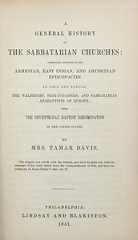
"A General History of the Sabbatarian Churches" by Tamar Davis is an historical account written in the mid-19th century. This work provides an in-depth examination of various Sabbatarian churches across Asia, Africa, and Europe, including their histories, practices, and the theological implications surrounding the observance of the Sabbath. The author aims to consolidate historical data and emphasize the importance of these groups in the broader context of Christianity. The opening portion ofthe text begins with a transcriber’s note, confirming corrections and formatting adjustments made to the original manuscript. Then, the author presents a preface that contextualizes the significance of the Sabbath controversy prevailing at the time of writing. Davis articulates her objective to gather and present a compact history of Sabbatarian practices, emphasizing that she does not intend to reiterate common arguments about the Sabbath. Instead, she asserts that the true observance of the Sabbath is a tradition stemming from early Christianity, supported by the examples of various ancient churches that resisted ecclesiastical authority. The introductory sections hint at the complex interplay of religious, historical, and cultural elements that will be explored throughout the book, focusing on key groups such as the Armenian, East Indian, and Abyssinian churches, and the Waldenses, pointing to their enduring commitment to Sabbatarianism. (This is an automatically generated summary.)
Read or download for free
| How to read | Url | Size | ||||
|---|---|---|---|---|---|---|
| Read now! | https://www.gutenberg.org/ebooks/66265.html.images | 501 kB | ||||
| EPUB3 (E-readers incl. Send-to-Kindle) | https://www.gutenberg.org/ebooks/66265.epub3.images | 293 kB | ||||
| EPUB (older E-readers) | https://www.gutenberg.org/ebooks/66265.epub.images | 289 kB | ||||
| EPUB (no images, older E-readers) | https://www.gutenberg.org/ebooks/66265.epub.noimages | 280 kB | ||||
| Kindle | https://www.gutenberg.org/ebooks/66265.kf8.images | 417 kB | ||||
| older Kindles | https://www.gutenberg.org/ebooks/66265.kindle.images | 377 kB | ||||
| Plain Text UTF-8 | https://www.gutenberg.org/ebooks/66265.txt.utf-8 | 455 kB | ||||
| Download HTML (zip) | https://www.gutenberg.org/cache/epub/66265/pg66265-h.zip | 251 kB | ||||
| There may bemore files related to this item. | ||||||
Similar Books
About this eBook
| Author | Davis, Tamar |
|---|---|
| LoC No. | ltf90011499 |
| Title | A General History of the Sabbatarian Churches Embracing Accounts of the Armenian, East Indian, and Abyssinian Episcopacies in Asia and Africa, the Waldenses, Semi-Judaisers, and Sabbatarian Anabaptists of Europe; with the Seventh-day Baptist Denominaton in the United States |
| Original Publication | United States: Lindsay and Blakiston,1851. |
| Credits | Brian Wilson, Chris Pinfield, and the Online Distributed Proofreading Team atwww.pgdp.net (This file was produced from images generously made available by The Internet Archive/American Libraries.) |
| Reading Level | Reading ease score: 54.9 (10th to 12th grade). Somewhat difficult to read. |
| Language | English |
| LoC Class | BX: Philosophy, Psychology, Religion: Christianity: Churches, Church movements |
| Subject | Sabbatarians -- History |
| Category | Text |
| EBook-No. | 66265 |
| Release Date | Sep 11, 2021 |
| Most Recently Updated | Oct 18, 2024 |
| Copyright Status | Public domain in the USA. |
| Downloads | 396 downloads in the last 30 days. |
| Project Gutenberg eBooks are always free! | |