Monitoring hazards & disasters worldwide since 1988
EM-DAT contains data on the occurrence and impacts of over 27,000 mass disasters worldwide from 1900 to the present day. The database is compiled from various sources, including UN agencies, non-governmental organizations, reinsurance companies, research institutes, and press agencies. TheCentre for Research on the Epidemiology of Disasters (CRED) distributes the data inopen access for non-commercial use.
Access the dataDocumentation
2026 Roadmap for EM-DAT

EM-DAT: the global disaster database
what it is, why it matters, and what’s next?
Access ...
Major GLIDE Number Update
CRED Crunch 79
Access ...
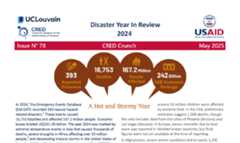
Disaster Year In Review 2024
CRED Crunch 78
Access ...
Latest news
What’s new?
Check our latest news by clicking on the slides or explore our entirenews orpublication repository.
EM-DAT Overview
More than 27,000 disaster records
EM-DAT defines disasters as situations or events which overwhelm local capacity, necessitating a request for external assistance at the national or international level. Disasters are unforeseen and often sudden events that cause significant damage, destruction, and human suffering.
The main objective of the database is to serve the purposes ofhumanitarian action at national and international levels. The initiative aims to rationalize decision-making fordisaster preparedness anddisaster risk reduction strategies, as well as provide an objective base forvulnerability assessment and priority setting.
Inclusion criteria
EM-DAT focuses on major disasters
EM-DAT globally records at the country levelhuman and economic losses for disasters with at least one of the following criteria:
- 10 fatalities;
- 100 affected people;
- a declaration of state of emergency;
- a call for international assistance.

Disaster Classification
EM-DAT adopts a hierarchical classification
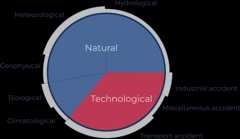
The database classifies disasters into two groups of hazards:natural andtechnological. The natural group is further classified up to four additional levels following the2014 IRDR Peril Classification and Hazard Glossary. The technological group is less detailed and comprises three main types: transport, industrial, and miscellaneous accidents.
EM-DAT in numbers
About 2/3 of disasters in EM-DAT are related to natural hazards

>790Drought

>1,570Earthquake

>600Extreme temperature

>5,750Flood

>790Landslide

>4,580Storm

>270Volcanic activity

>450Wildfire
“We rely on EM-DAT for planning and risk analysis, crucial for our humanitarian operations.”
Danitza Haughton,IOM (Panama)
“For over 20 years, EM-DAT’s data has been invaluable to the global disaster risk reduction community.”
Yuichi Ono,IRIDeS (Japan)
“EM-DAT’s global disaster data is fundamental to our Information Management work at the IFRC.”
Hamish Patten,IFRC (Switzerland)
“EM-DAT is vital for managing disaster risks, aiding in my research on socio-economic impacts since 2007. Without EM-DAT my career would have been completely different”
Ilan Noy,Victoria University of Wellington (New Zealand)
“EM-DAT is critical to climate change research, offering unmatched data quality and fostering open science.”
Wim Thiery,VUB (Belgium)
“As a climate scientist, EM-DAT is essential for understanding the relationship between extreme weather events and impacts.”
Aglae Jezequel,LMD (France)
“EM-DAT’s comprehensive flood data is crucial for my research, enabling detailed analyses and effective flood risk management strategies.”
Albert Kettner,Colorado University (USA)
“EM-DAT remains the leading and most credible source for disasters and loss data for Africa which has informed policies at continental regional and national levels”
Dewald van Niekerk,North-West University (South-Africa)
“Thanks to EM-DAT, we can transform past disaster data into actionable plans that save lives and strengthen resilience.”
Amod Mani Dixit,National Society for Earthquake Technology (Nepal)
About us
Behind EM-DAT
A long-term expertise
The CRED is now part of the Institute of Health and Society attached to the University of Louvain (UCLouvain). For more than 25 years, the EM-DAT database and project have been primarily sponsored by the United States Agency for International Development (USAID).
Host institution