
Welcome: Login | Sign Up | About CircleID Follow: | | |


 | ByDerek MorrSenior Systems Programmer, Pennsylvania State University | |
| ||
Cell phone carriers have seen a huge growth in wireless data usage. The iPhone isselling like hotcakes, and its usersgenerate large amounts of traffic. Not surprisingly, as cellular providers deploy faster network technologies, users generate even more data.
Here’s data from Verizon:
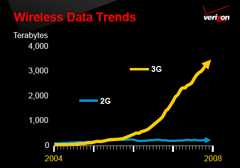
Customers’ demand for more, faster connectivity ispressuring cell carriers to accelerate their timelines for deploying next generation cellular technologies (the so-called “4G” technologies). One of the most promising of these technologies is LTE,Long Term Evolution. LTE will provide much more bandwidth than current 3G cellular system.
Aside from speed, LTE makes a significant change to cellular networks: Voice is now an IP service. With LTE, your handset is a voice over IP (VoIP) device. This eliminates the distinction between the “phone part” of your smartphone (voice calls, SMS, voicemail), and the “Internet part” (email, web, games, etc).In other words, your phone will need an IP address all the time, even just to receive voice calls.
Independently, the number of cellular subscribers is increasing rapidly. According to theUnited Nations, more than 40% of the world population has a cell phone:
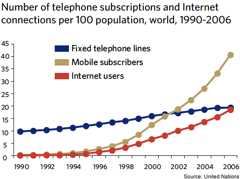
One research company predicts there will be5.2 billion cellular subscribers, worldwide, by 2011. Another firm estimates2 billion new cellular subscribers by 2013. If even a small fraction of these are using 4G, e.g. IP-based, communication, it will place substantial strain on IPv4 address reserves.
The problem, of course, is thatwe’re running out of IPv4 addresses. The IANA pool will most likely be depleted by the end of 2010. This has led many people to wonder if LTE deployments will require IPv6. Now we have an answer: Yes.
Verizon hasposted specs for any LTE device that will be permitted on its LTE network. IPv6 support is mandated. IPv4 is optional. That’s quite a statement, since IPv4 traffic currently dominates the Internet.
A few relevant quotes from Verizon’s spec:
“The device shall support IPv6. The device may support IPv4. IPv6 and IPv4 support shall be per the 3GPP Release 8 Specifications (March 2009)”. (section 3.2.4.1)
and
“The device shall be assigned an IPv6 address whenever it attaches to the LTE network.” (section 3.2.4.2)
IPv4 support appears optional:“If the device supports IPv4, then the device shall be able to support simultaneous IPv6 and IPv4 sessions.” (section 3.2.4.4)
Verizon appears to be trying to conserve IPv4 addresses by disallowing long-term address leases:“If the device supports IPv4, the device shall request an IPv4 address if an application using the LTE bearer requests a data connection using an IPv4 address. Once the application is closed, the IPv4 address shall be released by the device”. (section 3.2.4.3)
I’m curious how this will affect handset manufacturers. Windows Mobile and Symbian (used in Nokia phones) already support IPv6. Google is working on IPv6 support in Android. The iPhone and Blackberry don’t currently support IPv6. I’m curious if version 3.0 of the iPhone OS will add IPv6 support.
Derek,
excellent and timely post on Verizon.
It would now be interesting to dig out and cross-reference IPv6 commitment in the specifications of the rest of the class of 2010 which include Americans MetroPCS and CentyryTel and the Canadian trio Rogers, Telus and Bell Canada. The Nordics like always are telecom early birds with Teliasonera, Tele2 and Telenor while Japan fields NTT Docomo and KDDI. It would be reassuring that the class of 2010 does not miss this unique opportunity to start the road to the long term with an interoperable and high quality LTE future.
Time also for the class of 2011 where we see the US represented by Aircell, AT&T;and Cox while Europe comes on strong with Hutchison, Orange, Telefonica O2 and T-Mobile while, Asia pacific moves with China Mobile, China Telecom and New Zealand Telecom.
We still have to see who will give the valedictorian for the class of 2010. Good luck, ladies and gentlemen.
Yves Poppe
Yves
More and more professionals are choosing to publish critical posts on CircleID from all corners of the Internet industry. If you find it hard to keep up daily, consider subscribing to our weekly digest. We will provide you a convenient summary report once a week sent directly to your inbox. It's a quick and easy read.
Sponsored byVerisign

Sponsored byWhoisXML API

Sponsored byDNIB.com

Sponsored byVerisign

Sponsored byIPv4.Global

Sponsored byRadix

Sponsored byCSC

A World-Renowned Source for Internet Developments. Serving Since 2002.