|
|
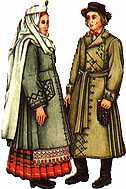
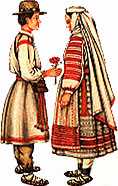
Clothing is an important ethnic feature of the nation. The origins ofBelarusian clothing tradition lie in the ancient Kiewan Rus'. The moderate continentalclimate, long winter and mild summer required a closed, warm clothing.Fabrics were made out of flux and wool, decoratedwith printed or embroiled ornaments, or weaved from using threads of different color. Thenobility were making their clothing mainly using imported fabrics - brocade, velvet, tuft- of different shades of red, blue, and less often green. The embroideries with silk and pearls were used as decorations. The general aesthetic requirement was static andsimplicity of the silhouette. The basics of set of male clothing was had a shirt with a beltand trousers, female - a shirt (longer than male) and "paniova" type skirt(wrap-around?). An outside clothing was usually a "svita" type coat often linedwith fur inside for winter clothing. These features were transferred to the clothing inwestern lands of ancient Rus', where in XIII-XVI a Belarusian nationality was formed. Thecostume of Belarusians conserved it's ties with costume of Russians and Ukrainians, butalso acquired the features of our other neighbors - Poles, Lithuanians, Latvians and otherEuropean nations. The formation of Belarusian costume has coincided with the developmentof new, more complicated techniques of cut, the sophistication of dressmaking in WesternEurope, which leaded to significant changes of European clothing. The shirt received morecomplicated cut, turn-down collar. Svita was improved by adding"vytac^ki"(pleets, side cuts?), oval cut in "proima"(collar?) andsleeves. [Here and further I'll do my best to translate the dressmaking terms in brackets with original Belarusian word shown too in case someone can translate it better. Please let me know about correct English terms if you have them]
The clothing of "mahnat"(big landlords) and city aristocracywas developing within the Western European tradition. It was made out of expensivefabrics, decorated with golden and silver embroidery, precious stones, colored buttons.The important composites of male dress were satin "z^upan"(a dressing gown) with"kuntus^"(coat, caftan?) on top of it, a long belt, wolf or beaver fur. Thefemale clothes included "fereziia", "hazuka","c^amara"(different types of blouse), decorated on the sides with ornaments orthe fur of sable, marten or fox. The aristocratic clothing has started to simplify at theend of XVIII c. Here you can see an example of thearistocratic clothing reconstructionas it was in XVI-XVII cc demonstrated in the court ofRadzivil's Castle in Niasvizh.
The further development of Belarusian Ian costume in XVII c.-middle XIX c.did not had any cardinal changes and was undergoing rather moderate evolution of differentelements. It was mostly reflected in the saturation of colors, rethinking of ornamentalmotives and development of regional traditions. Until the middle of XIX c.Belarusiancostume was having clearly ethnical character. In fact it was a type of the folk art. Oneof the important features was the traditional division of different types of clothing fordifferent activities. There was a clear division of clothing into categories used fordressing during weekdays or holidays, weddings or birthdays, during celebrations ormourning. For example during the religious "fast" folks were dressed in a special"fasting" clothes, where red color (traditionally designating "life,joy" among Slavs) was absent. The most beautiful clothes were worn to differentlabor holidays - Festive first taking out cattle on spring meadows ("na Yurauskuiurasu" - touching the dew of Yur'ia, ancient pagan God of Sun, who starts spring), theholidays of the First furrow ("Pers^aia barazna"), First sheaf in the field("Piers^y snop na nivie"), First hay harvest ("Piers^y pakos nasienaz^aci").
Beginning from the second half of XIX c. the invention of aniline dyesand fabric manufacturing of threads the traditional spectrum of colors was broadened.Traditional male clothing ensemble incorporated a shirt, pants and waistcoat (camisol?).The shirt was worn on outside pants fastened with colorful belt. The footwear wasranging from bast-shoes ("luptsi") to tall leather boots ("boty"). Butthe artistic fantasy and craftsmanship reached its peak in making female clothing markingthe general ethnic character of Belarusian costume . Extreme attention was devoted todecoration of sleeves. It was believed that the bright red rhombic ornaments have magicalpowers. Thus the hands of working women were protected from spells and bad spirits bydecoration of their sleeves with such ornaments. The upper clothing was usually decoratedwith squares or stripes (longitudinal or transverse) in a red, blue-green or silver-white shades. A closely fitting sleeveless cardigan ('garset") was often apart of women's clothing (especially festive clothing). It was usually made out of velvet,brocade, tuft or silk of a black, blue, raspberry colors and decorated with embroidery,application of braids buttons. The obligatory part of every costume was multi-color (mostfrequently red-green) belt with pompons, tassels or fringes. The women's' and men's' coats didnot differ much. It was usually made from felt under wool ("svita","siarmiaha", "latooshka", "boorka", "boornos") ,sheepskin ("kazhooh", ""kazhooshok") - first un-tanned white,later red-ochre tanned.
In the middle of the XX c. new developments happen. The plane ornaments start toacquire 3D quality due to the use of multiple shades of the same colors. The folk clothingis by this time split in the series of the local ensembles significantly differing fromeach other. The most clearly defined styles are shown below divided into majorgeographical regions: central Belarus. Nioman river region ("Paniamonnie"),Western and Eastern Paliessie, Dnieper river region ("Prydnieprouia") and Dzvinariver region ("Nadzvinnia"). |

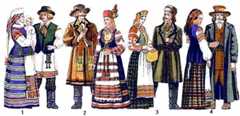
puhavicki style (1), liahavicki style (2), kapyl'ska-kliocki style (3), slucki style (4),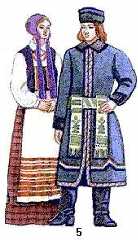
vileiski style (5),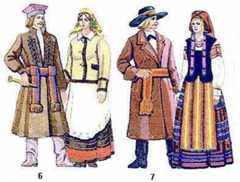
mastouski style(6), navahrudski style (7),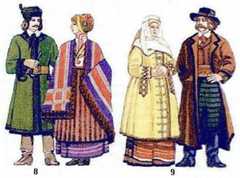
vaukavyska-kamianiecki style (8-9).
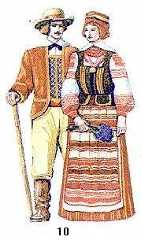
damachouski style (10),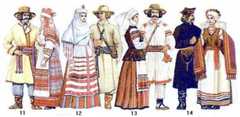
malarycki style (11), kobrynski style (12), pinski style (13), motal'ski style (14),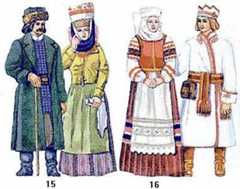
davyd-haradocka-turauski style (15), turava-mazyrski style (16),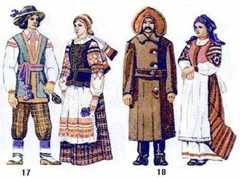
kalinkavicki style (17), brahinski style (18).
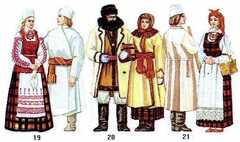
mahilyowski style (19-20), krasnapol'ski style (21),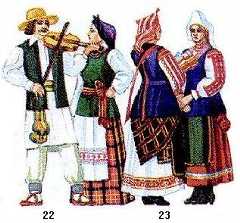
buda-kashaleuski style (22), nehliubski style (23),
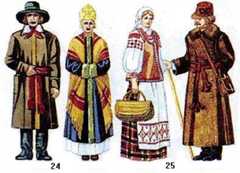
lepel'ski style (24), dubrovenski style (25),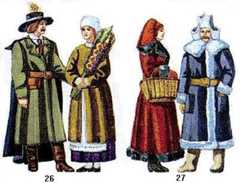
astraviecka-dzisenski region (26-27).
An article "Clothing" by M.F. Ramaniuk from
"Encyklapiedyja historyi Bielarusi"(Encyclopedia of the history ofBelarus") in 6 volumes, Publishing house "Bielaruskaja Encyklapiedyja"named after Piatrus' Brouka, Volume 1, 1993 - 494 pages.
ISBN 5-85700-074-2
The article "Clothing" is based on the book of N. Maslova "NarodnaiaOdezhda"("Folk clothing").
 This file is a part oftheVirtual Guide to Belarus - a collaborative projectofBelarusian scientists and professionals abroad. VG brings to you the most extensive compilation of the information about Belaruson the Web.
Please sendyour comments to the authors of VG toBelarus
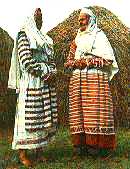 The folk dress was influencing the costume of aristocracy and was influenced itselfby an aristocratic clothing. The Belarusian costume of XVI-XVI c was enriched with newelements like "andarak" (a type of coat), "harset" (a type of topblouse) and with new principles of wearing - the techniques of tying. The silhouette becametighter to figure and was more reflecting Renaissance attitude to the world. Thetendencies in costume at this time were general strictness, majority of white color insome elements, traditional combination of white and red colors, geometrical ornaments - inaccordance with the eastern-Slavic tradition of clothing.
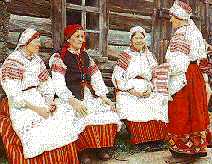 The costume was matching harmoniously
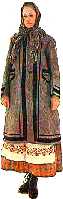 At the end of XIX c - beginning of XX c the polarization of society, development ofeconomy and industry have brought wide spectrum of changes to Belarusian costume. Newtypes of fabrics, mostly industrially manufactured have made their way to the countryside.The men's clothing became more complex and diverse. Semi-shades of colors were now usedinstead of clear colors. The semantic tradition of geometric ornamental decoration wasdisappearing giving place to plant ornaments. Distinctive

