Nothing so interesting. I needed a job. Well, I needed a job that could potentially use my skills and my C.S. degree, rather than staying a draftsman and PCB designer years after being told I would be "moving up soon". I did playComputer Space in a Sears department store, and BSed about what would today be called a multi-player distributed game, but it was 1974 or so and we never got past sitting around tossing out vague notions and wildly optimistic "plans". This was intended to be something where groups of nerds would build their own nodes, each with a 3-person "crew". Details (maybe, my memory is dim) on request, but as a totally pipe-dream with no plan of ever being commercial, really a footnote, if that.
Joe DeCuir. Long answer: Stuck in the aforementioned rut, I noticed on a trip to the Santa Clara Valley that there were buildings everywhere with what looked like theatre marquees advertising open technical jobs. That motivated me to dust off my resume, buy a truck (don't want to show up at an interview with helmet-hair), and start dropping applications in the valley. I was so discouraged by the lack of interest (from IBM, Rolm, HP) that I cut it short. Later, I went to visit school-friend Joe in the wilds of Nevada City, and even dropped in on Cyan Engineering, which reminded me of something from The Avengers (Steed and Peel variety). Anyway, I told him my tale of woe and he said that the Coin-Op group at Atari might be needing some people. The rest is history.
Yes, sort of. There is some debate on the order of programmers #3-#5 in Coin-Op. Dennis Koble may have been hired before me, but started later. Owen Rubin fits in there somewhere too, although I am pretty sure after me. Contrary to web-history, Owen and I, and I believe Dennis, all had CS degrees, so unless a certain Consumer programmer was hidden in a closet... There were programmers in Consumer, likeLarry Wagner, but only two in Coin-Op before I reported for duty. Well, there wasLarry Bryan, but he was gone by the name-change to Atari, IIRC, and before Atari used microprocessors.
My very first game assignment. This was a game that I suspect a lot of people wanted to do badly, and did. When theTank 8 hardware came out and allowed "so many" moving objects, it was time! Or maybe not. We (well, they) had to modify the hardware to display objects that were not basically squares, and that could get close to each other without exploding. Then I also had to come up with the software part of that mod, sorting the balls in H and V and assigning the right "logical" balls to each "physical". Got that part done, but got wrapped around the axle with the physics, or specifically the transcendentals. OK, mostly ArcTan. Management got pissed off at my slow progress and gave the game to another, "more experienced" programmer who, as far as I can tell, didn't bother to fix anything, other than dialing up the surface viscosity, making a game that was almost, but not quite, entirely unlike Pool.
I got re-assigned toBoxer... more like freed up to devote more time to it. Well, in truth, most of the time we were always working on more than one game, in various stages, at a time. But being thrown off Pool Shark freed me up to devote my full attention to Boxer. Not that it helped.
Drag Race – Great game. Activision later knocked off with their VCSDragster game. What were your thoughts about that?
Mixed. Activision also did a version of the never-released Boxer.
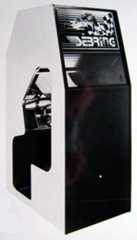
Not sure I'd agree with the Sea Wolf link, but whatever. Not sure where the idea came from, but we (I?) definitely wanted this to be a Depth Charge game, where one had to not only hit the button at the right time, but set the _depth_ correctly. Unfortunately, someone else (Meadows?) came out with a game named Depth Charge just as we were getting ready for production. That game was the more typical "bomber game with different graphics", but we had to rename ours and scrap 300 bezels with the (now) "wrong" name. Trivia: The first non-English language on this game was Norwegian.
Shout-outs to (IIRC) Jerry Lichac for that control, and to (IIRC)Rich Patak for the ping-bang-boom audio, also used inWolf Pack. Also toSteve Ehret, technician and some graphics.
More like "did some Proof of Concepts". I have no idea if any of my actual code got into the shipped product. Maybe some boilerplate diags.
I have (or had, as I can't seem to find it) the TT development board. This was an actual VCS board with a wire-wrapped daughter-board and air-wired jumpers. It also had a 40-pin 6502, as using the HP clip-on analyzer was easier/possible. What (smaller) CPU is in your TT board? I believe the reason for 2 RIOTS was more like the extra RAM, and possibly a second timer to make the gameplay software easier. If the production TT has a 6507, then "never mind". But it's interesting that coin-op games of the day often had hardware that could only be touched during VBlank, while the TIA was required to be touched in active video. Without knowing what CPU the production boards had, I'm in the dark.
The most interesting things I can say about Ultra Tank are:
claims you worked on a dedicated circuit that created a “wake” effect from the torpedoes onscreen in the game, and mentions the effect was similar to another game in development calledHydroPlane (“Sprint on water”).
Dave Sherman did the wake circuit for Wolf Pack, essentially a triangle generator modulated by pseudo-random noise to make it sparkle. HydroPlane used a variant with a bit-map rather than a triangle generator, to allow more flexibility. Of course, we could not afford a full-screen bitmap, so there were two small (32x32?) bitmaps, one for each boat, each with a square "window". We got a patent for that. But, as mentioned, Gene hated boat games. Also, players did not get into the physics of the boats or the pylons rather than a track, and if we went back to more car/track-like play, what's the point?
After watching a
The basic shape of the wake was drawn into the bitmap by software. You may overestimate the abilities for a 750khz 6502. Perhaps too much time marveling at what VCS programmers were able to do?
, which were originally proposed by Steve Bristow, Dave Stubben, and Lyle Rains.
In some two-player models built in late 1978 and early 1979, there was a bug that would allow the QB to throw a pass after crossing the line of scrimmage, then going back behind it. When the QB crossed scrimmage, all the defending X players would leave their receivers open as they pursued the run, making long completions easy.
It almost certainly was such a kit. As I said, I don't recall working on it, but perhapsEd Rotberg (who did aBaseball game on that hardware), orNorm Avellar (andGreg Rivera)? They teamed up on several games) or Dave Theurer did it, by way of familiarizing themselves with the hardware and existing software before doing their own games on the platform. The other games were 4-player Football and Soccer, but I don't remember who did what; I believe Theurer did the 4-player Football.
I (and some others) had pretty much always wanted the trackball, but were told it would be way too expensive (based on the multi-hundred-dollar prices charged by Litton et al.). When I saw a soccer game with one (I remember only that it was Japanese, and a soccer game. Taito is plausible) that became my rebuttal. I do not know if Jerry Lichac (Ed.: He designed the Trak-Ball) saw the game himself, or better, had access to one to examine, but I do know that he rose to the challenge magnificently. The most brilliant part was the use of a three-point suspension, rather than the four shafts used by the "professional" trackballs (which required higher precision in manufacture and probably finicky adjustment over lifespan.
When Jerry was challenged about how the third point would cause interference between the independent X and Y channels, he (rightly) replied that this was to be used "closed loop", with the player watching the screen, not the surface of the ball. I think the success of all those mice with 3-point suspension confirms that. Also, the first balls weren't black but were the veined brown ones seen on the first run of the game.
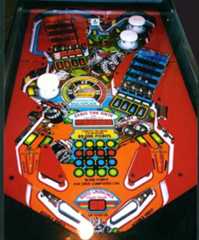
I dropped in on Dave Stubben as I was going home (he was our Team Leader and had an office near my lab bench). He was contemplating how to do a single, simple motion-object with fewer chips than usual. I started talking to him about the game it would be for, Video Pinball. As I left, I tossed off a wacky suggestion for a minimal-hardware "ball" generator, and the next day he showed me his interpretation of what I said. I also wrote the needed software (pretentious to call it a "driver"), and possibly some other such snippets like the ball-shooter input, LED multiplexing, and the sound generator. I also may have been the one to suggest the "nudge" switch. I don’t recall which ones of those I did. As you can see, I was doing support/utility stuff for other people’s games pretty much all along. Anyway, having piped up, I was tasked with doing the software interfaces (for the "ball" and the shooter), and possibly a rudimentary driver for the sound generator, which was a (one of the first?) programmable digital ones, as opposed to the custom analog circuits like ping-bang-boom or tapping off various sync-chain signals like Pong.
Later, I was tapped to do another game that became Solar War (after beingSuperman,Orion XIV, and possibly a few other names), to soak up leftover Video Pinball PCBs. We added some ROM (to allow, e.g. selectable message languages) which meant moving some of the I/O. Anyway, those changes were to go into a "new board" *if* we sold out of the initial "recycling" boards. So the software was written to be configurable for either board. This was how I got hit by karma for suggesting the minimal-chip ball circuit. But it was fun, and Dave Theurer (IIRC) pushed that digital sound generator pretty far.
(math engine). An old Atari VAX email from you dated February 23rd, 1984 stated "The only patent I know of on the old math-box is my patent on the "multiple simultaneous use of bit fields". One from you dated February 21st, 1984 talks about a new coin routine you and Ed Logg created, and you signed it "Dr. Bizzarro Albaugh". Another email from Vickers (May 1st, 1984) mentioned you been wanting for a long time to do some sort of interactive radio play. Finally, on August 9th, 1984 was this email from you: "What's the difference between Atari and the Titanic? The Titanic had entertainment. But the Titanic's entertainment was only for first class(Tourist class was the entertainment for some of the first class passengers... but that's another story.)"
Last Starfighter (math engine). In 2007,Jim Morris posted
B
According to Owen Rubin, Road Runner was changed from a laserdisc-based game to one w/o it, due to the prototype's LD player repeatedly failing when out on test location.
Usually, at least after the early days of 1 or 2-bit deep 8x8 images. You can get an idea of my "talents" by looking at the Atari Football logo, or to a lesser extent, at the tweaks I did to the Drag Race cars. Not that I made them better, but just possible to render. At that stage, we would ask the art department to, say, "Draw a car in 16x48 dots, in three shades of grey", and we'd get back a piece of graph paper with a drawing in a 16x48 box, but with multiple different shades per box. So other members of the team would do what they could. For example, Steve Ehretdid the images for Destroyer, including a whale that was never used. We had thought that it could be an extra difficulty, getting in the way of a path from the surface to a deep sub, but then realized that some player would actually aim for the whale, so it was dropped.
One of the bugs that did not get out (because Owen spotted it, and occasionally reminds me) was a "BOOUS HEAT" message that appeared briefly in Drag Race, but so infrequently and briefly that by the time Owen called my attention to it, it had gone. It was a bug in the queuing of writes to video RAM, which was needed because CPU access to that RAM was limited.
The feasibility study (with using a Flying Spot Scanner) did notget that far. Then Dave Sherman came up with a multiple-ellipse drawer to combine with the scalable motion objects from the original concept. That later led toTube Chase/Tunnel-Hunt when I jumped ship, when
I suspect "the usual": not enough earnings on test to justify the cost. Roughly one-half of Ed Logg's game were released, which made him a very successful guy at getting product all the way to release. :-) The history of Atari (and I suspect any non-fly-by-night game company) is littered with "started but never released" games.
Field test data alone is not the whole explanation. I'm sure I could sell a fleet of Tesla's if they were priced the same as Ford Fiestas. Alas, they are more expensive to make, so the question becomes, do the earnings add up to an ROI (return of investment) sufficient for an operator to shell out for an expensive game? Malibu would have been much more expensive than Sprint 2, even if priced in inflation-adjusted dollars.
Castles and Kings - original title forWarlords, and that it was a (rare) conversion from VCS (Carla Meninsky) to Coin-Op (Norm Avellar and Greg Rivera, IIRC).
Not so sure. I could have sworn that when I was surprised to read that, I checked with Norm Avellar, and he said something like that "(the idea) came from upstairs". I can't seem to find that email, and the latest I can find is from 2015, from me to him, so I have no idea.
You assume coin-op development would be longer. I'd say that the hardware itself would not even be harder, but easier. IIRC, it was essentiallyCentipede, but with pot inputs rather than a trackball. The Coin-Op team would have had two programmers, plus maybe an artist, and programming time would be pretty much all on gameplay, not sweating how to make the display work at all. So, *maybe* more man-hours, but probably not more wall-clock hours.
Not exactly an Easter egg, but when I did the on-screen display for volume adjustment (I believe first for Marble Madness), I noticed that the sound board had a 5-bit logarithmic attenuator, and a MUTE bit. The display mimicked a "LED bar VU", and had 33 possible levels, so I numbered every third such that it would "Go To Eleven".
And of course the high-score tables. When we first started using non-volatile memory for storing high scores and initials, we only saved the top four (out of ten) across power cycles. These (and the fleeting 5-10) started out with the initials of various folks who had worked on the game, plus of course some "suits" (Marketing and Management. We graciously offered to put the suits at the top). So, a completely new game would have their initials at the top, but after a few days of play, the top four slots would have the scores and initials of actual players, while the bottom six would have the initials that were refreshed on every power cycle - ours.
As for what others did in their games, I believe the USA version ofPole Position had (briefly, I don't think it got into production) a few billboards that only appeared at speed. Or maybe that was Sebring. Maybe some little 'in' jokes, like the actual vintage computers in Escape.
Darn little. Al Alcorn didn't want his elite crew "contaminated" by contact with Coin-Op folks, but I still talked to Joe. The only part I can recall playing was in debugging the test-setup for the first-silicon TIA. This was a lashup based on a KIM-1, and they had a "Heisenbug". The TIA registers could be read and written from the debugger, but not (reliably) by running code. I suggested that the issue may be the chip-select setup time being marginal, and so it was.
The same book
Not really. I mentioned some things to Jay and Joe during unofficial conversations, and some of these got into the ANTIC - in particular "data chaining" and "Display List interrupt". They were early in the definition of what the ANTIC "instructions" would be, and I don't remember who thought of the JMP, but I said it reminded me of the "Transfer In Channel" instruction on an IBM Channel, and that reminded me of data chaining (where an I/O operation can inherit the data address from a previous one, or in ANTIC, where a Mode can specify a data address, or inherit it from the previous one) and Interrupts when a particular channel instruction was fetched. I also strongly urged them to fight for the 800 being able to handle both upper and lower case in character modes. Management was apparently of the opinion that since the Apple ][ had only upper case (until later, or by using graphics modes), Atari didn’t need lower case, either.
On SIO I mentioned a potential problem, which became a real problem later, but was dismissed. So, I had no actual influence there. The SIO problem manifested as repeated strings on newer printers. A bad interaction between:
1) No packet numbering.
2) Bad instruction ordering in the SIO send routine, leading to a race condition.
3) Slightly different delay between packet reception and sending ACK on different printers.
Yes. It was basically an adaptation of the "Blue Box/White Box" Coin-Op development system, with the ST serving as the Blue Box. After I got a Proof of Concept running, the task was sent over to Tengen, along with the 1040 ST that was my personal property. I never got it back or was paid for it *sigh*. I also never got back the Famicom keyboard that was used in the Tetris case.
I can only answer in vague and well-publicized terms. Lawsuits went both ways. It is my understanding that the terms of the settlement prohibit disclosure of the terms of the settlement (first rule of fight club). I can confidently state that nearly everything that has been published about that case is false, but since "those that know can't tell, and those that tell don't know", there is little I can say, and less that I can say in public without risking further problems. For years I had two words clipped from a newspaper headline taped to the top of my monitor: "Avoid Litigation".
BTW: I just spent (wasted?) an hour or so trying to find a web-page that discussed the lockout chip, and how it worked, and how to defeat it. That page is distinguished by using the code-name "Acacia", which was only used in the transfer of the details of operation to the clean-room coders, and of course to refer to the chip in the legal proceedings. So at least someone violated the contract with Tengen or the court order. Anyway, in the process I came across an absolute mountain of misinformation, basically repeating the Nintendo version of the case. Seems like only one side can resist violating the seal, or is it that it's only a problem if you tell the truth, not if you lie?
Yes. We wanted to use a hard drive instead of a CD-ROM. The Sony-supplied code had bugs, and their debug tools would not allow you to display the contents of their top-secret code, but would allow you to copy blocks of memory, so I copied it to an area of memory that the tools would look at. I don't recall the exact bug, but I do recall that the disk driver code in the area looked very much like it had been written in Assembly (not the sort of idiomatic code that a compiler of the day would create), and "too clever by half". I wrote a simple test version in C, from which the default compiler produced "tighter" code than the original, and as a bonus, it lacked the bug.
That would make a much longer interview. 24+ years can’t be compressed that much, even if we filter for shenanigans. I suppose the Recreational Pharmaceuticals memos and the prima donna tee-shirt would be top of the list of what I did. There was a certain amount of pranking going on. We changed one manager’s login to execute a 6502 emulator running MSFT BASIC, and one programmer’s login to ask “Are you sure?” when he typed “DIR”. If you are looking for heartwarming stories of kindness and fortitude, I’ll have to think about it.