Topics & Articles Home
Culture
Ethnic Groups
History
Issues
Links
Viet Nam
Research Resources Used/ Recommended for Further Reading
Site Tools |  While the "Population Statistics & Demographics" article presented statistics on thepopulation characteristics of the Asian American population, this article presents statistics on thesocioeconomic characteristics of the largest Asian American ethnic groups, how they compare with each other, and with Whites, Blacks, and Hispanics/Latinos on various measures of socioeconomic achievement. As you will see, the numbers make for some very interesting comparisons. Differences in Socioeconomic AchievementIn examining the Asian American population and comparing it to other racial/ethnic groups such as Whites, Blacks, Hispanics/Latinos, and Native Americans, it is just as important (some would say even more important) to considersocioeconomic characteristics, in addition to population distributions. With that in mind, below are statistics and demographics from the 2000 Census on how the eight largest Asian American ethnic groups compare with each other and with the other major racial/ethnic groups in the U.S. To view the full-size table of statistics,click on the graphic below. Once the table appears, you can click on a column heading to sort up or down. You can also read the detailed description of themethodology and terminology used to create the statistics. 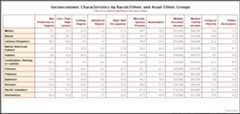 These are certainly a lot of numbers to process. Let's take them one measure at a time. In general, the results tend to show that once again, contrary to the perception that all Asian Americans are the same, there are significant differences among different Asian groups. For example, regarding beingNot Proficient in English, the results show that Cambodians, Hmong, and Laotians have the highest rate of lack of English fluency while Whites have the lowest. That's generally understandable since a large portion of the Southeast Asian population are refugees and therefore were not voluntary immigrants like all other Asian groups. Conventional immigrants usually self-select in terms of English proficiency while for refugees, immigration is more a matter of personal survival.  In fact, Cambodians, Hmong, and Laotians have the highest rates of havingLess than a High School education (Japanese have the smallest) and the lowest rates of having either aCollege Degree or anAdvanced Degree. Regarding educational attainment, Asian Indians have the highest rates -- an astounding 64.4% have college degrees while 12.5% have an advanced degree (a law, medical, or doctorate degree). It should be apparent by now that Asian Indians tend to have the highest socioeconomic attainment rates of all Asian Americans and that conversely, Cambodians, Hmong, and Laotians tend to have the lowest. For example, Asian Indians are tied for the highestMedian Personal Income with Japanese (with Latinos the lowest, barely below Native Americans). Asian Indians also have the highestMedian Family Income, more than twice that for the lowest group, Native Americans. The results also show that while Filipinos have the lowestPoverty rates, Native Americans have the highest (slightly higher than Blacks). This reflects the dire situation of many Native Americans who still live on reservations that offer little employment and opportunities for socioeconomic mobility. Nonetheless, Cambodians, Hmong, and Laotians have the highest rate of receivingPublic Assistance (with Asian Indians and Japanese having the lowest). Asian Indians also have the highest rate of beingMarried with Spouse Present while Blacks have the lowest. Whites are the most likely to be aHomeowner, while Cambodians, Hmong, and Laotians are the least likely. Asian Indians have the highest rate of being in theLabor Force, while somewhat surprisingly, Japanese have the lowest. As further evidence of the high socioeconomic achievement levels of Asian Indians, they have the highest rate of working in aHigh-Skill Occupation, generally characterized as executive, professional, technical, or upper management (with Latinos having the lowest rate), and the highest medianSocioeconomic Index (SEI) score that measures occupational prestige among employed workers (while Cambodians, Hmong, and Laotians had the lowest median SEI score). Comparing Apples to Oranges?Overall, these socioeconomic statistics and demographic comparisons suggest a few general patterns. First, it's clear that Asian Indians outperform all other racial/ethnic groups in most measures of socioeconomic achievement. Finally, these results clearly show that contrary to some popular misconceptions and stereotypes about Asian Americans being the "model minority," there can be very large and significant socioeconomic differences among Asian American ethnic groups. Several Asian groups are doing very well and in fact, consistentlyoutperform Whites on many measures of socioeconomic achievement. On the other hand, a few Asian groups may exhibit a few very positive achievements but on the whole, do not possess the same attainment levels of other Asian groups and Whites. All of this just goes to show that we need to be especially mindful of the specific histories, experiences, and characteristics of unique racial/ethnic groups and that we cannot automatically assume that just because they share some general similarities that they are all alike or that there are no differences among them.  Author CitationCopyright © 2001- by C.N. Le.Some rights reserved. Suggested reference: Le, C.N. . "Socioeconomic Statistics & Demographics"Asian-Nation: The Landscape of Asian America. <demographics.shtml> (). Related Articles and Blog Posts
|



 Second, traditionally disadvantaged groups of color such as Blacks, Native Americans, and Hispanic/Latinos still seem to lag behind in several socioeconomic measures. These groups of color are joined by Cambodians, Hmong, and Laotians (and to a lesser extent, Vietnamese), all of whose relatively low achievement rates are undoubtedly due to their refugee status.