

| |
This is a summary of the first 30 elections to DáilEireann, with a few other historical observations. I do not intend togo much further into politics in what is now the Irish Republic here,since many other sites do that in much more detail, and this web-siteis generally devoted toNorthernIrish elections. However this information does not seem to beeasily available elsewhere on the Web.So below is a summary of the election results to each Dail since 1918,with also a few notes on the history of the Senate, the President ofIreland and the Governor-General of the Irish Free State. Suggestionsand corrections, as ever, are welcome bysending me an emailorfilling in this form.
Table of results, 1918-2002 (parties that formed the newgovernment in bold)
| 1st Dáil (1918) | 70 SF | (no votetotals - see below) | ||||||
| 2nd Dáil (1921) | 125 SF | (no votetotals - see below) | ||||||
| 3rd Dáil (1922) | 58 * | 35 * | 17 Lab | 7 Fmr | 11 oth* | |||
| 38.5% | 21.3% | 21.4% | 7.9% | |||||
| 4th Dáil (1923) | 63 CnaG | 44 Republicans | 15 Fmr | 14 Lab | 17 oth** | |||
| 39.0% | 27.4% | 12.1% | 10.6% | |||||
| 5th Dáil (June 1927) | 47 CnaG | 44 FF | 22 Lab | 11 Fmr | 8 NL | 5 SF | 16 oth | |
| 27.4% | 26.2% | 12.6% | 8.9% | 7.3% | 3.6% | |||
| 6th Dáil (Sept 1927) | 62 CnaG | 57 FF | 13 Lab | 6 Fmr | 2 NL | 13 oth** | ||
| 38.6% | 35.2% | 9.1% | 6.4% | 1.6% | ||||
| 7th Dáil (1932) | 72 FF | 57 CnaG | 7 Lab | 4 Fmr | 13 oth** | |||
| 44.5% | 35.2% | 7.7% | 2.0% | |||||
| 8th Dáil (1933) | 77 FF | 48 CnaG | 11 NCP | 8 Lab | 9 oth** | |||
| 49.7% | 30.4% | 9.2% | 5.7% | |||||
| 9th Dáil (1937) | 69 FF | 48 FG | 13 Lab | 8 oth | ||||
| 45.2% | 34.8% | 10.3% | ||||||
| 10th Dáil (1938) | 77 FF*** | 45 FG*** | 9 Lab | 7 oth | ||||
| 51.9% | 33.3% | 10.0% | ||||||
| 11th Dáil (1943) | 67 FF | 32 FG | 17 Lab | 13 CnaT | 9 Inds | |||
| 41.8% | 23.1% | 15.7% | 9.0% | |||||
| 12th Dáil (1944) | 76 FF | 30 FG | 11 CnaT | 8 Lab | 4 Nat Lab | 9 Inds | ||
| 48.9% | 20.5% | 10.8% | 8.7% | 2.7% | ||||
| 13th Dáil (1948) | 68 FF | 31 FG | 14 Lab | 10 CnaP | 7 CnaT | 5 Nat Lab | 12 Inds | |
| 41.9% | 19.8% | 8.7% | 13.3% | 5.5% | 2.6% | |||
| 14th Dáil (1951) | 69 FF | 40 FG | 16 Lab | 6 CnaT | 2 CnaP | 14 Inds | ||
| 46.3% | 25.8% | 11.4% | 2.9% | 4.1% | ||||
| 15th Dáil (1954) | 65 FF | 50 FG | 19 Lab | 5 CnaT | 3 CnaP | 5 Inds | ||
| 43.4% | 32.0% | 12.1% | 3.1% | 3.8% | ||||
| 16th Dáil (1957) | 78 FF | 40 FG | 13 Lab | 4 SF | 3 CnaT | 1 CnaP | 8 Inds | |
| 48.3% | 26.6% | 9.1% | 5.4% | 2.4% | 1.7% | |||
| 17th Dáil (1961) | 70 FF | 47 FG | 16 Lab | 2 CnaT | 2 NPD | 1 CnaP | 6 oth | |
| 43.8% | 32.0% | 11.7% | 1.5% | 1.0% | 1.1% | |||
| 18th Dáil (1965) | 72 FF | 47 FG | 22 Lab | 1 CnaP | 2 Inds | |||
| 47.7% | 34.1% | 15.4% | 0.8% | |||||
| 19th Dáil (1969) | 75 FF | 50 FG | 18 Lab | 1 Ind | ||||
| 44.6% | 33.3% | 16.6% | ||||||
| 20th Dáil (1973) | 69 FF | 54 FG | 19 Lab | 2 Inds | ||||
| 46.2% | 35.1% | 13.7% | ||||||
| 21st Dáil (1977) | 84 FF | 43 FG | 17 Lab | 4 Inds | ||||
| 50.6% | 30.6% | 11.6% | ||||||
| 22nd Dáil (1981) | 78 FF | 65 FG | 15 Lab | 2 H-Blocks | 1 SFWP | 5 Inds | ||
| 45.3% | 36.5% | 9.9% | 3.1% | 1.7% | ||||
| 23rd Dáil (Feb 1982) | 81 FF | 63 FG | 15 Lab | 3 SFWP | 4 Inds | |||
| 47.3% | 37.3% | 9.1% | 2.2% | |||||
| 24th Dáil (Nov 1982) | 75 FF | 70 FG | 16 Lab | 2 WP | 3 Inds | |||
| 45.2% | 39.2% | 9.4% | 3.3% | |||||
| 25th Dáil (1987) | 81 FF | 51 FG | 14 PD | 12 Lab | 4 WP | 4 oth | ||
| 44.2% | 27.1% | 11.9% | 6.5% | 3.8% | ||||
| 26th Dáil (1989) | 77 FF | 55 FG | 15 Lab | 7 WP | 6 PD | 1 Gr | 5 Inds | |
| 44.2% | 29.3% | 9.5% | 5.0% | 5.5% | 1.5% | |||
| 27th Dáil (1992) | 68 FF**** | 45 FG**** | 33 Lab**** | 10 PD | 4 DL**** | 1 Gr | 5 Inds | |
| 39.1% | 24.5% | 19.5% | 4.7% | 2.8% | 1.4% | |||
| 28th Dáil (1997) | 76 FF | 55 FG | 17 Lab | 4 PD | 4 DL | 2 Gr | 1 SF | 7 oth |
| 39.3% | 27.9% | 10.4% | 4.7% | 2.5% | 2.8% | 2.5% | ||
| 29th Dáil (2002) | 81 FF | 31 FG | 20 Lab | 8 PD | 6 Gr | 5 SF | 15 oth | |
| 41.5% | 22.5% | 10.8% | 4.0% | 3.8% | 6.5% | |||
| 30th Dáil (2007) | 77 FF | 51 FG | 20 Lab | 6 Gr | 4 SF | 2 PD | 6 oth | |
| 41.6% | 27.3% | 10.1% | 4.7% | 6.9% | 2.7% | |||
* in 1922, 17 pro-Treaty, 16 anti-Treaty and 4 independentTD's were elected unopposed.
** in 1923, September 1927, 1932, and 1933, 3 independent TDs wereelected unopposed (representing Dublin University).
*** in 1938, 4 Fianna Fail and 2 Fine Gael TD's were elected unopposed.
**** in 1994 the Fianna Fail/Labour coalition broke down and wasreplaced by a Fine Gael/Labour/Democratic Left coalition.
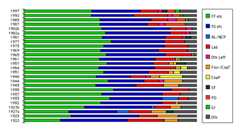
Votes cast in Dáil elections, 1923-1997.
Constituted from the successful Sinn Fein candidates for theUKGeneral Election of December 1918(voting took place in most constituencies on 14 December). Of the 105seats in Ireland, 73 were won by SF (25 unopposed), 22 Unionists, 6Nationalists, 3 "Labour Unionists", 1 Independent Unionist. Three SinnFeiners were elected in two different constituencies (Arthur Griffith,Eamon de Valera and Liam Mellows) so the numerical strength of thefirst Dáil was only 70 TD's.
Constituted from the successful Sinn Fein candidates for theHouses of Commons of the Parliaments of Northern Ireland and SouthernIreland, 1921. (As well as a House of Commons in each there was also aSenate of Southern Ireland and aSenate of Northern Ireland).Polling for the 52 seats in theNorthernIreland House of Commons took place on 24 May; Unionists won40, Nationalists 6 and Sinn Fein 6. No polling took place in SouthernIreland as all 128 seats were unopposed, 124 being won by Sinn Fein andthe other four by Independent (ex-Unionist) candidates representingDublin University (ie Trinity College). Five Sinn Feiners were electedin constituencies in both Northern Ireland and Southern Ireland(Michael Collins, Eamon de Valera, Arthur Griffith, Sean Milroy, andEoin MacNeill) so the numerical strength of the Second Dáilwas 125 TD's.
Elected in June 1922 and now internationally recognised as thelegislature of what had become the Irish Free State. In the 20constituencies out of 28 where there was a contest, the election tookplace on 16 June. Sinn Fein was now split into pro- and anti- Treatyfactions; 123 candidates ran on a "Coalition" platform claiming tounite the two, 65 on a pro-Treaty panel, 57 on an anti-Treaty panel andone (Dan Breen, unsuccessfully) on both. For the first time otherparties stood as well. Of 128 seats, 37 were uncontested. 58 pro-TreatySF candidates were elected (17 unopposed); 35 anti-Treaty SF (16 ofwhom were unopposed); 17 members of the Labour Party; 7 members of theFarmers Party; and 11 independents (of whom 4 were elected unopposedfor Dublin University). The Civil War broke out almost immediately andthe anti-Treaty faction boycotted the Dáil when iteventually met, so the pro-Treaty group had a secure majority of theremaining TDs and formed a government led by W.T. Cosgrave as Presidentafter the deaths of Arthur Griffith and Michael Collins.
Parenthesis: TheGovernor-Generaland theSenate
The Irish Free State had a bicameral legislatureunder its constitution, which came into force in December 1922. Theupper house had 60 members, selected by Cosgrave and by theDáil, who included about twenty ex-Unionists, a deliberateover-representation. The idea was that fifteen Senators (plusreplacements for any casual vacancies) should be elected by popularvote every three years.
The Treaty specified that the Irish Free State should have a GovernorGeneral a la Canada. The first holder of this office was the veteranIrish Nationalist T.M. Healy, who had been an MP off and on from 1880to 1920. His political influence waned rapidly as the new regime foundits feet.
Elected on 27 August 1923. A much expanded Dáil asa result of the implementation of the Irish Free State's constitution.Of the 153 seats, 63 were won by Cumann na nGaedheal, the newincarnation of the pro-Treaty government party; 44 by Republicans, whoremained anti-Treaty and boycotted the Dáil; 15 by theFarmers Party; 14 by Labour; two short-lived micro-parties, theBusinessmen's Party and the Progressive Association, elected two TD'seach respectively from Dublin and Cork; two TD's described themselvesas Independent Labour and there were another 10 Independents (including3 elected unopposed for Dublin University). Republicans again boycottedproceedings so Cosgrave started with a secure government majority(though this was eroded by defections as time went on). Three TD's fromthree different parties shared the name Patrick Hogan, which must haveconfused matters. Two TDs, Michael Hayes and Eoin MacNeill, wereelected for two constituencies.
Parenthesis: The1925Senate election
This unique event isdescribed in detail elsewhere on this site. The result wasthat future Senate elections in the Irish Free State were restricted toTDs and Senators, and the rate of replacement was stepped up to twentymembers plus vacancies rather than fifteen at each triennial election.
Elected on 9 June 1927; for the first time, all 153 seats werecontested (apart from that of the outgoing Ceann Comhairle, re-electedunopposed). 47 were won by Cumann na nGaedheal (including the CeannComhairle); 44 by the newly formed Fianna Fáil led by Eamonde Valera, which carried the majority of the Republican support fromprevious elections; 22 by Labour; 11 by the Farmers Party; 8 by theNational League, a short-lived attempt to revive the old IrishNationalist Party; 5 by Sinn Feiners who did not accept de Valera'sleadership; 2 by independent Republicans who disagreed with both deValera and the rump Sinn Fein; and 14 by Independents. Cosgraveprepared to form a Cumann na nGaedheal minority government, with FiannaFáil and Sinn Fein still boycotting the Dáil; butthe assassination on 10 July of Kevin O'Higgins, a senior governmentminister, radicalised the situation. A short-lived law was rushedthrough which would deprive abstentionist members of their seats, andon 11 August the 43 Fianna Fáil TDs signed the Oath ofAllegiance and entered the Dáil (one, Constance deMarkievicz, had died since the election). Cosgrave called an electionshortly after.
Elected on 15 September 1927. Of 153 seats, 62 were won byCumann na nGaedheal (including the outgoing Ceann Comhairle); 57 byFianna Fáil; 13 by Labour; 6 by the Farmers Party; 2 by theNational League; one by an independent Labour candidate, Jim Larkin(who was disqualified after the election); and 12 by other independents(including 3 unopposed from Dublin University). Cosgrave (who hadhimself been elected for two constituencies, which no TD has managedsince) formed a Cumann na nGaedheal government with Farmers Partysupport.
Parenthesis: Replacing theGovernor-General
Healy's services were dispensed with, rather to hisown surprise, in 1928, and he was replaced by James MacNeill, the IrishHigh Commissioner in London and brother of Eoin MacNeill.
Elected on 16 February 1932 (except in Leitrim-Sligo where anoutgoing TD running for re-election was shot dead during the campaign,and the vote took place on 2 March). Of 153 seats, FiannaFáil won 72; Cumann na nGaedheal 57 (including the outgoingCeann Comhairle); Labour 7; the Farmers Party 4; Independent Labourcandidates 2; Independent Farmer 1; and other independents 10(including 3 unopposed for Dublin University). Eamon de Valera formed aFianna Fáil government with Labour support. TheDáil sat for less than a year before de Valera called anearly election.
Parenthesis: Downgrading theGovernorGeneral
The new government was pledged to abolish allelements of the Treaty settlement which it found objectionable.Ministers lost no time in picking fights with the Governor-General overprotocol issues, and he resigned in October 1932. De Valera considered,but in the end rejected, the prospects of carrying on without one, andin the end appointed Domhnall Ua Buachalla (who had stood in Kildare inevery election from 1918, getting elected only in 1918, 1921 and June1927) as "Seanascheal". Ua Buachalla carried out no public dutieswhatsoever apart from signing legislation into law.
Elected on 24 January 1933. Of 153 seats, FiannaFáil won 77 (including the outgoing Ceann Comhairle); Cumannna nGaedheal 48; the new National Centre Party (effectively a merger ofthe rump of the National League and the Farmers Party, led by FrankMacDermot, whose brother was married to my great-aunt Caroline) won 11;Labour won 8; Independent Labour 1; and other independents 8 (including3 unopposed for Dublin University). Eamon de Valera formed a FiannaFáil government with Labour support (eventually winningenough by-elections to do without).
Parenthesis:Constitutionalchange
With a fuller parliamentary majority, de Valera wasable to abolish the Oath of Allegiance (1933), the Senate (June 1936),university representation in the Dáil (1934-36), allreferences to the monarch in the Constitution (December 1936, in theaftermath of the abdication of Edward VIII), and the Governor General(1937). A new Constitution was then put to referendum.
Elected on 1 July 1937, the same day as the plebiscite whichratified the new Constitution. The Dáil was considerablyreduced in size to 138 seats, of which Fianna Fáil won 69(including the outgoing Ceann Comhairle); Fine Gael (the new party ledby Cosgrave which had been formed by the merger of Cumann na nGaedheal,the National Centre Party and the extra-parliamentary Blueshirts) won48; Labour won 13; Independent Labour candidates 2, and otherindependents 6. Eamon de Valera again formed a Fianna Fáilgovernment with Labour support, and again called an early electionwithin a year.
Parenthesis: Senate andPresident
The new Constitution included both a Senate and aPresident (NB the head of government, rather than the head of state, ofthe Irish Free State had been designated President; that person nowbecame the Taoiseach). The new Senate, like the old, has 60 members,completely renewed after each Dáil election. Eleven arechosen by the new Taoiseach, three elected by graduates of DublinUniversity and three more by graduates of the National University, andthe remaining 43 by TDs, outgoing senators and county councillors fromfive panels of candidates which supposedly represent differentvocational interests. The Senate normally reflects the politicalmake-up of the new government. It has not done anything interestingenough to merit further mention on this page.
The President is directly elected by the people for a seven-year term.Candidates must be nominated either by twenty members of theDáil and/or Senate, or by nomination of four countycouncils, or an outgoing President can renominate himself or herself.The first President, elected unopposed in 1938, was Dr Douglas Hyde,who had been personally largely responsible for the Gaelic Revival halfa century before.
Elected on 17 June 1938. Of the 138 seats, FiannaFáil won 77 (including the outgoing Ceann Comhairle); FineGael 45; Labour 9; and Independents 7. Two constituencies, Donegal Westand Kerry South, were not contested; both returned two FF TD's and onefrom FG (the last occasion when any Dail election has beenuncontested). Eamon de Valera again formed a Fianna Fáilgovernment.
Elected on 23 June 1943. Of the 138 seats, FiannaFáil won 67 (including the outgoing Ceann Comhairle); FineGael a dismal 32; Labour 17; Clann na Talmhan (a new farmers partywhich basically had split from Fianna Fáil) 13; andindependents 9. Eamon de Valera again formed a Fianna Fáilminority government, and again called an early election within a year.
Elected on 30 May 1944. Of the 138 seats, FiannaFáil won 76 seats (including the outgoing Ceann Comhairle);Fine Gael an all-time low of 30; Clann na Talmhan 11; a divided Labourvote produced 8 Labour TDs and 4 National Labour; and nine independentspicked up the rest, Eamon de Valera again formed a FiannaFáil government.
Parenthesis: Presidential election1945
Hyde's retirement produced a three-way race for thepresidency in June 1945 between Fianna Fáil's Sean T.O'Kelly, Fine Gael's Sean MacEoin, and independent candidate PatrickMcCartan, who was supported by Labour, Clann na Talmhan, and otherindependents. The votes split almost exactly 50%/30%/20% between thethree, with O'Kelly a mere 5,000 short of the quota, which he easilymade up from McCartan's transfers.
Elected on 4 February 1948. The Dáil had beenexpanded to 147 seats; Fianna Fáil won 68 seats (includingthe outgoing Ceann Comhairle); Fine Gael 31 (proportionally even lessthan in 1938); Labour 14; Clann na Poblachta (a new party amalgamatingold IRA figures who had been marginalised by Fianna Fáilwith young socialists like Noel Browne) won 10; Clann na Talmhan 7;National Labour 5; and independents 12. Astonishingly, a coalition ofeveryone-except-Fianna-Fáil was constructed, with the newTaoiseach John A. Costello putting an end to sixteen years of FiannaFáil rule. However the Inter-Party Government disintegratedthree years later in a Church/State row over health provision.
Parenthesis: TheRepublic
The new government seems to have decided soon afterit was formed to declare the Irish state a Republic, and leave theBritish Commonwealth, though this only became public under ratherconfusing circumstances while Costello was visiting Canada. Thedescription "Irish Republic" or "Republic of Ireland" is therefore onlyaccurately applied to the state from 1949. The official name of thestate is, of course, Ireland (Eire in Irish).
Elected on 30 May 1951. Of the 147 seats, FiannaFáil won 69 (including the outgoing Ceann Comhairle); FineGael 40; a reunited Labour Party 16; Clann na Talmhan 6; Clann naPoblachta, hit worst of all by the fall of the government, 2; andindependents 14. Enough independents supported Fianna Fáilfor Eamon de Valera to form a minority Fianna Fáilgovernment; after three years they pulled the plug.
Parenthesis: Presidential election1952
Nobody was interested in opposing O'Kelly's bid for asecond term, and he was re-elected unopposed.
Elected 18 May 1954, except in Wicklow where a candidate haddied and the vote was postponed for a week. Of the 147 seats, FiannaFáil won 65; Fine Gael 50; Labour 19 (including the outgoingCeann Comhairle); Clann na Talmhan 5; Clann na Poblachta 3; andIndependents 5. John A. Costello again became Taoiseach, and a FineGael/Labour/Clann na Talmhan inter-party government was formed, withsupport from Clann na Poblachta, who pulled the plug on it after threeyears.
Elected 5 March 1957. Of the 147 seats, Fianna Fáilwon 78; Fine Gael 40; Labour 13 (including the outgoing CeannComhairle); Sinn Fein (still abstentionist, and seeking endorsement ofa renewed campaign of violence in Northern Ireland) 4; Clann na Talmhan3; Clann na Poblachta 1; Independents 8. For the last time, Eamon deValera formed a Fianna Fáil government.
Parenthesis: Presidential election1959
De Valera, now aged 77, defeated Sean MacEoin by 54%to 46%. However, his proposal to switch the electoral system fromproportional representation to the first-past-the-post system wasrejected by 52% to 48% in a referendum held on the same day. SeanLemass took over from De Valera as Taoiseach.
Elected 4 October 1961. A constituency revision had cut theDáil back to 144 seats, of which Fianna Fáil won70; Fine Gael 47; Labour 16 (including the outgoing Ceann Comhairle);Clann na Talmhan 2; National Progressive Democrats (a micro-partyfounded by Noel Browne) 2; Clann na Poblachta 1; Independents 6. Lemassformed a minority Fianna Fáil government.
Elected 7 April 1965. Of the 144 seats, Fianna Fáilwon 72; Fine Gael 47; Labour 22 (including the outgoing CeannComhairle); Clann na Poblachta 1; and Independents 2. Lemass formedanother minority Fianna Fáil government.
Parenthesis:1966
De Valera stood in his last election in June 1966.This time his Fine Gael opponent was T.F. O'Higgins. Dev was re-electedas President, but his margin of victory was by less than 1%. Later inthe year Lemass resigned as Taoiseach and leader of FiannaFáil and was replaced by Jack Lynch.
Elected 18 June 1969. Of the 144 seats, Fianna Fáilwon 75 (including the outgoing Ceann Comhairle); Fine Gael 50; Labour18; and one solitary independent, Joe Sheridan of Longford-Westmeath,made up the numbers. Lynch formed a majority Fianna Fáilgovernment.
Elected 28 February 1973. Of the 144 seats, FiannaFáil won 69 (including the outgoing Ceann Comhairle); FineGael 54; Labour 19; and Independents 2 (including Neil Blaney, who hadresigned from Lynch's cabinet as a result of the 1970 Arms Crisis andremained in the Dáil until he died in 1996). Fine Gael andLabour formed a coalition government, ending sixteen years of FiannFáil rule, with Liam Cosgrave becoming Taoiseach forty-oneyears after his father had lost office to De Valera.
Parenthesis:Presidents
De Valera's second term as President expired in June 1973,by which time he was 91, and a third term was not envisaged. FiannaFáil's candidate was Erskine Childers, a Protestant andformer FF minister whose father had been executed during the Civil War,and T.F. O'Higgins was again the Fine Gael candidate. Childers won by52% to 48%, but died suddenly in December 1974. The Chief Justice,Cearbhall O Dalaigh, was elected unopposed as his successor, but hethen resigned in October 1976 after some rather blunt criticism fromthe Minister of Defence. Patrick Hillery, another former FF ministerthen serving on the European Commission, was elected unopposed asIreland's sixth President (and the fourth in forty months).
Elected on 16 June 1977. The Dáil had been expandedto 148 seats, and the coalition's revised constituency boundaries werewidely expected to ensure its re-election. This did not happen. FiannaFáil won 84 seats, Fine Gael 43, Labour 17 (including theoutgoing Ceann Comhairle), and Independents 4 (including Noel Browneand Neil Blaney). Jack Lynch became Taoiseach again and formed a FiannaFáil government with the largest majority sinceindependence. he also set up an independent commission to carry outfuture constituency revisions. He resigned in 1979 and was repalced asTaoiseach and leader of Fianna Fáil by Charles Haughey.
Elected on 11 June 1981. The new independent commissionexpanded the Dáil to 166 seats (and it has remained at thatsize ever since). 78 were won by Fianna Fáil (including theoutgoing Ceann Comhairle), 65 by Fine Gael in a dramatic increase, 15by Labour, two by IRA prisoners in Northern Ireland (one of whom was onhunger-strike and died a few weeks after), one by Sinn Fein the WorkersParty, as the former "official wing" of Sinn Fein was now called, andfive by independents (including Browne and Blaney). Fine Gael andLabour had gone into the election on a coalition ticket, and formed aminority government under Garret Fitzgerald as Taoiseach. Theprecarious parliamentary arithmetic brought another election soon.
Elected on 18 February 1982. Of the 166 seats, FiannaFáil won 81, Fine Gael 63, Labour 15, Sinn Fein the WorkersParty 3, and Independents 4 (including the outgoing Ceann Comhairle andalso Blaney). It was now Charles Haughey's turn to form a minorityFianna Fáil government; again the parliamentary arithmeticdid not sustain it, and Ireland had its third election in eighteenmonths.
Elected on 24 November 1982. Of the 166 seats, FiannaFáil won 75; Fine Gael an all-time record of 70; Labour 16;Sinn Fein the Workers Party, now renamed simply the Workers Party, 2;and Independents 3 (including the outgoing Ceann Comhairle and alsoBlaney). Garret Fitzgerald was able to form a majority coalition withFine Gael and Labour which lasted for more than four years.
Parenthesis: Presidential election1983
Afer this sequence of elections, there was general reliefamong the political classes when Hillery announced that he would seek asecond term as President, and he was re-elected unopposed.
Elected on 17 February 1987. Of the 166 seats, FiannaFáil won 81; Fine Gael 51 (including the outgoing CeannComhairle); the Progressive Democrats, a new party which had split fromFianna Fáil with a more right-wing economic policy and moresecular social policies, won 14 seats; Labour won 12; the Workers Party4; and Independents 4 (including Blaney). Haughey formed a minorityFianna Fáil government with support from Fine Gael and theProgressive Democrats. This lasted for two years.
Elected on 15 June 1989. Of the 166 seats, FiannaFáil won 77; Fine Gael 55; Labour 15; the Workers Party 7;the Progressive Democrats 6; the Green Party/Comhaontas Glas 1; andother independents 5 (including the outgoing Ceann Comhairle). FiannaFáil were forced into a coalition with the ProgressiveDemocrats, who had split from them only a few years before. Again thecoalition was led by Charles Haughey as Taoiseach.
Parenthesis: Presidential election1990
This turned out to be the most written about and moststudied election campaign in Irish history. The Fianna Fáilcandidate was veteran minister Brian Lenihan; the Fine Gael candidate arecent recruit to Southern politics, the former SDLP figure AustinCurrie; the independent candidate, supported by Labour, the WorkersParty, and many others, was veteran civil liberties lawyer MaryRobinson. Robinson succeeded in building up a remarkable coalition ofsupporters, and got 39% of the first-preference votes; Lenihan, despitean ill-starred campaign that saw him sacked as foreign ministerhalf-way through, got 44%, and Currie, who gave the impression that hehad only been persuaded to stand at the last minute when GarretFitzgerald refused to do so, managed only 17%, an all-time low for FineGael. Currie's second preferences went to Robinson by a considerablemargin, ensuring that she was elected comfortably on the second count.The damage to Haughey's credibility as Fianna Fáil leaderled effectively to his resignation early in 1992; he was replaced asTaoiseach and Fianna Fáil leader by Albert Reynolds. (TheFine Gael leader resigned immediately, having had the party's worstever result.)
Elected 25 November 1992. Of the 166 seats, FiannaFáil won 68; Fine Gael 45; the Labour Party an astonishing33; the Progressive Democrats 10; Democratic Left (a majority factionwhch had split from the Workers Party earlier in the year) 4; the GreenParty/Comhaontas Glas 1; and independents 5 (including the outgoingCeann Comhairle). General expectations were that Fine Gael and theProgressive Democrats would form a coalition with Labour; but insteadLabour opted to do a deal with Fianna Fáil, keeping AlbertReynolds as Taoiseach of a government with a massive majority.
This coalition collapsed in bizarre circumstances in late 1994. AlbertReynolds was forced to resign as Taoiseach and leader of FiannaFáil; for a few weeks it seemed possible that Bertie Ahern,the new Fianna Fáil leader, would also form anothercoalition with Labour, but in the end a new government was formed underJohn Bruton as Taoiseach, with Fine Gael, Labour and Democratic Leftparticipation (by-election gains for all three parties meant that theynow had a parliamentary majority).
Elected 6 June 1997. Of the 166 seats, Fianna Fáilwon 76; Fine Gael 55; Labour 17; the Progressive Democrats 4;Democratic Left 4; the Green Party/Comhaontas Glas 2; Sinn Fein (thistime the party linked with the IRA and led by Gerry Adams) 1; andothers 7. Fianna Fáil and the Progressive Democrats, who hadrun on a joint platform, formed a minority coalition, with support froma number of independents, led by Bertie Ahern.
Parenthesis: Presidential election1997
The week after the Dáil election, it wasannounced that President Robinson was to be appointed the UN's HighCommissioner for Human Rights. She resigned the presidency a few weeksbefore her term would have expired anyway. A record five candidatescampaigned to succeed her. After the first count, Belfast law professorMary McAleese, the Fianna Fáil candidate, was well in thelead with 45% of first preferences; second was Fine Gael's MaryBanotti, with 29%; third was Rosemary "Dana" Scallon, a formerEurovision song contest winner who was running effectively as thesocial conservative candidate , got 14%; Adi Roche, running as thejoint candidate of the left-wing parties, got 7%, and Derek Nally, aformer policeman who was basically running as the only male candidate,did not quite manage 5%. The second preferences of the bottom threecandidates divided fairly evenly between the two front-runners,ensuring that McAleese won.
Elected 17 May 2002. Of the 166 seats, Fianna Fáilwon 81; Fine Gael 31; Labour 21; the Progressive Democrats 8; the GreenParty/Comhaontas Glas 6; Sinn Fein 5; and others 14.The FF/PD coalition became the first government to win re-election -with an increase from minority to majority government - since 1969.
Parenthesis: Presidential election2004
After two hotly contested elections, nobody botheredto stand against President McAleese when she nominated herself for asecond term, which expires in 2011.
Thanks to Eamonn O'Brien-Strain for pointing out some slips inan earlier version.
See also:Theconstituencies |The political parties |Useful books and links
Results from 1996 to 2001 for each seat:East Belfast |NorthBelfast |South Belfast|West Belfast |East Antrim |NorthAntrim |South Antrim|North Down |South Down |Fermanaghand South Tyrone |Foyle|Lagan Valley |East Londonderry |Mid Ulster |Newry and Armagh |Strangford |WestTyrone |Upper Bann
Other sites based atARK:ORB (Online ResearchBank) |CAIN(Conflict Archive on the INternet) |Northern Ireland Life andTimes Survey
Front page |Site Map |Notes and Queries |UpdatesMailing List |About thissite
Your comments, please! Send an email to me atnicholas.whyte@gmail.com.
Nicholas Whyte, 8 January 2001; modified 3 June 2007