Buy new:-20%JPY9,866 DeliveryDecember 29 - January 5 Ships from: Amazon Sold by: Top Premier Picks
Save with Used - Like NewJPY4,556 DeliveryMonday, January 5 Ships from: Amazon Sold by: USA AURORA

Download the free Kindle app and start reading Kindle books instantly on your smartphone, tablet, or computer -no Kindle device required.
Read instantly on your browser with Kindle for Web.
Using your mobile phone camera - scan the code below and download the Kindle app.



Follow the author
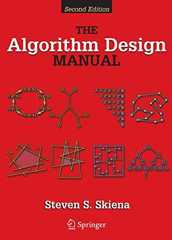
The Algorithm Design Manual 2nd ed. 2008 Edition
Purchase options and add-ons
This newly expanded and updated second edition of the best-selling classic continues to take the "mystery" out of designing algorithms, and analyzing their efficacy and efficiency. Expanding on the first edition, the book now serves as the primary textbook of choice for algorithm design courses while maintaining its status as the premier practical reference guide to algorithms for programmers, researchers, and students.
The reader-friendly Algorithm Design Manual provides straightforward access to combinatorial algorithms technology, stressing design over analysis. The first part, Techniques, provides accessible instruction on methods for designing and analyzing computer algorithms. The second part, Resources, is intended for browsing and reference, and comprises the catalog of algorithmic resources, implementations and an extensive bibliography.NEW to the second edition:• Doubles the tutorial material and exercises over the first edition
• Provides full online support for lecturers, and a completely updated and improved website component with lecture slides, audio and video
• Contains a unique catalog identifying the 75 algorithmic problems that arise most often in practice, leading the reader down the right path to solve them• Includes several NEW "war stories" relating experiences from real-world applications
• Provides up-to-date links leading to the very best algorithm implementations available in C, C++, and Java.- ISBN-101849967202
- ISBN-13978-1849967204
- Edition2nd ed. 2008
- Publication dateOctober 13, 2010
- LanguageEnglish
- Dimensions7.01 x 1.69 x 9.25 inches
- Print length748 pages
There is a newer edition of this item:

JPY 7,492
(430)
Only 19 left in stock (more on the way).
Frequently bought together


What do customers buy after viewing this item?
Most purchased | Highest rated
in this set of productsLowest Price
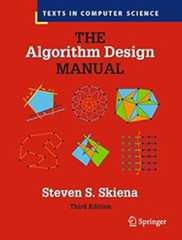
in this set of products- The Algorithm Design Manual (Texts in Computer Science)HardcoverJPY 1,795 shippingOnly 19 left in stock (more on the way).
- Introduction to Algorithms, fourth editionThomas H. CormenHardcoverJPY 2,071 shippingGet itDec 29 - Jan 5Only 3 left in stock (more on the way).
- Structure and Interpretation of Computer Programs - 2nd Edition (MIT Electrical Engineering and Computer Science)PaperbackJPY 1,664 shippingGet itDec 29 - Jan 13Usually ships within 3 to 5 days

Customers also bought or read
- Introduction to Algorithms, fourth edition#1 Best SellerComputer AlgorithmsHardcoverJPY13,298DeliveryDec 29, 2025 - Jan 5, 2026
- Structure and Interpretation of Computer Programs - 2nd Edition (MIT Electrical Engineering and Computer Science)PaperbackJPY11,598DeliveryDec 29, 2025 - Jan 13, 2026
- Cracking the Coding Interview: 189 Programming Questions and SolutionsPaperbackJPY3,247DeliveryMon, Jan 5
- Operating Systems: Three Easy Pieces#1 Best SellerComputer Operating Systems TheoryPaperbackJPY4,372DeliveryMon, Jan 5
- Design Patterns: Elements of Reusable Object-Oriented Software#1 Best SellerObject-Oriented DesignHardcoverJPY5,088DeliveryJan 5 - 23
- Crafting Interpreters#1 Best SellerSoftware Programming CompilersPaperbackJPY6,797DeliveryMon, Jan 5
- Reinforcement Learning, second edition: An Introduction (Adaptive Computation and Machine Learning series)HardcoverJPY11,745DeliveryMon, Jan 5
- A Common-Sense Guide to Data Structures and Algorithms, Second Edition: Level Up Your Core Programming SkillsPaperbackJPY6,950DeliveryMon, Jan 5
- Probabilistic Machine Learning: An Introduction (Adaptive Computation and Machine Learning series)HardcoverJPY19,329DeliveryMon, Jan 5
- C Programming Language, 2nd Edition#1 Best SellerC Programming LanguagePaperbackJPY10,823DeliveryMon, Jan 5
- The Pragmatic Programmer: Your Journey To Mastery, 20th Anniversary Edition (2nd Edition)#1 Best SellerSoftware Design & EngineeringHardcoverJPY7,486DeliveryMon, Jan 5
- Build a Large Language Model (From Scratch)#1 Best SellerData ProcessingPaperbackJPY7,615DeliveryMon, Jan 5
- Head First Design Patterns: Building Extensible and Maintainable Object-Oriented Software 2nd EditionPaperbackJPY6,803DeliveryMon, Jan 5
- Pattern Recognition and Machine Learning (Information Science and Statistics)HardcoverJPY9,410DeliveryMon, Jan 5
Editorial Reviews
Review
From the reviews of the second edition:
“This is a detailed and timeless book that I keep reaching for. A useful book that I can not keep access to long enough. It is a important book to have in your library. Unlike other algorithm books that I have the algorithms are written independent of any programming language.” (Mary Anne, Cats and Dogs with Data, maryannedata.com, April, 2014)
“The Algorithm Design Manual by Steven Skiena is aimed at two groups of people: students and professionals. … It is written in an informal style that I found pleasant and engaging. … The book’s unique structure makes it more likely to be immediately useful to the practitioner who has problem to solve and wants to quickly make progress. The book succeeds admirably. Would be helpful to the student who has never seen this material before. Overall, I recommend this book warmly.” (Neelakantan Kartha, The Book Review Column, 2011)
“Algorithms are the very heart of computing. This book is about right for most people. Each of the topics is treated in a readable informal style with lots of asides and accounts of personal experiences - ‘war stories’ in implementing algorithms. If you want to use it as a course textbook then there are lots of exercises at the end of every chapter. Highly recommended.” (Mike James, I Programmer, September, 2009)
"Addressing the main difficulties of solving problems, this book goes far beyond the design of algorithms. It is essential for scientists, engineers, and any professionals who aim to solve problems, with a noticeable emphasis on real problems. It will not only serve as a valuable undergraduate textbook, but it will also become an irreplaceable reference guide for most professionals in the area." (Carlos Linares Lopez, Computing Reviews, February, 2009)
"Skiena focuses on the practical aspects of algorithm design and use. This work fills an important gap in the knowledge of CS practitioners and students. This book is suitable as a text for an undergraduate algorithms class, but also as an invaluable reference for the practicing programmer. This second edition has updated the bibliography to include recent works, making it an extensive bibliography. The index is also thorough and very useful for finding specific problems." (William Fahle, ACM Computing Reviews, December, 2008)
"For a decade, Steven Skiena’s Algorithm Design Manual retained its title as the best and most comprehensive practical algorithm guide to help identify and solve problems. It is now available in an improved second edition that is worth buying simply for the updates. Every programmer should read this book, and anyone working in the field should keep it close to hand. Would I recommend it? Absolutely. This is the best investment a programmer or aspiring programmer can make." (Harold Thimbleby, Times Higher Education, November, 2008)
"My absolute favorite for this kind of interview preparation is Steven Skiena’s The Algorithm Design Manual. More than any other book it helped me understand just how astonishingly commonplace … graph problems are -- they should be part of every working programmer’s toolkit. The book also covers basic data structures and sorting algorithms, which is a nice bonus. Every 1 – pager has a simple picture, making it easy to remember. This is a great way to learn how to identify hundreds of problem types." (Steve Yegge, Steve Yegge’s Blog, March, 2008)
" The book is an algorithm implementation treasure trove, and putting all of these implementations in one place was no small feat. The list of implementations, an extensive bibliography make the book an invaluable resource for everyone interested in the subject." (ACM Computing Reviews)
From the Back Cover
....The most comprehensive guide to designing practical and efficient algorithms!....
The Algorithm Design Manual, Second Edition
"...the book is an algorithm-implementation treasure trove, and putting all of these implementations in one place was no small feat. The list of implementations [and] extensive bibliography make the book an invaluable resource for everyone interested in the subject."--ACM Computing Reviews
"It has all the right ingredients: rich contents, friendly, personal language, subtle humor, the right references, and a plethora of pointers to resources."-- P. Takis Metaxas, Wellesley College
"This is the most approachable book on algorithms I have."-- Megan Squire, Elon University, USA
This newly expanded and updated second edition of the best-selling classic continues to take the "mystery" out of designing algorithms, and analyzing their efficacy and efficiency. Expanding on the first edition, the book now serves as the primary textbook of choice for algorithm design courses while maintaining its status as the premier practical reference guide to algorithms for programmers, researchers, and students.
The reader-friendlyAlgorithm Design Manual provides straightforward access to combinatorial algorithms technology, stressing design over analysis. The first part,Techniques, provides accessible instruction on methods for designing and analyzing computer algorithms. The second part,Resources, is intended for browsing and reference, and comprises the catalog of algorithmic resources, implementations and an extensive bibliography.
NEW to the second edition:
•Doubles the tutorial material and exercises over the first edition
• Providesfull online support for lecturers, and acompletely updated and improved website component with lecture slides, audio and video
• Contains a unique catalog identifying the 75 algorithmic problems that arise most often in practice, leading the reader down the right path to solve them
• Includes severalNEW "war stories" relating experiences fromreal-world applications
• Provides up-to-date links leading to the very best algorithmimplementations available in C, C++, and Java
ADDITIONAL Learning Tools:
• Exercises include "job interview problems" from major software companies
• Highlighted take-home lesson boxes emphasize essential concepts
• Provides comprehensive references to both survey articles and the primary literature
• Exercises point to relevant programming contest challenge problems
• Many algorithms presented with actual code (written in C) as well as pseudo-code
• A full set of lecture slides and additional material available at www.algorist.com
Written by a well-known algorithms researcher who received the IEEE Computer Science and Engineering Teaching Award, this new edition ofThe Algorithm Design Manual is an essential learning tool for students needing a solid grounding in algorithms, as well as a special text/reference for professionals who need an authoritative and insightful guide. Professor Skiena is also author of the popular Springer text,Programming Challenges: The Programming Contest Training Manual.
About the Author
Steven Skiena is Professor of Computer Science at Stony Brook University. His research interests include the design of graph, string, and geometric algorithms, and their applications (particularly to biology). He is the author of four books, including "The Algorithm Design Manual" and "Calculated Bets: Computers, Gambling, and Mathematical Modeling to Win". He is recipient of the ONR Young Investigator Award and the IEEE Computer Science and Engineering Undergraduate Teaching Award.
Product details
- Publisher : Springer
- Publication date : October 13, 2010
- Edition : 2nd ed. 2008
- Language : English
- Print length : 748 pages
- ISBN-10 : 1849967202
- ISBN-13 : 978-1849967204
- Item Weight : 2.8 pounds
- Dimensions : 7.01 x 1.69 x 9.25 inches
- Best Sellers Rank: #579,997 in Books (See Top 100 in Books)
- #18 inDiscrete Mathematics (Books)
- #204 inData Processing
- #501 inSoftware Development (Books)
- Customer Reviews:
Product Videos

About the author

Steven S. Skiena is Distinguished Teaching Professor of Computer Science at Stony Brook University. He is the author of six well-regarded books: The Algorithm Design Manual (2020), The Data Science Design Manual (2017), Who's Bigger (2013), Calculated Bets: Computers, Gambling, and Mathematical Modeling to Win (2001), Programming Challenges (with Miguel Revilla, 2003) and Computational Discrete Mathematics (with Sriram Pemmaraju, 2003).
Customer reviews
Customer Reviews, including Product Star Ratings help customers to learn more about the product and decide whether it is the right product for them.
To calculate the overall star rating and percentage breakdown by star, we don’t use a simple average. Instead, our system considers things like how recent a review is and if the reviewer bought the item on Amazon. It also analyzed reviews to verify trustworthiness.
Learn more how customers reviews work on AmazonCustomers say

Select to learn more

Images in this review
Reviews with images
Great book but I received counterfeit copies
Top reviews from the United States
There was a problem filtering reviews. Please reload the page.
- Reviewed in the United States on April 11, 2013Format: PaperbackVerified PurchaseThis text strikes a perfect balance between too complex and too simple-- with hundreds of practical techniques that give a great overview of nearly every type of algorithm problem we encounter. This is NOT a "theory" text about big Oh (although it has a chapter), efficiency, p vs np and advanced calculus and linear algebra, but does show practical ways to design algorithms and answer questions in that interview.
As an example, older calculators always started "high" when finding quadratic factors or square roots. Skiena (p. 134) shows that three possible "front ends" can make subsequent iteration (trial and error until you're done) faster and more efficient: 1. The older always start high method 2. A common bisection technique-- split the problem, then, by "divide and conquer" go higher or lower and 3. Use interpolation to get closer sooner, then iterate.
The book is set up both as a self study and year long course text, but frankly the presentation is far from academic and much more rubber hits the road practical, realistic, design. The background is given with pseudocode, then the basic level of math needed to get the job done without pages of theory and proofs of Big Oh efficiency, etc.
Since 2008, the next edition in 2010, and this 2012 "printing corrections" edition (not considered a true edition, but contains many detailed corrections), this book has found a great audience in interview prep, because the author takes such a real world approach to solutions. Make sure you get the corrected edition if you buy from an Amazon third party vendor, you will if you get it directly from Amazon.
Highly recommended for all levels of programmers. The index also has been updated, and some of the previous reviews pointing out errors corrected, making this an outstanding reference. As if 700 pages weren't enough, the author also provides 19 sections of practical reviews of online resources and a detailed 43 page very current bib. If you're looking for a difficult to find "vein" of info (say, for example, on CAS algos), you'll find a wealth of info in these sections. Many volumes call themselves cookbooks, this really IS the best of that genre. If you can afford only one algo book, and want to use it without a tutor, teacher or coach, this is the one. Don't take that to mean it's simple-- it's just as deep as the academic texts, but simply removes all the math you don't use every day anyway. It's really more for programmers than researchers, but researchers would still learn a lot about how practical algo writers frame problems.
Library Picks reviews only for the benefit of Amazon shoppers and has nothing to do with Amazon, the authors, manufacturers or publishers of the items we review. We always buy the items we review for the sake of objectivity, and although we search for gems, are not shy about trashing an item if it's a waste of time or money for Amazon shoppers. If the reviewer identifies herself, her job or her field, it is only as a point of reference to help you gauge the background and any biases. - Reviewed in the United States on October 26, 2009Format: HardcoverVerified PurchaseI've read through the first half of the book, and am now at the catalog of algorithms that makes up the second half, and I've really enjoyed the book so far.
Most books on algorithms take a very formal, math heavy approach in which they present, analyze and prove things about a somewhat arbitrary collection of algorithms. There's usually no mention of real world applications.
This book, however, takes a different approach, and serves as a guide book for using algorithms in the real world. There's a heavy emphasis on formulating problems in terms of existing, solved problems. If you can "map" your problem to one with a known solution, then you can use the proven, existing solution to solve your problem. To emphasize that point, roughly the entire second half of the book is a catalog of known problems and solutions, with references to software libraries, books and other sources of information.
I also love that the example code is in C. Too many books give example code in languages with a lot of overhead, like Java, and end up obscuring the important parts with a ton of object-oriented crap. Yes - OOP is nice, but unless I'm reading a book on OOP, I don't want to dig through 30 lines of irrelevant boilerplate just to find the 10 lines relevant to the algorithm.
That said, it's not the best code in the world. Some of the snippets could be explained better. And there were a few stylistic issues, such as leaving off function return types and a bunch of global variables, that I didn't like, but I'm willing to forgive those because it's not a book on C, and the lack of syntactic clutter made the algorithm easier to see.
I also thought chapter nine was a bit too long. A good portion of the chapter is spent reducing various NP-complete problems to other NP-complete problems. Interesting, but it was a bit too theoretical, and didn't really fit with the with the rest of the book. - Reviewed in the United States on March 30, 2019Format: PaperbackVerified PurchaseI LOVE LOVE LOVE this book. It is so easy to read, and so practical ... concepts are explained wonderfully, with example code and very clear descriptions of motivations behind each strategy ... i LOVE the "stop and think" sections given for most sections where alternative solving methods are presented, and the catalog of problems in the back is just genious .. i LOVE the way this book is written in a very practical way, but with enough theory to give a holistic learning experience ... some books just drag on and on with theory, which is great, but actually many times extra uneeded information .. this book somehow seems to just get right to the heart of the concept and rounds each one out so beautifully ... Dr. Skiena this is truly an accomplishment, congrats and know that you will be helping countless software engineers for years to come with this book. (we all have that big white algos book, but this one, at probably a third of the size, is WAY better in my opinion) :)
- Reviewed in the United States on January 28, 2013I purchased this book (Kindle edition) to brush up on what I learned in Algorithms class over a decade ago. I found it has amazing and detailed information, and if I was teaching an algorithms course this would be THE text book. However, I found at times Skiena's presentation to unnecessarily complicate some of the material. Without a lecture to help clarify I found even myself getting confused. For this reason I can't give it 5 stars and would recommend watching MIT's video lectures on Algorithms first if you are a novice, and that should help enough to smooth over some of this book's rough edges in your mind. Other than that the "War Stories" are great tails of practical real-world algorithm solutions, and I loved the emphasis Skiena uses on proper data-structure selection for various algorithms and the comparison tables. I also liked the quick reference/cook-book chapter to aid in solving encountered problems.


Top reviews from other countries
- Luís VieiraReviewed in Brazil on January 17, 2019
5.0 out of 5 starsUm dos Melhores Livros de Algoritmos
Format: HardcoverVerified PurchaseÉ uma das melhores escolhas para quem procura aprender a desenvolver algoritmos, as explicações são concisas e bem organizadas, possuem imagens para facilitar a compreensão e relatos das aplicações dos algoritmos no mundo real. Os códigos de exemplos são escritos na línguagem C com uma fonte semelhante a das IDEs e editores utilizados pelos programadores. O livro está dividido em duas partes uma com toda a fundamentação teorica da construção e analise de algoritmos e outra com uma espécie de "guia do mochileiro de algoritmos" categorizando os problemas, estruturas de dados em capítulos e explicando soluções para eles.É uma das melhores escolhas para quem procura aprender a desenvolver algoritmos, as explicações são concisas e bem organizadas, possuem imagens para facilitar a compreensão e relatos das aplicações dos algoritmos no mundo real. Os códigos de exemplos são escritos na línguagem C com uma fonte semelhante a das IDEs e editores utilizados pelos programadores. O livro está dividido em duas partes uma com toda a fundamentação teorica da construção e analise de algoritmos e outra com uma espécie de "guia do mochileiro de algoritmos" categorizando os problemas, estruturas de dados em capítulos e explicando soluções para eles.5.0 out of 5 starsLuís VieiraUm dos Melhores Livros de Algoritmos
Reviewed in Brazil on January 17, 2019Images in this review

- SeanReviewed in Australia on April 10, 2021
3.0 out of 5 starsThis Kindle format isn't great
Format: eTextbookVerified PurchaseThe book itself is great, but the Kindle format and layout doesn't match the quality of the book. After reading it for a minute my eyes felt strained, and you can't change the font size of the code hunks in this book, which is really on my device. Btw, Amazon should allow customers review content and packaging separately, I feel like I've sinned when giving a 3 stars to this book. - Cliente AmazonReviewed in Italy on March 31, 2021
5.0 out of 5 starsLo consiglio
Format: HardcoverVerified PurchaseUn libro che non può mancare ad un Ingegnere Informatico - NiKhil JoshiReviewed in the United Kingdom on January 16, 2014
5.0 out of 5 starsA real manual to building ideas
Format: HardcoverVerified PurchaseWhat I like about this book is that, it does not talk about what a particular algorithm does and how it is implemented, but more it takes you on a flight between two algorithms. It trains the methodology, logical plan how (and possibly why) one takes off from an earlier algorithm and goes on developing something new.
A must read for any computer scientist, student or educator, who likes to invest more in ideas than the actual details. - CorMagReviewed in Germany on February 24, 2010
5.0 out of 5 starsEin Kochbuch mit leckeren Menüs
Format: HardcoverVerified PurchaseIch bin quasi neu in der "Optimierer Szene". Das ist erst mein drittes Buch über Optimierung. So please take my review with a grain of salt.
Mein spezifisches Optimierungsproblem ist ein "Integer/Combinatorial Otimization" Problem. So NP vollständig wie ein Problem nur sein kann und leider auch keiner der Klassiker aus der akademischen Literatur (kein TSP, kein echtes VRP, kein shortest Path, kein Knapsack...). oder wenigsten seh ich es so (was nicht viel aussagt.....leider). Also bin/war ich auf der Suche nach einem Buch, das es einem eine Einführung in das Design von Algos bietet. Obwohl das Buch weniger über Heurismen und Meta-Heurismen handelt, wie ich es mir erhofft habe, war es doch ein echter Glückstreffer, der mir bestimmt cnoch tolle Dienste leisten wird. Der I Teil des Buches behandelt das genereölle Design von Algos, Teil II ist ein Katalog/eine Klassifizierung von Problemen.
Das Buch deckt also recht viele Themenbereiche ab (einfach mal einen Blick ins Inhaltsverzeichnis werfen). Kurz und knapp, dafür aber sehr übersichtlich, prägnant und gut verständlich. Kein Formelmarathon und trotzdem, so finde ich, mit genügend Tiefe. Die "War Stories" sind unterhaltsam aber auch lehrreich. Auf der Home Page des Autors gibts code und interessante links.
Ich finds Klasse!