| Main | Introduction | Resources | Community | Shanghainese Dialogue | Other Resources |
| - News | - Background | - Pronunciation Drills | - BBS Forums | - Lesson Guide | - Articles |
| - About Us | - Consonants & Initials | - Hanzi Pronunciation | - Experimentation | - Lesson 1 | - Grammar |
| - Citations | - Vowels & Finals | - Romanizations | - Listen | - Lesson 2 | - Other Wu Dialects |
| - Tones & Accent | - Vocabulary List | - Shanghainese Culture | - Lesson 3 | - Wu Literature |
| - FAQ | - Dictionary | - more... | - Links |
INTRODUCTION
Pronunciation (Part 3 - Tones and Pitch Accent)
Shanghainese is a phonation register language (Duanmu 1990, Yip 1993, Zhu 1999), with itstwo overlapping registers defined by the phonation distinction ofvoiceless andbreathy voiced (murmured) initials.The upper register (murmurless) is capable of experiencing two relative pitch levels (High andLow). The Shanghainese tonal system is similar to the African languages, and distinctly different from Asian contour tonal languages such as Mandarin, Cantonese, Taiwanese Min and Thai (Duanmu 1994). The accent system is most similar to Japanese.
Tones
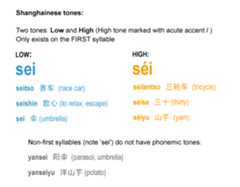
All initial syllables with a high pitch are marked with an acute accent (/). When pronouncing a syllable by itself or when emphasizing a syllable, the High tone is slightly falling (53) while the Low tone is slightly rising (12, 34).These contours disappear completely on the polysyllabic level; syllables in Shanghainese words mostly all have leveled (flat) pitches.. See below.
Pitch accent
A polysyllabic Shanghainese word (including its postpositions particles) in general can take on one of 3 pitch accent patterns. Except for a slight fall in the final syllable of some cases,syllables in polysyllabic Shanghainese words haveflat pitches.
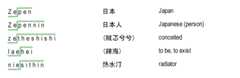
In this pattern,the first syllable is high pitched, with subsequent syllables having a relatively lower pitch. This pattern only includes words beginning with an initial high-pitched syllable (in other words, with an acute accent marked on the first syllable).
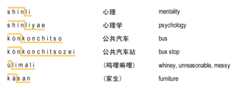
The most common of the three, this patternbegins with a low pitched initial syllable, followed by a higher pitched second syllable, with the third and subsequent syllables having a lower pitch again. This pattern includes all words with the first syllable being long and low pitched; as well as short syllables with voiceless initial consonants.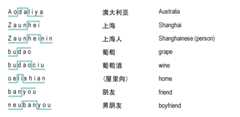
The least common of the three, this pattern begins with a low pitched initial syllable, subsequent syllables (up to 4 or 5 total) are all high pitched. This pattern is restricted only to words starting with ashort syllable that have avoiced or sonorant initial consonant. As a reminder, short syllables end with -e (such as e, oe, ae, ie); and voiced or sonorant consonants are: b, d, g, z, zh, j, v, r, m, n, l, gn.
Next:Frequently Asked Questions
Back to top.
Tones
All initial syllables with a high pitch are marked with an acute accent (/). When pronouncing a syllable by itself or when emphasizing a syllable, the High tone is slightly falling (53) while the Low tone is slightly rising (12, 34).These contours disappear completely on the polysyllabic level; syllables in Shanghainese words mostly all have leveled (flat) pitches.. See below.
Pitch accent
A polysyllabic Shanghainese word (including its postpositions particles) in general can take on one of 3 pitch accent patterns. Except for a slight fall in the final syllable of some cases,syllables in polysyllabic Shanghainese words haveflat pitches.
In this pattern,the first syllable is high pitched, with subsequent syllables having a relatively lower pitch. This pattern only includes words beginning with an initial high-pitched syllable (in other words, with an acute accent marked on the first syllable).
The most common of the three, this patternbegins with a low pitched initial syllable, followed by a higher pitched second syllable, with the third and subsequent syllables having a lower pitch again. This pattern includes all words with the first syllable being long and low pitched; as well as short syllables with voiceless initial consonants.
The least common of the three, this pattern begins with a low pitched initial syllable, subsequent syllables (up to 4 or 5 total) are all high pitched. This pattern is restricted only to words starting with ashort syllable that have avoiced or sonorant initial consonant. As a reminder, short syllables end with -e (such as e, oe, ae, ie); and voiced or sonorant consonants are: b, d, g, z, zh, j, v, r, m, n, l, gn.
Next:Frequently Asked Questions
Back to top.
[8]ページ先頭
©2009-2026 Movatter.jp