Thank you very much for visitingGunter's Space Page. I hope that this site is useful and informative for you.
If you appreciate the information provided on this site, please consider supporting my work by making a simple and secure donation via PayPal. Please help to run the website and keep everything free of charge. Thank you very much.
Ariel 1, 2 (UK 1, 2)
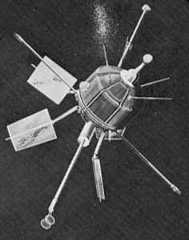
Ariel 1 [NASA]
Ariel 1 was designed to contribute to the current knowledge of the ionosphere and of sun-ionosphere relationships. The satellite was a 62 kg cylinder with a 58-cm diameter and a height of 22 cm. A tape recorder and instrumentation for one cosmic-ray, two solar emissions, and three ionospheric experiments were on board the satellite. Except for failure at launch of the solar Lyman-alpha experiment, the spacecraft operated nominally until 9 July 1962. Between that date and 8 September 1962, spacecraft operation was limited. The spacecraft was operated again from 25 August 1964, to 9 November 1964, to obtain data concurrent in time withExplorer 20.
Ariel 2 was launched from the Wallops Flight Facility using aScout-X3 rocket. It carried 3 British experiments to measure galactic radio noise.
| Nation: | UK, USA |
|---|---|
| Type / Application: | Science |
| Operator: | SERC, NASA |
| Contractors: | Westinghouse Electric (Spacecraft) |
| Equipment: | |
| Configuration: | |
| Propulsion: | |
| Power: | 4 deployable solar arrays, batteries |
| Lifetime: | |
| Mass: | 62 kg (#1), 68 kg (#2) |
| Orbit: | 397 km × 1202 km, 53.86° (#1); 289 km × 1343 km, 51.65° (#2) |
| Satellite | COSPAR | Date | LS | Launch Vehicle | Remarks | |
|---|---|---|---|---|---|---|
| Ariel 1 (UK 1, S 51) | 1962 ο 1 | 26.04.1962 | CC LC-17A | Delta | ||
| Ariel 2 (UK 2, S 52) | 1964-015A | 27.03.1964 | WI LA-3 | Scout-X3 |
Launch Sites:
- CC = Cape Canaveral Air Force Station, Eastern Test Range, Cape Canaveral, Florida, USA

- WI = Wallops Flight Facility, Wallops Island, Virginia, USA


