TheZip method returns an Observable that applies a function of your choosing to the combination of items emitted, in sequence, by two (or more) other Observables, with the results of this function becoming the items emitted by the returned Observable. It applies this function in strict sequence, so the first item emitted by the new Observable will be the result of the function applied to the first item emitted by Observable #1 and the first item emitted by Observable #2; the second item emitted by the new zip-Observable will be the result of the function applied to the second item emitted by Observable #1 and the second item emitted by Observable #2; and so forth. It will only emit as many items as the number of items emitted by the source Observable that emits the fewest items.
TBD
RxGroovy implements this operator as several variants ofzip and also aszipWith, an instance function version of the operator.

The last argument tozip is a function that accepts an item from each of the Observables being zipped and emits an item to be emitted in response by the Observable returned fromzip. You can provide the Observables to be zipped together tozip either as between two and nine individual parameters, or as a single parameter: either an Iterable of Observables or an Observable that emits Observables (as in the illustration above).
odds = Observable.from([1, 3, 5, 7, 9]);evens = Observable.from([2, 4, 6]);Observable.zip(odds, evens, {o, e -> [o, e]}).subscribe( { println(it); }, // onNext { println("Error: " + it.getMessage()); }, // onError { println("Sequence complete"); } // onCompleted);[1, 2][3, 4][5, 6]Sequence complete
Note that in this example, the resulting Observable completes normally after emitting three items, which is the number of items emitted by the shorter of the two component Observbles (evens, which emits three items).
zip(Iterable<Observable>,FuncN)zip(Observable<Observable>,FuncN)zip(Observable,Observable,Func2) (there are also versions that take up to nine Observables)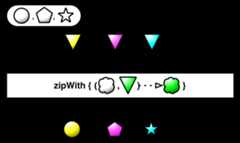
ThezipWith instance version of this operator always takes two parameters. The first parameter may be either a simple Observable, or an iterable (as in the illustration above).
zipWith(Observable,Func2)zipWith(Iterable,Func2)zip andzipWith do not by default operate on any particularScheduler.
RxJava implements this operator as several variants ofzip and also aszipWith, an instance function version of the operator.
The last argument tozip is a function that accepts an item from each of the Observables being zipped and emits an item to be emitted in response by the Observable returned fromzip. You can provide the Observables to be zipped together tozip either as between two and nine individual parameters, or as a single parameter: either an Iterable of Observables or an Observable that emits Observables (as in the illustration above).
zip(Iterable<Observable>,FuncN)zip(Observable<Observable>,FuncN)zip(Observable,Observable,Func2) (there are also versions that take up to nine Observables) ThezipWith instance version of this operator always takes two parameters. The first parameter may be either a simple Observable, or an iterable (as in the illustration above).
zipWith(Observable,Func2)zipWith(Iterable,Func2)zip andzipWith do not by default operate on any particularScheduler.
RxJS implements this operator aszip andzipArray.

zip accepts a variable number of Observables or Promises as parameters, followed by a function that accepts one item emitted by each of those Observables or resolved by those Promises as input and produces a single item to be emitted by the resulting Observable.
/* Using arguments */var range = Rx.Observable.range(0, 5);var source = Observable.zip( range, range.skip(1), range.skip(2), function (s1, s2, s3) { return s1 + ':' + s2 + ':' + s3; });var subscription = source.subscribe( function (x) { console.log('Next: ' + x); }, function (err) { console.log('Error: ' + err); }, function () { console.log('Completed'); });Next: 0:1:2Next: 1:2:3Next: 2:3:4Completed
/* Using promises and Observables */var range = Rx.Observable.range(0, 5);var source = Observable.zip( RSVP.Promise.resolve(0), RSVP.Promise.resolve(1), Rx.Observable.return(2) function (s1, s2, s3) { return s1 + ':' + s2 + ':' + s3; });var subscription = source.subscribe( function (x) { console.log('Next: ' + x); }, function (err) { console.log('Error: ' + err); }, function () { console.log('Completed'); });Next: 0:1:2Completed

zipArray accepts a variable number of Observables as parameters and returns an Observable that emits arrays, each one containing thenth item from each source Observable.
var range = Rx.Observable.range(0, 5);var source = Rx.Observable.zipArray( range, range.skip(1), range.skip(2));var subscription = source.subscribe( function (x) { console.log('Next: ' + x); }, function (err) { console.log('Error: ' + err); }, function () { console.log('Completed'); });Next: [0,1,2]Next: [1,2,3]Next: [2,3,4]Completed
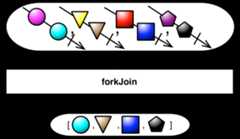
RxJS also implements a similar operator,forkJoin. There are two varieties of this operator. The first collects the last element emitted by each of the source Observables into an array and emits this array as its own sole emitted item. You can either pass a list of Observables toforkJoin as individual parameters or as an array of Observables.
var source = Rx.Observable.forkJoin( Rx.Observable.return(42), Rx.Observable.range(0, 10), Rx.Observable.fromArray([1,2,3]), RSVP.Promise.resolve(56));var subscription = source.subscribe( function (x) { console.log('Next: ' + x); }, function (err) { console.log('Error: ' + err); }, function () { console.log('Completed'); });Next: [42, 9, 3, 56]Completed

A second variant offorkJoin exists as a prototype function, and you call it on an instance of one source Observable, passing it another source Observable as a parameter. As a second parameter, you pass it a function that combines the final item emitted by the two source Observables into the sole item to be emitted by the resulting Observable.
var source1 = Rx.Observable.return(42);var source2 = Rx.Observable.range(0, 3);var source = source1.forkJoin(source2, function (s1, s2) { return s1 + s2;});var subscription = source.subscribe( function (x) { console.log('Next: ' + x); }, function (err) { console.log('Error: ' + err); }, function () { console.log('Completed'); });Next: 44Completed
forkJoin is found in the following distributions:
rx.all.jsrx.all.compat.jsrx.experimental.js (requiresrx.js,rx.compat.js,rx.lite.js, orrx.lite.compat.js)TBD
RxPHP implements this operator aszip.
Merges the specified observable sequences into one observable sequence by using the selector function whenever all of the observable sequences have produced an element at a corresponding index. If the result selector function is omitted, a list with the elements of the observable sequences at corresponding indexes will be yielded.
//from https://github.com/ReactiveX/RxPHP/blob/master/demo/zip/zip.php//Without a result selector$range = \Rx\Observable::fromArray(range(0, 4));$source = $range ->zip([ $range->skip(1), $range->skip(2) ]);$observer = $createStdoutObserver();$subscription = $source ->subscribe(new CallbackObserver( function ($array) use ($observer) { $observer->onNext(json_encode($array)); }, [$observer, 'onError'], [$observer, 'onCompleted'] ));Next value: [0,1,2]Next value: [1,2,3]Next value: [2,3,4]Complete!
//from https://github.com/ReactiveX/RxPHP/blob/master/demo/zip/zip-result-selector.php//With a result selector$range = \Rx\Observable::fromArray(range(0, 4));$source = $range ->zip([ $range->skip(1), $range->skip(2) ], function ($s1, $s2, $s3) { return $s1 . ':' . $s2 . ':' . $s3; });$observer = $createStdoutObserver();$subscription = $source->subscribe($createStdoutObserver());Next value: 0:1:2Next value: 1:2:3Next value: 2:3:4Complete!
RxPHP also has an operatorforkJoin.
Runs all observable sequences in parallel and collect their last elements.
//from https://github.com/ReactiveX/RxPHP/blob/master/demo/forkJoin/forkJoin.phpuse Rx\Observable;$obs1 = Observable::range(1, 4);$obs2 = Observable::range(3, 5);$obs3 = Observable::fromArray(['a', 'b', 'c']);$observable = Observable::forkJoin([$obs1, $obs2, $obs3], function($v1, $v2, $v3) { return $v1 . $v2 . $v3;});$observable->subscribe($stdoutObserver);Next value: 47cComplete!
TBD
TBD
 ReactiveX